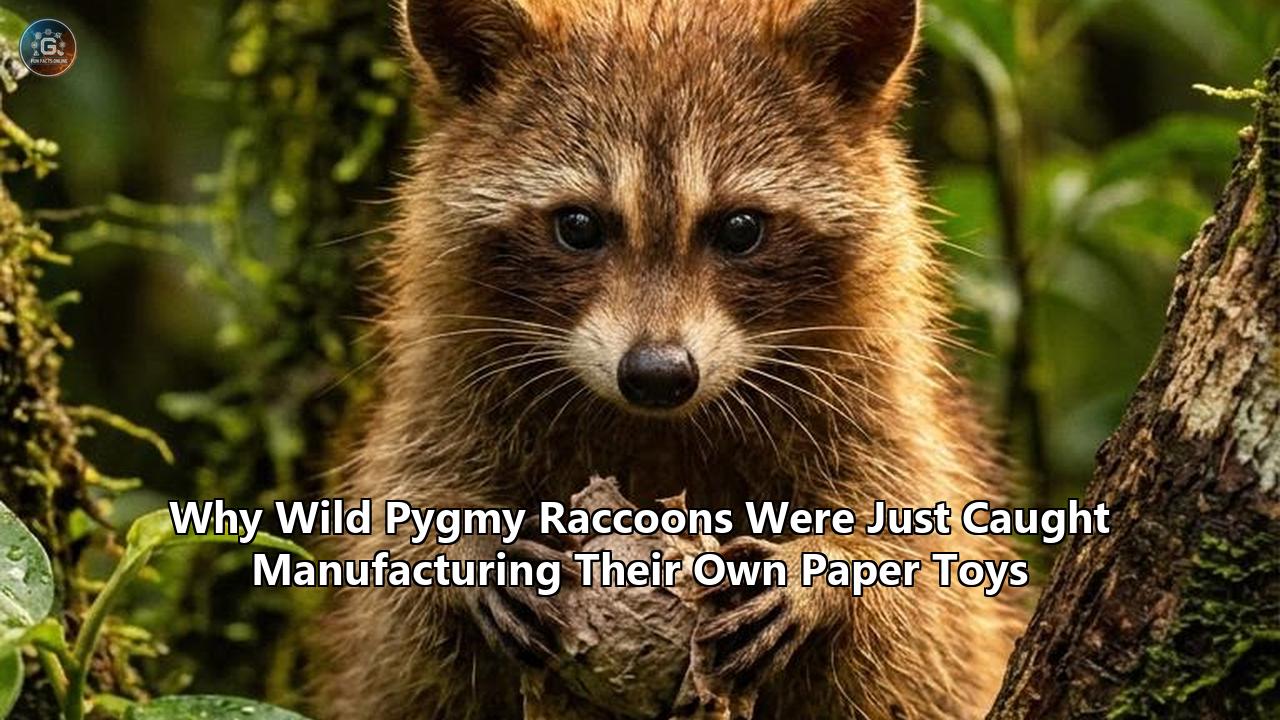
On the sands of Cozumel, an island off Mexico’s Yucatán Peninsula, wildlife biologists documenting how coastal tourism disrupts native wildlife recorded an unprecedented sequence of animal tool manufacture. Two juvenile female pygmy raccoons (Procyon pygmaeus) deliberately fished discarded paper receipts, napkins, and wrappers out of an open beach club trash bin, carried them to a freshwater dish, soaked the material, and methodically pressed, rolled, and compacted the wet fibers against the sand using their front paws. The resulting objects were dense, sand-encrusted, spherical balls.
The animals did not attempt to eat the paper, nor were they using the spheres to extract trapped food. Instead, they batted the balls across the ground, chased them, rolled them between their paws, and played an improvised game of keep-away with their sibling, their mother, and visiting juvenile Cozumel dwarf coatis (Nasua narica nelsoni).
The observation, published in the peer-reviewed journal Wild by Miami University ethologist Nessie O’Neil and conservation biologist Michelle Szydlowski, represents the first documented case of wild raccoons modifying human refuse into functional objects strictly for leisure and play.
The discovery immediately shifts our understanding of carnivoran cognition, but it arrives wrapped in a conservation crisis. Pygmy raccoons are critically endangered, with an estimated population of fewer than 250 mature individuals confined entirely to Cozumel’s coastal fringe. The young innovator raccoon that originated the sequence died weeks later from malnutrition and chemical toxicosis after ingesting tourism-generated waste at the same beach resort. The incident has brought animal culture, cognitive ethology, and island resort operations into a direct collision.
THE PAPER-BALL MANUFACTURING CYCLE
[Trash Can] ──> Extracts paper wrappers, receipts, and napkins
      │
      ▼
[Freshwater Basin] ──> Submerges cellulose to break fiber stiffness
      │
      ▼
[Intertidal Sand] ──> Rotational paw compaction & sand aggregation
      │
      ▼
[Dense Spherical Toy] ──> Solitary batting, sibling chase, interspecies play
The Beach Club Ethogram: Mechanics of Non-Utilitarian Manufacture
The manufacture of the paper spheres was documented across 64 hours of systematic field observations conducted between January and February 2026 along Cozumel’s southwestern coastline. The researchers were evaluating how high-density cruise ship tourism alters the foraging rhythms of endemic carnivores. They did not expect to record multi-step material fabrication.
The production cycle follows an invariant, ordered sequence that ethologists classify as an action syntax:
- Selective Material Harvesting: The juvenile raccoons bypassed rigid plastics, aluminum cans, and heavy cardboard inside the resort waste receptacles. They specifically extracted high-cellulose, pliable paper: point-of-sale thermal receipts, paper napkins, and thin paper food liners.
- Hydro-Softening: Gripping the paper between their distal paw pads, the juveniles transported the dry sheets several meters to a stainless-steel freshwater bowl placed outside for domestic pets. The raccoons submerged the dry material until capillary action saturated the pulp, altering its tensile strength and pliability.
- Rotational Compaction and Sand Aggregation: The saturated cellulose was hauled out onto the beach. Using their digits, the animals rolled, pressed, and repeatedly folded the wet paper against loose carbonate sand. As the wet cellulose fibers interlocked, the exterior gathered coarse sand grains. This abrasive additive weighted the sphere, created structural cohesion, and prevented the wad from unravelling into flat sheets.
- Recreational Deployment: Once a firm, ball-shaped mass was achieved, the raccoons initiated play. They struck the balls with alternating forepaws, pursued them across flat beach terrain, caught them between their forelimbs, and engaged in bouts of mutual chasing.
The raccoons exhibited no nutritional motivation. Food residue was absent from several of the receipts utilized, and finished items were never chewed, licked, or stashed as forage.
The animals were purposefully modifying the physical state of an external object to alter its functional affordance—transforming flat, low-utility garbage into a spherical plaything engineered for rolling and batting.
Neuroethological Preconditions Behind Pygmy Raccoon Behavior
The emergence of paper toy construction is tied to the specialized neuroanatomy of the procyonid family. To evaluate why this skill surfaced on an isolated Caribbean island, researchers must examine how evolutionary adaptations intersect with anthropogenic substrates.
Forepaw dexterity in raccoons is among the most sophisticated outside the primate order. Raccoon forepaws lack an opposable thumb, but they compensate with an exceptional density of low-threshold mechanoreceptors concentrated in the glabrous skin of the digits. In common raccoons (Procyon lotor) and their insular dwarf cousin (Procyon pygmaeus), sensory inputs from the front paws occupy a disproportionately massive territory within the primary somatosensory cortex.
A raccoon effectively "sees" the tactile world through its paws.
┌────────────────────────────────────────────────────────┐
│     EVOLUTIONARY PRE-ADAPTATIONS IN PROCYONIDS        │
├──────────────────────────┬─────────────────────────────┤
│ Somatosensory Primacy    │ Highly concentrated digital │
│                          │ mechanoreceptors            │
├──────────────────────────┼─────────────────────────────┤
│ Obligate Tactile Dousing │ Water wetting softens skin  │
│                          │ & raises nerve sensitivity  │
├──────────────────────────┼─────────────────────────────┤
│ Island Dwarfism Pressures│ Smaller body mass requiring │
│                          │ fine-scale foraging shifts  │
└──────────────────────────┴─────────────────────────────┘
The hydro-softening phase of the paper-making routine stems from an evolutionary action pattern known as tactile dousing. In natural mangrove habitats, raccoons manipulate prey underwater. Moisture softens the cornified stratum corneum of their paw pads, raising the tactile sensitivity of their nerve endings and allowing them to detect the contours of crabs, mollusks, and small fish without visual aid.
The juveniles on Cozumel repurposed this deeply rooted motor sequence. Instead of dousing an aquatic animal to assess its edible contours, they harnessed water to soften structural cellulose, shifting their instinctive sensorimotor habits into an act of physical engineering.
The baseline cognitive demands of pygmy raccoon behavior have long been shaped by the hyper-variable ecology of Cozumel. Isolated on the island for thousands of years, Procyon pygmaeus experienced morphological insular dwarfism, developing a body mass nearly 45 percent smaller than mainland raccoons. Surviving in limited mangrove tracts subject to regular hurricane devastation required exploratory behavioral flexibility. When human resorts introduced novel industrial materials, the raccoons applied their tactile exploration to substrates evolution never anticipated.
Ethological Upheaval: The Definition of Material Culture
For decades, the standard scientific framework surrounding animal material culture remained bound to utility. The established benchmark required that manufactured or deployed tools deliver a direct survival benefit: extracting calories, defending territory, or sheltering from the elements.
Tool modification in non-human animals is rare and dominated by select lineages:
- Chimpanzees (Pan troglodytes) stripping leaves off twigs to fish for termites or chewing leaves into absorbent sponges to collect drinking water.
- New Caledonian crows (Corvus moneduloides) fashioning stepped hooks from Pandanus leaves to pry grubs out of decayed wood.
- Indo-Pacific bottlenose dolphins (Tursiops aduncus) severing marine sponges to wear over their rostrums as protective shields while foraging on coarse sea floors.
- Sea otters (Enhydra lutris) selecting specific anvil stones to fracture hard-shelled bivalves.
                     TOOL-USE CATEGORIES IN WILD ANIMALS

       Utilitarian / Foraging                    Non-Utilitarian / Play
 ┌─────────────────────────────────┐       ┌─────────────────────────────────┐
 │ • Chimp termite-fishing probes  │       │ • Macaque stone-handling stacks │
 │ • Crow hooked pandanus stems    │  VS   │ • Dolphin vortex bubble rings   │
 │ • Dolphin marine sponge shields │       │ • Pygmy raccoon paper balls     │
 │ • Sea otter anvil stones        │       │   (Manufactured composite toy)  │
 └─────────────────────────────────┘       └─────────────────────────────────┘
The paper balls constructed by the Cozumel raccoons do not conform to this foraging model. The behavior belongs to a far more elusive class of non-utilitarian object manipulation.
The only comparable, widely verified wild animal analogue is the stone-handling tradition seen in certain troops of Japanese macaques (Macaca fuscata). First documented at Arashiyama near Kyoto in 1979 by Michael Huffman, young macaques repeatedly gather, roll, click, and scatter small stones without nutritional incentive. Ethologists confirmed stone-handling as a socially transmitted play culture.
Yet the Cozumel raccoons carried the process one step further.
Macaques collect natural stones in their unaltered geological state. The pygmy raccoons transformed the physical state of their raw material, synthesizing cellulose, water, and mineral grains into a structurally distinct composite object. Documenting this capability in a wild carnivoran disrupts the assumption that complex, multi-stage material craftsmanship is limited to primates and corvids.
Social Learning and the Extinction of Knowledge
The scientific significance of the Cozumel discovery extends beyond the object itself: researchers captured the direct peer-to-peer transmission of the manufacturing technique.
During the initial documentation window, the older juvenile female performed the complete retrieval, wetting, rolling, and compaction sequence while her younger sister watched from less than a meter away. The observer then walked directly to the same trash container, removed a paper napkin, and attempted to replicate the behavior.
                     TRANSMISSION SEQUENCE

[Juvenile 1 (Innovator)] ──> Executes full manufacture sequence
           │
           │ Demonstrative modeling
           ▼
[Juvenile 2 (Learner)]   ──> Attempts replication; initial failure
           │
           │ Active intervention / Scaffolding
           ▼
[Juvenile 1 Intervenes]  ──> Takes incomplete paper, finishes ball
           │
           │ Independent execution
           ▼
[Juvenile 2 Autonomous]  ──> Successfully converts wrappers solo
Her first attempts were clumsy. The pulp disintegrated because the learner had applied uneven pressure along the wet edges. In a remarkable display of social scaffolding, the older sister stepped in, retrieved the torn paper, and completed the compaction while the novice played with an already finished ball nearby.
Across subsequent days, the younger raccoon achieved complete mechanical independence. Later, after the older sister was permanently removed from the site, the younger female was filmed single-handedly converting a discarded hamburger wrapper into a compact sphere.
To determine whether this was a universal reflex or a localized cultural tradition, the researchers ran a field control. They surveyed a third beach club 30 kilometers away on the northwestern shore of the island. The environmental baseline was identical:
- Habituated juvenile pygmy raccoons were present.
- Accessible, open trash bins held identical paper napkins and thermal receipts.
- Fresh water dishes and soft intertidal sand were within reach.
Across equivalent observation periods, raccoons at the control site never constructed paper balls. They scavenged food scraps and ignored clean paper.
This geographical divergence indicates that the toy-making routine was not an innate species-wide stereotypy, but a localized cultural innovation invented within a specific family group.
┌────────────────────────────────────────────────────────┐
│           COZUMEL HABITAT SITE COMPARISON              │
├──────────────────────────┬──────────────┬──────────────┤
│ Environmental Variable   │ Site 1       │ Site 3       │
│                          │ (Southwest)  │ (Northwest)  │
├──────────────────────────┼──────────────┼──────────────┤
│ Juvenile Raccoons        │ Present      │ Present      │
│ Paper Waste Accessible   │ Present      │ Present      │
│ Freshwater Dishes        │ Present      │ Present      │
│ Loose Carbonate Sand     │ Present      │ Present      │
│ Paper Ball Fabrication   │ OBSERVED     │ ABSENT       │
└──────────────────────────┴──────────────┴──────────────┘
The vulnerability of such animal traditions became apparent when the original innovator, Juvenile 1, died. Suffering from acute gastroenteritis, chronic malnutrition, and chemical toxicosis from consuming spoiled tourist food, the animal was captured by local rehabilitators but died in clinical care.
Had she died before her sibling mastered the behavior, this novel cultural tradition would have been wiped out instantly.
This loss highlights an understudied frontier in biodiversity loss: the extinction of animal knowledge. When critically endangered populations collapse, genetic diversity is not the only thing that disappears. Learned traditions, behavioral innovations, and social cultures can vanish long before the final individual dies.
Stakeholder Impact: Ecological, Scientific, and Commercial Fronts
The documentation of paper manipulation introduces immediate complications across multiple institutions and commercial industries operating on Cozumel.
                      INTERCONNECTED STAKEHOLDERS

           ┌───────────────────────┴───────────────────────┐
           ▼                                               ▼
  [Field Ethologists]                             [Hospitality Sector]
  • Rewrites play theory                          • Waste security mandates
  • Expanding cognitive ethograms                 • Restructuring beach clubs
           │                                               │
           └───────────────────────┬───────────────────────┘
                                   │
           ┌───────────────────────┴───────────────────────┐
           ▼                                               ▼
  [Mexican Regulators (CONANP)]                   [Endemic Fauna]
  • Fines for open trash bins                     • Exposure to lethal toxins
  • Reassessing ecotourism policy                 • Risk of infectious disease
1. Wildlife Biologists and Ethologists
For cognitive scientists, this discovery breaks down the boundary between utilitarian tool use and play.
Field biologists must now expand behavioral inventories for small carnivores. Standard monitoring protocols historically classified non-foraging object manipulation as purposeless displacement activity. Ethologists are updating their ethograms to record how anthropogenic materials stimulate object play, tactile fabrication, and peer instruction in wild carnivores.
2. The Pygmy Raccoon and Dwarf Coati Populations
The animals face severe trade-offs. The Cozumel raccoon is pushed toward coastal beach clubs because its native inland mangrove and semi-evergreen forest habitats have been fragmented by roads and commercial developments.
While beach clubs offer cognitive stimulation and easy, high-calorie food, they operate as ecological traps. Interaction with human garbage exposes the raccoons to chemical toxins, fatal intestinal blockages from plastic ingestion, and pathogen spillover—including canine distemper, feline panleukopenia, and toxoplasmosis spread by feral island pets.
The mother of the toy-making sisters was observed drinking spilled margaritas from a resort patio, suffering motor incoordination that left her unable to forage naturally or protect her litter.
                 BEACH CLUB ECOSYSTEM TRAP

┌─────────────────────────────────┐       ┌─────────────────────────────────┐
│     Immediate Perceived Gain    │       │         Lethal Reality          │
├─────────────────────────────────┤       ├─────────────────────────────────┤
│ • Concentrated food scraps      │       │ • Severe nutritional deficits   │
│ • Freshwater basins             │ ----> │ • Ingestion of microplastics    │
│ • Novel materials for play      │       │ • Toxin & ethanol poisoning     │
│ • Shade & infrastructure        │       │ • Infectious pathogen exposure  │
└─────────────────────────────────┘       └─────────────────────────────────┘
3. The Tourism and Hospitality Industry
Cozumel operates as one of the busiest cruise ship destinations in the Western Hemisphere, hosting more than four million cruise passengers annually. Beach clubs catering to day visitors survive on open bars, food service, and unrestricted seaside leisure.
The viral coverage of raccoons manufacturing toys turns these commercial establishments into immediate focal points for wildlife tourism. Operators must now manage crowds eager to view or feed the raccoons, while facing regulatory pressure to overhaul their trash infrastructure.
4. Mexican Environmental Regulators
The National Commission of Protected Natural Areas (CONANP) and the Federal Attorney for Environmental Protection (PROFEPA) face immediate regulatory challenges:
- Enforcing Waste Protocols: Enforcing strict, wildlife-proof waste containment mandates on commercial concessions operating within or adjacent to maritime-terrestrial zones.
- Managing Tourist Distance: Preventing tourists from baiting the animals with wrappers to film them making paper balls for social media.
- Revising Island Conservation Mandates: Re-evaluating management plans within the Flora and Fauna Protection Area of Cozumel to secure ecological corridors between interior mangroves and the coast, reducing raccoon reliance on beach resorts.
The Anthropocene Paradox: Cognitive Scaffolding Versus Toxic Vulnerability
The discovery exposes a sharp paradox in modern conservation: human trash can act as an engine for cognitive innovation while remaining physically lethal to the animals using it.
Urban ethologists refer to this dynamic as anthropogenic cognitive scaffolding. Monotonous or degraded wild environments may offer fewer distinct tactile challenges. When novel human synthetic goods appear, an animal with high problem-solving capability explores those affordances.
Receipt paper, with its thin, chemically bleached cellulose weave, responds to moisture and compaction differently than native red mangrove (Rhizophora mangle) leaves or turtle grass (Thalassia testudinum). The synthetic material made paper ball fabrication possible.
Yet this enrichment comes at a steep physiological price:
- Chemical Leaching: Thermal receipt paper contains high levels of endocrine-disrupting chemicals like Bisphenol A (BPA) and Bisphenol S (BPS), which absorb through mucous membranes and wet paw pads.
- Dietary Breakdown: Scavenging raccoons consume discarded fried foods, processed carbohydrates, and alcohol, causing severe tooth decay, metabolic failure, and suppressed immune function.
- Loss of Wild Foraging Competence: Pups habituated to tourist refuse fail to master the complex predatory skills needed to hunt blue land crabs (Cardisoma guanhumi) and marine mollusks, making them entirely dependent on hotel waste.
                 ANTHROPOCENE COGNITIVE PARADOX

                 Novel Material Affordance
                 (Thermal receipts, napkins)
                            │
               ┌────────────┴────────────┐
               ▼                         ▼
      Cognitive Innovation      Physiological Threat
    ┌───────────────────────┐ ┌───────────────────────┐
    │ Water-assisted        │ │ Toxin absorption      │
    │ multi-step compaction │ │ (BPA/BPS coatings)    │
    │                       │ │                       │
    │ Social scaffolding &  │ │ Reliance on junk food │
    │ interspecies play     │ │ & gastrointestinal    │
    │                       │ │ fatal impactions      │
    └───────────────────────┘ └───────────────────────┘
The death of the innovating raccoon shows that a species can be cognitively resilient while remaining ecologically fragile. High intelligence does not protect a species from habitat degradation. Instead, it frequently draws curious animals directly into the most hazardous corners of human environments.
Short-Term Consequences: Conservation Realignment on Cozumel
The documentation of toy-making has triggered immediate management changes across Cozumel’s commercial beachfronts.
                  SHORT-TERM MANAGEMENT SHIFTS

[Scientific Baseline] ──> Standardizing video tracking of object use
           │
           ▼
[Beachfront Reforms]  ──> Retrofitting bins with locking counterweights
           │
           ▼
[Visitor Control]     ──> Distributing multi-language "Do Not Provision" briefs
           │
           ▼
[Emergency Care]      ──> Upgrading island veterinary diagnostic facilities
1. Mandatory Waste Retrofitting
Municipal authorities and conservation officials are working with beach clubs along the coastal highway to deploy animal-proof garbage enclosures. Standard open bins are being replaced with heavy, counterweighted lids and locking latches engineered to resist procyonid paws.
Ironically, while securing this trash is necessary to prevent fatal poisonings, it will cut off the supply of paper that made the toy tradition possible. Biologists will be watching to see if the raccoons transfer their manufacturing routine to natural substrates like sea wrack, dried sponges, or mangrove leaf litter.
2. Ecotourism Disturbance Controls
Following viral social media posts detailing the discovery, beachfront tourists have attempted to coax raccoons into making toys using napkins and receipts.
CONANP wardens have stepped up unannounced inspections at high-traffic concessions. Multi-language informational boards are being placed along key beach corridors, warning visitors that feeding, touching, or giving waste to Procyon pygmaeus violates Mexican environmental law under NOM-059-SEMARNAT-2010, which carries heavy fines and potential detention.
3. Rapid Behavioral Tracking
Field ethologists have expanded tracking arrays across southwest Cozumel. Researchers are using trail cameras, micro-acoustic sensors, and focused focal follows to document whether the surviving sister transmits the ball-manufacturing skill to wild peers outside her immediate family.
Biologists are tracking whether neighboring juvenile dwarf coatis—who participated in the paper ball games—replicate any part of the fabrication sequence themselves.
4. Upgrading Island Rehabilitation Facilities
The loss of the innovator juvenile revealed major gaps in Cozumel's emergency veterinary infrastructure. Local wildlife clinics often lack the specialized diagnostic gear, blood chemistry analyzers, and intensive care isolation needed to treat poisoned wild procyonids.
Conservation non-profits have launched emergency funding drives to establish a dedicated wildlife clinical center on the island, aimed at intercepting sick raccoons before metabolic poisoning becomes irreversible.
Long-Term Consequences: Reimagining Carnivore Conservation and Animal Culture
Over the next decade, the impact of the paper-making raccoons will ripple through global conservation policy, ethological theory, and Cozumel’s regional planning.
                      DECADAL IMPACT MATRIX

  ┌────────────────────────────────┬────────────────────────────────┐
  │ Strategic Area                 │ 10-Year Operational Trajectory │
  ├────────────────────────────────┼────────────────────────────────┤
  │ International Conservation Law │ Incorporating cultural lineages│
  │                                │ into IUCN status assessments   │
  ├────────────────────────────────┼────────────────────────────────┤
  │ Regional Land Use (Cozumel)    │ Mandating mangrove-to-coast    │
  │                                │ biological corridors           │
  ├────────────────────────────────┼────────────────────────────────┤
  │ Comparative Cognition          │ Formalizing play-artifact      │
  │                                │ ethograms for non-primates     │
  └────────────────────────────────┴────────────────────────────────┘
Institutionalizing Animal Culture in Conservation Metrics
The International Union for Conservation of Nature (IUCN) has traditionally measured species endangerment using purely demographic criteria: total mature population, area of occupancy, degree of habitat fragmentation, and genetic diversity ($N_e$).
However, the United Nations Convention on the Conservation of Migratory Species of Wild Animals (CMS) recently pushed conservationists to consider animal culture—specifically how social learning, behavioral traditions, and unique knowledge lineages affect species survival.
The Cozumel discovery proves that non-primate, non-cetacean species develop localized cultural traditions that are vulnerable to extinction.
Going forward, biodiversity assessments for threatened insular carnivores must evaluate cultural diversity alongside genetic diversity. Losing a sub-population does not just shrink the gene pool; it can erase behavioral adaptations and unique problem-solving cultures that cannot be re-engineered in a captive breeding facility.
                TRADITIONAL VS. HOLISTIC CONSERVATION

      Traditional IUCN Framework           Evolving Cultural Paradigm
   ┌──────────────────────────────┐     ┌──────────────────────────────┐
   │ • Census counts              │     │ • Census counts              │
   │ • Habitat square kilometers  │     │ • Habitat square kilometers  │
   │ • Genetic diversity (Ne)     │  +  │ • Genetic diversity (Ne)     │
   │                              │     │ • Behavioral traditions      │
   │                              │     │ • Social learning lineages   │
   │                              │     │ • Cognitive repertoires      │
   └──────────────────────────────┘     └──────────────────────────────┘
Land-Use Planning and Habitat Restoration
The commercial pressure driving pygmy raccoons into beach clubs is direct habitat destruction. Coastal highway expansion, resort developments, and golf courses have severed the natural environmental gradient connecting interior mangrove wetlands with coastal feeding flats.
Long-term survival strategies require municipal zoning boards in Quintana Roo to mandate biological underpasses across the coastal ring road, restore degraded mangrove wetlands, and enforce substantial setback zones where commercial construction is banned.
Unless these fragmented wild habitats are reconnected, pygmy raccoons will remain trapped in dangerous resort environments, relying on garbage for mental stimulation and food.
Expanding Comparative Cognition Beyond Classic Model Species
Cognitive science has long concentrated its funding on great apes, corvids, and cetaceans. Wild carnivores were often viewed as creatures driven by rigid instincts or basic associative learning.
Documenting material crafting and peer tutoring in Procyon pygmaeus challenges this research bias.
Ethologists are preparing multi-year comparative studies on cognitive flexibility across procyonids, mustelids, and viverrids living in urban and human-dominated environments. Biologists are re-examining how species with high manual dexterity adapt to human trash, assessing whether city environments are sparking independent cultural traditions across other species worldwide.
What to Watch Next: Milestones, Research Horizons, and Open Questions
The events on Cozumel's beaches have sparked a new chapter in field ethology, but several urgent questions remain unanswered:
- Vertical Cultural Transmission: The central question is whether the surviving sister, Juvenile 2, will preserve this behavior into adulthood and teach the ball-making sequence to her own future kits. Researchers will monitor her movements and social interactions through upcoming breeding seasons.
- Interspecies Adoption: Juvenile dwarf coatis participated in paper ball games with the young raccoons. Observers are watching to see if coatis, who share similar foraging pressures and paw dexterity, will start manipulating paper waste themselves, or if the behavior will stay confined to this single raccoon family.
- Substrate Switching After Waste Lockdown: As beach clubs roll out animal-proof trash bins, will the raccoons abandon the behavior entirely, or will they adapt the hydro-softening and compaction sequence to wild materials like fibrous coastal plants, dried sponge, or marine algae?
- Legislative and Waste Enforcement: The municipality of Cozumel and CONANP are preparing a revised coastal waste management directive. Observers will track whether commercial operators comply with the new rules, or if unsealed trash continues to pull endangered carnivores out of protected mangroves and onto resort grounds.
The image of an endangered dwarf raccoon rolling a paper ball on a Caribbean beach captures the strange realities of the modern natural world. It shows how wild species can display remarkable intelligence and creativity in response to human expansion, while exposing how vulnerable they are to the very environments that stimulate that behavior. Protecting these animals requires more than just counting surviving individuals; it demands protecting their natural habitats, their safety, and the fragile cultures they build along the edge of survival.
Reference:
- https://nessieexplains.com/2026/08/25/culture-and-toy-making-in-critically-endangered-pygmy-raccoons/
- https://www.mdpi.com/3042-4526/3/3/33
- https://en.socportal.info/en/news/pygmy-raccoons-were-spotted-making-paper-balls/
- https://soz6.com/news/pygmy-raccoons-teach-each-other-to-make-toys-out-of-paper-and-sand
- https://phys.org/visualstories/2026-09-critically-endangered-pygmy-raccoons-paper.amp
- https://www.reddit.com/r/nature/comments/1w842my/critically_endangered_pygmy_raccoons_observed/
- https://www.researchgate.net/publication/233967886_Procyon_pygmaeus_Carnivora_Procyonidae
- https://www.reddit.com/r/Raccoons/comments/1vy25l9/critically_endangered_pygmy_raccoons_have_learned/
- https://academic.oup.com/jmammal/article/87/3/501/897415
- https://www.ebsco.com/articles/history/27624cfc-307a-5c1d-90c9-ab89c2d854e1/home-range-and-activity-patterns-of-the-critically-endangered-endemic-pygmy-raccoon-of-cozumel-island-mexico/
- https://www.researchgate.net/publication/233967938_Conservation_of_the_endemic_dwarf_carnivores_of_Cozumel_Island_Mexico
- https://pubmed.ncbi.nlm.nih.gov/16244074/