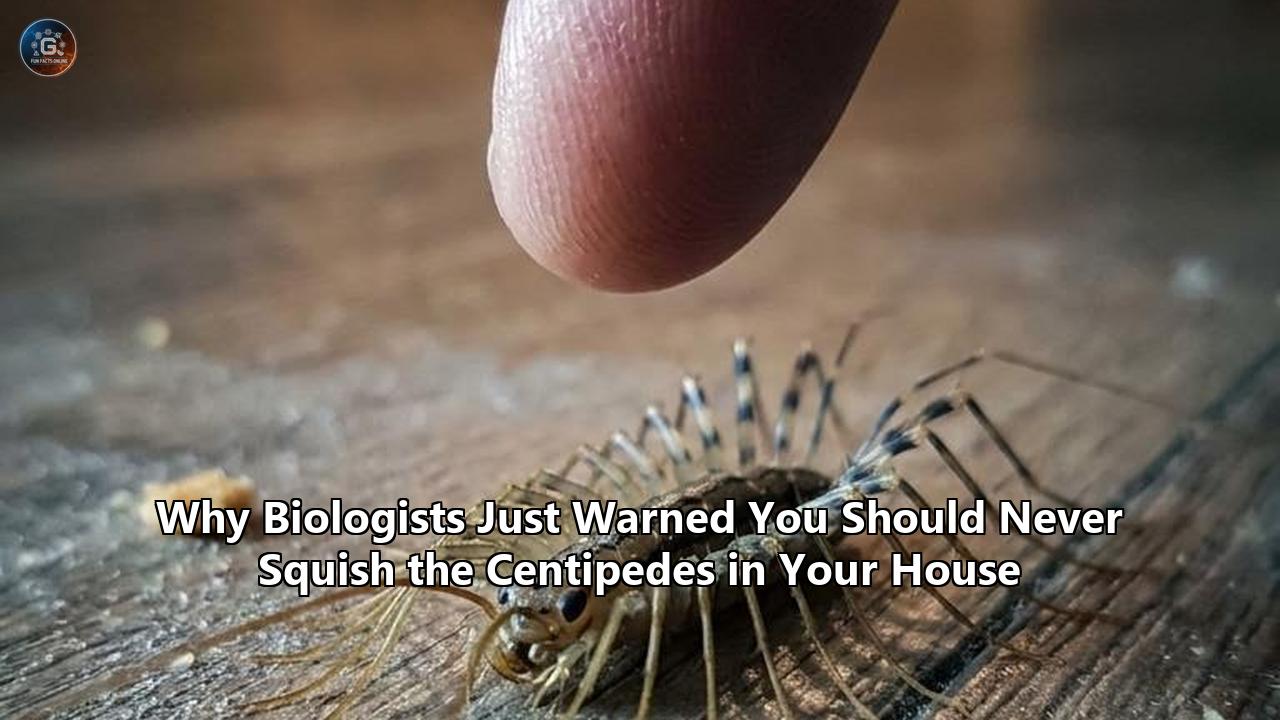
On a cool, damp evening, a homeowner walks down a flight of creaking basement stairs to retrieve a load of laundry. They reach for the pull-string of a bare bulb, casting a sudden, harsh glare across the concrete floor. In that instant, something moves. It does not crawl; it glides with a swift, fluid, and deeply unsettling velocity. It appears less like an insect and more like an animated feather or a disembodied mustache of thirty long, twitching legs, darting across the floor and climbing a vertical brick wall with impossible ease.
For most people, the immediate reaction is visceral. The human brain, primed by evolutionary biology to fear fast-moving, multi-legged organisms, triggers an adrenaline spike. A hand reaches for a nearby shoe, a rolled-up magazine, or a can of synthetic bug spray. The target is Scutigera coleoptrata, the common house centipede. Within seconds, the creature is reduced to a smudged stain on the concrete.
However, a growing coalition of urban entomologists, evolutionary biologists, and indoor ecologists are issuing an urgent public warning: Stop squishing them.
As spring temperatures rise across the hemisphere, sparking a seasonal surge in indoor wildlife sightings, researchers are launching public educational campaigns to reframe how we view these ancient predators. According to university extension services and ecological research units, killing a house centipede is not just an unnecessary act of domestic violence; it is a ecological mistake that actively degrades the health, safety, and hygiene of your living space.
By investigating the complex biology, hunting mechanics, and ecological functions of Scutigera coleoptrata, it becomes clear that these creatures are highly sophisticated, self-cleaning, and completely harmless biological defense systems.
The Biologists’ Dossier: Meet Your Unsung Roommate
To understand why biologists are stepping in to defend an animal that looks like it crawled out of a prehistoric coal forest, we must first look at what a house centipede actually is.
Kingdom: Animalia
  Phylum: Arthropoda
    Subphylum: Myriapoda
      Class: Chilopoda
        Order: Scutigeromorpha
          Family: Scutigeridae
            Genus: Scutigera
              Species: S. coleoptrata
Contrary to popular belief, centipedes are not insects. They are myriapods, a subphylum of arthropods that also includes millipedes. While insects have three body segments and six legs, myriapods are characterized by a highly segmented trunk, with each segment bearing its own pair of legs.
Scutigera coleoptrata is native to the Mediterranean basin. For thousands of years, it inhabited caves, rocky crevices, and leaf litter, adapting to dark, humid environments. But as human civilizations began building stone huts, wooden houses, and eventually heated modern homes with basements, crawlspaces, and complex plumbing networks, the house centipede found a perfect artificial ecosystem. It migrated across the globe via shipping crates and trade routes, becoming a cosmopolitan inhabitant of human structures on nearly every continent."We have spent centuries trying to sanitize our homes and isolate ourselves from nature," says Dr. Arthur Vance, an urban entomologist who has spent over two decades studying the indoor biome. "But the reality is that our homes are not sterile boxes. They are rich, complex ecosystems. When we examine these ecosystems closely, we realize that house centipedes beneficial properties far outweigh their startling appearance."
An adult house centipede typically has a body length of one to two inches, but its incredibly long, thread-like legs and antennae can make it appear up to four inches wide. Its body is a pale, yellowish-gray, marked by three dark, longitudinal stripes running down its back.
The most striking feature—and the source of most human panic—is the legs. Despite the name "centipede" (which literally translates to "one hundred feet"), Scutigera coleoptrata has exactly 30 legs when fully mature. These legs are long, delicate, and banded with dark stripes, giving them a feathered appearance that is highly distinct from the shorter, stouter legs of soil-dwelling centipedes.
The Biomechanics of a Nightmare: How 30 Legs Achieve 42 mph Relative Speeds
To witness a house centipede in motion is to watch a masterclass in biomechanical engineering. To the human eye, the creature seems to slide effortlessly, like a drops of quicksilver or a tiny hovercraft. This movement is made possible by a highly specialized locomotion system that has been perfected over millions of years of evolution.
One of the greatest engineering puzzles of a multi-legged creature is preventing its own limbs from tangling. If you have 15 pairs of legs operating in close proximity, a single mistimed step could cause a catastrophic pile-up.
To solve this, Scutigera coleoptrata evolved a gradient leg-length system. The pairs of legs are not uniform; instead, they get progressively longer from the front of the body to the rear. The first pair of legs is relatively short, while the final pair (the 15th pair) is exceptionally long, often twice the length of the body in adult females.
[Head] -> Leg Pair 1 (Shortest)
       -> Leg Pair 2
       -> Leg Pair 3 ...
       -> Leg Pair 15 (Longest) -> [Tail]
This structural variation allows the rear legs to swing wider and higher than the legs in front of them. When the centipede runs, its legs move in a metachronal wave—a sequential, coordinated rhythm where the tips of the legs on each side follow a wave-like pattern of movement. Because the rear legs are longer and swing on the outside of the shorter front legs, they cross over them without ever touching or tangling.
This design enables the centipede to reach speeds of up to 0.4 meters per second (about 1.3 feet per second). While that might sound modest in absolute terms, when scaled to the creature’s body size, it is equivalent to a human running at a sustained speed of nearly 42 miles per hour. They can run up walls, hang upside down from plaster ceilings, and pivot on a dime, making them some of the fastest and most agile land invertebrates on Earth.
But their legs are not just tools for transportation; they are active weapons. House centipedes utilize a highly unusual hunting strategy known to biologists as "lassoing".
When a centipede encounters an insect, it doesn't just bite it. It charges forward at maximum speed and jumps on top of the prey, using its long, highly flexible legs to wrap around and trap the insect, pinning it to the ground like a wrestler caught in a net.
This leg-lasso technique is so effective that a house centipede can capture and hold multiple insects simultaneously. It can wrap three legs around a fly, pin a silverfish with two more, and use its front appendages to administer a lethal sting to a third victim. It is a highly efficient, multi-tasking killing machine operating quietly in the dark corners of your home.
The Sensory Vanguard: Compound Eyes and Chemosensory Whips
Most centipedes are virtually blind. Because they spent their evolutionary history burrowing deep in the soil, under heavy rocks, or inside decaying logs, they had little use for vision. They rely on simple light-detecting organs called ocelli, or are completely eyeless, navigating entirely by touch and chemical cues.
Scutigera coleoptrata is a stark evolutionary outlier. It belongs to the subclass Notostigmophora, the only group of centipedes that possesses true compound eyes.These eyes are highly complex, consisting of hundreds of individual photoreception units called ommatidia, complete with their own crystalline cones and corneas. The eyes are situated on the sides of the head and are highly sensitive to movement, light intensities, and even ultraviolet light. This visual acuity allows them to track fast-flying prey like houseflies and moths in low-light environments, adjusting their trajectory mid-chase with calculated precision.
Yet, despite these highly developed eyes, the centipede's true primary guidance system is its antennae.
A house centipede’s antennae are incredibly long, often exceeding the length of its body. They are composed of hundreds of tiny, jointed segments and are packed with an array of specialized sensory receptors. These receptors are sensitive to:
- Tactile Feedback: The slightest physical vibration in the air or on the floor. A centipede can detect the microscopic vibrations of a cockroach walking across a carpet several feet away.
- Olfactory / Chemosensory Cues: Chemical trails left by other insects, helping the centipede track down nests, mating pairs, or food sources.
- Hygroreception: Changes in ambient humidity, which is critical for their survival since their thin exoskeletons are highly prone to drying out.
This sensory suite is mirrored at the other end of the animal's body. The 15th pair of legs is so long and thin that they look identical to the antennae. This is not an accident; it is an evolutionary trait known as automimicry.
When the centipede is at rest, it is incredibly difficult for a predator—such as a bird, a spider, or a cat—to tell which end is the head and which is the tail. If a predator attacks the rear legs, thinking it is targeting the head, the centipede can easily detach those legs to make a quick escape, leaving the predator holding a twitching, decoy limb while the centipede scurries to safety.
Not Jaws, But Stings: Demystifying the Centipede Bite
One of the primary reasons people squish house centipedes is the fear of being bitten. They are known to be venomous, and the sight of their rapid movement immediately conjures images of painful, toxic punctures.
However, looking closer at the anatomy of Scutigera coleoptrata reveals that almost everything the public believes about their "bite" is biologically incorrect.
First, strictly speaking, house centipedes do not bite. They sting.
They do not have true fangs or heavy, crushing mandibles like spiders or beetles. Instead, they possess a highly modified pair of appendages called forcipules. These are actually the legs of the first body segment, located directly beneath the head, which have evolved over eons to curve forward around the mouth.
                 [Antennae]
                 /        \
             (Compound  Eyes)
             [  Mouthparts  ]
              /  \      /  \
             (  Left  ) (  Right ) <-- Forcipules (Modified Legs with Venom Glands)
These forcipules act like a pair of hypodermic needles. They are connected to large venom glands located inside the centipede's head. When the centipede captures an insect, it uses these modified legs to pierce the prey’s exoskeleton and inject a potent cocktail of neurotoxins, which quickly paralyzes the insect, allowing the centipede to feed at its leisure.
While this venom is incredibly destructive to a cockroach or a silverfish, it poses virtually zero danger to a human being.
"A house centipede's primary goal is to avoid humans at all costs," explains Dr. Vance. "They are not aggressive. They will only attempt to sting a human if they are picked up, squeezed, or stepped on directly with bare feet. And even then, they face a major physical hurdle: their forcipules are simply too weak."
For the vast majority of house centipedes, their modified legs lack the muscular power and structural rigidity required to puncture human skin. In the rare event that a particularly large centipede manages to break the skin, the resulting sensation is incredibly mild.
For most people, a house centipede sting is far less painful than a bee sting. It typically results in a small, localized red mark, minor swelling, and perhaps a slight itching sensation that resolves within a few hours. Unless a person has a specific, highly rare allergic reaction to insect and arthropod venoms, the risk of serious medical complications is non-existent.
They do not carry diseases, they do not feed on human food, they do not damage wooden structures, and they do not spin messy webs that collect dust. They are, from a medical and structural standpoint, completely benign.
The Silent Pest Controller: An Indoor Apex Predator
To truly appreciate why biologists insist on preserving these creatures, we must look at the specific ecological niche they fill within the domestic environment. The house centipede is not a pest; it is an apex predator of the indoor world, serving as a highly effective biological shield against some of the most destructive and disease-carrying pests on earth.
Understanding why house centipedes beneficial nature is so critical to the indoor microbiome starts with their diet. They are strict insectivores, and their prey list reads like a homeowner’s worst nightmares:
1. Cockroaches (Blattodea)
Cockroaches are notorious vectors for bacteria like Salmonella, E. coli, and Listeria. Their shed skins and droppings are also a leading cause of asthma and severe allergic reactions in children, particularly in urban environments. House centipedes are highly effective cockroach hunters. They can chase down fast-moving German cockroaches, bypass their hard outer shells, and eliminate them before they can establish a colony.
2. Bed Bugs (Cimex lectularius)
Perhaps no household pest inspires as much psychological terror as the bed bug. Resistant to many common chemical treatments and highly difficult to eradicate, bed bugs feed on human blood and reproduce at alarming rates. House centipedes are natural predators of bed bugs, hunting them in the dark crevices of walls, baseboards, and furniture where they hide during the day.
3. Silverfish (Lepisma saccharinum)
Though they do not bite humans, silverfish can cause extensive damage to property. They feed on carbohydrates and starches, meaning they will chew through books, wallpaper, dry goods, cardboard boxes, and expensive clothing made of silk or cotton. Because silverfish prefer the same damp, humid basements and bathrooms as house centipedes, the two frequently cross paths. To a centipede, a silverfish is a soft-bodied, slow-moving delicacy.
4. Termites (Isoptera)
Termites cause billions of dollars in structural damage to homes every year by quietly eating away at wooden beams, floor joists, and drywall backing. House centipedes will actively hunt and consume termite workers, helping to keep their populations in check before they can cause catastrophic structural failure.
5. Clothes Moths and Carpet Beetles
The larvae of clothes moths (Tineola bisselliella) and carpet beetles (Anthrenus scrophulariae) are responsible for ruining carpets, upholstered furniture, blankets, and fine clothing. They feed on animal fibers like wool, feathers, and fur. House centipedes hunt these slow-moving larvae in the dusty, undisturbed corners of closets, attics, and under heavy furniture where human vacuum cleaners rarely reach.
| Pest Species | Human Risk | Damage Type | Centipede Interaction |
|---|---|---|---|
| Cockroach | High (Salmonella, allergens) | Contaminates food | Actively hunted and eaten |
| Bed Bug | Medium (Bites, sleep deprivation) | Psychological distress | Hunted in baseboard cracks |
| Silverfish | Low (None) | Destroys books, paper, clothing | Primary dietary staple |
| Termite | Low (None) | Severe structural wood damage | Hunted at entry points |
| Carpet Beetle | Low (Allergic rashes) | Ruins carpets, upholstery, wool | Consumes destructive larvae |
By allowing a house centipede to live in your basement or crawlspace, you are essentially deploying a free, 24/7, organic pest control service that uses no toxic chemicals, leaves no residue, and actively tracks down the pests you are most afraid of.
The Bio-Indicator: Why Seeing Too Many is a Message from Your House
While biologists advocate for the preservation of house centipedes, they also note a crucial caveat: The number of centipedes you see is a direct reflection of the health of your home.
Ecologists refer to house centipedes as "bio-indicators." Because they are top-tier predators in the indoor ecosystem, their presence and population density are entirely dependent on the availability of food and moisture.
If you see a single house centipede once or twice a month scurrying across your bathroom floor or basement wall, there is absolutely no reason to worry. This is a normal, healthy level of predatory activity. It means the centipede is doing its job, patrolling the perimeter and picking off the occasional stray ant, spider, or fly that slips through the door.
However, if you are seeing multiple house centipedes every day, or if you find yourself constantly encountering them in different rooms of your house, the centipedes are not the problem. They are a symptom of a much larger, hidden issue.
[Excess Moisture / Humidity] ---> [Thriving Insect Population] ---> [Sustained Centipede Surge]"A predator population cannot survive without a matching prey base," says Dr. Vance. "Centipedes are not vegetarian. They cannot eat your cereal, they cannot chew on your drywall, and they cannot live on dust. If you have ten house centipedes thriving in your basement, it is because there are hundreds, if not thousands, of other insects—like roaches, silverfish, or termites—providing them with a steady food supply."
In this scenario, squishing the centipedes is actually the worst thing you can do. By killing the predators, you are removing the only natural barrier keeping the actual pest population in check, allowing the roaches or termites to multiply completely unchecked.
Instead of playing a violent game of whack-a-mole with your multi-legged helpers, homeowners should play detective. Seeing a sudden surge of house centipedes is an early warning system from your house, indicating that you likely have:
- A Hidden Moisture Problem: Centipedes have a highly permeable exoskeleton that easily loses water. They cannot survive in dry air. A sudden increase in their numbers suggests that there is a leak, a malfunctioning sump pump, high relative humidity, or poor drainage around your foundation, creating the damp, swampy conditions they—and many destructive pests—crave.
- An Undetected Pest Infestation: There is a highly abundant food source nearby. This might be a colony of silverfish living behind your damp basement walls, a termite colony chewing through a sill plate, or a family of mice whose droppings are attracting carpet beetles and flies.
By addressing the underlying moisture and pest issues, you will naturally and humanely reduce the centipede population. When their food and water supplies dry up, they will either migrate back outdoors or die off naturally, without you ever having to swing a shoe.
The Chemical Warfare Trap: The High Cost of Synthetic Pesticides
When faced with a house centipede or a suspected insect problem, the default modern reaction is often to call an exterminator or spray a can of broad-spectrum synthetic pesticide along the baseboards.
However, indoor ecologists warn that this chemical approach is a dangerous trap that often backfires, creating a far worse environment for human inhabitants.
Most commercial pest sprays rely on synthetic pyrethroids or organophosphates. These are powerful neurotoxins designed to kill insects on contact or leave a toxic residue that kills any bug that walks across it. While these chemicals are highly effective at killing house centipedes, they carry significant, often invisible costs.
1. Destroying the Natural Biological Control
When you spray a broad-spectrum pesticide, you are executing a form of ecological scorched-earth policy. You kill the centipedes, but you also kill any beneficial spiders, predatory beetles, and other natural allies.
Because pests like cockroaches and bed bugs often have faster reproductive cycles and have evolved widespread resistance to chemical sprays, they are much quicker to rebound than their predators. Once the centipedes are gone, any surviving pests can multiply exponentially, free from the threat of predation. This often leads to a cycle of chemical dependency, where homeowners must spray more and more toxic chemicals to manage a pest problem that used to be kept under control naturally.
2. Human and Pet Exposure Risks
Our homes are enclosed spaces with limited ventilation. When we spray liquid pesticides indoors, we are introducing toxic chemicals that settle into carpets, floorboards, toys, and pet beds.
Studies have shown that exposure to common indoor pesticides can be linked to a range of health issues, especially in toddlers and pets who spend their time crawling on the floor and putting their hands or paws in their mouths. Symptoms of low-grade pesticide exposure can include:
- Chronic headaches and dizziness
- Respiratory irritation and worsening of asthma symptoms
- Skin rashes and contact dermatitis
- Endocrine disruption and potential long-term developmental issues in young children
By contrast, letting a house centipede crawl behind your drywall is entirely free of chemical toxicity. They do not leave chemical residues, they do not pollute your indoor air, and they cost absolutely nothing. Instead of viewing them as invaders, recognizing house centipedes beneficial roles as built-in pest control units represents a shift in how we manage our living spaces.
An Evolutionary Marvel: Survivors of the Silurian Era
For those who still struggle to overcome their instinctual revulsion, looking closely at how house centipedes beneficial behavior operates can demystify the fear. It also helps to understand the incredible evolutionary pedigree of these animals.
When you look at a house centipede on your bathroom wall, you are not looking at a modern pest that evolved yesterday to feed on trash. You are looking at a living fossil—a survivor of one of the most successful lineages in the history of terrestrial life on Earth.
[Silurian Period] (418M Years Ago) ---> Scutigeromorph stem group appears (First land predators)
  [Carboniferous Period] (300M Years Ago) ---> Giant myriapods rule the forests
    [Cretaceous Period] (145M Years Ago) ---> Modern Scutigeromorpha crown group emerges
      [Present Day] (2026) ---> S. coleoptrata patrols your basement
The earliest known fossil centipedes have been identified as belonging to the order Scutigeromorpha, dating back to the late Silurian period, approximately 418 million years ago.
To put that into perspective:
- Before the Dinosaurs: House centipedes were running across the land 180 million years before the first dinosaur (Coelophysis) took its first breath.
- Before Trees Evolved: When the ancestors of Scutigera crawled out of the ancient oceans, the dry land was covered only in mosses, lichens, and small, primitive plants. Large, woody trees had not yet evolved.
- The First Land Predators: These ancient scutigeromorphs were among the very first animals to successfully colonize the land, serving as some of the earliest terrestrial predators on our planet.
Their basic anatomical structure has remained remarkably stable for hundreds of millions of years. Their unique dorsal respiratory system—where a single breathing pore (spiracle) is located on the middle-back of each major body segment, rather than on the sides like other centipedes—is a direct adaptation designed to maximize oxygen intake during rapid, open-air pursuits.
They have survived multiple mass extinction events, ice ages, continental drifts, and the rise and fall of countless species. They are evolutionary champions, and their presence in our homes is a testament to their incredible adaptability and survival skills.
To squish such an ancient, finely tuned organism simply because its appearance makes us slightly uncomfortable is a tragic dismissal of natural history.
The Path to Coexistence: How to Humanely Manage Your Leggy Roommates
It is one thing to appreciate the biological significance of Scutigera coleoptrata in theory, but it is another thing entirely to share a bathroom with one. Biologists understand that arachnophobia and insect phobias are real, powerful, and often involuntary psychological responses.
If you simply cannot bring yourself to cohabitate with a house centipede, you do not have to resort to violence. There are several highly effective, humane, and ecological ways to manage their presence without ever harming them.
1. The Glass-and-Cardboard Relocation Method
This is the classic, time-tested approach for moving spiders, bees, and centipedes safely outdoors.
Because house centipedes are incredibly fast, capturing them can be a challenge. The key is to wait until they are resting on a flat, solid surface like a wall or floor.
- Step 1: Grab a wide-mouthed glass tumbler.
- Step 2: Move slowly and place the glass firmly over the centipede.
- Step 3: Take a piece of stiff cardboard or heavy paper (like a postcard or junk mail envelope) and gently slide it between the rim of the glass and the wall or floor.
- Step 4: Once the card is fully underneath the glass, secure it with your hand and carry the glass outside.
- Step 5: Release the centipede into your garden, mulch pile, or near a woodpile.
Once outside, the centipede will immediately find a damp crevice and go to work eating grubs, cutworms, and other garden pests, ensuring its ecological talents are still put to good use.
2. Eliminate Their Favorite Foods
If you want centipedes to leave your home voluntarily, the most effective strategy is to cut off their food supply. You can do this by aggressively tackling other insect populations in your house:
- Store Food in Airtight Containers: Keep pantry staples like flour, sugar, and cereals sealed in glass or hard plastic containers to prevent ants and beetles from invading.
- Vacuum Regularly: Vacuuming removes dust bunnies, crumbs, and insect eggs, denying carpet beetles and moths a place to feed and reproduce.
- Clear Cardboard and Paper Clutter: Old stacks of magazines, newspapers, and cardboard boxes are prime habitats and food sources for silverfish. Swap cardboard storage bins for plastic totes with tight-fitting lids.
3. Starve Them of Moisture
House centipedes cannot survive without high relative humidity. If your home is dry, they will either dehydrate and die, or leave in search of a better environment.
- Run a Dehumidifier: Keep your basement, crawlspace, or bathroom humidity below 50%. This single step is often enough to eliminate both centipedes and their insect prey.
- Fix Plumbing Leaks: Repair dripping pipes, leaky faucets, and running toilets immediately. Even a small amount of condensation on a cold pipe can provide a centipede with a vital water source.
- Improve Ventilation: Use exhaust fans in your bathroom and kitchen to clear out humid air after bathing or cooking. Ensure your crawlspace is properly vented to prevent moisture build-up.
4. Fortify the Perimeter
To keep house centipedes outside where they belong, you need to seal the physical pathways they use to enter your living areas.
- Seal Cracks and Crevices: Inspect your basement floor and foundation walls. Use expanding foam or concrete caulk to seal any cracks, expansion joints, or gaps around utility pipes.
- Install Door Sweeps: Ensure that all exterior doors, basement doors, and garage doors have tight-fitting rubber door sweeps installed along the bottom.
- Screen Sump Pumps and Floor Drains: Sump pump wells and basement floor drains are prime highway corridors for centipedes entering from under concrete slabs. Install fine wire mesh screens over these openings to block their entry.
- Clear Foundation Vegetation: Keep mulch, dead leaves, wood piles, and heavy shrubbery at least two feet away from your home's foundation. This creates a dry, exposed zone that centipedes are reluctant to cross.
[Outside Garden / Mulch] (Healthy Habitat)
       ||
       ||   [Dry, Exposed Foundation Buffer Zone] <-- Keep clear of mulch & leaves
       ||
[Sealed Basement Wall] <-- Caulk cracks & screen drains
       ||
[Clean, Dry Indoor Environment] (Unhonored by Centipedes)
The New Paradigm of Indoor Ecology
For decades, our relationship with the natural world has been defined by a desire for total control. We have sought to draw a sharp, uncompromising line between the "wild" outdoors and our "clean" indoors. Anyone or anything that crosses that line has been treated as an enemy, subject to immediate chemical or physical elimination.
But as our understanding of ecology, microbiology, and the environment deepens, we are beginning to realize that this artificial division is both impossible and counterproductive.
Our homes are not sterile bubbles; they are living, breathing ecosystems. When we spray broad-spectrum chemicals to wipe out every single crawling creature, we do not create a safer home. We create a toxic, unbalanced environment where harmful, disease-carrying pests thrive because we have systematically executed their natural predators.
The house centipede, with its thirty striped legs and blistering speed, is a stark reminder of this biological reality. It is not a monster, nor is it a pest. It is a highly evolved, self-grooming, non-destructive, and completely free biological filter that quietly works the night shift to keep your home clean, safe, and hygienic.
The next time you walk down your basement stairs and startle a house centipede, take a deep breath. Resign the shoe back to your foot. Watch it for a moment as it stands frozen under the light, its long antennae tasting the air, ready to spring into action against the silverfish and cockroaches hiding behind your drywall.
Honor its 418-million-year-old heritage. Let it slide back into the shadows, and let it do its job.
Reference:
- https://harvestsavvy.com/house-centipedes/
- https://my1053wjlt.com/benefits-of-house-centipedes/
- https://animaldiversity.org/accounts/Scutigera_coleoptrata/
- https://fesfas.com/blogs/news/house-centipede-the-beneficial-pest-control-ally-in-your-home
- https://www.youtube.com/shorts/T26h1GUoZyk
- https://thefw.com/house-centipede-beneficial/
- https://en.wikipedia.org/wiki/Centipede
- https://australian.museum/learn/animals/centipedes/house-centipede/
- https://www.minnesotaseasons.com/Centipedes/house_centipede.html
- https://soil.evs.buffalo.edu/index.php/Scutigera_Coleoptrata
- https://en.wikipedia.org/wiki/Scutigera_coleoptrata
- https://allspecies.fandom.com/wiki/House_Centipede
- https://www.wildcreatureshongkong.org/single-post/scutigera-coleoptrata
- https://extension.psu.edu/house-centipedes
- https://en.wikipedia.org/wiki/Scutigeromorpha
- https://en.wikipedia.org/wiki/Compound_eye
- https://webpreneurships.com/the-bug-you-should-never-kill-and-why-youll-be-glad-its-in-your-home/