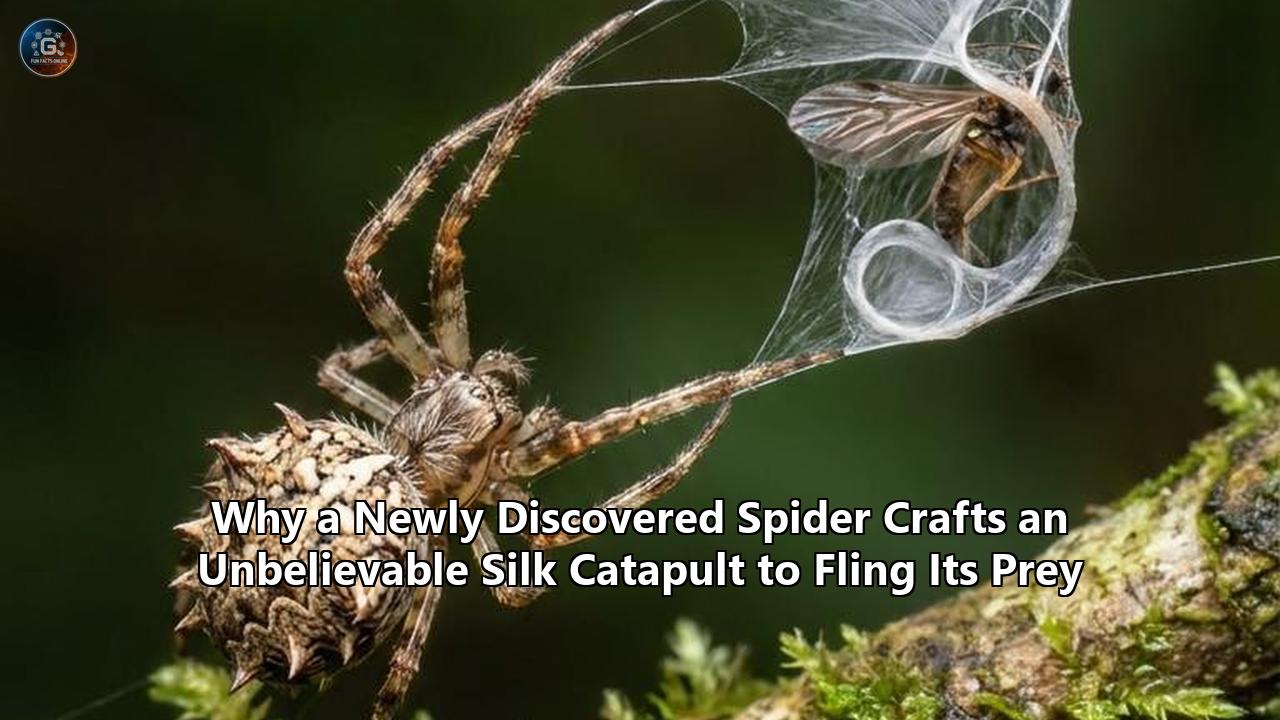
Deep within the humid, pitch-black undercanopy of northern Queensland’s Cape York Peninsula, a silent arms race has escalated to a terrifying biomechanical extreme.
The green tree ant (Oecophylla smaragdina) is a formidable force of the Australian rainforest. Operating in aggressive, hyper-territorial colonies containing up to five million workers, these ants patrol tree branches and forest floors with a swift, collective defense system. If a worker is threatened, it releases alarm pheromones that summon a swarming wall of nestmates within minutes, ready to tear apart any intruder with powerful mandibles and acid sprays. For most insect predators, a head-on encounter with a green tree ant is a quick path to a painful death.
But a newly discovered nocturnal spider—measuring a mere three to five millimeters—has solved this predatory equation. It does not chase the ants, nor does it weave a passive, sticky web hoping one might blunder into it. Instead, this tiny arachnid, belonging to the genus Propostira, spends hours building a highly tensioned vertical siege engine. It is a device that forces the ant’s own territorial aggression to pull the trigger, catapulting the dangerous prey off its trail, high into the air, and directly into an waiting web.
This spectacular mechanism, published in the journal Current Biology, represents a staggering feat of evolutionary design. The Propostira species—popularly dubbed the "ballista spider" after the ancient Roman torsion-powered catapult—harnesses a high-powered spider silk catapult to weaponize elastic energy. When the trap is sprung, the target ant experiences accelerations of up to 1,367 meters per second squared—approximately 140 times the acceleration due to gravity (140 Gs). For comparison, this is roughly 15 times the maximum g-force a fighter jet pilot can survive, delivered in a blistering 42 milliseconds.
  [ Spider's Core Web ] (Positioned safely 30-50 cm above)
          ^
          |  (Ant launched upward at 4.4 m/s / 140 Gs)
          |
  [ Tension Silk Bundle ] (15-60 tightly stretched lines)
          |
  [ Bait/Trigger Cone ] (Thin silk wrapper + suspected pheromones)
          |
  [ Anchor Point ] === Bitten & severed by defensive Green Tree Ant
The discovery of the ballista spider’s trap completely inverts our traditional understanding of spider web mechanics, offering an elegant blueprint of ecological specialization and extreme power amplification.
The Serendipitous Discovery: A Needle in Several Haystacks
The scientific journey to documenting this phenomenal predator began not in a sterile laboratory, but through a flash of motion in the dark. In 2022, Professor Greg Anderson—a biomedical researcher, spider taxonomist, and wildlife photographer—was exploring a remote stretch of rainforest in northern Queensland. Amidst the tangled foliage, Anderson caught a fleeting glimpse of a green tree ant suddenly launched skyward at high velocity, vanishing into a messy web suspended a foot above. At the time, the movement was a literal blur. Without ultra-high-speed camera equipment, the physical trigger and the identity of the engineer remained a mystery.
Intrigued by the observation, Anderson contacted Professor Ajay Narendra, an insect neuroethologist at Macquarie University’s School of Natural Sciences, and postgraduate researcher Pranav Joshi. Realizing they were looking at a hunting strategy never before documented in the arachnid world, the team organized an expedition in early 2023. They traveled to the dense, rugged tropical forests near Cooktown, at the far northern edge of Queensland’s Cape York Peninsula.
"To be able to even find the spider was a needle in several haystacks," Narendra recalled. The spiders are incredibly small, perfectly camouflaged, and strictly active after dark. During the day, they curl up inside tiny silken retreats on the undersides of leaves, suspended half a meter above active foraging trails of green tree ants.
For ten grueling days and nights, Narendra, Joshi, and their collaborators, including spider-silk specialist Dr. Jonas Wolff from the University of Greifswald in Germany, combed the humid foliage. They set up highly sensitive infrared cameras and advanced high-speed videography rigs capable of capturing thousands of frames per second, braving the oppressive heat, swarming mosquitoes, and aggressive weaver ant colonies.
The team's persistence paid off, but not without immediate technological hurdles. The first time they witnessed the trap trigger in the wild, the camera failed to record the action. The event was simply too fast. To finally capture the launch sequence in detail, the researchers had to push their high-speed cameras to record at 5,000 to 7,000 frames per second. The resulting footage revealed a flawless, repeatable sequence of structural failure and ballistic trajectory that left the researchers breathless.
Engineering a Siege Weapon: The Three-Phase Construction
To understand the sheer power of the spider silk catapult, one must dissect how the ballista spider manufactures its vertical trap. The construction process is an exhausting, highly coordinated engineering feat that takes the 5-millimeter spider up to four hours to complete every night. Because the trap is completely destroyed after a single launch, the spider must expend a massive amount of metabolic energy to rebuild its machine from scratch before each night’s hunt.
The construction unfolds in three distinct, highly precise phases:
Phase 1: The Descent and Ground Anchoring
About 30 minutes after sunset, the spider emerges from its daytime leaf-refuge. It begins by dropping vertically from its main suspended web (the "core web") on a single, strong dragline. Descending between 30 and 50 centimeters, the spider targets a lower substrate—typically the surface of a leaf, a small twig, or the forest floor—that is actively crossed by foraging green tree ants. Upon landing, the spider presses its spinnerets to the surface, laying down a highly secure silk anchor point.
Phase 2: Drawing the Bow
The spider then climbs back up its vertical dragline to the core web. Rather than leaving the line loose, it physically pulls the silk taut, securing it to the upper web structure under heavy elastic tension.
The spider does not stop at a single line. Over the next several hours, it repeats this vertical loop with robotic precision. It descends to the exact same anchor point, lays another line, climbs back up, and pulls it tight. It does this 15 to 60 times, bundling the parallel silk lines together.
This meticulous process forms a fan-shaped, vertical array of highly tensioned silk lines that gradually taper into a tight, conical bundle near the ground. Like pulling back a compound bow, the spider is slowly storing its own muscle energy directly inside the molecular structure of the bundled silk.
Phase 3: Wrapping the Bait and Trigger
Once the structural core of the catapult is tensioned, the spider wraps the lower portion of the cone, close to the ground, in a much finer, delicate wrapping silk. This fine silk serves as both a physical trigger and a chemical lure.
With the trigger mechanism primed, the spider retreats back up the vertical lines, positioning itself safely in its core web a foot above the forest floor. It sits quietly, holding the main lines, waiting for its target to strike.
Biomechanical Mastery: Power Amplification Beyond Muscle
The exceptional speed of the ballista spider's launch is a classic case of power amplification. In biological systems, muscles are fundamentally constrained by how quickly they can contract. Even the fastest contracting muscle tissue cannot produce the instantaneous power densities required to launch an object at hundreds of Gs.
To overcome these metabolic limitations, many organisms use elastic storage systems. They spend a long time using slow muscle contractions to deform an elastic material, then release that stored energy in a fraction of a millisecond.
  Energy Accumulation (Hours):
  [Spider Muscle Work] ===> Deforms ===> [Spider Silk Proteins] (High Elastic Storage)

  Energy Release (Milliseconds):
  [Trigger Bitten] ===> Instant Elastic Recoil ===> [140-G Kinetic Launch]
What makes the ballista spider’s snare unique is that it exhibits a superior energy performance compared with other known silk-based catapult systems. To quantify this performance, Dr. Jonas Wolff collected silk samples from the Cape York snares and analyzed them under scanning electron microscopy (SEM) back at the University of Greifswald.
The results of their biomechanical modeling were jaw-dropping:
- Kinetic Energy Density: Gram for gram, the ballista spider's web stores more elastic energy than any other known biological catapult.
- Theoretical Power Output: If you scaled the spider's web up to a weight of one kilogram (2.2 pounds), the silk would store 78.17 kilojoules of kinetic energy. Upon release, it would briefly exert an astronomical 11.73 megawatts of power.
- Launch Velocity: When the trap is sprung, the ant is pulled off the ground at a speed of up to 4.4 meters per second (14.4 feet per second, or nearly 10 miles per hour).
- Acceleration Profile: The peak acceleration of 1,367 m/s² (140 Gs) occurs within a tiny 42-millisecond window.
This massive power density is a direct consequence of spider silk's unique protein structure. Spider dragline silk is composed of highly structured crystalline beta-sheet domains embedded in amorphous, flexible glycine-rich regions. This combination grants the material both high tensile strength (rivaling steel) and exceptional elasticity.
By bundling up to 60 of these lines in parallel, the ballista spider creates a micro-structured spring. The tension alignment ensures that when the trigger is severed, the elastic recovery of the amorphous protein chains occurs almost simultaneously across all fibers, dumping the entirety of the stored kinetic energy into the target in the blink of an eye.
The Prey-Triggered "Dead Man's Switch"
In nearly all known predatory traps in nature, the predator must actively sense the presence of prey and decide when to release the trigger.
For instance, the slingshot spider (family Theridiosomatidae) pulls its web back like a slingshot, sits at the center, and manually cuts or releases a tension line with its hind legs when a flying insect passes nearby.
  Traditional Slingshot Spider (Theridiosomatidae):
  [Spider pulls web] ---> [Senses prey] ---> [Spider releases web manually] ---> [Launches self + web]

  New Ballista Spider (Propostira sp.):
  [Spider tensions web] ---> [Leaves trap dormant] ---> [Ant bites trigger] ---> [Ant launches itself]
The ballista spider’s snare is a completely automated system. The spider does not release the trap; the prey triggers the launch itself. It is a biological "dead man's switch."
When a green tree ant approaches the vertical silk cone, it does not simply step on a sticky thread. Instead, it actively attacks the structure. Green tree ants are aggressively vigilant and clean up any foreign objects or strange silk structures in their vicinity.
When the ant encounters the fine wrapping silk at the base of the cone, its territorial reflex is immediately tripped. The ant lunges forward and bites the silk.
Because the spider’s vertical tension lines are wrapped in a sticky, adhesive coating near the ground, the ant’s mouthparts and front legs become instantly stuck to the silk. As the ant bites harder to sever the annoying obstacle, it cuts through the delicate lower anchor threads.
The moment those anchor fibers fail, the structural connection holding the heavily tensioned spring to the leaf is severed. The vertical bundle of 60 lines violently contracts upward.
Because the ant is stuck to the cone, it cannot release its grip. The massive, stored elastic tension of the spider silk catapult snaps upward, yanking the ant off the substrate and launching it nearly a foot into the air, where it lands squarely in the spider's sticky core web.
Why the Extreme Specialization? Overcoming the Ant's Arsenal
Why would a spider evolve a hunting mechanism so incredibly complex, labor-intensive, and narrowly specialized? The answer lies in the terrifying physiology and social structure of the green tree ant.
┌────────────────────────────────────────────────────────────────────────┐
│                        GREEN TREE ANT ARSENAL                          │
├────────────────────────────────────────────────────────────────────────┤
│ • Massive Colonies: Up to 5 million workers per nest                   │
│ • Strong Adhesion: Smooth foot pads (arolia) hold 100x body weight      │
│ • Chemical Alarm: Pheromones recruit swarms within minutes             │
│ • Formic Acid: Highly corrosive defensive chemical sprays               │
└────────────────────────────────────────────────────────────────────────┘
The green tree ant is not an ordinary target. To capture one, the ballista spider has to overcome three major evolutionary hurdles:
1. Breaking the Grip of the "Super-Glue" Foot Pads
Weaver ants are masters of adhesion. Their feet are equipped with specialized, highly flexible smooth attachment pads called arolia (or pulvilli). These pads are constantly lubricated by a thin, hydrophobic liquid film secreted from the tarsus, working in tandem with dense arrays of microscopic tarsal friction hairs.
This "wet adhesion" and mechanical "preflex" allow weaver ants to easily walk upside down on smooth glass and leaves, holding onto surfaces with forces equivalent to more than 100 times their own body weight. In lab tests using a high-velocity centrifuge, researchers have found that weaver ants can withstand sideways forces up to 600 to 800 times their body weight without detaching from a smooth turntable.
If a spider tried to simply pull a weaver ant off a leaf using normal muscle force, the ant's foot pads would instantly engage, anchoring it securely to the leaf. The spider would find itself locked in an unwinnable tug-of-war.
The massive, instantaneous 140-G acceleration of the ballista spider’s snare is specifically tuned to solve this problem. The sudden, violent jerk delivers a peak force that instantly buckles the ant’s tarsal hairs and shears the wet-adhesive contact of the arolia before the ant’s mechanical preflex can engage, ripping the insect clean off the leaf.
2. Preventing Chemical Recruitment and Swarming
When a green tree ant is attacked by a predator, its immediate response is to release volatile alarm pheromones (such as hexanal and 1-hexanol) from its mandibular glands. These compounds diffuse rapidly through the air, acting as a chemical beacon that triggers a frantic, aggressive swarming response from any nestmates within a few meters.
If the ballista spider tried to struggle with an ant on its foraging trail, the resulting chemical alarm would quickly summon hundreds of reinforcements, which would swarm the web, kill the spider, and tear the web to pieces.
  On-Trail Attack (Failure):
  [Spider attacks Ant on leaf] ---> [Ant releases Alarm Pheromones] ---> [Swarms recruit] ---> [Spider killed]

  Ballista Catapult (Success):
  [Ant bites Trigger] ---> [Launched 30 cm upward in 42 ms] ---> [Pheromones drift away] ---> [Spider safe]
The catapult mechanism circumvents this collective defense through acoustic and chemical isolation. The rapid vertical displacement of 30+ centimeters instantly yanks the ant away from its foraging trail.
Any alarm pheromones released by the terrified, flying ant are carried away by ambient air currents high above the ground. Because the chemical signal never reaches the ground-level trail, the colony remains completely unaware that one of their workers has just been snatched.
The spider can safely feed on its isolated victim in its suspended core web, picking off individual workers one by one without ever alerting the massive empire below.
3. Avoiding Direct Contact with Formic Acid and Mandibles
Green tree ants are highly venomous, possessing powerful mandibles and the ability to spray concentrated formic acid into wounds.
By using an automated, mechanical trap, the ballista spider completely avoids dangerous physical contact during the most hazardous phase of the hunt.
The spider does not rush down to help wrap the struggling ant. It sits safely in its core web, letting the ant thrash around and exhaust itself inside the messy, sticky upper web. Only after the ant is completely immobilized and tightly bound by the web's adhesive threads does the tiny spider approach to administer a safe, lethal bite.
The Chemical Seduction: Is the Web Baited?
One of the most intriguing details of the Propostira discovery is the spider’s absolute prey specificity.
To test whether the catapult was a general insect trap or a highly target-specific weapon, Professor Ajay Narendra and Pranav Joshi conducted a series of controlled field experiments. They captured and released various other nocturnal ant species that actively forage in the same Queensland canopy, including carpenters (Camponotus sp.) and acrobat ants (Crematogaster sp.), near active spider traps.
The results were stark: while the green tree ants consistently approached and bit the silk cones, the other ant species completely ignored them. Even when an acrobat ant accidentally bumped into the fine wrapping silk, it showed no sign of aggression and quickly walked away without triggering the snare.
This extreme specificity led the research team to formulate the pheromone mimicry hypothesis.
"We suspect during the final construction stage the spider adds a pheromone that specifically lures worker ants and induces an aggressive attack, triggering the snare," Narendra explained.
  The Target-Specific Chemical Mimicry Loop:
  [Spider Spinnerets]
       │
       └───> Secretes wrapping silk + synthetic Oecophylla pheromone
                 │
                 └───> [Airborne Diffusion]
                           │
                           └───> Only detected by Green Tree Ant (*O. smaragdina*)
                                     │
                                     └───> Ant perceives a rival nest invader
                                               │
                                               └───> aggressive biting reflex triggered
The team believes that the ballista spider chemically coats the fine wrapping silk of the lower cone with a synthetic volatile compound that mimics the territorial boundary pheromones or the cuticular hydrocarbons of an enemy colony of Oecophylla smaragdina.
To a green tree ant, this chemical signal does not smell like food; it smells like a highly offensive, rival intruder trespassing on their territory. The ant’s immediate instinct is not to forage, but to aggressively bite and destroy the source of the smell, unknowingly executing its own vertical launch into the spider's kitchen.
While the exact chemical structure of this synthetic lure is currently being isolated and analyzed via gas chromatography-mass spectrometry (GC-MS) at Macquarie University, the ecological implications are clear: the ballista spider has evolved a multi-sensory hunting system that seamlessly combines structural engineering, physical chemistry, and chemical warfare.
Evolutionary Trajectory: Where Does the Ballista Fit?
To place the ballista spider in its proper evolutionary context, we must compare its hunting strategy to other elite web-based ballistic systems in the arachnid tree of life:
Slingshot Spiders (Theridiosomatidae)
These tiny spiders build a conical web with a central tension line. The spider sits at the center, holds the line with its front legs, and pulls the web tight against an anchor branch, acting as the human hand pulling a slingshot elastic.
When a flying insect passes, the spider releases its grip, launching both itself and the web forward to snare the prey in mid-air. This is an active, predator-controlled mechanical system designed primarily for flying insects.
Net-Casting Spiders (Deinopidae)
These spiders hold a small, highly stretchable rectangular net of sticky cribellar silk between their front legs.
They hang upside down above walking trails and manually throw the net downward onto passing insects. This is a highly active, visually-guided hunting system requiring specialized, giant night-vision eyes.
Gumfoot-Web Spiders (Theridiidae)
As members of the cobweb spider family Theridiidae, ballista spiders share an evolutionary lineage with common cobweb weavers, which construct sticky "gumfoot" lines. These lines are held under tension and secured to the ground with weak, sticky droplets.
When a crawling insect steps on the line, the weak anchor breaks, and the elastic recoil of the single line lifts the prey off the ground, leaving it suspended in the air.
                  ┌─────────────── THERIDIIDAE FAMILY ───────────────┐
                  │                                                  │
       [Passive Gumfoot Weavers]                         [Automated Ballista Spiders]
       • Weak ground anchor                              • Strong, structural ground anchor
       • Passive, adhesive-reliant lift                  • 15-60 bundled tension lines
       • Low power, slow recoil                          • High energy density (140-G catapult)
       • Triggered by prey stepping on line              • Triggered by prey biting/cutting trigger
The ballista spider’s snare represents a monumental evolutionary leap. It transforms the passive, single-threaded lifting mechanism of a theridiid gumfoot line into a highly coordinated, multi-threaded vertical catapult.
By shifting the trigger mechanism from a passive step to an active, defensive bite, the spider successfully targets highly aggressive, heavily armored prey that would easily escape or destroy a standard gumfoot web.
Behind the Scenes in the Queensland Canopy: The Fight to Film 42 Milliseconds
Documenting this complex behavior presented an array of extreme physical challenges for the international research team. The tropical rainforests of northern Queensland are incredibly dense, and working after midnight in these environments is a logistically daunting task.
"To capture the moment, we had to push the cameras to 5,000 to 7,000 frames per second, which I honestly have never had to do when I've been filming animals," Narendra explained.
┌────────────────────────────────────────────────────────────────────────┐
│                        FIELD FILMING CHALLENGES                        │
├────────────────────────────────────────────────────────────────────────┤
│ • Speed: Trap triggers and launches the ant in under 42 milliseconds.  │
│ • Scale: The spider and its tension cone are only 3 to 5mm long.       │
│ • Light: Spider is strictly nocturnal; visible light scares them.      │
│ • Environment: 90%+ humidity causes lens condensation and fogging.    │
└────────────────────────────────────────────────────────────────────────┘
Filming at 7,000 frames per second requires an immense amount of light to properly expose each frame. However, the ballista spider is highly sensitive to bright, visible light; if illuminated by standard spotlights, the spider immediately stops building its trap, retreats to its leaf-hide, or drops to the ground to escape.
To bypass this behavioral hurdle, the team had to design a custom, high-intensity infrared (IR) illumination array. Because spiders and ants lack photoreceptors sensitive to long-wavelength infrared light, the researchers could flood the miniature stage with invisible IR light, allowing their high-speed, IR-sensitive cameras to capture the action in complete, natural darkness.
Focusing a macro lens on a 5-millimeter target suspended in mid-air on a breezy rainforest night was another nightmare. The slightest breeze would sway the leaf and the silk catapult out of the razor-thin depth of field.
To stabilize their shots, the team had to construct temporary, wind-blocking enclosures around the active web sites using lightweight plastic sheeting, working in stifling heat and near-total humidity.
The physical fatigue was immense. The team slept in shifts during the day and spent their nights huddled under the canopy, staring at high-resolution field monitors.
On one memorable night, after spending hours setting up a shot on a pristine, newly constructed silk cone, a stray falling leaf drifted down from the upper canopy, struck the anchor point, and triggered the trap with zero biological return. The entire four-hour work of the spider—and the setup of the film crew—was destroyed in a single frame.
"By the time we blinked, the ant was caught in the web, so we had no idea what actually happened," Narendra said, recalling their early attempts. "Lucky for us, nature and behaviors are quite repeatable."
Eventually, the team captured dozens of clean, high-speed launches, providing the raw kinematic data needed to calculate the record-breaking accelerations and power densities of this biological catapult.
The Taxonomic Mystery: formalizing a Species Without a Name
Despite the detailed publication in Current Biology, the ballista spider remains officially unnamed. It currently sits in taxonomic databases under the placeholder Propostira sp..
  Kingdom: Animalia
    Phylum: Arthropoda
      Subphylum: Chelicerata
        Class: Arachnida
          Order: Araneae
            Family: Theridiidae (Cobweb spiders)
              Genus: Propostira (Simon, 1894)
                Species: [Unnamed "Ballista Spider" from Cape York]
The genus Propostira was first established by French arachnologist Eugène Louis Simon in 1894, based on specimens found in India and Sri Lanka. For over a century, the genus remained obscure, containing only two officially recognized species: Propostira quadrangulata and Propostira ranii.
Neither of these Asian species has ever been observed constructing a spring-loaded catapult, leading researchers to wonder if the ballistic mechanism is an evolutionary innovation exclusive to the newly discovered Australian lineage.
Formally describing a new spider species is a painstaking taxonomic process that requires more than just high-speed videos of its hunting behavior.
The researchers must collect several mature male and female specimens and perform micro-dissections of their reproductive organs (the pedipalps in males and the epigynum in females). These microscopic structures are highly complex and species-specific, acting as a physical "lock and key" mechanism that prevents cross-breeding between closely related species.
Once the physical specimens are dissected, drawn, photographed, and compared to the historical type specimens of Propostira housed in museums in Paris and Kolkata, a formal taxonomic paper will be published to grant the ballista spider its official scientific name.
Currently, the team is working on this taxonomic description, alongside genetic barcoding of the spider’s mitochondrial DNA (specifically the Cytochrome c Oxidase Subunit I gene) to map its exact placement on the evolutionary tree of cobweb spiders.
Engineering the Future: Bio-Inspired Applications
The discovery of the ballista spider is not just a triumph for evolutionary biology; it is a goldmine for materials scientists, mechanical engineers, and roboticists.
In modern engineering, designing high-power micro-actuators that can store and release energy rapidly at the millimeter scale is incredibly difficult. Conventional batteries, electromagnetic motors, and pneumatic systems become highly inefficient and heavy when scaled down to micro-robotics.
The ballista spider’s spider silk catapult provides a brilliant, natural proof-of-concept for how to design highly efficient, passive micro-engines.
┌────────────────────────────────────────────────────────────────────────┐
│                        BIO-INSPIRED APPLICATIONS                       │
├────────────────────────────────────────────────────────────────────────┤
│ • Soft Micro-Robotics: Heavy battery-free mechanical micro-actuators. │
│ • High-Energy Polymers: Synthetic silks storing elastic energy.        │
│ • Autonomous Sensors: Mechanical traps triggered by target contact.    │
│ • Defense Tech: Passive, high-velocity projectile launching systems.   │
└────────────────────────────────────────────────────────────────────────┘
Several engineering research groups are already analyzing the Current Biology kinematic data to explore several key technological avenues:
1. High-Energy-Density Synthetic Elastomers
By studying how the ballista spider’s silk stores 78.17 kJ/kg of kinetic energy, materials scientists hope to design synthetic block copolymers that mimic the crystalline and amorphous structure of the silk.
These advanced polymers could be used to manufacture ultra-lightweight, high-performance elastic springs for prosthetics, sports equipment, and energy-recovery suspension systems in electric vehicles.
2. Autonomous, Battery-Free Micro-Robots
In soft robotics, researchers are trying to develop autonomous micro-sensors and mechanical traps that can operate without any onboard electrical power.
By mimicking the ballista spider’s "prey-triggered" structural fuse, engineers could design mechanical security valves, deep-sea sampling traps, or environmental sensors that remain completely dormant for years under tension, triggering instantly and mechanically only when physically contacted by a target object.
3. Next-Generation Materials Testing
How the green tree ant survives a 140-G launch without its internal organs rupturing or its exoskeleton fracturing is a major physiological mystery.
Understanding the micro-structural mechanics of the ant’s cuticle and internal organ suspension could inspire new designs for impact-resistant materials, military helmets, and black-box housing units designed to withstand catastrophic, high-velocity collisions.
What to Watch For Next
As the scientific community digests this discovery, several critical, unresolved questions remain on the horizon:
- The Chemical Formula of the Lure: Will researchers successfully isolate and synthesize the specific pheromone compound used by the ballista spider to bait the green tree ants? If so, this could lead to the development of highly specific, organic pest-control agents for agriculture.
- The Formal Name: What will be the official species name granted to this remarkable arachnid? (Taxonomists are hinting at a name that will honor its unique catapulting behavior or its Cape York origin).
- The Geography of the Catapult: Is this hunting strategy truly localized to the Cape York Peninsula, or are there other undiscovered Propostira species employing similar ballistic weaponry across the tropical rainforests of Southeast Asia and India?
The ballista spider is a vivid reminder that even in the 21st century, the remote corners of our planet harbor complex, highly evolved survival strategies that challenge the very limits of modern physical science and engineering. By looking closely into the dark, humid canopies of Queensland, scientists have unlocked a masterclass in biomechanics, proving that sometimes, the most sophisticated engineering is spun from the body of an animal no larger than a grain of rice.
Reference:
- https://www.sciencealert.com/scientists-discover-a-spider-that-catapults-prey-into-its-web-at-a-brutal-140-g
- https://krdo.com/news/2026/06/23/watch-the-first-ever-video-of-a-newfound-spiders-spring-loaded-death-trap/
- https://www.smithsonianmag.com/smart-news/this-newly-discovered-spider-builds-a-unique-web-that-sends-ants-catapulting-through-the-air-180989003/
- https://www.zmescience.com/ecology/animals-ecology/ballista-spider-australia-catapult-silk/
- https://www.youtube.com/shorts/h_Mhzvn47Kg
- https://www.sciencedaily.com/releases/2026/06/260623014002.htm
- https://lighthouse.mq.edu.au/article/2026/june-2026/this-tiny-australian-spider-uses-a-highpowered-web-catapult-to-trap-and-eat-aggressive-ants
- https://lighthouse.mq.edu.au/article/2026/june-2026/this-tiny-australian-spider-uses-a-highpowered-web-catapult-to-trap-and-eat-aggressive-ants
- https://petapixel.com/2026/06/23/scientists-capture-footage-of-spider-catapulting-prey-into-web-using-ingenious-snare-trap/
- https://www.wcbu.org/2026-06-27/australian-prof-ajay-narendra-discusses-his-teams-discovery-of-the-ballista-spider
- https://newsparlor.com/article/an-australian-spider-builds-a-silk-catapult-that-hurls-ants-to-their-doom
- https://www.smithsonianmag.com/smart-news/this-newly-discovered-spider-builds-a-unique-web-that-sends-ants-catapulting-through-the-air-180989003/
- https://www.sciencedaily.com/releases/2026/06/260623014002.htm
- https://www.sciencedaily.com/releases/2026/06/260623014002.htm
- https://www.notopedia.com/board-details/52714/1/Ballista-Spider-Discovered-In-Australia:-New-Propostira-Species-Uses-High-Speed-Silk-Trap
- https://www.discovermagazine.com/australian-ballista-spider-uses-a-spring-loaded-trap-to-snare-aggressive-ants-49277
- https://journals.biologists.com/jeb/article/207/1/67/14729/Biomechanics-of-ant-adhesive-pads-frictional
- https://pubmed.ncbi.nlm.nih.gov/21680393/
- https://sicb.org/abstracts/thin-liquid-films-and-ant-adhesion/
- https://journals.plos.org/plosone/article?id=10.1371/journal.pone.0141269
- https://pubmed.ncbi.nlm.nih.gov/23446523/
- https://www.researchgate.net/publication/407491438_Ballistic_high-powered_spider_webs_overcome_dangerous_prey_defenses
- https://particle.news/story/spider-builds-spring-loaded-ballista-snare-to-catapult-green-tree-ants
- https://www.bioscience.com.pk/en/subject/biology/this-spider-is-not-like-the-others-it-catapults-its-prey-into-a-trap-at-140-times-earths-gravity
- https://idw-online.de/en/news873066
- https://en.wikipedia.org/wiki/Propostira
- https://petapixel.com/2026/06/23/scientists-capture-footage-of-spider-catapulting-prey-into-web-using-ingenious-snare-trap/