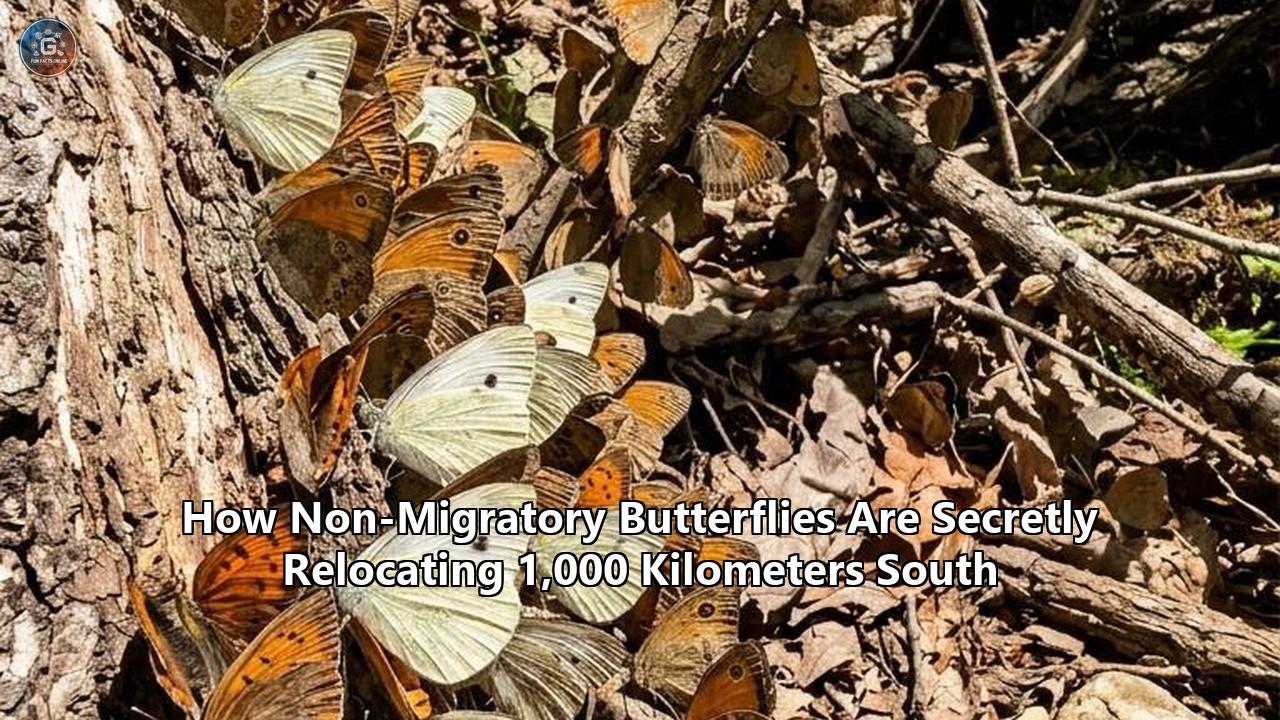
A landmark taxonomy review by the Commonwealth Scientific and Industrial Research Organisation (CSIRO) in Australia, alongside a global synthesis published in Nature Ecology & Evolution, has revealed an ecological phenomenon: insect species historically classified as strictly non-migratory are relocating hundreds—and in some cases nearly 1,000—kilometers south.
Led by Dr. Michael Braby, a leading taxonomist at the Australian National Insect Collection, the CSIRO review evaluated historical insect specimens spanning over a century alongside millions of modern digital records. The research confirmed that at least 23 sedentary, non-migratory butterfly species along Australia’s eastern seaboard have systematically abandoned or expanded beyond their historical geographic limits, establishing permanent, breeding populations far south of their known ranges.
The record holder for this covert relocation is the Pale Ciliate-blue (Anthene lycaenoides). Historically confined to tropical northern Queensland—with a documented southern boundary near Cannonvale and Airlie Beach—the species has established thriving, multi-generational breeding colonies in the Brisbane region. That represents a southward shift of 960 kilometers.
PALE CILIATE-BLUE (Anthene lycaenoides) RANGE SHIFT
===================================================

[ Historical Range Limit ] ---> Cannonvale / Airlie Beach (Northern QLD)
                                 |
                                 | ~10 km / year average dispersal
                                 | (Stealth creep over 20-30 years)
                                 v
[ New Established Limit ]  ---> Brisbane Region (Southern QLD)
                                 Total Shift: ~960 km SOUTH
This discovery coincides with the release of the largest global analysis of insect range dynamics to date. Conducted by an international team led by Dr. Shawan Chowdhury at Monash University’s Global Change Ecology Lab, the global study compiled 6,182 range-shift records across 1,758 butterfly species in 105 countries. The team found that approximately 10 percent of the world's butterfly species have altered their geographic distributions, with climate change and severe weather driving nearly 80 percent of documented movements.
These findings challenge basic assumptions in conservation biology. For decades, ecologists operated under a strict dichotomy: migratory species (such as the Monarch or Painted Lady) possessed the behavioral and physiological machinery to travel thousands of kilometers, while non-migratory species were assumed to be bound to localized patches, highly vulnerable to localized extinction if their home habitats degraded.
Instead, non-migratory species are executing large-scale relocations. They are doing so quietly, incrementally, and against conventional expectations, using micro-corridors, suburban gardens, and shifting thermal envelopes to migrate poleward. Analyzing this specific news event offers critical lessons into how ecosystems are reorganizing under climate stress, how human land use inadvertently facilitates insect movement, and why global biodiversity monitoring frameworks require immediate overhaul.
The Mechanics of "Stealth Dispersal"
To understand how a sedentary insect moves 1,000 kilometers south, one must first dismantle the concept of animal migration. True migration involves directional, seasonal, often round-trip movements executed by individual organisms or single seasonal generations responding to predictable environmental cues. The movement of non-migratory butterflies, by contrast, is a multi-generational, directional range expansion—what entomologists term "stealth dispersal" or "range creeping".
Individual Pale Ciliate-blues do not take flight and journey 960 kilometers. The adult butterfly is a short-lived insect with a wingspan of barely three centimeters, possessing limited flight endurance and spending most of its adult life within meters of its larval host plants. Yet, over a period of 20 to 30 years, the species shifted southward at an average velocity of roughly 10 kilometers per year.
STEALTH DISPERSAL vs. TRUE OBLIGATE MIGRATION
------------------------------------------------------------------------------------
Trait                      Stealth Dispersal                 True Migration
------------------------------------------------------------------------------------
Example Species            Pale Ciliate-blue                 Monarch / Painted Lady
Movement Pattern           Multi-generational range shift    Single/Seasonal round-trip
Distance per Individual    Low (100 meters to few km)        High (1,000s of km)
Population Mechanism       Incremental territorial creep     Mass seasonal flight
Primary Driver             Thermal shifts & host availability Seasonal resource tracking
------------------------------------------------------------------------------------
This incremental movement occurs through a continuous process of edge colonization:
- Female Dispersal at Population Edges: High population densities or microclimatic stress at the southern boundary of a species’ current range prompt mated females to disperse short distances into previously unoccupied territory.
- Micro-Habitat Selection: These females seek out microclimates—such as sun-lit canopy gaps, urban heat islands, or sheltered river valleys—that match their thermal tolerances.
- Host Plant Colonization: Larvae establish on local host plants, successfully completing metamorphosis if winter conditions remain mild enough to prevent freeze mortality.
- Establishment of Anchor Colonies: Over several breeding cycles, a new localized population becomes self-sustaining, serving as the launching pad for the next 10-kilometer step south.
Analyzing the mechanics behind this non-migratory butterfly movement reveals a process distinct from seasonal migration. It is an evolutionary and ecological adaptation, where localized dispersal behavior, repeated over dozens of generations, yields geographical range shifts on continental scales.
Why South? The Hemispheric Thermal Paradox
For observers accustomed to Northern Hemisphere ecological literature, a shift southward might initially sound counterintuitive. In North America and Europe, climate-induced range shifts are almost universally framed as poleward movements north toward higher latitudes or upward along mountain gradients.
In the Southern Hemisphere, however, moving south is moving poleward. The equator lies to the north, and the South Pole lies to the south. As global mean temperatures rise, thermal zones (isotherms) in Australia and South America are moving toward the South Pole.
HEMISPHERIC DYNAMICS OF POLEWARD RANGE SHIFTS
----------------------------------------------------------------------
Hemisphere         Equator Position   Poleward Direction   Movement
----------------------------------------------------------------------
Northern          South              North                Northward
Southern          North              South                Southward
----------------------------------------------------------------------
In Australia’s eastern coastal strip, tropical and subtropical climates are pushing steadily southward into temperate regions. Tropical insects living near their upper thermal thresholds in northern Queensland face extreme heat stress, desiccation, and degraded host plants. To survive, their range boundaries must track cooler conditions southward.
However, regional climate change velocity—the speed and direction at which temperature and precipitation profiles move across a landscape—is rarely linear. As shown in parallel studies on North American butterflies conducted by Dr. Sarah Diamond and Dr. Carmen da Silva, insects do not simply follow a straight line to the poles. They move along complex vector paths dictated by localized microclimates, moisture gradients, and topography.
In eastern Australia, the Great Dividing Range creates a physical barrier to the west, while the Pacific Ocean bounds the east. This leaves a narrow coastal corridor of forest, agricultural land, and urban centers. Sedentary butterflies moving south are constrained by this geography, turning the eastern coast into an ecological highway for shifting fauna.
Environmental Accelerants: Host Plants, Cities, and Fire
Climate warming alone does not explain how fragile, non-migratory insects cross hundreds of kilometers of fragmented land. The CSIRO analysis highlighted three environmental accelerants that act as enablers for southward range expansions: host plant availability, urban microclimates, and post-fire landscape dynamics.
┌─────────────────────────────────────────────────────────────────┐
│              ENVIRONMENTAL ACCELERANTS OF DISPERSAL             │
├───────────────────────────────┬─────────────────────────────────┤
│ 1. Ornamental Host Plants     │ Urban gardens introduce exotic  │
│                               │ & native plants south of range. │
├───────────────────────────────┼─────────────────────────────────┤
│ 2. Urban Heat Islands         │ Elevated city temperatures ease │
│                               │ winter survival for caterpillars│
├───────────────────────────────┼─────────────────────────────────┤
│ 3. Disturbed Regrowth         │ Post-bushfire vegetation yields │
│                               │ abundant fresh foliage for food │
└───────────────────────────────┴─────────────────────────────────┘
1. The Proliferation of Ornamental Host Plants
Many non-migratory butterflies are dietary specialists as caterpillars, feeding exclusively on specific plant families. Historically, a butterfly's geographic boundary was locked to the native range of its host plant. However, widespread human landscape modification has decoupled these relationships.
Gardens, parks, and suburban developments along eastern Australia have introduced thousands of ornamental, non-native, and translocated native plant species. The Pale Ciliate-blue larvae feed on various Fabaceae (legumes) and Sapindaceae (soapberries). As suburban landscapes in southern Queensland and New South Wales were planted with native rain-forest trees and tropical legumes, humans unintentionally built a continuous chain of nurseries extending hundreds of kilometers south of the insect's historical range.
2. Urban Heat Islands as Winter Refugia
Winter temperatures historically functioned as a thermal barrier, killing butterfly eggs, larvae, or pupae that ventured too far poleward. Modern urban heat islands—where concrete, asphalt, and building density elevate local ambient temperatures by 2°C to 5°C above surrounding rural areas—create localized micro-refUGIA.
A non-migratory butterfly moving south can survive cold snaps by colonizing urban centers, using the artificial warmth of a city like Brisbane or Gold Coast to ride out winter conditions that would otherwise destroy a rural population.
3. Bushfire Dynamics and Disturbed Regrowth
Australia’s changing fire regimes, marked by increasingly frequent and intense bushfires, create vast swathes of disturbed forest. While severe fire destroys local insect populations in the short term, the subsequent ecological succession generates dense patches of saplings and soft regrowth foliage.
For opportunistic herbivores, these post-fire regrowth areas offer nutrient-rich feeding grounds. As Dr. Braby noted, disturbed vegetation following megafires acts as an ecological magnet, drawing colonizing butterfly populations into newly opened landscapes.
Lessons from the Global Synthesis: Nature Ecology & Evolution
The Australian discoveries are part of a broader global reconfiguration of insect life. To place the 1,000-kilometer Australian shift into perspective, it is necessary to examine the findings of the August 2026 global meta-analysis published in Nature Ecology & Evolution by Dr. Shawan Chowdhury and colleagues.
GLOBAL BUTTERFLY RANGE SHIFT PATTERNS (Chowdhury et al., 2026)
--------------------------------------------------------------------
Total Species Analyzed:          1,758 (approx. 10% of global total)
Total Shift Records Analyzed:    6,182 across 105 countries
Primary Driver:                  Climate Change & Extreme Weather (79%)

Shift Categories:
  ── Range Expansions:           80% of shifting species
  ── Range Contractions:         27% of shifting species
  ── Elevational Shifts:         22% of shifting species
--------------------------------------------------------------------
The global study assessed records for 1,758 butterfly species across 105 countries—representing roughly 10 percent of all known butterfly species on Earth. The data reveals four critical principles about how insect distributions are changing worldwide:
Principle 1: Range Expansion Outpaces Contraction in the Tropics
In tropical regions—where 80 percent of all insect species live—most range shifts take the form of expansions rather than simple northward/southward retreats. Tropical species, long believed to be thermal specialists with limited capacity to adapt, are actively expanding their footprints into surrounding regions as temperature corridors open up.
For instance, the iridescent blue Godartiana byses in Brazil is flitting southward as temperatures rise, while the Tawny Coster (Acraea terpsicore), native to the Indian subcontinent, has rapidly expanded across South Asia into Southeast Asia and Australia at an astounding rate of 135 kilometers per year.
TAWNY COSTER (Acraea terpsicore) EXPANSION VELOCITY
===================================================
Native Region:      Indian Subcontinent
Expansion Speed:    ~135 km / year
Trajectory:         South Asia ---> Southeast Asia ---> Australia
Mechanism:          High larval adaptability & wind-assisted flight
Principle 2: Temperate Regions Suffer Severe Contractions
While tropical and subtropical species are often expanding their outer margins, temperate species are experiencing severe range contractions. In regions like Northern Europe and North America, land-use intensity and habitat destruction prevent species from tracking changing climate envelopes.
In Sweden, for example, the study documented that while 61 percent of local butterfly species exhibited horizontal expansions, 85 percent suffered severe contractions at their trailing edges. In Germany, the cranberry fritillary (Boloria aquilonaris) has lost vast swathes of its habitat due to peatland drainage for agriculture.
Principle 3: Elevation as an Emergency Escape
When horizontal movement is blocked by oceans, urban sprawl, or agricultural deserts, butterflies shift vertically. The global synthesis found that 22 percent of shifting species moved along elevational gradients, retreating up mountain slopes to access cooler temperatures.
In Mexico, where tropical lowlands are warming rapidly, 39 percent of all documented shifting species are moving upward into montane pine-oak forests. However, elevational shifts represent an ecological dead end: as species move higher, the total land area shrinks, eventually running out of mountain top—a phenomenon known as the "escalator to extinction."
THE ELEVATIONAL ELEVATOR ("Escalator to Extinction")
-------------------------------------------------------------------
 Peak Zone    [▲] Peak runs out of space ---> Extinction Risk High
 Upper Slopes [▲▲▲] Species shift up as lowlands overheat
 Base Level   [▲▲▲▲▲▲] Original habitat becomes thermally unsuitable
-------------------------------------------------------------------
Principle 4: Climate Velocity Triggers Multidirectional Shifts
Extracting data from long-term monitoring programs, researchers found that non-migratory species do not respond uniformly to global temperature averages. Local climate change velocities—which integrate localized temperature changes, precipitation fluctuations, and seasonality—dictate movement far better than regional averages.
This explains why some non-migratory species shift south, others west, and others east, seeking micro-refugia where precipitation and host plant vigor remain stable.
The Ecological Domino Effect: Cascading Impacts
When a non-migratory species relocates 1,000 kilometers into a new ecosystem, it does not arrive in a vacuum. It enters an established ecological network composed of native plants, resident competitors, specialized predators, and mutualistic symbionts. The arrival of these "climate refugees" triggers a series of ecological domino effects.
                     ECOLOGICAL CASCA DE
                     ───────────────────
           Arriving Southward Range-Shifter
                          │
       ┌──────────────────┼──────────────────┐
       ▼                  ▼                  ▼
Displaced Native    Host Plant Overuse  Mutualistic Partner
  Competitors       & Hybridization     Mismatch (e.g., Ants)
1. Disruption of Larval Food Webs and Plant Defense Systems
When butterflies arrive in new territories, their caterpillars feed on native plants that may not have evolved chemical defenses against them. Conversely, colonizing caterpillars may feed on novel host plants, altering localized plant reproduction.
In the United States, range expansions by the invasive cabbage white (Pieris rapae) and shifting native species have driven contractions in the native mustard white (Pieris oleracea), as caterpillars compete for the same glucosinolate-containing host plants.
2. Breakdown of Myrmecophilous Symbiosis
A significant portion of the Australian butterflies shifting south belong to the family Lycaenidae (the blues, coppers, and hairstreaks). Lycaenid caterpillars frequently engage in complex mutualistic relationships with ants (myrmecophily). The caterpillars secrete nectar-rich liquids from specialized dorsal nectary organs; in exchange, ants guard the caterpillars from parasitic wasps and predatory spiders.
MYRMECOPHILOUS MUTUALISM IN LYCAENIDAE
┌─────────────────────────┐               ┌─────────────────────────┐
│   Lycaenid Caterpillar  │──────────────>│       Native Ants       │
│  (Secretes Sugar-Nectar)│ Sugar Reward  │ (e.g., Iridomyrmex sp.) │
└─────────────────────────┘               └─────────────────────────┘
             ▲                                         │
             │          Protection From Predators      │
             └─────────────────────────────────────────┘
When a butterfly like the Pale Ciliate-blue shifts 960 kilometers south, it risks outrunning its co-evolved ant partners. If the southern territory lacks compatible ant species (such as specific Iridomyrmex species), caterpillar mortality rates skyrocket due to predation.
Conversely, if the shifting butterfly successfully partners with local southern ant species, it can disrupt local ant-plant mutualisms, diverting ants away from protecting native flora or tending native lycaenids.
3. Reproductive Interference and Hybridization
As shifting species move into territories occupied by closely related native species, reproductive boundaries can blur. Male butterflies of the colonizing species may attempt to mate with females of local species, leading to reproductive interference, wasted reproductive effort, or hybridization that dilutes local genetic adaptations.
Overcoming Data Blind Spots: The Science Behind the Discovery
The revelation that non-migratory butterflies are undertaking massive southward relocations was made possible by combining historical museum collections with modern citizen science databases.
DATA INTEGRATION PIPELINE
-------------------------------------------------------------------------
Historical Specimens            Digital Citizen Science
(Australian National Insect)  + (iNaturalist & Butterflies Australia)
  [100+ years of baseline]        [Millions of real-time geotagged photos]
                               │
                               ▼
            AI Image Verification & Taxonomic Review
                               │
                               ▼
             Validated 1,000 km Southward Range Shifts
-------------------------------------------------------------------------
Historically, tracking insect movements over broad geographic regions was hindered by sampling bias. Professional entomologists are few in number, and formal scientific field surveys are often restricted to specific national parks or ecological research stations. This left vast areas unmonitored, allowing non-migratory species to quietly shift their ranges without detection for decades.
Three key methodological breakthroughs brought these concealed range shifts to light:
1. The Australian National Insect Collection (ANIC)
Housed at CSIRO in Canberra, the ANIC contains over two million insect specimens stored across thousands of wooden drawers. Many of these butterflies were collected by amateur enthusiasts and professional taxonomists over a century ago.
By digitizing the precise location, date, and elevation metadata recorded on the handwritten pins beneath these historical specimens, Dr. Michael Braby’s team established a verified baseline of where every Australian butterfly species existed prior to the major acceleration of global climate warming in the late 20th century.
HISTORICAL BASELINE vs. MODERN CITIZEN SCIENCE
---------------------------------------------------------------------------------
Data Source                 Timeframe        Strengths             Weaknesses
---------------------------------------------------------------------------------
ANIC Museum Drawer Pins     1890–1980        Verified Taxonomy,    Geographically
                                             Historical Baseline   Sparse Data

iNaturalist & Butterflies   2010–Present     Massive Scale, Real-  Requires Verification,
Australia                                    time Spatial Density  Observer Bias
---------------------------------------------------------------------------------
2. Crowdsourced Citizen Science Infrastructure
Platforms like iNaturalist and Butterflies Australia have turned thousands of nature enthusiasts, bushwalkers, and gardeners into active field monitors. Equipped with smartphones and macro lenses, citizen scientists photograph butterflies in suburban backyards, roadside reserves, and rural parks.
Computer vision algorithms instantly flag potential species matches, which are then vetted by expert taxonomists. This spatial density provided the granular data needed to prove that sightings of species like the Pale Ciliate-blue in Brisbane were not vagrants, but established, self-sustaining breeding populations.
3. Multilingual and Non-Traditional Literature Synthesis
As highlighted by Dr. Shawan Chowdhury’s team, previous global ecological reviews suffered from an English-language bias that overlooked tropical biodiversity hotspots. By analyzing scientific literature published in 15 different languages and directly surveying 68 local butterfly experts across 49 countries, the Monash University team uncovered thousands of undocumented range shifts in South America, Africa, and Southeast Asia.
"When we included non-English studies and expert knowledge, a completely different global picture emerged. Without these sources, we would have dramatically underestimated the global patterns of range shifts, especially overlooking key patterns in the tropics, where 80% of insect species live."
— Dr. Shawan Chowdhury, Head of Global Change Ecology Lab, Monash University
Tracking non-migratory butterfly movement requires fusing historical museum collections with modern citizen science, breaking down barriers between historical archives and real-time field data.
Conservation Policy Realignment: Overhauling Biodiversity Management
The reality that sedentary insects are executing 1,000-kilometer range shifts exposes a mismatch between ecological reality and international conservation policy.
For more than a century, global conservation strategy has been anchored in the concept of static protected areas—creating national parks, nature reserves, and wildlife sanctuaries with fixed geographical boundaries. The implicit assumption was that if you protect the land, you protect the species living within it.
STATIC PROTECTED AREAS vs. DYNAMIC RANGE SHIFTS
┌─────────────────────────────────────────────────────────────┐
│ PARADIGM SHIFT REQUIRED:                                    │
│                                                             │
│ Static Reserves (Fixed Lines on a Map)                      │
│                      │                                      │
│                      ▼                                      │
│ Shifting Species (Moving ~10 km / year)                      │
│                      │                                      │
│                      ▼                                      │
│ RESULT: Protected Parks become empty of target species      │
│         while new target habitats lack legal protection.     │
└─────────────────────────────────────────────────────────────┘
However, when climate change forces species to move 10 kilometers per year, static park boundaries quickly become obsolete. A national park designed to protect a specific butterfly species in 1980 may become thermally uninhabitable for that insect by 2030, while the new territory the butterfly colonizes 500 kilometers south may consist of unprotected private land, agricultural plots, or suburban housing developments.
The documentation of non-migratory butterfly movement underscores the inadequacy of legacy conservation frameworks, forcing land managers to adopt four new operational principles:
1. Dynamic Climate Corridors and Linear Greenways
Instead of isolated island reserves, conservation planning must prioritize continuous linear corridors that cross municipal and state borders. Riparian zones along rivers, highway margins, utility easements, and urban tree canopy programs must be designed as continuous stepping stones to facilitate southward insect dispersal.
2. Strategic Assisted Migration and Translocation
For non-migratory species that lack flight capacity or are trapped by physical barriers (such as agricultural deserts, mountain ranges, or sprawling urban centers), natural range creeping may be impossible.
Conservationists are forced to consider "assisted migration"—deliberately collecting larvae or gravid females from degraded northern ranges and releasing them into newly suitable microclimates 500 to 1,000 kilometers south.
ASSISTED MIGRATION PROTOCOL FOR TRAPPED SPECIES
[ Trapped Northern Population ] ──( Human Translocation )──> [ Suitable Southern Microclimate ]
  * High heat stress               Avoids physical barriers    * Suitable host plants
  * Physical barrier blocks crawl   (Cities, farms, deserts)    * Favorable thermal envelope
3. Urban Biodiversity Integration
Because cities frequently act as stepping stones and heat refugia for shifting tropical insects, urban planning must be formally integrated into national biodiversity strategies. Municipal councils can support range-shifting fauna by revising public landscaping lists to include native host plants, minimizing synthetic pesticide use in urban parks, and creating micro-refugia in public botanical gardens.
4. Equitable, Multilingual Global Monitoring
As emphasized by co-author Dr. Akito Kawahara, Director of the McGuire Center for Lepidoptera and Biodiversity at the Florida Museum of Natural History, biodiversity monitoring must be democratized and funded equitably. Tropics-heavy regions in Global South nations require investment in monitoring infrastructure, open-access databases, and cross-border scientific exchanges.
Lessons and Strategic Takeaways
Analyzing this shift offers systemic insights for ecologists, policymakers, and environmental managers. The relocation of non-migratory butterflies provides four key lessons for managing biodiversity in an era of global environmental change:
┌─────────────────────────────────────────────────────────────────┐
│                    FOUR LESSONS FROM THE SHIFT                  │
├─────────────────────────────────────────────────────────────────┤
│ 1. Behavioral Flexibility Overcomes Categorical Assumptions     │
│    Sedentary species can execute massive multi-generational     │
│    expansions when environmental pressures reach thresholds.    │
├─────────────────────────────────────────────────────────────────┤
│ 2. Human Landscape Modification Creates Ecological Highways     │
│    Urban heat islands & ornamental plant nurseries inadvertently│
│    facilitate long-distance poleward range expansions.          │
├─────────────────────────────────────────────────────────────────┤
│ 3. Baseline Data Sets Are Essential to Detect Stealth Trends     │
│    Without historical specimen collections, modern shifts would │
│    be misclassified as temporary vagrancy or anomaly.           │
├─────────────────────────────────────────────────────────────────┤
│ 4. Conservation Must Transition from Static to Dynamic Models   │
│    Protected area boundaries must evolve into connected, cross- │
│    jurisdictional habitat corridors that track climate shifts.  │
└─────────────────────────────────────────────────────────────────┘
1. Ecological Classifications Are Dynamic, Not Fixed
The strict scientific division between "migratory" and "non-migratory" insects is more fluid than previously taught. When ecological conditions deteriorate, localized dispersal behaviors, repeated across generations, can yield migration-scale range shifts. Conservation biologists must evaluate species based on their operational adaptive capacity rather than legacy ecological labels.
2. Anthropogenic Habitats Can Act as Dispersal Infrastructure
While urbanization and agriculture are major drivers of habitat destruction, modified landscapes can inadvertently provide critical dispersal infrastructure. Urban gardens, botanical collections, post-fire regrowth, and roadside vegetation networks act as stepping stones, enabling species to cross hundreds of kilometers of otherwise hostile terrain. Land managers should design these human-dominated landscapes to intentionally support native species movement.
3. Historical Collections Are Critical to Modern Science
The discovery of 1,000-kilometer shifts was made possible by physical specimens collected by naturalists over a century ago. Natural history museums and national insect collections are not dusty relics; they are essential baseline infrastructure for tracking planetary change. Funding for specimen digitization, museum curation, and taxonomist training remains a fundamental prerequisite for detecting ecological shifts.
4. Conservation Strategy Must Adapt to Species on the Move
Focusing solely on protecting historical distributions is a strategy destined for failure under rapid warming. Conservation agencies must shift from a paradigm of preservation—trying to keep ecosystems exactly as they were—to a paradigm of stewardship through transformation. This requires anticipating where species will need to live 50 years from now and building ecological corridors today to ensure they can get there safely.
What to Watch Next
As scientists digest these findings, research is shifting from simply documenting range shifts to predicting their long-term consequences. Key developments to monitor over the coming months and years include:
- Publication of the 3rd Edition of Australia's Field Guide: Dr. Michael Braby is currently finalizing the third edition of the definitive Field Guide to Butterflies of Australia, which will officially revise the distribution maps for dozens of species and establish updated southern boundaries.
- Evolutionary Selection Studies: Evolutionary biologists are investigating whether colonizing populations at the expanding southern edge are undergoing rapid natural selection. Researchers are measuring wing aspect ratios, thorax muscle mass, and flight metabolic rates to determine if "range creeping" is selecting for longer-distance fliers.
- Genomic Tracking of Edge Populations: Genetic sequencing projects are underway to compare the genomic diversity of historic northern populations with newly established southern colonies. These studies will reveal whether southern shifts are executed by diverse, healthy populations or driven by severe genetic bottlenecks.
- Policy Integration in Global Biodiversity Frameworks: Conservation bodies are watching to see if upcoming international climate and biodiversity summits will incorporate dynamic range-shifting metrics into global protected area targets.
The silent relocation of non-migratory butterflies 1,000 kilometers south is a warning signal from the natural world. As insects—the foundational engineers of terrestrial ecosystems—reshape their ranges to survive on a changing planet, human societies must adapt their scientific models, land management practices, and conservation policies to keep pace with a world on the move.
Reference:
- https://www.csiro.au/en/news/All/Articles/2026/August/butterfly-effect
- https://www.anthropocenemagazine.org/2026/08/as-the-world-warms-butterflies-are-relocating-at-an-astonishing-scale/
- https://www.floridamuseum.ufl.edu/science/butterflies-worldwide-are-on-the-move-as-the-climate-warms/
- https://www.insectlore.com/blogs/butterflies/butterfly-migration
- https://www.wildlifetrusts.org/butterflies-without-borders
- https://www.miragenews.com/butterfly-effects-of-climate-change-1726683/
- https://animalecologyinfocus.com/2024/07/04/how-are-north-american-butterflies-shifting-their-ranges-in-response-to-climate-change/
- https://pubmed.ncbi.nlm.nih.gov/38922857/
- https://www.smithsonianmag.com/smart-news/butterflies-around-the-world-are-moving-to-new-habitats-largely-because-of-climate-change-a-study-suggests-180989279/
- https://www.downtoearth.org.in/wildlife-biodiversity/80-butterflies-have-expanded-their-ranges-while-a-quarter-face-range-contractions-due-to-climate-change-study