The Silent Calculator in the Carolina Swamps
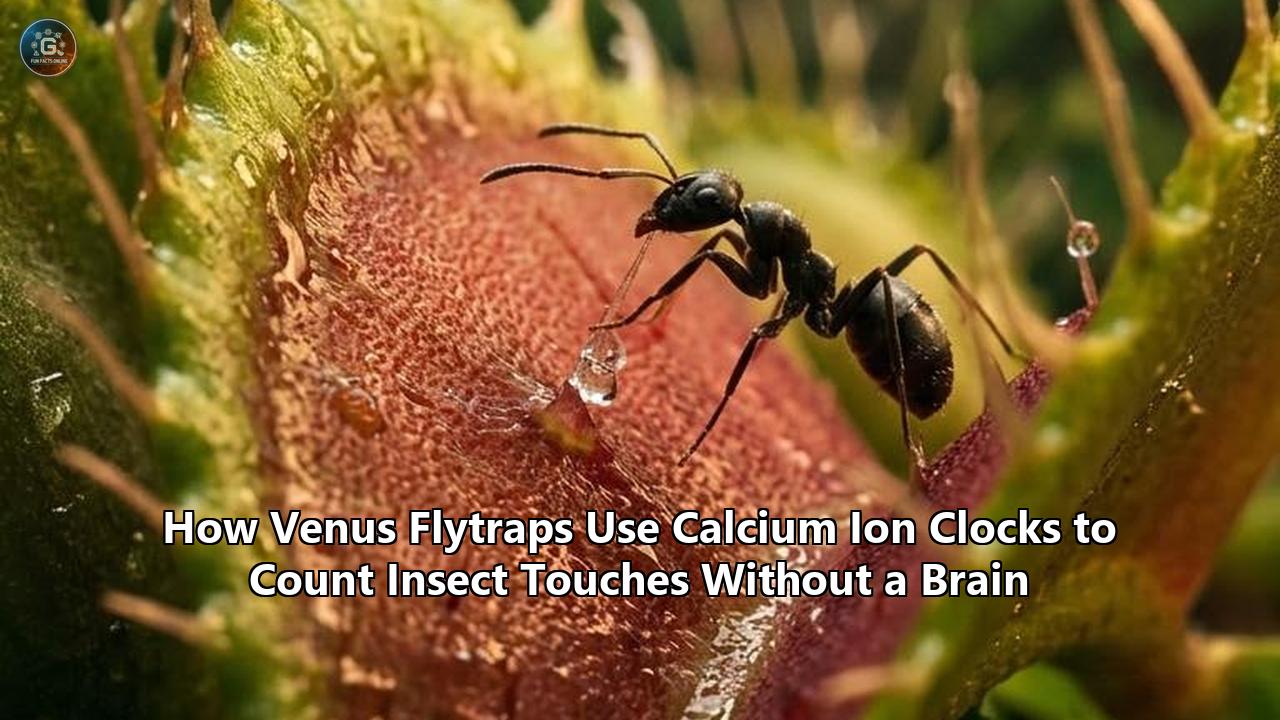
Deep in the nitrogen-poor, waterlogged bogs of the coastal Carolinas, a housefly lands on a glistening green leaf. Attracted by a faint, sugary aroma, the insect walks across the plant’s surface, its delicate legs brushing against a tiny, translucent hair.
Nothing happens. The leaf remains wide open, motionless in the humid air.
Unaware of the silent countdown now ticking inside the plant's cells, the fly takes another step and brushes against a second hair nine seconds later. In less than a tenth of a second, the two halves of the leaf snap shut with force, interlocking their outer spines like the bars of a cage. The fly is trapped.
For centuries, this rapid movement has captivated naturalists. Charles Darwin famously called Dionaea muscipula—the Venus flytrap—“one of the most wonderful plants in the world.” Yet beneath the physical speed of its trap lay a deeper biological paradox: How can an organism with no brain, no central nervous system, and not a single neuron count stimuli, retain short-term memories, and perform complex cost-benefit calculations before deciding to act?
[Touch 1] ──> Localized Mechanical Strain ──> DmMSL10 Opening ──> Subcritical Calcium Wave (Timer Active)
                                                                             │
                                                                 (Within ~30 Seconds)
                                                                             ▼
[Touch 2] ──> Second Action Potential ──> Second Calcium Surge ──> Threshold Exceeded ──> SNAP! (< 100ms)
The answer, uncovered through a series of discoveries by international teams of biophysicists and molecular biologists, lies in a mechanism that reads like high-tech bio-engineering: a biological clock built from calcium ions, working alongside a newly identified molecular force sensor that acts as a physical amplifier.
Recent findings published in Nature Communications have filled in the crucial missing link of this puzzle. Researchers led by Assistant Professor Hiraku Suda and Professor Masatsugu Toyota of Saitama University, collaborating with Professor Mitsuyasu Hasebe at Japan's National Institute for Basic Biology (NIBB), have pinpointed the exact mechanosensitive ion channel—named DmMSL10—that converts the faintest touch of an insect leg into an electrical spark.
Combined with earlier landmark work visualising fluorescent calcium waves in real time, science has finally traced the complete evidence trail of how a brainless plant uses chemical arithmetic to survive.
The Evidence Trail: Making the Invisible Clock Visible
To understand the mystery of the flytrap's memory, researchers had to overcome a fundamental problem: plants do not have nerves, yet they transmit information using electrical signals that closely resemble animal nerve impulses.
When an insect brushes a sensory hair, it triggers an action potential—a rapid voltage spike that ripples across the trap tissue at speeds up to 10 centimeters per second. But an action potential is fleeting; it lasts only a fraction of a second. If a second touch is required to spring the trap, where does the plant store the memory of the first touch during the intervening seconds?
As early as 1988, German botanists Dieter Hodick and Andreas Sievers hypothesized that calcium ions ($Ca^{2+}$) might be the hidden memory currency. They posited that each mechanical stimulus causes a sudden influx of calcium into the plant’s cells. If a second stimulus occurs before that calcium can be pumped away, the concentrations add together. Cross a specific concentration threshold, and the trap closes.
For more than thirty years, this remained an untested theory. Measuring calcium concentrations inside living, moving plant tissue without damaging the delicate microscopic structures was technologically impossible.
The breakthrough came when Hiraku Suda, then a graduate student working in Hasebe’s lab at NIBB, spent two and a half grueling years developing a genetic transformation technique tailored specifically for Dionaea muscipula.
Using Agrobacterium-mediated transformation, Suda’s team successfully inserted the gene for GCaMP6f—a biosensor protein that emits bright green fluorescence whenever it binds to calcium ions—directly into the flytrap's genome.
[Resting Cell]  ──> Low Cytosolic [Ca²⁺]   ──> Sensor Dim
[Hair Touched]  ──> Rapid Influx of Ca²⁺   ──> GCaMP6f Binds Ca²⁺ ──> Neon Green Glow
"I tried so many experiments over two and a half years, but all failed," Suda recalled in a statement following the initial publication of the GCaMP study in Nature Plants. "The Venus flytrap was such an attractive system that I did not give up."
When the team placed the fluorescent transgenic flytraps under high-speed two-photon microscopes and touched a sensory hair with a needle, the dark leaf lit up. A brilliant wave of neon green fluorescence exploded from the base of the hair and raced across the entire leaf blade within seconds.
For the first time, human eyes could directly observe plant short-term memory in motion.
The Arithmetic of Hunger: How Calcium Stores Time
The GCaMP6 experiments revealed the precise dynamics of the flytrap’s internal timer. Understanding how venus flytraps work requires viewing calcium not merely as a chemical element, but as an analog memory storage device.
Closing a trap is one of the most energetically expensive mechanical actions in the plant kingdom. It relies on a rapid redistribution of water between cellular layers, combined with a sudden release of stored elastic strain in the curved leaves—a process known as snap-buckling.
If the plant snapped shut every time a raindrop fell, a debris particle blew in, or a gust of wind shook the leaf, it would quickly exhaust its metabolic energy and starve to death.
To prevent these false alarms, the plant employs a strict arithmetic filter:
1. Touch One: Arming the Stopwatch
When an insect touches a single hair, an action potential fires, triggering an immediate spike in cytosolic calcium concentration ($[Ca^{2+}]_{cyt}$). The calcium level surges from a resting state of roughly 100 nanomolar to a high peak.
However, this initial peak remains strictly below the critical threshold required for trap movement. The trap stays fully open.
2. The Decay Phase: The Clock Ticks Down
The moment cytosolic calcium peaks, membrane-bound calcium pumps (ATPases) and ion exchangers begin actively pumping $Ca^{2+}$ out of the cytoplasm and back into internal storage vaults—primarily the central vacuole and endoplasmic reticulum.
As a result, the intracellular calcium concentration begins an exponential decay. This decaying concentration represents the plant's "short-term memory." The clock is ticking down.
3. Touch Two: Summation and Snap
If a second touch occurs within roughly 30 seconds, a second action potential fires. This injects a new wave of calcium into the cells before the first wave has completely dissipated.
The new calcium is added directly onto the residual calcium left over from the first stimulus:
$$\text{Total } [Ca^{2+}] = [Ca^{2+}]_{\text{residual}} + [Ca^{2+}]_{\text{new stimulus}}$$
Because the two surges summate, the total cytosolic calcium level crosses the critical threshold. This triggers downstream signaling proteins, prompting water to flood out of the cells on the interior surface of the leaf midrib. The sudden loss of turgor pressure causes the leaf curvature to flip from convex to concave, snapping the trap closed in approximately 100 milliseconds.
Cytosolic [Ca²⁺]
  ^
  |        Peak 2 (Crosses Threshold!)
  |           /\ ─── THRESHOLD ─────────────────── [TRAP SNAPS SHUT]
  |  Peak 1  /  \
  |   /\    /    \
  |  /  \  /      \
  | /    \/        \
  |/   (Decay)      \
  +---------------------------------------------> Time (seconds)
  0s      10s       20s                  30s
If the second touch takes longer than 30 seconds to arrive, the calcium level drops back near its baseline. A second touch occurring after 45 seconds will produce a second calcium spike, but because the baseline has reset, the signal fails to reach the threshold. The memory has been erased; the clock has reset.
Inside the Hair: Unmasking DmMSL10, the Tactile Sparkplug
While the calcium clock explained how the plant remembers touches, a primary question remained unanswered for decades: How does the soft physical grazing of an ant's leg translate into that very first spike of electrical voltage and calcium?
Each flytrap leaf possesses six specialized sensory hairs—three on each inner lobe. These 1.5-millimeter-long structures are marvels of biological engineering.
A sensory hair is divided into two main parts: a long, rigid upper lever arm and a flexible, flexible base containing a ring of specialized, indented notch cells.
       /  <-- Rigid Lever Arm (Pushed by Insect)
      /
     /
   (   ) <-- Flexible Hinge / Basal Notch Cells (High DmMSL10 Density)
  ======= <-- Leaf Blade Tissue
In late 2025, Suda, alongside Professor Masatsugu Toyota at Saitama University and their international research team, published findings in Nature Communications identifying the exact molecular sparkplug hidden inside these basal notch cells.
Using two-photon microscopy paired with single-cell electrophysiological recordings, the team isolated a mechanosensitive ion channel called DmMSL10 (a member of the MSCS-like channel family).
"Our approach enabled us to visualize the moment a physical stimulus is converted into a biological signal in living plants," Suda explained in a research release from Saitama University.
Here is how this tactile sensor operates at the single-cell level:
- Mechanical Leverage: When an insect collides with the lever arm, the physical force is magnified at the flexible base, stretching the cell membranes of the basal notch cells.
- Channel Opening: This membrane tension physically stretches open the pores of the DmMSL10 channels embedded in the cell membrane.
- Receptor Potential: Positive ions ($Ca^{2+}$ and $K^+$) rush into the cell through DmMSL10, creating a small, local electrical change called a receptor potential.
- The All-or-None Action Potential: If the touch is extremely weak—such as a speck of dust—DmMSL10 produces only a tiny receptor potential that stays localized to the hair base. But if the touch exceeds a specific mechanical force, DmMSL10 acts as a bio-amplifier. The local voltage crosses a secondary trigger point, opening voltage-gated ion channels that fire an all-or-none, trap-wide action potential.
To confirm DmMSL10’s central role, Toyota and Suda used gene editing to create DmMSL10 knockout plants. The results were definitive. When ants walked across the leaves of the knockout mutants, the insects bumped into sensory hairs repeatedly.
In wild-type flytraps, these ant touches produced bright calcium waves and rapid trap closures. In the DmMSL10 knockout plants, the hairs still bent, but they produced only faint, subthreshold local electrical flickers.
The molecular amplifier was gone. Lacking the ability to amplify the touch of an ant, the mutant traps remained wide open, completely blind to the prey walking across them.
"DmMSL10 is a key mechanosensor for the highly sensitive sensory hairs that enable the detection of touch stimuli from even the faintest, barely grazing contacts," Suda stated.
The 'Dyscalculia' Anomaly: When the Memory Circuit Breaks
In science, broken systems often reveal more about normal biology than functional ones. A key piece of evidence regarding the flytrap's internal calculator arrived via a discovery made at a plant exhibition in Germany.
Dr. Sönke Scherzer, a plant researcher working in the lab of biophysicist Professor Rainer Hedrich at the Julius-Maximilians-Universität (JMU) Würzburg, stumbled upon a peculiar Venus flytrap cultivar. While visually identical to standard plants, this individual had lost its ability to react to touch.
You could bend its sensory hairs two, five, or twenty times, but its trap never closed. Hedrich’s team formally named the mutant ---Dyscalculia--- (DYSC), after the learning disability that affects a person's ability to understand numbers.
Standard Flytrap:   Touch 1 (AP + Ca²⁺ Wave) ──> Touch 2 (AP + Ca²⁺ Surge) ──> SNAP!
DYSC Mutant:       Touch 1 (AP + Ca²⁺ Wave) ──> Touch 2 (AP + Ca²⁺ Surge) ──> [NO RESPONSE]
The JMU research team subjected DYSC to intense electrophysiological testing. The initial hypothesis was that the mutant's sensory hairs were broken, or that it was unable to fire electrical action potentials.
The results, published in Current Biology, surprised the investigators:
- Tactile Sensing: Perfect. The basal hair cells responded normally to mechanical touch.
- Electrical System: Unimpaired. Bending a sensory hair on a DYSC plant generated normal, full-amplitude action potentials that traveled across the leaf at normal speed.
- Calcium Waves: Present. Every touch produced a localized wave of calcium ions identical to those seen in wild-type plants.
Where DYSC failed was in its downstream reading mechanism. Transcriptomic sequencing revealed that DYSC plants suffered from a genetic defect that prevented them from producing key calcium-binding decoding proteins.
The plant could generate the electrical spark and flood its cells with calcium, but its cellular machinery was incapable of "reading" or "counting" those calcium spikes.
"Counting is about measuring the individual calcium spikes and accounting for them for trap closure and prey processing," Professor Hedrich explained following the study. "DYSC cannot properly read, count, and decode touch-induced calcium signals".
The DYSC mutant provided absolute proof of a dual-control architecture: electrical action potentials act as the rapid-transit telephone wires broadcasting the signal across centimeters of leaf tissue in milliseconds, but the calcium concentration is the actual central processing unit—the chemical ledger where numbers are added, held, and calculated.
Beyond Two: The Calculus of Digestion
The flytrap's mathematical capabilities do not stop once the trap snaps shut. In fact, closing the leaves is merely phase one of a multi-step hunting program.
Once the trap snaps shut, an insect is rarely killed instantly. Trapped in a dark, cramped chamber, the panicked prey thrashes violently, continually bumping into the six sensory hairs. This continuous mechanical stimulation drives the plant into higher mathematical phases.
[Touch 1] ──> Timer Set (Calcium Surge)
[Touch 2] ──> Trap Snap Closure (< 100ms)
[Touch 3] ──> Jasmonic Acid Release ──> Hermetic Seal
[Touch 4] ──> Acidification (pH drops to ~2.0)
[Touch 5+] ─> Digestive Enzyme Secretion & Nutrient Transporters Activated
Touch Three: Hermetic Sealing
As the struggling prey strikes a sensory hair for the third time, the repeated action potentials and accumulating calcium concentrations trigger the synthesis of jasmonic acid.
In non-carnivorous plants, jasmonate is a stress hormone released during herbivore attack. In Dionaea, it has been repurposed as a developmental switch.
Jasmonate causes the margins of the trap lobes to press tightly against each other, sealing the trap hermetically. The trap transitions from an open cage to an airtight, leak-proof "green stomach".
Touches Four and Five: Acid Bath and Enzyme Secretion
By the fourth and fifth touches, the persistent calcium surges activate specialized digestive glands that carpet the interior leaf surface.
The glands begin pumping hydrogen ions ($H^+$) into the sealed cavity, dropping the pH to around 2.0—a level of acidity comparable to human gastric fluid.
Simultaneously, the glands secrete a cocktail of digestive enzymes, including:
- Chitinases to break down the insect’s tough exoskeleton.
- Proteases to disassemble animal proteins into amino acids.
- Phosphatases and Nucleases to extract nitrogen and phosphorus.
At the same time, the plant upregulates genes encoding specialized transport proteins. Over the next 5 to 12 days, these transporters absorb the nutrient-rich fluid directly into the leaf’s vascular system.
Understanding this progressive escalation illustrates how venus flytraps work as efficient biological managers. If a dead leaf or a piece of bark falls into the trap, it may hit the hairs twice, causing the trap to snap shut.
However, because the inanimate object does not move again, touch three, four, and five never occur. Recognizing that no further stimulation is present, the plant refrains from producing costly digestive enzymes. It slowly reopens the trap within 24 to 36 hours, dumping the useless debris and resetting its leaves for real prey.
Bio-Computing Without Neurons: What Lies Ahead
The discovery that a brainless organism can use ion channels, membrane potentials, and calcium waves to perform mathematical logic is altering how biophysicists view plant cognition and bio-engineering.
For decades, neurobiology was considered the exclusive domain of the animal kingdom. The Venus flytrap proves that complex information processing does not require synapses, axons, or brains.
Instead, plants can build functional bio-computers out of fundamental cellular components: mechanosensitive channels like DmMSL10 acting as physical inputs, action potentials acting as high-speed data buses, and cytosolic calcium levels acting as volatile RAM memory.
┌────────────────────────────────────────────────────────┐
│               ANIMAL NEUROLOGY VS. PLANT BIOCALCULUS   │
├──────────────────────┬─────────────────────────────────┤
│ ANIMAL NEURON        │ VENUS FLYTRAP CELL              │
├──────────────────────┼─────────────────────────────────┤
│ Mechanoreceptor      │ DmMSL10 Ion Channel             │
│ Nerve Impulse        │ Calcium-Driven Action Potential │
│ Synaptic Memory      │ Cytosolic [Ca²⁺] Decay Clock    │
│ Brain/Ganglia        │ Threshold Summation Network     │
└──────────────────────┴─────────────────────────────────┘
This realization has ignited interest among researchers in synthetic biology and soft robotics. Engineers are studying the Venus flytrap's calcium clock to design self-actuating, low-power biopolymers and bio-hybrid sensors.
By mimicking the plant’s dual-stage threshold system, roboticists hope to develop soft grippers that can distinguish between accidental bumps and intentional contact without requiring centralized microprocessors or heavy battery packs.
Meanwhile, for plant biophysicists, the investigative trail is far from over. With DmMSL10 identified as the initial touch sensor and GCaMP6 establishing the calcium wave dynamics, the next frontier lies in mapping every downstream protein that reads the calcium clock.
Researchers led by Hedrich and Toyota are currently working to isolate the specific calcium-dependent protein kinases (CDPKs) and calmodulin targets that trigger the rapid opening of water channels (aquaporins) and anion channels (such as ALMT12) in the motor cells.
"Many plant responses arise from mechanosensing—the plant's tactile sense," Suda noted. "The underlying molecular mechanisms may be shared far beyond the Venus flytrap".
As research uncovers these remaining molecular links, the Venus flytrap stands as a testament to evolutionary ingenuity—a plant that solved the problem of hunting without eyes, moving without muscles, and calculating without a brain.
References & Further Reading
- Suda, H., et al. (2025). "MSL10 is a high-sensitivity mechanosensor in the tactile sense of the Venus flytrap." Nature Communications, DOI: 10.1038/s41467-025-63419-w.
- Suda, H., Mano, H., Toyota, M., Hasebe, M., et al. (2020). "Calcium dynamics visualize the electrical memory of Venus flytrap." Nature Plants, 6(10), 1219–1224.
- Scherzer, S., Böhm, J., Hedrich, R., et al. (2023). "The dyscalculia mutant of the Venus flytrap is defective in processing touch-induced calcium signals." Current Biology, 33(3), 560–566.
- Böhm, J., Scherzer, S., Krol, E., Kreuzer, I., von Meyer, K., Lorey, C., ... & Hedrich, R. (2016). "The Venus Flytrap Dionaea muscipula Counts Touch-Induced Action Potentials with Calcium Memory." Current Biology, 26(3), 286-295.
- Scherzer, S., et al. (2022). "A unique inventory of ion transporters poises the Venus flytrap to fast-propagating action potentials and calcium waves." Current Biology, 32(18), 3938-3949.
Reference:
- https://www.eurekalert.org/news-releases/1099563
- https://www.nibb.ac.jp/en/press/2020/10/06.html
- https://www.uni-wuerzburg.de/en/news-and-events/news/detail/news/how-the-venus-flytrap-counts/
- https://www.sciencenews.org/article/how-venus-flytraps-store-short-term-memories-prey
- https://www.youtube.com/watch?v=5Ri4VNX56CA
- https://www.sciencealert.com/chilling-experiment-pinpoints-the-moment-you-have-a-venus-flytrap-s-full-attention
- https://www.labxchange.org/library/items/lb:LabXchange:1324695c:html:1
- https://www.edubloxtutor.com/plants-that-count-the-venus-flytraps-ability-to-do-math/
- https://www.quora.com/How-are-Venus-flytraps-able-to-count-the-number-of-stimulations-so-as-to-determine-if-the-object-is-prey
- https://www.researchgate.net/figure/GCaMP6f-signals-in-glands-by-a-series-of-mechanical-stimuli-A-bright-field-image-upper_fig1_344610611
- https://pubmed.ncbi.nlm.nih.gov/36693369/
- https://researchmap.jp/hirakusuda/published_papers/35767993
- https://gizmodo.com/this-is-how-a-venus-flytrap-knows-its-time-to-snap-shut-2000665690
- https://www.uni-wuerzburg.de/en/news-and-events/news/detail/news/dionaea-dysc-mutant/