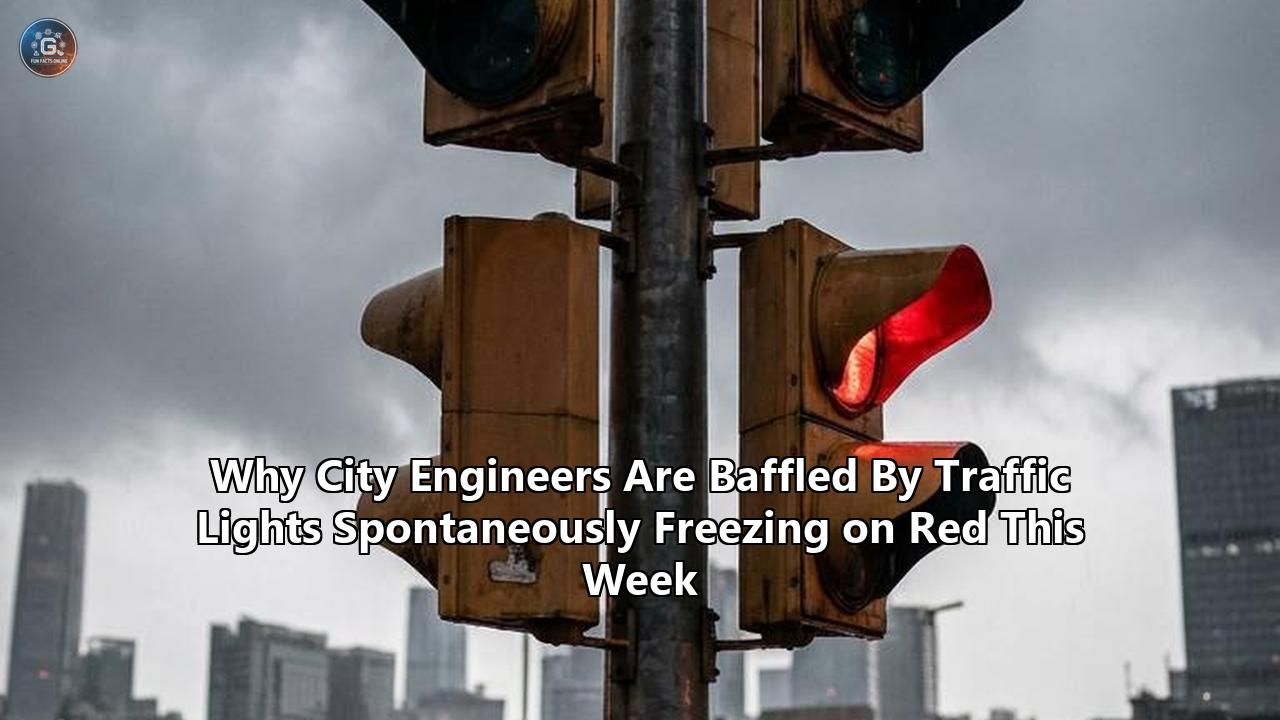
At 2:14 a.m. Eastern Time on Monday, the automated traffic management center in Atlanta registered a minor telemetry anomaly in the Buckhead district. Within twenty minutes, the same alert tripped in Austin’s downtown grid and Seattle’s South Lake Union neighborhood. By the time the morning rush hour began, city engineers across three major North American tech hubs were facing an unprecedented crisis: over 1,400 major intersections had simultaneously locked down, with traffic lights stuck on red in all directions.
Unlike a typical power failure that leaves intersections dark, or a standard hardware fault that triggers a universally recognized four-way flashing red, this week’s software failure paralyzed the hardware in a rigid, illuminated standoff. Commuters found themselves staring at solid crimson lights that simply never cycled. Transit buses were trapped in depot lanes. First responders were forced to run active solid reds through dense, bewildered traffic, creating immense safety hazards.
As of Tuesday afternoon, municipal transportation departments are still scrambling to manually override the affected control cabinets. The localized gridlock has cost an estimated $42 million in lost productivity and delayed freight across the three cities, according to preliminary data from the Urban Mobility Institute.
But the core issue frustrating city engineers is not just the traffic—it is the blatant failure of a fundamental mechanical safeguard. Decades-old fail-safes built into traffic signal infrastructure are designed specifically to prevent an intersection from freezing in a solid-red configuration. Yet, a coordinated, over-the-air firmware update to a next-generation adaptive traffic platform managed to bypass these hardware monitors entirely.
"We have technicians physically driving from cabinet to cabinet with a set of keys and a laptop to manually re-flash the controllers," said Marcus Thorne, a senior systems engineer for the Georgia Department of Transportation. "When the Malfunction Management Unit detects a conflict, it is hardwired to drop the load switches and flash the lights. It did not do that. The system held the solid red state and stopped communicating with our centralized servers. We are essentially locked out of our own grid."
The Ground Zero Timeline
To understand the magnitude of this infrastructure failure, one must look at how rapidly the software contagion spread during the early hours of Monday morning.
The affected cities share a common thread: they recently adopted a centralized, cloud-tethered adaptive traffic control system (ATCS) deployed by a major urban mobility consortium. This system utilizes Edge AI and high-resolution cameras to dynamically adjust light timing based on real-time vehicle trajectories and pedestrian presence. Sunday night, the vendor initiated an over-the-air (OTA) patch designated as Version 4.1.2. The update was intended to refine integration with Vehicle-to-Everything (V2X) communication protocols, allowing the controllers to directly ping the adaptive cruise control systems of approaching autonomous and semi-autonomous vehicles.
The deployment began at 1:00 a.m. By 2:14 a.m., the first advanced traffic controllers (ATCs) in Atlanta finished compiling the update and rebooted. Instead of resuming normal fixed-time or actuated operations, the controllers entered a critical loop.
In Austin, the fallout hit the heavily trafficked I-35 frontage roads. At 3:30 a.m., night-shift logistics drivers reported that consecutive intersections stretching for three miles were completely locked. By 6:00 a.m., local police departments began dispatching officers to direct traffic, but the sheer volume of incapacitated intersections vastly outnumbered available law enforcement personnel.
Seattle’s South Lake Union, a densely packed tech corridor, experienced complete arterial failure by 7:15 a.m. Pacific Time. King County Metro was forced to reroute or entirely suspend over two dozen bus routes. Delivery vehicles blocked box junctions, and ride-share algorithms surged pricing to maximum caps as drivers refused to enter the affected zones.
"We saw the initial error codes populating on our dashboard at 2:30 a.m., but the diagnostic logs were nonsensical," said Sarah Jenkins, an infrastructure analyst with the City of Austin. "The system was reporting that all phases were successfully executing, but the camera feeds showed lines of cars sitting motionless. When you have traffic lights stuck on red for forty-five minutes straight, driver patience evaporates, and that is when the secondary collisions began."
Local authorities logged over 310 minor collisions across the three cities between 6:00 a.m. and 10:00 a.m. Monday, almost entirely resulting from drivers attempting to cautiously run the solid reds, only to collide with cross-traffic attempting the exact same maneuver.
Hardware vs. Software: The Anatomy of the Bypass
The bafflement among civil engineers stems from the architectural design of modern traffic signaling, which is built on a philosophy of extreme distrust toward software.
In standard North American traffic engineering, regulated heavily by NEMA (National Electrical Manufacturers Association) TS-2 standards and the NTCIP (National Transportation Communications for ITS Protocol), the software running the intersection does not directly control the electrical current flowing to the LED bulbs. Instead, a traffic controller sends logic commands to a separate, physically distinct component called a Malfunction Management Unit (MMU) or Conflict Monitor.
The MMU is the ultimate arbiter of safety. It continuously monitors the voltage on the field wires. If the controller attempts to do something dangerous—like showing green lights to conflicting directions simultaneously—the MMU instantly severs the controller’s connection to the load switches. A mechanical relay drops, and the intersection defaults to a flashing red state, effectively turning the intersection into an all-way stop sign.
The system is designed to trigger this fail-safe if the software crashes, if the voltage drops, or if the controller stops sending a regular "heartbeat" signal. So why didn't the MMU drop the system into a flashing red state on Monday?
"The update didn't crash the controller in a traditional sense; it trapped it in a state of suspended animation while continuing to spoof the heartbeat signal to the MMU," explains Dr. Elena Rostova, a cybersecurity and intelligent transportation systems researcher at the Georgia Institute of Technology. "The V2X patch contained a memory leak in the module responsible for parsing predictive braking data from approaching cars. When the buffer overflowed, the logic sequence froze exactly at the all-red clearance interval."
Traffic lights cycle through a brief "all-red" phase between directional changes to allow vehicles to clear the intersection. The MMU recognizes "all-red" as a perfectly safe, valid state. Because the controller was still technically running and successfully sending the required watchdog pulses to the MMU, the hardware monitor saw no conflict. It simply assumed the controller was intentionally commanding a very long all-red clearance phase.
"It is a blind spot in the TS-2 architecture," Rostova adds. "The conflict monitor is trained to look for dangerous electrical states, like dual greens, or a total loss of processor activity. It is not programmed to evaluate the temporal logic of a safe state. It doesn't know that a 40-minute solid red is a functional failure."
The Edge AI and V2X Culprit
The root cause of this incident highlights the growing friction between legacy infrastructure and the aggressive push toward smart city automation.
For decades, traffic lights operated on simple electromechanical dials, later evolving into localized microprocessors that used induction loops buried in the asphalt to detect cars. Today, modern ATCs are high-powered edge-computing devices. They run complex Linux-based operating systems, connect to municipal fiber-optic networks, and run machine learning inference models locally to optimize traffic flow.
The Version 4.1.2 patch was designed to leverage the emerging V2X ecosystem. In recent years, automakers have increasingly integrated direct short-range communications into their vehicles, allowing cars to broadcast their speed, heading, and braking intentions to surrounding infrastructure. The goal of Monday’s patch was to allow the traffic controllers to ingest this telemetry. If the controller knew a heavy freight truck was approaching and could not brake in time for a yellow light, the AI would extend the green phase to prevent a dangerous sudden stop.
However, the integration of third-party telemetry introduces vast amounts of unstructured data into the controller's processing queue. According to preliminary incident reports released by the vendors involved, the software failed to properly garbage-collect obsolete telemetry data from the V2X queue.
As the morning progressed and traffic volume increased, the memory cache in the intersection controllers maxed out. The core logic thread governing the NEMA phase cycling was starved of computational resources and hung. The controllers froze at the safest point in their cycle—the all-red clearance—while a secondary, lightweight thread continued to send the "I am alive" watchdog signal to the hardware monitor.
"We added layers of massive complexity to a system that fundamentally exists to turn three colored lightbulbs on and off," said Julian Vance, director of infrastructure at a prominent smart-city consultancy. "We are treating traffic cabinets like smartphones, pushing weekend software updates to them to improve 'app' performance. But when a smartphone freezes, you miss a text message. When an ATC freezes, you paralyze a city block."
The Driver Psychology of the "Endless Red"
Beyond the technical autopsy, this week's failure provided a massive, unscripted behavioral experiment in how human drivers react to ambiguous infrastructure failures.
When a traffic light goes dark, or flashes red, traffic laws universally dictate that drivers must treat the intersection as a multi-way stop. The rules are clear, and driver behavior generally adapts. However, there is very little legal or psychological framework for traffic lights stuck on red.
At the affected intersections in Seattle and Austin, traffic cameras captured distinct patterns of driver behavior. For the first four to five minutes, drivers remained completely compliant, assuming it was simply an unusually long cycle, perhaps triggered by an emergency vehicle preemption system or a stalled pedestrian crossing.
Between the five and eight-minute marks, compliance began to erode. Drivers at the front of the queue began honking, inching forward, and visually scanning the cross-streets. By the ten-minute mark, the collective agreement to obey the signal collapsed entirely.
"The social contract of the road requires trust in the infrastructure," notes Dr. Aris Thorne, a transportation psychologist who studies driver-automation interaction. "When the infrastructure clearly abandons its end of the bargain, drivers resort to localized, ad-hoc rule-making. The problem is that every driver decides the rules differently."
Some drivers slowly crept into the intersection, treating the solid red as a stop sign. Others, frustrated by the delay, accelerated aggressively through the gap, assuming cross-traffic would remain stopped. The asymmetry of these decisions led to the spike in collisions.
Law enforcement agencies are now facing a jurisdictional headache. Technically, running a solid red light is an absolute strict-liability offense in most states. Automated red-light cameras at several of the affected Atlanta intersections dutifully snapped thousands of photographs, automatically generating hundreds of thousands of dollars in citations for drivers who finally gave up and crossed the intersection.
The Atlanta municipal court system issued a statement Tuesday morning confirming they will proactively void any red-light camera citations issued between 2:00 a.m. and 12:00 p.m. on Monday at the affected locations. However, the liability for the resulting fender-benders remains a legal quagmire. Insurance companies will likely argue over whether the city, the software vendor, or the drivers bear the ultimate responsibility for collisions that occurred during the outage.
The Economic and Logistics Impact
The ripple effects of the Monday morning lockup extended far beyond frustrated commuters. The economic toll of a synchronized infrastructure failure scales exponentially with every passing hour.
In Austin, the gridlock along the I-35 corridor severely disrupted just-in-time supply chains. Several major tech manufacturing plants located just outside the city center reported production delays after multiple shifts of workers were stranded on the frontage roads. Delivery logistics companies, relying on algorithmic routing, saw their software continuously reroute delivery vans into equally gridlocked adjacent zones, effectively trapping entire fleets in a loop of unnavigable streets.
The gig economy was particularly hard hit. Food delivery drivers and ride-share operators rely on rapid turnover to maintain their hourly earnings. With intersections completely jammed and traffic moving at a crawl, earnings plummeted.
"I sat at the corner of Westlake and Mercer for twenty-five minutes," said David Chen, a ride-share driver in Seattle. "The light just stayed red. People were getting out of their cars to walk up and look at the control box. My passenger eventually just canceled the ride, opened the door, and walked the remaining two miles to work. I lost half my morning shift."
The localized crisis closely mirrors other recent high-profile infrastructure software failures, such as the August 2025 UK National Air Traffic Services (NATS) radar glitch. In that incident, corrupted radar metadata entered a flight plan processing system, bypassing isolation protocols and triggering cascading software errors that grounded flights across Europe.
In both the UK NATS incident and this week's traffic controller failure, the core vulnerability was the same: critical systems failed to safely compartmentalize and reject anomalous data from external sources. The integration of highly connected, external data streams—whether it is shared European flight metadata or V2X telemetry from autonomous cars—expands the attack surface and the potential for logic errors.
"We are learning a very expensive lesson about the limits of digital redundancy," Vance noted. "We assume that because a system is connected to the cloud, it is more resilient. In reality, we have just centralized the point of failure. Ten years ago, a traffic light failed because a physical relay burnt out. Only that one intersection was affected. Today, a software bug can drop a thousand intersections at exactly the same second."
The Physical Recovery Effort
The sheer physical logistics of recovering from a software lockup of this scale proved to be a formidable challenge for city engineers. Because the controllers had frozen their network stacks alongside the signal logic, they could not receive a remote reboot command from the central traffic management centers.
The only way to reset the system was a "hard cycle"—physically cutting the power to the cabinet and restarting the hardware.
In Atlanta alone, the DOT had to dispatch every available technician, alongside fire department personnel, to manually open the NEMA cabinets at over 400 intersections. Navigating to these cabinets was incredibly difficult precisely because the streets were completely gridlocked. Technicians resorted to using police escorts driving on sidewalks or riding electric bicycles to reach the control boxes.
Once a technician reached the cabinet, the process involved flipping the main breaker, waiting thirty seconds for the capacitors to drain, and rebooting the system. To prevent the controllers from simply reconnecting to the network and downloading the faulty patch again, technicians had to manually disconnect the fiber-optic or cellular modems inside the cabinets, forcing the intersections to run on isolated, fixed-time schedules.
As of Tuesday, nearly all affected intersections have been restored to basic functionality, but they are operating entirely offline. The dynamic, AI-driven traffic flow algorithms that cities spent millions to implement are currently disabled, resulting in sluggish but moving traffic. The cities are effectively running on technology from 2005 until the vendor can provide a certified, sandboxed firmware fix.
Regulatory Fallout and What Happens Next
The events of this week have drawn immediate scrutiny from federal regulators, marking a potential turning point in how municipal infrastructure software is governed.
On Tuesday morning, the Cybersecurity and Infrastructure Security Agency (CISA), in coordination with the National Highway Traffic Safety Administration (NHTSA), announced the deployment of a joint technical team to investigate the firmware failure. While there is currently no evidence of malicious cyberactivity or a targeted attack, CISA is treating the incident as a critical infrastructure vulnerability.
The core focus of the upcoming investigations will likely center on the practice of deploying over-the-air updates to Tier-1 municipal infrastructure without mandatory phased rollouts. Software companies commonly use A/B testing or regional "canary" deployments, updating a small fraction of devices to monitor for fatal bugs before a wide release. It appears the mobility vendor pushed the Version 4.1.2 patch to entire metropolitan grids simultaneously during a low-traffic maintenance window.
City councils in Seattle and Austin have already drafted emergency resolutions demanding a moratorium on OTA updates for traffic management systems without explicit, 30-day prior authorization and localized sandbox testing by city engineers.
Furthermore, the failure has reignited debates within the NEMA and NTCIP standards committees. Hardware engineers are already circulating proposals for a "Logic Timeout" mandate for Malfunction Management Units. Under these proposed guidelines, future MMUs would be equipped with a rudimentary hardware timer. If traffic lights stuck on red exceed a strictly defined interval—such as three minutes—the hardware monitor would forcibly drop the load switches and initiate a flashing red sequence, regardless of whether the software controller claims the state is safe.
As cities continue to aggressively integrate AI, edge computing, and V2X communications into the public right-of-way, the friction between software agility and hardware reliability will only intensify. The coming weeks will require a massive forensic audit of the vendor's code repository. Municipalities will be watching closely as the Department of Transportation establishes new precedents for software accountability. Until then, commuters navigating these cities will likely experience longer wait times and unoptimized signal timing as the infrastructure remains defensively severed from the cloud.
Reference:
- https://patents.google.com/patent/US10198943B2/en
- https://www.scribd.com/document/493340161/NEMA-TS2-2003-r2008
- https://www.editraffic.com/wp-content/uploads/2012/10/888-1216-002-SSM-LEip-Operation-Manual.pdf
- https://www.reddit.com/r/drivingUK/comments/1dphzs4/what_do_you_do_if_the_traffic_lights_are_stuck_on/
- https://www.ppi-int.com/industry-news/uk-radar-glitch-at-airport/
- https://www.theguardian.com/business/2025/jul/31/uk-air-traffic-control-atc-boss-technical-failure-nats