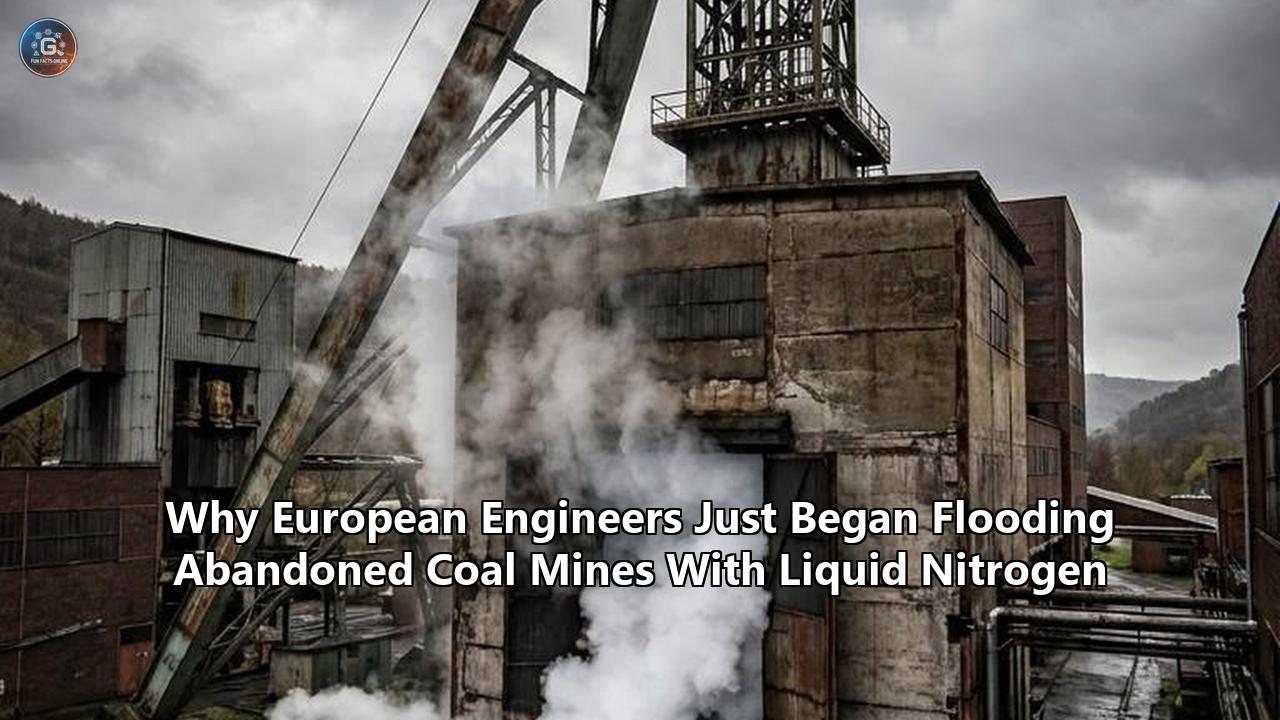
Deep beneath the rolling hills of Germany’s Ruhr region and the decommissioned collieries of northern England, an unprecedented engineering operation is underway. As of early May 2026, European engineers have begun deliberately flooding targeted sections of abandoned coal mine shafts with thousands of gallons of liquid nitrogen. To a casual observer, pumping a cryogenic fluid—chilled to a staggering -196°C (-320°F)—into the dark, crumbling arteries of obsolete fossil fuel infrastructure might seem like a bizarre industrial experiment. In reality, it represents one of the most sophisticated, dual-purpose engineering initiatives in the history of the European energy transition.
This ambitious deployment addresses two massive, long-standing problems simultaneously. First, it is being used as a high-tech weapon to finally suffocate subterranean coal seam fires that have been smoldering uncontrollably for decades. Second, and far more consequentially for the global energy grid, engineers are transforming these vast underground voids into colossal, grid-scale cryogenic batteries. By utilizing Liquid Air Energy Storage (LAES) and Liquid Nitrogen Energy Storage (LESS) systems, these dead mines are being resurrected to store excess renewable energy from wind and solar farms.
The European Union has aggressively accelerated this initiative, recently channeling tens of millions of euros through the EU Innovation Fund into mine-repurposing projects across Sweden, Germany, and Slovenia. But to understand why engineers are backing fleets of cryogenic tanker trucks up to rusted mine shafts today, we have to break down the complex thermodynamics, the geological hazards, and the brutal economics of keeping the continent's power grid stable.
The Anatomy of Europe's Subterranean Liability
For over two centuries, coal was the undisputed engine of European industrialization. From the massive open-cast pits of Lusatia to the deep-shaft labyrinths of South Wales, the continent was aggressively hollowed out. Today, as Europe pushes toward a legally binding phase-out of coal—with countries like Spain, France, and the UK having already closed their facilities, and Germany accelerating its exit toward 2030—the physical legacy of that era remains.
An abandoned coal mine is not simply an empty cave; it is a highly volatile, degrading geological structure. When a mining company ceases operations and turns off the massive industrial water pumps, the void begins to flood with groundwater. The remaining coal pillars, exposed to fluctuating air currents and moisture, begin to slowly oxidize. This oxidation generates heat. Because coal is an excellent thermal insulator, that heat cannot easily escape.
If the internal temperature of a coal pillar reaches a critical threshold—typically around 70°C to 80°C—it triggers spontaneous combustion. The result is an underground coal seam fire. These fires are notoriously difficult to track and nearly impossible to extinguish using conventional methods. They can burn for decades, releasing toxic carbon monoxide, hydrogen sulfide, and vast quantities of greenhouse gases into the atmosphere through fissures in the earth. They also cause severe thermal subsidence, where the burning coal reduces to ash, causing the ground above to collapse, destroying roads, forests, and residential neighborhoods.
For decades, firefighters and engineers tried pumping millions of gallons of water into these burning shafts. It rarely worked. When cold water hits a coal fire burning at 1,000°C, it flashes instantly into steam. This rapid expansion of steam causes violent localized explosions that fracture the surrounding rock, creating new fissures that suck fresh oxygen down into the mine, effectively feeding the fire they were trying to extinguish. Expanding firefighting foams and chemical slurries have been tested with limited success, but they struggle to reach the deep, complex geometries of a collapsed mine working.
This persistent failure is exactly why engineers turned their attention to cryogenics.
The First Objective: The Cryogenic Quench
The recent decision to deploy liquid nitrogen to combat these fires relies on the extreme physics of phase changes and oxygen displacement. Liquid nitrogen is nitrogen gas that has been compressed and cooled to its boiling point of -196°C. It is a colorless, odorless, and chemically inert fluid.
When engineers pump liquid nitrogen into a burning coal mine, two highly effective physical reactions occur almost instantaneously. First is the massive, rapid extraction of heat. Unlike water, which turns to steam and fractures the geology, liquid nitrogen undergoes a phase change that aggressively absorbs thermal energy from the burning coal without creating high-pressure steam explosions.
Second, and more importantly, is the expansion ratio. When liquid nitrogen boils and turns back into a gas, it expands to nearly 700 times its liquid volume. As this massive wave of cold nitrogen gas expands rapidly through the mine shafts, it acts as a suffocating blanket. Because nitrogen is inert, it completely displaces the oxygen in the localized atmosphere. Without oxygen, the chemical reaction of combustion is instantly halted.
Recent field deployments utilizing a "cryogenic slurry"—a mixture of liquid nitrogen and solid carbon dioxide pellets (dry ice)—have proven exceptionally effective. The solid CO2 sublimates slowly, ensuring that the environment remains inert and cold long after the initial liquid nitrogen has boiled away. This prevents the deep-seated heat of the surrounding rock from reigniting the coal once oxygen inevitably seeps back into the shaft.
While the concept of using nitrogen for fire safety is common in active mining—where gaseous nitrogen is used to flush methane and inert sealed areas—the sheer scale of injecting liquid nitrogen directly into abandoned voids represents a dramatic escalation in environmental remediation. But extinguishing fires is only half of the story. The true economic driver behind the sudden influx of liquid nitrogen coal mines is energy storage.
The Physics of Liquid Air Energy Storage (LAES)
The global energy transition faces a fundamental, existential bottleneck: intermittency. Solar panels only generate electricity when the sun shines, and wind turbines only spin when the wind blows. Because the power grid requires a perfect, real-time balance between supply and demand, excess renewable energy generated on a windy Sunday afternoon is often wasted—curtailed by grid operators because there is nowhere to store it. Conversely, when demand spikes on a windless winter evening, grid operators are forced to turn on expensive, highly polluting natural gas "peaker" plants.
Lithium-ion batteries are excellent for short-term energy shifting, holding power for two to four hours. However, they are entirely unsuited for long-duration energy storage (LDES) due to their immense cost at scale, reliance on mined rare-earth metals, and gradual chemical degradation over time.
Enter Liquid Air Energy Storage (LAES), a technology that engineers are now rapidly adapting for subterranean use. LAES operates on the principle of using excess electricity to refrigerate ambient air (or purified nitrogen) until it liquefies, storing it in giant insulated tanks, and then boiling it back into a gas to drive a turbine when electricity is needed.
Here is how the thermodynamic cycle works inside these newly repurposed coal mines:
1. The Charging Phase (Liquefaction):When the grid has a surplus of renewable energy, that electricity is used to power massive industrial compressors on the surface of the mine. These compressors draw in ambient air, clean it, and extract the moisture and carbon dioxide (which would freeze solid and block the pipes). The purified air—which is 78% nitrogen—is then subjected to a series of compression and cooling cycles. Utilizing the Joule-Thomson effect, the gas is expanded through a valve, causing its temperature to plummet. Eventually, the temperature drops below -196°C, and the gas condenses into a cryogenic liquid.
2. The Storage Phase:This is where the abandoned coal mine becomes an invaluable asset. Storing thousands of tons of cryogenic liquid on the surface requires massive, highly insulated, and heavily regulated storage tanks that take up valuable real estate and face strict zoning laws. By utilizing the vertical shafts and massive excavated caverns of stable, hard-rock coal mines, engineers can house these insulated storage vessels hundreds of meters underground. The subterranean environment offers consistent, cool temperatures, shielding the tanks from surface weather fluctuations and reducing the thermal leakage, or "boil-off," of the liquid nitrogen. This allows the energy to be stored for weeks or even months with minimal loss.
3. The Discharging Phase (Power Generation):When the grid requires a sudden injection of electricity—such as during a winter storm or an evening demand peak—the stored liquid nitrogen is pumped up to high pressure (around 70 to 100 bar). It is then passed through a series of heat exchangers.
This is where the ingenuity of the engineering truly shines. To boil a liquid that rests at -196°C, you do not need fire; you just need something warmer than -196°C. Ambient surface air is more than hot enough to cause the liquid nitrogen to boil violently. As it boils, it undergoes that massive 700-to-1 volumetric expansion. This high-pressure, rapidly expanding gas is channeled into a series of expansion turbines, spinning them at thousands of revolutions per minute to drive a generator and push megawatts of electricity back into the grid.
The Geothermal Synergy: Mining Waste Heat
The thermodynamics of LAES dictate that the warmer the heat source used during the discharge phase, the more forceful the expansion of the gas, and the higher the overall efficiency of the system. In early surface-level LAES pilot plants, the round-trip efficiency (the amount of electricity you get back compared to what you put in) hovered around 50% to 60%. This was a limiting factor compared to lithium-ion batteries, which boast efficiencies of over 90%.
However, European engineers realized that flooded, abandoned coal mines hold a secret weapon: geothermal mine water.
When deep coal mines are abandoned and the pumps are shut off, they slowly fill with groundwater. Because the Earth's temperature increases with depth (the geothermal gradient), the water trapped in these deep shafts is naturally heated by the surrounding rock. In many deep European mines, this water sits at a constant, tepid temperature of 15°C to 20°C (59°F to 68°F) year-round.
While 20°C water is practically useless for traditional geothermal power generation, which requires boiling water or steam, it is an absolute goldmine for a cryogenic system. When -196°C liquid nitrogen is exposed to a heat exchanger warmed by an inexhaustible supply of 20°C mine water, the temperature differential is a staggering 216 degrees.
By pumping this naturally warmed mine water through the heat exchangers during the discharge phase, engineers can massively supercharge the boiling and expansion of the liquid nitrogen. This geothermal synergy boosts the round-trip efficiency of the underground LAES system to upwards of 70%, making it highly competitive with other forms of mechanical storage. Furthermore, as the liquid nitrogen absorbs the heat, it simultaneously chills the mine water. This resulting "waste cold" can be captured and stored in a separate thermal reservoir, which is then used to help cool the incoming air during the next charging cycle, creating a highly efficient, closed-loop thermal ecosystem.
Why Europe is Leading the Charge
The concentration of these liquid nitrogen coal mines in Europe is not a coincidence. It is the direct result of geographic necessity, strict regulatory frameworks, and intense economic pressure.
Following the global energy market disruptions of 2022, and the subsequent volatility of natural gas supplies, European governments prioritized energy independence and grid resilience. The aggressive deployment of offshore wind in the North Sea and massive solar installations in southern Europe have fundamentally altered the continent's energy mix. In fact, by 2025, electricity generated from wind and solar surpassed fossil fuel generation in the EU for the first time in history.
But this green surplus has created massive grid instability. During periods of high wind, countries like the UK and Germany routinely produce more electricity than they can consume. Because they lack sufficient grid-scale storage, grid operators are forced to pay wind farms to turn their turbines off—a practice known as curtailment. Between October 2022 and January 2023 alone, the UK wasted vast amounts of wind energy, costing the country billions in lost efficiency and reliance on imported backup gas.
Pumped hydro storage—where water is pumped up a mountain during times of excess power and released through a turbine when power is needed—is the traditional solution for long-duration storage. But pumped hydro requires highly specific mountainous topography, and nearly all suitable sites in Europe have already been developed.
Conversely, Europe sits on a vast, distributed network of abandoned coal infrastructure. Germany's Ruhr valley, the UK's Yorkshire and Welsh coalfields, and the expansive mining regions of Poland, the Czech Republic, and Slovenia are perfectly situated. These mines are already connected to high-voltage transmission lines, meaning the electrical infrastructure required to move massive amounts of power in and out of the site is already built.
By retrofitting these sites with cryogenic LAES technology, companies can bypass the multi-year delays associated with building new high-voltage grid connections. A prime example is LEAG, a major energy company operating in eastern Germany. LEAG is currently transforming its massive lignite open-cast pits and thermal power plants into Europe’s largest green energy hub. By utilizing existing grid infrastructure, they are deploying a combination of floating solar, wind, and massive thermal and electricity storage systems on the footprint of their former coal empire, effectively creating a 7 GW to 14 GW renewable powerhouse.
Similarly, the Swedish company Mine Storage recently secured a €22 million grant from the EU Innovation Fund to transform a decommissioned iron mine shaft in Norberg into a grid-scale energy storage facility. While their initial focus heavily features underground pumped hydro, the influx of EU capital is rapidly expanding the scope of what can be engineered in these subterranean spaces, paving the way for the integration of isobaric compressed air and liquid nitrogen systems.
The Rock Mechanics of Extreme Cold
Injecting thousands of gallons of a cryogenic liquid into a century-old geological void is an undertaking fraught with severe geotechnical challenges. The rocks that make up coal seams—predominantly shale, mudstone, and sandstone—were never meant to experience temperatures approaching absolute zero.
When rock is exposed to -196°C, the trace amounts of water trapped within its pores freeze instantly. Because water expands by about 9% when it turns to ice, this rapid freezing exerts immense tensile stress on the internal structure of the rock. This can lead to a phenomenon known as cryofracturing or frost shattering.
If engineers simply pumped liquid nitrogen directly into a raw, unlined coal shaft, the thermal shock would cause the walls to shatter and collapse, potentially blocking the shaft or compromising the structural integrity of the entire mine. Furthermore, the cyclic nature of an energy storage system—where the storage caverns undergo continuous cycles of extreme cooling and subsequent warming—induces cyclic thermal fatigue in the rock mass.
To overcome this, European geological engineers are utilizing advanced cryogenic linings and thermodynamic buffer zones. The underground liquid nitrogen storage tanks are heavily insulated and suspended within the shafts or specially excavated rock caverns. The tanks are constructed from specialized austenitic stainless steels or aluminum alloys that retain their ductility and strength at cryogenic temperatures, preventing them from becoming brittle and shattering.
Between the storage tank and the raw rock wall, engineers design an annular space that acts as an insulating thermal barrier. This space is constantly monitored for temperature fluctuations and gas leaks. In some highly stable rock formations, engineers are experimenting with utilizing the rock itself as part of the thermal storage medium, carefully managing the temperature gradients to induce controlled freezing of the surrounding groundwater, effectively creating an impermeable, structurally reinforced "ice wall" around the cavern. Ironically, this technique—known as artificial ground freezing—was first pioneered in 1882 in Germany (the Poetsch process) specifically to help sink coal mine shafts through water-bearing rock layers. Now, engineers are using the exact same thermodynamic principles to turn those abandoned shafts into batteries.
Economics and the "Just Transition"
The sudden rise of liquid nitrogen coal mines is not just an engineering triumph; it is a critical socioeconomic lifeline. The phase-out of coal across Europe has devastated local economies that have relied on mining for generations. The closure of a colliery does not just mean the loss of mining jobs; it triggers a cascade of economic decline, impacting local logistics, engineering firms, and municipal tax bases.
The concept of the "Just Transition"—ensuring that the economic burden of moving toward a green economy does not disproportionately fall on the working class—is a central pillar of the European Green Deal. The repurposing of coal mines into LAES and cryogenic facilities is perhaps the most literal manifestation of this policy.
Building and operating a cryogenic energy storage facility requires a highly skilled workforce. The skills possessed by former coal miners and oil and gas workers—managing complex hydraulic systems, operating heavy compressors, maintaining high-pressure pipework, and understanding deep-shaft safety protocols—translate almost perfectly to the operation of a liquid nitrogen energy facility.
When a company like Highview Power in the UK or Gravitricity in Slovenia sets up operations at a legacy mine, they are directly rehiring the local workforce. Gravitricity, for example, is currently assessing the operational shafts of the Velenje coal mine in Slovenia. While Gravitricity initially focuses on gravity-based energy storage—dropping massive weights down shafts to generate power—the feasibility studies being conducted on these deep, well-maintained shafts are exactly what are required to assess them for cryogenic fluid storage as well. The operational crossover is vast, and the economic revitalization of these communities provides the critical political capital needed to accelerate the green transition.
From a pure financial perspective, the Levelized Cost of Storage (LCOS) for LAES becomes highly attractive when scaled up. Unlike chemical batteries, which scale linearly in cost (if you want a battery that lasts twice as long, you have to buy twice as many expensive battery cells), LAES scales non-linearly. The expensive components of a LAES system are the compressors and the expansion turbines. If an operator wants to double their storage capacity, they do not need to buy more turbines; they simply need to build a larger insulated tank to hold more liquid nitrogen. By utilizing the pre-existing, massive volumetric space of an abandoned coal mine, the capital expenditure required for storage expansion drops precipitously. Over a 30-year lifespan, grid-scale LAES is projected to cost less than half per megawatt-hour compared to large-scale lithium-ion battery parks.
Safety and the Inert Gas Paradox
A common concern raised by local communities when they hear about plans to flood local mines with industrial gases is the risk of explosion. Coal mining regions have deep, generational trauma associated with underground explosions, typically caused by the ignition of highly volatile methane gas (firedamp) or coal dust.
The introduction of millions of liters of nitrogen actually represents a massive upgrade in local safety. Nitrogen is inherently non-flammable and entirely non-reactive. In fact, it is the exact opposite of an explosion hazard; it is an extinguishing agent. By flooding the deep, abandoned workings of a coal mine with nitrogen gas (as it slowly boils off from the liquid storage or is actively pumped into the voids for fire suppression), engineers are deliberately "inerting" the mine.
When the oxygen levels in an abandoned mine are displaced by nitrogen, it becomes chemically impossible for the residual coal dust or leaking methane to ignite. The primary safety risk associated with liquid nitrogen is not fire, but asphyxiation and cryogenic burns. If a pipe were to rupture in a confined underground space, the rapidly expanding nitrogen gas would immediately push all the oxygen out of the room.
To mitigate this, modern underground cryogenic facilities are entirely automated and operated remotely from the surface. Advanced oxygen-monitoring sensors are deployed throughout the shafts, and any maintenance requiring human entry is conducted under strict confined-space protocols, often utilizing supplied-air respirators. The risk profile of storing inert liquid nitrogen underground is exponentially lower than the historical risk of mining the coal itself, or even the contemporary risk of storing thousands of highly reactive lithium-ion battery cells in a surface warehouse, which are prone to violent thermal runaway if damaged.
The Future of the Subterranean Grid
As the first generation of these repurposed facilities comes online throughout 2026, the implications for the global energy landscape are vast. The engineering data gathered from these European test sites—ranging from the thermal conductivity of frozen shale to the long-term maintenance costs of cryogenic expansion turbines—will serve as a blueprint for the rest of the world.
There are over a million closed or abandoned mines globally. The United States has thousands of abandoned shafts winding beneath the Appalachian Mountains. China, which currently mines and burns more coal than the rest of the world combined, has initiated massive research programs into the stabilization and utilization of its own rapidly growing inventory of abandoned coal mine goafs. If the European model proves financially viable at scale, the global export of this cryogenic technology will rapidly accelerate.
Looking forward to 2027 and beyond, engineers are already exploring the next iteration of this technology. One major area of development is the integration of cryogenic carbon capture. Because carbon dioxide freezes solid at a much higher temperature (-78°C) than nitrogen liquefies (-196°C), the air purification process at the front end of a LAES system naturally isolates and removes CO2 from the ambient air. Researchers are investigating whether these facilities could be optimized to actively scrub CO2 from the atmosphere during the charging phase, turning the energy storage plant into a massive Direct Air Capture (DAC) facility. The solid CO2 could then be permanently sequestered deep within the unrecoverable areas of the coal mine.
Furthermore, grid operators are closely monitoring the dispatchability metrics of these initial sites. The critical metric to watch over the next 18 months is how quickly these underground turbines can spool up from a cold start to full megawatt capacity when the grid frequency drops. If they can achieve response times comparable to natural gas peaker plants, it will effectively sound the death knell for fossil-fuel-based grid balancing.
The transformation of these sites represents a profound narrative shift. The coal mines of Europe, which spent two centuries pulling carbon out of the earth and pumping greenhouse gases into the atmosphere, are now being engineered to do the exact opposite. By utilizing the extreme physics of liquid nitrogen, engineers are neutralizing the toxic legacy of underground fires and turning the voids left behind into the exact mechanism required to finalize the transition to a renewable world. The deep, dark shafts that once fueled the industrial revolution are now the invisible, freezing batteries powering its green successor.
Reference:
- https://publications.jrc.ec.europa.eu/repository/bitstream/JRC139267/JRC139267_01.pdf
- https://innoenergy.com/news-resources/mine-storage-awarded-e22-million-grant-from-eu-innovation-fund/
- https://beyondfossilfuels.org/europes-coal-exit/
- https://balkangreenenergynews.com/leag-is-transforming-coal-plant-into-germanys-largest-energy-storage-system/
- https://www.osmre.gov/programs/mine-fires
- https://stacks.cdc.gov/view/cdc/227571/cdc_227571_DS1.pdf
- https://adgastech.com/onsite-nitrogen-gas-generation-in-the-mining-industry/
- https://www.atlascopco.com/en-lt/compressors/industry-solutions/mining/mining-safety-nitrogen
- https://research.birmingham.ac.uk/files/160501324/1_s2.0_S2666792421000391_main.pdf
- https://hackaday.com/2020/07/24/liquid-air-energy-storage-a-power-grid-battery-using-regular-old-ambient-air/
- https://www.energymonitor.ai/renewables/uk-can-displace-expensive-gas-and-coal-with-storage-and-energy-efficiency/
- https://minexforum.com/2026/03/10/coal-demand-rebounds-in-europe-as-energy-security-concerns-drive-temporary-shift/
- https://www.researchgate.net/publication/333180763_Main_challenges_of_closedabandoned_coal_mine_resource_utilization_in_China
- https://ideas.repec.org/a/eee/energy/v311y2024ics0360544224031682.html
- https://thermalscience.rs/pdfs/papers-2025/TSCI2502145C.pdf
- https://www.pivotscipub.com/ges/4/3/0003/html
- https://www.enlit.world/library/slovenian-coal-mine-looks-to-gravity-energy-storage-for-greener-future
- https://www.mdpi.com/2313-0105/12/2/40