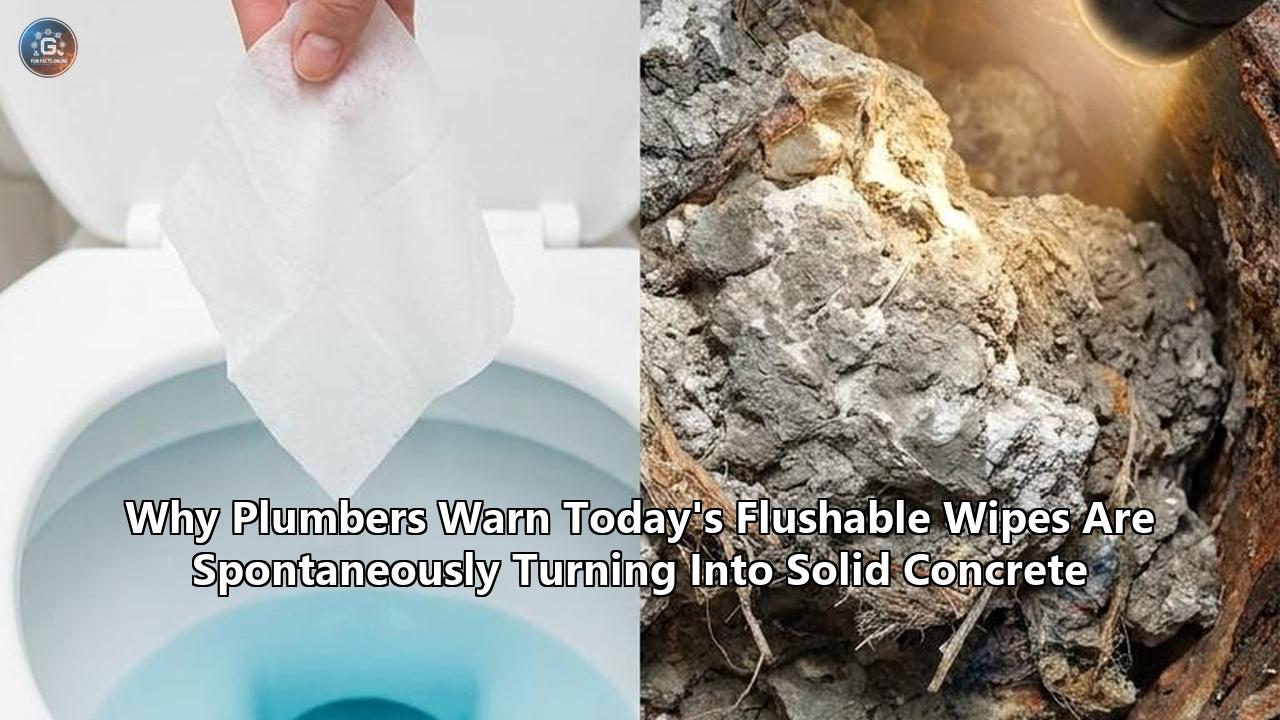
A massive, subterranean emergency in May 2026 has brought municipal public works departments across the globe to a breaking point. Beneath city streets, plumbing and sanitation crews are no longer just fighting clogs; they are excavating solid, concrete-like walls of calcified waste. The culprit is a product sitting in millions of bathrooms right now: the "flushable" wipe.
Last week, utility workers in several major metropolitan areas were forced to deploy heavy-duty jackhammers and robotic cutting tools to clear sewer mains that had completely hardened. When engineers analyzed the blockages, they did not find typical organic waste. Instead, they extracted gray, twisted, textile-like rags woven into a rock-solid matrix of saponified grease and minerals. These wipes, heavily marketed for their convenience and hygiene, are acting as the structural rebar in underground blockages known as "fatbergs," causing a chemical chain reaction that literally turns them into a cement-like mass.
This is a full-blown infrastructure crisis. Municipalities are currently spending upwards of $441 million annually in the United States alone just to mitigate the damage caused by these products. As the sheer volume of wipes entering the wastewater system reaches record highs, public works directors, environmental scientists, and consumer protection agencies are sounding the alarm. The deceptive marketing of these hygiene products is pushing aging sewer systems past their operational limits, forcing a massive, expensive, and technologically complex response from civil engineers.
The Illusion of Dispersibility
The core of the crisis lies in a major discrepancy between consumer expectations and material science. To understand the scale of the problem, one must look at the physical composition of the product.
Toilet paper is manufactured specifically to disintegrate. It consists of short cellulosic fibers that lose their structural integrity almost the moment they are submerged and agitated in water. Under laboratory conditions, standard toilet paper breaks down into a useless pulp within three minutes.
Flushable wipes are engineered for a completely different purpose. They must remain wet inside their packaging for months without degrading, and they must withstand vigorous scrubbing without tearing. To achieve this, manufacturers utilize non-woven technologies, binding regenerated cellulosic fibers like rayon and lyocell, and sometimes synthetic polymers, into a tight mesh.
When a consumer flushes one of these wipes, it successfully clears the toilet bowl. Because the product physically travels down the drain, manufacturers have historically defended the "flushable" label. However, clearing the immediate U-bend of a residential toilet is not the benchmark for plumbing safety. Once the wipe enters the main lateral pipe, it remains entirely intact. Rigorous independent testing by consumer advocacy groups has demonstrated that even after 20 hours of continuous agitation in water, so-called flushable wipes retain their shape, strength, and fabric-like structure.
When homeowners ask plumbers, "are flushable wipes safe," the industry response has become uniformly negative. The wipes are not dispersible. They are merely mobile, traveling deep into the plumbing infrastructure where they begin to cause catastrophic damage.
The Chemistry of a Fatberg: How Fabric Becomes Concrete
If wipes merely remained soft rags floating through the sewer, the problem would be manageable. The true disaster occurs because of the unique chemical environment of municipal wastewater.
Sewers carry a constant stream of fats, oils, and grease (FOG) discarded by residential kitchens and commercial restaurants. Under normal circumstances, hot liquid grease cools as it travels underground, solidifying into soft, sticky masses. When these soft fat masses encounter an intact flushable wipe, the fabric acts as a net. The wipe's porous, non-woven structure perfectly absorbs and traps the grease.
This physical trapping is only the first stage. As millions of wipes combine with tons of grease, a chemical reaction known as saponification occurs. Sewers contain high levels of calcium, naturally present in hard water and leaching from concrete pipes and surrounding soils. When the free fatty acids in the trapped grease react with this calcium, they undergo a rapid transition. The calcium causes the lipids to solidify into a soap-like, rock-hard substance.
Because the flushable wipes are embedded throughout this chemical mixture, they act exactly like steel rebar in poured concrete. They provide the tensile strength that prevents the hardened grease from breaking apart under the natural pressure of the water flow. Over months and years, these masses grow into subterranean behemoths. They latch onto tree roots, pipe joints, and minor imperfections in the sewer line, continually accumulating new layers of wipes and saponified fat.
By the time a municipality detects the blockage, the mass has often achieved the density of a solid rock. Standard hydro-jetting—which uses high-pressure water to clear pipes—is frequently useless against a fully formed fatberg. Crews are forced to manually dig up streets, halt traffic, and cut away the hardened pipes piece by piece.
The Financial Toll on Homeowners
The consequences of this chemical hardening do not strictly wait until the wipes reach the main city sewer. The financial devastation routinely strikes directly at the residential level.
For homeowners relying on septic tanks, the presence of these non-biodegradable sheets is disastrous. Septic systems operate on a delicate balance of bacterial breakdown. Organic waste settles and is consumed by anaerobic bacteria, while the relatively clean effluent water drains into a leach field. Flushable wipes cannot be digested by these bacteria. They accumulate at the bottom of the tank, rapidly reducing its capacity and blocking the baffle that leads to the drain field. Pumping out a septic tank clogged with heavily compacted, grease-soaked wipes requires specialized equipment and carries hefty surcharges.
In homes connected to municipal sewers, the wipes frequently snag on the lateral lines—the pipe connecting the home to the street. Older homes with clay pipes or cast-iron lines are particularly vulnerable due to rough interior surfaces and minor root intrusions. A single snagged wipe quickly catches a second, and a third. Within weeks, the homeowner experiences slow drains, gurgling toilets, and eventually, a total sewage backup where raw, untreated waste flows backward into bathtubs, sinks, and floor drains.
At this stage, families frantically searching online for answers to whether are flushable wipes safe discover the truth too late. Plumbers charging emergency rates must deploy heavy mechanical snakes to drill through the blockage. If the calcified mass has caused the lateral pipe to crack or collapse under pressure, the repair shifts from a simple drain clearing to an excavation. Homeowners are forced to tear up their driveways, lawns, or foundational slabs to replace the crushed line. These repairs routinely run between $4,000 and $20,000, costs that are rarely fully covered by standard homeowners' insurance. In severe municipal incidents, such as one extreme case involving a church in Lawton, Oklahoma, severe sewer backups caused by wipe blockages resulted in over $100,000 in property damage.
Wiping Out Municipal Budgets
Beyond the property lines of individual citizens, the cumulative effect of flushable wipes is crippling public infrastructure. Sewer systems are communal networks; they carry the consequences of every poor decision made in every bathroom in the city.
Public works departments are reporting staggering statistics. In some jurisdictions, up to 75% of all sanitary sewer overflows are directly attributed to flushable wipes. An overflow is a critical environmental hazard. When a main line is blocked by a calcified fatberg, the millions of gallons of incoming wastewater have nowhere to go. The pressure forces raw sewage out of manhole covers, spilling into public streets, parks, and local waterways.
These spills trigger immediate environmental crises. Untreated sewage introduces deadly pathogens, heavy metals, and massive nitrogen loads into rivers and oceans, causing fish kills and threatening public drinking water supplies. The cleanup requires hazardous materials teams, and the Environmental Protection Agency (EPA) heavily fines cities that fail to contain sanitary overflows.
The maintenance demands are draining municipal coffers. Cities are forced to preemptively vacuum out lift station pumps on a weekly basis, dispatching crews to manually pull tangled, rope-like cords of wipes from the impellers. A pump station failure can cause an entire neighborhood's sewage to back up simultaneously. Because these costs are baked into the city's operational budget, every taxpayer ends up subsidizing the damage caused by the deceptive marketing of wipe manufacturers, leading to sharp increases in local water and utility bills.
Legislative Retaliation and Corporate Accountability
Recognizing that consumer education alone cannot stop a crisis of this magnitude, civic leaders, utilities, and attorneys general have launched an aggressive legal offensive against the manufacturers of flushable wipes. The goal is to force corporate accountability for the externalized costs of their products.
Over the past decade, a wave of class-action lawsuits and municipal litigation has systematically dismantled the unregulated use of the word "flushable." Utilities in states ranging from Minnesota to South Carolina have sued industry giants like Kimberly-Clark and Procter & Gamble, arguing that their marketing constitutes a public nuisance and outright fraud.
These legal battles have exposed a critical regulatory loophole: until recently, there was no government standard defining what "flushable" actually meant. The industry was essentially policing itself, relying on internal testing methods that bore no resemblance to the actual conditions of aging, grease-filled, municipal sewer pipes.
The courts have begun to agree with the utilities. In highly publicized federal rulings, judges have refused to dismiss claims that major retailers and manufacturers intentionally misled the public. This intense legal pressure has resulted in massive settlements, including a notable $20 million agreement by Kimberly-Clark to compensate consumers nationwide who suffered plumbing damage.
More importantly, the litigation is forcing a change in marketing. Several companies have entered into consent agreements with the Federal Trade Commission (FTC), legally binding them to stop promoting certain wet wipes as flushable without robust, independent, real-world evidence.
In the international arena, governments are moving faster than the courts. In 2022, Australia and New Zealand established a strict, categorical product labeling standard for flushability. To carry the flushable label in those countries, a product must pass a battery of tests simulating actual sewer conditions, proving it disintegrates into small pieces within a specified, short timeframe. If a wipe fails, it must feature a highly visible "Do Not Flush" logo. This aggressive regulatory stance has forced global manufacturers to adapt their product lines, setting a precedent that North American and European regulators are now heavily pressured to adopt.
Engineering the Fight Back: Smart Sewers and Acoustic Mapping
While the legal battles grind through the courts, utility companies and civil engineers are deploying advanced technology to combat the fatbergs currently calcifying beneath their feet. The era of blindly snaking pipes is over; modern sewer maintenance has become a high-tech, precision operation.
Leading the charge are acoustic monitoring and smart sensor networks. Utilities like Thames Water in London—the site of some of the world's most infamous and massive fatbergs—have installed highly sensitive flow monitors equipped with acoustic technology. These sensors bounce sound waves through the sewer pipes, actively mapping the interior geometry of the lines. By analyzing the acoustic reflections, engineers can detect the early formation of a wipe-and-grease mass before it calcifies into a solid block.
When a narrowing of the pipe is detected, rapid-response teams are dispatched with specialized hydro-excavation trucks. If the mass has already begun to undergo saponification, simple water pressure is useless. Crews must utilize robotic, track-mounted cutting tools. These small robots are lowered into the pipes, equipped with high-speed spinning blades and grinding heads that physically chew through the concrete-like wipes and fat, restoring the flow of the pipe without requiring an open-street excavation.
Simultaneously, cities are attacking the chemical catalyst of the fatbergs: the grease. Municipalities are passing strict ordinances requiring commercial kitchens, restaurants, and food processing facilities to install advanced, high-efficiency grease traps and interceptors. These devices are heavily monitored and subjected to random municipal inspections. By restricting the amount of free fatty acids entering the sewer, engineers aim to starve the fatbergs of the chemical agent required to turn the flushable wipes into concrete.
Material Science: Redesigning the Culprit
The ultimate solution to the crisis does not lie in better robots or endless lawsuits; it requires a fundamental redesign of the product itself. Material scientists are actively working to answer a new mandate: how can we ensure the answer to whether are flushable wipes safe is finally a resounding "yes"?
The challenge is a paradox of design. A wipe must remain wet and strong in a plastic tub for a year, but instantly disintegrate when submerged in a toilet. Early attempts at "biodegradable" wipes failed to solve the plumbing issue. A product that takes six months to biodegrade in a landfill is useless in a sewer system, where it will cause a blockage in six minutes. Sewers are largely anaerobic environments, meaning biological breakdown happens far too slowly to prevent physical clogs.
The new frontier of wipe technology is focused on rapid physical dispersibility rather than slow biological degradation. Researchers are developing novel plant-based polymers and hydro-entangled cellulosic fibers that react specifically to the chemical makeup of toilet water. One promising avenue involves binding the fibers with a weak ionic bond that holds strong in the presence of the specific moisturizing lotion inside the package, but instantly dissolves when diluted by the high volume of neutral water in a toilet bowl.
While these next-generation, truly dispersible prototypes are entering the market, they remain more expensive to produce than traditional rayon-plastic blends. Until economies of scale bring the price down, and until strict legislation forces the old technology off the shelves, the burden remains on the consumer to navigate a highly deceptive marketplace.
The Consumer's Role: Breaking the Cycle
The immediate mitigation of this global infrastructure crisis requires a radical shift in consumer behavior. The public must unlearn decades of convenient, but deeply harmful, marketing.
Plumbers and public works directors have established a zero-tolerance policy for current market products. Their directive is simple: the only things that should ever be flushed down a toilet are human waste and standard toilet paper.
For consumers unsure about the products currently sitting in their bathrooms, public works officials recommend a basic at-home experiment known as the "water cup test". Drop a single wipe into a glass of water and wait 15 minutes. If the wipe has not completely dissolved into an unrecognizable, mushy pulp by the time the timer rings, it is not safe for your plumbing. The vast majority of commercially available wet wipes will fail this test, remaining entirely intact.
If you must use wet wipes for personal hygiene, medical reasons, or baby care, they must be disposed of in a physical trash can. To manage odors and hygiene, consumers can utilize diaper genies or small, tightly sealed waste bins next to the toilet.
For those who refuse to sacrifice the clean feeling of a wet wipe but want to protect their pipes, the market has provided excellent, safe alternatives. The most effective solution is the installation of a bidet. Once viewed as a luxury European novelty, bidets and bidet toilet seat attachments have surged in popularity. They provide superior hygiene using nothing but a targeted stream of water, completely eliminating the need for abrasive paper or synthetic wipes.
Another viable alternative is toilet paper moistening sprays. These liquid formulas are designed to be sprayed directly onto standard toilet paper just before use. They provide the soothing, cleaning effect of a wet wipe, but because the substrate is strictly fast-dissolving toilet paper, it poses absolutely zero risk to lateral lines, septic tanks, or municipal sewers.
What to Watch For Next
The battle over the bathroom drain is entering its most critical phase. As we move deeper into 2026, the intersection of plumbing, municipal finance, and consumer rights will yield several major developments.
First, watch for a decisive escalation from federal regulatory bodies. Consumer advocacy groups are heavily petitioning the FTC to issue a blanket ban on the word "flushable" for any product containing non-woven, slow-degrading fibers. If the FTC moves to strictly regulate the term, it will force a multi-billion-dollar rebranding effort across the hygiene industry.
Second, monitor local utility billing structures. As cities continue to hemorrhage money fighting calcified fatbergs, some progressive public works departments are proposing "wipe taxes" or targeted utility fee increases for retailers who sell non-compliant wipes within city limits. The financial burden is shifting from the victimized municipality back up the supply chain.
Finally, the crisis is accelerating a broader cultural reckoning regarding how we view our wastewater infrastructure. For generations, the toilet has been treated as a magical disappearing hole—a place where problems are flushed away and instantly forgotten. The reality of calcified, concrete-like monsters tearing apart our subterranean cities has shattered that illusion.
Our sewers are not black holes; they are complex, sensitive biological and chemical processing systems. They require cooperative stewardship from every household connected to the grid. As the science of wastewater management evolves, and as the true cost of convenience becomes impossible to ignore, society is learning a hard, expensive lesson: just because something goes down the drain, doesn't mean it goes away.