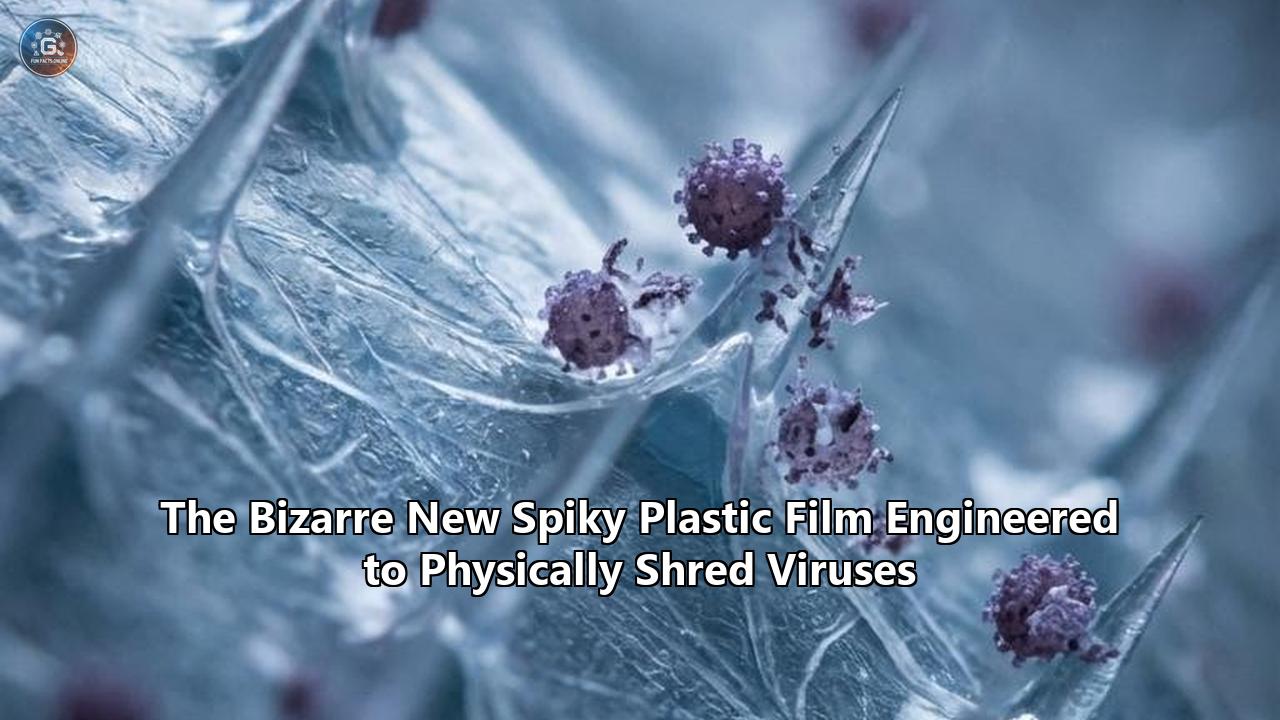
April 2026: An international team of researchers operating out of Australia’s RMIT University has successfully engineered a flexible acrylic polymer coated in microscopic nanopillars capable of physically tearing respiratory viruses apart on contact. Outlined this week in the journal Advanced Science, the material achieved up to a 94 percent destruction rate against human parainfluenza virus type 3 (hPIV-3) within a single hour. The mechanism relies purely on geometric tension rather than chemical disruption.
By manipulating the surface architecture of cheap, mass-producible acrylic, scientists have triggered a mechanical failure in the viral envelope. The researchers essentially built a microscopic array of blunt spikes that grab the pathogen's outer fatty layer and pull it until it ruptures. Because the mechanism is rooted entirely in physical geometry, no chemical agents are consumed, no toxic residues are left behind, and the targeted pathogens cannot mutate to develop resistance.
The implications for global health infrastructure are immediate. High-touch surfaces in clinical environments—from medical monitors to bed rails—serve as primary vectors for hospital-acquired infections. The transition of this technology from a theoretical laboratory concept into an adaptable, scalable polymer represents the culmination of a multi-year engineering escalation. Tracing this development reveals a timeline defined by biological mimicry, extreme manufacturing hurdles, and a fundamental shift in how materials scientists approach the mechanics of microscopic combat.
The Early Warning Signs: The Disinfection Treadmill (2020–2022)
The origins of this specific materials science pursuit trace directly back to the operational failures exposed during the early years of the COVID-19 pandemic. Global health systems recognized an uncomfortable reality: chemical sanitization is a fundamentally transient solution. As hospitals sprayed millions of gallons of bleach, hydrogen peroxide, and quaternary ammonium compounds onto surfaces, the limitations of chemical warfare against pathogens became starkly apparent.
Disinfectants must remain wet for a specific contact time to effectively neutralize a virus. Once a surface dries, its protective barrier vanishes. A chemically sanitized hospital table is instantly recontaminated the moment an infected patient touches it. Furthermore, the relentless application of harsh chemicals accelerates the degradation of sensitive medical equipment and contributes to a rising tide of antimicrobial resistance.
Compounding this problem was the specific affinity respiratory viruses have for synthetic polymers. Epidemiological data and surface stability tests conducted throughout the early 2020s proved that viruses thrive on smooth, waterproof substrates. A comprehensive review of surface persistence indicated that while SARS-CoV-2 was absorbed and neutralized by porous paper within three hours, the virus remained highly stable and infectious on smooth plastic surfaces for up to seven days. The very materials used to build the modern hospital—sturdy, wipeable, non-porous plastics—were actively sheltering the micro-droplets of water necessary for viral survival.
The scientific community faced a distinct bottleneck. Chemical coatings infused with silver, copper, or tannic acid offered some residual protection, but these active ingredients eventually depleted, proved toxic, or leached into the environment. The mandate became clear: engineers needed to design a surface that was inherently and permanently hostile to viral resting states, requiring zero chemical intervention.
The Biomimetic Pivot: Looking to the Insect World (2022–2023)
To bypass the limitations of chemistry, researchers turned toward mechanical physics, drawing direct inspiration from entomology. For millions of years, specific species of insects have navigated environments teeming with lethal pathogens without the benefit of chemical disinfectants. Biologists had long understood that the wings of certain cicadas and dragonflies possess inherent antimicrobial properties.
Microscopic analysis of these insect wings revealed surfaces entirely devoid of smooth planes. Instead, they are densely packed with nanoscale pillars. When a bacterial cell lands on a cicada wing, the membrane of the bacteria sags between these microscopic spikes. The resulting tension causes the bacterial cell wall to stretch and ultimately rupture, spilling its internal contents and killing the organism through pure physical force.
Materials scientists spent the early 2020s successfully mimicking these bactericidal surfaces, etching similar spikes into titanium and silicon to kill staph and E. coli. However, translating this mechanism to neutralize viruses presented a mathematically daunting escalation.
Viruses operate on a vastly different dimensional scale than bacteria. A typical bacterial cell is a sprawling giant compared to a viral particle. If an engineer built a nanospike array scaled to puncture a bacterium, a virus dropping onto that same surface would likely just slip between the spikes or rest unharmed on a single point. To achieve mechano-virucidal action, the topographical features had to be shrunk by orders of magnitude, venturing into the extreme limits of nanofabrication.
The First Breakthrough: The Rigid Silicon Bed of Nails (Early 2024)
The first major turning point in this timeline arrived in early 2024. A cross-disciplinary team at the Royal Melbourne Institute of Technology (RMIT), led by molecular biologist Natalie Borg and applied physicist Samson Mah, announced the creation of a synthetic surface capable of physically destroying a virus.
Published in ACS Nano, the team detailed a process utilizing specialized equipment at the Melbourne Center for Nanofabrication. By directing streams of charged ions at a flat silicon wafer, they chipped away specific microscopic zones to create a dense forest of incredibly sharp spires. The resulting nanospikes stood just 290 nanometers tall, with tips measuring a mere 2 nanometers in thickness—roughly 30,000 times thinner than a single strand of human hair.
To the naked eye, the material resembled a flat, smooth, black mirror. But under an electron microscope, it was a lethal bed of nails. When researchers exposed the surface to hPIV-3—a highly contagious pathogen responsible for bronchitis, croup, and pneumonia—the results were devastating to the virus. The sharp nanospikes physically skewered the viral particles upon contact. Within six hours, 96 percent of the hPIV-3 virions were critically damaged or completely torn apart, rendering them entirely incapable of replicating or causing infection.
This success provided definitive proof of concept. The mechanical destruction of a virus was physically possible. Mah noted at the time that implementing this cutting-edge technology in high-risk environments could significantly bolster containment measures against infectious diseases.
Yet, an engineering reality quickly dampened the initial celebration. The breakthrough was achieved on a rigid silicon wafer. Silicon is brittle, expensive, and difficult to manufacture at scale. You cannot mold a flat silicon mirror around a hospital bed rail, drape it over a keyboard, or apply it to a curved door handle. For the technology to have any practical impact on public health, the nanoscale geometry had to be transplanted onto a cheap, flexible, and durable material.
The Engineering Escalation: Translating Spikes to Polymer (2024–2025)
Moving from silicon to plastic triggered a new sequence of manufacturing hurdles. Silicon can be precisely etched using ion beams because of its crystalline structure. Acrylic polymers, conversely, are entirely different materials. They are softer, more variable, and prone to deformation at the nanoscale.
Attempting to recreate the ultra-sharp, 2-nanometer tips of the silicon design onto a plastic substrate proved chemically and structurally unfeasible. If you try to cast a plastic spike that sharp, the polymer simply lacks the structural integrity to hold the point. The microscopic plastic tips would likely bend, fold, or melt under minimal thermal stress.
The researchers were forced to rethink the shape of the weapon. If they could not build sharp needles to skewer the virus, what geometry could plastic reliably hold?
The team shifted their focus from sharp spikes to blunt nanopillars. By utilizing advanced molding techniques, they discovered they could imprint thousands of ultra-fine, flat-topped columns into a thin sheet of flexible acrylic. The resulting antiviral plastic film felt perfectly smooth to the human touch, similar to standard commercial cling wrap.
But a critical biological question emerged: if the pillars were no longer sharp enough to pierce the viral membrane like a needle, how could they destroy the pathogen? The researchers initiated a series of finite element simulations, computationally dropping viral particles onto different arrangements of blunt plastic pillars to observe the mechanical stresses at play.
The Paradigm Pivot: Stretching Instead of Skewering (Late 2025)
The simulation data, followed by rigorous laboratory testing, revealed the most significant turning point in the project's history. The blunt pillars did not need to act like needles; they needed to act like gripping hands.
The researchers discovered that when a virus landed on a dense array of blunt plastic nanopillars, the pillars exerted a coordinated outward force on the viral envelope. Instead of puncturing the pathogen, the geometry forced the fatty outer membrane of the virus to stretch across the gaps between the pillars.
This led to the formulation of a stringent new design rule: the kill rate was dictated almost entirely by the spacing between the pillars, rather than their height or sharpness.
The physics required a specific zone of precise geometry. The researchers systematically tested different gaps between the nanofeatures. When the pillars were spaced 200 nanometers apart, the virus simply slipped into the valleys between them, surviving unharmed. When the gap was narrowed to 100 nanometers, the antiviral effect was present but weak.
The structural failure of the virus maxed out at exactly 60 nanometers of separation.
At a 60-nanometer spacing, multiple blunt pillars pressed against a single viral particle simultaneously. The computational models demonstrated that this exact configuration generated localized stress concentrations exceeding 10 megapascals on the viral envelope. This extreme physical tension stretched the fragile fatty membrane of the hPIV-3 virus far past its mechanical breaking point.
"When the nanopillars are closer together, more of them can press on the same virus at once, stretching its outer shell past breaking point," Mah explained. The collective action of the microscopic columns pulled the virus apart. The researchers had successfully transitioned from a mechanism of skewering to a mechanism of rupturing.
Furthermore, they confirmed that this physical shredding left the viral RNA completely exposed but chemically unaltered, proving definitively that the destruction was purely mechanical and not the result of a chemical reaction with the acrylic.
The Breaking Reality: Mass Production and Scalability (April 2026)
This mechanical revelation brings the timeline to the current moment. The findings published this week in Advanced Science do not merely detail a new way to kill a virus; they detail a way to do it on an industrial scale.
The leap from the 2024 silicon wafer to the 2026 flexible polymer is massive because of how the respective materials are manufactured. The team developed a specialized mold to cast the 60-nanometer-spaced pillars into the acrylic. Crucially, this mold is explicitly designed to be integrated into existing roll-to-roll manufacturing systems.
Roll-to-roll processing is the same continuous fabrication method used to produce newsprint, aluminum foil, and commercial plastic wrap. By adapting the nanopillar mold to this continuous feed system, an antiviral plastic film can theoretically be churned out in massive factory rolls using equipment that already exists on manufacturing floors globally.
The resulting flexible film retains the exact same destructive capabilities as the rigid lab tests. During the controlled trials outlined in the new study, the flexible acrylic film reduced the infectivity of the hPIV-3 virus by up to 94 percent within 60 minutes of contact.
The operational advantages over standard chemical cleaning protocols are vast. A hospital room coated with this antiviral plastic film would possess continuous, passive pathogen resistance. An infected patient touching a tray table would deposit viral particles onto a surface that immediately begins tearing those particles apart. No nurse needs to arrive with a bleach wipe to initiate the sanitization process; the geometry of the table itself is doing the work. As long as the physical structure of the nanopillars remains undamaged, the surface will theoretically continue to shred viruses indefinitely.
The Imminent Applications and Structural Challenges
With the fundamental science established and a pathway to scalable manufacturing secured, the next phase of this timeline moves directly into commercial and clinical deployment. The primary target environments are those where cross-contamination is a constant, high-stakes threat.
Healthcare facilities represent the most urgent deployment zone. High-touch areas such as bedside monitors, automated medication dispensers, elevator buttons, and touchscreen diagnostic tools are notoriously difficult to keep sterile. Wrapping these surfaces in an antiviral plastic film provides a persistent baseline of defense that operates independently of human cleaning schedules.
Beyond the hospital, the transportation and consumer electronics sectors are highly viable adoption targets. Public transit systems—bus handrails, train grab-handles, and subway turnstiles—are primary vectors for seasonal respiratory outbreaks. Similarly, smartphone screens, which harbor vast ecosystems of bacteria and viruses due to constant contact with human hands and faces, could be manufactured with a native layer of mechano-virucidal acrylic.
However, the transition from controlled laboratory conditions to the chaotic physical reality of public infrastructure introduces immediate logistical challenges. How well do the 60-nanometer pillars stand up to the macro-level friction of thousands of human hands? While the acrylic is flexible, excessive scratching, heavy abrasion, or the accumulation of thick organic dirt could easily fill in the microscopic valleys between the pillars, effectively neutralizing the stretching mechanism. The film will not eliminate the need for cleaning to remove physical grime, but it will sever the chain of biological transmission between those cleanings.
The Unresolved Biological Frontiers: What Happens Next?
As this technology prepares to exit the laboratory, several critical scientific and engineering questions remain unresolved, dictating the next era of research for Mah and the RMIT team.
The most pressing biological challenge lies in the specific anatomy of different viral families. The current data, resulting in the 94 percent destruction rate, was achieved using the human parainfluenza virus type 3. hPIV-3 is an enveloped virus, meaning its outermost layer consists of a relatively fragile lipid (fatty) membrane. This lipid envelope is highly susceptible to the mechanical stretching forces generated by the blunt nanopillars.
The SARS-CoV-2 virus, the influenza virus, and respiratory syncytial virus (RSV) are also enveloped viruses. Based on the mechanical data, the polymer should theoretically be highly effective at shredding these pathogens as well, as they share the same structural vulnerability.
However, a massive subset of dangerous pathogens belongs to the category of non-enveloped viruses. Norovirus, rhinoviruses (which cause the common cold), and adenoviruses lack this fatty outer membrane. Instead, their genetic payload is encased in a rigid, highly resilient protein shell known as a capsid.
Protein capsids are significantly tougher and more structurally stable than lipid envelopes. The immediate, upcoming milestone for the RMIT team is testing the 60-nanometer spaced pillars against these non-enveloped viruses. It remains entirely unknown if the blunt plastic pillars can generate enough megapascals of stress to crack a rigid protein shell, or if a pathogen like norovirus will simply bounce off the nanostructures unharmed. If the film fails against non-enveloped viruses, researchers may have to engineer a secondary mechanism or a hybrid surface geometry to handle tougher capsids.
Additionally, researchers face a localized geometric challenge involving complex macro-structures. The 60-nanometer spacing is easily maintained when the acrylic film is applied to a flat surface like a computer monitor. But what happens to the microscopic spacing when the flexible film is forcefully bent around the tight curve of a door handle or the sharp edge of a medical device? Bending the polymer stretches the surface outward, inevitably widening the gaps between the nanopillars at the apex of the curve. If the gap widens from the optimal 60 nanometers to the ineffective 100-nanometer range, the surface could lose its antiviral properties exactly where human hands are most likely to grip it.
Engineers will need to calculate the precise curvature limits of the polymer and potentially pre-compensate for bending by manufacturing films with tighter default spacing for specific curved applications.
The successful engineering of this mechano-virucidal surface marks a severe pivot in our defensive posture against infectious disease. For the last century, human infection control has relied on chemical eradication—a reactive, consumable, and increasingly compromised strategy. By weaponizing the physical geometry of an everyday synthetic polymer, materials science is moving toward a model of passive, continuous deterrence. The timeline that began with observing the wings of a dragonfly has escalated into a scalable manufacturing process that alters the microscopic topography of the built environment.
The ultimate success of this technology will hinge on the upcoming trials against the highly resilient non-enveloped pathogens and the physical durability of the nano-etchings under the punishing wear and tear of public spaces. As factory trials for roll-to-roll production begin, the race is actively underway to determine how quickly this invisible bed of nails can be deployed across global health networks, fundamentally altering the microscopic lethality of the surfaces we touch every day.
Reference:
- https://www.eurekalert.org/news-releases/1124449
- https://studyfinds.com/plastic-spikes-kill-viruse/
- http://www.gzjiayumed.com/en/ArticleShow.asp?ArtID=12537
- https://www.sciencealert.com/scientists-created-a-plastic-film-that-physically-rips-viruses-apart
- https://scienceblog.com/plastic-film-kills-viruses-by-tearing-them-apart/
- https://www.sciencealert.com/this-prickly-new-material-literally-pops-viruses-with-up-to-96-success
- https://pmc.ncbi.nlm.nih.gov/articles/PMC7695943/
- https://www.popsci.com/technology/silicon-virus-spikes/
- https://www.labonline.com.au/content/life-scientist/article/could-this-virus-tearing-plastic-film-protect-hospital-equipment--303856400
- https://e360.yale.edu/digest/dangerous-viruses-can-survive-in-fresh-water-by-clinging-to-plastic-waste-study-finds