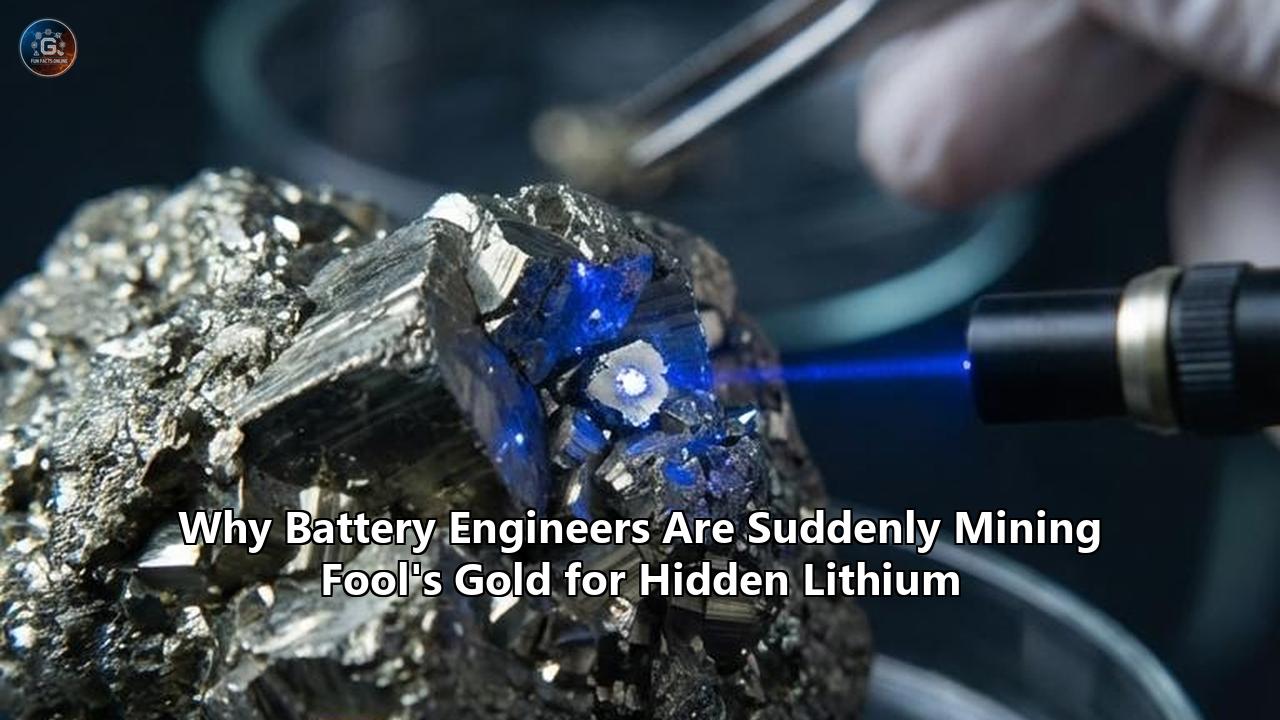
An unexpected chemical partnership buried deep within ancient Appalachian rock is rewriting the rules of the global energy transition. Researchers analyzing sedimentary shale from the eastern United States have discovered significant concentrations of lithium trapped inside iron pyrite—the infamous, brassy-yellow mineral long ridiculed by prospectors as "fool’s gold."
Presented at the European Geosciences Union (EGU) General Assembly, the findings reveal a previously unrecorded geological phenomenon. In 15 middle-Devonian shale samples dating back roughly 390 million years, geochemists found that pyrite acts as a highly effective host for lithium. In some core samples, a staggering 54 percent of the total lithium yield was extracted directly from the pyrite fraction.
The revelation triggers immediate commercial and environmental implications for a battery industry desperate to secure domestic supply chains. Rather than blasting pristine landscapes or draining arid aquifers, energy companies now have a viable blueprint to extract this critical battery metal from the millions of tons of industrial waste, drill cuttings, and mine tailings already sitting in the Appalachian basin.
"This is unheard of," said Shailee Bhattacharya, a sedimentary geochemist and doctoral researcher working alongside Professor Shikha Sharma at West Virginia University’s IsoBioGeM Lab. "But it is promising because it hints at the possibility that certain shales could be a lithium source that doesn't require new mines. We can talk about sustainable energy without using a lot of energy resources."
As global electric vehicle adoption accelerates and grid-scale storage demands mount, the race to secure lightweight, highly reactive lithium has evolved into a geopolitical scramble. Finding it hidden in the waste rock of America's historic coal and gas country upends standard resource models, offering a path to supply the clean energy economy by cleaning up the industrial debris of the past.
The Science of an Unlikely Mineral Marriage
To understand why this discovery caught the geological community off guard, one must look at how lithium naturally behaves. Lithium is an intensely reactive, lightweight alkali metal. In natural environments, it violently interacts with water and bonds readily with various elements, but it is rarely found interacting with sulfur-rich minerals.
Most geological models focus on lithium locked within silicate minerals in igneous pegmatite rocks, or dissolved in vast, subterranean brine aquifers. The scientific literature contained virtually zero data suggesting lithium would sequester itself within the crystal lattice of an iron sulfide like pyrite.
Bhattacharya's team initially set out to determine whether historical industrial waste sites could be repurposed. The Appalachian basin, stretching from New York down to Alabama, is heavily scarred by centuries of intense fossil fuel extraction. Mountains of drill cuttings and tailing ponds dot the landscape. The WVU researchers targeted middle-Devonian shale—a fine-grained sedimentary rock formed under ancient seas—because it is abundant, highly organic, and frequently intersected by previous drilling operations.
When the team leached the rocks and tracked the elemental origin of the resulting mineral fractions, the data returned an anomaly. The presence of lithium scaled directly with the presence of pyrite. The more fool's gold the shale contained, the higher the lithium concentration in the leachate. Pyrite was not merely sitting adjacent to the lithium; it was actively hosting it.
"I am trying to understand how lithium and pyrite could be associated with one another," Bhattacharya stated. The exact biogeochemical mechanism that forced these elements together under the crushing pressures of the Devonian period remains an active area of investigation. However, the data confirms that organic-rich shale formations hold an untapped reserve of battery metals hidden in plain sight.
The Environmental Toll of the Status Quo
The urgency to commercialize this discovery stems directly from the severe ecological and economic limitations of standard global supply chains. At present, the automotive and energy storage sectors rely almost entirely on two primary lithium extraction methods, both of which exact a heavy toll on the surrounding environment.
The first method dominates the "Lithium Triangle"—a sprawling region encompassing the arid high-altitude salt flats of Argentina, Bolivia, and Chile. Here, operators pump millions of gallons of ancient, lithium-rich saltwater from underground aquifers to the surface. The brine sits in massive, vividly colored evaporation ponds for 12 to 18 months. As the desert sun evaporates the water, a concentrated chemical sludge remains, which is then processed into lithium carbonate.
While solar evaporation is relatively cheap, the water usage is astronomical. Pumping subterranean brine depletes the localized water table, devastating the delicate ecosystems of the Atacama and Uyuni deserts and stripping Indigenous communities of the fresh water required for agriculture.
The second dominant method is hard-rock mining, primarily centralized in Australia. Operators use explosives and heavy diesel machinery to excavate spodumene, a lithium-bearing pegmatite mineral. The rock must be crushed, roasted at temperatures exceeding 1,000 degrees Celsius, and treated with sulfuric acid to isolate the lithium. This process is intensely carbon-heavy, generating massive volumes of greenhouse gases, airborne particulate matter, and toxic slag.
These legacy lithium extraction methods are increasingly at odds with the fundamental premise of the green energy transition. Automakers face mounting pressure from investors and regulators to audit the carbon footprint of their supply chains. A zero-emission electric vehicle loses much of its environmental credibility if the raw materials powering its chassis required burning millions of gallons of diesel fuel and draining desert aquifers to acquire.
This is precisely why the Appalachian pyrite discovery commands such intense scrutiny. Reprocessing drill cuttings and historical mine tailings circumvents the most destructive phases of mineral acquisition. The rock has already been excavated, broken, and hauled to the surface. By tapping into existing waste streams, chemical engineers can skip the violent, energy-intensive extraction phase entirely.
A Circular Economy in Coal Country
Repurposing industrial waste for high-value mineral recovery is not a theoretical concept; it is an active economic model in other sectors. In South Africa, companies like DRDGold have generated billion-dollar revenues by reprocessing decades-old sand dumps and slime dams around Johannesburg to recover trace amounts of gold left behind by 20th-century miners.
Applying this closed-loop model to Appalachian shale waste offers dual benefits: securing a domestic critical mineral supply while simultaneously funding the remediation of hazardous industrial sites. For decades, abandoned mine drainage—often heavy in iron sulfides like pyrite—has polluted the waterways of West Virginia, Pennsylvania, and Ohio. When exposed to air and water, pyrite oxidizes to form sulfuric acid, turning local streams a toxic, rusty orange.
If energy companies can extract commercial value from pyrite, the economic calculus of environmental cleanup changes drastically. Waste tailing facilities transition from multi-million-dollar liabilities into lucrative, lithium-bearing assets.
The U.S. government has heavily incentivized this exact type of supply chain pivot. Legislation passed in the early 2020s, including the Infrastructure Investment and Jobs Act and the Inflation Reduction Act, unleashed billions of dollars in tax credits and direct funding for domestic critical mineral processing. However, a major bottleneck has been the fierce local opposition to new open-pit mining permits. Environmental groups and local municipalities routinely block proposed lithium mines in states like Nevada and Maine, citing concerns over water contamination and habitat loss.
Extracting lithium from historical Appalachian tailings bypasses many of these zoning and permitting battles. The land is already zoned for industrial waste; the environmental impact has already occurred. Developing secondary processing facilities on these brownfield sites presents a path of least resistance for a domestic supply chain desperately trying to decouple from Chinese mineral processing monopolies.
Serendipity and the Lithium-Sulfur Horizon
Beyond the geopolitical and environmental victories, the chemical pairing of lithium and pyrite carries an unexpected layer of engineering synergy. While geological literature lacked data on the intersection of lithium and sulfur-rich pyrite, the electrochemical engineering sector has been intensely focused on bringing these two elements together.
Most consumer electronics and modern electric vehicles rely on lithium-ion batteries, which utilize liquid electrolytes and heavy-metal cathodes typically made from nickel, manganese, and cobalt. These batteries are highly effective but come with critical vulnerabilities. Cobalt is expensive and frequently tied to human rights abuses in the Democratic Republic of Congo. Furthermore, the liquid electrolytes in traditional designs can become highly unstable. When a lithium-ion battery experiences thermal runaway, the inherent reactivity of the lithium fuels a localized chemical fire that is notoriously difficult to extinguish.
To solve these issues, battery engineers are aggressively prototyping lithium-sulfur (Li-S) architectures. Sulfur is abundant, incredibly cheap, and highly conductive when paired correctly. A commercially viable lithium-sulfur battery theoretically offers double the energy density of a standard lithium-ion cell at a fraction of the weight, eliminating the need for rare-earth metals like cobalt entirely.
The fact that West Virginia researchers discovered lithium naturally hosted within a sulfur-rich mineral like iron pyrite creates a compelling narrative for materials scientists. "Organic-rich shale may show potential for higher lithium recovery because of the curious interaction between lithium and pyrite," Bhattacharya noted. As extraction technologies evolve to separate the lithium from the iron sulfide, the resulting byproducts could directly feed the precise material requirements of next-generation Li-S battery manufacturing lines.
Evaluating the Scale: Potential vs. Reality
Despite the optimism surrounding the European Geosciences Union presentation, material scientists and geologists advise caution against viewing fool's gold as a standalone silver bullet for the global battery shortage.
The concentrations of lithium found in pyrite within these shale samples are notable for their location, but they do not immediately rival the sheer density of primary sources. The richest brine pools in South America yield lithium concentrations far exceeding what is naturally occurring in Devonian shale.
Bhattacharya is explicit about the limitations of the current dataset. "This is a well-specific study," she emphasized, warning that the immediate findings cannot yet be extrapolated to every shale formation or tailing pond across the globe. The precise biogeochemical factors that caused lithium to bond with pyrite in these 15 samples may be unique to the localized conditions of the Appalachian basin during the Devonian period.
Furthermore, identifying a mineral deposit and establishing a commercially viable extraction circuit are two drastically different undertakings. The industry must now develop specialized metallurgical techniques to scale the separation of lithium from pyrite. The leaching processes used in the IsoBioGeM Lab environment are highly controlled and rely on exact chemical reagents. Scaling these chemical separation techniques to process millions of tons of coarse drill cuttings in an outdoor industrial setting will require substantial capital expenditure and years of pilot testing.
If the separation requires excessive amounts of corrosive acids, fresh water, or heat, the economic and environmental benefits of avoiding new mines will evaporate. The efficiency of the proposed lithium extraction methods deployed on these tailings will dictate whether Appalachian fool's gold can truly compete on the global commodities market.
To offset the lower per-ton concentration of lithium, processing facilities will have to rely on extreme volume. Fortunately, volume is the one resource Appalachian waste sites possess in abundance. The total accessible reserves trapped within the sprawling geographic footprint of these historical operations could compensate for the lower initial ore grades, provided the processing technology achieves high efficiency at a low marginal cost.
The Geopolitical Context: Securing the Supply Chain
The discovery arrives at a critical juncture for international trade and automotive manufacturing. Global lithium reserves are currently estimated at roughly 80 million tons, heavily centralized in South America, Australia, and China. While the United States possesses significant subterranean deposits, regulatory bottlenecks and high operational costs have historically kept domestic production to a minimum.
Simultaneously, the demand curve is steepening. Global mandates pushing the phase-out of internal combustion engines by 2035 have forced automakers into fierce bidding wars for secure battery metals. Any disruption in the Pacific shipping lanes or diplomatic friction over export tariffs immediately threatens the production schedules of every major EV manufacturer.
By treating pyrite as a "marker mineral" for lithium-rich shales, geologists now have a new tool to identify potential domestic resources. Exploration companies are re-evaluating their portfolios, sending survey teams back into legacy sedimentary basins equipped with fresh parameters. If a tailing pond historically known for high pyrite concentration is now flagged as a potential lithium asset, the valuation of that land changes overnight.
This dynamic shifts the narrative of energy transitions. Historically, the pursuit of new energy paradigms resulted in the abandonment of old extraction sites, leaving local economies hollowed out and environments severely degraded. The transition from coal to natural gas to renewables left regions like Appalachia bearing the scars of past industrial eras while missing out on the economic boom of the next.
Mining battery metals from the very waste generated by the fossil fuel era effectively closes the loop. It channels the aggressive capital of the clean tech sector directly into the environmental remediation of historical mining towns.
What Happens Next
The immediate priority for the scientific community is replication and expansive surveying. Geochemical teams must determine if this phenomenon is strictly isolated to middle-Devonian rocks in the eastern United States, or if iron sulfides harbor hidden lithium in other major sedimentary basins globally.
Researchers are currently designing wider sampling grids, moving beyond the initial 15 cores to test hundreds of samples across varied stratigraphic layers. Meanwhile, chemical engineers are taking the lab-scale leaching data and modeling commercial separation circuits, attempting to calculate the exact cost-per-ton of processing pyrite tailings against current lithium spot market prices.
Pilot facilities will likely emerge adjacent to large, centralized waste dumps within the next several years, testing advanced separation technologies that minimize water consumption. If these pilot plants successfully produce battery-grade lithium carbonate without generating secondary hazardous waste, it will trigger an aggressive land grab for historical industrial sites previously deemed worthless.
The quest for lithium has consistently forced humanity deeper into remote deserts and unyielding rock. By turning the lens back onto the debris of our own industrial history, battery engineers have unlocked a profound opportunity. Fool’s gold, it appears, may have just been waiting for the right kind of prospector.
Reference:
- https://www.ecoticias.com/en/fools-gold-could-help-power-the-green-transition/25162/
- https://www.mining.com/researchers-point-to-pyrite-as-possible-source-of-lithium/
- https://www.goodnewsnetwork.org/pyrite-may-be-known-as-fools-gold-but-contains-a-kind-of-green-gold-lithium/
- https://www.sciencedaily.com/releases/2026/04/260416032604.htm
- https://medium.com/the-geopolitical-economist/lithium-in-pyrite-a-game-changing-discovery-for-u-s-mining-and-global-energy-transition-f815fa024a14
- https://www.eurekalert.org/news-releases/1041091