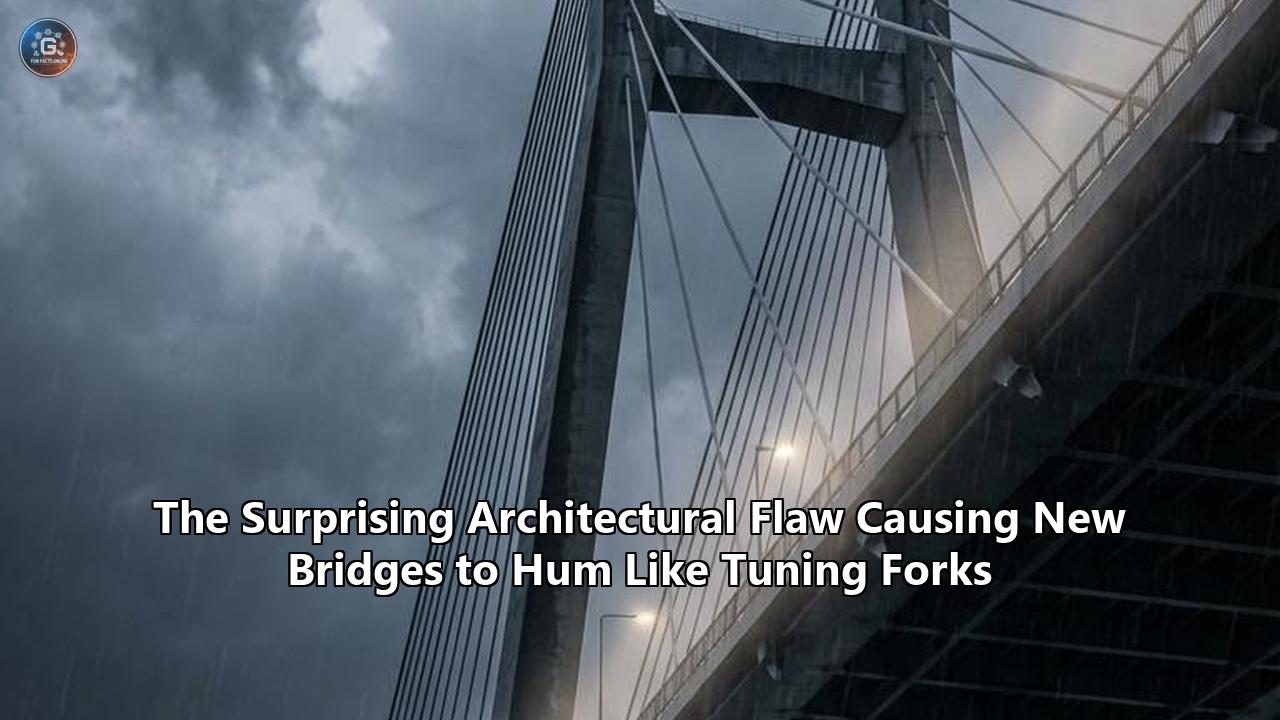
The Golden Gate Bridge, an engineering marvel that has defined the San Francisco skyline for nearly a century, was recently saved from a catastrophic structural vulnerability. To protect the suspension bridge from increasingly severe weather and potential 100-mph wind events, the Golden Gate Bridge, Highway and Transportation District initiated a $12 million aerodynamic retrofit. Engineers systematically removed the bridge’s original, bulky sidewalk safety railings and replaced them with 12,000 significantly narrower, highly aerodynamic vertical slats. The primary objective was achieved: the bridge’s wind resistance was upgraded from a dangerous 70 mph threshold to a highly secure 100 mph capacity.
But the structural triumph immediately triggered an unprecedented urban nuisance. As high winds whipped off the Pacific Ocean and passed through the newly installed western railing, the 12,000 slim metal slats began to act precisely like the reeds of a gargantuan woodwind instrument. The bridge began to sing. Emitting a massive, inescapable hum pitched consistently at the musical note A, the structure broadcasted a low-frequency drone that penetrated residential neighborhoods up to five miles away, reaching as far as Berkeley.
Bridge officials were forced to quickly approve a $450,000 mitigation project, deploying specialized U-shaped aluminum clips fitted with rubber sleeves to dampen the vibrations without undoing the vital aerodynamic upgrades.
This incident is not an isolated local curiosity; it exposes a critical blind spot in modern civil engineering. As climate change accelerates and municipalities scramble to retrofit aging infrastructure against extreme weather, structural engineers are aggressively altering the aerodynamic profiles of long-span bridges worldwide. The San Francisco incident provides a real-time case study into the unintended consequences of these rapid structural modifications. By optimizing purely for wind resistance while entirely sidelining acoustic outputs, engineers inadvertently transformed essential infrastructure into a source of severe environmental noise pollution.
To understand the trajectory of global infrastructure modernization, we must systematically analyze this architectural oversight. The fallout extends far beyond a single bridge, fundamentally altering how civil engineers approach environmental impact, municipal policy, and the strict technical requirements of aerodynamic testing.
The Mechanics of the Hum: When Infrastructure Becomes an Instrument
To grasp the magnitude of this engineering oversight, it is necessary to examine the specific fluid dynamics at play. When architects and structural engineers attempt to explain why bridges hum under specific environmental conditions, the answer invariably points to a phenomenon known as von Kármán vortex shedding.
When a fluid—in this case, high-velocity wind—flows past a blunt or semi-blunt object like a bridge handrail slat, the airflow separates. As the air detaches from the surface of the object, it creates alternating low-pressure zones, or vortices, on the downstream side. These vortices shed in a highly predictable, alternating pattern. If the frequency of this shedding aligns with the natural mechanical resonant frequency of the object itself, the object begins to vibrate.
In the case of the Golden Gate Bridge retrofit, the original, wider handrail slats displaced wind inefficiently, but their mass and width meant their resonant frequency rarely interacted cleanly with the shedding vortices. They were aerodynamically dangerous but acoustically silent. The new, thinner slats were explicitly designed to slice through the air, drastically reducing drag and allowing wind to pass freely across the bridge deck. However, their slender, uniform profile inadvertently created the perfect conditions for resonance.
When sustained winds hit the western railing from specific angles, the alternating vortices caused the 12,000 individual slats to vibrate in unison. Because the slats were physically uniform in size, tension, and material, they vibrated at the exact same frequency, acting as thousands of synchronized tuning forks. The resulting sound waves amplified one another, generating a singular, continuous drone that dominated the acoustic landscape of the Bay Area.
This exact mechanism—where aerodynamic flow induces unwanted vibration—is a known entity in aerospace and automotive design, disciplines broadly categorized under aeroacoustics. However, civil engineering has historically isolated structural aerodynamics from acoustics. Bridges are built to stand, not to be silent. The prevailing wisdom dictated that as long as vortex shedding did not result in a structural failure (a condition known as flutter), the design was successful. The recent events in California forcibly dismantle that limited framework.
The Catalyst: Why Aerodynamic Retrofits Are Surging
To evaluate who is affected by this design flaw, we must first establish why these retrofits are suddenly ubiquitous. The aggressive modification of bridge deck profiles is a direct response to a changing global climate and a haunting historical precedent.
The specter of the 1940 Tacoma Narrows Bridge collapse looms over all modern suspension bridge engineering. Just months after its completion, the Washington state bridge experienced 40-mph winds. The solid, plate-girder design of the bridge deck acted like a sail, catching the wind and inducing violent aeroelastic flutter. The bridge twisted uncontrollably until its structural integrity failed, sending the primary span crashing into the Puget Sound.
For decades, engineers avoided this by building heavy, stiff, truss-stiffened decks that allowed wind to pass through open gaps. But as global temperatures rise, the frequency and intensity of extreme wind events are increasing. The original 70-mph wind tolerance of the Golden Gate Bridge was deemed insufficient for the coming decades. Authorities modeled a "once-in-a-century" 100-mph wind event and realized the iconic structure could suffer catastrophic damage if its wind profile was not aggressively slimmed down.
This exact risk assessment is currently unfolding in transportation departments across the globe. From the tidal estuaries of the United Kingdom to the typhoon-prone straits of Japan, bridge authorities are actively seeking to reduce the wind load on aging suspension and cable-stayed bridges. The default solution is to replace thick, drag-heavy components with thin, aerodynamic alternatives.
Because the structural imperative to prevent a multi-billion-dollar collapse rightfully supersedes all other concerns, aerodynamic retrofits are being fast-tracked. But the subsequent noise pollution proves that solving the structural equation in a vacuum creates severe secondary crises.
Who is Affected: The Ripple Effects of the Acoustic Flaw
The fallout from this architectural oversight cascades through multiple distinct groups, from local residents bearing the immediate environmental burden to the municipal governments forced to foot the bill for experimental remediation.
The Immediate Community and Environmental Impact
The most direct victims of this engineering blind spot are the residents living within the acoustic blast radius of the bridge. The drone produced by the vibrating slats is not a localized inconvenience; it is a highly pervasive, low-frequency sound that travels exceptional distances over open water. Residents up to five miles away reported the noise penetrating double-paned windows and disrupting daily life.
Low-frequency noise pollution is notoriously difficult to block and has well-documented psychological and physiological impacts. Prolonged exposure to continuous, unnatural drones elevates cortisol levels, disrupts sleep patterns, and induces chronic stress. The community response was immediate and visceral, with residents describing the sound as everything from a "wheezing kazoo" to an unbearable psychological irritant akin to torture.
Furthermore, the environmental impact extends to local wildlife. The San Francisco Bay is a critical habitat for migratory birds and marine mammals. While human complaints dominate the headlines, the introduction of a massive, continuous 440 Hz frequency into the local ecosystem inevitably disrupts the acoustic environment relied upon by local fauna for navigation and communication.
Bridge Authorities and Municipal Budgets
For transportation authorities, the acoustic flaw manifested as a sudden, highly public relations crisis accompanied by unexpected financial liabilities. The Golden Gate Bridge, Highway and Transportation District had just executed a necessary, structurally sound $12 million safety upgrade, only to be vilified by the public they were trying to protect.
Authorities were placed in an impossible position: they could not revert to the old slats, as doing so would knowingly leave the bridge vulnerable to a catastrophic collapse in high winds. They were forced to maintain the offending structure while simultaneously funding an emergency research and development program to invent a fix. This effectively redirected hundreds of thousands of dollars in public funds—ultimately costing $450,000 for the manufacturing of custom dampening clips—away from other critical infrastructure maintenance.
The Structural Engineering Sector
For civil engineers and architectural firms, the humming bridge is a jarring professional wake-up call. It exposes a systemic flaw in the testing and validation pipelines used to approve multi-million-dollar public works.
Prior to the retrofit, the new aerodynamic slats were heavily tested in wind tunnels. However, these tests utilized scale models. In fluid dynamics, scaling down a physical model alters the Reynolds number—a dimensionless quantity used to predict fluid flow patterns. While scale models are highly effective at predicting massive structural forces like lift, drag, and catastrophic flutter, they are frequently inadequate for predicting fine-scale aeroacoustic phenomena. The engineers accurately proved the bridge would stand, but the scaled-down models failed to replicate the precise vortex shedding frequency that would cause the actual, full-sized aluminum slats to ring.
This failure places the engineering sector under intense scrutiny, forcing firms to rapidly re-evaluate how they test for aerodynamic compliance before approving similar retrofits worldwide.
What Changes: The Short-Term Remediation Strategy
The immediate response to the humming bridge dictates exactly how future architectural flaws of this nature will be handled. The short-term consequences involve a frantic pivot from theoretical modeling to physical, full-scale mitigation.
The $450,000 Retrofit of the Retrofit
Because the structural integrity of the bridge was paramount, any acoustic fix could not compromise the newly achieved 100-mph wind rating. Engineers could not block the airflow; they had to disrupt the precise uniformity of the vortex shedding.
The solution developed by acoustic and aerodynamic specialists involved the mass production of 12,000 bespoke U-shaped aluminum clips, each lined with a highly durable rubber sleeve. These clips were designed to be manually attached to the edge of every single vertical slat on the western railing.
This micro-retrofit accomplishes two specific physical tasks. First, the aluminum clip subtly alters the blunt profile of the slat, tripping the airflow just enough to disrupt the uniform detachment of the alternating vortices. By scrambling the wake, the aerodynamic force driving the vibration is drastically reduced. Second, the rubber sleeve acts as a mechanical dampener. Even if the wind manages to induce some localized vortex shedding, the rubber absorbs the kinetic energy before it can trigger the resonant frequency of the metal slat.
This fix, slated to cost nearly half a million dollars, reduces the acoustic output by an estimated 75%. However, the logistical complexity of manually installing 12,000 individual clips over open water, while navigating high winds and active traffic, underscores just how expensive and inefficient post-construction acoustic mitigation truly is.
The Shift to 1:1 Scale Wind Tunnel Testing
The most immediate operational change occurring within the civil engineering industry is the abandonment of purely scaled wind tunnel testing for detailed deck components.
Transportation authorities are no longer accepting scaled extrapolations for handrails, fairings, and pedestrian barriers. To ensure the $450,000 clip solution would actually work, engineers were forced to construct a full-size, 1:1 scale replica of a bridge railing section and test it inside a specialized wind tunnel. Moving forward, any project that alters the aerodynamic profile of a major bridge will likely require full-scale aeroacoustic testing of its component parts before a single piece of steel is ordered.
Long-Term Consequences: Redefining Infrastructure Design
As the immediate crisis is contained, the long-term consequences of this architectural oversight are beginning to permanently alter the foundations of infrastructure design, municipal policy, and structural modeling.
The Mandatory Integration of Aeroacoustics
Historically, civil engineering and aeroacoustics existed in separate silos. Moving forward, the integration of the two disciplines will become a mandatory requirement for public infrastructure projects.
When evaluating why bridges hum under new design parameters, engineers realize that fluid-structure interaction (FSI) models must now output acoustic data alongside structural data. Modern Computational Fluid Dynamics (CFD) software is being rapidly upgraded to simulate the sound generated by wind passing over proposed structures. In the next decade, architectural firms bidding on bridge retrofits will be required to submit "Acoustic Impact Thresholds" as part of their standard structural viability reports. A bridge that is structurally invincible but acoustically intolerable will be rejected at the design phase.
Updates to Environmental Impact Reports (EIR)
Municipal governments are equally affected by this paradigm shift. Currently, Environmental Impact Reports (EIRs) for bridge construction focus heavily on localized construction noise—the temporary sound of jackhammers, pile driving, and heavy machinery. They rarely account for the permanent acoustic signature of the finished structure interacting with the local climate.
City planners and environmental regulatory bodies are actively revising their guidelines to prevent future acoustic disasters. We will see the implementation of stringent, legally binding decibel limits for wind-induced infrastructure noise. If a proposed aerodynamic retrofit projects an acoustic output exceeding these thresholds in a 50-mph wind, the design will be legally blocked. This forces a massive regulatory hurdle onto the desks of transportation departments, complicating their ability to quickly fortify bridges against climate change.
The End of Uniform Design Elements
The most visible long-term consequence will be an aesthetic shift in how bridges are built. The humming phenomenon relies heavily on uniformity. The 12,000 identical slats on the Golden Gate Bridge vibrated at the exact same frequency, amplifying the sound.
To prevent this tuning-fork effect, future aerodynamic retrofits will likely abandon uniformity in favor of randomized or mathematically varied design elements. We will begin to see bridge railings and wind fairings designed with varying thicknesses, asymmetric spacing, or alternating materials. By intentionally designing components with slightly different natural resonant frequencies, engineers can ensure that even if vortex shedding occurs, the individual parts will vibrate at conflicting pitches, effectively canceling each other out rather than amplifying into a unified roar. The hyper-uniform, sleek aesthetics of 20th-century bridge design will gradually give way to more complex, staggered profiles dictated by acoustic necessity.
Forward-Looking Perspective: What to Watch For Next
The era of the "silent" bridge has ended; the era of the actively managed aeroacoustic structure has begun. As we look to the immediate future of global infrastructure, several critical developments are poised to emerge from the lessons learned in San Francisco.
First, watch for a surge in preemptive acoustic retrofits on other major suspension bridges. As climate mandates require older structures—such as the George Washington Bridge in New York or the Verrazzano-Narrows Bridge—to upgrade their wind profiles, engineering firms will be forced to apply the U-clip dampening technology proactively. The $450,000 fix pioneered in California will likely become a standard, patented component in the global supply chain for bridge maintenance.
Second, the structural engineering sector is approaching a breakthrough in passive noise cancellation. Rather than bolting rubber clips onto metal slats post-construction, material scientists are developing new composite alloys and 3D-printed concrete variants that are inherently highly damped. These materials possess the high tensile strength required to withstand hurricane-force winds but lack the acoustic resonance of standard extruded aluminum or steel.
Finally, we are witnessing the birth of "smart" aerodynamic infrastructure. The next generation of long-span bridges may feature dynamic wind fairings—components that mechanically alter their angle or shape based on real-time wind speed data. By actively managing the airflow across the deck, these automated systems could simultaneously achieve optimal wind resistance and zero acoustic output, eliminating the vortex shedding problem entirely.
The surprising architectural flaw that turned a vital safety retrofit into a massive urban noise violation serves as a crucial inflection point. It has forcibly reminded the engineering world that infrastructure does not exist in a vacuum. A bridge is not merely a mathematical equation of load and wind resistance; it is a physical entity that interacts violently with its environment. As extreme weather accelerates the need for structural fortification, the mandate is no longer just to ensure the bridge remains standing. It must also remain quiet.
Reference:
- https://www.theguardian.com/us-news/2021/dec/17/golden-gate-bridge-eerie-hum-silenced-2022
- https://www.thestructuralengineer.info/news/solution-under-way-for-golden-gate-bridge-humming
- https://www.sfchronicle.com/sf/article/The-rain-made-the-Golden-Gate-Bridge-hum-louder-16569428.php
- https://www.youtube.com/watch?v=qXfGqV7i3yM
- https://www.fox7austin.com/news/theres-a-plan-to-stop-the-humming-sound-on-the-golden-gate-bridge
- https://www.mdpi.com/2674-032X/5/4/27
- https://www.bridgeweb.com/Golden-Gate-Bridge-sings-after-retrofit/7299
- https://www.engineeringcivil.com/how-does-the-shape-of-bridge-deck-affect-the-aerodynamic-behaviour.html
- https://forcetechnology.com/no/services/aerodynamics/bridge-aerodynamics
- https://www.youtube.com/shorts/Zk2UPi7YfvE?app=desktop
- https://www.youtube.com/watch?v=A-GwGKxwSEE