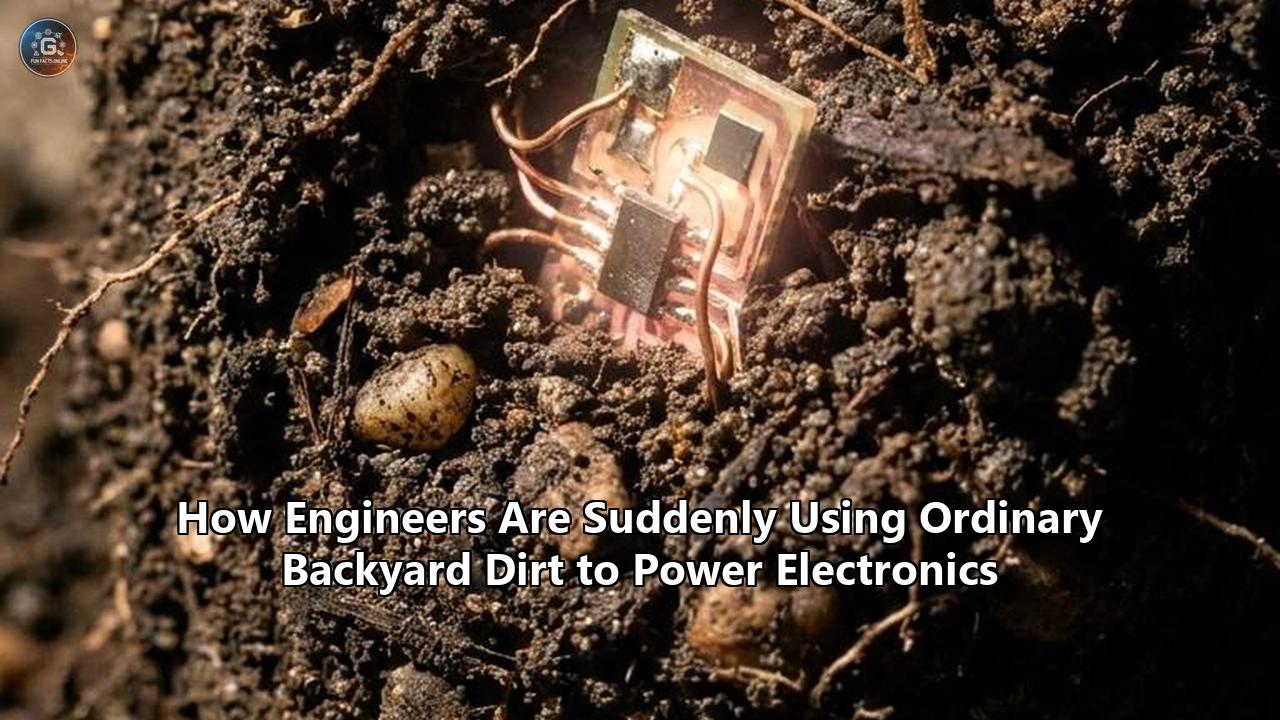
On the morning of May 1, 2026, engineers across a dozen large-scale commercial farming operations in California’s San Joaquin Valley began quietly removing thousands of lithium-ion batteries from their underground irrigation sensors. In their place, technicians dropped small, paperback-sized cartridges of carbon felt and conductive metal directly into the dirt. There are no cables attached to these new power sources, and there are no replacement schedules logged in the farm management software. As soon as the soil settled around the cartridges, naturally occurring microbes began consuming organic matter, releasing a steady trickle of electrons, and powering the sensor network back up.
These networks are not expected to be dug up again for the rest of the decade.
The mass deployment underway this spring marks the commercial activation of computing infrastructure powered entirely by dirt. For decades, the concept of harvesting electricity from the metabolic processes of subterranean bacteria was relegated to laboratory demonstrations and university science fairs. Now, high-yield agriculture and wetland monitoring projects are aggressively pivoting toward this battery-free paradigm. The shift is driven by a stark economic and environmental reality: the internet of things (IoT) has scaled to billions of decentralized endpoints, and the logistics of manufacturing, burying, and eventually replacing millions of toxic chemical batteries across vast physical landscapes has become an unsustainable operational bottleneck.
The solution emerging in the fields today relies on advanced microbial fuel cells (MFCs) engineered specifically for unpredictable terrestrial environments. By reconfiguring the physical geometry of these cells to survive both drought and flood conditions, developers have crossed the critical threshold where the power generated outlasts the physical degradation of the sensors themselves.
This is the timeline of how hardware engineers learned to treat the earth itself as a permanent, living battery, and why the sudden viability of soil based electronics is currently rewriting the economics of precision agriculture and decentralized computing.
The Impending Trillion-Node Bottleneck
To understand why major agribusinesses and environmental agencies are moving aggressively toward microbial power in 2026, one must examine the scaling crisis that hit precision agriculture and environmental monitoring over the last three years.
By the early 2020s, agronomic science had proven that hyper-local data collection could drastically reduce agricultural resource waste. Deploying dense arrays of sensors to measure soil moisture, temperature, electrical conductivity, and nutrient levels allowed farm management systems to micro-dose fertilizer and optimize irrigation schedules. Real-time telemetry could reduce water usage by up to 30 percent in water-stressed regions, a vital metric as climate volatility increased and aquifer levels dropped globally.
However, the hardware deployment curve hit a harsh physical limit. If an operation wanted to monitor 10,000 acres at a high resolution, it needed to deploy thousands of remote wireless sensors. Every single one of those nodes required power.
Solar panels were the initial default for remote deployments, but they proved highly vulnerable in agricultural and environmental settings. Canopy cover from maturing crops blocked sunlight, while dust, mud, and bird droppings degraded panel efficiency. More importantly, solar-powered systems still required chemical batteries to store energy for nighttime operations and overcast days.
The reliance on lithium-ion and alkaline batteries created an enormous secondary problem. The lifespan of a standard coin cell or small battery pack in harsh, temperature-fluctuating environments is notoriously short. Across a massive network, hardware failure rates compounded. Farm operators found themselves dispatching technicians daily just to dig up dead sensors, replace batteries, and recalibrate equipment. The operational expenditure (OPEX) of maintaining the power supply quickly eclipsed the value of the data being collected.
Beyond the immediate financial cost, the environmental contradiction of "smart" agriculture became impossible to ignore. The core mission of deploying these sensors was to protect the environment and optimize natural resources, yet the deployment strategy required burying millions of toxic, heavy-metal-laden batteries in the very soil being monitored.
Bill Yen, a lead researcher whose work at Northwestern University and Stanford laid the foundation for the hardware being deployed today, summarized the scaling problem bluntly during early prototype development: "If we imagine a future with trillions of these devices, we cannot build every one of them out of lithium, heavy metals and toxins that are dangerous to the environment."
The technology sector needed an alternative power source that was intrinsically biocompatible, capable of functioning entirely underground, and resilient enough to operate without human intervention for years at a time. The answer already existed beneath their feet, but it had stubbornly resisted commercialization for more than a century.
A Century in the Dark: The 1911 Discovery
The biological engine driving today's agricultural deployments was not engineered in a modern laboratory; it evolved billions of years ago. Specific species of bacteria, most notably those in the genus Geobacter and Shewanella, possess a unique metabolic capability. As they consume and break down organic carbon in the dirt, they must dispose of excess electrons. Unlike humans and other oxygen-breathing organisms that transfer electrons to oxygen inside their bodies, these specific microbes—known as exoelectrogens—can transfer electrons outside of their cell walls to external conductive materials.
They literally "breathe" metals.
This phenomenon was first documented in 1911 when Michael Cressé Potter, a botanist at the University of Durham, managed to generate a weak electrical current from Saccharomyces cerevisiae (brewer's yeast). Potter’s demonstration proved that living microorganisms could serve as the active agents in a fuel cell, bypassing the need for highly refined chemical electrolytes.
In a traditional chemical battery, a reaction between an anode and a cathode forces electrons through an external circuit, providing power until the chemical reactants are depleted. In a microbial fuel cell (MFC), the exoelectrogenic bacteria act as the catalyst at the anode. As long as the bacteria have a food source (organic carbon naturally present in the soil) and an electron acceptor (the anode), the reaction continues perpetually.
Despite the elegance of the concept, microbial fuel cells languished as a laboratory curiosity for over a century. The core issue was the delicate biological and environmental balance required to keep the circuit running.
For a soil-based MFC to function, two contradictory conditions must be met simultaneously. First, the anode—where the bacteria colonize and transfer electrons—must be buried deep enough to remain consistently damp and largely free of oxygen (anoxic). If oxygen reaches the anode, the bacteria will simply transfer their electrons to the oxygen instead of the metal, and the electrical current halts. Second, the cathode—which receives the electrons after they travel through the sensor's circuitry—must be highly oxygenated to complete the chemical reaction by combining the electrons, oxygen, and hydrogen ions to form water.
In highly controlled environments like wastewater treatment plants, engineers could easily satisfy these conditions by pumping liquid over separated electrodes. By the early 2000s, sediment microbial fuel cells (SMFCs) were successfully tested in marine and wetland environments, where the permanent waterlogging maintained the anoxic conditions for the anode, while a floating cathode accessed the air.
But agricultural soil is chaotic. It cycles rapidly between being entirely flooded during irrigation and bone-dry during droughts. When researchers attempted to bury traditional, flat microbial fuel cells in standard dirt, the systems failed repeatedly. If the soil dried out, the anode lost its conductive connection to the bacteria. If the soil flooded, the cathode became submerged, cutting off its oxygen supply and choking the circuit.
The inability to engineer a physical casing that could withstand the volatile hydrology of normal, backyard dirt kept exoelectrogen power out of commercial technology for decades. It was a materials and geometry problem, waiting for a structural breakthrough.
The 2024 Geometry Redesign: Building the "Terracell"
The turning point that directly enabled today's commercial rollout occurred between late 2023 and early 2024, driven by a multi-institution research team featuring engineers from Northwestern University, Georgia Tech, Stanford, and the University of California systems. Led by researchers including Bill Yen, Josiah Hester, and George Wells, the team abandoned the traditional flat-plane designs of legacy fuel cells.
They realized that forcing both the anode and cathode to share a horizontal plane in fluctuating soil was mathematically doomed. Instead, the team redesigned the fundamental geometry of the power supply, creating a system that would eventually be dubbed the "Terracell".
The resulting hardware, roughly the size of a standard paperback book, relied on a vertical orientation. The engineers placed a carbon felt anode horizontally at the very bottom of the unit, burying it deep in the earth where moisture is most likely to be retained even during surface droughts.
Above this, they constructed a vertical, cylindrical cathode that extended upward, passing through the top layers of the soil and remaining flush with the surface. The brilliance of this design lay in the physical separation and the specialized materials used. The vertical cathode was coated in a specialized waterproofing material that allowed oxygen gas to pass through it while blocking liquid water.
This geometric configuration solved the century-old vulnerability of soil based electronics. If the field was heavily irrigated or flooded by a storm, the waterproofing on the vertical cathode prevented the system from drowning; it could still "breathe" oxygen from the air above. Conversely, if the field went through a dry period, the deeply buried anode remained in contact with the residual moisture trapped further beneath the surface.
When the researchers subjected this new geometry to rigorous testing, the results shattered previous limitations. Traditional soil MFCs required near-saturated environments to function. The Northwestern-led design generated consistent, stable power in soil with a volumetric water content of just 42 percent—conditions representing typical, non-flooded agricultural land.
Even more critically, the power output of this redesigned cell outpaced its predecessors by a massive margin. The vertical configuration generated on average 68 times more power than was required to run the baseline sensors they were testing. Furthermore, the physical endurance of the power unit was projected to outlast comparable battery technologies by at least 120 percent.
The researchers proved their concept by hooking the new soil-powered fuel cell to moisture and touch sensors (the latter mimicking wildlife tracking equipment). The system booted up, the sensors took their readings, and the data was successfully recorded.
However, generating power was only half the equation for decentralized computing. Transmitting the data out of the dirt without draining the fragile microbial power reserve required a separate feat of engineering physics.
Computing Without a Voice: The RF Backscatter Miracle
A major challenge in designing viable soil based electronics is the power asymmetry between sensing data and transmitting data. An environmental sensor measuring pH or moisture requires mere microwatts of power—well within the continuous trickle provided by microbial fuel cells. But activating a conventional radio transmitter (like Wi-Fi, Bluetooth, or even standard cellular modems) to send that data to a server requires sudden, massive spikes of electricity.
If a microbial fuel cell attempted to power a standard radio antenna directly, it would instantly drain its stored charge and the system would brown out. To make the 2024 soil computing breakthrough viable for mass agricultural deployment, the engineers had to eliminate the radio transmitter entirely.
They accomplished this using a technique called ambient radio frequency (RF) backscatter.
Instead of generating its own radio waves—which requires heavy power consumption—the soil-powered sensor was equipped with a specialized, ultra-low-power antenna designed to simply reflect existing radio signals. In practice, a central base station (often mounted on a nearby barn, tractor, or drone) emits a steady radio wave over the field. When the buried sensor needs to transmit a moisture reading, it rapidly toggles an electronic switch that changes the impedance of its antenna.
This toggling causes the antenna to alternate between absorbing the incoming radio wave and reflecting it back toward the base station. By controlling the timing of these reflections, the soil sensor encodes its data as a series of ones and zeros into the bouncing radio wave.
The base station receives the modified, reflected signal and decodes the sensor's readings. Because the sensor only acts as a dynamic mirror rather than a radio broadcaster, its power consumption drops by orders of magnitude. The microbial fuel cell can easily support the minuscule energy required to flip the impedance switch, allowing for continuous, real-time data transmission without ever depleting the biological battery.
This synthesis of vertical soil cell geometry and RF backscatter communications completed the puzzle. It proved that high-fidelity computing infrastructure could exist permanently in the dirt, powered by the dirt, communicating seamlessly with the above-ground world.
The Escalation: From Laboratory to the Fields (2025)
The transition from a successful academic paper in early 2024 to the mass commercial deployments of May 2026 required a frantic period of hardware integration and network scaling throughout 2025.
Initially, the academic breakthrough gained massive attention within industrial design and sustainability sectors. By late 2024, the "Terracell" concept had secured honorable mentions in elite design competitions, such as the Fast Company Innovation by Design Awards, signaling its readiness to move out of the university labs. Josiah Hester, directing the Ka Moamoa Lab, emphasized the immediate value proposition during this period: "Terracell could reduce e-waste and extend the useful lifetime of electronics deployed for agriculture, environmental monitoring, and smart cities".
Throughout 2025, commercial agricultural hardware manufacturers began licensing and adapting the vertical cell geometry. They faced a market desperate for better telemetry. Global agriculture was under immense pressure. Climate volatility was wreaking havoc on traditional planting calendars, input costs for synthetic fertilizers were spiking, and chronic labor shortages meant there were fewer farmhands available to manually scout fields.
The agricultural sector realized that the only way to maintain profit margins and crop yields was to fully embrace automation and hyper-precision data. In 2025, the market saw an expansion in what soil sensors could actually measure. Early moisture sensors evolved into dense, multi-parameter arrays capable of simultaneously reading soil salinity, pH balance, and precise macronutrient levels. Some advanced probes even began tracking carbon sequestration markers, allowing farmers to verify and sell carbon credits based on their regenerative farming practices.
But as the sensors became more complex, their reliance on seamless connectivity and persistent power became absolute. This is where the integration of soil-powered hardware met the expansion of Low-Power Wide-Area Networks (LPWAN).
Throughout 2025, rural connectivity protocols like LoRaWAN (Long Range Wide Area Network) and NB-IoT (Narrowband IoT) saw massive consolidation and cost reduction. These networks are specifically designed to listen for the faint, sporadic data packets generated by low-power edge devices. Farm operators began installing high-tower LoRaWAN gateways capable of covering thousands of acres.
By marrying the zero-maintenance microbial power supplies with the vast, low-overhead coverage of LoRaWAN, agricultural technology companies finally achieved the holy grail of digital farming: "deploy and forget" infrastructure.
Hardware teams refined the manufacturing of the carbon felt anodes, ensuring they could be mass-produced cheaply. They developed automated insertion tools that allowed tractors to inject the paperback-sized fuel cells directly into the earth at precise depths alongside the sensor arrays. The economics of connectivity shifted. Farm managers no longer had to budget for the thousands of hours previously required to hunt down and replace dead lithium batteries beneath crop canopies. The soil grid was becoming a permanent utility.
The 2026 Reality: The Economics of Perpetual Power
Today’s massive activation of these systems marks a fundamental shift in how the physical world interfaces with the digital one. The financial modeling dictating these deployments is heavily weighted toward eliminating operational disruption.
In high-value specialty crops—such as the almond orchards of California or the vineyards of Europe—irrigation timing is a microscopic science. Applying water at the wrong developmental stage can dilute sugar content in grapes or cause rot in root systems. Traditional battery-powered sensors frequently failed at these critical junctures; a battery dying in July meant a blind spot in the telemetry just when the heat index demanded precise water management.
With the microbial fuel cell infrastructure going live this month, that blind spot is eradicated. Because the exoelectrogens constantly feed on the naturally occurring organic carbon in the soil, the power supply is fundamentally tethered to the health of the field itself. George Wells, one of the co-authors of the original foundational research, summarized the paradigm shift: “These microbes are ubiquitous; they already live in soil everywhere. We can capture minute amounts of energy to fuel practical, low-power applications".
The current deployments are highly integrated. The sensors powered by the dirt are communicating directly with autonomous irrigation valves and automated fertilizer micro-dosing systems. If a microbial-powered sensor detects a localized drop in nitrogen, it bounces a backscatter signal to a drone or a central gateway, which then instructs an autonomous ground vehicle to navigate to that precise GPS coordinate and apply targeted nutrients.
This continuous, real-time feedback loop is dramatically shrinking the environmental footprint of large-scale farming. By completely automating the decision-making process based on highly accurate, uninterrupted soil data, farms are actively lowering synthetic chemical runoff into local watersheds.
Furthermore, the transition from lithium to soil based electronics within the agricultural sector is intercepting a growing regulatory crisis surrounding electronic waste. With IoT device counts projected to crest into the trillions over the coming decades, environmental protection agencies globally have been bracing for an avalanche of discarded micro-batteries. The hardware entering the soil today sidesteps this entirely. The carbon felt, conductive metals, and simple circuit boards represent a fraction of the toxic load inherent in legacy battery chemistry. If a tractor accidentally destroys a sensor during tilling, there is no risk of a punctured lithium pouch leaching into the groundwater.
The economic case is no longer theoretical; the deployment of networked soil sensors actively reduces water usage for irrigation by an average of 20 to 30 percent, generating a rapid return on investment and driving adoption across regions gripped by chronic water scarcity. With the OPEX of battery replacement removed from the ledger, the total cost of ownership for a dense sensor network has plummeted, allowing medium-scale operations to finally afford the kind of precision analytics previously reserved for massive corporate farms.
The Next Frontier: Expanding the Microbial Grid
While precision agriculture represents the immediate, driving market for this technology in 2026, the implications of perpetual, decentralized power extend far beyond farming. The escalation of this technology is already pointing toward broader civic and environmental engineering applications.
One of the most pressing unresolved frontiers is the deployment of soil-powered hardware in remote environmental conservation. Wetlands, peat bogs, and coastal estuaries are critical carbon sinks, and monitoring their health is vital for global climate modeling. However, these are notoriously hostile environments for traditional electronics. They are persistently flooded, shaded by dense vegetation, and geographically isolated.
The vertical geometry that allows current agricultural fuel cells to survive flooding makes them ideal candidates for deep-swamp deployment. Pilot programs are currently being drafted to drop these sensors into remote wetlands to track water quality, detect the presence of heavy metal pollutants, and monitor wildlife movement—all without the need to ever send a technician back into the marsh to swap a battery.
Simultaneously, engineers are exploring how to scale up the raw power output of microbial cells for active infrastructure. While the microwatts generated by a single, paperback-sized cell are sufficient for telemetry and edge computing, stacking multiple cells in a series can generate higher voltages.
This concept traces back to field tests conducted in 2019 in Icapuí, a remote fishing village in North-East Brazil. In that proof-of-concept, researchers from the University of Bath buried a networked array of soil microbial fuel cells and connected them to a larger battery. The continuous trickle of microbial electricity was stored up and used to power an electrochemical reactor that successfully purified three liters of drinking water per day—enough to sustain a person's daily hydration needs in a region where rainwater harvesting was historically dangerous due to contamination.
Scaling that water purification capability using the highly efficient 2024 cell geometries could provide a template for decentralized, self-powering water treatment systems in off-grid communities globally. If the dirt itself can power the purification of the water that flows through it, the requirements for heavy infrastructure in the developing world could be radically altered.
Furthermore, the computing hardware itself is evolving. As ultra-low-power microprocessors become more capable, the ability to run complex algorithms directly at the edge—right there in the dirt—is becoming a reality. Rather than transmitting raw moisture and temperature data to a cloud server for analysis, the next generation of soil based electronics will likely run localized machine-learning models. A sensor could monitor its own micro-environment, learn the specific drainage patterns of its exact location over multiple seasons, and only transmit an alert when it detects a genuine anomaly, further reducing power draw and network congestion.
There are still significant engineering hurdles to clear. Power management circuitry must become even more efficient at regulating the erratic voltage spikes that biological organisms sometimes produce. Soil conditions vary wildly by region, and the specific mix of exoelectrogenic bacteria in the volcanic ash soils of Hawaii differs from the heavy clay of the American Midwest; engineers must ensure the carbon anodes are universally hospitable to diverse microbial colonies.
But the physical activation of large-scale networks today proves that the fundamental barrier has been broken. The computing industry has spent decades attempting to build enclosures that protect delicate electronics from the chaotic, wet, dirty reality of the physical world. Today, hardware engineers have officially stopped fighting the dirt. By inviting the bacteria in, treating organic decomposition as a localized power utility, and stripping out the toxic reliance on chemical batteries, they have created a digital network that operates in harmony with the biome it measures.
The timeline of technology is rarely defined by when an idea is first conceived—Potter knew the earth was electric over a century ago. It is defined by when the engineering finally catches up to the biology. As agricultural operations wire up their fields this spring with elements as simple as carbon and felt, they are ushering in an era of computing that is literally grounded. The machines are now feeding off the earth, and the earth, in turn, is finally getting a voice that won't die when the battery runs out.