Four hundred meters beneath the forested hills of the Ardennes along the Franco-Belgian border, a cavernous room houses thirty cubic meters of scintillator liquid shielded by tons of steel and oil. The Chooz Nuclear Power Plant above had gone completely dark for scheduled maintenance and refueling. Both pressurized water reactors were switched off; their control rods were fully inserted, their fission chains extinguished. By all conventional metrics of power generation, the cores were dead.
Yet deep underground inside the Double Chooz experiment, the sensors registered a persistent, rhythmic particle whisper.
Over a 17.2-day observation window in which both reactor units remained offline, physicists recorded approximately 100 inverse beta-decay events. Subatomic messengers were pouring out through the heavy reactor pressure vessels, traversing hundreds of meters of solid rock, and lighting up the underground detector. The Max Planck Institute for Nuclear Physics (MPIK) team, led by physicists Anthony Onillon and Thierry Lasserre, confirmed in Physical Review Letters what nuclear theorists had calculated for decades: shut down nuclear cores do not go silent. They radiate a sustained, multi-layered phantom emission that persists for years across both electromagnetic and subatomic spectra.
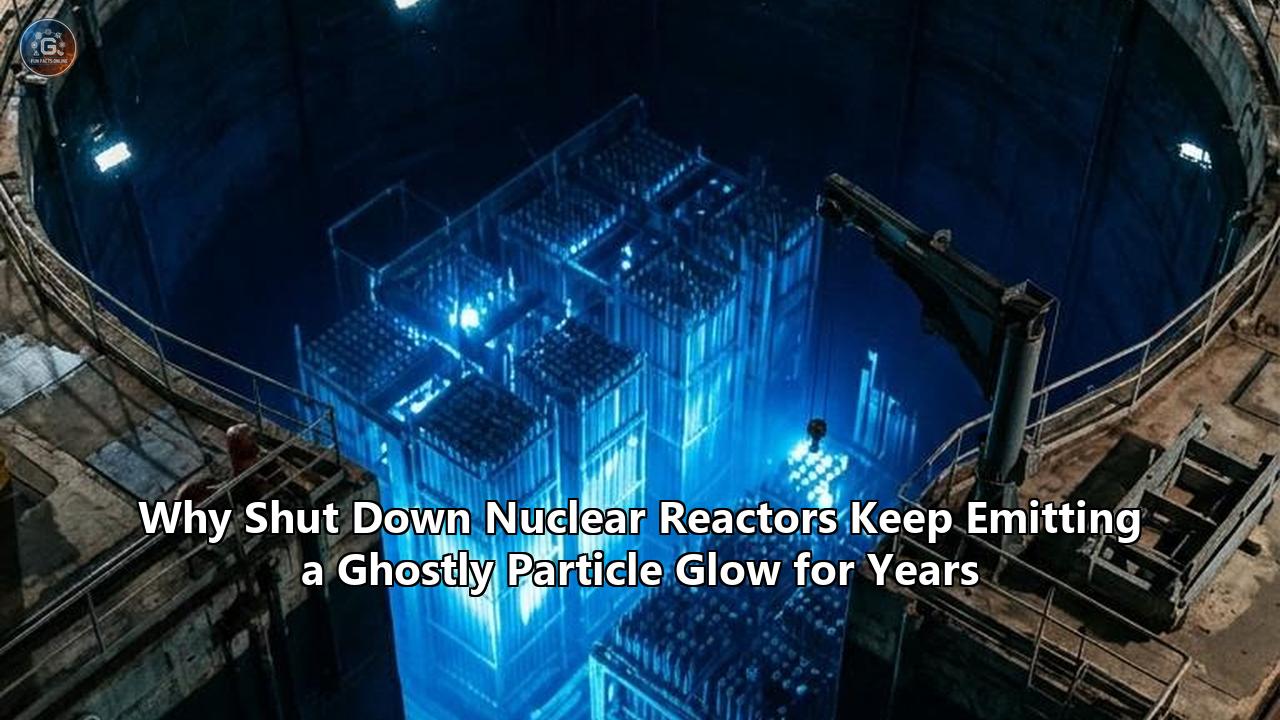
Stand on the gantry above a commercial reactor’s spent fuel pool, dim the high-bay sodium lights, and a parallel phenomenon unfolds in the visual spectrum. Bathed beneath 40 feet of demineralized water, fuel assemblies removed from service years prior radiate a mesmerizing, electric sapphire light.
This visual nuclear reactor glow is accompanied by an invisible, high-energy particle storm. Understanding why this dual emission continues long after a plant is decommissioned requires following an intricate evidence trail—one that spans relativistic optical mechanics, isotopic decay chains, and the elusive physics of fundamental particles.
The Optical Illusion: Breaking the Speed of Light in Water
To understand the visible luminescence, one must first confront a common misconception: the idea that fuel assemblies glow because radioactive material inherently shines. Uranium dioxide pellets inside a fresh, unburned fuel rod are matte black ceramics that emit no visible light. The electric blue radiance only emerges after the fuel has undergone intense neutron bombardment inside an operating core, and it only becomes visible when those spent assemblies are submerged in a dielectric medium like water.
Cherenkov Shockwave Geometry:
-----------------------------------------------------------
Particle Path (v > c/n)  ------>  [ Relativistic Electron ]
                                      / \
                                     / θ \   Constructive Wavefront
                                    /     \  (Visible Blue Photons)
                                   /       \
Condition for Emission: cos(θ) = 1 / (n * β)
-----------------------------------------------------------
"People frequently assume they are seeing direct radioactive emission or some form of chemical phosphorescence," explains Dr. Elena Rostova, an optical physicist specializing in radiation transport. "In reality, you are witnessing an optical shockwave. It is the electromagnetic equivalent of an aircraft breaking the sound barrier."
The phenomenon is Cherenkov radiation, first characterized systematically by Soviet physicist Pavel Cherenkov in 1934 and explained theoretically by Ilya Frank and Igor Tamm. While nothing can exceed the cosmic speed of light in a vacuum ($c \approx 299,792\text{ km/s}$), light slows down when traversing dense media. In water, which has a refractive index of $n \approx 1.33$, the phase velocity of light drops to roughly $225,000\text{ km/s}$—a 25 percent reduction.
When high-energy charged particles traverse water at speeds exceeding this local threshold ($v > c/n$), they outrun the electromagnetic fields they create. As the charged particle tears through the water, it polarizes the electron clouds of adjacent water molecules. As those molecules snap back to their equilibrium state, they emit electromagnetic waves.
Under normal speeds, these waves destructively interfere and cancel out. But when the particle travels faster than the speed of light in that liquid, the wavefronts pile up behind it, constructively interfering along a coherent conical wavefront defined by the Cherenkov angle:
$$\cos\theta_C = \frac{1}{n\beta}$$
Where:
- $\theta_C$ is the emission angle of the photon cone.
- $n$ is the refractive index of the medium ($1.333$ for pure water).
- $\beta$ is the particle's velocity relative to the vacuum speed of light ($v/c$).
Because the Frank-Tamm formula dictates that the number of emitted photons per unit path length is inversely proportional to the square of the wavelength ($dN/dx \propto 1/\lambda^2$), the emission is heavily weighted toward the high-frequency, short-wavelength end of the spectrum: ultraviolet, violet, and deep blue. Human retinas perceive this skewed distribution as that unmistakable, ethereal blue hue.
Yet this explanation raises an immediate physical paradox. The spent fuel rods in storage pools are hermetically sealed inside thick zirconium-alloy cladding tubes designed to withstand extreme thermal and mechanical loads. Beta particles (electrons) emitted by decaying fission products inside the fuel matrix cannot penetrate through the solid metal walls of the cladding.
How do relativistic electrons appear in the surrounding water if they cannot escape the fuel rods?
The Compton Trail: How Sealed Fuel Ignites the Water
The resolution to this mystery lies in a secondary interaction known as Compton scattering.
Inside the spent fuel matrix, unstable fission products undergo continuous beta decay, releasing high-energy electrons alongside intense gamma-ray photons. While the beta particles are stopped cold by the fuel pellets and zirconium cladding, the uncharged, highly penetrating gamma rays slice straight through the metal casing into the surrounding water.
Isotopic Decay Chain -> Cladding Penetration -> Cherenkov Light:
+------------------------+      +--------------------+      +--------------------+
| Unstable Fission Core  | ---> | Gamma Ray (γ)      | ---> | Water Medium (H2O) |
| (Cs-137, Sr-90 Decay)  |      | Escapes Cladding   |      | Compton Collision  |
+------------------------+      +--------------------+      +--------------------+
                                                                      |
                                                                      v
                                                            [ Superluminal Electron ]
                                                                      |
                                                                      v
                                                            [ Nuclear Reactor Glow ]
Once inside the water, these gamma photons collide with atomic electrons bound in hydrogen and oxygen molecules. In a high-energy collision, the gamma photon transfers a massive portion of its kinetic energy to the orbital electron, ejecting it from the atom at relativistic speed.
To initiate Cherenkov radiation in water, an electron must achieve a minimum kinetic energy:
$$E_{th} = m_e c^2 \left( \frac{1}{\sqrt{1 - (1/n)^2}} - 1 \right) \approx 175\text{ keV}$$
A single gamma ray emitted by Cesium-137 (662 keV) or Cobalt-60 (1.17 MeV and 1.33 MeV) possesses more than enough energy to kick a water electron past the 175 keV threshold. Once freed, these superluminal electrons hurtle through the pool for a fraction of a millimeter, displacing local molecular charges and shedding thousands of Cherenkov photons before dropping below relativistic velocities.
The visible nuclear reactor glow seen in spent fuel pools is therefore not the product of bare beta radiation, but an indirect optical emission driven by Compton-scattered electrons energized by escaping gamma rays.
The Residual Forge: The Isotopes That Power the Decades-Long Burn
When an operating nuclear reactor scrams, control rods made of boron, cadmium, or hafnium drop into the core within seconds, absorbing the thermal neutrons that sustain the chain reaction. Prompt fission drops to zero almost instantly.
Thermal output does not collapse to zero, however. A newly shut down 3,000-megawatt thermal ($MW_{th}$) reactor continues generating approximately 200 megawatts of thermal energy immediately following shutdown purely from decay heat—the thermal energy released as unstable fission products transmute into stable elements.
Post-Shutdown Thermal Output Dynamics:
--------------------------------------------------------------
Time Post-Scram        Thermal Power Output    Dominant Mechanism
--------------------------------------------------------------
0 seconds              ~200 MWth (7% of nominal) Short-lived fission products
1 hour                 ~30 MWth (1%)            I-131, Xe-135, Ba-140
1 month                ~3 MWth (0.1%)           Ce-144, Ru-106, Zr-95
1 year                 ~600 kWth                Cs-137, Sr-90, Pm-147
10 years               ~100 kWth                Cs-137, Sr-90, Pu-238, Am-241
--------------------------------------------------------------
The isotopic composition of spent nuclear fuel is a shifting chemical ecosystem. Immediately after shutdown, short-lived, violently radioactive isotopes dominate the radiological inventory:
- Iodine-131 ($t_{1/2} = 8.02\text{ days}$): Emits energetic beta particles and 364 keV gamma rays.
- Xenon-135 ($t_{1/2} = 9.14\text{ hours}$): A potent neutron poison that rapidly decays away.
- Barium-140 / Lanthanum-140 ($t_{1/2} = 12.7\text{ days} / 1.68\text{ days}$): Yields exceptionally hard gamma emissions up to 2.5 MeV.
Within several months, these volatile isotopes extinguish themselves. The long-term optical and thermal emissions transition to medium-lived fission products, principally pairs of isotopes that operate as long-term isotopic engines:
The Cesium-137 / Barium-137m Engine
Cesium-137 possesses a half-life of 30.08 years. It decays via beta-minus emission into a metastable isomer, Barium-137m, which has a half-life of just 2.55 minutes. As Barium-137m drops to its ground state, it releases a characteristic 662 keV gamma ray. This single decay chain accounts for the vast majority of penetrating gamma radiation leaving spent fuel assemblies between 5 and 50 years after removal from the reactor.
The Strontium-90 / Yttrium-90 Cascade
Strontium-90 ($t_{1/2} = 28.79\text{ years}$) decays by emitting a weak 546 keV beta particle into Yttrium-90 ($t_{1/2} = 64\text{ hours}$). Yttrium-90 then decays into stable Zirconium-90, releasing an energetic beta particle with an endpoint energy of 2.28 MeV.
Cobalt-60 Activation Products
Beyond the fuel itself, the structural steel of the reactor pressure vessel, grid spacers, and fuel assembly hardware contains trace amounts of Cobalt-59. Under continuous neutron flux during reactor operation, this material absorbs neutrons to become Cobalt-60 ($t_{1/2} = 5.27\text{ years}$), which emits paired high-energy gammas at 1.17 MeV and 1.33 MeV.
Together, these isotopes transform spent fuel into a continuous gamma-ray radiator that sustains the optical Cherenkov glow for decades in wet storage.
The Subatomic Ghost: Capturing the Antineutrino Whisper
While the optical luminescence can be shielded and extinguished beneath several meters of water, another component of the shutdown reactor's particle output escapes effortlessly.
Every time an unstable fission product undergoes beta-minus decay, a down quark inside a neutron converts into an up quark, converting the neutron into a proton and ejecting an electron and an electron antineutrino ($\bar{\nu}_e$):
$$n \rightarrow p + e^- + \bar{\nu}_e$$
Antineutrinos are nearly massless fundamental particles with zero electrical charge. They interact with ordinary matter exclusively through the weak nuclear force and gravity. A single antineutrino can pass through a light-year of solid lead without striking an atom.
Inverse Beta Decay (IBD) Detection Mechanism:
--------------------------------------------------------------------------
Incoming Antineutrino (anti-ν_e) + Proton (p) inside Liquid Scintillator
   │
   ├──> Positron (e+) ──> Annihilates with e- ──> Prompt Flash (1-8 MeV)
   │                                                     │
   │                                                     │ (~30 µs delay)
   │                                                     v
   └──> Neutron (n)  ──> Captured by Gadolinium ──> Delayed Burst (8 MeV)
--------------------------------------------------------------------------
For decades, neutrino physicists assumed that once a reactor was switched off, the antineutrino flux would collapse so drastically that detection would become virtually impossible against cosmic background noise.
The Double Chooz collaboration challenged this assumption. Operating an underground liquid scintillator detector 400 meters away from two commercial 4.25 $GW_{th}$ reactor cores in France, the researchers monitored the site during an extended shutdown period.
The detection relies on inverse beta decay (IBD):
$$\bar{\nu}_e + p \rightarrow e^+ + n$$
When an antineutrino strikes a free proton (a hydrogen nucleus) in the liquid scintillator, it generates two distinct signals separated by time:
- The Prompt Signal: The positron slows down and annihilates with an electron, releasing two 511 keV gamma rays that generate an immediate flash of light.
- The Delayed Signal: The neutron wanders through the liquid for approximately 30 microseconds until it is captured by a nucleus (often Gadolinium doped into the scintillator), triggering an 8 MeV cascade of gamma rays.
"Detecting the tiny residual signal after shutdown required exceptionally low backgrounds and careful analysis techniques developed over many years," explained co-lead author Anthony Onillon of MPIK. "Antineutrinos interact only extremely rarely with matter. However, when one interacts within the detector, this characteristic double-light signal can be distinguished clearly from environmental background events."
The collaboration's analysis of 17.2 days of reactor-off data revealed roughly 100 candidate antineutrino interactions originating from long-lived beta-decaying isotopes within the core and adjacent storage pools. The spectral energy distribution matched the team's theoretical decay simulations.
Even when fully powered down, a nuclear reactor maintains an inescapable subatomic footprint.
The Safeguards Vanguard: Weaponizing the Glow
The persistence of these dual emissions is far more than a physical curiosity; it forms the technological backbone of global non-proliferation monitoring.
Under the Treaty on the Non-Proliferation of Nuclear Weapons (NPT), the International Atomic Energy Agency (IAEA) is tasked with tracking every gram of fissile material across hundreds of commercial facilities worldwide. A significant challenge lies in spent fuel storage pools, where tens of thousands of assemblies are submerged. Because spent fuel contains substantial quantities of Plutonium-239 created by neutron capture in Uranium-238, inspectors must confirm that declared assemblies have not been covertly removed or replaced with non-radioactive structural dummies.
Historically, verifying assemblies required lowering radiation sensors deep into the water, a time-consuming process that posed contamination risks. In the late 1980s, Canadian researchers at Atomic Energy of Canada Limited (AECL) developed the first Cerenkov Viewing Device (CVD).
Cherenkov Verification Geometry for Spent Fuel:
+-----------------------------------------------------------+
| IAEA Inspector with XCVD / DCVD                           |
| [ Digital UV Optical Sensor ]                              |
+-----------------------------------------------------------+
                             \
                              \ Narrow-band UV Alignment (300-400 nm)
                               \
~~~~~~~~~~~~~~~~~~~~~~~~~~~~~~~~\~~~~~~~~~~~~~~~~~~~~~~~~~~~~ (Water Surface)
                                 \
    [ Assembly Rack ]             \  [ Cherenkov Light Cone ]
   +-----------------+             \+-----------------+
   | Fuel Assembly A |              | Fuel Assembly B | (Verified Active)
   | (Gamma Emitter) |              | (Gamma Emitter) |
   +-----------------+              +-----------------+
Today, inspectors employ the Digital Cerenkov Viewing Device (DCVD) and the Next-Generation Cerenkov Viewing Device (XCVD). These instruments filter out ambient facility lighting and focus exclusively on the narrow ultraviolet band (300–400 nm) of the nuclear reactor glow.
"Every spent fuel assembly has a unique optical Cherenkov signature that corresponds directly to its burnup history and cooling time," says Mark Harrison, an international nuclear safeguards specialist. "A stainless steel dummy assembly will show complete darkness. An assembly where fuel pins have been diverted displays distinct geometric anomalies in the Cherenkov pattern between the fuel channels."
The latest deployment of the XCVD allows partial defect verification—detecting whether even a fraction of the fuel pins have been removed from the center of an assembly.
The recent Double Chooz antineutrino measurements pave the way for an even more radical verification tool: non-intrusive, standoff safeguards. Future antineutrino detectors positioned outside containment buildings could continuously audit the isotopic inventory of spent fuel pools in real time, detecting unauthorized fuel movements without requiring inspectors to enter the facility.
Secondary Radiations: Radioluminescence and Water Splitting
The interaction of persistent radiation fields with surrounding materials triggers secondary physical and chemical phenomena that modify the environment of shut-down reactors.
Atmospheric Radioluminescence
When spent fuel assemblies are transferred out of wet pools into dry storage casks or hot cells, the optical medium shifts from liquid water to ambient air. In air, the refractive index is $n \approx 1.0003$, raising the threshold energy for Cherenkov radiation to approximately 21 MeV—far higher than the energy of gamma rays emitted by spent fuel. As a result, Cherenkov light in air is virtually non-existent.
Yet a faint, ghostly illumination can still be observed in high-radiation air environments. This is atmospheric radioluminescence, also called nitrogen fluorescence.
High-energy gamma rays and secondary electrons ionize nitrogen molecules ($N_2$) in the air, elevating them to the excited $C^3\Pi_u$ electronic state. When these molecules drop back to the ground $B^3\Pi_g$ state, they emit narrow ultraviolet and deep violet emission lines (principally between 337 nm and 391 nm). In a pitch-black cell containing intensely active fuel assemblies, the surrounding air emits a pale, purplish haze.
Radiolytic Water Decomposition Cascade:
+-------------+
| Gamma / Beta| ───> Ionization of H2O
+-------------+         │
                        ├──> Hydrated Electron (e-_aq) -> Strong optical absorption
                        ├──> Hydroxyl Radical (•OH)
                        ├──> Hydrogen Radical (•H)
                        │
                        └──> Recombination ──> Molecular Hydrogen (H2) + H2O2
Water Radiolysis and the Hydrated Electron
In wet storage pools, ionizing radiation constantly drives radiolysis—the molecular dissociation of water.
When Compton electrons interact with water molecules, they generate reactive ions and free radicals: hydroxyl radicals ($\bullet OH$), hydrogen radicals ($\bullet H$), and hydrated electrons ($e^-_{aq}$).
The hydrated electron is one of the most reactive chemical species in nuclear chemistry. It consists of a thermalized electron trapped within a cage of four to six oriented water molecules.
These trapped electrons exhibit a broad optical absorption band centered in the red and near-infrared region ($\sim 720\text{ nm}$). While Cherenkov radiation produces light, the transient accumulation of hydrated electrons subtly alters the optical transmission properties of the water itself, absorbing red light and reinforcing the dominance of the blue spectrum.
To prevent explosive hydrogen gas build-up from radiolytic water splitting, spent fuel pools must maintain continuous active cooling and water filtration, circulating water through demineralizers to clear out radiolytic ions and impurities.
Comparative Profile: Emissions from Active vs. Decommissioned Cores
The energetic profile of a reactor shifts dramatically as it transitions from full commercial operation through its long cooldown phase:
| Metric / Parameter | Active Operating Core (100% Power) | 1 Month Post-Shutdown | 10 Years Post-Shutdown (Pool Storage) |
|---|---|---|---|
| Primary Energy Source | Sustained $^{235}\text{U} / ^{239}\text{Pu}$ Chain Fission | Short/Medium-lived Fission Products | Long-lived Fission Products ($^{137}\text{Cs}, ^{90}\text{Sr}$) |
| Dominant Visual Emission | Intense Cherenkov (Core-wide) | Moderate Cherenkov (Core/Pool) | Localized Cherenkov at Assembly Interfaces |
| Primary Cherenkov Driver | Prompt Fission Gammas & Betas | Compton Scattering from Medium Gammas | Compton Scattering from $^{137}\text{Cs} \rightarrow ^{137m}\text{Ba}$ (662 keV) |
| Antineutrino Flux ($\bar{\nu}_e/\text{sec}$) | $\sim 10^{20}\text{ to } 10^{21}\text{ sec}^{-1}$ | $\sim 10^{17}\text{ to } 10^{18}\text{ sec}^{-1}$ | $\sim 10^{14}\text{ to } 10^{15}\text{ sec}^{-1}$ |
| Detection Method | Short-baseline detectors / Kilowatt arrays | Standard liquid scintillator monitoring | Ultra-low-background IBD detectors |
| Dominant Isotopic Signatures | $^{135}\text{Xe}, ^{131}\text{I}, ^{140}\text{La}$ | $^{95}\text{Zr}, ^{95}\text{Nb}, ^{106}\text{Ru}, ^{144}\text{Ce}$ | $^{137}\text{Cs}, ^{90}\text{Sr}-^{90}\text{Y}, ^{60}\text{Co}, ^{241}\text{Am}$ |
| Human Perception | Blinding blue-violet through shielding pool | Distinct blue radiance around bundles | Faint blue haze visible to dark-adapted eye |
The Next Surveillance Frontier
The realization that shut down reactors maintain an active, measurable particle signature for years is accelerating developments across experimental physics and nuclear security.
Several next-generation neutrino observatories are incorporating residual reactor monitoring into their scientific baselines. The Jiangmen Underground Neutrino Observatory (JUNO) and its satellite experiment JUNO-TAO in China have initiated high-precision measurements of reactor-off periods to separate background antineutrino emissions from spent nuclear fuel pools.
Meanwhile, the Advanced Instrumentation Testbed (AIT-NEO) project at the Boulby Underground Laboratory in the United Kingdom is demonstrating that kiloton-scale water-based scintillator detectors can monitor reactor operations and spent-fuel inventories remotely from standoff distances of tens of kilometers.
Global Anti-Neutrino & Cherenkov Monitoring Network:
============================================================================
Facility / Project      Location          Detection Focus
============================================================================
Double Chooz    France            Shutdown core residual antineutrino flux
JUNO-TAO        China             High-precision isotopic decay separation
WATCHMAN / AIT-NEO      United Kingdom    Remote standoff reactor / pool monitoring
XCVD Program    IAEA Global       High-resolution UV Cherenkov verification
============================================================================
These instruments are demonstrating that nuclear material cannot be entirely concealed. Whether through the cobalt wavefronts of Cherenkov photons or the silent passage of millions of antineutrinos through solid rock, the physics of nuclear decay ensures that every fuel assembly leaves a permanent trace.
As decommissioned facilities across Europe, North America, and Asia enter multi-decade decommissioning programs, the study of lingering particle luminescence has evolved from an academic curiosity into an applied physical discipline. Long after the turbines grind to a halt and the control rooms go silent, the atomic embers inside the fuel keep shining, providing a persistent record of the energy contained within their atomic cores.
Reference:
- https://nuclear-news.net/2026/08/08/8-b-first-measurement-of-antineutrinos-from-spent-nuclear-fuel-confirms-emissions-persist-after-reactor-shutdown/
- https://thedebrief.org/scientists-have-detected-antineutrinos-the-most-elusive-particle-in-the-universe-in-an-inactive-nuclear-reactor/
- https://www.sciencedaily.com/releases/2026/08/260814011036.htm
- https://en.wikipedia.org/wiki/Spent_fuel_pool
- https://www.energy.gov/ne/articles/cherenkov-radiation-explained
- https://nuclearheritage.com/a-canadian-nuclear-safeguards-invention/
- https://www.reddit.com/r/NuclearPower/comments/1ihl11d/every_explanation_about_the_blue_glowtscherenkow/
- https://connectsci.au/news/news-parent/9865/Antineutrinos-detected-from-spent-nuclear-fuel-for
- https://scitechdaily.com/scientists-detect-a-nuclear-reactors-ghostly-signal-after-shutdown/
- https://resources.inmm.org/sites/default/files/2023-07/finalpaper_376_0508062520.pdf
- http://resources.inmm.org/annual-meeting-proceedings/partial-defect-verification-spent-fuel-new-iaea-cerenkov-viewing-devices