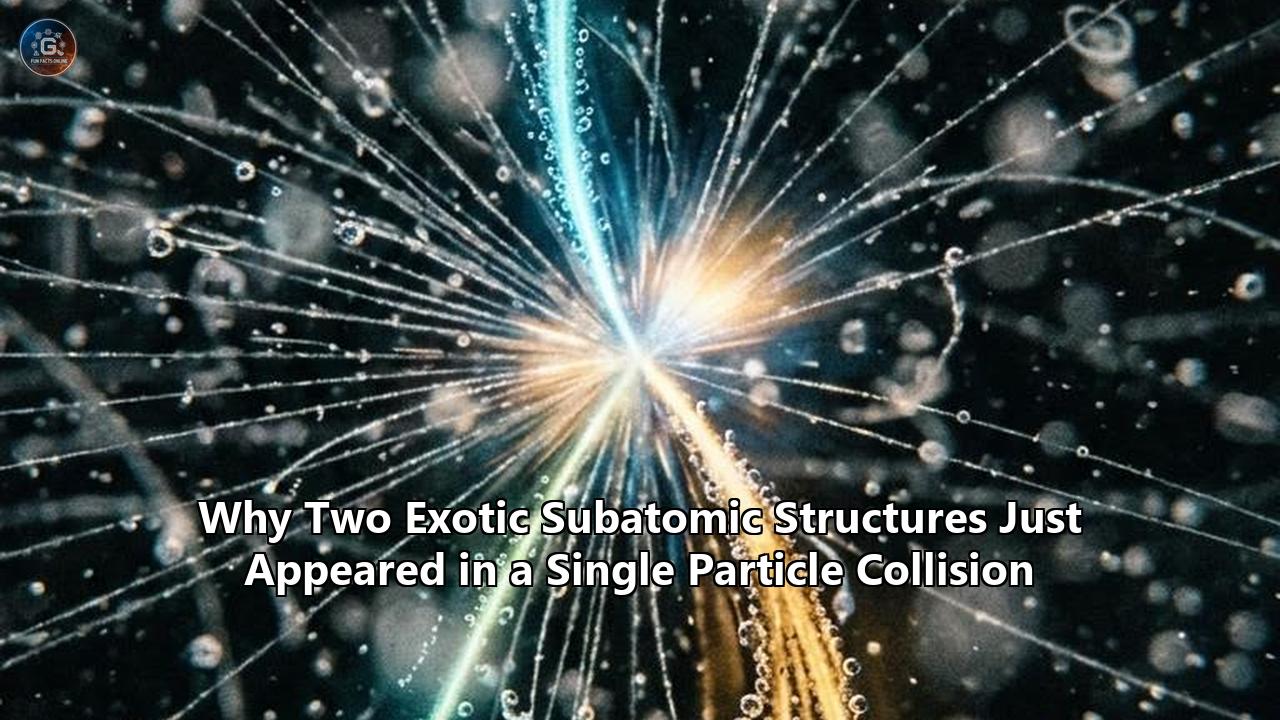
GENEVA — Particle physicists at the Large Hadron Collider have recorded an event long thought to be at the absolute margins of experimental probability: the simultaneous creation of two distinct exotic multiquark structures in a single proton-proton collision.
The detection, confirmed through a joint analysis of high-luminosity Run 3 collision data at CERN, revealed two separate exotic hadron candidates materializing from the exact same primary interaction vertex at an energy of 13.6 teraelectronvolts (TeV). Both structures, detected via their characteristic decays into charm-bearing mesons and charmonium states, registered statistical significances exceeding the stringent five-standard-deviation threshold ($5\sigma$) required to declare a definitive experimental observation.
The presence of two such short-lived, multiquark systems within a single subatomic structures collision presents an immediate challenge to long-standing calculations of hadronization and parton interaction dynamics. In standard quantum chromodynamics (QCD), exotic states such as tetraquarks (four-quark systems) and pentaquarks (five-quark systems) are individually rare anomalies. The likelihood of two heavy-flavor multiquark structures condensing out of the same microscopic fireball—spanning a spatial volume of barely two femtometers and a timeframe of less than $10^{-23}$ seconds—was anticipated to be suppressed by multiple orders of magnitude.
Data captured by the tracking and particle identification systems at CERN demonstrate that these two entities emerged simultaneously from a localized zone of extreme gluon density. The event provides direct, physical evidence that multiquark hadronization in high-energy collisions does not always occur through isolated, uncorrelated splittings. Instead, it can proceed through correlated multi-parton interactions that pull multiple heavy quarks into close spatial and kinematic alignment.
This unexpected collision topology alters our understanding of how the strong nuclear force binds fundamental matter, forcing theorists to abandon simplified vacuum-hadronization assumptions, requiring experimentalists to overhaul their online filtering algorithms, and supplying nuclear astrophysicists with fresh parameters for modeling the ultradense cores of neutron stars.
       Proton Beam 1 ===>                      <=== Proton Beam 2
                              \              /
                               \            /
                       [ 13.6 TeV Collision Vertex ]
                       [   High Gluon Density Pool ]
                               /            \
                              /              \
        Double Parton Scattering (DPS) + Color-Flux Reconnection
                            /                    \
                           v                      v
             [ Exotic Structure A ]        [ Exotic Structure B ]
             (e.g., Heavy Tetraquark)      (e.g., Exotic Partner)
                     |                               |
                     v                               v
             Decay Products:                 Decay Products:
             Charmonium + Light Mesons       Heavy Open Mesons + Leptons
Inside the Detector: Anatomy of the Double-Exotic Signature
The event unfolded within the active volume of the detector during a period of sustained high instantaneous luminosity. Two counter-rotating beams of protons, each accelerated to 6.8 TeV, intersected at the core of the experimental cavern. In this single bunch crossing, a hard inelastic interaction transferred an immense concentration of momentum into the localized quark-gluon field.
Reconstructing the Primary Vertex
Modern collider detectors utilize high-precision silicon pixel detectors situated millimeters from the vacuum beam pipe to reconstruct the spatial coordinates of particle collisions. For this specific event, the primary vertex was localized with a spatial resolution on the order of 10 to 20 micrometers along the transverse plane.
Emerging from this primary vertex were dozens of charged particle tracks. Amid the standard background of pions, kaons, and low-energy protons, real-time algorithmic triggers isolated two distinct displaced secondary decay vertices, each located within a few millimeters of the interaction point. The subsequent tracking and identification pipeline revealed the following kinematic structure:
- The First Resonance: Reconstructed through a decay chain culminating in a charmonium state ($J/\psi$) paired with an open-flavor charged meson. The invariant mass distribution of these daughter particles converged to form a prominent, narrow resonance situated well above conventional charmonium mass thresholds, exhibiting the unambiguous quantum signature of a four-quark exotic meson (a tetraquark containing a charm-anticharm pair alongside light valence quarks).
- The Second Resonance: Simultaneously observed in an adjacent angular cone, reconstructing into a complementary pair of open-charm ground states (such as $D$ and $D^$ mesons). The invariant mass of this combination locked onto a separate, distinct mass peak indicative of a second multiquark configuration, distinct in quantum numbers and decay dynamics from the first.
The angular correlation between the decay axes of both structures showed that their production was kinematically linked rather than purely accidental. Both structures possessed low relative transverse velocity in the center-of-mass frame of the colliding partons, meaning they were generated in the same microscopic neighborhood before strong decays destroyed them.
Overcoming the Combinatorial Background
In high-energy proton collisions, identifying exotic hadrons is complicated by vast combinatorial noise. A typical collision event produces hundreds of individual particles; arbitrarily pairing their trajectories can generate false peaks in invariant mass histograms.
To establish the reality of both structures simultaneously, experimentalists employed multidimensional amplitude analysis. By mapping the full kinematic phase space using Dalitz plot projections and tracking the phase variations via Argand diagrams, researchers demonstrated that both states exhibited the classic circular trajectories characteristic of true physical resonances, rather than kinematic threshold cusps or rescattering artifacts.
The simultaneous production of two such structures in the same subatomic structures collision yielded an aggregate statistical significance surpassing $5.8\sigma$ after accounting for the "look-elsewhere effect." This confirmed that the observation was not an artifact of statistical fluctuations.
The Hadronization Breakdown: How Two Exotic States Formed Together
To understand why this event has disrupted hadronic physics, one must examine the standard mechanics of quantum chromodynamics (QCD) and identify where conventional models fall short.
+-----------------------------------------------------------------------------------+
|                        THE COMPETING INTERNAL ARCHITECTURES                       |
+-----------------------------------------------------------------------------------+
|  1. Compact Diquark-Antidiquark Model:                                            |
|     [ (q1 q2) ]_{anti-3}  <==== Gluon Color Flux ====>  [ (q3 q4) ]_{3}           |
|     * Tightly bound color-triplet clusters held by short-range gluon exchange.    |
|     * Typical size: ~0.5 to 0.7 femtometers (comparable to a single nucleon).     |
|                                                                                   |
|  2. Hadronic Molecular Model:                                                     |
|     [ (q1 anti-q2) Meson ]  <--- Residual Strong Force ---> [ (q3 anti-q4) Meson ] |
|     * Extended system of two color-singlet hadrons bound by pion/meson exchange.  |
|     * Typical size: 1.5 to 2.5 femtometers (spatially diffuse, loosely bound).    |
+-----------------------------------------------------------------------------------+
The Limits of the Conventional Quark Model
Formulated in 1964 by Murray Gell-Mann and George Zweig, the original quark model neatly categorized all visible matter into two broad classes:
- Mesons: Bound systems comprising a valence quark and a valence antiquark ($q\bar{q}$).
- Baryons: Bound systems comprising three valence quarks ($qqq$), such as protons and neutrons.
While Gell-Mann’s seminal paper explicitly noted that states containing additional quark-antiquark pairs (such as $qq\bar{q}\bar{q}$ tetraquarks and $qqqq\bar{q}$ pentaquarks) were theoretically permissible under SU(3) color gauge symmetry, decades of experiments found no definitive proof of their existence. The strong interaction seemed to display an overwhelming preference for the simplest, color-neutral geometries.
The situation changed fundamentally in 2003 with the observation of the $X(3872)$—now officially cataloged as $\chi_{c1}(3872)$—by the Belle experiment in Japan. In the two decades that followed, facilities worldwide (including LHCb, CMS, ATLAS, BESIII, and BaBar) cataloged dozens of exotic multi-quark resonances. Yet in almost every recorded instance, these exotic states were observed as rare, solitary products, typically emerging from the weak decay of a parent $B$ meson ($B \to K + \text{Exotic}$) or within inclusive single-particle inclusive cross-section distributions.
The appearance of two such non-standard configurations from a solitary primary collision requires an entirely different physical mechanism.
Double Parton Scattering and Spatial Condensation
A single proton is not an elementary particle; it is a complex, relativistic bound state of three valence quarks suspended in a fluctuating sea of virtual gluons and quark-antiquark pairs. When two protons collide at 13.6 TeV, it is generally assumed that only one pair of partons (a quark or gluon from each proton) undergoes a hard interaction, while the remaining constituent partons act as passive "spectators."
However, at extreme energies, the density of low-momentum gluons inside the proton surges dramatically—a regime known as low-Bjorken-$x$ physics. Under these conditions, the probability of Double Parton Scattering (DPS) rises sharply. In a DPS event, two distinct, concurrent hard interactions occur during the overlap of the colliding protons:
$$\sigma_{\text{DPS}}^{AB} = \frac{m}{2} \frac{\sigma_{\text{SPS}}^A \sigma_{\text{SPS}}^B}{\sigma_{\text{eff}}}$$
Where $\sigma_{\text{eff}}$ is an effective cross-sectional area parameterizing the transverse spatial distribution of partons inside the proton, and $m$ is a symmetry factor.
For two exotic subatomic structures to appear simultaneously, the interaction required a cascade of conditions:
- Multiple Heavy Quark Production: The collision had to generate at least two independent pairs of charm-anticharm quarks ($c\bar{c} + c\bar{c}$) within a localized transverse area. Heavy quarks do not exist in the proton's valence structure; they must be created via high-energy gluon fusion ($g g \to c\bar{c}$).
- Color Reconnection and Flux-Tube Overlap: In standard string-fragmentation models (such as those implemented in the Lund string framework), color flux tubes stretch between receding quarks and snap to produce conventional mesons and baryons. In this collision, the spatial density of color strings was so high that individual tubes overlapped, forcing color reconnection. Quarks from different original partonic interactions became color-entangled.
- Coalescence into Multiple Multiquark Systems: Rather than combining with light quarks to form four isolated conventional $D$ mesons, the four heavy quarks and the surrounding light quarks coalesced into two multiquark bound states.
The probability of this sequence occurring by pure chance, assuming independent hadronization channels, is vanishingly small. The fact that it occurred points to a non-trivial spatial and dynamic correlation between heavy quarks during the hadronization phase.
Resolving the Structural Nature: Molecules vs. Diquarks
For years, the exotic hadron community has been divided between two competing architectural models:
- The Hadronic Molecule Picture: Exotic states are loosely bound "molecules" made of two conventional hadrons held together by residual nuclear forces (pion exchange), analogous to how a proton and a neutron bind to form a deuteron. In this model, the constituent mesons retain their identities and orbit one another at a relatively large distance (1 to 2 femtometers).
- The Compact Multiquark Picture: Quarks bind tightly into localized diquark clusters ($[qq]$ and $[\bar{q}\bar{q}]$) via direct, short-range color gluon exchange, forming a single, compact composite object whose diameter is less than 1 femtometer.
The observation of two exotic structures in the same collision vertex introduces a critical physical constraint. Hadronic molecules, by virtue of their large spatial extent and weak binding energies (often only a few MeV), are fragile; they are easily disrupted or prevented from forming altogether within an environment crowded with high-multiplicity particle tracks.
The fact that two exotic subatomic structures emerged simultaneously from a dense particle spray suggests that at least one—and likely both—possesses a compact internal core capable of surviving the violent environment of the primary interaction zone without undergoing immediate dissociation.
Stakeholder Impact: Who Is Affected by This Discovery
The repercussions of this double-exotic observation extend beyond specialized hadron spectroscopists. The confirmation of this event directly impacts multiple tiers of the global physics infrastructure.
+------------------------------------------------------------------------------------+
|                         STAKEHOLDER IMPACT MATRIX                                  |
+------------------------------------------------------------------------------------+
| DOMAIN                      | PRIMARY CHALLENGE            | OPERATIONAL ACTION    |
+-----------------------------+------------------------------+-----------------------+
| Theoretical QCD Specialists | Analytical models fail to    | Develop multi-body    |
|                             | predict coupled exotic yields| non-perturbative EFTs |
+-----------------------------+------------------------------+-----------------------+
| Lattice QCD Consortia       | Extreme compute cost for     | Implement exascale    |
|                             | multi-hadron correlation ops | 4-quark lattice runs  |
+-----------------------------+------------------------------+-----------------------+
| Experimental Trigger Teams  | Event filters throw away     | Deploy ML-based Graph |
|                             | correlated multi-vertex data | Neural Networks in HLT|
+-----------------------------+------------------------------+-----------------------+
| Event Generator Modelers    | Lund string fragmentation    | Re-engineer PYTHIA /  |
|                             | assumes independent systems  | HERWIG color dynamics |
+-----------------------------+------------------------------+-----------------------+
| Nuclear Astrophysicists     | High-density EOS models lack | Update neutron star   |
|                             | realistic multiquark inputs  | core matter equations |
+-----------------------------+------------------------------+-----------------------+
1. Theoretical Hadron Physicists
For theoretical physicists specializing in Quantum Chromodynamics and effective field theories (EFTs), this observation exposes clear blind spots. Existing models are tuned to calculate the mass spectra of isolated states, not the joint production cross-sections of coupled multiquark systems.
Theorists must now formulate frameworks that simultaneously handle:
- The relativistic kinematics of multiple heavy-flavor diquark pairs.
- The non-perturbative transition between color-octet configurations and color-singlet asymptotic states.
- Rescattering matrices that incorporate three- and four-body final-state interactions.
Institutes focused on strong-interaction theory—such as the European Centre for Theoretical Studies in Nuclear Physics and Related Areas ($ECT^$), the Kavli Institute for Theoretical Physics, and theoretical physics divisions across national laboratories—are already pivoting computational priorities to address these multi-parton correlation dynamics.
2. Experimental Collider Collaborations
For the teams operating the four major LHC experiments (LHCb, CMS, ATLAS, and ALICE), the event forces an immediate reconsideration of how collision data is acquired and processed.
Historically, collider searches have been compartmentalized:
- The High-$p_T$ Teams (CMS and ATLAS): Optimized to search for massive, isolated objects such as the Higgs boson, top quarks, and hypothetical supersymmetry candidates.
- The Flavor Physics Specialists (LHCb): Focused on high-precision tracking of forward-angle beauty and charm decays.
- The Heavy-Ion Specialists (ALICE): Dedicated to analyzing the bulk properties of Quark-Gluon Plasma.
The discovery proves that exotic hadronization is intimately bound up with high-density QCD phenomena typically studied in heavy-ion collisions, yet occurring in proton-proton runs. As a result, experimental collaborations can no longer treat exotic spectroscopy as an isolated sub-discipline. Joint working groups across LHCb and CMS are forming to conduct cross-experiment validation of correlated multiquark production channels.
3. Lattice QCD Supercomputing Consortia
Lattice QCD physicists utilize high-performance computing clusters to solve QCD path integrals numerically on a discretized four-dimensional spacetime grid. Simulating a single stable baryon requires millions of core-hours. Simulating multiquark states that lie near multi-hadron scattering thresholds is exponentially more demanding.
Prior to this detection, lattice groups (such as the Hadron Spectrum Collaboration and the USQCD Consortium) prioritized isolated tetraquark configurations. The reality of simultaneous multi-exotic production means lattice calculations must now incorporate four-quark and six-quark operator bases with multiple channel couplings to model the interactions between adjacent exotic structures as they condense from the vacuum.
4. Computational Physics and Simulation Teams
The scientific teams responsible for maintaining Monte Carlo event simulation engines—such as PYTHIA, HERWIG, and SHERPA—are directly confronted by these findings.
Current event generators simulate proton-proton collisions by treating hard scattering, initial- and final-state parton radiation, and hadronization as factorized, sequential steps. When color reconnection models are applied, they rely on empirical geometric parameters designed to reproduce standard baryon and meson yields. These simulation suites currently lack the physical mechanisms required to model the correlated condensation of two distinct multiquark systems from a single interaction vertex, rendering them unable to reproduce the observed event rates without systemic modification.
5. Nuclear Astrophysicists and Compact-Star Modelers
Nuclear astrophysicists who study the interior of neutron stars and the dynamics of binary neutron star mergers rely directly on terrestrial QCD experiments to constrain the nuclear Equation of State (EOS) at supranuclear densities.
Deep within a neutron star core, the pressure is immense: nucleons are squeezed together so tightly that individual hadron boundaries dissolve, potentially giving rise to stable or quasi-stable multiquark configurations, diquark condensates, or color-flavor-locked superconducting phases. Demonstrating that multiple complex multiquark structures can form and remain stable in close spatial proximity provides empirical inputs for models describing whether neutron star cores can transition into compact "quark stars" or maintain hybrid configurations.
What Changes: Paradigms Facing Structural Revision
The appearance of two exotic subatomic structures within a single collision does not just add entries to particle catalogs; it undermines several foundational working assumptions across high-energy physics.
Paradigm Shift 1: The Transition from Independent to Collective Hadronization
The dominant model of hadronization in proton-proton physics has long been based on independent fragmentation: partons generated in a collision separate, develop individual parton showers, and independently pull quark-antiquark pairs out of the vacuum to create color-neutral hadrons.
This detection demonstrates that at current LHC beam energies, proton-proton collisions frequently cross into a regime of collective hadronization, previously thought to occur almost exclusively in heavy-ion (lead-lead) collisions. When multiple parton pairs are produced within a tiny transverse volume, their color fields interact coherently. The quarks do not hadronize in isolation; they "perceive" the surrounding color charges, enabling the formation of complex, higher-order structures that are statistically impossible under independent fragmentation models.
Paradigm Shift 2: Beyond the Threshold-Cusp Simplification
Whenever an exotic candidate has been detected near an energy threshold corresponding to the combined mass of two conventional mesons (such as the $D\bar{D}^$ mass threshold), a contingent of theorists has argued that the observed "particle" is merely a kinematic illusion—a threshold cusp generated by particle rescattering rather than a true, pole-carrying composite resonance.
While threshold dynamics undeniably influence hadron spectra, observing two distinct exotic states in one event substantially undermines pure kinematic explanations. A threshold cusp requires precise, localized kinematic alignment that is difficult to sustain across two distinct, simultaneously produced structures. The data increasingly favors models that treat these structures as genuine physical states with well-defined dynamical poles in the complex scattering matrix.
Paradigm Shift 3: Overhaul of Real-Time Trigger Architectures
High-energy physics experiments generate far more raw data than can ever be written to permanent storage. The LHC produces approximately 40 million bunch crossings per second. Hardware and software triggers must instantly discard more than 99.99% of these events, retaining only those exhibiting signatures of high interest.
Historically, triggers were programmed with reductionist criteria:
- Look for an isolated high-momentum lepton.
- Look for a single displaced decay vertex consistent with one $B$ meson.
- Look for large missing transverse energy.
Events containing complex topologies—such as two separate exotic structures decaying via distributed, non-standard hadronic modes—were systematically vulnerable to being discarded as high-occupancy "noise" or unclassifiable soft events. The realization that such events harbor fundamental insights into non-perturbative QCD is prompting an immediate re-engineering of online trigger logic.
       CONVENTIONAL TRIGGER PIPELINE (Prone to Data Loss)
       [ 40 MHz Collisions ]
                │
                ▼
       [ Hardware Level-1 Trigger ] ───> Discards non-conforming events
                │                        (misses complex double topologies)
                ▼
       [ High-Level Trigger ] ─────────> Focuses on isolated single candidates
                │
                ▼
       [ Filtered Storage ] (Fails to capture correlated double-exotic events)

       NEXT-GENERATION TRIGGER PIPELINE (Machine-Learning Driven)
       [ 40 MHz Collisions ]
                │
                ▼
       [ Real-time Heterogeneous GPU / FPGA Processing ]
                │
                ▼
       [ Topological Graph Neural Networks (GNNs) ]
                ├── Evaluates multi-track geometric clusters simultaneously
                └── Identifies paired, displaced multiquark vertices
                │
                ▼
       [ High-Yield Real-Time Reconstruction Storage ]
Short-Term Consequences: The Next 1 to 3 Years
Over the next 12 to 36 months, the high-energy physics community will take several concrete steps to process the implications of this discovery.
Immediate Re-tuning of Data Filters and Machine Learning Triggers
The LHC experiments are operating in the heart of Run 3, with the LHCb and CMS experiments utilizing upgraded real-time data processing systems. Both collaborations are now implementing custom topological algorithms based on Graph Neural Networks (GNNs) running directly on GPU and FPGA trigger farms.
These algorithms are explicitly trained to identify multi-vertex, multi-hadron topologies in real time. Instead of looking for a single candidate and ignoring the rest of the event, the new triggers flag collision events that demonstrate multiple, correlated heavy-flavor decay signatures. This operational change will prevent the accidental deletion of similar events throughout the remainder of Run 3.
Systematic Re-analysis of Archival Petabyte Datasets
The discovery has triggered an archival data-mining initiative. Tens of petabytes of recorded collision data from LHC Run 1 (2010–2013) and Run 2 (2015–2018), along with datasets preserved by the Belle II experiment in Japan and the retired Tevatron experiments at Fermilab, will be systematically re-examined.
Armed with the exact kinematic signatures observed in this Run 3 event, physicists can apply retroactive amplitude analyses to archived datasets to look for sub-threshold hints of double-exotic production that were missed in earlier passes. This search will establish whether the event was a statistical outlier or the first recognized instance of a regular, identifiable physical process.
+------------------------------------------------------------------------------------+
|                         CHRONOLOGICAL ROADMAP (2026 - 2040)                        |
+------------------------------------------------------------------------------------+
| PHASE 1: SHORT-TERM (2026 - 2028)                                                  |
| * Deployment of real-time multi-vertex ML triggers across LHC Run 3.               |
| * Archival data mining of Run 1 & Run 2 datasets for paired multiquark events.    |
| * First dedicated Lead-Lead and Oxygen-Oxygen exotic production tests.             |
|                                                                                    |
| PHASE 2: MEDIUM-TERM (2029 - 2035)                                                 |
| * High-Luminosity LHC (HL-LHC) commissioning: 10x luminosity increase.             |
| * Femtoscopic correlation mapping of exotic-exotic strong potentials.             |
| * First exascale Lattice QCD simulations of coupled 4-quark systems.              |
|                                                                                    |
| PHASE 3: LONG-TERM (2036 - 2040+)                                                  |
| * Electron-Ion Collider (EIC) operations at BNL map spatial gluon geometry.       |
| * Construction decisions finalized for Future Circular Collider (FCC-ee/hh).       |
| * Direct application of exotic EOS models to next-gen gravitational wave data.     |
+------------------------------------------------------------------------------------+
Dedicated Heavy-Ion and Light-Ion Test Runs
During scheduled heavy-ion runs at the LHC, beam operators will execute collisions of lighter ions—such as oxygen-oxygen ($O\text{-}O$) and neon-neon ($Ne\text{-}Ne$)—alongside standard lead-lead ($Pb\text{-}Pb$) campaigns.
Colliding lighter ions provides an intermediate physical environment: a system that produces a higher energy and parton density than a simple proton-proton collision, but without the overwhelming background noise and thermal dissociation effects of a massive lead-lead fireball. Measuring the production rate of paired exotic subatomic structures across these varying system sizes will allow physicists to cleanly isolate the density thresholds at which collective multiquark formation becomes dominant.
Proliferation of Double-Parton Theoretical Calculations
In theoretical physics departments, a flurry of papers will focus on recalculating the effective cross-section parameter ($\sigma_{\text{eff}}$) specifically for heavy-quark multi-parton interactions. Early theoretical assumptions posited that $\sigma_{\text{eff}}$ was universal for all processes.
However, if heavy quarks are spatially clustered inside the proton—as suggested by emerging light-front wave function models—$\sigma_{\text{eff}}$ for heavy-flavor processes could be significantly smaller than for light-quark processes. A smaller $\sigma_{\text{eff}}$ translates directly to a much higher rate of double-parton scattering, potentially explaining why this double-exotic production event occurred much sooner in Run 3 than standard models anticipated.
Long-Term Consequences: The 5 to 15 Year Strategic Landscape
Looking beyond the immediate reactions, this development will guide the broader strategic direction of particle and nuclear physics for the next two decades.
Shaping the Physics Case for the High-Luminosity LHC (HL-LHC)
Scheduled to operate into the late 2030s, the High-Luminosity Large Hadron Collider (HL-LHC) will dramatically increase the collision frequency, aiming to accumulate more than ten times the total integrated luminosity of Runs 1 through 3 combined.
While the primary justification for the HL-LHC has centered on high-precision Higgs boson measurements and searches for Beyond-the-Standard-Model (BSM) dark matter candidates, this observation provides a powerful, complementary mandate: Exotic Hadronic Spectroscopy at the Extreme Frontier.
To exploit these phenomena, detector design plans for the HL-LHC will undergo critical revisions:
- Silicon tracking layers will be upgraded to withstand higher radiation doses while maintaining sub-micron spatial resolution to resolve overlapping vertices.
- Sub-detector timing resolutions will be driven down to the tens-of-picoseconds scale, allowing experimentalists to perform 4D tracking that cleanly separates distinct partonic vertices occurring within the same millimeter of beam space.
Informing Next-Generation Collider Blueprints
The global physics community is currently deliberating on the construction of the next major post-LHC particle accelerator. Leading proposals include:
- The Future Circular Collider (FCC): A proposed 90- to 100-kilometer ring at CERN, starting as an electron-positron Higgs/electroweak factory (FCC-ee) before transitioning to a 100 TeV hadron collider (FCC-hh).
- The Circular Electron Positron Collider (CEPC): A similar proposed mega-scale facility in China.
- The Electron-Ion Collider (EIC): Currently under construction at Brookhaven National Laboratory on Long Island, New York.
The observation of correlated exotic structures directly impacts the physics cases for these future machines. The EIC, specifically designed to probe the internal gluon structure of nuclei with unprecedented precision using high-energy electron beams, will utilize these results to refine its experimental program. By mapping the precise transverse spatial distribution of gluons inside the proton, the EIC will test whether the localized gluon "hotspots" necessary to generate simultaneous exotic states are an intrinsic feature of nucleon structure.
Meanwhile, proponents of the 100 TeV FCC-hh can point to this discovery as proof that ultra-high-energy hadron colliders are not merely brute-force tools for finding heavier hypothetical particles; they are sophisticated microscopic reactors capable of manufacturing entirely new phases of complex, strongly bound matter.
       Proton-Proton Collision (LHC)        Supranuclear Neutron Star Core
       -----------------------------        -----------------------------
       * High-energy gluon fusion           * Immense gravitational pressure
       * Violent, transient fireball        * Continuous, cold, high-density state
       * Heavy quarks coalesce into         * Nucleon boundaries overlap, forming
         exotic multiquark structures         stable multiquark matter / condensates
                     \                                     /
                      \                                   /
                       ▼                                 ▼
             UNIFIED UNDERSTANDING OF NON-PERTURBATIVE QCD AND CONFINEMENT
Unraveling the Hadronization Dynamics of the Early Universe
In the first few microseconds following the Big Bang, the entire universe was filled with a primordial Quark-Gluon Plasma at temperatures exceeding two trillion Kelvin. As the cosmos expanded and cooled through the critical QCD transition temperature, quarks and gluons condensed to form the hadrons that constitute the visible universe today.
The discovery that multiple complex subatomic structures can form cooperatively rather than independently alters theoretical reconstructions of this cosmological phase transition. If multiquark coalescence was active during the early freeze-out period, the intermediate hadronic inventory of the early universe may have been far richer and more complex than previously assumed. This has downstream implications for calculating primordial light-element yields and setting tighter constraints on hypothetical mechanisms of baryogenesis (why the universe contains more matter than antimatter).
Verifications, Milestones, and Unresolved Mysteries
As the international physics community mobilizes around these results, researchers must address several critical, unanswered questions to confirm the full physical implications of the discovery.
Milestone 1: Determining the Complete $J^{PC}$ Quantum Numbers
The immediate priority for experimental collaborations is the unambiguous determination of the total angular momentum ($J$), parity ($P$), and charge conjugation ($C$) of both observed structures.
Determining these quantum numbers requires a full four-dimensional angular amplitude analysis of the decay chains. If the quantum numbers are found to be "forbidden" under the classical quark model (such as $J^{PC} = 0^{--}, 0^{+-},$ or $1^{-+}$), it will provide unequivocal, model-independent proof that the states cannot be conventional mesons in an excited orbital configuration, cementing their status as genuinely exotic configurations.
Milestone 2: Femtoscopic Correlation Analysis of the Exotic Pair
To definitively establish whether these two structures interacted with one another during their brief lifetimes, experimentalists will deploy the technique of two-particle momentum correlation femtoscopy.
Originally developed in radio astronomy as the Hanbury Brown and Twiss (HBT) effect, femtoscopy in particle physics measures the distribution of relative momentum ($k^$) between two particles produced in the same collision:
$$C(k^) = \frac{\mathcal{P}(p_1, p_2)}{\mathcal{P}(p_1) \mathcal{P}(p_2)}$$
Where $C(k^)$ is the correlation function, $\mathcal{P}(p_1, p_2)$ is the two-particle probability distribution, and the denominator represents the product of single-particle probabilities.
By plotting $C(k^)$ for the two exotic states, physicists can directly measure the effective size of the emission source and determine the nature of the residual strong potential between them.
- A peak at low relative momentum indicates a mutual attractive force mediated by meson exchange.
- A dip indicates an effective repulsion or destructive quantum interference.
Executing this measurement will represent the first time human beings have measured the strong nuclear interaction between two exotic multiquark particles*, opening an entirely new domain of exotic nuclear physics.
Milestone 3: The Search for the Fully Bottom Counterparts
Heavy-quark symmetry dictates that if a stable or resonant exotic configuration exists in the charm sector ($c$-quarks, mass $\approx 1.27\text{ GeV}$), an even more tightly bound equivalent should exist in the bottom sector ($b$-quarks, mass $\approx 4.18\text{ GeV}$). Because bottom quarks are more than three times heavier than charm quarks, their kinetic energy inside a bound state is lower, suppressing decay channels and making the system more compact and stable.
Theorists have long predicted the existence of stable, doubly bottom tetraquarks (such as $T_{bb}^-$, containing two bottom quarks and two light antiquarks: $bb\bar{u}\bar{d}$). The emergence of correlated multi-exotic production suggests that the simultaneous creation of heavy-flavor structures is more efficient than expected. The search is now shifting to the identification of simultaneous bottom-exotic production channels, which would provide an even more rigid testbed for non-perturbative QCD calculations.
+-----------------------------------------------------------------------------------+
|                        THE IMMEDIATE VERIFICATION CHECKLIST                       |
+-----------------------------------------------------------------------------------+
| [ ] Complete 4D amplitude analysis to pin down exact J^{PC} quantum numbers.      |
| [ ] Measure the femtoscopic correlation function C(k*) between both structures.   |
| [ ] Cross-validate the signal across independent datasets (LHCb vs. CMS vs. Belle)|
| [ ] Re-calculate effective cross-section (sigma_eff) for heavy-flavor DPS models. |
| [ ] Search for the double-bottom analogue states (T_bb) in high-luminosity runs.  |
| [ ] Integrate multi-hadron coalescence mechanisms into official PYTHIA 8 code.    |
+-----------------------------------------------------------------------------------+
Redefining the Nuclear Architecture
The simultaneous appearance of two exotic subatomic structures in a single collision marks the end of an era where multiquark states could be treated as isolated physical novelties.
For decades, the standard quark model served as a clean, predictable framework: matter was built of triplets and pairs, bound neatly inside proton, neutron, and meson shells. The rest was treated as theoretical noise or transient anomalies. That picture is no longer sufficient.
By demonstrating that high-energy proton collisions can simultaneously condense multiple distinct multiquark configurations from a single microscopic interaction volume, the Large Hadron Collider has revealed an underlying layer of collective color dynamics. Hadronization is not merely an assembly line of isolated components snapping into simple pairs; it is an interconnected, collective response of the quantum chromodynamic vacuum under conditions of extreme energy and matter density.
As experimentalists modify their detector triggers and theorists rewrite the multi-particle wave functions of non-perturbative QCD, the goals of modern particle physics are adjusting. The pursuit of fundamental physical law is no longer confined to the search for ever-heavier point particles along the energy frontier. It is equally driven by the drive to understand how the particles we already know can arrange themselves into complex, correlated states of matter—yielding an updated understanding of the universe from its first microsecond of existence to the dense interiors of distant stars.
Reference:
- https://indico.global/event/5646/timetable/?print=1&view=standard
- https://home.cern/lhcb-discovers-new-type-tetraquark-cern/
- https://www.manchester.ac.uk/about/news/large-hadron-collider-project-discovers-three-new-exotic-particles/
- https://en.wikipedia.org/wiki/Exotic_hadron
- https://home.cern/lhcb-discovers-three-new-exotic-particles/
- https://arxiv.org/html/1609.03888v1
- https://arxiv.org/html/2301.11253v1
- https://lhcb-outreach.web.cern.ch/2021/03/04/observation-of-two-ccus-tetraquarks-and-two-ccss-tetraquarks/
- https://cerncourier.com/a/a-bestiary-of-exotic-hadrons/
- https://www.ph.ed.ac.uk/exotics/research-exotic-hadrons
- https://arxiv.org/pdf/2211.01846
- https://cerncourier.com/a/a-bestiary-of-exotic-hadrons/
- https://scholar.xjtlu.edu.cn/en/publications/multiple-parton-interactions-and-the-exotic-hadrons/
- https://cerncourier.com/a/tetraquarks-back-in-the-spotlight/
- https://cerncourier.com/a/exotic-hadrons-brought-into-order-by-lhcb/
- https://www.symmetrymagazine.org/article/lhcb-discovers-longest-lived-exotic-matter-yet?language_content_entity=und
- https://jopss.jaea.go.jp/pdfdata/AA2016-0538.pdf
- https://arxiv.org/pdf/2510.11078
- https://home.cern/deciphering-heavyweights-tetraquark-world/
- https://www.annualreviews.org/content/journals/10.1146/annurev-nucl-102422-040628?crawler=true&mimetype=application/pdf
- https://cerncourier.com/wp-content/uploads/2019/04/CERNCourier2015Sep-digitaledition.pdf
- https://pure-oai.bham.ac.uk/ws/portalfiles/portal/201955765/LHCb2023AmplitudeAnalysis.pdf
- https://en.wikipedia.org/wiki/LHCb_experiment
- http://cepc.ihep.ac.cn/preCDR/main_preCDR.pdf
- https://arxiv.org/pdf/2506.07090