A team of physicists in China just broke a fundamental rule of acoustics, engineering a physical structure that acts as a near-perfect conduit for targeted audio signals while remaining completely undetectable to ambient noise.
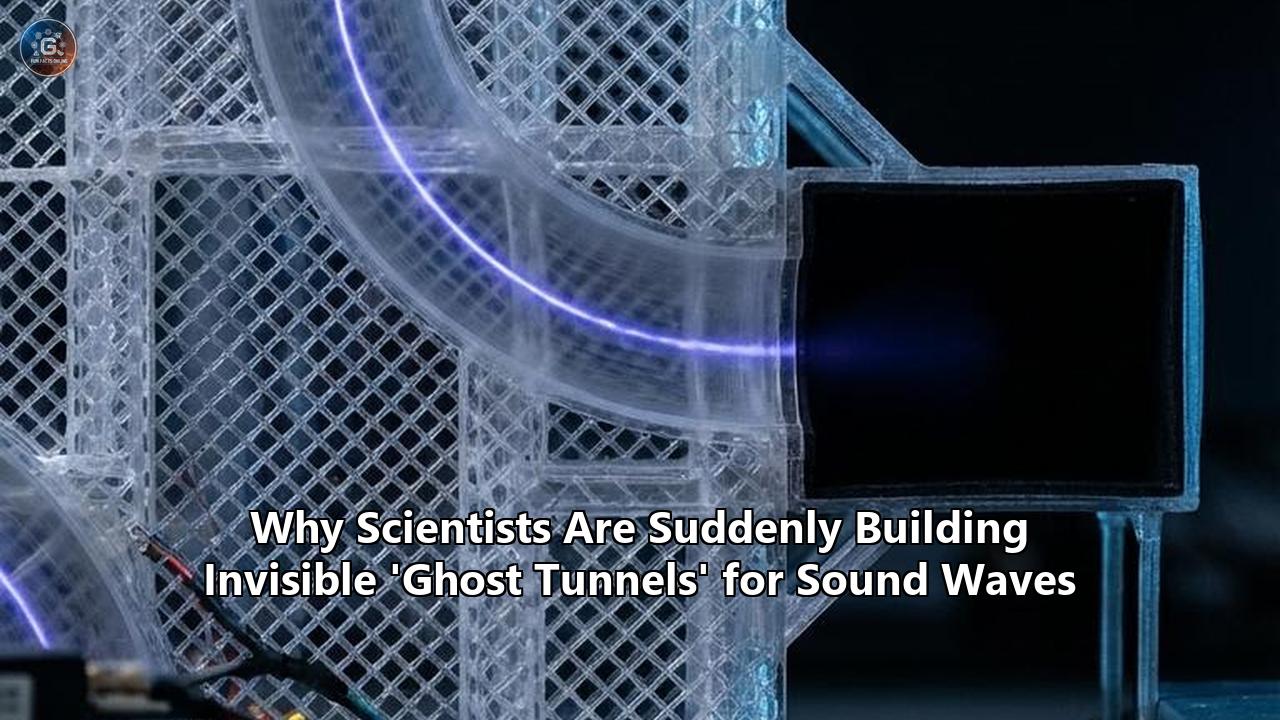
In research published this April in Physical Review Letters, a team led by Changqing Xu at Nanjing Normal University unveiled a specialized acoustic metamaterial they call a "ghost tunnel." The structure performs a seemingly paradoxical feat: it operates as a high-fidelity waveguide that confines and transmits sound entering through its ends with near-zero loss, yet it is essentially transparent to any acoustic energy approaching it from the sides. To external noise, the tunnel simply does not exist.
This development abruptly shifts the landscape of wave physics. Historically, acoustic waveguides—even simple structures like hollow pipes—rely on rigid boundaries that reflect internal waves back into the channel to keep them on track. The inescapable drawback of these physical boundaries is that they inherently interact with their external environment. When external sound hits a traditional waveguide, it scatters, creating interference, acoustic shadows, and signal degradation. Xu’s team has bypassed this limitation entirely.
The immediate impact of this breakthrough extends far beyond laboratory curiosities. By allowing multiple acoustic channels to coexist in intensely crowded environments without cross-interference, this architecture provides a blueprint for entirely new approaches to urban infrastructure, military stealth, medical ultrasound, and spatial audio. To understand the scale of this disruption, one must look at how the metamaterial subverts the standard behavior of wave propagation.
The Physics of the Zero-Index Illusion
The mechanics underlying the ghost tunnel rely on a concept known as the zero-index effect, achieved through the precise geometric arrangement of sub-wavelength structures. Metamaterials are engineered assemblies that derive their properties not from their base chemical composition, but from their physical architecture. By manipulating the shape, size, and orientation of microscopic channels and resonators, physicists can force waves to behave in ways that natural materials cannot replicate.
In standard environments, sound travels through a medium (like air or water) with a specific refractive index, which dictates how the wave bends, slows, or scatters when it encounters an obstacle. Xu’s team engineered a space-coiling structure that induces an effective refractive index of zero at a specific operating frequency. When the refractive index drops to zero, the acoustic wavelength inside the metamaterial effectively stretches to infinity.
This infinite wavelength condition radically alters the spatial phase dynamics of the sound. Because the phase of the wave is uniform throughout the entire zero-index medium, the sound does not propagate through the tunnel in traditional undulating peaks and troughs. Instead, the entire internal volume oscillates synchronously. This allows the sound entering the tunnel to pass through to the exit with near-perfect transmission, entirely immune to internal geometry variations or bends in the path.
Simultaneously, the research team achieved impedance matching with the surrounding open air. Acoustic impedance dictates how much sound is reflected when transitioning between two different mediums; a high impedance mismatch is why sound bounces off a concrete wall but passes easily through a screen door. By perfectly matching the metamaterial's impedance to the ambient air, external waves approaching the ghost tunnel from perpendicular or off-axis angles encounter no reflective boundary. They pass straight through the structure, emerging on the other side completely undistorted, leaving the internal signal undisturbed.
The resulting illusion is profound. If you were to map the acoustic environment, you would see localized sound perfectly contained and routed along a specific vector, while cross-traffic noise flows directly through the physical structure housing that vector as if it were a phantom. Building these ghost tunnels sound waves can navigate without disruption introduces an unprecedented level of control over complex signal environments.
The Primary Stakeholders: Public Health and Urban Infrastructure
The timing of this discovery intersects with an escalating global health crisis. The World Health Organization (WHO) and the European Environment Agency (EEA) have increasingly categorized environmental noise not just as a nuisance, but as a severe biological hazard.
According to the latest EEA data, over 20 percent of Europeans—more than 100 million people—are consistently exposed to harmful transport noise levels above 55 decibels. When measured against stricter WHO recommendations, that figure jumps to nearly one in three citizens. Chronic exposure to this ambient mechanical friction is devastating to human biology. The continuous activation of the human stress response by urban noise contributes to 73,000 premature deaths annually in Europe alone, driving approximately 49,000 new cardiovascular disease cases and severely disrupting the sleep of 4.6 million people. The economic toll is staggering, costing the region an estimated EUR 100 billion annually in lost healthy life years.
Urban planners and civil engineers are currently constrained by the blunt instruments of traditional noise mitigation: massive concrete sound walls, thick acoustic glazing, and earth berms. These solutions block light, disrupt airflow, and consume massive amounts of physical real estate. The ghost tunnel architecture provides an entirely new paradigm for architectural acoustics.
If civil engineers can scale zero-index acoustic metamaterials, infrastructure could be radically redesigned. Highway barriers could be replaced with visually transparent, air-permeable metamaterial lattices that channel traffic noise strictly longitudinally down the highway corridor, completely invisible to the lateral environment of adjacent residential neighborhoods. The noise would be perfectly guided along the road network rather than bleeding outward, while natural environmental sounds (like wind or wildlife) could pass straight through the barrier laterally without reflecting back at the drivers.
Transforming the Medical and Occupational Landscape
Beyond macro-infrastructure, the occupational and medical sectors stand to be transformed by the targeted application of these principles. Hospital environments are notoriously loud, with alarms, equipment monitors, and constant foot traffic directly impeding patient recovery. Conventional acoustic treatments in these spaces are often unhygienic, as porous foam absorbers harbor pathogens and are difficult to sterilize.
Companies like Metasonixx, an award-winning acoustic metamaterial spin-out from the Universities of Sussex and Bristol, are already proving the viability of engineered noise cancellation in clinical spaces. Their existing technologies utilize acoustic metamaterials to create transparent panels—such as their Sonoblind system—that block specific frequencies while permitting airflow and light.
Integrating ghost tunnel mechanics into this existing commercial framework would escalate capabilities from simple noise blocking to complex noise routing. Rather than just blocking the sound of a ventilator from reaching a sleeping patient, a metamaterial shroud could capture the acoustic energy of the machine and route it efficiently through a ghost tunnel directly to a localized monitoring station. The sound would exist only within that invisible pipeline; doctors could hear the machine perfectly at the terminus, while the patient lying inches from the machine hears nothing. Furthermore, because the tunnel is invisible to external sound, the ambient communication between nurses on the ward would not be distorted by bouncing off the machine's acoustic shroud.
In the realm of medical imaging, the implications for ultrasound diagnostics are equally compelling. Ultrasound relies on high-frequency sound waves penetrating tissue to create structural maps. Currently, these waves scatter when hitting bone or dense tissue, creating acoustic shadows that obscure underlying structures. Applying zero-index mechanics to acoustic lenses could allow ultrasound waves to be channeled through tissue with zero lateral scattering, vastly increasing the resolution and depth penetration of non-invasive diagnostics.
The Economic Ripple: Accelerating the Metamaterials Market
The commercialization of acoustic metamaterials is already in a state of rapid acceleration, and the validation of ghost tunnel mechanics in Physical Review Letters provides a potent catalyst for further investment.
In 2025, the global engineering acoustic metamaterial market was valued at a relatively nascent $110 million. However, as the focus shifts from theoretical physics and 3D-printed lab prototypes to scalable manufacturing, the sector is experiencing aggressive compound annual growth. Projections indicate the market will expand significantly over the next decade, with specific estimates pushing toward $172 million by 2034 purely in the engineering segment, while broader applications across automotive and construction sectors are drawing billions in peripheral R&D.
The primary barrier to deploying ghost tunnels and similar topological acoustics has historically been the complexity of fabrication. Designing a material with a negative bulk modulus and mass density at resonance requires sub-millimeter precision across large surface areas. But manufacturing partnerships are bridging this gap. For instance, Metasonixx recently partnered with digital manufacturing giant Protolabs to transition their acoustic metamaterials from expensive, slow 3D printing to rapid, scalable injection molding. By utilizing polycarbonate injection molding, they proved that complex space-coiling acoustic structures can be mass-produced cheaply and reliably.
This manufacturing infrastructure is exactly what will be required to bring the Nanjing Normal University breakthrough out of the lab. Automotive manufacturers represent one of the most aggressive potential buyers. As the automotive industry transitions to electric vehicles (EVs), the acoustic profile of cars is changing. While internal combustion engines masked tire and wind noise, the silence of electric drivetrains has made auxiliary noises glaringly obvious.
Simultaneously, regulators are grappling with the dangers of silent vehicles. The United Nations Regulation No. 138 (UNR 138) mandates that electric vehicles use an Acoustic Vehicle Alerting System (AVAS) at low speeds to warn pedestrians. Automakers are caught in a contradictory design loop: they must artificially project warning sounds outward for pedestrian safety, while simultaneously spending millions on heavy cabin insulation to keep that exact same noise away from the driver.
A ghost tunnel architecture solves this elegantly. By embedding a zero-index metamaterial channel into the chassis, the AVAS warning sound could be routed perfectly forward and backward from the vehicle without any lateral bleed into the passenger cabin. The cabin remains pristine and quiet without requiring hundreds of pounds of sound-deadening foam, directly improving the EV's weight and battery range.
Security and Defense: The Stealth Sonar Paradigm
The military and defense sectors operate on the cutting edge of wave manipulation, and the tactical advantages of an invisible acoustic conduit are profound. Over 25 percent of the demand in the engineering acoustic metamaterial market currently originates from defense and aerospace applications, driven heavily by stealth technology requirements.
In naval warfare, submarines and autonomous underwater vehicles (AUVs) rely heavily on sonar. Active sonar emits an acoustic ping and listens for the reflection, but doing so immediately reveals the emitting vessel's location to anyone listening in the ocean. The acoustic energy propagates outward radially; even highly directional modern sonar arrays suffer from "side lobes"—leakage of sound energy in unintended directions that enemy passive sonar networks can detect.
If naval engineers translate the ghost tunnel mechanics into hydrodynamic environments, they could construct active sonar emitters capped with zero-index metamaterial arrays. This would channel the acoustic ping into an intensely focused, perfectly collimated beam. Because the internal wavelength is effectively infinite, the signal would not suffer from the standard diffraction limits that typically cause sonar beams to spread and weaken over distance.
More importantly, because the structure is impedance-matched and transparent to off-axis waves, the acoustic array itself would become invisible to enemy active sonar. Currently, the physical geometry of a submarine's sonar dome can reflect incoming pings, betraying its position. A metamaterial hull coating that integrates ghost tunnel properties could absorb or perfectly pass-through incoming enemy sonar, while still allowing the submarine's own internal acoustic sensors to function flawlessly. It creates an asymmetric battlefield visibility: the capability to project sensory energy outward without creating a reflective physical profile.
The Electromagnetic Horizon: Translating the Architecture
While the immediate applications of this discovery are strictly acoustic, the underlying mathematics of zero-index materials and topological insulators are substrate-agnostic. The principles that govern how waves behave in a fluid or gas are fundamentally analogous to how electromagnetic waves behave in a vacuum or a fiber optic cable.
The researchers at Nanjing Normal University explicitly noted that the zero-index and impedance-matching principles they demonstrated could transfer directly to electromagnetic wave systems and electronic circuits. This theoretical bridge has immense implications for the future of telecommunications and optical computing.
In fiber optics, data is transmitted via light pulses down silica glass tubes. Similar to traditional acoustic pipes, these optical fibers rely on total internal reflection to keep the light bouncing down the core. If the fiber bends too sharply, the angle of reflection breaks down, and light bleeds out of the cable, resulting in data loss.
If optical engineers can construct electromagnetic ghost tunnels at the nanoscale, it would allow for photonic circuits that route light with zero loss, regardless of how tightly the circuit is physically coiled or bent. Because the refractive index drops to zero, the light's phase velocity becomes virtually infinite, meaning the optical signal would experience no phase delay as it traverses the chip.
Furthermore, the transparency to side-incident waves solves a critical hardware density problem. In modern microprocessors, moving optical or electrical channels too close together results in "crosstalk"—electromagnetic interference where a signal in one channel corrupts the signal in an adjacent channel. With ghost tunnels sound waves avoid crosstalk entirely because neighboring signals pass straight through the channels without interacting. Replicating this in silicon photonics would allow engineers to pack optical data channels infinitely close together without interference, shattering current physical limitations on data processing density and advancing the timeline for practical quantum computing.
Unresolved Questions and The Path Forward
Despite the sheer scale of its potential, the development of the ghost tunnel is currently bounded by rigid physical constraints that must be overcome before mass deployment.
The most pressing limitation is bandwidth. The zero-index effect relies on highly specific resonance conditions within the space-coiling metamaterial. In the experimental models, these unique properties—the infinite wavelength and the perfect impedance matching—often occur only at incredibly narrow frequency bands (for instance, specific acoustic trials in literature cite phenomena occurring exactly at frequencies like 453.64 Hz).
Real-world environments are rarely monochromatic. Urban traffic noise, human speech, and turbulent airflow are broadband—they consist of hundreds of overlapping frequencies occurring simultaneously. A ghost tunnel optimized for 453 Hz might perfectly channel that specific drone, but it would act as a conventional, highly reflective physical barrier to a 1000 Hz siren or a 200 Hz rumble.
The next monumental milestone for the acoustic metamaterial industry will be achieving broadband zero-index behavior. Researchers are currently exploring hybrid acoustic metamaterials that layer multiple geometric structures of varying sizes to expand the effective operational frequency range. By combining locally resonant structures with Bragg scattering mechanics, material scientists hope to widen the zero-index window from a singular frequency point into a broad operational spectrum.
Additionally, the transition from two-dimensional laboratory demonstrations to robust, three-dimensional implementations remains a complex engineering hurdle. While the Nanjing team has proven the mathematical and physical viability of the ghost tunnel, manufacturing a 3D macro-structure capable of enduring the thermal expansion, physical weathering, and mechanical sheer forces of an outdoor highway environment requires rigorous material science advancements. The structural polymers or metals used must maintain their microscopic geometric integrity despite macroscopic environmental stress.
The timeline for commercial integration will likely be phased. Over the next two to three years, expect to see ghost tunnel mechanics applied in highly controlled, single-frequency environments—such as optimizing the acoustic pathways inside industrial machinery, HVAC systems, or specialized audio testing facilities. By the early 2030s, as additive manufacturing and AI-driven generative design optimize complex hybrid geometries, these invisible conduits will begin appearing in consumer electronics, automotive design, and eventually, public infrastructure.
The realization of the acoustic ghost tunnel represents a fundamental pivot in how humanity interacts with its environment. For centuries, our approach to wave dynamics has been defensive—building thicker walls, denser foams, and heavier barriers to hide from unwanted energy. We are now entering an era of absolute structural manipulation. By engineering materials where ghost tunnels sound waves naturally slip through without friction or reflection, physicists have proven that the physical boundaries of our world are no longer absolute limits. They are simply variables waiting to be rewritten.
Reference:
- https://lifeboat.com/blog/2026/04/ghost-tunnels-guide-sound-waves-in-one-direction-while-staying-invisible-to-others
- https://www.reddit.com/r/InterstellarKinetics/comments/1skg3ka/exclusive_chinese_scientists_engineered_a_ghost/
- https://m.vk.com/wall-181052480_71839
- https://arxiv.org/abs/2410.20377
- https://www.intelmarketresearch.com/engineering-acoustic-metamaterial-market-36036
- https://phys.org/concepts/acoustic-wave/
- https://jns.nju.edu.cn/EN/Y2017/V53/I1/69
- https://www.who.int/europe/teams/living---working-environments/protecting-people-from-harmful-exposure-to-environmental-noise
- https://www.eea.europa.eu/en/analysis/publications/environmental-noise-in-europe-2025
- https://metasonixx.uk/about-us-1
- https://www.sussex.ac.uk/broadcast/read/66437
- https://www.24chemicalresearch.com/reports/307061/engineering-acoustic-metamaterial-market
- https://www.protolabs.com/en-gb/resources/case-studies/metasonixx/
- https://www.globalgrowthinsights.com/market-reports/acoustic-metamaterial-market-113444
- https://www.durham.ac.uk/departments/academic/engineering/research/nodes/computational-mechanics/research-interests-and-projects/current-research-projects/
- https://www.researchgate.net/publication/385318072_Acoustic_Zero-Index_Metamaterials_for_Leaky-Wave_Antennas
- https://trueinitiative.org/insights/traffic-noise-pollution-latest-threat-to-cities/
- https://pubs.acs.org/doi/10.1021/acs.chemrev.2c00800
- https://www.researchgate.net/lab/Changqing-Xu-Lab-3
- https://www.researchgate.net/profile/Changqing-Xu