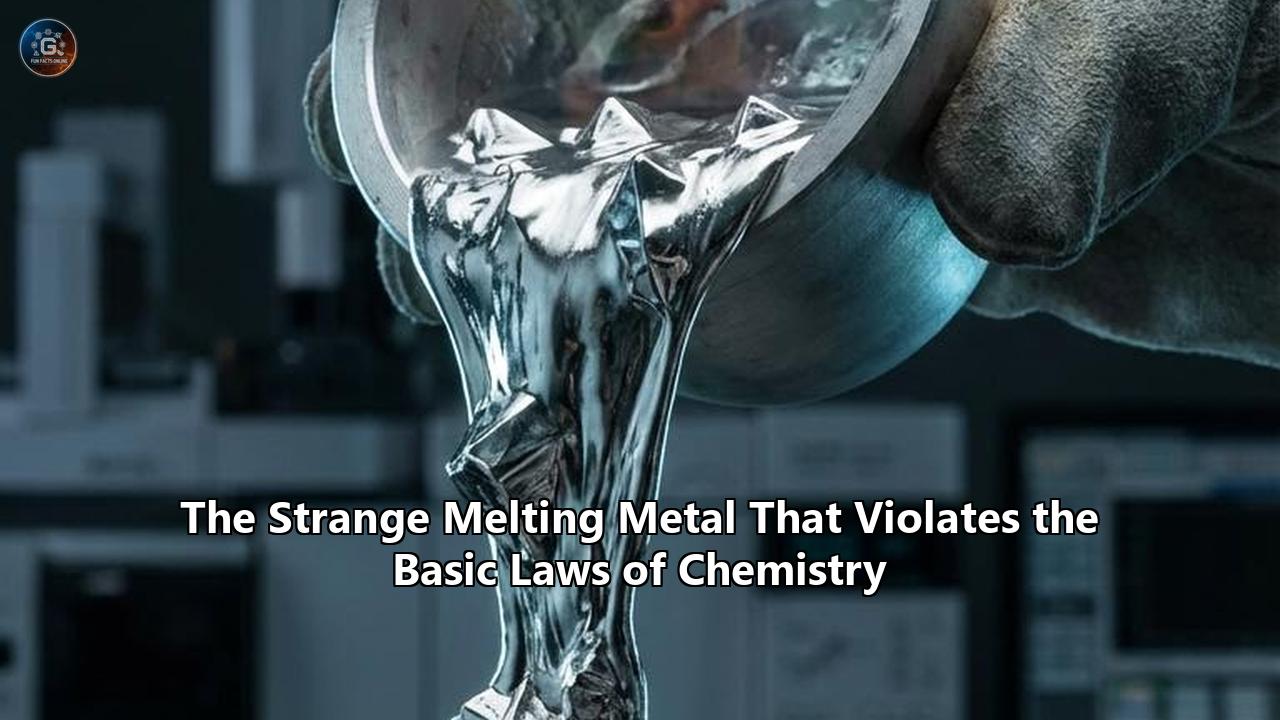
On April 14, 2026, researchers at the University of Auckland dismantled a 30-year-old pillar of materials science, revealing that liquid gallium explicitly violates classical assumptions about how heat and chemical bonds interact. Published in the journal Materials Horizons, the findings prove that gallium’s covalent bonds vanish the moment it melts—only to spontaneously reappear and strengthen as the liquid is subjected to increasingly higher temperatures,.
The discovery, led by Professor Nicola Gaston and Dr. Steph Lambie at the MacDiarmid Institute for Advanced Materials and Nanotechnology, overturns decades of established literature regarding liquid metals. According to standard thermodynamic principles, increasing the thermal energy of a system increases its entropy. Atoms move faster, structures break down, and chemical bonds dissolve. Gallium, however, is doing the exact opposite. Once pushed hundreds of degrees past its transition phase, the liquid’s atoms begin re-forming into organized dimers, sharing electrons in a covalent embrace that normally only belongs to solid, non-metallic states,.
This counterintuitive behavior forces a fundamental rewrite of how we model liquid metals. It also directly pits competing methodologies, manufacturing approaches, and material sciences against one another, as engineers race to exploit these newly understood high-temperature bonding mechanics for semiconductors, catalysis, and self-assembling nanotechnology,.
The 30-Year Blind Spot: Competing Models of Liquid Structure
For three decades, physicists and chemists operated under a consensus model to explain gallium’s strange behavior,. In its solid state, gallium atoms pair into dimers, sharing electrons via covalent bonds—a rarity for a metal. Because solid gallium packs into a less dense structure than its liquid form, it behaves like water and ice; it shrinks and becomes denser upon melting.
The old consensus hypothesized that these covalent bonds persisted through the melting process and remained intact within the liquid, supposedly explaining why the metal conducts electricity better immediately after liquefying, but then experiences a nonlinear spike in electrical resistivity as it gets hotter,.
The Auckland team’s data dismantles that theory. By tracking atomic motion, they proved the bonds completely dissolve at 30°C (86°F),. This sudden and total dissolution of bonds triggers a massive entropy spike—a sudden surge in structural disorder. That dramatic entropy spike is what stabilizes the liquid state at such low thermal energy, necessitating a completely new explanation for the notoriously low gallium melting point,.
Yet, the real anomaly occurs further up the thermometer. As the liquid metal absorbs more heat, the atomic sea subtly reorganizes. The covalent bonds snap back into place, creating a localized order within the chaotic liquid,.
This revelation was made possible by a shift in competing analytical approaches—moving away from classical physical observation and toward advanced quantum computational modeling.
Physical Observation vs. Quantum Simulation
The persistence of the old model highlights the inherent tradeoffs between experimental observation techniques and computational simulations.
Historically, liquid metals were studied using X-ray diffraction and neutron scattering. These top-down observational methods fire beams of energy at a material and measure the scattering patterns to determine atomic placement.
- The Tradeoff of X-ray Scattering: While excellent for mapping static crystal lattices in solids, X-ray scattering provides an averaged, blurred snapshot when applied to a liquid. It captures the proximity of atoms but struggles to differentiate between a persistent covalent bond and two atoms that simply happen to be bumping into each other in a dense liquid flow.
- The Tradeoff of Ab Initio Molecular Dynamics (AIMD): The Auckland researchers bypassed the limitations of physical scattering by utilizing large-scale AIMD simulations,. This computational approach calculates the quantum mechanical interactions of individual electrons and atoms in real-time over varying temperatures,.
The tradeoff here is computational expense. AIMD requires immense supercomputing resources to track just a few hundred atoms over a span of picoseconds. However, the data granularity is unmatched. The simulations revealed the temporal dynamics of the electrons, showing unequivocally that the electron-sharing behaviors vanished at the phase transition and re-emerged under extreme heat—a nuance completely invisible to traditional X-ray averaging,.
Competing Materials: The Liquid Metal Hierarchy
The timing of this discovery intersects with a massive industrial push to replace traditional solvents and thermal management systems with liquid metals. Engineers must constantly weigh the tradeoffs of competing elements, and understanding gallium's high-temperature covalency suddenly shifts the cost-benefit analysis in its favor.
Mercury vs. Gallium
For decades, mercury was the default liquid metal for electrical switches, thermometers, and fluid conductors.
- Mercury's Strengths: It is liquid at room temperature, highly conductive, and chemically stable in its pure form.
- Mercury's Weaknesses: It is highly toxic, produces dangerous vapors at room temperature, and carries severe environmental liabilities.
Gallium, by contrast, possesses a near-zero vapor pressure. It does not evaporate into the air, and it is largely non-toxic. The newly discovered high-temperature bonding profile explains exactly why gallium remains so stable and resists vaporizing even when subjected to intense heat in industrial environments. The covalent rebonding acts as an internal tether, keeping the atomic structure cohesive.
Bismuth Alloys vs. Gallium Alloys
When building cooling systems for high-density semiconductors or nuclear reactors, engineers often debate between bismuth-based alloys and gallium-based alloys (like Galinstan, a mix of gallium, indium, and tin).
- Bismuth Alloys: These have excellent heat transfer properties and expand upon freezing (useful for certain casting techniques), but they generally require higher temperatures to remain liquid.
- Gallium Alloys: Galinstan remains liquid well below zero degrees Celsius.
The unresolved problem with gallium alloys in high-heat electronics was predicting their thermal and electrical conductivity at extreme operating temperatures. Because engineers relied on the old assumption that heat degraded the internal structure, their thermal models often drifted from reality when applied to high-performance computing hardware. Now, armed with the knowledge that covalent bonds reform at high heat, thermal engineers can precisely calculate the nonlinear resistivity of gallium-based coolants, giving them a distinct predictive advantage over bismuth alternatives.
Bottom-Up vs. Top-Down Nanomanufacturing
Perhaps the most immediate commercial battlefield affected by the Auckland discovery is nanomanufacturing. Building microscopic structures—like the components on a microchip or specialized catalysts—requires a choice between two competing philosophies: top-down milling or bottom-up self-assembly.
The Top-Down Approach: Lithography
Currently, the global semiconductor and nanotech industries rely almost exclusively on top-down manufacturing, specifically extreme ultraviolet (EUV) lithography.
- The Process: A silicon wafer is coated in photoresist, exposed to precise light patterns, and chemically etched to carve out structures.
- The Tradeoff: This method achieves exact precision but is notoriously expensive, energy-intensive, and inherently wasteful, as bulk material is destroyed to leave the desired shape behind. Furthermore, it is largely restricted to two-dimensional layers built on top of one another.
The Bottom-Up Approach: Liquid Metal Solvents
An alternative approach gaining traction is autonomous self-assembly, where atoms naturally organize themselves into complex shapes,. Because of its unique electron-sharing properties, liquid gallium can act as a solvent for other metals. When foreign metals like zinc, copper, or platinum are dissolved into hot liquid gallium and allowed to cool, they precipitate out into highly ordered, complex nanostructures,.
Prior to the April 2026 announcement, this process was largely trial and error. Researchers could dissolve zinc in gallium and watch it form perfect, six-sided metallic "snowflakes," but they did not fully understand the exact forces driving the alignment,.
The revelation that gallium forms strong covalent networks at high temperatures solves this mystery. The reformed gallium dimers create a structured framework within the liquid. When another metal is introduced, it is forced to interact with this invisible scaffolding. By manipulating the temperature precisely, engineers can now control the density of these covalent bonds, effectively tuning the liquid environment to force dissolved atoms to crystallize into specific, three-dimensional shapes.
This makes bottom-up nanomanufacturing highly competitive against lithography for certain applications. While it may not replace the precise circuitry etching of logic chips, growing metallic structures autonomously in a liquid bath is vastly cheaper, requires less energy, and allows for complex 3D geometries that lithography simply cannot achieve.
The Electrical Conductivity Paradox
The shifting atomic structure of gallium also forces a re-evaluation of how we approach electrical engineering with liquid metals. The flow of electricity through a metal is entirely dependent on how the atoms are arranged and how much they vibrate.
In a standard metal like copper, the relationship between heat and electrical resistance is linear and predictable. As copper heats up, its atoms vibrate more violently. These vibrations scatter the electrons trying to pass through, causing resistance to rise proportionally with temperature.
Gallium directly violates this linear expectation.
- The Phase Transition Drop: When solid gallium melts, its electrical resistivity actually drops,. This is highly unusual. For most metals, losing the ordered solid lattice means more electron scattering and higher resistance. But because gallium’s covalent dimer bonds break entirely at the melting point, a sudden abundance of free electrons is released into the liquid, boosting its conductivity.
- The Nonlinear Heat Spike: As engineers apply more heat to the liquid, expecting a standard linear increase in resistance due to thermal vibration, gallium’s resistivity instead climbs in a steep, nonlinear curve.
The newly published findings perfectly explain this paradox. Pushing the material well past its gallium melting point reveals that the atoms are not just vibrating faster; they are chemically locking back into covalent pairs,. These newly reformed pairs trap electrons, creating a conduction bottleneck. The hotter the liquid gets, the more bonds form, and the harder it becomes for an electrical current to push through.
Tradeoffs in Battery Design
This electrical behavior creates both a hurdle and an opportunity for next-generation energy storage, specifically liquid metal batteries designed for grid-scale renewable energy storage.
- The Hurdle: If a battery utilizes liquid gallium at high operating temperatures, the reforming covalent bonds will increase internal resistance, causing the battery to lose efficiency and generate unwanted waste heat.
- The Opportunity: If battery engineers intentionally design the system to operate exactly at the transition threshold—hovering just above the anomalous gallium melting point—they can maximize the availability of free electrons, minimizing resistivity and boosting the charge/discharge rate of the battery.
By defining the exact temperatures where covalency re-emerges, the Auckland team has provided the necessary map for battery designers to thread this thermal needle.
Catalysis: Green Chemistry vs. Solid-State Reactions
The chemical industry relies heavily on catalysts—substances that speed up chemical reactions without being consumed. Platinum, palladium, and rhodium are standard solid catalysts used in everything from petroleum refining to pharmaceutical synthesis. However, utilizing solid catalysts comes with severe tradeoffs.
The Limits of Solid Catalysts
Solid catalysts only facilitate reactions on their surface. A highly porous block of platinum might have a high surface area, but eventually, the active sites become blocked by carbon buildup (coking), rendering the catalyst useless. Furthermore, these reactions often require extreme heat and pressure to force the reactant molecules to interact with the solid metal.
The Liquid Metal Advantage
Gallium-based liquid metal catalysts offer a competing approach that bypasses these limitations,. By dissolving trace amounts of active metals (like platinum or nickel) into liquid gallium, chemists create a dynamic, fluid catalyst.
- Surface Renewal: Because the catalyst is a liquid, its surface is constantly churning. As reactant molecules hit the surface and convert, they drift away, and new active metal atoms instantly well up from the liquid interior. Coking and surface blockage are virtually eliminated.
- Energy Efficiency: Liquid metal catalysts can drive reactions at significantly lower temperatures, cutting the energy requirements of chemical plants.
The April 2026 discovery adds a critical new layer to this technology. Until now, chemists did not understand why liquid gallium was so effective at holding other catalytic metals in a stable, reactive suspension. The proof of high-temperature covalency shows that the gallium atoms are actively sharing electrons with the dissolved metals, creating an optimized electrochemical environment,.
Chemists can now apply this knowledge to tune their liquid catalysts. By adjusting the operating temperature to strengthen or weaken the gallium covalent network, they can selectively control which chemical reactions occur, guiding raw materials into specific product pathways with minimal waste.
Examining the Entropy Mechanism
To understand the sheer scale of the shift in physics paradigms, it requires looking closely at entropy—the thermodynamic measure of disorder.
Standard physics teaches that melting is a battle between enthalpy (the energy holding a solid lattice together) and entropy (the chaotic kinetic energy of heat). A solid melts when the entropic disorder overcomes the enthalpic bonds.
For 30 years, researchers assumed that gallium’s solid dimers stayed intact during melting. This meant the entropy change between the solid and liquid states was thought to be relatively small. If the structure wasn't changing that much, why did it melt so easily? The old models had to rely on complex, highly specific mathematical workarounds to justify why a material with allegedly persistent bonds would liquefy at roughly 30°C.
Dr. Lambie and Professor Gaston’s research slices through these convoluted theories with Occam’s razor,. Because their simulations prove the dimer bonds completely shatter at the melting point, the transition from solid to liquid represents an enormous, sudden spike in entropy,.
This massive jump in disorder heavily stabilizes the liquid phase. The atoms are suddenly so free and disconnected that the system requires very little thermal energy to maintain the liquid state. This entropy spike is what actually drives the gallium melting point down to a level where human body heat can initiate the phase change,.
The tradeoff in this phase transition is that the liquid state immediately following the melt is highly chaotic, possessing minimal structure. But nature abhors an imbalance. As the heat continues to rise, the system seeks a new equilibrium, utilizing the excess thermal energy not to vibrate aimlessly, but to pull the atoms back into shared electron states.
What This Means for Martian Exploration
While the immediate applications of this discovery reside in semiconductors, batteries, and nanomanufacturing, it has unexpected downstream effects on astrobiology and planetary science,.
Currently, researchers at the University of Auckland’s School of Environment are investigating gallium as a potential chemical "fingerprint" for identifying past microbial life on Mars,. Certain microbes process metals, leaving behind specific isotopic or structural signatures in the rock record.
Because gallium does not occur in pure form in nature—it is extracted from minerals like bauxite—its behavior within planetary crusts is tied strictly to its thermal and chemical environment. Geochemists analyzing Martian rock samples need to understand exactly how gallium would have behaved under varying volcanic or hydrothermal temperatures billions of years ago.
Under the old thermodynamic model, geochemists might misinterpret a high concentration of clustered gallium in a Martian rock as a biological anomaly. Armed with the new structural roadmap, they now know that gallium will naturally cluster and form covalent structures under specific high-heat geological processes. Distinguishing between a natural thermodynamic clustering and a biological fingerprint is now far more precise, ensuring that the search for extraterrestrial life relies on accurate metallurgical baselines.
Looking Ahead: The Next Phase of Materials Science
The immediate aftermath of the April 2026 announcement leaves several unresolved questions that will define the next decade of materials science.
Will Other Strange Metals Be Re-Evaluated?
If the foundational literature on liquid gallium was incorrect for 30 years, physicists must now ask if similar blind spots exist for other non-standard metals. Elements like bismuth, antimony, and certain rare-earth alloys exhibit their own phase-transition anomalies. The Auckland team’s successful application of ab initio molecular dynamics sets a new precedent. We will likely see a surge in computational resources directed at re-simulating the liquid states of these elements to see if they, too, hide covalent rebonding at high temperatures.
Engineering the Interface
The next major milestone for researchers is understanding what happens at the very edge of the liquid metal. A secondary study published alongside the main findings noted that liquid gallium is not entirely disordered at its surface, forming subtle geometric patterns influenced by oxidation.
For electronics manufacturers utilizing liquid metal as a thermal paste between a silicon chip and a heat sink, the surface interface is the only thing that matters. How do the high-temperature covalent bonds interact with a rigid silicon lattice? If the bonds align with the silicon, heat transfer will be near-perfect. If they clash, it creates a thermal bottleneck. Competitors in the semiconductor space will aggressively pursue proprietary models of this interface, leveraging the Auckland data to design custom gallium alloys that physically bond to silicon under operating heat.
The Scaling Challenge
Finally, while the behavior of gallium is now understood at the atomic level, translating this into industrial-scale manufacturing involves heavy tradeoffs. Liquid metal environments are notoriously difficult to control in large vats. The same surface tension and liquid dynamics that allow for autonomous nanoparticle growth in a highly controlled laboratory setting can lead to erratic fluid behavior when scaled up to a 1000-liter chemical reactor.
Engineers must develop new reactor designs that can maintain highly precise temperature zones. By keeping certain parts of a gallium bath precisely at the melting point to maximize conductivity, while heating other zones to force covalent structure formation, manufacturers could theoretically create continuous-flow systems that assemble complex nanomaterials non-stop.
The validation of high-temperature covalency in a liquid metal alters the trajectory of inorganic chemistry. By proving that heat can construct bonds just as effectively as it destroys them, the researchers at the University of Auckland have dismantled a textbook constraint. As competitive industries absorb this data, the element that melts in your hand is set to become the structural foundation for technologies operating in the most extreme thermal environments on the planet.
Reference:
- https://scitechdaily.com/this-metal-melts-in-your-hand-and-scientists-just-discovered-something-strange/
- https://www.auckland.ac.nz/en/news/2024/07/01/strange-metal-gallium-s-quirk-revealed-by-research-.html
- https://www.earth.com/news/scientists-discover-previously-unknown-properties-of-a-very-unusual-metal-gallium/
- https://scitechdaily.com/this-metal-melts-in-your-hand-and-scientists-just-discovered-something-strange/
- https://cbe.ncsu.edu/event/why-is-gallium-liquid-at-room-temperature-nicola-gaston-univ-of-auckland/
- https://www.sciencedaily.com/releases/2022/12/221209094748.htm
- https://www.labnews.co.uk/article/2031081/uncovering-the-magic-of-metallographic-turing-pattern-formation
- https://community.materialssquare.com/t/scientists-uncover-previously-unknown-properties-of-gallium/446
- https://www.eurekalert.org/news-releases/1049508