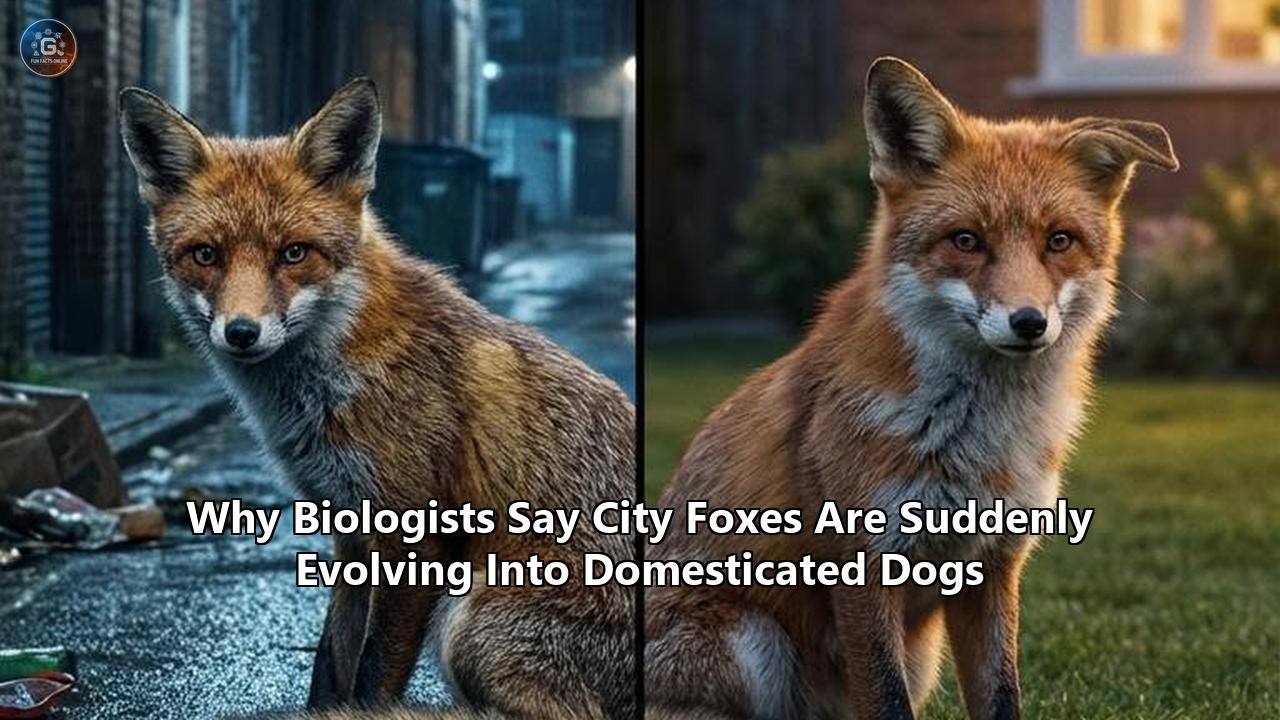
The red foxes wandering through the concrete corridors of London, Glasgow, and other major metropolitan areas are no longer the same animals that inhabit the surrounding countryside. They are undergoing a rapid, spontaneous genetic shift that is entirely altering their biology, behavior, and physical appearance. Evolutionary biologists and geneticists studying urban wildlife populations in 2026 have confirmed that city foxes are exhibiting clear, measurable signs of "domestication syndrome"—a suite of physical and behavioral traits traditionally associated with tame pets.
Without any deliberate human breeding, these urban predators are evolving to look and act more like domesticated dogs. Their snouts are becoming shorter and wider. Their braincases are shrinking. The physical size differences between males and females are rapidly disappearing. They are losing their innate flight response, altering their circadian rhythms, and displaying a newfound tolerance for densely packed human environments.
This is not merely a case of clever animals learning new tricks to survive in the city. It is a fundamental, genomic alteration occurring in real-time. The pressures of the anthropogenic environment are acting as a powerful filter, fundamentally rewriting the red fox’s evolutionary trajectory.
To understand why this is happening, we must look beyond the simple availability of discarded fast food. The phenomenon of urban fox evolution represents one of the most visible and rapid examples of natural selection occurring alongside human civilization. It is a biological puzzle that forces us to reexamine the very origins of our own domesticated pets, the invisible mechanisms of embryonic development, and the future of urban ecosystems.
The Anatomy of a Scavenger
The scientific confirmation of this shift began with a vast, dusty collection of bones. At the National Museums Scotland, researchers maintain a collection of roughly 1,500 fox skulls. These specimens were collected during organized, large-scale culls in London and its surrounding rural counties between 1971 and 1973. Each skull was meticulously cataloged with its geographical origin, creating a perfect time capsule of fox morphology.
When a team led by Dr. Kevin Parsons, an evolutionary biologist at the University of Glasgow, subjected these skulls to modern biomechanical analysis and 3D imaging, the data revealed a stark divergence. The rural fox skulls retained the classic architecture of a wild hunter: long, narrow snouts designed for the rapid, snapping motions required to catch agile prey like field mice, voles, and rabbits. Their braincases were large, housing the complex neural machinery necessary for mapping vast, unstructured wilderness territories and executing sophisticated hunting strategies.
The urban skulls told a completely different story.
Foxes collected from within the city limits possessed significantly shorter, wider snouts. From a biomechanical perspective, a shorter snout sacrifices closing speed but greatly increases bite force at the back of the jaw. An urban fox does not need to snap at lightning speed to catch a discarded chicken bone, a sealed plastic container, or a half-eaten bagel. Instead, it needs crushing power to break open packaging and chew through dense, static urban refuse.
Furthermore, the urban skulls exhibited a marked reduction in braincase size. In the wild, brain tissue is metabolically expensive. An animal must consume vast amounts of calories simply to keep its brain functioning. In a city, where food is stationary, abundant, and constantly replenished by humans, the cognitive demands of survival shift. The spatial memory required to track seasonal prey migrations across hundreds of acres is no longer necessary. Evolution, which is ruthlessly efficient, begins to scale down expensive biological hardware when it is no longer required.
The Glasgow researchers also noted a dramatic reduction in sexual dimorphism. In rural populations, male foxes are distinctly larger and possess thicker, heavier cranial structures than females, a trait driven by the need to violently defend large territories and compete for mates. In the city, where territories are highly compressed and food is omnipresent, the evolutionary return on investment for massive male body size diminishes. The males and females begin to look the same.
"What the foxes are doing this to themselves," Parsons observed when detailing the initial findings. "This is the result of foxes that have decided to live near people, showing these traits that make them look more like domesticated animals."
Charles Darwin and the Domestication Syndrome
To comprehend why a shift in diet and territory leads to such specific physical alterations, we have to revisit a biological mystery that first troubled Charles Darwin in the 19th century.
While writing The Variation of Animals and Plants Under Domestication in 1868, Darwin noticed a bizarre pattern among the animals humans had tamed. Whether it was a dog, a pig, a cow, or a sheep, domesticated mammals consistently shared a specific suite of physical traits that their wild ancestors entirely lacked.
Darwin documented that domesticated animals frequently exhibited:
- Floppy or pendulous ears, unlike the erect ears of wild wolves or boars.
- Shorter, pushed-in faces and reduced dentition.
- Smaller overall brain sizes.
- Curly tails.
- Piebald coloring (patches of white, unpigmented skin and fur).
- More frequent reproductive cycles.
Darwin could not explain why humans, when breeding animals purely for docility and tameness, would consistently end up with animals that had floppy ears and white patches. Early farmers certainly did not care if a pig had curly hair or a spotted coat; they only cared that the animal was calm enough to be penned and handled. Yet, the physical traits always arrived tightly packaged with the behavioral tameness. This unbreakable biological link became known as "Domestication Syndrome."
For over a century, the mechanism driving Domestication Syndrome remained one of biology's most stubborn black boxes. It was clear that selecting for a single behavioral trait—lack of fear toward humans—triggered a cascade of morphological side effects, but the genetic wiring connecting behavior to bone structure was unknown.
The urban fox evolution unfolding in modern cities provides the missing link in real-time. By adapting to the stressful, human-dominated environment of the metropolis, foxes are unknowingly pulling the exact same genetic levers that early humans pulled when domesticating the wolf.
The Neural Crest Cell Hypothesis
The explanation for Domestication Syndrome, and the exact biological mechanism driving the physical transformation of city foxes, lies deep within the earliest stages of embryonic development. The prevailing scientific explanation is known as the Neural Crest Cell (NCC) hypothesis, formally detailed by researchers Adam Wilkins, Richard Wrangham, and W. Tecumseh Fitch.
When a vertebrate embryo is developing in the womb, a temporary group of cells forms along the neural tube (which eventually becomes the spinal cord). These are the neural crest cells. As the embryo grows, these cells migrate throughout the body to form a wide variety of vital structures and tissues.
Crucially, neural crest cells are responsible for developing:
- The Adrenal Glands: Specifically, the adrenal medulla, which produces adrenaline and cortisol—the hormones responsible for the "fight or flight" stress response.
- Facial Cartilage and Bone: The cells migrate to the front of the skull to form the snout, the jaws, and the teeth.
- Ear Cartilage: They provide the rigid structure that allows wild animals to hold their ears erect.
- Melanocytes: The cells that provide pigment to the skin and fur.
When an environment—whether it is an ancient human settlement or a modern city alleyway—demands that an animal be less fearful, nature selects for individuals that produce less adrenaline and cortisol. The most efficient way for evolution to achieve this is to slightly delay or reduce the migration of neural crest cells during embryonic development. Fewer neural crest cells reaching the adrenal glands means a smaller adrenal system, which means a calmer, less easily spooked animal.
But because neural crest cells are a biological package deal, reducing them to lower fear has unavoidable downstream consequences.
If fewer neural crest cells migrate to the face, the animal develops a shorter snout and smaller teeth. If fewer cells reach the ears, the cartilage is weak, resulting in floppy ears. If fewer cells reach the skin, the animal develops unpigmented, white patches of fur.
The city environment heavily rewards foxes that are not paralyzed by the fear of traffic, streetlights, and humans. The foxes that flee at the first sight of a pedestrian miss out on the calorie-rich scavenged food. The foxes with a genetically diminished stress response stay, eat, and survive to reproduce. By continually selecting for the calmest, least reactive individuals, the urban environment is effectively starving the fox embryos of neural crest cells, accidentally triggering the entire suite of domestication traits.
Re-running the Tape: From Wolves to Dogs
The implications of this process extend far beyond the city limits. By studying the transformation of the urban fox, evolutionary biologists are effectively looking through a window into our own deep past. The spontaneous self-domestication of the fox is a near-perfect analog for how the domestic dog originated from the gray wolf.
For decades, the popular narrative of dog domestication suggested that early human hunter-gatherers ventured into the wilderness, stole wolf pups from their dens, and actively trained them to be hunting companions. Modern evolutionary biology largely rejects this theory. Wild wolves, even when hand-raised from birth, retain a high prey drive, intense territoriality, and a deep-seated unpredictability that makes them exceedingly dangerous to keep around human infants.
Instead, the consensus is that wolves domesticated themselves, much like the urban fox is doing today.
Between 15,000 and 30,000 years ago, early humans began to form semi-permanent settlements. These settlements produced something entirely new to the paleolithic landscape: massive, concentrated garbage dumps. Human middens were filled with butchered animal bones, scraps of hide, and discarded food.
For a wild wolf, hunting large game like elk or bison is a high-risk, metabolically exhausting endeavor. A wolf that could simply walk up to a human midden and eat discarded scraps had a massive survival advantage. However, to access that food, the wolf had to tolerate the proximity of humans. The wolves with the lowest innate flight distances—those with slightly dampened adrenal responses—were the ones that successfully fed and bred.
Over generations, this self-selecting population of garbage-eating wolves experienced the neural crest cell deficit. Their snouts shortened. Their teeth shrank. They developed floppy ears and piebald coats. They lost the ability to survive in the deep wilderness and became biologically tethered to human settlements. They evolved into dogs.
Dr. Andrew Kitchener, a zoologist involved in the Glasgow study, emphasizes this exact parallel. "Human-animal interactions are continuous, and some of the basic environmental aspects that may have occurred during the initial phases of domestication for our current pets, like dogs and cats, were probably similar to the conditions in which our urban foxes and other urban animals are living today," Kitchener explains. "Adapting to life around humans actually primes some animals for domestication."
The Siberian Silver Fox Experiment
We know with absolute certainty that selecting for tameness alters canine biology, not just from historical inference, but from one of the most famous long-term biological studies ever conducted: the Soviet silver fox experiment.
In 1959, a Soviet geneticist named Dmitry Belyaev, alongside researcher Lyudmila Trut, launched an ambitious project at the Institute of Cytology and Genetics in Novosibirsk, Siberia. Their goal was to replicate the evolution of the dog by selectively breeding the silver fox (a melanistic color variant of the red fox).
Belyaev’s methodology was ruthlessly simple. He measured the "flight distance" of captive foxes—how close a human could get before the fox reacted with aggression or fear. He only allowed the absolute calmest, most human-tolerant foxes to breed. He did not select for size, coat color, or ear shape. He selected exclusively for tameness.
The results were astonishingly rapid. By the tenth generation, a significant percentage of the fox pups were actively seeking human attention, wagging their tails, and whimpering for affection—behaviors completely absent in wild foxes.
But the behavioral shifts were only half the story. As the generations progressed, the tamed foxes began to physically transform. They developed floppy ears that remained downturned into adulthood. Their tails curled up over their backs like those of domestic dogs. Their coats, normally a solid, sleek silver-black, began to exhibit "star" mutations—large patches of white fur on their foreheads and chests. Their snouts shortened, and their brain chemistry fundamentally altered.
Blood tests revealed that the domesticated foxes had significantly lower basal levels of corticosteroids (stress hormones) and much higher levels of serotonin compared to the control group of wild-type foxes.
The Siberian experiment proved that the domestication syndrome was a real, genetically linked phenomenon. Belyaev artificially forced the evolution of the fox through strict human selection in a controlled laboratory environment.
What makes the current urban fox evolution so critical to science is that it is the exact same biological process, happening in the wild, driven entirely by natural environmental pressures. The streets of London, Bristol, and Chicago are functioning as a decentralized, unmanaged version of Belyaev’s Siberian laboratory. The city itself is the selective breeder.
The Role of Neoteny and Hormonal Shifts
At the core of both the Siberian experiment and the ongoing evolution of city foxes is the concept of neoteny. Neoteny is the retention of juvenile physical and behavioral traits into adulthood.
When you look at a wild wolf pup, it shares many physical characteristics with an adult domestic dog: a shortened face, a rounded skull, and floppy ears. Behaviorally, wild pups are curious, playful, and highly social. As a wild canid matures, genetic switches activate, causing the snout to elongate, the ears to stand erect, and the behavior to shift toward territoriality, aggression, and extreme caution.
Domestication essentially breaks those genetic switches. A domestic dog is, biologically speaking, a wolf that never fully grows up. It retains the physical appearance and the playful, submissive psychology of a juvenile its entire life.
Urban foxes are currently sliding down this exact neotenic pathway. Behavioral ecologists monitoring city populations are observing adult foxes displaying play behaviors—tossing objects, wrestling with siblings, and showing curiosity toward novel items—much later in life than their rural counterparts.
This behavioral neoteny is deeply linked to an altered endocrine system. Recent studies into canine evolution emphasize the profound impact of human environments on animal hormone regulation. For instance, a 2017 study by Sweden's Linköping University on modern domestic dogs found that the demands of human society have actively selected for higher levels of oxytocin, the hormone responsible for social bonding and trust. Dogs with specific oxytocin receptor variants were far more likely to seek human help when faced with an unsolvable task.
Dr. Brian Hare, an evolutionary anthropologist, and Vanessa Woods, who directs the Duke Canine Cognition Center, argue that dogs are currently undergoing a "third wave" of evolution, driven by the modern expectation that they serve purely as calm, indoor companions rather than working animals. This modern selection pressure continues to alter their biology, increasing their sensitivity to oxytocin.
Urban foxes are at the very beginning of this hormonal journey. By living in constant, close proximity to humans, the foxes that experience overwhelming spikes of cortisol at the sight of a person burn excessive energy and suffer from chronic stress, which suppresses their immune systems and lowers their reproductive success. The foxes with a genetically blunted cortisol response and a slightly higher baseline of oxytocin—making them more tolerant of crowding and novel social situations—thrive. The chemical makeup of their brains is literally being rewritten by the acoustics, the lighting, and the spatial density of the metropolis.
The Ecological and Economic Ripple Effects
The implications of this rapid evolutionary shift extend deeply into the ecology and economy of modern cities. Urban centers are no longer viewed by biologists as sterile, anti-nature environments. Instead, they are recognized as massive, high-pressure evolutionary crucibles—novel ecosystems that are actively generating new biological variants.
The sheer density of the urban fox population highlights the carrying capacity of the city. In parts of London, fox densities have reached extraordinary numbers, with estimates suggesting there is one fox for every 300 human residents, totaling over 10,000 foxes within the city alone. A rural fox might command a territory of several square kilometers, aggressively defending its borders from intruders. An urban fox, benefiting from the immense caloric density of human food waste, will compress its territory to just a few city blocks, often sharing overlapping ranges with other foxes without the lethal territorial disputes seen in the wild.
This dietary reliance on anthropogenic subsidies fundamentally alters the local food web. City foxes are omnivorous opportunists. While they do prey on urban pests like rats, mice, and feral pigeons, a massive portion of their caloric intake comes directly from human waste: discarded takeout containers, pet food left on back porches, and unsecured garbage bins.
Economically, this creates a complex dynamic. On one hand, urban foxes provide a free municipal sanitation service, consuming thousands of tons of organic waste and helping to regulate rodent populations. They act as apex predators in a highly truncated ecosystem. On the other hand, their presence requires constant adaptation of urban infrastructure. Municipalities spend millions designing "fox-proof" waste management systems, reinforcing public park boundaries, and managing citizen complaints regarding noise, property damage, and fouled gardens.
More profoundly, as urban foxes become genetically distinct from their rural counterparts, we are witnessing the severing of ecological ties. Researchers have noted that urban foxes are becoming less likely to mate with rural foxes, even when their territories border one another at the city limits. This reproductive isolation—driven by differences in behavior, mating calls, and circadian rhythms—is the first critical step toward speciation. If this trend continues uninterrupted, the city foxes could eventually become an entirely separate species: a true Vulpes urbanus, uniquely adapted to concrete, asphalt, and artificial light.
The Public Health Paradox: Tameness Does Not Equal Safety
While the scientific mechanics of self-domestication are fascinating, the reality of living alongside a rapidly evolving, fearless predator presents a stark public health challenge.
As the flight response diminishes, the traditional spatial buffer between wild animals and human populations evaporates. Foxes that once fled at the sound of a snapping twig now casually trot past pedestrians, sleep on patio furniture, and confidently approach humans in parks expecting to be fed. This loss of fear creates an epidemiological bridge between the wild ecosystem and the domestic sphere.
Dr. Marcus Thorne, a specialist in zoonotic diseases studying urban wildlife dynamics in 2026, explicitly warns against romanticizing this evolutionary shift. "We cannot mistake 'tameness' for 'safety,'" Thorne emphasizes. "A self-domesticated animal still possesses the biological weaponry of its ancestors, but without the predictable boundaries of wild behavior."
The breakdown of the fear barrier drastically alters the pathogenesis of zoonotic transmission. When wild animals maintain their distance, the transmission of parasites and pathogens to humans and domestic pets is relatively rare, usually limited to instances of accidental contact. When wild predators share the same physical space as domestic dogs, cats, and human children, the transmission pathways multiply.
Urban foxes are known reservoirs for several significant pathogens. They frequently carry Sarcoptes scabiei, the microscopic mite responsible for sarcoptic mange. While mange is devastating and often fatal to the foxes themselves, the mites can easily transfer to domestic dogs through shared environments, causing severe dermatological distress.
Furthermore, foxes in many regions carry Echinococcus multilocularis, a highly dangerous tapeworm. The adult tapeworms live in the fox's intestines, shedding eggs into the animal's feces. If an urban fox defecates in a public park, a residential garden, or an urban farm, those microscopic eggs can contaminate the soil. Humans who accidentally ingest the eggs—through unwashed vegetables or contaminated hands—can develop alveolar echinococcosis, a severe, tumor-like parasitic disease that attacks the liver and is notoriously difficult to treat.
In regions where the rabies virus is endemic in wildlife populations (though currently eradicated in the UK, it remains a severe threat in parts of Europe and North America), the presence of a hyper-dense, fearless urban canid population represents a nightmare scenario for epidemiologists. A rapid outbreak within a highly social, densely packed city fox population could quickly spill over into domestic pets and humans.
As evolutionary geneticist Dr. Elena Rossi notes, "The transition from wild to urban-adapted is not a simple behavioral adjustment. We are witnessing a genomic shift where the selection for low-stress reactivity fundamentally alters the morphology and neurochemistry of the species." This requires a proactive, highly specialized model of epidemiological surveillance. Public health officials can no longer treat city foxes as transient wild visitors; they must manage them as a permanent, endemic vector integrated deeply into the urban fabric.
A Global Urban Laboratory
The deep-seated biological mechanisms driving urban fox evolution are not exclusive to the red fox. Around the globe, the intense evolutionary pressures of the human-built environment are forcing other highly adaptable species to undergo similar transformations.
In the United States, the urban coyote (often colloquially referred to as the "coywolf" due to historical genetic admixture with wolves and domestic dogs) has successfully colonized nearly every major metropolitan area, from the sprawling suburbs of Los Angeles to the dense, vertical environment of downtown Chicago. Like the urban fox, city-dwelling coyotes are exhibiting shifting circadian rhythms, becoming almost entirely nocturnal to avoid peak human activity, while simultaneously showing a marked reduction in fear toward human infrastructure.
Raccoons in cities like Toronto and New York are demonstrating enhanced cognitive flexibility. Some researchers argue that the complex physical challenges of navigating urban environments—bypassing latches, opening complex garbage bins, and memorizing labyrinthine sewer and transit routes—are actively selecting for higher intelligence and problem-solving capabilities in urban raccoon populations.
The phenomenon is so widespread that biologists now recognize the "Urban Heat Island" effect—where concrete and asphalt trap heat, altering local microclimates—as just one small part of a broader "Urban Evolutionary Syndrome." Cities represent the most radical, rapid environmental shift in the history of the planet. They are characterized by constant artificial light, extreme noise pollution, chemical contamination, fragmented green spaces, and an overabundance of hyper-processed, calorie-dense human food.
Any animal that cannot adapt to this extreme environment is rapidly pushed out or goes extinct locally. The animals that remain, like the red fox, are forced through a brutal genetic bottleneck. The survivors are those possessing the exact genetic quirks—lower cortisol, higher behavioral plasticity, delayed neural crest cell migration—necessary to tolerate us.
The Future of the Human-Canid Relationship
As we look toward the future, the phenomenon of urban fox evolution forces us to confront uncomfortable questions about our role in shaping the natural world. We are no longer passively observing nature; the sheer footprint of our civilization is actively rewriting the DNA of the species that live alongside us.
Over the next decade, advances in genomic sequencing will likely allow scientists to map the exact genetic markers that differentiate an urban fox from a rural one. We will be able to pinpoint the specific alleles responsible for the shortened snout, the shrunken braincase, and the blunted adrenaline response. This data will provide unprecedented insight into the mechanics of evolution, proving that profound biological changes do not always require millions of years—under extreme environmental pressure, they can occur in a matter of decades.
For wildlife managers, urban planners, and municipal governments, the policy implications are immediate. The traditional approach to urban wildlife management—trapping, culling, or attempting to relocate animals back to the "wild"—is functionally obsolete. As the London cull of the 1970s proved, removing foxes from an urban area simply creates a territorial vacuum that is immediately filled by neighboring foxes. Furthermore, attempting to relocate a self-domesticated, urban-adapted fox to a rural forest is effectively a death sentence; they no longer possess the behavioral or morphological tools to survive as wild hunters.
We are watching a new branch form on the canine evolutionary tree. Just as the ancient wolves split into the wild predators we fear and the domestic dogs we invite into our beds, the red fox is bifurcating. The country fox will remain a skittish, sharp-snouted ghost of the woodlands. The city fox is marching down a different path entirely—one paved with concrete, lit by sodium streetlamps, and inextricably linked to human existence.
Whether this ongoing domestication will eventually lead to a completely tame, recognized subspecies of "city dog," or whether it will plateau into a permanent, uneasy coexistence with a fearless scavenger, remains to be seen. What is undeniable is that the next chapter of canine evolution is not happening in a remote wilderness or a controlled laboratory. It is happening right now, in the alleyway behind your home.
Reference:
- https://bigthink.com/life/urban-foxes-self-evolve-exhibiting-darwins-domestication-syndrome/
- https://extendedevolutionarysynthesis.com/developmental-bias-driving-self-domestication-processes-and-macroevolution-the-case-of-red-foxes-living-in-urban-and-rural-habitats/
- https://nationaltoday.com/us/ca/san-diego/news/2026/04/06/urban-foxes-exhibit-self-domestication-traits/
- https://wellbeingintl.org/urban-fox-differences/
- https://www.smithsonianmag.com/smart-news/london-foxes-show-early-signs-domestication-180975042/
- https://www.forbes.com/sites/saratabin/2020/06/05/city-life-might-domesticate-foxes/
- https://www.iflscience.com/urban-foxes-have-become-more-like-pet-dogs-56256
- https://theecologist.org/2020/jun/03/evolution-urban-fox
- https://www.bordertelegraph.com/news/national/18491722.urban-red-foxes-becoming-similar-domesticated-dogs/
- https://pmc.ncbi.nlm.nih.gov/articles/PMC2763232/
- https://www.inverse.com/science/urban-fox-evolves-in-real-time
- https://colombiaone.com/2025/06/04/dog-evolution/
- https://www.countryside-jobs.com/article/urban-red-foxes-are-diverging-from-their-country-cousins