On February 10, 2026, a research coalition led by scientists at Scripps Research and the International AIDS Vaccine Initiative (IAVI) published a study in Nature Communications that resolved a decades-old blind spot in virology. By utilizing a specialized molecular framing tool, the scientific team captured the exact structural mechanisms that pathogens like HIV and Ebola use to conceal their most vulnerable regions from the human immune system.
Further operational details released by the institutes in mid-April confirm the immediate practical impact of the discovery: a process of isolating broadly neutralizing antibodies that previously required months of painstaking molecular guesswork can now be executed in a single week.
The breakthrough centers on an approach intersecting structural biology and lipid chemistry. When scientists leverage nanodisc technology viruses lose their primary structural camouflage, allowing researchers to study viral surface proteins in a state that almost perfectly mimics their native environment. This effectively solves one of the most persistent bottlenecks in rational vaccine design—how to target the parts of a virus that only expose themselves when attached to a cellular membrane.
To understand why this specific advancement alters the trajectory of modern drug development, we have to look at the structural deception that has caused billions of dollars in failed HIV and influenza vaccine trials over the last thirty years.
The Biological Blind Spot in Vaccine Development
Viruses are essentially genetic payloads wrapped in an outer envelope, studded with specialized proteins. These surface glycoproteins operate as the molecular keys that allow a pathogen to unlock and invade human cells. Because these proteins sit on the outside of the virus, they are the primary targets for the body’s immune system and, by extension, the primary focus of vaccine developers.
When researchers attempt to design a vaccine, they typically isolate these viral surface proteins to study how human antibodies bind to them. However, this introduces a severe mechanical problem. In a living virus, the base of the surface protein is anchored directly into the virus's lipid membrane. But to study these proteins in a laboratory setting or use them as analytical "bait" to fish for antibodies, scientists traditionally have to splice off the membrane-anchoring segment so the protein remains soluble in water.
Removing that anchor fundamentally alters the protein's behavior. Without the tension and physical boundary provided by the lipid membrane, the base of the protein becomes unstable. It flops, contorts, and assumes unnatural shapes that do not exist during an actual human infection. Consequently, the immune responses generated against these laboratory-modified, soluble proteins often fail when confronted with a real virus.
Pathogens like HIV and Ebola have evolved to exploit this exact mechanical limitation. They cluster their most highly conserved, non-mutating vulnerable spots right at the base of their surface proteins, nestled tightly against their lipid envelope. Because laboratory studies historically lacked the lipid membrane context, these hidden weak spots remained virtually invisible to structural biologists.
The Architecture of an Artificial Membrane
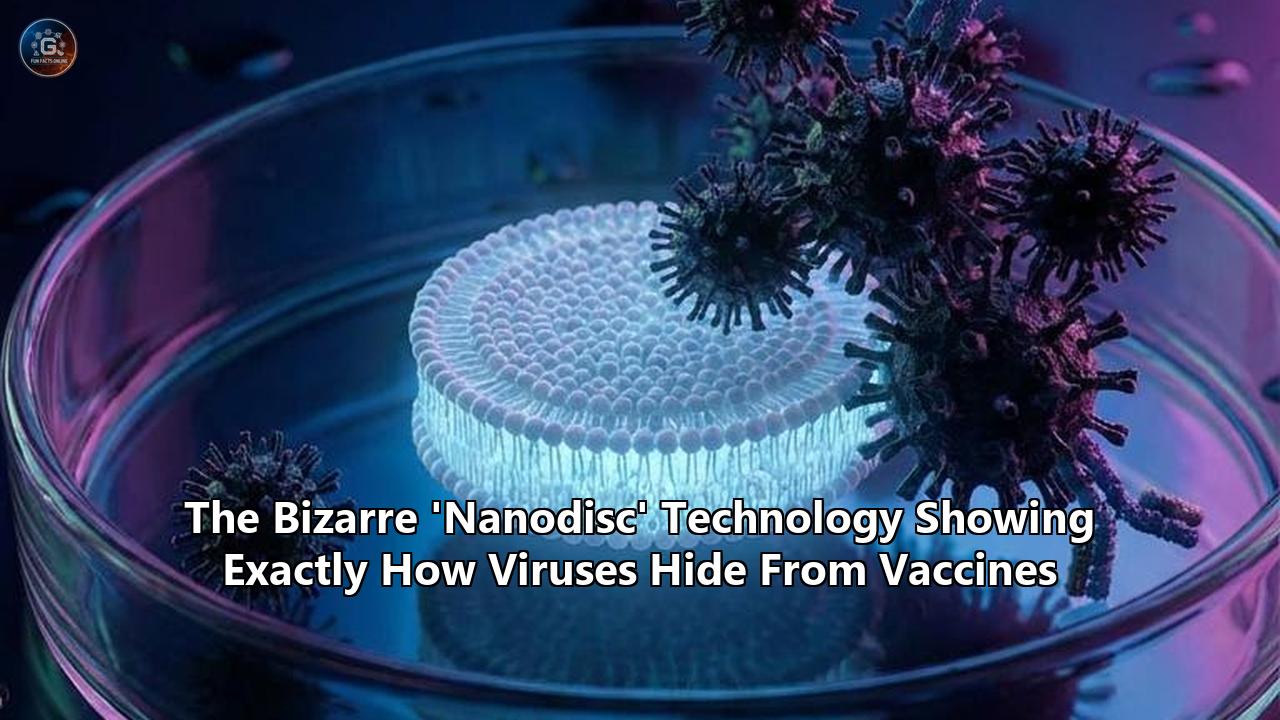
To solve the solubility problem without sacrificing the membrane context, the Scripps Research team turned to nanoscale engineering. A nanodisc is a self-assembling microscopic patch of lipid bilayer—essentially a tiny, artificial biological floor—encircled by a protective belt made of membrane scaffold proteins (MSPs).
Originally derived from apolipoprotein A-I (a protein involved in human cholesterol transport), these scaffold belts tightly wrap around the edges of the lipids, preventing them from aggregating or degrading in water. The resulting structure is a highly stable, uniform disc typically measuring between 10 and 16 nanometers in diameter. Recent engineering advances, including covalently circularized nanodiscs (cND) and DNA-corralled nanodiscs (DCND), have even expanded this capacity up to 90 nanometers to accommodate massive viral protein complexes.
The manufacturing process is a marvel of biological self-assembly. Researchers extract the target viral protein using specialized detergents that keep the hydrophobic (water-repelling) base intact. They then introduce synthetic phospholipids, cholesterol, and the membrane scaffold proteins. As the detergent is carefully dialed back and removed through dialysis, the components automatically self-assemble. The lipids form a bilayer around the base of the viral protein, and the scaffold protein locks everything into a water-soluble disc.
Through the specific application of nanodisc technology viruses that historically evaded exact mapping can finally be observed exactly as they appear in nature. The viral protein remains firmly rooted in a lipid bilayer, completely preserving its natural conformation, while the entire complex remains soluble enough to run through advanced laboratory machinery.
Case Study: Unmasking HIV’s Hidden Geometry
The true power of this platform was demonstrated against HIV, a virus infamous for its staggering mutation rate and impenetrable "glycan shield"—a dense coating of sugar molecules that deflects immune cells.
The Scripps and IAVI researchers focused on the HIV envelope glycoprotein (Env), specifically targeting a region known as the membrane-proximal external region (MPER). The MPER sits at the exact stalk where the Env protein meets the virus's outer membrane. It is a highly coveted target for vaccine developers because, unlike the rest of the HIV virus, the MPER rarely mutates. If a vaccine could train the immune system to attack the MPER, it could theoretically neutralize almost all global strains of HIV.
For years, scientists struggled to understand how a specific broadly neutralizing antibody, known as 10E8, managed to successfully attack the MPER. Soluble protein studies yielded incomplete data because the structural mechanics didn't make sense without the membrane present.
By embedding the HIV Env protein into their nanodisc platform, the researchers utilized cryogenic electron microscopy (cryo-EM) to freeze the molecules and capture their structure at a staggering 3.5 Ångström resolution. The resulting three-dimensional map revealed exactly how the virus hides, and exactly how the antibody breaches its defenses.
The cryo-EM data showed that the 10E8 antibody does not just bind to the viral protein. It physically interacts with the viral lipid membrane itself. The antibody utilizes the lipid bilayer as a structural brace, wedging itself against the membrane to pry open a binding pocket between the viral protein subunits.
This dual-binding mechanism—gripping both the viral stalk and the lipid floor simultaneously—explains why decades of HIV vaccine candidates using soluble proteins failed to elicit this kind of defense. Without the lipid membrane present in the vaccine, the human immune system simply lacks the structural context required to develop the correct antibody geometry.
Proving Modularity with Ebola Virus
To verify that the platform was not merely an isolated success for HIV, the research team immediately applied the exact same nanodisc pipeline to the Ebola virus. Ebola operates entirely differently from HIV; it is a filamentous filovirus that utilizes a unique surface glycoprotein (GP) to infect human macrophages and dendritic cells.
Despite the radical differences in viral architecture, the nanodisc platform successfully anchored the intact Ebola GP in its native, three-part (trimeric) form. Subsequent testing confirmed that Ebola-specific antibodies could effectively recognize and bind to these nanodisc-embedded proteins with the exact same affinity expected in a live viral infection.
This modularity is the core reason the biotechnology sector is paying close attention. Because the underlying lipid and scaffold architecture remains constant, the platform can theoretically swap out the central payload to study the surface proteins of almost any enveloped virus, including Lassa fever, Zika, influenza, and highly mutated variants of SARS-CoV-2.
Advanced Analytics: Accelerating Biopharmaceutical Economics
While the structural discoveries are academically profound, the immediate economic and operational advantages of this system lie in its integration with high-throughput pharmaceutical analytics.
Discovering a therapeutic antibody or mapping an immune response requires sorting through millions of human B cells. Typically, biopharmaceutical companies use modified viral proteins as "molecular bait." They tag the viral protein with a fluorescent marker, mix it with a blood sample, and isolate the rare B cells that stick to the bait using Fluorescence-Activated Cell Sorting (FACS).
Historically, using membrane-bound proteins for FACS was a logistical nightmare. They clumped together, required toxic detergents, and triggered false positives. Soluble proteins were easier to handle but missed the most potent antibodies.
The recent Nature Communications study proved that researchers can take a fully assembled viral glycoprotein nanodisc, tag it with a fluorescent probe, and run it directly through standard FACS machinery. The nanodisc acts as a perfect, stable, water-soluble decoy of the real virus.
Furthermore, the team demonstrated the nanodiscs' compatibility with Surface Plasmon Resonance (SPR)—a technique used to measure the exact binding kinetics and grip strength of an antibody in real-time. By flowing antibodies over nanodiscs anchored to a sensor chip, researchers captured highly accurate binding data that perfectly mirrored native cellular interactions.
The operational velocity this provides is unprecedented. William Schief noted that because the preparation system is scalable and highly reproducible, creating exact molecular bait for a new viral variant now takes approximately one week, down from a month or longer. In an industry where rational drug design pipelines can cost upwards of $2.5 billion per approved therapy, cutting weeks off the iterative testing cycle for every single antigen variant drastically reduces the financial friction of vaccine discovery.
Direct Therapeutics: Weaponizing the Discs
While Scripps and IAVI are utilizing this technology as an analytical lens, a parallel sector of bioengineering is weaponizing the discs to act as direct antiviral therapeutics. In the expanding ecosystem of nanodisc technology viruses are not just subjects of observation—they are targets for mechanical destruction.
Recent studies published in journals like Small Methods have detailed the creation of Antibody-Nanodisc Complexes (ANCs). Instead of using the nanodisc to study how an antibody works, bioengineers are physically attaching antiviral antibodies directly to the exterior of the nanodisc itself.
When these customized complexes are injected into an infected host, they operate as heavily armed microscopic decoys. For example, in preclinical models targeting the influenza virus, the attached antibody first hunts down and locks onto the flu virus's surface proteins. Once the nanodisc is anchored to the virus, a brutal mechanical process occurs.
Because the nanodisc is made of an exposed lipid bilayer, it natively wants to merge with other lipid membranes. The nanodisc physically fuses with the influenza virus's outer envelope. In doing so, it acts as a "nanoperforator," ripping a permanent pore into the viral shell. The virus undergoes premature uncoating, shedding its protective envelope and exposing its fragile RNA payload to immediate degradation by host enzymes before it can ever infect a human cell.
In mouse models, the administration of these ANCs dramatically amplified the antiviral efficacy of standard broadly neutralizing antibodies, significantly reducing both morbidity and mortality compared to administering the antibody alone. By forcing the virus to merge with an empty, artificial membrane, the nanodisc forces the pathogen to effectively disembowel itself.
The Receptor Decoy Strategy
Beyond direct perforation, nanodiscs are being engineered as high-affinity chemical sponges. Viruses like influenza invade the respiratory tract by binding to sialic acid receptors on the surface of human lung cells.
Bioengineers are now loading nanodiscs with dense concentrations of these specific sialic acid receptors. When sprayed into the nasal cavity or lungs, these nanodiscs act as highly stable, floating decoys. The influenza viruses bind to the nanodiscs instead of the actual human tissue. Because the nanodisc provides a highly stable, native-like environment for the receptors, the virus binds to the decoy with far greater affinity than it would to a standard soluble drug.
This effectively neutralizes the viral load, stopping the infection from replicating and spreading deep into the respiratory system. Because this approach targets the physical entry mechanism rather than a specific viral mutation, it remains highly effective even as the virus continuously drifts and mutates its outer proteins.
Thermal Stability and the Cold Chain Problem
Another massive implication of integrating this architecture into global health infrastructure is thermal stability. One of the greatest hurdles in global vaccine distribution is the "cold chain"—the requirement to keep advanced vaccines (like mRNA-LNPs) continuously frozen from the manufacturing plant to the patient's arm.
The lipid composition of a nanodisc can be heavily customized. Researchers are currently exploring the integration of ether glycerophospholipids—specialized lipids modeled after those found in thermophile bacteria that survive in deep-sea hydrothermal vents.
When viral envelope proteins are assembled into nanodiscs built from these ultra-durable bacterial lipids, the entire vaccine structure gains immense resistance to heat. This specific iteration of the technology points toward a future where highly potent, structurally perfect viral vaccines can sit on a clinic shelf at room temperature for months without degrading, vastly improving access for developing nations.
The Next Generation of Universal Vaccines
The precise mapping capabilities demonstrated by the February 2026 data are already shifting the strategic targets for next-generation immunizations. The ultimate goal for both influenza and coronaviruses is a "universal" vaccine—a single shot that provides permanent immunity regardless of how the virus mutates year after year.
The highly mutating regions of SARS-CoV-2 and influenza are located at the very top of their spike and hemagglutinin proteins, respectively. The bases, or stalks, of these proteins mutate very rarely. By using nanodiscs to stabilize the viral stalks and strip away the distracting, highly-mutational heads, researchers are currently designing "low-sugar" and structurally locked immunogens.
These engineered viral stalks, perfectly held in their native shape by the nanodisc membrane, can be used to train the immune system to strictly target the non-mutating base. If successful, an antibody response generated against the stalk of a coronavirus spike protein would neutralize not just the current strain of COVID-19, but potentially future novel coronaviruses that cross over from animal reservoirs.
The Forward Horizon: Milestones and Unresolved Questions
The structural biology community is moving rapidly to capitalize on this refined line of sight. Within the discipline of nanodisc technology viruses are forcing a shift from reactive trial-and-error vaccine formulation to precise, atomic-level rational design.
The immediate next step for the Scripps and IAVI teams involves translating their structural discoveries into active clinical assets. Using the 3.5 Ångström cryo-EM blueprints obtained from the nanodiscs, computational biologists are currently drafting synthetic HIV immunogens that perfectly mimic the newly revealed lipid-protein geometry. These structurally stabilized proteins will eventually advance toward Phase 1 human trials, representing the first generation of HIV vaccine candidates designed with an exact understanding of the membrane interface.
However, several operational and biological questions remain unresolved. While producing nanodiscs for laboratory analytics and B cell sorting is now highly efficient, scaling the production of clinical-grade, GMP-certified nanodiscs for direct injection into millions of humans presents a different challenge entirely. The membrane scaffold proteins require precise calibration, and ensuring the absolute homogeneity of billions of artificial discs in a commercial manufacturing setting will test current biomanufacturing limits.
Additionally, researchers must rigorously map how the human immune system processes the nanodisc scaffold itself over repeated exposures. If a patient receives multiple nanodisc-based vaccines or therapeutics over their lifetime, it is vital to ensure the body does not develop neutralizing antibodies against the apolipoprotein-derived scaffold belt, which could prematurely clear the drug before it executes its therapeutic function.
Despite these scaling challenges, the fundamental breakthrough remains absolute. By artificially recreating the exact cellular floors where viruses conduct their most complex maneuvers, researchers have eliminated the pathogen's ability to hide in plain sight. The era of guessing what a viral protein looks like at the moment of infection is over; we can now lock them in place, map every atom, and engineer exact molecular countermeasures.
Reference:
- https://www.news-medical.net/news/20260411/Nanodisc-technology-improves-study-of-viral-proteins-for-vaccines.aspx
- https://www.sciencedaily.com/releases/2026/04/260411022027.htm
- https://www.frontiersin.org/journals/bioengineering-and-biotechnology/articles/10.3389/fbioe.2020.00539/full
- https://www.biointron.com/antibody-industry-trends/week-2-july-2025-nanodiscs-in-therapeutic-antibody-discovery.html
- https://pmc.ncbi.nlm.nih.gov/articles/PMC12262266/
- https://pubmed.ncbi.nlm.nih.gov/41667448/
- https://pubs.acs.org/doi/10.1021/acscentsci.2c00981
- https://patents.google.com/patent/US10660854B2/en
- https://pubmed.ncbi.nlm.nih.gov/35107214/
- https://studenttheses.uu.nl/bitstream/handle/20.500.12932/46054/Writing%20assignment%20-%20Sanne%20van%20Falier%20%286481221%29.pdf?sequence=1&isAllowed=y
- https://2024.igem.wiki/bnu-china/implementation
- https://www.news-medical.net/news/20250325/Scientists-develop-universal-vaccine-targeting-multiple-coronaviruses.aspx
- https://pmc.ncbi.nlm.nih.gov/articles/PMC9765445/