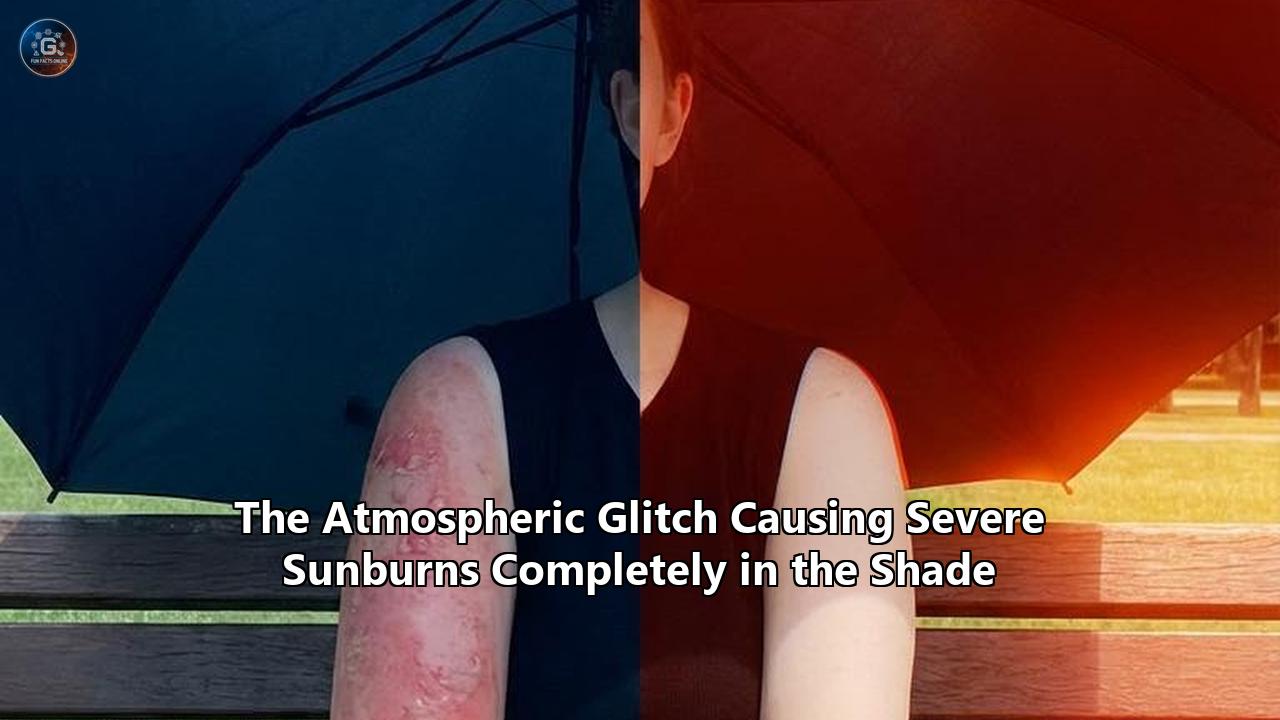
On the afternoon of Friday, April 10, 2026, emergency dermatology clinics and urgent care centers across the Denver metropolitan area registered a highly anomalous influx of patients. By early evening, hospital triage logs showed over 300 individuals seeking treatment for severe, blistering erythema—second-degree sunburns covering their faces, necks, forearms, and legs. While an outbreak of severe sun damage is not entirely unusual for a high-altitude city in the spring, medical staff quickly identified a bewildering common denominator: nearly all of the afflicted patients insisted they had spent the entire afternoon out of the direct sun.
They had been sitting beneath heavy canvas restaurant awnings, thick tree canopies, or deep architectural overhangs. The ambient air temperature hovered at a mild 57°F (14°C) with mostly cloudy skies. Direct sunlight was intermittent at best. Yet, these individuals suffered radiation damage consistent with hours of exposure on a highly reflective snowfield at high noon.
Meteorologists and atmospheric physicists quickly identified the culprit behind this mass medical event. A rare, highly localized atmospheric alignment had temporarily turned the sky over the Colorado Front Range into a massive ultraviolet magnifying glass.
This event provides a pristine case study for researchers, urban planners, and public health officials. By deconstructing the precise meteorological and physical mechanics that caused hundreds of people to experience severe sunburn in the shade, we can extract critical principles about the dynamic nature of our atmosphere, the limitations of current weather modeling, and the hidden physics of scattered radiation.
The Broken-Cloud Effect and Radiation Magnification
To understand how high-intensity ultraviolet radiation can completely bypass physical shade structures, we must first discard the assumption that clouds act as a reliable solar shield. While overcast, dense stratocumulus clouds can attenuate UV radiation by up to 70%, partially cloudy skies generate the exact opposite effect.
Atmospheric physicists refer to this as "cloud enhancement" or the "broken-cloud effect." When the sky features a mix of dense, towering cumulus clouds and patches of clear blue or thin, high-altitude cirrus clouds, solar radiation undergoes severe optical manipulation.
As ultraviolet rays descend through the atmosphere, they hit the vertical edges of towering cumulus clouds. Instead of being absorbed, the UV radiation reflects off the condensed water vapor on the sides of these clouds. The clouds effectively act as massive, suspended mirrors. This reflected UV radiation is then forced down to the surface through the clear gaps between the clouds.
When a person stands directly beneath one of these clear gaps during a broken-cloud event, they are not just receiving the baseline clear-sky UV radiation from the sun. They are receiving the direct beam plus the secondary radiation bouncing off the walls of the surrounding clouds. Decades of atmospheric data, including foundational studies utilizing Monte Carlo radiative transfer models, have demonstrated that broken cloud conditions can enhance surface UV-B radiation by 25% to 50% above what would be expected on a perfectly clear, cloudless day. In extreme cases, researchers have recorded brief spikes where cloud enhancement drove UV indices up by a factor of four.
On April 10 in Denver, the atmospheric profile featured a thick lower layer of broken cumulus clouds beneath a high, wispy layer of cirrus ice-crystal clouds. The high cirrus clouds scattered the incoming UV rays via refraction, redirecting them into the lower cumulus canyons, which then funneled and concentrated the radiation down onto the city.
The Geometry of Diffuse Radiation
The concept of shade relies on a fundamental misunderstanding of how light behaves. When we deploy a patio umbrella or stand under a tree, we are only blocking "direct" radiation—the straight-line beam of photons traveling directly from the solar disk to the ground.
However, ultraviolet radiation is subject to intense Rayleigh scattering. Because UV wavelengths are so short (280 to 315 nanometers for UV-B), they scatter easily when they collide with nitrogen and oxygen molecules in the Earth's atmosphere. This scattering means that a massive percentage of the UV radiation reaching the ground does not come straight from the sun; it comes from all directions of the sky dome. This is known as "diffuse" radiation.
During the April 2026 anomaly, the broken-cloud effect supercharged the diffuse radiation component. An standard patio umbrella blocks roughly a 90-degree cone of the sky directly overhead. This leaves the remaining 270 degrees of the atmospheric hemisphere completely visible to the subject sitting beneath it. If the lateral sky is hyper-radiant due to cloud reflection and atmospheric scattering, the umbrella provides a false sanctuary. The radiation simply bypasses the physical barrier by attacking from the sides.
This mechanism is why patients experienced sunburn in the shade. The umbrella successfully intercepted the direct beam, but the highly energized, scattered diffuse radiation bombarded their skin horizontally.
The Stratospheric Context: Global Healing vs. Local Volatility
To fully contextualize the severity of the UV radiation that breached the troposphere over Colorado, we must look higher up into the stratosphere.
The ozone layer is Earth's primary defense against UV-B radiation. Recent data regarding the health of this protective shield has been overwhelmingly positive. According to late 2025 assessments from NASA and the National Oceanic and Atmospheric Administration (NOAA), the annual Antarctic ozone hole was the fifth smallest since 1992, averaging 7.23 million square miles (18.71 million square kilometers). Furthermore, the Copernicus Atmosphere Monitoring Service documented that the 2025 hole closed unusually early on December 1, marking one of the shortest seasons in the satellite record. This confirmed a long-term recovery trend driven by the 1987 Montreal Protocol's ban on chlorofluorocarbons (CFCs).
If the global ozone layer is healing, why did a major U.S. city experience a hazardous UV spike?
The lesson here is the critical difference between global climatic trends and localized atmospheric volatility. The shrinking of the Antarctic ozone hole represents a macro-scale recovery. However, the stratosphere above the mid-latitudes remains highly dynamic and subject to short-term, localized thinning.
Atmospheric dynamics, including shifts in the polar vortex, variations in stratospheric temperatures, and the movement of upper-level jet streams, can temporarily stretch and thin the ozone layer over specific regions. When the April 10 cloud-enhancement event occurred over Denver, it coincided with a transient, localized dip in total column ozone. The planetary sunscreen was temporarily thinner right as the tropospheric cloud formations began magnifying the incoming radiation.
This intersection of variables—a stratospheric ozone dip combined with a tropospheric cloud enhancement event, occurring at a high elevation (5,280 feet above sea level, where there is simply less atmosphere to filter light)—created a compounding multiplier effect.
The Thermal Trap: Biological and Psychological Disconnects
The medical severity of this case study is rooted not just in physics, but in human behavioral psychology. Human beings are biologically wired to use heat as a proxy for radiation danger.
When we stand in direct, unclouded sunlight, we feel the warmth of infrared radiation on our skin. This thermal feedback loop triggers protective behaviors: we seek shelter, we put on hats, or we apply sunscreen. Ultraviolet radiation, however, carries no thermal signature. It is completely imperceptible to the human nervous system until the cellular damage is already done.
During the Denver incident, the ambient temperature was highly deceptive. At 57°F (14°C), with a 40% humidity level and occasional light breezes, the environment felt distinctly cool and autumnal. The cloud cover further suppressed the infrared heat from the sun. People sitting on outdoor patios or under park trees felt perfectly comfortable.
Because their thermal pain receptors were untriggered, the standard behavioral feedback loop completely failed. Diners sat for hours enjoying lunch, completely unaware that their skin cells were absorbing massive doses of high-energy UV-B photons.
At a cellular level, UV-B radiation directly damages DNA by causing adjacent thymine or cytosine bases to bond together, forming structures called cyclobutane pyrimidine dimers. When the cellular machinery attempts to read this damaged DNA, it fails. If the damage is extensive enough, the cells initiate apoptosis—programmed cell death. The redness, blistering, and intense pain of a severe sunburn are the resulting inflammatory response as the body increases blood flow to the area to clear away the dead and dying cells.
By the time the victims in Denver felt the familiar, tightening sting of erythema, they were already at home, hours removed from the exposure. The thermal trap had successfully disabled their defensive instincts.
The Urban Albedo Multiplier
The physical environment of a modern city introduces another critical variable into this case study: albedo, or surface reflectivity.
In a natural environment like a forest or a grassy field, the ground absorbs a significant portion of incoming UV radiation. Grass, for example, typically reflects only 2% to 3% of UV rays. The urban built environment operates on entirely different optical parameters.
Standard weathered concrete reflects approximately 10% to 12% of UV radiation. Light-colored building facades, glass windows, and metallic architectural elements can reflect significantly higher percentages. When evaluating how individuals suffered severe sunburn in the shade, the geometry of the urban canyon must be factored in.
A person sitting under an awning on a city sidewalk is shielded from above, but they are surrounded by concrete pavements and glass storefronts. During a cloud-enhancement event, the hyper-intense diffuse radiation strikes these urban surfaces and bounces directly into the shaded areas. The environment itself becomes a secondary radiation source.
This dynamic reveals a fundamental flaw in how we design urban shade. Most urban infrastructure—bus shelters, patio umbrellas, park gazebos—is designed strictly with vertical overhead protection in mind. This strictly downward-facing protection model fails entirely when confronted with high-albedo urban surfaces and extreme atmospheric scattering. The radiation simply enters through the open sides, reflecting off the pavement and striking the skin from below.
Algorithmic Blind Spots: The Limits of the UV Index
This localized medical crisis exposed a severe vulnerability in how meteorological organizations communicate radiation risk to the public.
The UV Index, originally developed by Canadian scientists in 1992 and subsequently adopted by the World Health Organization, is an essential public health tool. However, it operates on a set of assumptions that struggle to account for rapid atmospheric volatility.
Standard UV Index forecasts rely on clear-sky deterministic models. They factor in the solar zenith angle (the sun's position in the sky based on time of day, latitude, and time of year), the altitude of the location, and the current ozone column thickness.
When clouds are introduced into the forecast, meteorological models typically apply a Cloud Modification Factor (CMF) to attenuate the expected UV index. If an overcast sky is predicted, the algorithm assumes a reduction in UV intensity and lowers the numerical warning accordingly.
The algorithmic blind spot lies in the unpredictable nature of broken clouds. Traditional weather models cannot easily predict the exact spatial distribution of cumulus clouds minute-by-minute, nor can they accurately model the exact angle of sunlight bouncing off the vertical edges of those clouds in real-time. As a result, when a cloud enhancement event occurs, the actual ground-level UV irradiance can vastly exceed the forecasted UV Index.
On April 10, the official UV forecast for Denver indicated a moderate risk level, predicting heavy attenuation due to the overcast conditions. The forecast models failed to anticipate the highly specific, localized alignment of the cirrus and cumulus layers that transformed the cloud cover from a shield into a magnifying glass.
Meteorological agencies are acutely aware of this limitation. Advanced research utilizing neural networks and machine learning is actively being deployed to estimate UV erythemal irradiance with higher fidelity. By feeding vast datasets of sky-imager photography, broadband solar irradiance, and aerosol optical depth into artificial neural networks, researchers are attempting to teach algorithms to recognize the real-time visual signatures of cloud enhancement.
Until these neural network forecasting models are fully integrated into consumer weather applications, the public remains vulnerable to sudden, localized radiation spikes that standard algorithms simply cannot see coming.
Principles Extracted: A Blueprint for Adaptation
The events in Colorado serve as a forcing function, demanding a reevaluation of how we interact with our immediate environment. By analyzing this case study, we can extract several operational principles that apply to public health, urban design, and personal behavior.
1. The Redefinition of "Shade"The most immediate lesson is that partial shade is not total protection. The geometric limitations of overhead structures—umbrellas, awnings, and thin tree canopies—render them highly susceptible to lateral, diffuse radiation. To achieve genuine protection during high-UV periods, structural shade must account for the Sky View Factor (SVF). Effective protection requires minimizing the visible sky from all angles, not just the zenith. This requires incorporating vertical barriers, side-shading, or heavily vegetated perimeters into architectural designs, effectively blocking the lateral entry of scattered radiation.
2. Decoupling Temperature from Radiation RiskPublic health messaging must aggressively sever the mental link between heat and UV danger. Educational campaigns should emphasize that ultraviolet radiation is a cold, invisible threat. The reliance on thermal comfort as an indicator of safety is a dangerous evolutionary hangover. Skin protection strategies—such as broad-spectrum sunscreen application and UV-protective clothing—must be tied to the calendar, the altitude, and the time of day, rather than the reading on a thermometer.
3. Adjusting to a Volatile StratosphereWhile the long-term stabilization of the Antarctic ozone hole is a triumph of international environmental policy, it does not guarantee homogenous protection across the globe. Mid-latitude populations must adapt to the reality of transient stratospheric thinning. Regional micro-holes, driven by shifting polar vortices and complex upper-atmosphere thermodynamics, will continue to occur. Sun protection must be treated as a daily baseline necessity, rather than a reactive measure reserved for clear summer days at the beach.
4. The Hazard of Urban AlbedoUrban planners and architects must factor radiation reflectivity into their material choices. The widespread use of high-albedo materials for sidewalks and building facades inadvertently creates radiation traps in highly populated pedestrian zones. Designing streetscapes with materials that absorb, rather than reflect, UV radiation can drastically reduce the horizontal bombardment that bypasses overhead shade structures.
Looking Forward: The Next Era of Meteorological Tracking
The April 2026 atmospheric glitch provides a stark warning about the complexities of our atmospheric system. As we move forward, the focus must shift toward hyper-local, real-time environmental monitoring.
The next major milestone in public health meteorology will be the deployment of dense, ground-level UV sensor networks integrated directly into smart-city infrastructure. Rather than relying entirely on satellite data and macro-level predictive models, cities will utilize street-level sensors to measure exact erythemal irradiance in real-time, accounting for urban albedo and immediate cloud-enhancement events.
Simultaneously, the integration of artificial intelligence into weather prediction will revolutionize our ability to forecast broken-cloud radiation spikes. Neural networks, trained on decades of radiative transfer data and real-time sky imagery, will soon be able to issue hyper-local "flash UV warnings" to mobile devices, alerting pedestrians when the optical geometry of the sky has turned dangerous.
Until these technological safety nets are fully realized, the burden of protection falls on the individual. The primary takeaway from the Denver anomaly is a simple but profound shift in environmental awareness: the presence of a shadow does not guarantee the absence of the sun. Even when the sky is obscured, the air is cool, and the direct light is blocked, the invisible physics of the atmosphere are constantly at work. Understanding these hidden dynamics is the only reliable defense against suffering a severe sunburn in the shade.
Reference:
- https://ozone.unep.org/2025-antarctic-ozone-hole-among-smallest-decades
- https://www.noaa.gov/news-release/noaa-nasa-2025-ozone-hole-is-5th-smallest-since-1992
- https://www.ecoticias.com/en/the-ozone-hole-over-antarctica-closed-unusually-early-in-2025-and-scientists-believe-there-is-a-reason-that-almost-no-one-is-looking-at/26003/
- https://www.earth.com/news/antarctic-ozone-hole-shrinks-to-smallest-size-in-six-years/
- https://wmo.int/media/news/small-and-short-lived-2025-ozone-hole-confirms-long-term-recovery-trend