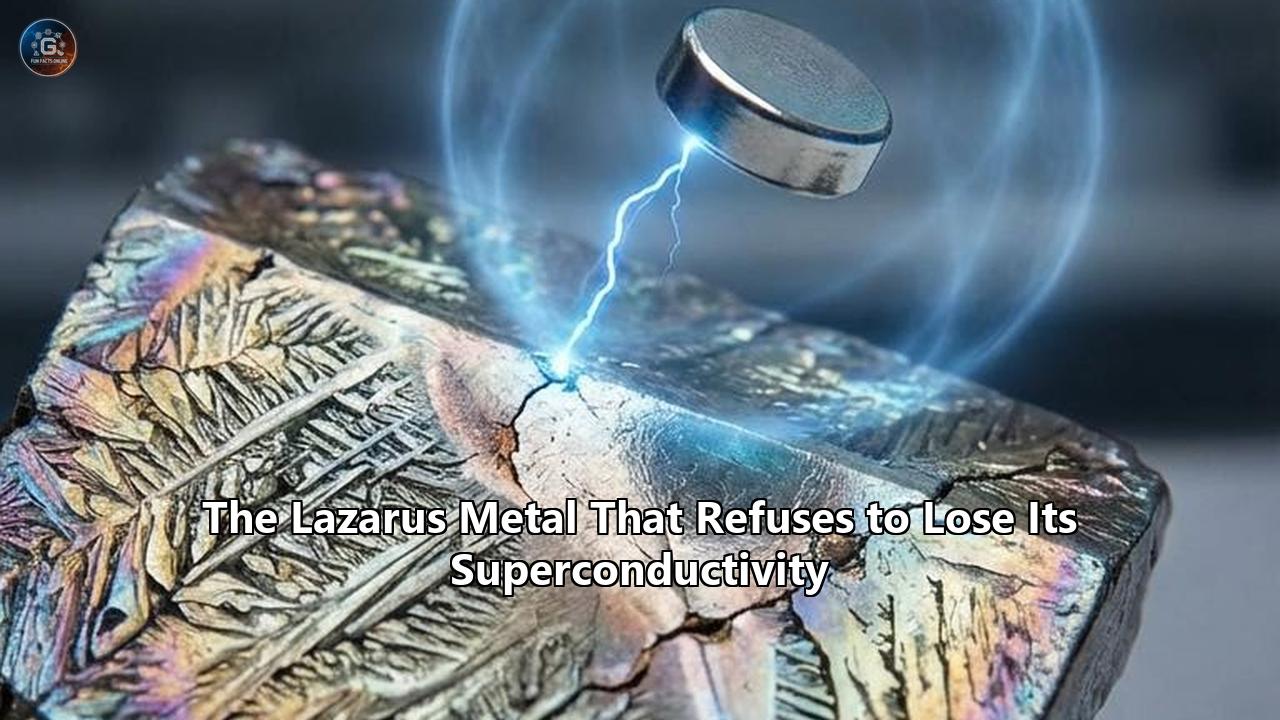
On April 10, 2026, a collaboration of physicists from Rice University and the National Institute of Standards and Technology (NIST) published a paper in the journal Science detailing the exact boundaries of a quantum anomaly that defies the foundational laws of physics. The team successfully mapped a three-dimensional, toroidal "halo" of superconductivity in a heavy-fermion metal known as uranium ditelluride ($UTe_2$).
What makes this halo extraordinary is the environment in which it exists. Under normal circumstances, intense magnetic fields act as the absolute executioner of the superconducting state. Expose a conventional superconductor to a magnetic field of sufficient strength, and its ability to conduct electricity with zero resistance instantly shatters. Yet, in $UTe_2$, the superconductivity is destroyed by a magnetic field at 35 Tesla, only to inexplicably resurrect itself when the field is pushed even higher—persisting across a brutal regime from 40 Tesla up to 65 Tesla.
Physicists refer to this as the "Lazarus phase," a nod to the biblical figure who rose from the dead. But the April 2026 mapping goes beyond merely confirming the existence of this resurrection. The data from Rice University and NIST reveals that this high-field return of zero electrical resistance is strictly dependent on the precise angular alignment of the magnetic field relative to the material's crystal lattice.
"When I first saw the experimental data, I was stunned," said Andriy Nevidomskyy, a physicist at Rice University's Center for Quantum Materials and co-author of the April 2026 study. "The superconductivity was first suppressed by the magnetic field as expected but then reemerged in higher fields and only for what appeared to be a narrow field direction. There was no immediate explanation for this puzzling behavior."
Working alongside experimentalist Sylvia Lewin at NIST, the team documented a highly specific geometry to the survival of the Cooper pairs. "Our measurements revealed a three-dimensional superconducting halo that wraps around the hard b-axis of the crystal," Lewin reported. "This was a surprising and beautiful result."
Behind the published abstracts and the refined data graphics lies a profound theoretical crisis. The existence of the Lazarus phase in $UTe_2$ forces condensed matter physicists to rethink the mechanisms that bind electrons together. The material does not just survive extreme conditions; it appears to thrive within them, suggesting a complex interplay of magnetic spin, topological surface states, and heavy-fermion dynamics that researchers are only beginning to decode.
An Accidental Synthesis
The reality of superconductivity research is rarely as neat as the theoretical textbooks imply. The genesis of the $UTe_2$ anomaly did not begin with a targeted search for a high-field topological superconductor, but rather with an accident in a laboratory crucible.
In 2019, Sheng Ran, then a research associate at the University of Maryland's Center for Nanophysics and Advanced Materials (CNAM), was attempting to synthesize a completely different uranium-based compound. During the process, the chemical reaction yielded crystals of uranium ditelluride—a material that had been documented decades prior but largely dismissed by the scientific community as physically unremarkable. It was considered a "dud".
However, the team, led by Johnpierre Paglione and NIST physicist Nick Butch, decided to run the accidental crystal through routine low-temperature diagnostics. When cooled below 1.6 Kelvin (-271.5 degrees Celsius), the supposedly boring metal dropped its electrical resistance to zero. More shockingly, it exhibited behavioral signatures normally reserved for rare ferromagnetic superconductors, despite the fact that $UTe_2$ is not inherently ferromagnetic.
"This is a very recently discovered superconductor with a host of other unconventional behavior," Butch noted during the early phases of the material's evaluation. "So it's already weird. It almost certainly has something to do with the novelty of the material. There's something different going on in there."
The initial measurements showed that $UTe_2$ could withstand magnetic fields up to 35 Tesla depending on the axis of orientation—an incredibly high threshold for a superconductor with a critical temperature of just 1.6 Kelvin. For perspective, 35 Tesla is approximately 3,500 times stronger than a typical refrigerator magnet, and more than ten times the strength of the magnets used in standard clinical MRI machines. But as the team pushed the material into extreme magnetic field facilities, the true anomaly surfaced: the field killed the superconductivity at 35 Tesla, but rotating the sample and increasing the field to 40 Tesla caused the zero-resistance state to snap back into existence.
The Physics of Magnetic Assassination
To understand why the Lazarus phase continues to baffle physicists, one must understand the microscopic mechanics of how a magnetic field murders a conventional superconductor.
In standard materials—such as niobium-titanium or lead—superconductivity is driven by the Bardeen-Cooper-Schrieffer (BCS) mechanism. As the metal cools below its critical temperature, electrons overcome their natural electrostatic repulsion and pair up into what are known as Cooper pairs. These pairs condense into a macroscopic quantum state, moving through the atomic lattice without scattering, which results in zero electrical resistance.
In the vast majority of superconductors, these Cooper pairs form as "spin singlets." Electrons have a quantum property called spin, which can point either "up" or "down." In a spin singlet, one electron points up while its partner points down. Because their spins are directly opposed, the total spin angular momentum of the pair is zero.
When a magnetic field is applied to the material, it exerts a force on these electrons. This disruption occurs through two primary mechanisms. First is the orbital effect: the magnetic field physically deflects the moving electrons via the Lorentz force, twisting their trajectories and eventually ripping the Cooper pair apart. Second is the Zeeman effect, which governs the Pauli paramagnetic limit. A strong magnetic field naturally wants to align all electron spins parallel to the field direction. Because a spin singlet requires the electrons to be anti-parallel, pushing the magnetic field beyond the Pauli limit forces the "down" electron to flip "up," instantly annihilating the Cooper pair and destroying the superconductivity.
By all textbook calculations, a magnetic field of 35 Tesla is an order of magnitude higher than the Pauli limit for a conventional superconductor operating at 1.6 Kelvin. The fact that $UTe_2$ survived up to 35 Tesla was already a massive violation of the expected rules. The fact that it reemerged at 40 Tesla and survived up to 65 Tesla indicated that the paired electrons in this material were operating under an entirely different set of physical laws.
The Spin-Triplet Rebellion
The survival of the Lazarus metal lies in a rare quantum configuration known as "spin-triplet" pairing. Unlike conventional spin singlets, the electrons forming Cooper pairs in $UTe_2$ align their spins in the same direction. Because both spins are parallel (yielding a total spin of 1 rather than 0), the applied magnetic field does not force them to flip and break apart. Instead, the pairs simply rotate to align their joint spin with the external field, allowing the superconducting state to weather magnetic forces that would obliterate a conventional material.
Furthermore, uranium ditelluride is classified as a heavy-fermion system. "To fully appreciate the hype surrounding the material, we need to take a closer look at superconductivity," explains Dr. Toni Helm from the Dresden High Magnetic Field Laboratory (HLD), who has extensively studied the material's unconventional properties. In heavy-fermion materials, the conduction electrons interact violently with the localized magnetic moments of the uranium atoms.
"Together, they can shield the magnetism of the material, behaving as a single particle with – for electrons – an extremely high mass," Helm noted. This extreme mass slows the electrons down, which alters the standard orbital effects of the magnetic field and contributes to the metal's extraordinary resilience. To date, $UTe_2$ is the undisputed heavyweight champion of the superconducting world; no other heavy-fermion system maintains a superconducting state at such punishing magnetic field strengths.
Inside the Magnetic Crucible
Reaching the threshold of the Lazarus phase requires infrastructure that only a few laboratories on Earth possess. In the highly competitive landscape of high-field superconductivity research, securing time on the 65-Tesla magnets requires researchers to travel to specialized facilities like the National High Magnetic Field Laboratory (MagLab) in Tallahassee, or the pulsed field facility at Los Alamos National Laboratory.
These facilities do not use standard superconducting magnets to generate 65 Tesla, because standard superconductors would self-destruct under the strain. Instead, they use pulsed resistive magnets. To generate a 65 to 70 Tesla field, massive capacitor banks—sometimes occupying entire rooms—discharge a staggering amount of electrical energy into a highly engineered coil of copper alloy in a fraction of a second.
The physical forces generated inside the coil are violent. The Lorentz forces pushing outward against the copper wire are equivalent to the pressures found at the deepest parts of the ocean. If the magnet is not properly reinforced with high-tensile materials like Zylon, the coil will literally explode, tearing itself apart into shrapnel. Consequently, the extreme magnetic field can only be sustained for a few milliseconds.
During this microsecond window, researchers must beam their signals through the tiny, cryogenically cooled $UTe_2$ crystal positioned at the center of the bore, measuring its electrical resistance and heat capacity before the magnetic field collapses.
It was during these high-stress pulsed field experiments that another layer of the anomaly was uncovered. In January 2025, an international collaboration published findings in the Proceedings of the National Academy of Sciences (PNAS) detailing what happens when $UTe_2$ is subjected to 70 Tesla pulsed fields. The team observed a deeply counterintuitive phenomenon: as the magnetic field approached the 40 Tesla boundary, the material's critical temperature ($T_c$) did not just survive—it actually elevated.
While the baseline zero-resistance state of the material begins at 1.6 Kelvin, pushing the magnetic field near 40 Tesla forced the critical temperature up to approximately 2.4 Kelvin.
"This finding is counterintuitive, as magnetic fields typically suppress superconductivity; however, in this case, they appear to stabilize and enhance it under specific conditions," the researchers noted. The magnetic field was not merely failing to destroy the Cooper pairs; it was actively strengthening the pairing mechanism, acting as a catalyst for a more robust quantum fluid.
Mapping the Quantum Topography
While macroscopic resistance measurements in pulsed magnetic fields proved the existence of the Lazarus phase, understanding the precise spatial arrangement of the electrons required an entirely different approach. You cannot put a scanning tunneling microscope inside a 65-Tesla pulsed magnet—the vibrations and electrical noise would render atomic-scale imaging impossible.
Instead, researchers turned to zero-field, ultra-low temperature microscopy to map the fundamental nature of the spin-triplet pairs. In April 2025, Dr. Qiangqiang Gu, working within the Seamus Davis group at Cornell University, utilized a highly advanced technique called Scanned Josephson Tunneling Microscopy (SJTM) alongside Scanned Andreev Tunneling Microscopy (SATM) to look directly at the superconducting condensate of $UTe_2$.
Standard Scanning Tunneling Microscopy (STM) works by bringing an atomically sharp metallic tip within a fraction of a nanometer of a sample's surface. A voltage is applied, and single electrons quantum-mechanically "tunnel" across the vacuum gap, creating a topographical map of the electron density. But single electrons cannot show you the behavior of the Cooper pairs.
To solve this, the Cornell team used an s-wave superconducting tip, effectively tunneling fully formed Cooper pairs—charge 2e Andreev tunneling—directly into the surface of the uranium ditelluride. The results were definitive. Gu and his colleagues visualized spin-triplet pairing density wave states with micro-electron-volt ($\mu eV$) energy resolution.
More crucially, the imaging provided direct evidence of robust "zero-energy surface states" at specific crystalline terminations. This observation was the smoking gun the physics community had been hunting for, firmly confirming $UTe_2$ as the first known 3D intrinsic topological superconductor.
The Ghost Particle Protocol
The verification of $UTe_2$ as a topological superconductor explains the immense influx of funding and attention from both state-sponsored physics laboratories and private technology sectors. The ultimate goal driving this specific vein of superconductivity research is the creation of fault-tolerant topological qubits.
Today's quantum computers operate using "noisy intermediate-scale quantum" (NISQ) technology. The standard superconducting qubits used by tech giants like IBM and Google are incredibly fragile. Any stray environmental noise—a fluctuation in temperature, a stray photon, a trace magnetic field—causes the qubit to lose its quantum superposition, a fatal process known as decoherence. To build a commercial-scale quantum computer, researchers must implement massive error-correction protocols, often requiring thousands of physical qubits just to simulate one logical, stable qubit.
Topological superconductors offer a structural bypass to this problem. According to theoretical physics, a spin-triplet topological superconductor like $UTe_2$ should harbor exotic quasi-particles known as Majorana zero modes on its boundaries or surfaces.
First theorized by Italian physicist Ettore Majorana in 1937, a Majorana fermion is a particle that is its own antiparticle. In the context of condensed matter physics, they do not exist as fundamental particles roaming the universe, but rather as collective excitations of electrons that emerge at the edge of topological superconductors.
The defining trait of Majorana zero modes is their non-Abelian statistics. If you encode quantum information into a pair of Majorana zero modes, the information is stored non-locally. Because the "particle" is essentially split and spread across the surface of the material, no single localized environmental disturbance can collapse the wavefunction. The quantum information can only be altered by physically swapping the positions of the Majorana zero modes—a process called "braiding."
For years, tech companies like Microsoft poured billions into creating artificial topological superconductors by layering conventional superconductors on top of semiconductor nanowires. The results have been plagued by material defects, false positives, and agonizingly slow progress.
Uranium ditelluride offers a tantalizing alternative: a material that is intrinsically topological in its natural, bulk form. The 2025 discovery of zero-energy surface states by the Cornell group suggests that $UTe_2$ natively hosts the exact environmental conditions required to sustain Majorana zero modes. If engineers can learn to isolate and braid these emergent quasi-particles on the surface of a $UTe_2$ crystal, it could serve as the foundation for quantum processors that are inherently immune to decoherence—the equivalent of transitioning from the fragile vacuum tubes of the 1940s to the solid-state silicon transistor.
The Phenomenological Fix
Despite the empirical verification of its topological nature and its high-field resilience, the fundamental "why" of the material remains fiercely debated. Condensed matter physicists rely on microscopic theories to predict how materials will behave. BCS theory works perfectly for standard metals, but the microscopic mechanism gluing the electrons together in $UTe_2$ remains opaque.
The magnetic spin fluctuations in the uranium atoms are intensely complex. The 5f orbital electrons of the uranium atoms are highly localized, yet they hybridize with the conduction electrons from the tellurium atoms, creating a dense, interacting fluid that defies standard mathematical mapping.
Faced with a microscopic puzzle that currently exceeds our analytical capabilities, researchers have had to adapt. This marks a rare pivot in superconductivity research, where macroscopic phenomenological models are currently outpacing fundamental microscopic theory.
In the April 2026 Science paper, Andriy Nevidomskyy detailed how his theoretical team managed to model the Lazarus halo without actually solving the microscopic electron interactions. "To understand what was happening, Nevidomskyy created a theoretical model that could explain the observations without depending heavily on uncertain microscopic details," the researchers noted.
The team built an effective phenomenological framework that required only a minimal set of assumptions regarding the underlying pairing forces. By focusing on the spatial symmetries of the crystal lattice and the macroscopic thermodynamics of the phase transitions, they accurately reproduced the exact toroidal, doughnut-shaped halo of superconductivity observed by the NIST experimentalists.
"The model uses a phenomenological approach, focusing on the overall behavior rather than the exact underlying mechanisms that cause electrons to pair into Cooper pairs," the study outlined. "The results matched the experimental data closely, especially the unusual way superconductivity changes with the direction of the magnetic field. The model shows how orientation plays a crucial role in whether superconductivity survives or returns in $UTe_2$."
This approach is highly unorthodox. It is the physics equivalent of accurately predicting the complex aerodynamic drag of a hypersonic jet without actually understanding the molecular structure of the air it flies through. The success of the phenomenological model proves that the Lazarus phase is inherently tied to the rigid geometry of the material's crystalline axis—specifically wrapping around the "hard b-axis"—but it leaves the deepest question unanswered: what invisible force is actually holding those triplet pairs together in the crucible of a 65-Tesla field?
The Next Horizon
The saga of the Lazarus metal is far from concluded. As of mid-2026, the global condensed matter community is racing to translate the cryogenic, high-magnetic-field anomalies of $UTe_2$ into controllable, engineered technologies.
There are severe physical limitations to the material as it exists. As Toni Helm pointed out during the 2024 studies, "$UTe_2$ cannot be used to make leads for a superconducting electromagnet. Firstly, the material's properties make it unsuitable for this endeavor, and secondly, it is radioactive."
Working with depleted uranium requires specialized shielding, rigorous safety protocols, and severely restricts the environments in which the material can be deployed. Furthermore, a critical temperature of 1.6 Kelvin (or even 2.4 Kelvin under extreme magnetic pressure) mandates the use of expensive, bulky dilution refrigerators. You will not find a $UTe_2$ processor in a consumer desktop or a standard data center anytime soon.
However, the true value of uranium ditelluride was never about mass commercialization. It is a Rosetta Stone. By studying exactly how the spin-triplet pairing survives magnetic assassination and how the topological surface states harbor zero-energy modes, materials scientists can reverse-engineer the required physics.
The current trajectory involves the search for structural analogs—synthetic non-radioactive compounds, potentially utilizing rare-earth elements or transition metals like cerium or rhodium, that mimic the exact heavy-fermion, spin-triplet architecture of $UTe_2$ but at higher, more manageable temperatures.
Simultaneously, the advanced scanning microscopy techniques pioneered in 2025 are being turned toward other unconventional superconductors. The ability to tunnel Cooper pairs directly into a sample and visually map the pairing density waves provides an entirely new diagnostic tool for quantum materials.
Uranium ditelluride spent decades sitting in materials science catalogs, entirely ignored, written off as a toxic, radioactive artifact of mid-century chemical synthesis. Today, it stands at the absolute center of quantum physics—a material that rises from the dead under the crushing weight of a 65-Tesla field, hiding ghost particles on its surface, and demanding that theorists rewrite the rules of what electrons can do.
The existence of the Lazarus metal proves that our understanding of quantum condensation is still remarkably incomplete. The answers are hiding in the halo, waiting for the right magnetic angle to be pulled into the light.
Reference:
- https://www.sciencedaily.com/releases/2026/04/260409101108.htm
- https://scitechdaily.com/strange-form-of-superconductivity-stuns-scientists/
- https://nationalmaglab.org/media/ngopdtc1/oct2019_dc_pff_lazarus_superconductivity.pdf
- https://www.sci.news/physics/lazarus-superconductivity-uranium-ditelluride-07673.html
- https://nationalmaglab.org/news-events/news/rare-lazarus-superconductivity/
- https://www.labmanager.com/rare-lazarus-superconductivity-observed-in-promising-rediscovered-material-773
- https://www.nist.gov/news-events/news/2019/08/newfound-superconductor-material-could-be-silicon-quantum-computers
- https://scitechdaily.com/ute2-unleashes-new-superconductivity-secrets/
- https://nationalmaglab.org/user-facilities/dc-field/research/science-highlights/lazarus-superconductivity/
- https://mgml.eu/news/2025/UTe2-PNAS
- https://tdli.sjtu.edu.cn/en/event/4036