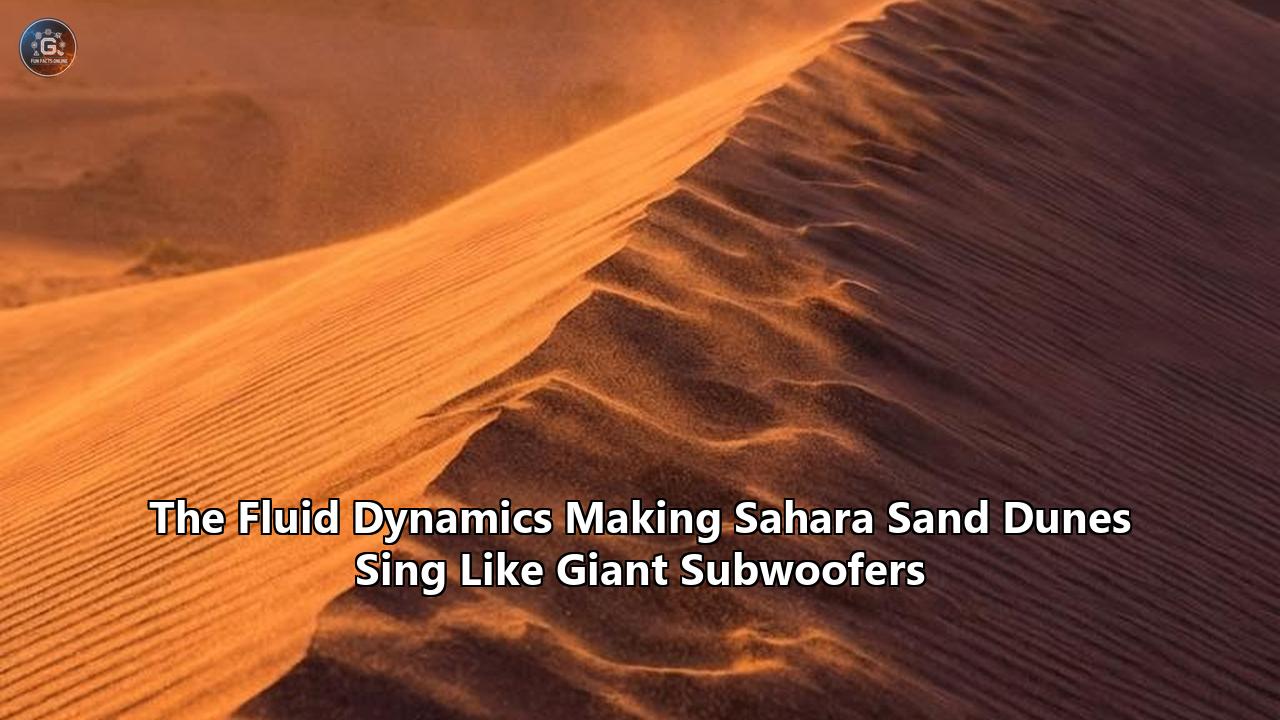
Deep in the hyper-arid regions of the Sahara, the Gobi, and the Mojave, an immense, low-frequency rumble occasionally shatters the silence of the desert. The sound, often compared to the hum of a propeller plane, the drone of a cello, or a heavy bass drop, can reach volumes of up to 105 decibels and sustain itself for over fifteen minutes. For centuries, this phenomenon was attributed to restless spirits or subterranean rivers. Now, an international cohort of physicists and mechanical engineers has decoded the exact fluid dynamics driving this acoustic anomaly.
Recent laboratory reconstructions and field studies in environmental fluid dynamics have definitively cracked how these massive geological structures act like giant, naturally occurring subwoofers. When a critical mass of dry sand avalanches down the steep slip face of a dune, the grains do not merely tumble; they engage in a highly synchronized granular shear flow. As the particles slide, they collide and compress the air between them in unison, generating distinct frequencies typically ranging from 70 to 110 Hertz.
However, the cascading sand is only half of the acoustic equation. Researchers from institutions like the University of Colorado Boulder and Paris Diderot University have discovered that the dune itself acts as a massive resonating chamber. Deep beneath the shifting surface lies a highly compacted sublayer or a moisture-retaining core. When the surface avalanche generates acoustic waves, these vibrations travel downward, strike the hard internal boundary, and reflect upward. This internal geometry functions precisely like an acoustic waveguide—or the wooden body of a stringed instrument—amplifying the synchronized friction of millions of microscopic grains into a deafening roar.
This breakthrough in understanding singing sand dunes extends far beyond solving a geological curiosity. The underlying science of how solid particles spontaneously synchronize and flow like a liquid has cracked open a critical blind spot in modern physics. By decoding the granular fluid dynamics of the desert, researchers are developing urgently needed solutions for two distinct but deeply connected global crises: the accelerated migration of desert dunes swallowing human infrastructure, and the catastrophic structural failures of industrial granular transport systems.
The Granular Paradox: Why Sand Defies Classical Physics
To comprehend the sheer destructive potential of shifting sands, engineers must first grapple with the physical paradox of granular materials. After water, granular matter is the second most manipulated substance on Earth, yet it routinely defies the classical laws of Newtonian fluid dynamics.
Standard fluid dynamics relies heavily on the assumption of incompressibility—the idea that the density of a fluid moving through a simple shear flow remains largely constant. Water flowing through a pipe or a riverbed adheres to these rules, allowing engineers to calculate pressure, velocity, and structural load with high precision. Sand, however, exists in a liminal state of matter. A pile of sand acts as a solid when you stand on it, flows like a liquid when poured from a bucket, and behaves like a gas when whipped into a dust storm.
When a sand dune avalanches, the sheer stress triggers a phase transition. The grains lose their static friction and begin to flow, but unlike water, this granular shear flow violates the incompressibility condition. The volume of the flowing layer physically dilates. As the grains tumble, the interstitial air pockets expand and contract. In a singing dune, the particles are typically highly uniform in size—usually between 100 and 500 microns—and coated in a microscopic silica-water gel known as desert glaze. This uniformity allows the grains to lock into a synchronized rhythmic motion.
The resulting acoustic emission is a direct byproduct of this fluid-mechanical violation. But while the song of the dunes is mathematically beautiful, the erratic nature of granular flow presents a massive, unpredictable hazard. Because standard hydrodynamic equations fail to predict how and when a static dune will suddenly liquefy into an avalanche, structural engineers and city planners have historically struggled to build defenses against them.
The Macro-Scale Menace: Megadunes on the March
The failure to accurately model granular flow has resulted in severe economic and humanitarian consequences across the globe. Driven by shifting wind patterns and worsening droughts, mobile desert dunes are migrating at aggressive speeds, threatening the settlements and infrastructure of an estimated one billion people worldwide.
Unlike a localized landslide, dune migration is a continuous, relentless fluid-dynamic process. A single massive barchan (crescent-shaped) dune can consume highways, railways, agricultural land, and entire villages. Data collected by geotech firms tracking geohazards in the Middle East indicates that some aggressive dune formations in Saudi Arabia migrate up to eight meters per year.
In Mauritania, the capital city of Nouakchott provides a harrowing case study of what happens when natural dune dynamics are destabilized. Nouakchott sits at or slightly below sea level, historically protected from the Atlantic Ocean by a continuous, fragile cordon of coastal sand dunes. Over the past few decades, a combination of uncontrolled sand mining, overgrazing of stabilizing vegetation, and severe droughts has degraded this natural barrier. The protective wall has fractured into deep breaches. As the structural integrity of the granular matrix fails, marine intrusion accelerates, washing seawater into the city and compromising freshwater supplies, public space, and vital roadways.
The economic toll of this encroachment is staggering. In Egypt's El-Minya governorate, sand dunes encroaching upon the western Nile riverbank and the Baher Youssef channel routinely devastate agricultural zones. The continuous influx of windblown sand into irrigation canals degrades water quality and necessitates heavy dredging operations, costing tens of millions of dollars annually. When critical transport corridors, such as Egypt's Western Desert Road, are severed by linear and barchan dune migration, the logistical blockages ripple through the regional economy.
Historically, the dominant strategy for managing encroaching sand was brute force: deploying fleets of bulldozers and excavators to mechanically clear the roads. This approach is not only exorbitantly expensive but ultimately futile. Because engineers lacked a functional model for how the dunes internally structure themselves and how their slip faces initiate flow, the cleared sand simply returned with the next major wind event.
The Micro-Scale Crisis: Silo Quakes and Industrial Collapse
The exact same gaps in fluid dynamic modeling that allow dunes to swallow highways also trigger catastrophic failures in industrial settings. From pharmaceutical manufacturing to global agriculture, the storage and transport of granular materials are plagued by unpredictable flow dynamics.
When agricultural grain, coal, or chemical powders are discharged from a large cylindrical steel silo, the internal flow must be perfectly managed. Engineers typically aim for "mass flow," where all particles in the silo move downward at a uniform velocity. However, because granular friction behaves so erratically, silos frequently shift into "funnel flow." In this state, a stagnant zone of material adheres to the outer walls while a high-velocity channel forms down the exact center.
The transition between these flow states generates massive, uneven friction against the thin steel walls of the silo. Just as an avalanching dune generates low-frequency acoustic vibrations, the discharging grain can trigger a phenomenon known in mechanical engineering as a "silo quake." The internal shear flow creates violent, pulsating vibrations that resonate through the entire structure.
Worse still, the friction between the flowing grains and the stationary grains creates unpredictable overpressure coefficients. In a liquid tank, pressure scales linearly with depth. In a granular silo, the friction redistributes the downward weight outward against the walls. If an internal avalanche occurs—similar to a dune face collapsing—the sudden spike in localized wall pressure can cause the steel shell to buckle under axial compression. The silo violently implodes, spilling thousands of tons of material, halting supply chains, and frequently causing fatal industrial accidents.
For decades, resolving these silo collapses and predicting dune migration seemed like disparate challenges. The breakthrough came when researchers realized that the acoustic resonance of the desert could serve as a unifying diagnostic tool.
Acoustic Seismology: Using the Song to Map the Structure
By analyzing the specific frequencies of singing sand dunes, fluid dynamicists and geophysicists have developed a non-invasive method for mapping the internal architecture of massive granular bodies.
Traditionally, understanding the core structure of a dune required destructive and highly impractical excavation or the deployment of expensive ground-penetrating radar systems that are difficult to drag across shifting, hyper-arid environments. Today, researchers utilize the dune's own acoustic emissions as a natural seismograph.
When the Caltech and Paris Diderot teams mapped the acoustics of these dunes, they discovered that the frequency of the sound is inextricably linked to the shear rate of the avalanching grains, while the amplification relies on the depth and density of the internal waveguide. By recording the surface avalanches with high-fidelity microphones and measuring the vibrations with accelerometers placed on the sand, scientists can calculate the exact depth of the moisture core or hard-packed sublayer.
This acoustic data is now being merged with advanced satellite imaging. Using complex algorithms like COSI-Corr (Co-registration of Optically Sensed Images and Correlation), researchers can track a dune's velocity and shifting morphology from space with sub-pixel accuracy. When this remote sensing is combined with the acoustic mapping of the dune's internal slip planes, scientists can finally build accurate, three-dimensional predictive models of granular flow.
They can now anticipate exactly when a dune's slip face will reach the critical angle of repose, how much volume will cascade during the next avalanche, and precisely how far the entire structure will migrate after a specific wind event. The dune is no longer an unpredictable, solid mountain of sand; it is a mapped, quantifiable fluid system.
Re-Engineering the Flow: Solutions from the Sahara to the Silo
Armed with these new models, civil engineers and environmental leaders are deploying sophisticated, fluid-dynamic interventions to manage granular flows, completely abandoning the brute-force clearing methods of the past.
In the realm of infrastructure protection, engineers are applying the concept of "wake-induced long-range dune repulsion." Just as hydrodynamics can dictate how water flows around a bridge pylon, aerodynamic principles can be used to alter the wind patterns that drive dune migration. By constructing highly specific, porous barriers upwind of a threatened highway or settlement, engineers can deliberately alter the drift potential of the wind.
Instead of trying to stop the sand completely—which only causes it to pile up and eventually overwhelm the barrier—these structures disrupt the shear flow at the dune's crest. They force the wind to scour the sand away from the slip face, essentially steering the massive dune around the critical infrastructure.
In highly vulnerable coastal areas like Nouakchott, international coalitions such as the West Africa Coastal Areas Management Program (WACA) are utilizing nature-based solutions to reinforce the granular matrix of the coastal dunes. Armed with an understanding of how internal moisture and root systems alter the fluid dynamics of the sand, teams are planting dense networks of thorny branches and specific halophytic vegetation deep into the dune's slip planes. These biological anchors act as a stabilizing mesh. They alter the localized friction coefficients, effectively locking the grains in place and preventing the synchronized shearing required for an avalanche. This living wall absorbs the kinetic energy of the ocean winds, stopping the marine intrusion that threatens the Mauritanian capital.
Simultaneously, mechanical engineers are applying the mathematics of the singing dunes to redesign industrial silos. By understanding how synchronized avalanches create overpressure, engineers are installing central decompression tubes inside large-scale storage units. These tubes fundamentally alter the flow geometry, forcing the granular material to discharge in a controlled, predictable mass flow rather than chaotic funnel flow. The result is a drastic reduction in silo quakes, eliminating the low-frequency vibrations that lead to structural buckling and ensuring the safe transport of millions of tons of agricultural and pharmaceutical goods.
The Next Frontier in Environmental Fluid Dynamics
The ongoing research into the fluid dynamics of singing sand dunes arrives at a critical moment in global climate management. As global temperatures rise and weather patterns grow increasingly erratic, the localized wind patterns that have governed global sand seas for millennia are shifting.
Current predictive models utilizing CMIP6 climate scenarios suggest that areas previously considered safe from sand encroachment will soon face the rapid migration of newly mobilized dune fields. The drift potential in the Gobi, the Sahara, and the deserts of the American Southwest is changing, altering the sheer stress applied to these massive granular oceans.
The physics that orchestrate the deep, resonant hum of the desert have provided humanity with a vital diagnostic key. Granular flow remains one of the most complex mechanical behaviors in the natural world, but the acoustic signature of the sliding grains has given scientists the blueprint needed to model, predict, and ultimately manage it.
The acoustic monitoring of remote desert environments is expected to expand, linking localized sensor networks with continuous satellite observation to create a global early warning system for severe desertification. Engineers will refine aerodynamic interventions, continuing to steer the dunes rather than fighting them, while industrial manufacturers scale up these fluid-dynamic insights to secure the global supply chain.
The desert has been singing for thousands of years. By finally listening to the mechanics of the song, engineers and scientists are learning not just how to survive the encroaching sands, but how to master the complex, shifting fluid dynamics of the earth itself.