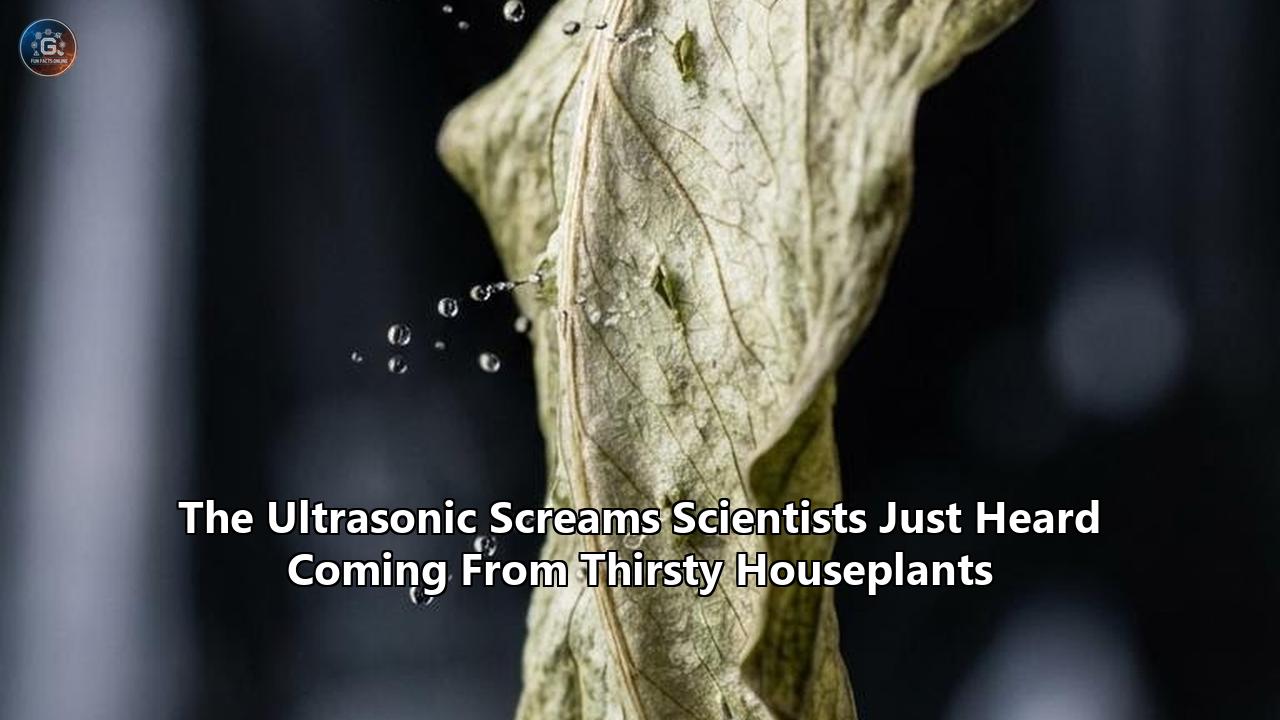
Female moths soaring over a field of tomatoes are making life-or-death reproductive decisions based on high-frequency noises that humans cannot even hear. According to a landmark study published in the journal eLife by researchers at Tel Aviv University, these insects actively listen to the ultrasonic distress signals emitted by dehydrated foliage, deliberately avoiding plants that are crying out for water.
This discovery represents the first definitive scientific proof of an acoustic interaction between plants and animals. It builds upon a highly publicized 2023 breakthrough by the same research team, which first proved that flora subjected to physical stress or severe dehydration emit distinct, airborne popping noises.
The latest experiments, led by zoologist Professor Yossi Yovel and evolutionary biologist Professor Lilach Hadany alongside researchers Rya Seltzer and Guy Zer Eshel, demonstrate that this botanical acoustic environment is not just ambient noise. It is an active data stream used by local wildlife. When female moths are looking for a place to lay their eggs—eggs that will hatch into hungry caterpillars needing rich, hydrated leaves to survive—they steer clear of the clicking, popping foliage, opting instead for silent, healthy plants.
The implications stretch far beyond the realm of entomology. By proving that the natural environment is filled with high-frequency information regarding plant health, scientists have opened an entirely new frontier in ecology and agronomy. Precision agriculture, already heavily reliant on drones, soil sensors, and satellite imagery, is now racing to decode and utilize the thirsty plants sound to revolutionize global irrigation management.
To understand why this matters, one must first dismantle the long-held assumption that the plant kingdom is silent. We are now entering an era of biological acoustic monitoring where understanding the subtle mechanics of plant distress could help mitigate agricultural water crises, shift our understanding of evolutionary biology, and fundamentally alter how we perceive the seemingly quiet green spaces around us.
The Physics of a Botanical Scream
To comprehend how a tomato or tobacco plant generates noise without vocal cords, lungs, or moving parts, it is necessary to examine the microscopic plumbing that keeps flora alive. The mechanism responsible for these ultrasonic emissions relies on a phenomenon known as cavitation.
Plants pull water from the soil through their roots and up into their leaves via a network of dead, hollow cells called the xylem. This upward movement defies gravity, driven by a process called transpiration. As water evaporates from microscopic pores in the leaves (stomata), it creates negative pressure. Because water molecules are highly cohesive—they like to stick together—this negative pressure acts like a vacuum, pulling the entire chain of water molecules up through the xylem. Biologists refer to this as the cohesion-tension theory.
When a plant is well-hydrated, this system operates smoothly. However, when soil moisture drops and the plant becomes dehydrated, the tension within the xylem increases dramatically. The plant is essentially sucking hard on a dry straw. Eventually, the tension becomes too much for the physical properties of the water to maintain. The water column snaps.
When the water column breaks, dissolved air within the fluid suddenly expands, forming a microscopic bubble inside the xylem tube. The rapid formation and subsequent collapse of this air bubble releases a sudden burst of mechanical energy. This energy ripples through the plant tissue and transfers into the surrounding air as a high-frequency acoustic shockwave.
To human ears, this process is completely silent. The frequencies generated by cavitation range from 20 to 100 kilohertz. The absolute upper limit of human hearing, usually only present in young children, peaks at roughly 20 kilohertz, with most adults maxing out around 15 or 16 kilohertz. But if we lower the frequency to make it audible, the noise resembles the rapid clicking of a typewriter, a child stomping on plastic bubble wrap, or popcorn popping in a microwave.
The sheer volume of these clicks is what surprised researchers the most. These are not faint, microscopic vibrations that require specialized contact microphones to detect. They are airborne sounds. The Tel Aviv researchers recorded them using microphones placed ten centimeters away from the subjects, but acoustic modeling suggests that mammals and insects with sensitive high-frequency hearing can detect these pops from three to five meters away. At its source, the volume of the clicking is comparable to normal human conversation, hovering around 60 decibels.
Furthermore, the frequency of the popping serves as a direct, real-time indicator of the plant's internal physiological state. A healthy, well-watered tomato plant is remarkably quiet, emitting perhaps one random pop per hour. But as the soil dries, the acoustic profile changes radically. Long before the plant shows any visible signs of wilting or discoloration, the clicking accelerates. By the fourth or fifth day of total water deprivation, the plant enters a state of severe acoustic distress, firing off 30 to 50 distinct ultrasonic pops every single hour.
The popping eventually subsides, not because the plant has recovered, but because it has effectively dried out completely, leaving no more water columns to snap. The sound is inextricably linked to the physical struggle for moisture.
Training Algorithms to Hear the Forest for the Trees
Proving that a plant clicks in a perfectly silent, soundproofed basement acoustic chamber is one thing; proving that these sounds are distinct, recognizable, and usable in a real-world environment is an entirely different scientific hurdle. To bridge this gap, the researchers turned to advanced machine learning.
The challenge was acoustic differentiation. Can you distinguish the pop of a tomato plant from the pop of a tobacco plant? Can you separate the sound of a plant suffering from dehydration from a plant that has just had its stem physically severed by a hungry herbivore or a gardener’s shears?
To answer this, the team at Tel Aviv University gathered thousands of hours of audio recordings. They isolated plants in acoustic boxes, subjected them to different types of stress—specifically drought and physical cutting—and recorded the results. They then fed these massive audio datasets into artificial intelligence algorithms. The machine learning models analyzed the subtle variations in the acoustic waveforms: the exact peak frequency, the duration of the click, the decay rate of the sound wave, and the intervals between pops.
The results were astonishing. The algorithm learned to identify not only the specific species of plant making the noise but also the exact cause of its distress, achieving an accuracy rate of up to 81 percent. The AI could reliably look at an audio spectrogram and declare, with high confidence, that it was analyzing a thirsty tomato rather than a cut tobacco plant.
But greenhouses and agricultural fields are not silent acoustic chambers. They are chaotic, noisy environments. Greenhouses feature whirring ventilation fans, dripping irrigation pipes, rustling leaves, and the voices of agricultural workers. Outdoor fields have wind, rain, tractors, and passing traffic.
To test the viability of their findings, the researchers moved their microphones from the basement into a bustling, commercial-style greenhouse. They trained their algorithms to filter out the cacophony of background noise and isolate the specific ultrasonic spikes characteristic of cavitation. The algorithm successfully identified the dehydrated plants amid the acoustic clutter, proving that the thirsty plants sound is distinct enough to be monitored in real-world agricultural settings.
This computational success shifts the discovery from a neat biological trivia fact into a highly deployable technological tool. If an algorithm can be trained to recognize the exact acoustic signature of drought stress for specific crop species, then that algorithm can be loaded onto edge-computing devices and deployed globally.
Evolution, Ecology, and the "Intent" of Sound
One of the most intense debates triggered by these findings centers on the evolutionary biology of the sounds themselves. When the media first reported on the Tel Aviv study, headlines frequently anthropomorphized the plants, claiming that they were "screaming" or "crying" for help.
Professor Lilach Hadany is quick to correct this misconception. "Screaming assumes the plant is intentionally making the noise," Hadany explained when the initial research was published. The scientific consensus is that these emissions are a physical byproduct of stress, not an intentional communication strategy.
In evolutionary biology, there is a strict distinction between a "signal" and a "cue." A signal is a trait that has evolved specifically for the purpose of communication. A peacock's tail is a signal; a wolf's howl is a signal. A cue, on the other hand, is a byproduct of an organism's behavior or physiology that another organism happens to observe and exploit. The sound of a deer snapping a twig while walking through the forest is a cue; the deer did not snap the twig to communicate with a nearby predator, but the predator uses the cue to locate the deer.
The scientific paper published in eLife explicitly categorizes the plant sounds as a cue. "The sounds emitted by drought-stressed plants are probably a cue rather than a signal, i.e., they did not evolve to convey information to insects," the paper notes. "The interaction that we have demonstrated in this study, therefore, cannot be considered 'communication' according to the conservative definition of the term".
However, in the brutal arithmetic of natural selection, intent does not matter. If a reliable stream of information exists in the environment, organisms will evolve to exploit it.
This brings us back to the female moths. Insects have complex interactions with the plant world. They rely on plants for food, shelter, and breeding grounds. For a female moth, finding the optimal host plant for her larvae is the single most important decision she will make. If she lays her eggs on a healthy, robust plant, her caterpillars will have an abundance of food. If she lays her eggs on a dehydrated, dying plant, her offspring will likely starve.
The Tel Aviv researchers knew that many moth species possess tympanal organs capable of detecting ultrasonic frequencies. These organs originally evolved to hear the echolocation clicks of predatory bats, allowing the moths to take evasive maneuvers in mid-air. But evolution is highly efficient; once an organism possesses the hardware to hear high-frequency sound, that hardware can be utilized for other tasks.
By placing female moths in controlled environments with access to both healthy, quiet plants and stressed, clicking plants, the researchers observed a distinct behavioral preference. The moths avoided the acoustic distress signals. They used the cue of cavitation to bypass dying hosts, ensuring the survival of their genetic line.
If moths are listening, it is almost certain that other species are as well. Rodents, bats, and various insects all operate within this ultrasonic frequency range. A mouse scurrying through a field might use the density of plant clicks to navigate toward areas of higher moisture. A predatory insect might use the sounds of a wounded plant to locate herbivores to eat. The acoustic landscape of a field is likely a rich, multi-layered web of information driving unseen ecological interactions.
The most provocative question, however, is whether other plants are listening.
Botanists have known for decades that plants communicate via chemical signals. When a plant is attacked by pests, it releases Volatile Organic Compounds (VOCs) into the air. Neighboring plants detect these airborne chemicals and preemptively ramp up their own defensive chemical production, making their leaves less palatable to the incoming threat. Similarly, plants share chemical distress signals through underground mycorrhizal fungal networks.
But chemical and fungal communication is slow. It relies on wind currents and root interactions. Sound, by contrast, travels through the air at roughly 343 meters per second. It is instantaneous.
If a plant can detect the ultrasonic popping of its dehydrated neighbor, it could theoretically close its stomata to conserve water before the drought even reaches its own root system. While researchers have not yet definitively proven that flora possess the biological machinery to "hear" and respond to airborne cavitation clicks, earlier studies have shown that certain plants respond to the sound of chewing caterpillars or the hum of pollinating bees. Investigating whether the thirsty plants sound acts as a rapid-response alarm system for neighboring flora is currently one of the most intensely pursued topics in plant biology.
The Economics of Acoustic Agriculture
While evolutionary biologists debate the ecological implications, agronomists and economists are focused on a much more immediate application: saving water.
Global agriculture is facing an existential crisis. The farming sector accounts for approximately 70 percent of all global freshwater withdrawals. As climate change accelerates, increasing the frequency and severity of droughts worldwide, the margin for error in crop irrigation is rapidly shrinking. Farmers can no longer afford to over-water their fields just to be safe, nor can they afford the yield losses associated with under-watering.
Currently, precision agriculture relies primarily on soil moisture sensors and drone-based multispectral imagery. Soil sensors are effective but highly localized; a sensor tells you the moisture level of the soil exactly where it is planted, but soil composition can vary wildly across a single acre. To get a truly accurate picture of a massive commercial field, a farmer must install and maintain thousands of expensive sensors. Multispectral drone imagery, which measures the light reflected off the crop canopy to assess plant health, is incredibly useful but essentially reactive. By the time a plant's physical color profile changes enough to be detected by a drone, the plant is already experiencing stress, and maximum yield potential may have already been compromised.
Acoustic monitoring offers a revolutionary middle ground.
Instead of measuring the soil to guess if the plant is getting enough water, or looking at the leaves to see if the plant is already suffering, acoustic sensors allow farmers to listen directly to the plant's internal hydraulic system. It is the agricultural equivalent of putting a stethoscope to a patient's chest.
"We believe that humans can also utilize this information, given the right tools," Professor Hadany stated, pointing directly toward the commercialization of this data. "Apparently, an idyllic field of flowers can be a rather noisy place. It's just that we can't hear the sounds".
Because the ultrasonic clicks travel through the air and can be detected from several meters away, a single acoustic sensor placed on a pole in a greenhouse or field could monitor dozens, perhaps hundreds, of surrounding plants simultaneously. If the microphone picks up a spike in the specific 40 to 80 kilohertz frequency associated with cavitation, the automated irrigation system could be triggered instantly, delivering water precisely when and where the plants demand it, long before any visible signs of drought stress appear.
This level of micromanagement could lead to massive reductions in water usage. In large-scale operations cultivating water-intensive crops like tomatoes, almonds, or grapes, a 5 to 10 percent reduction in water usage translates to billions of gallons saved annually, drastically reducing overhead costs and easing the strain on depleted local aquifers.
Furthermore, acoustic monitoring is entirely non-invasive. Previous attempts to measure plant acoustics required clamping physical vibration sensors directly onto stems or leaves, a process that risks damaging the plant and is utterly unscalable for commercial farming. By relying on airborne sounds, acoustic arrays can be deployed rapidly without ever touching the crops.
The integration of acoustic technology into the current agricultural tech stack is already underway. Engineers are working to design weather-proof, solar-powered, highly durable ultrasonic microphones that can withstand the dust, rain, and extreme temperatures of outdoor farming. These microphones must be paired with edge-computing microprocessors capable of running the AI algorithms locally, as streaming constant high-fidelity audio from rural farmland to cloud servers requires too much bandwidth. The devices will process the audio on-site, count the cavitation clicks, and beam a simple data packet—"Zone 4 is emitting 45 clicks per hour"—back to the farmer's dashboard.
Expanding the Acoustic Library
The initial Tel Aviv research focused heavily on tomatoes and tobacco because they are standard model organisms in plant biology; they grow quickly, are easily manipulated in a lab, and have well-documented physiological responses. But global agriculture relies on a vast diversity of species, and each species has entirely different vascular architecture.
Recognizing this, the researchers conducted a preliminary survey of other plants to see if the phenomenon was universal. They tested wheat, corn, Cabernet Sauvignon grapevines, henbit, and pincushion cacti.
Every single species they tested emitted ultrasonic sounds when stressed.
However, the specific acoustic signatures—the dialect, so to speak—varied. A woody vine like a Cabernet Sauvignon grape has much larger, more rigid xylem vessels than a soft, herbaceous tomato plant. When a larger water column snaps under higher tension in a woody stem, the resulting cavitation pop has a different frequency peak and wave structure. A pincushion cactus, highly adapted to extreme drought, utilizes an entirely different method of photosynthesis (CAM photosynthesis) and manages its internal water pressure very differently than wheat. Consequently, its acoustic threshold for stress differs significantly.
This physiological diversity means that before acoustic monitoring can become a universal agricultural standard, scientists must build a comprehensive "acoustic library" of the world's commercial crops. Machine learning algorithms must be trained on the specific distress calls of soybeans, rice, cotton, almonds, and citrus trees.
Agronomists must also determine the economic threshold for intervention. For a tomato plant, 35 clicks per hour indicates severe dehydration that requires immediate watering. But for a drought-resistant grapevine, which is often intentionally subjected to mild water stress (a technique called deficit irrigation) to improve the flavor concentration in the grapes, 35 clicks an hour might represent the perfect physiological state. Agronomists will need to map the acoustic data against crop yield data to find the optimal "noise level" for different farming objectives.
Investigating Other Stressors: Does Disease Have a Sound?
If dehydration and physical injury cause distinct acoustic emissions, the immediate follow-up question is whether other types of stress also change a plant's acoustic profile.
Plants face a multitude of threats beyond drought and herbivores. Fungal pathogens, bacterial infections, extreme heat waves, unexpected frost, and soil salinity all disrupt a plant's internal homeostasis.
Fungal vascular wilts, for example, physically clog the xylem tubes. Pathogens like Fusarium or Verticillium invade the plant's roots and multiply within the water-carrying vessels, literally blocking the flow of water. To the upper leaves, this blockage feels exactly like a drought, even if the surrounding soil is completely saturated. It is highly probable that a plant suffering from vascular disease will emit cavitation pops similar to a dehydrated plant. If an AI algorithm can be trained to detect the subtle acoustic differences between drought-induced cavitation and pathogen-induced cavitation, farmers could identify disease outbreaks days or weeks before the foliage begins to yellow, allowing them to isolate and treat infected zones before the pathogen spreads across the entire field.
Similarly, extreme temperature fluctuations affect the physical properties of water and the tension within the plant. Freeze-thaw cycles in the spring frequently cause air bubbles to form in the xylem of trees, a phenomenon known as freeze-induced cavitation. Monitoring the acoustic activity of orchards during unexpected frost events could provide fruit growers with real-time data on the extent of frost damage to the internal vascular systems of their trees.
The potential for identifying pests is also massive. While the Tel Aviv study focused on researchers physically cutting stems with scissors, insect herbivores cause much more complex damage. The way a caterpillar chews through a leaf vein, or the way an aphid pierces the phloem with its stylet, likely creates specific micro-acoustic disruptions. Integrating the detection of these sounds with the detection of the thirsty plants sound could turn a single microphone into a comprehensive, all-in-one diagnostic tool for crop health.
The Technological Hurdles Ahead
Despite the profound promise of acoustic agronomy, several significant technological and logistical hurdles remain before we see widespread commercial deployment.
The primary challenge is audio fidelity in complex environments. While the Tel Aviv researchers successfully filtered out standard greenhouse background noise, the acoustic reality of a commercial outdoor farm is highly unpredictable. High winds blowing through dense crop canopies create high-frequency friction noises that can easily masquerade as cavitation clicks. Heavy rain striking broad leaves creates a deafening ultrasonic roar that completely drowns out the subtle popping of the xylem.
Furthermore, the natural environment is filled with biological ultrasound. The evening air over a cornfield is saturated with the echolocation pings of hunting bats, the high-frequency stridulation of crickets and katydids, and the ultrasonic mating calls of various moths.
To overcome this, the next generation of agricultural AI must be incredibly sophisticated. It will likely require multi-modal sensor fusion. Instead of relying solely on microphones, the system of the future will cross-reference acoustic data with environmental data. If the microphone detects 40 ultrasonic clicks per hour, but the local anemometer registers wind gusts of 30 miles per hour, the AI might lower its confidence score that the sounds are originating from the plants. If the AI detects plant stress sounds, it will instantly check the soil moisture sensor data and the local weather forecast before triggering the irrigation pumps.
There is also the challenge of hardware cost. For this technology to benefit the global agricultural sector—including smallholder farms in developing nations where water scarcity is often most acute—the sensor arrays must be cheap, durable, and easily repairable. Current high-fidelity ultrasonic microphones are relatively expensive lab equipment. The commercialization phase will require hardware startups to mass-produce stripped-down, ruggedized sensors specifically tuned to the 20-100 kilohertz range.
Redefining the Silent Kingdom
The revelation that plants emit high-frequency noises, and that insects actively use these noises to make ecological decisions, forces a profound philosophical shift in how humanity views the natural world.
For centuries, biology has operated under an unstated bias that complex, rapid communication and acoustic interaction are the exclusive domains of animals. Plants were viewed as a static green backdrop—living, certainly, but passive, silent, and fundamentally inert.
The last two decades of botanical research have systematically dismantled this bias. We learned that plants share resources through underground fungal networks, earning the moniker the "Wood Wide Web." We learned that they send chemical warnings through the air to prepare their neighbors for insect attacks. We learned that they can sense gravity, track the movement of the sun, and react to the physical touch of a climbing vine or a crawling insect.
Now, we must add acoustics to their repertoire. The discovery by Yovel, Hadany, and their teams proves that plants have an active acoustic presence. A forest, a greenhouse, or a simple vegetable garden is not a quiet place. It is a bustling, noisy environment, crackling with the sounds of millions of microscopic water columns snapping under the strain of survival.
This acoustic layer of the ecosystem has been operating completely unnoticed by human ears for millions of years. It has shaped the evolutionary path of insects, influenced the foraging habits of mammals, and dictated the unseen rhythms of predator and prey.
As we move forward, the immediate focus will rightly remain on the practical applications. The drive to refine algorithms, build durable sensors, and save billions of gallons of agricultural water is an urgent economic and environmental necessity. If we can harness this data, the farms of the future will be deeply interactive spaces where human engineering bends to the specific, real-time requests of the crops themselves.
But beyond the economics of irrigation and crop yields, the real value of this research lies in its capacity to expand our perception. We now know that when a drought sets in, the landscape does not suffer in silence. The flora is practically screaming. The tools to hear them are finally in our hands; the next great scientific endeavor is figuring out exactly how to listen.
Reference:
- https://www.timesofisrael.com/groundbreaking-israeli-study-first-ever-to-show-insects-listening-in-on-plants-talking/
- https://english.tau.ac.il/research/moths-plants
- https://www.sciencenews.org/article/plant-stress-ultrasonic-click-noise-sound
- https://blog.backyardbrains.com/2023/06/plants-let-out-clicking-sounds/
- https://impakter.com/plants-make-noises-when-theyre-thirsty-or-being-cut-science-proves/
- https://www.theguardian.com/environment/2023/mar/30/plants-emit-ultrasonic-sounds-in-rapid-bursts-when-stressed-scientists-say
- https://made-of-honor.livejournal.com/5050222.html
- https://www.jns.org/culture-and-society/tel-aviv-u-researchers-first-ever-to-record-sounds-emitted-from-plants