Researchers at Osaka Metropolitan University (OMU) have just published data revealing exactly how dragonflies detect extreme red and near-infrared light—and the genetic mechanism they use is a direct mirror of the one found in human eyes. The findings, published earlier this year in Cellular and Molecular Life Sciences and widely announced by the university this week, solve a longstanding biological puzzle regarding how these high-speed predators process visual information at the extreme edges of the light spectrum.
The OMU research team, led by Professors Mitsumasa Koyanagi and Akihisa Terakita alongside graduate researcher Ryu Sato, isolated a specific light-sensitive protein—an opsin—in dragonflies that actively responds to light wavelengths up to 720 nanometers (nm). This pushes well past the deepest reds that the human eye can typically register, venturing into the near-infrared zone.
The scientific shock lies not just in the insect’s visual range, but in the specific molecular architecture making it possible. Despite sharing their last common ancestor with mammals hundreds of millions of years ago, dragonflies evolved this red-sensing capability using the exact same amino acid substitution that allows human eyes to see red. This represents one of the most precise examples of parallel evolution ever recorded in visual neuroscience.
By successfully mapping this biological mechanism, the OMU team has immediately pivoted to medical applications. They have already engineered a synthetic version of this dragonfly opsin capable of reacting to 738 nm light. When inserted into mammalian cells in a laboratory setting, this modified insect DNA allowed the cells to be controlled by deep-penetrating near-infrared light. This development clears a major hurdle in the field of optogenetics, offering a non-invasive way to manipulate deep tissue and neural pathways in human medicine without the need for invasive surgical implants.
Understanding how we arrived at this moment requires tracing a decade-long scientific escalation. For researchers seeking to have dragonfly vision explained at a molecular level, the insect's eye has long presented an impossibly complex mosaic that defied the standard rules of animal sight.
The Biological Baseline of Sight and the "Impossible Colors"
To comprehend the sheer scale of the dragonfly’s visual apparatus, we must first establish the physiological baseline that governs most of the animal kingdom. Color perception is dictated by opsins, which are specialized, light-reactive proteins located in the photoreceptor cells of the retina. These opsins absorb incoming photons and convert that light energy into electrochemical signals, which the brain then translates into what we perceive as color.
Humans rely on a trichromatic system. We possess three primary visual opsins: one tuned to short wavelengths (blue), one to medium wavelengths (green), and one to long wavelengths (red). Every hue, shade, and tint that a human will ever experience is a composite generated by these three base sensors reacting in different ratios. If a wavelength falls outside the roughly 380 nm to 700 nm range, our opsins simply cannot react to it; it becomes an "impossible color," entirely invisible to our biology.
Insects, as a general rule, have a visual spectrum that is shifted downward on the electromagnetic scale. A typical insect, such as a honeybee, also uses three opsins, but theirs are tuned to ultraviolet (UV), blue, and green. Because they lack a long-wavelength opsin, the color red is essentially invisible to them, likely appearing as a dull grey or black. This is why many insect-pollinated flowers have evolved to display vivid UV patterns that humans cannot see, guiding the insects to nectar like landing lights on a runway.
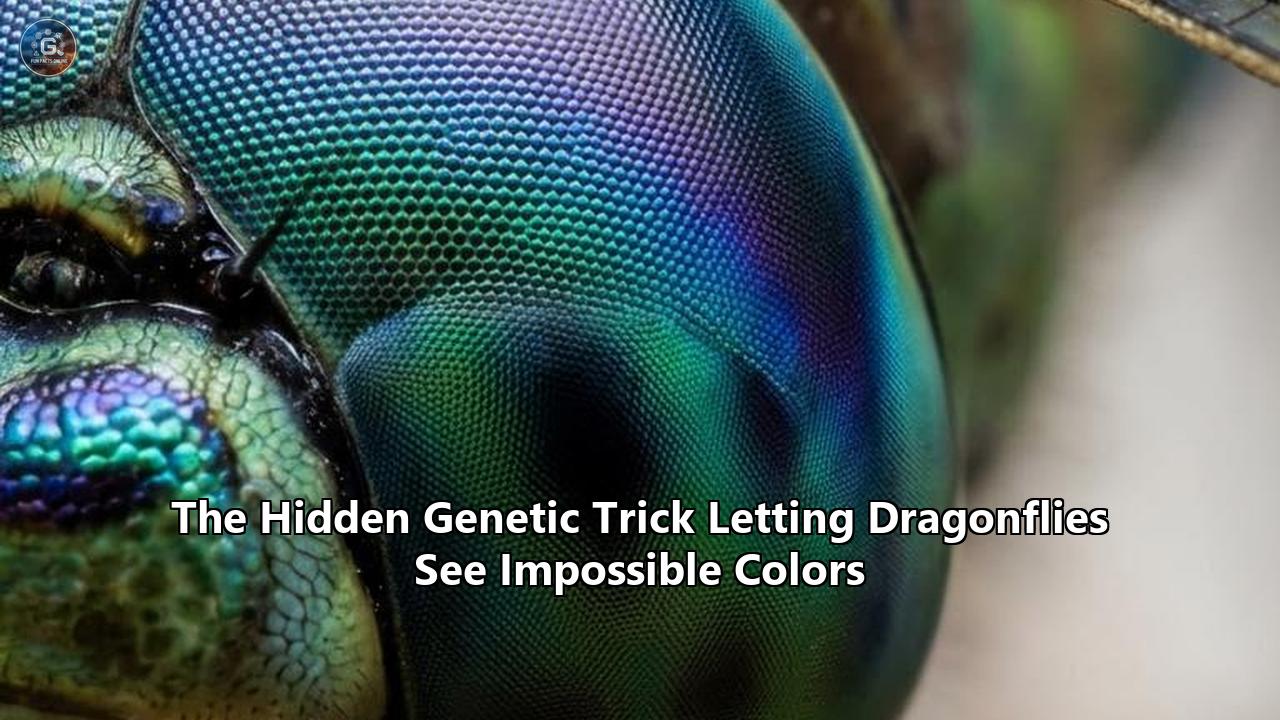
For decades, entomologists assumed dragonflies operated under a similar, perhaps slightly enhanced, visual constraint. They are equipped with two massive compound eyes, each constructed from up to 30,000 individual hexagonal facets called ommatidia. Each ommatidium acts as a standalone eye with its own lens and cluster of light-detecting cells, capturing a tiny fragment of the surrounding environment. The dragonfly’s brain stitches these 30,000 inputs together into a continuous, nearly 360-degree panoramic mosaic, processing up to 200 frames per second with a reaction time of just 25 milliseconds.
But while the mechanical speed and resolution of their compound eyes were well documented, the actual spectrum of colors they could perceive remained a mystery. It was not until the mapping of their genetic code that the true scope of their visual reality was revealed.
The 2015 Genomic Shock: 33 Ways to See Light
The first major turning point in getting dragonfly vision explained occurred in 2015, when a team led by Ryo Futahashi at Japan's National Institute of Advanced Industrial Science and Technology decided to comprehensively sequence the visual genes of several dragonfly species.
Because theories predicted that three or four opsin genes were sufficient for encoding the entire visible spectrum, the researchers expected to find a slight variation of the standard insect model. Instead, the transcriptomic and genomic surveys of the family Libellulidae returned a genetic profile so expansive that it forced a rewrite of entomological textbooks.
Futahashi’s team discovered that dragonflies possess an extraordinary diversity of opsin genes—between 15 and 33 distinct visual opsins depending on the species. To put this in perspective, this genetic load puts dragonflies on par with the mantis shrimp, a marine crustacean widely regarded as having the most complex ocular system on Earth.
The 2015 data revealed that dragonflies carry one opsin dedicated to ultraviolet light, five short-wavelength (SW) opsins for varying shades of blue, and a staggering ten long-wavelength (LW) opsins meant for greens, yellows, and reds. This genetic redundancy suggested that dragonflies were perceiving a spectrum of colors—and minute gradations between those colors—that are mathematically impossible for the human brain to visualize.
Further analysis of this 33-opsin arsenal revealed a highly specialized spatiotemporal expression pattern. The opsins a dragonfly uses change drastically depending on its life stage and the physical location on its eye. During their larval stage as aquatic nymphs, dragonflies express a very limited number of opsins, reflecting the dim, long-wavelength-skewed light conditions underwater. Sand-burrowing species often lack short-wavelength opsin expression entirely during this phase.
Upon metamorphosing into aerial adults, their visual system undergoes a radical genetic activation. The adult compound eye is physically divided by opsin expression. The dorsal (upper) region of the eye activates multiple short-wavelength (blue/UV) opsins, perfectly tuning the upward gaze to track prey against the bright, blue canvas of the sky. Meanwhile, the ventral (lower) region of the eye expresses a dense cluster of long-wavelength opsins, optimizing the downward gaze to spot movement against the green, brown, and red backdrops of terrestrial foliage and soil.
This discovery answered how dragonflies manage their environment, but it created a new, highly specific mystery. With so many long-wavelength opsins clustered in the lower half of their eyes, just how far into the red spectrum could a dragonfly see? And on a molecular level, how were their proteins achieving this sensitivity when other insects could not?
Targeting the Deep Red: The Molecular Hunt
Between 2015 and the end of 2025, the scientific focus shifted from counting the genes to deciphering their exact chemical mechanics. The goal was to isolate the specific opsin responsible for the dragonfly’s extreme long-wavelength vision and subject it to spectroscopic analysis.
The research required extracting the exact proteins and measuring their absorption maximum—the specific wavelength of light at which the protein reacts most violently. The OMU team, heavily invested in the molecular evolution of sensory proteins, zeroed in on a species known as Asiagomphus melaenops, a clubtail dragonfly native to East Asia.
In their laboratories, Sato, Terakita, and Koyanagi isolated an opsin designated as RhLWA2. When they measured the recombinant pigment of this specific protein, the data returned an absorption maximum of 580 nm, with a sensitivity tail that extended powerfully into the 720 nm range.
“This is one of the most red-sensitive visual pigments ever found,” Professor Terakita noted upon the publication of the findings. “Dragonflies can likely see deeper into red light than most insects”.
To understand how the RhLWA2 protein achieved this, the team engaged in mutational analysis, systematically altering the amino acid sequence of the dragonfly opsin to see which specific piece of the genetic code was responsible for dragging the insect's vision into the deep red. They discovered that the entire capability hinged on a single site within the protein structure: Position 292.
Parallel Evolution: The Mammalian Mirror
When the OMU team analyzed what was happening at Position 292, they found an amino acid substitution—specifically, a shift involving the amino acids serine, alanine, and valine (S292A and A292V).
This specific aspect of dragonfly vision explained sent ripples through the evolutionary biology community because this precise amino acid swap is not a novel insect trick. It is the exact same spectral tuning mechanism that occurred in the ancestors of primates to create the mammalian red opsin.
Hundreds of millions of years ago, the evolutionary lineage that would eventually produce humans split from the lineage that would produce insects. Long after that split, primates faced environmental pressures that required them to differentiate red fruit from green leaves. Through random mutation and natural selection, primate DNA altered the amino acid at a specific site in their visual proteins, granting them red vision.
Completely independently, in an entirely different biological kingdom, dragonflies faced their own environmental pressures. Their DNA mutated at the exact same site, using the exact same chemical substitution, to solve the exact same problem.
"Surprisingly, the mechanism by which dragonfly red opsin detects red light is identical to that of red opsin in mammals, including humans," explained Ryu Sato, the first author of the January 2026 study. "This is an unexpected result, suggesting that the same evolutionary process occurred independently in distantly related lineages".
This phenomenon, known as parallel evolution, occurs when distinct species independently develop similar traits due to analogous environmental challenges. While parallel evolution is common in broad physiological traits—such as birds and bats both developing wings—finding it at the exact microscopic level of a single amino acid substitution within a complex protein structure is exceedingly rare.
High-Speed Aerial Ecology: The Need for Near-Infrared
With the mechanics of dragonfly vision explained, behavioral ecologists immediately looked for the environmental pressure that forced this extreme mutation. Why would an insect need to see light at 720 nm, hovering on the border of near-infrared?
The answer lies in the intense, high-speed reproductive ecology of the dragonfly. Dragonflies are hyper-aggressive, territorial predators. They do not have the luxury of slow, close-up inspections of their peers. When a male dragonfly spots another dragonfly encroaching on its airspace at high velocity, it must make an instantaneous calculation: is this an intruding rival male to be attacked, or a receptive female to be mated with?
To test whether red-shifted vision played a role in this rapid identification, the OMU researchers utilized reflectance measurements. They directed various wavelengths of light at the bodies of both male and female dragonflies and measured how the light bounced off their exoskeletons.
The results were definitive. While males and females might look highly similar to the human eye or under standard blue/green light, their exoskeletons exhibit marked disparities in how they reflect red and near-infrared light. The female exoskeleton reflects specific near-infrared signatures that the male exoskeleton absorbs.
Because the male dragonfly’s RhLWA2 opsin is tuned specifically to this 720 nm wavelength, the female essentially lights up against the background of the sky and foliage. This deep-red sensitivity provides the male with a high-contrast, near-infrared targeting system, allowing him to distinguish a mate from a rival in a fraction of a second while flying at top speed.
This extreme adaptation perfectly complements their role as apex micro-predators. Equipped with 30,000 ommatidia, processing visual data ten times faster than a human, and utilizing a near-infrared targeting system dictated by a mammalian-style genetic mutation, the dragonfly maintains a hunting success rate of up to 97 percent—the highest observed capture rate of any animal on the planet.
The Optogenetic Leap: Hacking Human Cells with Insect DNA
While the discovery of Position 292 solves an evolutionary mystery, the most immediate impact of the April 2026 announcement is happening in medical engineering laboratories. Seeing dragonfly vision explained as a readymade genetic blueprint has provided a massive shortcut for the field of optogenetics.
Optogenetics is a biological technique that involves introducing light-sensitive proteins (opsins) into living cells—usually neurons—so that those cells can be activated or deactivated simply by shining a light on them. Since its inception, optogenetics has allowed neuroscientists to map brain circuits, study neurodegenerative diseases like Parkinson's, and explore potential treatments for blindness by making specific cells fire on command.
However, the field has historically been bottlenecked by the physics of light. Most of the opsins currently used in optogenetic therapies are sourced from algae or microbes, and they respond best to blue or green light. When applied to human tissue, blue and green wavelengths scatter rapidly. They cannot penetrate deep into blood, fat, or dense muscle tissue. To trigger a blue-light opsin inside a patient's brain or internal organs, surgeons must implant invasive fiber-optic cables directly into the tissue.
Near-infrared light, however, behaves differently. Because it possesses a longer wavelength, near-infrared light can pass through mammalian tissue with minimal scattering. If medical engineers had an opsin that responded exclusively to near-infrared light, they could theoretically control targeted cells deep inside a patient's body using an external light source, bypassing the need for invasive surgery.
The problem has always been finding a highly efficient, naturally occurring protein that responds to these long wavelengths. The dragonfly's RhLWA2 opsin is exactly the tool the medical community has been searching for.
Sensing the technological potential, Koyanagi and his team did not stop at simply observing the natural dragonfly opsin. They actively engineered it. By introducing a specific synthetic mutation—V211C—into the dragonfly's genetic code, the researchers successfully shifted the opsin’s absorption maximum even further down the spectrum, moving it from 580 nm to 590 nm.
This engineered, red-shifted insect protein was then introduced into cultured mammalian cells. When the team exposed these modified cells to 738 nm near-infrared light, the cells exhibited significant calcium ion responses, proving that the cellular machinery had been successfully activated by the light.
"In this study, we succeeded in shifting the sensitivity of a modified near-infrared opsin from Gomphidae dragonflies even further toward longer wavelengths," Professor Koyanagi stated in the university's research brief. "These findings demonstrate this opsin as a promising optogenetic tool capable of detecting light even deep within living organisms".
By lifting the genetic code directly from a predatory insect and tweaking a single amino acid, researchers have bypassed decades of synthetic protein design. Medical devices utilizing these dragonfly-derived near-infrared opsins could soon be used to trigger insulin release in diabetics, manage deep-tissue pain receptors, or stimulate damaged neurons without ever breaking the patient's skin.
The Next Biological Frontier
The OMU findings mark a definitive shift in how sensory biology is utilized. The timeline—from Futahashi counting 33 genes in 2015 to Koyanagi’s team successfully triggering mammalian cells with near-infrared light in 2026—demonstrates the rapidly accelerating pace of genomic research.
Moving forward, the focus will split into two distinct tracks. In the medical sector, the immediate next step is in vivo animal trials. Researchers will attempt to use the V211C-mutated dragonfly opsin in living mice to monitor how effectively external near-infrared light can penetrate tissue and activate targeted neural pathways. Success in these trials will lay the groundwork for next-generation, non-invasive neuroprosthetics and light-driven cellular therapies.
On the ecological front, entomologists are turning their attention back to the dragonfly's remaining 32 opsins. If the RhLWA2 protein hides a near-infrared detection system mirroring mammalian genetics, researchers are now actively questioning what other sensory tricks are locked inside the insect's short-wavelength and ultraviolet receptors.
The deep-red mutation at Position 292 proves that nature routinely recycles its most effective molecular architectures across wildly divergent species. As genomic mapping technologies grow increasingly precise, the vast, 30,000-facet mosaic of the dragonfly eye will likely continue to serve as an open-source biological catalog, providing engineers and neuroscientists with millions of years of evolutionary research and development.
Reference:
- https://neurosciencenews.com/dragonfly-red-vision-parallel-evolution-30489/
- https://pubmed.ncbi.nlm.nih.gov/41559344/
- https://www.indiatoday.in/science/story/dragonflies-red-light-vision-human-eyes-opsin-discovery-optogenetics-2894294-2026-04-10
- https://bioengineer.org/dragonflies-and-humans-detect-red-light-using-the-same-mechanism/
- https://pmc.ncbi.nlm.nih.gov/articles/PMC12824042/
- https://anatomytoyou.com/2016/02/23/dragonfly-eyes-detect-up-to-30-different-colours/
- https://www.aist.go.jp/aist_e/list/latest_research/2015/20150908/en20150908.html
- https://pmc.ncbi.nlm.nih.gov/articles/PMC4371951/
- https://www.quora.com/What-is-the-difference-between-the-dragonfly-eye-and-the-human-eye
- https://www.quora.com/Why-are-light-sources-never-brown-with-the-exemption-of-pixels-on-a-display-Is-it-a-color-of-light-that-is-impossible-to-reproduce-If-so-then-why-is-it-compared-to-all-of-the-other-colors
- https://www.quora.com/Since-insects-are-colour-blind-why-do-flowers-have-colours
- https://www.youtube.com/watch?v=ryf-7V-1E2E
- https://pubmed.ncbi.nlm.nih.gov/25713365/
- https://www.researchgate.net/publication/272840303_Extraordinary_diversity_of_visual_opsin_genes_in_dragonflies
- https://pubs.acs.org/doi/10.1021/bi00060a001
- https://bioengineer.org/dragonflies-and-humans-detect-red-light-using-the-same-mechanism/