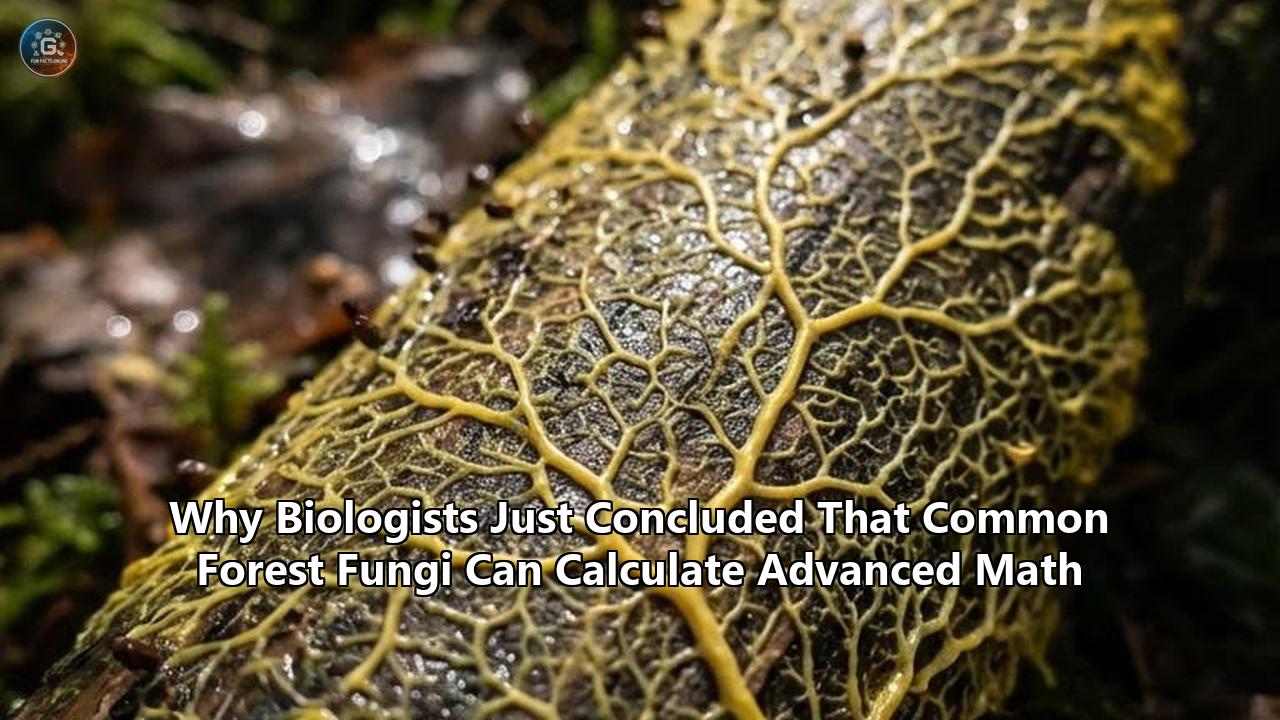
A species of wood-decaying fungus has just passed a geometric cognitive test, demonstrating spatial awareness, resource optimization, and mathematical calculation without the use of a brain or central nervous system. In a study published by researchers at Japan’s Tohoku University, a team led by microbial ecologist Yu Fukasawa documented the mycelial network of Phanerochaete velutina actively recognizing the physical arrangement of its environment and altering its structural growth to solve a spatial routing problem.
The experiment, which incubated the fungus on wooden blocks arranged in distinct circle and cross shapes over 116 days, proved that the mycelium does not simply grow outward blindly. Instead, it evaluates the geometry of its available resources, communicates that layout across its entire fibrous network, and deploys precise foraging strategies based on the shape it encounters. In the cross arrangement, the fungus identified the four outermost blocks as strategic outposts, funneling dense mycelial connections to these points to launch outward foraging expeditions. In the circular arrangement, the network maintained equal connections across the perimeter but deliberately avoided sending tendrils into the empty center, calculating that overextending into a depleted interior would be a waste of energy.
Fukasawa’s conclusion is stark: fungi possess memories, they learn, and they make decisions. The way they solve problems compared to humans challenges fundamental biological assumptions.
This discovery serves as a critical inflection point in the study of basal cognition. By treating the Tohoku University experiment as a primary case study, we can extract profound lessons about alternative models of computation, decentralized decision-making, and the physical algorithms running silently beneath the forest floor. The implications extend far beyond mycology, offering an immediate blueprint for computer scientists, urban planners, and network engineers attempting to build more resilient, self-organizing systems.
Case Study Analysis: The Geometry of the Mycelial Algorithm
To understand the broader pattern of this behavior, we must first deconstruct the exact mechanics of the Tohoku University experiment. The researchers did not simply observe random biological growth; they designed a constraint-based resource problem.
Phanerochaete velutina is a white-rot fungus that naturally decomposes wood in temperate forests. Its survival depends on locating decaying matter, extracting nutrients, and moving on before the local energy supply is exhausted. When the researchers placed nine colonized wood blocks into a cross and a circle on a soil dish, they were essentially programming an environmental prompt.If the fungus were a passive organism reacting only to immediate chemical gradients, it would have spread uniformly in all directions from the inoculated blocks. Instead, the network behaved like a single, coordinated computational entity. Once the initial tendrils from neighboring blocks touched and linked, the fungus executed a series of resource-allocation calculations. It pruned redundant pathways, retracted excess hyphae (the microscopic filaments that make up the network), and consolidated its energy into the most mathematically efficient routes.
The mass loss of the wood blocks—a direct indicator of fungal decay activity—was mathematically correlated with the density of the mycelial cord connections. The fungus decayed the wood in the circular arrangement more aggressively than in the cross arrangement, indicating an ability to adjust its metabolic output based on the spatial configuration of its food.
Principle 1: Decentralized Topography Assessment
The first major lesson extracted from this case study is the viability of completely decentralized topography assessment. In human-engineered networks—such as cellular routing or logistics supply chains—a central processor (a server or a dispatcher) usually receives data from peripheral nodes, calculates the most efficient route, and sends instructions back down the chain.
The fungal network achieves the same result without a central hub. Information regarding the spatial arrangement of the wood blocks was communicated across the entire mycelial web, triggering localized morphological changes that benefited the macro-structure. This is an elegant manifestation of fungi intelligence, where the computation is distributed across the physical medium itself. The network is the computer.
For engineers designing mesh networks for autonomous vehicles or drone swarms, this biological case study proves that highly complex, shape-recognizing spatial calculations can be executed strictly through peer-to-peer nodal communication, without relying on a vulnerable central command structure.
The Wetware Hardware: How Fungi Transmit Data
If a fungus can recognize a circle and a cross, the immediate scientific question becomes: how is the data being transmitted? How does a hyphal tip on the outer edge of a cross arrangement inform the rest of the network to stop growing inward?
Biological research running parallel to the Tohoku study provides the structural context. Fungi grow by extending thread-like hyphae, which bundle together to form mycelial cords. These cords function remarkably like neural pathways in an animal brain. Recent advancements in high-throughput imaging, specifically by the Inria Mosaic project team in France, have successfully visualized these underground systems, tracking over 500,000 fungal nodes and 100,000 nutrient flow trajectories simultaneously.
Data is transmitted through these biological wires via electrical action potentials, identical in concept to the electrical spikes fired by human neurons. Researchers at the Unconventional Computing Laboratory at UWE Bristol, led by Andrew Adamatzky, have spent the last few years measuring these micro-electrical impulses. By inserting microelectrodes directly into mycelium, Adamatzky’s team recorded distinct spikes of electrical activity.
The fungal network uses these electrical signals to encode information about environmental stimuli—light, chemicals, toxins, and physical obstacles. When Phanerochaete velutina encountered the cross arrangement in Fukasawa's lab, the physical resistance and chemical makeup of the space were likely translated into a specific sequence of electrical and hydraulic signals. As these signals cascaded through the mycelium, they altered the internal fluid dynamics and cellular growth rates of the organism, literally physically shaping the network in response to the data.
Principle 2: Form Follows Computation
In traditional computing, the hardware is rigid (silicon chips, copper traces) and the software is dynamic. The fungal case study reveals a system where the hardware and software are indistinguishable. The mycelium physically reconfigures its own geometry to represent the solution to the problem it is solving.
When the fungus avoided the center of the circle, it was executing a spatial algorithm. The absence of mycelium in the dead center was not a lack of action; it was an active computational output. The network "calculated" that the return on investment for exploring the center was negative, and so it pruned its hardware in that direction.
This principle of structural computation is currently driving the nascent field of "myceliotronics." If living tissue can adapt its physical form to process information, it can be harnessed to build self-repairing sensors and bio-computers.
Translating the Case Study into Fungal Computing
The realization that common forest fungi can calculate advanced math and optimize geometric networks has pushed computer scientists to harness this exact biological machinery. The transition from studying fungi intelligence in the forest to deploying it on a motherboard is already underway.
At the Unconventional Computing Laboratory, researchers have moved beyond merely observing electrical spikes; they are actively stimulating mycelial networks to create living logic gates. By connecting pairs of electrodes to Pleurotus ostreatus (the common oyster mushroom), scientists inject small electrical currents into the network. Because the mycelium alters its conductivity based on repeated stimulation—forming faster communication pathways built from memory, much like human brain cells forming habits—researchers can correlate the presence or absence of an electrical spike to a binary zero or one.
This bio-computing architecture operates on a fraction of the energy required by standard microprocessors. Traditional AI and heavy computational models demand massive data centers, cooling systems, and immense power draw. Fungal computers, while exponentially slower than silicon, offer a highly efficient, low-power alternative for specific tasks.
Principle 3: Habituation as Algorithmic Memory
A key takeaway from the integration of mycelium into electronics is the concept of biological habituation serving as memory. In Fukasawa’s spatial experiment, the fungus remembered the location of the resources and maintained the structural integrity of the circle and cross shapes long after the initial exploration phase. In Adamatzky’s lab, stimulating the mycelium at two separate points repeatedly causes the network to increase its conductivity between those points.
This means the fungal network possesses short-term memory. It encodes the history of its interactions with the environment directly into its physical and electrical resistance patterns. In computational terms, this is akin to a memristor—a component that changes its resistance depending on the amount of current that has flowed through it in the past.
Engineers are currently developing fungal environmental sensors based on this principle. Because the mycelium is hyper-sensitive to changes in moisture, chemical toxins, and temperature, a fungal processor integrated into a city’s infrastructure could monitor environmental health continuously. If a pollutant is introduced to the soil or water, the chemical change alters the fungal network's spiking activity. A conventional computer hooked up to the fungal wetware translates that altered spike pattern into readable data, alerting human operators to the contamination.
The Algorithmic Efficiency of the Forest Floor
Taking the lessons from the laboratory back out into the wild, the geometric capabilities of Phanerochaete velutina force a radical reassessment of forest ecology. The mathematical efficiency demonstrated in the petri dish is happening on a macro-scale across entire continents.
Forests are underlaid with arbuscular mycorrhizal networks and ectomycorrhizal fungi that link the root systems of distinct trees. These networks engage in complex resource trading, exchanging soil minerals (like phosphorus and nitrogen) for carbon sugars synthesized by the trees through photosynthesis.
The Tohoku University case study proves that fungal networks map and calculate their spatial realities. When applied to a forest ecosystem, this means the underground mycelium is continuously running massive optimization algorithms. It is calculating the shortest path between a dying, carbon-rich tree and a younger sapling in need of nutrients. It is assessing the geometric layout of the forest floor, measuring the hydraulic pressure required to push nutrients up a steep incline versus routing them around a subterranean rock formation.
Principle 4: Dynamic Risk Assessment in Resource Routing
In the circular arrangement of wood blocks, the mycelial network actively avoided the center. Ecologically, this demonstrates an advanced risk assessment protocol. The fungus calculated that deploying resources into an enclosed, confined space offered no external reward and would trap the foraging hyphae in a dead end.
When designing human infrastructure—such as municipal water grids or fiber-optic broadband layouts—engineers use complex software, such as Voronoi diagrams or Steiner tree algorithms, to prevent over-deployment in dead zones. Fungi perform these exact calculations biologically. They do not overextend their infrastructure. They build only the necessary nodes to maintain network integrity, holding resources in reserve for outward expansion.
Understanding this dynamic risk assessment allows agronomists and forest managers to rethink conservation strategies. If a logging operation clear-cuts a section of a forest, it is not merely removing trees; it is severing a highly sophisticated computational grid. The remaining fungal network must immediately recalculate its resource routing, abandoning "dead" outpost nodes and reinforcing inner connections to survive the trauma. Recognizing this mathematical reality demands a shift toward logging practices that preserve the topological integrity of the soil network.
The Cognitive Threshold: What Constitutes a Mind?
The undeniable evidence that fungi calculate, remember, and adapt brings us to a contentious philosophical and scientific boundary. Nicholas P. Money, a fungal biologist at Miami University, notes that studying fungi intelligence challenges the prevailing neuro-centric ideology that a brain is strictly necessary for cognitive abilities.
The concept of "basal cognition" posits that intelligence is not a binary trait exclusive to complex animals, but a scalable property of living tissue. When Phanerochaete velutina recognized the cross shape and prioritized the outer blocks, it was exhibiting an active, context-dependent response to a problem.
Opponents of applying the term "intelligence" to fungi argue that these actions are simply hard-coded biological algorithms—complex reflex arcs driven by natural selection. A fungus expands outward because evolution favored organisms that didn't trap themselves in depleted zones.
However, the counterargument, strengthened by the varied spiking activity recorded in fungal computers, is that all intelligence, including human cognition, is ultimately a biological algorithm. Human brains rely on ion channels, chemical gradients, and electrical action potentials. If an organism can process environmental input, encode that data into memory, communicate it across a network, and deploy a deliberate physical strategy to alter its outcome, the line between biological reflex and basic cognition becomes negligible.
Principle 5: Intelligence as a Network Property
The final, overarching lesson from the spatial shape experiment is that intelligence can be a property of a network, rather than a centralized organ. A single hyphal thread does not know it is part of a cross or a circle. It only knows its immediate chemical surroundings. But when millions of these threads are linked, the emergent macro-structure is capable of "seeing" the shape.
This principle of emergent network intelligence is highly relevant to the development of Artificial Neural Networks (ANNs). Modern AI systems attempt to simulate this emergent property artificially, using billions of parameters to calculate probabilistic outputs. Yet, they remain largely centralized and computationally heavy. The mycelial network represents a biologically perfected, highly optimized version of an Artificial Neural Network, achieving complex spatial problem-solving with zero central processing and minimal energy expenditure.
The Future of Fungal Technology and Architecture
The confirmation of spatial and geometric calculation in fungi opens up vast technological pathways. Over the next decade, the intersection of mycology, computer science, and material engineering will accelerate rapidly.
One primary area of development is biomaterials. Pivot Fellows and materials scientists at institutions like the University of Michigan are currently investigating how to replace highly carbon-intensive materials like concrete with mycelium-based alternatives. Fungi intelligence plays a crucial role here. A traditional building material is dead and static. A mycelium-based bio-composite retains the natural resilience of the fungal system. If the material becomes damaged or fractured, the dormant network, given the right stimuli, could theoretically reactivate to bind the composite back together—a self-healing brick that calculates its own structural integrity.
Furthermore, the integration of fungal sensors into wearable technology is a near-term milestone. Lab tests have shown that fungal wearables can withstand high-humidity environments for months while accurately detecting chemical or electrical changes. A bio-garment laced with conductive mycelium could serve as a smart textile, processing biometric data from the wearer’s skin through natural, low-power fungal logic gates.
Looking forward from this April 2026 vantage point, the next major hurdle for researchers is establishing a standardized "language" of fungal electrical spikes. While scientists can currently measure the spikes and assign basic binary values to them, translating the full spectrum of fungal communication remains unresolved. We know the mycelium alters its network based on complex spatial data, but we do not yet have the precise algorithmic cipher to read that data in real-time as the fungus processes it.
The breakthrough at Tohoku University provides the empirical foundation. By proving that a common forest fungus can map its environment, distinguish a cross from a circle, and execute a mathematically sound resource strategy, biology has handed engineering a new operating system. The physical algorithms running quietly through the dirt are not random natural phenomena; they are advanced, decentralized calculations. As researchers continue to decode these biological circuits, the future of resilient infrastructure, low-power computing, and autonomous networking will increasingly rely on the quiet, brainless intelligence of fungi.
Reference:
- https://www.sciencealert.com/this-fungus-appears-to-be-able-to-recognize-shapes-study-shows
- https://sj.jst.go.jp/news/202411/n1122-04k.html
- https://www.tohoku.ac.jp/en/press/do_fungi_recognize_shapes.html
- https://mindmatters.ai/2025/07/do-fungi-demonstrate-a-form-of-intelligence-what-does-that-mean/
- https://www.pbs.org/newshour/science/how-a-new-fungi-study-could-affect-how-we-think-about-cognition
- https://www.inria.fr/en/secret-networks-plants-fungi-digital-environment
- https://coolhunting.com/tech/creating-computers-out-of-mushrooms/
- https://techhq.com/news/fungal-machines-building-computers-and-sensors-from-nature/
- https://www.fishersci.it/it/it/lab-reporter/2023/issue-3/fungal-future-exploring-the-potential-of-mushroom-computing.html
- https://hackaday.com/2023/03/15/unconventional-computing-laboratory-grows-its-own-electronics/
- https://www.researchgate.net/publication/368672413_Foraging_for_fashion's_future_The_use_of_mycelium_materials_and_fungi_intelligence_in_fashion_design
- https://samim.io/p/2021-11-07-towards-fungal-computer-by-andrew-adamatzky/
- https://asquaresolution.com/blog/do-fungi-recognize-shapes-exploring-natures-hidden-intelligence/
- https://www.simonsfoundation.org/2025/08/25/from-fungi-to-qubits-pivot-fellows-share-findings-in-their-new-fields/