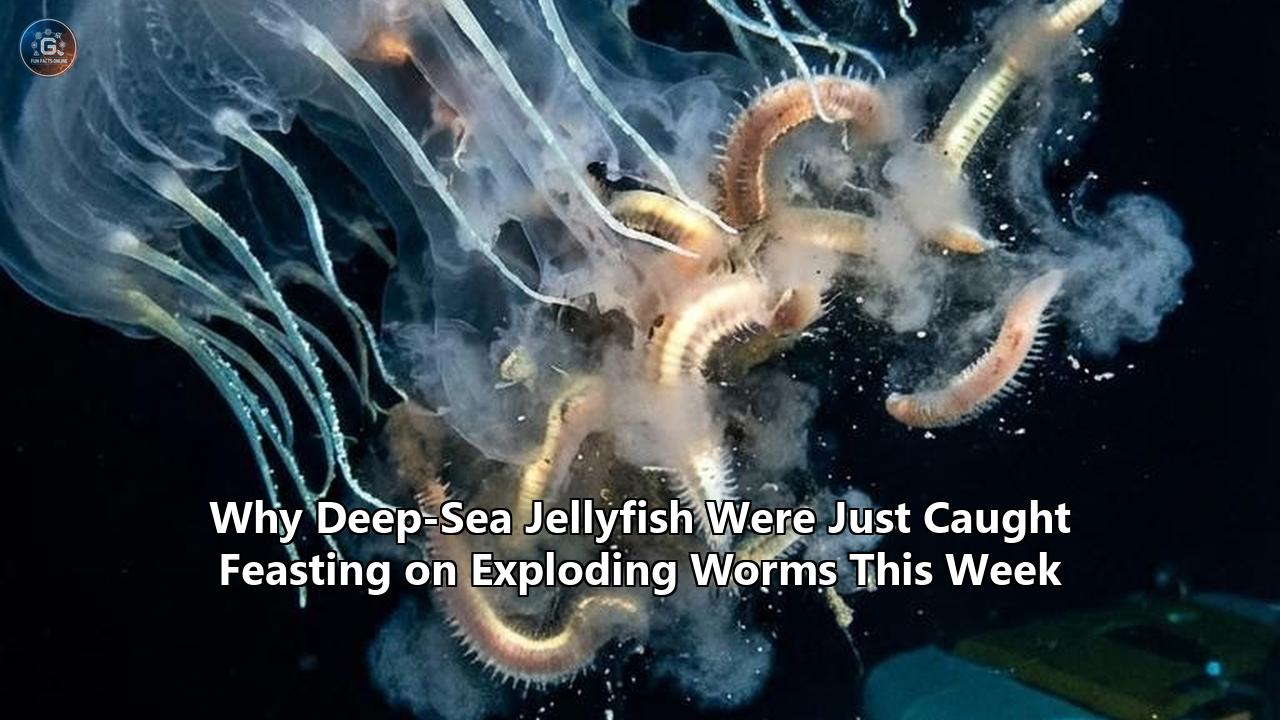
On a warm summer night under the illumination of a full moon, the quiet waters of Denmark’s Kerteminde Fjord transformed into a chaotic biological battleground. Thousands of bottom-dwelling marine worms abandoned their burrows, swimming frantically toward the surface in a synchronized mass spawning event. As they released clouds of eggs and sperm, the worms’ bodies literally ruptured, leaving them dead or dying in the water column.
For years, marine biologists believed this brief, violent spectacle primarily served as a seasonal buffet for trout and other predatory fish. But research published this week in the journal Hydrobiologia by a team from the University of Southern Denmark (SDU) reveals an unexpected apex predator crashing the feast: jellyfish.
Scientists documented the common moon jelly (Aurelia aurita) and the highly invasive comb jelly (Mnemiopsis leidyi) actively hunting these swarming, "exploding" polychaete worms. Over the course of a year-long observational study, researchers captured 166 moon jellies and found 45 of them contained at least one partially digested worm. Of 71 comb jellies collected, three contained worm remains.
The raw numbers severely underrepresent the scale of the slaughter. Gelatinous zooplankton digest soft-bodied prey in a matter of hours. By the time researchers typically conduct daylight sampling, the nocturnal evidence has vanished. This discovery exposes a critical flaw in how scientists measure marine food webs, shifting our understanding of how energy moves through the ocean and presenting a complex new challenge for fisheries managers battling invasive species.
The Biological Mechanics of the "Exploding" Worm
To understand the magnitude of this ecological interaction, one must look at the extreme life cycle of the prey. The worms in question, primarily Platynereis dumerilii and Alitta succinea, are polychaetes. For the vast majority of their lives, these segmented marine worms remain hidden out of sight, living in complex burrow systems built into the benthic zone—the lowest level of a body of water.
They survive by scavenging organic material, avoiding predators, and conserving energy. But reproduction triggers a fatal physiological transformation known as epitoky.
During epitoky, the worm's internal organs degenerate to make room for massive quantities of gametes (eggs or sperm). Their musculature alters, and their parapodia—the fleshy, bristle-bearing appendages along their sides—morph into specialized swimming paddles. Guided by lunar cycles and rising summer water temperatures, these transformed worms, now called epitokes, launch themselves from the seabed toward the surface in a synchronized swarm.
The climax of this journey is abrupt. The sheer pressure of the swelling gametes, combined with vigorous swimming motions, causes the worms' body walls to rupture. They literally burst in the open water to ensure maximum dispersion of their genetic material, a fatal reproductive strategy that leaves thousands of nutrient-dense carcasses drifting in the current.
For predators, this is an ephemeral caloric goldmine. For jellyfish—animals completely lacking a brain, central nervous system, or complex visual organs—intercepting this swarm requires an opportunistic feeding strategy previously thought impossible for gelatinous creatures.
A Critical Blind Spot in Marine Ecology
The SDU findings highlight a fundamental problem in oceanography: scientists have historically misunderstood the directionality of marine energy transfers.
Standard ecological models rely on the concept of the "biological pump" or "marine snow." Energy is supposed to flow downward. Phytoplankton synthesize sunlight at the surface, are eaten by larger pelagic creatures, and when those surface-dwellers die, their organic matter sinks to the seafloor to sustain benthic scavengers.
The observation of jellyfish eating benthic worms proves energy is also being violently pumped upward. Bottom-dwelling biomass is actively transporting nutrients from the dark seabed back into the upper water column, where it is intercepted by mid-water predators.
This revelation from shallow fjords is forcing biologists to rethink predator-prey dynamics in the open ocean. Historically, assumptions about the deep sea jellyfish diet relied on daytime observations and the belief that abyssal jellies simply waited for detritus to drift past their tentacles. But the deep ocean is home to its own highly specialized polychaete worms, and this week's data heavily implies that deep-water gelatinous zooplankton are executing the exact same hunting strategies.
Consider the midnight zone, roughly 2,700 meters below the surface. Here, researchers have identified Swima bombiviridis, a holopelagic polychaete colloquially known as the "green bomber worm". Unlike coastal worms that rupture to spawn, Swima worms possess modified gills that act as biological depth charges. When threatened by a predator, the worm detaches fluid-filled sacs that burst into glowing green bioluminescence, creating a dazzling decoy while the worm paddles away into the darkness.
If shallow-water comb jellies are actively exploiting benthic-pelagic coupling to hunt bursting coastal worms, marine ecologists now suspect that deep-water jellies are routinely triggering the bioluminescent explosions of Swima worms. For decades, mapping the deep sea jellyfish diet has been hampered by these exact methodological limitations: diurnal sampling bias and the rapid digestion rates of gelatinous stomachs. The Danish fjord discovery provides the missing behavioral link, suggesting that the entire global population of jellyfish is far more predatory—and heavily reliant on benthic worms—than previously calculated.
Why It Matters: The Invasive Comb Jelly Threat
While the mechanics of this predator-prey interaction rewrite biology textbooks, the immediate real-world consequences are deeply troubling for local ecosystems. The presence of Mnemiopsis leidyi at this feast elevates the discovery from a scientific curiosity to an urgent conservation crisis.
Mnemiopsis leidyi, the sea walnut or warty comb jelly, is not native to Northern Europe. Originating in the western Atlantic Ocean, it was introduced to the Black Sea in the 1980s via the ballast water of commercial cargo ships. The results were catastrophic. With no natural predators, the comb jelly population exploded, consuming vast quantities of zooplankton, fish eggs, and larvae. The invasion triggered a total collapse of the Black Sea anchovy fishery, costing the regional economy hundreds of millions of dollars and permanently altering the marine food web.Now, Mnemiopsis leidyi has established a foothold in Danish waters, including the Kerteminde Fjord. Marine biologists have monitored its spread with growing alarm, but its consumption of swarming polychaete worms reveals an uncalculated competitive advantage.
Native commercial fish, such as sea trout, rely heavily on the summer worm swarms to build fat reserves. If an invasive comb jelly is systematically stripping this nutrient-dense resource out of the water column, native fish populations face a dual threat: the jellies are eating the fish larvae directly, and they are consuming the primary food source required by the surviving adult fish.
"We suspect that Mnemiopsis consumed more worms than we could detect," noted Jamileh Javidpour, an associate professor at SDU and co-author of the study. "They also hunt at night, which is exactly when the worms swarm. By the time we sampled them in daylight, the worms would have been fully digested and impossible for us to see".
Javidpour’s observation cuts to the core of the problem. Because jellyfish digest soft tissue in roughly 120 minutes, ecological impact assessments based on daytime trawls have likely underestimated the comb jelly’s caloric intake by orders of magnitude. They are invisible gluttons, silently degrading the carrying capacity of the ecosystem under the cover of darkness.
The Climate Connection: Accelerating the Jellyfish Advantage
The sudden visibility of this feeding behavior is not happening in a vacuum. It is deeply intertwined with anthropogenic pressures altering the oceans.
Jellyfish populations are currently thriving globally, exploiting conditions that are actively hostile to other marine life. Agricultural runoff and wastewater discharge pump excess nitrogen and phosphorus into coastal waters, triggering massive algae blooms. When this algae dies and decomposes, it strips oxygen from the water, creating hypoxic "dead zones."
Most predatory fish cannot survive in low-oxygen environments and are forced to flee. Jellyfish, however, possess remarkably low metabolic demands. They can tolerate severe hypoxia, allowing them to swim into dead zones without competition and consume whatever life remains.
Simultaneously, chronic overfishing has systematically removed natural jellyfish predators—like sea turtles and large pelagic fish—from the water column. Warmer ocean temperatures, driven by climate change, also accelerate jellyfish reproductive cycles. Some species reproduce both sexually and asexually through a process called strobilation, where a single benthic polyp can release dozens of miniature jellies into the water.
When you combine warming waters, reduced competition, and a newly discovered ability to exploit hidden benthic energy sources like exploding worms, the competitive advantage shifts heavily toward gelatinous zooplankton. This combination of factors ensures that short-lived seasonal energy bursts—like the polychaete spawning event—disproportionately benefit jellyfish populations over native fish.
The Scientific Solution: Isotope Tracing and Nocturnal Observation
Faced with a predator that destroys evidence of its diet within two hours, the SDU research team had to rely on advanced biogeochemical techniques to prove their hypothesis. Visual confirmation of a worm inside a translucent jellyfish bell was not enough; skeptics could argue the worm was accidentally entangled or ingested passively without providing actual caloric value.
To solve this, biologist Hannah Yeo and her colleagues utilized stable isotope analysis.
Isotopes are variants of chemical elements that possess the same number of protons but a different number of neutrons. In marine ecosystems, the ratio of heavy to light isotopes—specifically carbon-13 to carbon-12 and nitrogen-15 to nitrogen-14—changes predictably as energy moves up the food chain. By analyzing the isotopic signature of the jellyfish tissue, the researchers could trace the specific chemical markers of the polychaete worms directly into the cellular structure of the predators.
The isotopic data confirmed that the comb jellies and moon jellies were not merely trapping the worms; they were rapidly digesting them, breaking down their complex proteins, and successfully assimilating the worms' nutrients into their own gelatinous tissues.
This methodological triumph provides a crucial blueprint for resolving the mysteries of the deep sea jellyfish diet. Researchers operating remotely operated vehicles (ROVs) thousands of meters below the surface frequently struggle to capture fragile deep-sea jellies with intact stomach contents. By applying stable isotope analysis to tissue samples gathered by ROVs, marine chemists can bypass the rapid digestion problem entirely, mapping the chemical signatures of abyssal worms and bioluminescent prey directly into the cellular makeup of deep-water predators.
Furthermore, the SDU study forces a mandate for nocturnal sampling. Marine research institutes are now adjusting their deployment schedules, utilizing autonomous underwater vehicles (AUVs) equipped with infrared cameras and environmental DNA (eDNA) sensors to monitor the water column between dusk and dawn. By sampling water for the genetic residue left behind by both the exploding worms and the feeding jellyfish, scientists can track the scale of this interaction without needing to physically capture the rapidly digesting jellies.
Rethinking Ecosystem Management
For policymakers and fisheries managers, this discovery demands an immediate overhaul of ecosystem-based management strategies.
Currently, commercial fishing quotas and conservation models are built on rigid assumptions about who eats whom. If a massive, previously unquantified amount of benthic energy is being diverted into the gelatinous food web, fishery models predicting the recovery of trout, cod, or anchovy populations will fail.
Danish environmental authorities, alongside the European Environment Agency, must now treat the invasive comb jelly not just as a consumer of fish larvae, but as a direct competitor for foundational benthic resources. Managing this threat requires localized interventions.
Some proposed solutions focus on physical removal, utilizing specialized water-filtration nets to cull comb jellies in enclosed fjords before they can intercept the summer worm swarms. Other long-term strategies involve strict ballast water management protocols to prevent further introductions of Mnemiopsis leidyi into vulnerable Baltic and Nordic waters.
Moreover, recognizing this upward energy transfer alters how authorities manage the seabed itself. Polychaete worms require healthy, undisturbed benthic habitats to survive and build their burrows. Bottom-trawling fishing methods, which drag heavy nets across the seafloor, obliterate these burrow networks. If bottom trawling destroys the polychaete population, it entirely removes the summer nutrient pulse that both native fish and opportunistic jellyfish rely on, triggering cascading starvation events throughout the water column.
Protecting the seabed from physical destruction is no longer just about preserving benthic biodiversity; it is a required step to ensure the survival of pelagic fish that intercept these worms during their fatal reproductive flights.
Looking Ahead: The Next Phase of Jellyfish Research
The revelation that jellyfish actively hunt swarming, rupturing worms opens a vast frontier for immediate oceanographic research.
This coming summer, as coastal waters warm and the July and August full moons approach, marine laboratories across Northern Europe will mobilize. Armed with the knowledge from the SDU study, researchers will deploy acoustic tracking arrays and nocturnal camera traps to capture the exact mechanics of how Mnemiopsis leidyi intercepts the worms in the dark. How do brainless predators detect the swarm? Are they sensing the chemical release of the rupturing gametes, or are they detecting the physical vibration of thousands of frantically paddling epitokes?
Simultaneously, deep-ocean exploration vessels, such as the Schmidt Ocean Institute’s R/V Falkor (too), are expanding their ROV surveys of cold seeps and abyssal plains. As scientists document expansive new hydrothermal vents and whale falls, they are heavily scrutinizing the interaction between giant phantom jellyfish and deep-water polychaetes. Unlocking the complete picture of the deep sea jellyfish diet will depend on correlating the chemical signatures found in these abyssal jellies with the bioluminescent bombers living near the ocean floor.
We are witnessing the rapid dismantling of long-held oceanographic assumptions. The water column is not a simple downward conveyor belt of dead organic matter, and jellyfish are not passive drifters waiting for a meal to bump into their tentacles. They are highly efficient, opportunistic predators capable of exploiting the most violent and fleeting reproductive events in the animal kingdom.
As ocean temperatures continue to rise and human activity reshapes marine environments, the species best equipped to adapt will inherit the oceans. Right now, the data indicates that the silent, brainless, and rapidly digesting jellyfish are winning the biological arms race. Understanding exactly what fuels their expansion is the first critical step toward stabilizing the fragile marine food webs they threaten to consume.
Reference:
- https://scitechdaily.com/jellyfish-caught-feasting-on-exploding-sea-worms-for-the-first-time/
- https://www.discoverwildlife.com/animal-facts/marine-animals/polychaete-jellyfish-denmark
- https://www.iflscience.com/hungry-jellyfish-wait-in-the-water-column-for-spawning-worms-in-first-ever-observation-of-behavior-83228
- https://marinelifeindia.wordpress.com/2013/11/18/marine-jelly-the-gelatinous-egg-mass-of-a-marine-polychaete-worm/
- https://only.one/read/thirteen-unbelievable-species-in-the-high-seas
- https://www.acs.org/content/dam/acsorg/education/resources/highschool/chemmatters/issues/2015-2016/October%202015/chemmatters-tg-oct2015-light-under-sea.docx
- https://www.researchgate.net/publication/227759511_Swima_Annelida_Acrocirridae_holopelagic_worms_from_the_deep_Pacific
- https://www.mbari.org/animal/bomber-worm/
- https://www.eurekalert.org/news-releases/1123605
- https://www.iflscience.com/watch-a-giant-phantom-jellyfish-dancing-thanks-to-deep-sea-explorers-who-found-over-25-new-species-82451