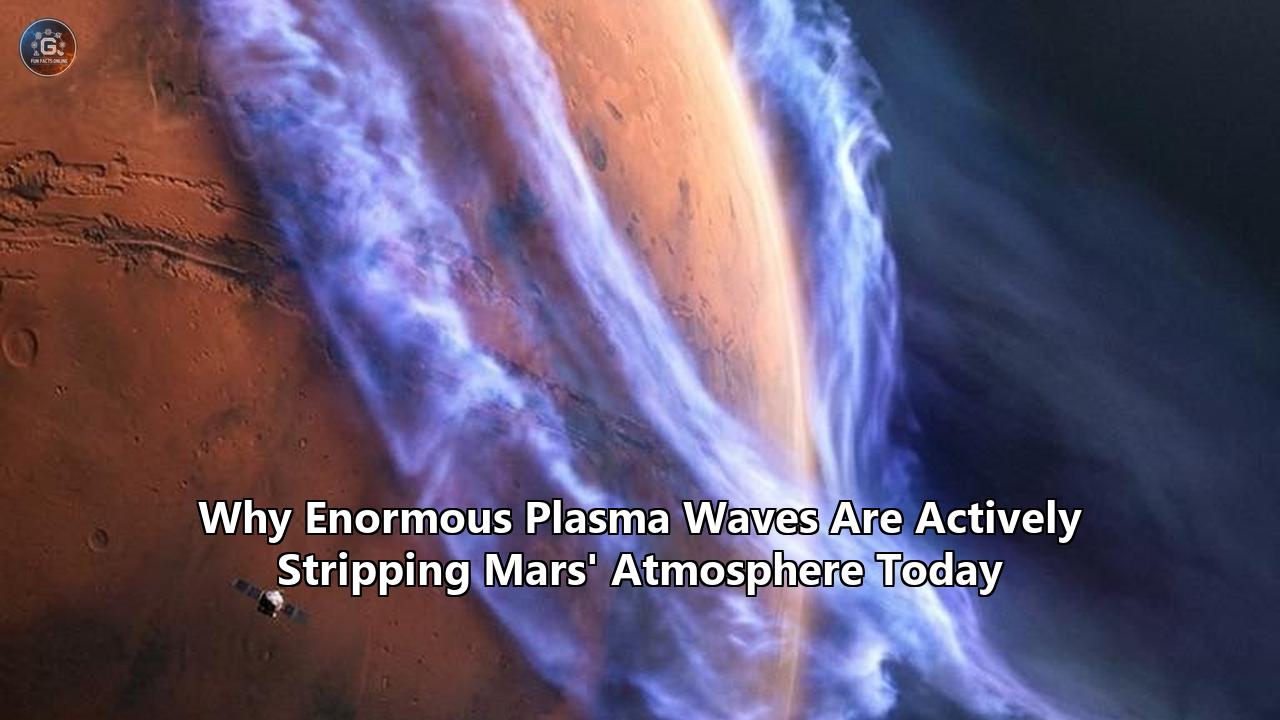
In a discovery that reshapes how planetary scientists understand the decay of alien worlds, dual spacecraft orbiting Mars have captured direct observational evidence of giant rolling plasma waves physically tearing off chunks of the Martian atmosphere and hurling them into deep space.
Published in Science Advances, a multi-agency analysis led by Dr. Chi Zhang of Boston University’s Center for Space Physics reveals that these massive plasma disturbances—known as Kelvin-Helmholtz waves—generate violent, short-lived "plasma clouds" at the boundary where the solar wind slams into the upper atmosphere. These localized atmospheric bursts eject gas ions at rates 10 to 100 times higher than Mars’s previously known steady-state escape channels.
The finding solves a thirty-year astrophysical puzzle regarding how unmagnetized planets lose their volatile gases. By aligning real-time telemetry from NASA’s Mars Atmosphere and Volatile Evolution (MAVEN) orbiter with China’s Tianwen-1 spacecraft, researchers synchronized upstream solar wind measurements with downstream atmospheric loss for the first time in history. The resulting data proves that Mars atmosphere loss is not merely a slow, continuous trickle, but a dynamic process punctuated by sudden, violent strip-mining events that have altered the planet's evolutionary timeline.
  UNMAGNIFIED SOLAR WIND (400–800 km/s)
  ====================================>
          ~~~~~~~~~~~~~~~   <--- Kelvin-Helmholtz Boundary Waves
     ( ( ( Plasma Cloud ) ) ) <--- Bulk Atmospheric Detachment (10-100x Loss Rate)
  ~~~~~~~~~~~~~~~~~~~~~~~~~~~~~
  MARTIAN IONOSPHERE (Slower planetary ions: H+, O+, O2+)
  ====================================>
                  MARS
The Physics of Deep-Space Whitecaps: How Kelvin-Helmholtz Waves Form
To understand how plasma waves strip an atmosphere, picture wind blowing across a calm lake. As the fast-moving air drags across the slow-moving surface of the water, friction creates small ripples. If the wind blows hard enough, those ripples grow into rolling waves, whitecaps, and swirling vortices that lift ocean spray straight into the air.
In the upper atmosphere of Mars, a fluid dynamical process unfolds, but with plasma instead of liquid water.
Mars lacks a global, core-generated magnetic field like Earth’s magnetosphere, which acts as a protective shield to deflect incoming space weather. Consequently, the solar wind—a relentless supersonic stream of charged particles (mostly protons and alpha particles) flowing from the Sun at speeds between 400 and 800 kilometers per second—collides directly with the upper layer of Mars's atmosphere, known as the ionosphere.
Earth vs. Mars: Solar Wind Defense Mechanisms

Earth:
[ Sun ] ---> [ Solar Wind ] ---> ) Magnetosphere Shield ( ---> Earth Safe

Mars:
[ Sun ] ---> [ Solar Wind ] ---> || Direct Collision with Upper Atmosphere || ---> Mass Loss
The Martian ionosphere consists of gas molecules that have been broken apart by solar ultraviolet radiation into positively charged ions (such as $O^+$, $O_2^+$, and $CO_2^+$) and free electrons. When the ultra-fast solar wind scrapes against this stationary or slow-moving ionospheric boundary, it creates extreme velocity shear.
This speed difference triggers the Kelvin-Helmholtz (KH) instability—a classic fluid dynamics phenomenon named after Lord Kelvin and Hermann von Helmholtz. In a magnetized space environment, the shear forces roll the boundary boundary layer into colossal electromagnetic waves.
As these boundary waves grow and curl over themselves, they pinch off, creating isolated, magnetized bubbles filled with heavy planetary gas ions. These detached pockets are "plasma clouds". Once separated from the main body of the ionosphere, the energy and momentum transferred from the solar wind hurl these plasma clouds into interplanetary space, permanently severing the planet from its atmospheric gases.
The Two-Orbiter Detective Story: Why It Took Decades to Prove
For over three decades, theoretical space physicists posited that Kelvin-Helmholtz instabilities ought to exist at Mars. Computer simulations consistently predicted that boundary waves should erode the ionosphere, but proving it experimentally remained elusive.
The fundamental obstacle was a geometry problem that no single spacecraft could solve.
A single orbiter passing through Mars's upper atmosphere can measure local plasma densities and magnetic field fluctuations. However, when an instrument detects an escaping pocket of gas, scientists cannot determine whether that burst was caused by a localized boundary wave, a sudden surge in solar wind speed, a solar flare, or a coronal mass ejection (CME) that occurred hours earlier.
To establish definitive cause and effect, researchers required two independent spacecraft positioned in specific locations simultaneously:
- One spacecraft stationed far upstream in deep space to act as a solar wind monitor, recording the undisturbed conditions of the Sun's output.
- A second spacecraft operating downstream, flying low through the Martian ionosphere to record the immediate response of the planetary plasma.
Dual-Spacecraft Observation Geometry

                    [ Tianwen-1 ]
                 (Upstream Solar Wind Monitor)
                         |
  Solar Wind Stream      v
  =============================================>
                          ~~~~~ KH Waves ~~~~~
                                 |
                                 v
                          [ NASA MAVEN ]
                     (Downstream Escape Detector)
                                 |
                             (( MARS ))
That dual vantage point was realized through an international orbital configuration combining NASA's MAVEN and China’s Tianwen-1 orbiter.
While Tianwen-1 orbited far out in the solar wind monitoring raw solar velocity, density, and magnetic vectors, MAVEN flew through the critical magnetic pileup boundary and ionopause. By aligning the high-precision timestamps from both spacecraft during an isolated passage, the research team achieved unprecedented multi-point plasma diagnostic coverage.
"A major challenge in connecting the solar wind to atmospheric escape at Mars was that a single spacecraft could not simultaneously measure both the undisturbed solar wind upstream and the escaping atmospheric ions near Mars," explained lead author Chi Zhang.
During a representative quasi-periodic cloud event analyzed in the study, Tianwen-1 recorded a steady, uniform upstream solar stream. Simultaneously, just 1,900 kilometers away at the atmospheric boundary, MAVEN's instruments recorded the rapid formation, curling, and detachment of Kelvin-Helmholtz plasma clouds, directly connecting solar wind shear to mass escape events.
Dissecting the Three Escape Pathways: Steady Streams vs. Sudden Bursts
Prior to this multi-spacecraft analysis, planetary scientists categorized Mars atmosphere loss into two primary steady-state channels driven by solar wind interaction:
- The Dayside Polar Plume: Photons from the Sun ionize upper-atmosphere neutral gases. The convective electric field carried by the solar wind grabs these newly formed ions and pulls them into a broad, continuous plume sweeping out over the planet’s poles.
- The Nightside Magnetotail Channel: Solar wind magnetic field lines drape around Mars like pasta wrapped around a fork. This creates an elongated, induced "magnetotail" behind the nightside of the planet. Atmospheric ions slowly drift down this tail and trickle out into deep space.
While these steady channels account for a continuous, predictable decay, they failed to account for the total atmospheric mass loss required by historical climate models. The new Science Advances paper fills that mass-balance gap by establishing the third, non-steady escape channel: Kelvin-Helmholtz Bulk Cloud Escape.
| Escape Channel | Primary Mechanism | Flow Profile | Relative Loss Intensity | Spatial Distribution |
|---|---|---|---|---|
| Dayside Polar Plume | Electric field pickup ($\mathbf{E} = -\mathbf{v} \times \mathbf{B}$) | Steady continuous stream | Moderate baseline rate | Polar hemispheres |
| Nightside Magnetotail | Downstream magnetic tail drift | Steady trickle | Low-to-moderate baseline rate | Anti-solar nightside tail |
| KH Plasma Clouds | Shear-driven boundary instability | Short, high-density violent bursts | 10x to 100x baseline spike | Concentrated along electric field hemisphere |
When Kelvin-Helmholtz waves pinch off into plasma clouds, they do not release single particles; they rip away dense, aggregated pockets of gas. Particle detectors onboard MAVEN—specifically the SupraThermal and Thermal Ion Composition (STATIC) suite—revealed that these plasma clouds carry massive concentrations of oxygen ($O^+$), molecular oxygen ($O_2^+$), and carbon dioxide ($CO_2^+$) ions.
Atmospheric Escape Profile Over Time

Loss Rate (Ions/sec)
 ^
 |             /\ Plasma Cloud Burst (10-100x)
 |            /  \
 |  ---------/----\----------------------------- Polar Plume Baseline
 |  ............................................ Magnetotail Drift Baseline
 +--------------------------------------------------> Time
Instead of individual ions being accelerated out one by one, millions of ions escape simultaneously inside a single coherent structure. The peak ion fluxes measured inside these plasma clouds ranged from $10^6$ to $10^8$ escaping ions per square centimeter per second.
Asymmetry and Micro-Scale Physics: Why One Side of Mars Takes the Brunt
One of the most striking revelations of the dual-spacecraft study is that Kelvin-Helmholtz wave formation and cloud escape do not occur uniformly across Mars. The planet is not stripped evenly like an peeling onion; instead, atmospheric shredding is heavily asymmetrical.
This asymmetry is dictated by the orientation of the solar wind's convective electric field ($\mathbf{E}$), defined by the vector cross-product of the solar wind velocity ($\mathbf{v}$) and the interplanetary magnetic field ($\mathbf{B}$):
$$\mathbf{E} = -\mathbf{v} \times \mathbf{B}$$
Depending on the direction of this electric field, one hemisphere of Mars experiences enhanced plasma coupling, while the opposite hemisphere remains relatively stable.
                Solar Wind Velocity (v) ===>
                Magnetic Field (B)     v v v
                ----------------------------
                Convective Electric Field (E) = -v x B
                                |
                                v
      +---------------------------------------------------+
      | Hemisphere A (+E Direction)  | Hemisphere B (-E)  |
      | ---------------------------  | ------------------ |
      | Severe KH Instabilities      | Stable Boundary    |
      | Violent Plasma Cloud Ejection| Low Mass Escape    |
      +---------------------------------------------------+
                                |
                             (( MARS ))
"The process is not distributed evenly around Mars," noted Zhang. "Instead, it is mainly observed on one side of the planet, depending on the direction of the solar wind electric field."
On the hemisphere where the convective electric field points away from the planet ($+E$ hemisphere), atmospheric ions are pulled upward into the shear layer, feeding mass directly into the growing Kelvin-Helmholtz waves. On the opposite hemisphere ($-E$ hemisphere), the electric field pushes ions back toward the planet, dampening shear instabilities and suppressing plasma cloud detachment.
The Spatial Scale Resolution Mystery
By leveraging the orbital spacing between MAVEN and Tianwen-1, scientists also solved a long-running debate regarding the physical size of these plasma structures.
Previous global magnetohydrodynamic (MHD) computer simulations estimated that plasma clouds were immense, planetary-scale features spanning thousands of kilometers across. However, during one tightly monitored alignment event, MAVEN was positioned approximately 1,900 kilometers away from Tianwen-1.
While MAVEN was embedded inside a dense, active plasma cloud, Tianwen-1—just 1,900 km away—detected no density surge or boundary displacement whatsoever.
This single geometry constraint proved that individual plasma clouds are far more compact than theoretical models had assumed. Rather than massive planetary ribbons, they are hyper-localized, highly concentrated "mini-vortices".
This micro-scale nature makes them significantly more dangerous to atmospheric stability: because they are small and dense, they transfer kinetic energy with incredible efficiency, stripping away concentrated pockets of atmosphere without dispersing energy over a wide area.
Rewriting Martian Paleoclimate: Did Water Disappear Faster Than Expected?
The confirmation of wave-driven bulk plasma escape forces planetary geologists and climatologists to re-evaluate the history of liquid water on Mars.
Four billion years ago, during the Noachian period, Mars was a dramatically different world. Geomorphological evidence gathered by NASA’s Curiosity and Perseverance rovers—ranging from ancient river deltas in Jezero Crater to deeply eroded valley networks across the Southern Highlands—proves that liquid water once flowed abundantly across the surface. For liquid oceans, lakes, and rivers to exist, ancient Mars required a thick atmosphere dominated by $CO_2$ and $H_2O$ vapor, providing sufficient surface pressure and greenhouse warming.
                  MARS PALEOCLIMATE TIMELINE

  Ancient Noachian Era (~4.0 Billion Years Ago)
  +-----------------------------------------------------------+
  | Dense Atmosphere (1-2 bar CO2) | Warm Temps | Liquid Oceans|
  +-----------------------------------------------------------+
                               |
                               | Dynamo Shutoff (~3.8 Ga)
                               | Solar Wind Erosion Accelerates
                               v
  Early Hesperian Era (~3.5 Billion Years Ago)
  +-----------------------------------------------------------+
  | Rapid Atmosphere Loss Driven by Violent KH Waves & CMEs   |
  +-----------------------------------------------------------+
                               |
                               v
  Present-Day Amazonian Era (Today)
  +-----------------------------------------------------------+
  | Hyper-Arid Desert | Thin Atmosphere (~6-8 mbar) | Frozen  |
  +-----------------------------------------------------------+
Around 3.8 to 4.0 billion years ago, Mars’s internal dynamo died, causing its global magnetic field to collapse. Left unprotected, the atmosphere was exposed to the ancient Sun.
Critically, the young Sun was far more violent than it is today. Four billion years ago, the solar wind was up to 100 times denser, and extreme ultraviolet (EUV) radiation was significantly higher.
Because Kelvin-Helmholtz instabilities grow proportionally to the density and velocity shear of the solar wind, wave-driven Mars atmosphere loss during the planet's early history must have been exponentially more destructive than previously modeled.
Solar Wind Intensity Comparison

Young Sun (~4.0 Billion Years Ago):
[ Dense, Fast Solar Wind ] ======> Ultra-Violent KH Waves ======> Extreme Atmospheric Stripping

Modern Sun (Today):
[ Standard Solar Wind ] ---------> Moderate KH Waves ------------> Episodic Plasma Cloud Stripping
If episodic plasma clouds carry 10 to 100 times more atmospheric mass than steady escape channels during modern, quiet solar conditions, their impact during the Sun's youthful, highly active phase would have been catastrophic.
"This discovery changes how we model the timeline of Mars's paleoclimate," noted space physics researchers tracking the MAVEN data. "If plasma waves were stripping the atmosphere away much faster during periods of high solar activity, ancient Mars may have lost its habitability window and its surface oceans far quicker than previously believed."
Rather than a slow, linear decay over billions of years, Mars likely experienced massive "atmospheric collapse events" during periods of intense solar activity, stripping away whole bars of surface pressure in short geological windows.
Exoplanetary Implications: Habitability Near Red Dwarf Stars
The discovery that plasma waves aggressively strip unmagnetized atmospheres extends far beyond our solar system. It directly impacts the search for extraterrestrial life on exoplanets orbiting M-dwarf (red dwarf) stars—the most common class of stars in the Milky Way galaxy.
Red dwarf systems, such as TRAPPIST-1 and Proxima Centauri, are prime targets in modern astrobiology. Many of these systems feature rocky, Earth-sized planets orbiting within the "habitable zone," where temperatures allow liquid water to exist. However, because red dwarf stars are small and cool, their habitable zones are situated extremely close to the star—often less than one-tenth the distance between Earth and the Sun.
Habitable Zone Distance Comparison

Yellow Dwarf System (G-Type, like our Sun):
[ Star ] -----------------------------------------> [ Habitable Zone Orbit (1 AU) ]

Red Dwarf System (M-Dwarf, like TRAPPIST-1):
[ Star ] -> [ Ultra-Close Habitable Zone Orbit (0.01 - 0.05 AU) ]
            (Exposed to extreme stellar wind shear & plasma waves)
At these ultra-close orbital distances, exoplanets are subjected to stellar winds hundreds to thousands of times more intense than what Mars experiences today. Furthermore, many of these worlds lack intrinsic magnetic fields.
Applying the MAVEN/Tianwen-1 Kelvin-Helmholtz wave framework to these alien systems paints a challenging picture for planetary habitability:
- Extreme Shear Forces: High-density stellar winds striking close-in unmagnetized exoplanets will trigger non-stop, hyper-violent Kelvin-Helmholtz instabilities.
- Rapid Desiccation: Plasma cloud formation would proceed continuously, stripping away atmospheric reservoirs of water vapor, nitrogen, and carbon dioxide within tens of millions of years of planetary formation.
- Atmospheric Survival Thresholds: For a terrestrial exoplanet around an M-dwarf star to retain its atmosphere, it must either possess a remarkably powerful intrinsic magnetic field or continuously replenish its atmosphere through massive, sustained volcanic outgassing.
Understanding the wave dynamics active at Mars provides astrobiologists with a quantitative template to model which exoplanets can retain their atmospheres and which are stripped down to barren, airless rocks.
The Next Frontier: ESCAPADE and the Era of Multi-Probe Exploration
While the combined data from MAVEN and Tianwen-1 provided the first proof of plasma-wave erosion, critical questions remain. Exactly how much atmospheric mass do these short-lived plasma clouds strip away globally over a full Martian year? How do these waves behave during extreme solar storms, such as Coronal Mass Ejections?
Answers are on the horizon thanks to dedicated multi-spacecraft planetary plasma missions.
In November 2025, NASA launched the ESCAPADE (Escape and Plasma Acceleration and Dynamics Explorers) mission aboard Blue Origin's New Glenn rocket. Managed by the Space Sciences Laboratory at UC Berkeley, ESCAPADE consists of two identical, low-cost spacecraft named "Blue" and "Gold".
NASA ESCAPADE Dual-Orbiter Architecture

          [ Blue Spacecraft ]                 [ Gold Spacecraft ]
    (Upstream Solar Wind & IMF)        (Downstream Atmospheric Boundary)
                 \                                     /
                  \                                   /
                   v                                 v
        =========================================================
        Full 3D Stereo Mapping of Mars Atmosphere Loss Mechanisms
Currently traversing an interplanetary loiter trajectory, the twin ESCAPADE spacecraft are scheduled to enter Mars orbit in 2027.
Unlike previous missions that relied on opportunistic alignments between spacecraft from different space agencies, ESCAPADE was explicitly engineered from day one to conduct coordinated, multi-point plasma observations:
- Campaign A: "Blue" and "Gold" will fly in formation like "pearls on a string" along the exact same orbital plane, spaced just minutes apart. This allows researchers to measure how rapidly Kelvin-Helmholtz waves grow, curl, and break in real time on sub-minute timescales.
- Campaign B: The twin orbiters will separate, placing one spacecraft upstream in the undisturbed solar wind while the second orbits deep within the atmospheric escape boundary. This configuration will yield continuous, 24/7 cross-correlation between solar wind fluctuations and atmospheric ejection events.
Equipped with high-precision electrostatic analyzers (EESA), fluxgate magnetometers (EMAG), and Langmuir probes (ELP), ESCAPADE will map Mars’s hybrid magnetosphere in three dimensions.
By timing its science operations with the ongoing Solar Cycle peak, ESCAPADE will capture the full brunt of extreme space weather striking Mars. The data will allow scientists to quantify the global rate of Mars atmosphere loss driven by plasma waves, providing the final empirical key to unlocking the deep past—and future—of the Red Planet.
Reference:
- https://studyfinds.com/sun-mars-atmosphere/
- https://dailygalaxy.com/2026/08/scientists-discovered-force-tearing-mars/
- https://www.sciencedaily.com/releases/2026/08/260801042816.htm
- https://m.rediff.com/news/report/mars-atmosphere-stripped-by-solar-winds-via-kelvin-helmholtz-waves/20260803.htm
- https://www.youtube.com/watch?v=W0mFT3fRsBg
- https://www.universetoday.com/articles/maven-spacecraft-finds-new-plasma-squeezing-at-mars
- https://lasp.colorado.edu/maven/science/space-weather/
- https://mappingignorance.org/2016/01/11/maven-and-how-the-sun-blew-mars-atmosphere/
- https://www.space.com/astronomy/mars/very-interesting-wiggles-in-data-from-silent-nasa-mars-spacecraft-lead-to-unexpected-solar-wind-discovery
- https://science.nasa.gov/mission/escapade/
- https://news.berkeley.edu/2025/11/05/nasas-escapade-mission-to-mars-twin-uc-berkeley-satellites-dubbed-blue-and-gold-will-launch-in-early-november/
- https://www.eoportal.org/satellite-missions/escapade
- https://skyandtelescope.org/astronomy-news/escapade-mission-launches-for-a-long-trip-to-mars/
- https://en.wikipedia.org/wiki/ESCAPADE
- https://www.hou.usra.edu/meetings/lpsc2025/pdf/2460.pdf