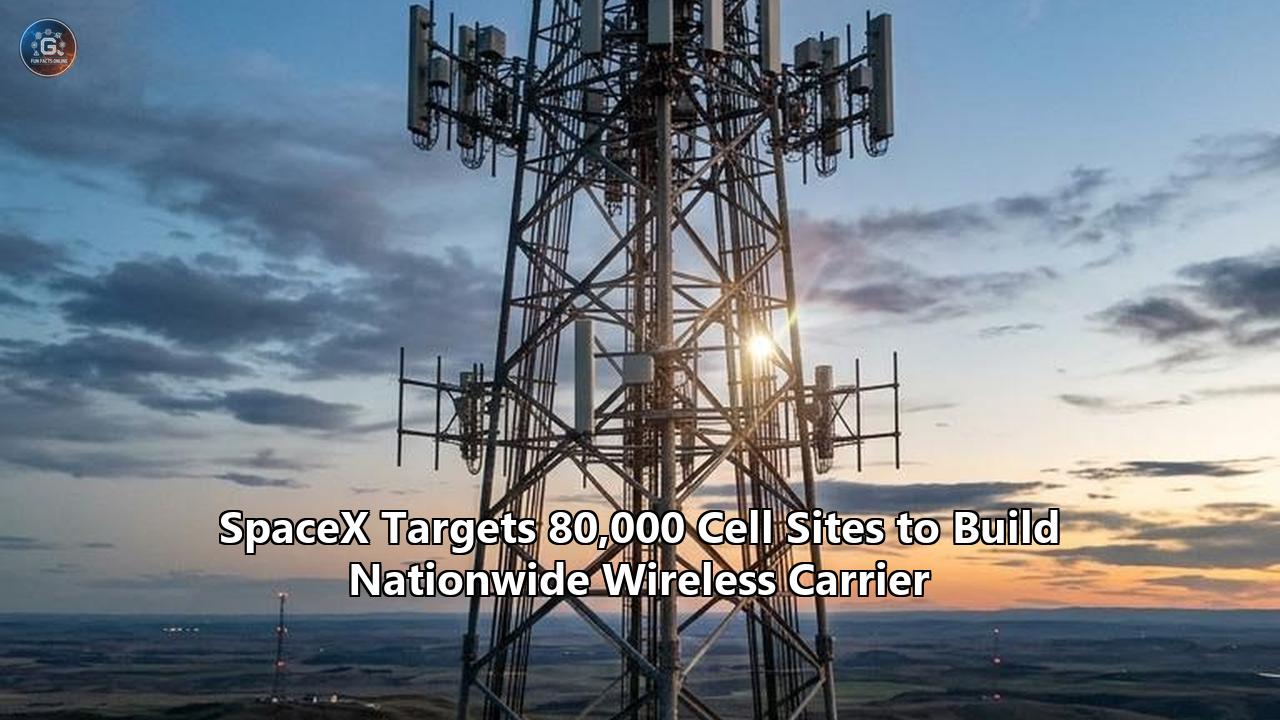
SpaceX is actively negotiating access to at least 80,000 cell sites across the United States, initiating discussions with major wireless infrastructure operators to construct a standalone terrestrial network. The initiative, revealed through industry channel disclosures and corroborated during infrastructure earnings calls in late October 2026, marks an aggressive escalation from direct-to-device supplemental connectivity into a fully realized fourth nationwide mobile carrier.
The scale of the initiative is unprecedented for a new entrant. To put 80,000 sites in perspective, Crown Castle operates approximately 40,000 macro towers, American Tower manages roughly 42,000 domestic sites, and Vertical Bridge holds roughly 18,000. In total, the United States contains roughly 158,500 purpose-built cellular macro towers. SpaceX is effectively attempting to secure lease rights on more than half the existing cell towers in the country. If realized, this deployment would match or exceed the physical ground footprints of incumbent carriers: T-Mobile operates roughly 85,000 macro sites, AT&T operates around 75,000, and Verizon maintains between 65,000 and 75,000.
The market reaction was immediate and punitive for telecom incumbents. Following initial reports of the tower negotiations, shares of AT&T, Verizon, and T-Mobile dropped between 4% and 5% in extended trading, deepening a multi-week slump triggered by SpaceX’s recent high-profile spectrum acquisitions. Conversely, shares of cellular tower real estate investment trust (REIT) Crown Castle surged more than 9%, while American Tower climbed 5%.
During Crown Castle’s quarterly earnings call, Chief Executive Officer Chris Hillabrant acknowledged the industry-wide discussions when pressed on prospective tenant relationships with space-based telecommunications providers: "I don't think I want to get into customer-specific detail, but you can assume that we're talking to all parties".
The development reveals that Elon Musk’s telecommunications ambition has outgrown the technical boundaries of orbit. By marrying space-based low Earth orbit (LEO) antennas with an expansive terrestrial tower grid and a vast low-band spectrum war chest, SpaceX is quietly assembling a hybrid cellular network engineered to overcome the fundamental laws of radio frequency physics that have constrained space-to-phone communications since their inception.
+---------------------------------------------------------------------------------------+
|                    SPACEX TRI-BRID WIRELESS INFRASTRUCTURE MATRIX                     |
+---------------------------------------------------------------------------------------+
|  LAYER           |  PLATFORM                    |  SPECTRUM          |  ROLE          |
|------------------+------------------------------+--------------------+----------------|
|  Orbital Layer   |  15,000 VLEO Mobile V2 Sats  |  2 GHz AWS-4/H     |  Ubiquitous    |
|                  |  (326–335 km altitude)       |  (EchoStar/Tristar)|  rural/remote  |
|------------------+------------------------------+--------------------+----------------|
|  Terrestrial     |  80,000 Leased Macro Towers  |  800 MHz SMR       |  High-capacity |
|  Macro Layer     |  (Crown Castle / AMT / VB)   |  (Grain portfolio) |  urban/highway |
|------------------+------------------------------+--------------------+----------------|
|  Edge Premise    |  Consumer Rooftop Femtocells |  Shared Mid/Low    |  In-building   |
|  Micro Layer     |  (Starlink Dish Add-ons)     |  Band Array        |  penetration   |
+---------------------------------------------------------------------------------------+
The Physics Wall: Why Space Alone Cannot Build a Carrier
To understand why SpaceX is seeking 80,000 ground sites, one must look at the hard limits of radio frequency (RF) propagation. For the past three years, direct-to-device marketing presented an orbital dream: a constellation of LEO satellites beaming LTE directly to unmodified smartphones in users' pockets, erasing dead zones without a single new tower.
As early trials for SpaceX Starlink cell service proved capable of routing emergency texts and basic data streams, incumbent carriers maintained an air of public skepticism. That skepticism was not posturing; it was grounded in the Friis transmission formula and Shannon-Hartley channel capacity theorem.
Friis Transmission Equation:
             (λ)^2
Pr = Pt Gt Gr -----
             (4πd)^2

Where:
  Pr = Received power at handset
  Pt = Transmitted power from orbital payload
  Gt = Transmit antenna gain (satellite phased array)
  Gr = Receive antenna gain (omnidirectional handset antenna)
  d  = Propagation distance (~350 km to 550 km)
  λ  = Carrier wavelength (c / frequency)
Direct-to-cell satellites face three severe physical bottlenecks that make an orbit-only commercial wireless carrier technically unviable:
1. Free Space Path Loss and the Handset Power Budget
A terrestrial smartphone communicates with a macro tower typically 1 to 5 kilometers away. When communicating directly with a satellite, that distance increases to between 350 and 550 kilometers. Free Space Path Loss (FSPL) scales with the square of both the distance and the frequency. Even at a relatively low altitude of 350 kilometers, path loss is roughly 35 to 45 decibels (dB) higher than a typical ground-based link.
While a Starlink satellite can deploy large active phased-array antennas with immense transmit gain to blast downlink signals to the ground, the return link (uplink) is bound by the laws of commercial user equipment (UE). A standard 5G smartphone is limited to a maximum transmit power of 23 dBm (approximately 200 milliwatts) via an omnidirectional, low-efficiency internal antenna. Forcing a 200-milliwatt transmitter to punch through 350 kilometers of tropospheric and ionospheric distortion leaves virtually zero link margin. A phone tucked inside an interior hallway, a pocket, or a basement cannot close the uplink loop to a satellite beam.
2. Spectral Density and Spatial Reuse Limits
Cellular networks achieve immense capacity through extreme frequency reuse. In a dense city like Chicago or Dallas, carriers deploy thousands of macro and small-cell sectors. Each sector reuses the same blocks of licensed spectrum every few hundred meters, dividing the aggregate bandwidth among manageable clusters of active devices.
In contrast, a direct-to-cell satellite phased array projects a spot beam that spans hundreds of square kilometers on the ground. If SpaceX illuminates an entire metropolitan region with a single orbital spot beam using 10 MHz of bandwidth, that 10 MHz must be dynamically shared among every single active handset inside that multi-county footprint. The resulting per-user throughput quickly drops to kilobits per second—adequate for emergency SOS messages, SMS, and low-bitrate telemetry, but incapable of supporting simultaneous streaming, video calls, or standard 5G data consumption across millions of urban subscribers.
Verizon Chief Executive Dan Schulman addressed this exact bottleneck when outlining his company’s competitive moat: "It is basically not possible because of physics, not because of execution but because of physics for satellite to effectively compete against the terrestrial network in either mobility or broadband in urban and suburban geographies".
SpaceX's engineering leadership arrived at the identical mathematical conclusion. Orbital direct-to-cell arrays cannot replace the urban and suburban ground layer. To build an authentic national carrier capable of capturing a share of the $600 billion domestic wireless market, SpaceX had to acquire physical ground real estate.
The Spectrum Assemblage: From EchoStar to the $8 Billion Grain Deal
A wireless network is only as capable as the airwaves it controls. For years, SpaceX operated under temporary special temporary authorities (STAs) and supplemental coverage frameworks, leasing narrow slices of spectrum from mobile partners like T-Mobile (specifically using 5+5 MHz of T-Mobile's mid-band PCS G-Block). That model relegated SpaceX to the status of a secondary, subordinate infrastructure vendor.
Over the past twelve months, SpaceX systematically broke out of that regulatory and technical box by executing an aggressive spectrum acquisition campaign valued at nearly $30 billion.
+------------------------------------------------------------------------------------+
|                         SPACEX SPECTRUM ASSET LEDGER                               |
+------------------------------------------------------------------------------------+
| ASSET BLOCK            | SOURCE            | CAPITAL OUTLAY | OPERATIONAL PROFILE  |
|------------------------+-------------------+----------------+----------------------|
| 800 MHz SMR Band       | Grain Management  | ~$8.0 Billion  | Low-band uplink/down |
| (Up to 14 MHz paired)  | (ex-T-Mobile)     | (Definitive)   | In-building baseline |
|------------------------+-------------------+----------------+----------------------|
| AWS-4 (2.0 GHz) &      | EchoStar Corp     | ~$17.0 Billion | Mid-band high-cap    |
| PCS H-Block            | (Direct Transfer) | (Base deal)    | Space/Ground hybrid  |
|------------------------+-------------------+----------------+----------------------|
| AWS-3 Paired &         | Tristar /         | ~$2.6 Billion  | Supplementary mobile |
| Unpaired Blocks        | EchoStar Option   | (Follow-on)    | downlinks/terrestrial|
|------------------------+-------------------+----------------+----------------------|
| PCS G-Block (Leased)   | T-Mobile US       | Commercial SLA | Initial direct-to-cell|
| (1910–1915 / 1990–1995)|                   | (Revocable)    | pilot framework      |
+------------------------------------------------------------------------------------+
The decisive tactical maneuver occurred on October 8, 2026, when SpaceX signed a definitive agreement to acquire the nationwide 800 MHz low-band spectrum portfolio held by digital infrastructure private equity firm Grain Management for approximately $8 billion.
The lineage of these 800 MHz airwaves carries significant historical weight. Originally assembled by Nextel and later inherited by Sprint for legacy Specialized Mobile Radio (SMR) and CDMA operations, the portfolio was transferred to T-Mobile following its 2020 merger with Sprint. Under antitrust remedies mandated by the Department of Justice, T-Mobile was required to make the spectrum available to Dish Network. When Dish failed to secure financing to finalize the option, the airwaves sat in limbo until Grain Management executed a cash-and-spectrum asset swap with T-Mobile in August 2026. Just two months later, Grain flipped the entire nationwide asset to SpaceX.
The acquisition gave SpaceX up to 14 MHz of nationwide, paired low-band spectrum below 1 GHz. In RF engineering, sub-1 GHz spectrum is known as "beachfront property" for two foundational reasons:
- Diffraction over geographic obstacles: Long-wavelength signals bend around natural topology, hills, and dense vegetation far more efficiently than mid-band or millimeter-wave signals.
- Building penetration: 800 MHz frequencies experience minimal attenuation through reinforced concrete, double-pane glass, and drywall compared to 2 GHz or 3.5 GHz signals.
By pairing this 800 MHz foundation with the roughly 65 MHz of mid-band AWS-4 (2.0 GHz) and AWS-H block spectrum acquired from EchoStar in transactions expanding up to $20 billion, SpaceX solved its structural link-budget equation.
The mid-band airwaves provide wide-pipe capacity down from orbit and out from macro towers, while the low-band 800 MHz allocation provides the structural penetration required to maintain an unbroken voice and data session when a customer steps indoors or enters a parking structure.
The Tri-Brid Network Architecture
The architectural vision behind the 80,000 tower search is not an abandonment of SpaceX’s satellite network, but the completion of an integrated, tri-brid wireless fabric. The technical ambition underpinning SpaceX Starlink cell service demands an architecture that bypasses the classic trade-offs between coverage breadth and localized capacity.
       [ Starlink Mobile V2 Satellite Fleet (326-335 km) ]
                     |                       |
          (AWS-4 Mid-Band / 800 MHz)    (Laser Inter-Satellite Mesh)
                     |                       |
                     v                       v
      +-----------------------------+   +-----------------------------+
      |  Remote / Rural / Offshore  |   |    Spaceborne vEPC Core     |
      | Handset Direct-to-Cell Link |   |   (Authentication/Routing)  |
      +-----------------------------+   +-----------------------------+
                     |
                     | (Seamless Handoff)
                     v
   +------------------------------------+----------------------------------+
   |                                    |                                  |
   v                                    v                                  v
[ Terrestrial Macro Tower ]   [ Rooftop Starlink Dish ]         [ Direct Handset ]
(80,000 Sites / Sub-1 GHz)    (Femtocell / Mini-eNodeB)        (Unmodified 5G UE)
   |                                    |                                  |
   +-----------------> High-Density Terrestrial Radio <--------------------+
                      Access Network (Open RAN / vRAN)
The system operates across three mutually reinforcing physical layers:
Layer 1: The Orbital Shell (15,000 VLEO Satellites)
On October 6, 2026, the FCC granted formal regulatory authorization for SpaceX to deploy a dedicated constellation of 15,000 Very Low Earth Orbit (VLEO) direct-to-device satellites operating at extreme low altitudes between 326 and 335 kilometers.
These satellites differ radically from standard Starlink broadband platforms. They feature massive deployable phased-array apertures measuring dozens of square meters, integrated with custom, space-hardened LTE/5G baseband processors (eNodeBs/gNodeBs). Operating at 330 kilometers cuts path loss by several decibels compared to typical 550-kilometer shells, drastically improving the signal-to-noise ratio (SNR) for handset reception.
These spacecraft act as dynamic, floating cell towers. Handled through proprietary Doppler compensation algorithms and onboard software-defined radios (SDRs), they modulate signals to account for the orbital velocity of over 27,000 km/h, making the high-speed orbital node appear entirely stationary to a standard commercial smartphone on the surface.
Layer 2: The Terrestrial Macro Footprint (80,000 Towers)
By negotiating Master Lease Agreements (MLAs) across Crown Castle, American Tower, and Vertical Bridge, SpaceX plans to deploy its own radio access network (RAN) hardware across 80,000 established structures.
Instead of traditional, proprietary base station cabinets, SpaceX is leveraging an Open RAN (O-RAN) architecture paired with virtualized Baseband Units (vBBUs). At these tower sites:
- Technicians install multi-band active antenna units (AAUs) capable of transmitting and receiving across the newly acquired 800 MHz, AWS-3, and AWS-4 bands.
- Data is backhauled using a combination of direct dark fiber connections and ultra-high-throughput millimeter-wave Starlink Gateway transceivers mounted directly to the tower platforms.
- In suburban corridors and along interstate highway systems, these 80,000 sites take over heavy data traffic, offloading user devices from the orbital constellation.
Layer 3: The Edge-Premises Layer (Millions of Rooftop Femtocells)
The most overlooked element of the architecture was disclosed by SpaceX President and Chief Operating Officer Gwynne Shotwell during the company's recent earnings call. Shotwell confirmed that SpaceX intends to deploy compact cellular base stations—femtocells—integrated directly into the hardware of Starlink residential and commercial satellite dishes.
"You could put a cellular base station on the gear that holds a Starlink broadband dish," Shotwell stated. "You could have these little femtocells around the country, and deploy that as you need it... We will basically leverage the real estate for Starlink installs and other towers".
With over 2 million Starlink dish installations active in North America, each dish represents a customer-powered, zero-acquisition-cost real estate asset. By adding a small-cell radio module operating in SpaceX's licensed 800 MHz and AWS spectrum to the dish assembly, each home becomes a localized cellular micro-site. The micro-site creates an RF bubble spanning 30 to 50 meters around the premises, using the customer’s broadband dish connection for satellite-to-terrestrial fiber backhaul.
When an authorized user walks into a residence, their phone effortlessly hands off from an orbital beam or distant macro tower to the local rooftop micro-cell.
Regulatory Warfare: The SCS Battle at the FCC
The physical realization of this tri-brid carrier has ignited a fierce administrative war inside the Federal Communications Commission.
Under Chairman Brendan Carr, the FCC drafted a comprehensive Notice of Proposed Rulemaking (NPRM) scheduled for a formal Commission vote on October 29, 2026, aimed at overhauling the original 2024 Supplemental Coverage from Space (SCS) framework.
The draft rules would fundamentally rewrite how satellite operators and wireless spectrum intersect:
- Spectrum Expansion: The proposal adds 482 MHz of spectrum to the SCS framework, expanding the number of eligible frequency bands from 5 to 13.
- Dismantling Leasing Mandates: The original framework required satellite providers to hold a single nationwide lease covering an entire Geographically Independent Area (GIA) from a legacy carrier. The new draft eliminates this rule, establishing a localized co-existence framework.
- Direct Spectrum Ownership: The proposed rules drop the requirement that satellite operators obtain waivers to broadcast on terrestrial spectrum that they own outright, validating SpaceX's direct spectrum acquisitions.
+-----------------------------------------------------------------------------------+
|               THE FCC SUPPLEMENTAL COVERAGE FROM SPACE (SCS) SPLIT                |
+-----------------------------------------------------------------------------------+
| PROVISION              | 2024 FRAMEWORK (LEGACY)     | OCTOBER 2026 DRAFT NPRM    |
|------------------------+-----------------------------+----------------------------|
| Eligible Spectrum      | 5 Allocated Bands           | 13 Bands (+482 MHz added)  |
|------------------------+-----------------------------+----------------------------|
| Carrier Leasing Rules  | Mandatory Single-Carrier    | Regional co-existence;     |
|                        | Nationwide Lease Required   | Direct-ownership parity    |
|------------------------+-----------------------------+----------------------------|
| TDD Bands (2.5/3.4 GHz)| Excluded entirely           | Proposed for qualification |
|------------------------+-----------------------------+----------------------------|
| Incumbent Veto Power   | Carrier holds operational   | Shared interference limits |
|                        | control and shutdown rights | overseen via FCC Part 100  |
+-----------------------------------------------------------------------------------+
Incumbent wireless carriers recognized the strategic danger immediately. On October 20, 2026, representatives from AT&T, Verizon, and T-Mobile, unified under the cellular industry's primary trade association, CTIA, held emergency ex-parte meetings with advisers to Chairman Carr and Commissioners Anna Gomez and Olivia Trusty.
According to the official CTIA regulatory filing dated October 22, the legacy carriers urged regulators to strip key provisions from the draft. Specifically, CTIA demanded the immediate removal of Time-Division Duplex (TDD) spectrum—such as the 2.5 GHz band (the foundation of T-Mobile’s Ultra Capacity 5G) and the 3.45 GHz mid-band—from satellite eligibility. CTIA argued that firing high-powered orbital beams into TDD spectrum would create catastrophic interference for more than 300 million existing terrestrial mobile devices due to complex uplink/downlink synchronization conflicts.
Even more critically, CTIA demanded that the FCC reject rules allowing satellite operators to share frequencies without explicit carrier consent, demanding the preservation of strict carrier termination rights.
The regulatory battle marks an acrimonious split between SpaceX and T-Mobile. In August 2022, T-Mobile CEO Mike Sievert and Elon Musk stood together at Starbase, Texas, to unveil the original direct-to-cell initiative with broad promises of ending cellular dead zones. Four years later, SpaceX’s spectrum purchases and tower negotiations have turned a collaborative partner into an existential threat. In formal filings regarding the rollout of SpaceX Starlink cell service, regulators noted that expanding direct-to-device rules directly benefits public safety, while incumbent carriers warned of severe RF degradation to legacy networks.
Buildout Reality vs. The Ultimate MVNO Bluff
As reports of the 80,000 tower negotiations circulate through the wireless and financial sectors, an intense debate has emerged among Wall Street telecom analysts: Is SpaceX truly preparing to sink tens of billions of dollars into civil engineering, or is this the most aggressive negotiating leverage play in commercial telecom history?
The financial hurdles of standing up 80,000 physical cell sites are immense. Analysts at TD Cowen estimate that constructing a full-scale nationwide terrestrial mobile radio network from scratch would cost SpaceX upwards of $80 billion over several years.
Terrestrial Macro Site Buildout Economics (Estimated per site):
  - Baseband Units (BBU) and Open RAN server cards:    $15,000 - $25,000
  - Multi-band Remote Radio Heads (RRHs) & Antennas:   $30,000 - $45,000
  - Tower Structural Modifications & Rigging:         $20,000 - $40,000
  - Dedicated Fiber Backhaul Drops / Microwave Links:  $10,000 - $30,000
  - Power Systems, Rectifiers & Battery Backup:       $15,000 - $25,000
------------------------------------------------------------------------
Total Average Upfront Capital Outlay per Site:        ~$90,000 - $165,000
Total Upfront CAPEX for 80,000 Macro Sites:          $7.2B - $13.2 Billion

Ongoing Operational Expenses (Annual per site):
  - Tower Ground / Space Lease to REIT (CCI/AMT):     $30,000 - $45,000
  - Backhaul Lease & Transit Costs:                   $12,000 - $18,000
  - Power Consumption & Utility Maintenance:          $6,000  - $10,000
------------------------------------------------------------------------
Total Annual Operational Overhead (80,000 Sites):    $3.8B - $5.8 Billion/year
Beyond the capital expense of buying radios and leasing tower space from Crown Castle and American Tower, an operator must resolve fiber backhaul termination, physical site access, structural load calculations, power utility provisioning, and ongoing maintenance logistics across 80,000 locations.
Because of these staggering capital costs, telecom veterans point to an alternative theory: the Master Mobile Virtual Network Operator (MVNO) squeeze.
Ken Schmidt, President of wireless infrastructure advisory firm Steel In The Air, noted the strategic dynamic: "I hope Starlink is serious about 80,000 sites; it's good for consumers, good for the tower industry, bad for the carriers, and good for landowners/building owners. But it seems like exactly what I would do if I wanted to pressure the Big 3 and force one to sign an MVNO deal, too".
Under the MVNO squeeze theory, SpaceX does not actually desire to maintain 80,000 ground sites. Instead, by acquiring nationwide 800 MHz and AWS spectrum and publicly pursuing tower space with Crown Castle, SpaceX demonstrates to AT&T, Verizon, and T-Mobile that it possesses both the capital and the spectrum assets to build an unassailable fourth competitor.
               +------------------------------------------------+
               |     SPACEX STRATEGIC GAME THEORY MATRIX        |
               +------------------------------------------------+
                                       |
                   Does an Incumbent Carrier Break Ranks?
                                       |
                 +---------------------+---------------------+
                 | YES                                       | NO
                 v                                           v
    [ Comprehensive National MVNO ]             [ Full Facilities Buildout ]
    - Carrier opens nationwide 5G RAN           - Exercises 80,000 Tower Leases
    - SpaceX trades orbital failover/roaming    - Deploys proprietary O-RAN gear
    - Eliminates $80B terrestrial build cost    - Launches fully independent 4th MNO
    - Starlink Mobile launches overnight        - Crushes carrier stock valuations
If one of the Big Three carriers breaks ranks and signs an asymmetrical, wholesale MVNO agreement—granting SpaceX deep wholesale access to its ground-level 5G network in exchange for reciprocal global roaming on the 15,000 Starlink satellite constellation—SpaceX achieves nationwide mobile reach overnight without having to deploy a single physical wrench to a cell tower.
Yet, viewing the 80,000-site target as an empty bluff ignores the history of SpaceX’s capital allocation.
When SpaceX announced plans to manufacture its own high-throughput satellites in Redmond, Washington, legacy aerospace executives declared the constellation commercially unfeasible. When Starlink initially deployed, broadband analysts insisted consumer satellite equipment could never be produced for less than thousands of dollars per unit. Today, Starlink operates more than 7,000 orbital spacecraft, supports over 13 million active subscribers globally, and generated more than $5.2 billion in revenue in the third quarter of 2026 alone.
During SpaceX’s third-quarter earnings call, Elon Musk directly dismissed the idea that the company is playing by standard telecom conventions: "I think we probably should do a longer presentation on the game plan for Starlink connectivity and why we think it will ultimately be a business that generates several hundred billion dollars in revenue a year".
Musk subsequently reinforced the stance on X: "Veterans of the cellular industry look at the chess board of existing pieces and don't see a solution. They don't understand that SpaceX is developing entirely new pieces that fundamentally alter the strategic landscape".
The financial trajectory of SpaceX Starlink cell service rests on whether the business can convert terrestrial tower leases into viable operating margins, or if the sheer threat of those leases forces incumbents to yield. SpaceX's Q3 revenue reached $14.6 billion, with net income hitting $4.4 billion, demonstrating that the space company has the corporate balance sheet, liquidity, and equity valuation to finance a facilities-based network buildout that would bankrupt a traditional startup.
The Handset and Silicon Ecosystem
A wireless carrier cannot launch without devices that can access its signals. Even if SpaceX secures 80,000 towers and launches 15,000 VLEO satellites, an ordinary iPhone or Samsung Galaxy handset must be able to modulate and demodulate the RF frequencies without bulky aftermarket accessories.
This is where the recent 800 MHz and AWS spectrum acquisitions form the critical link.
In early direct-to-cell iterations, SpaceX was locked into 3GPP Non-Terrestrial Network (NTN) standards, which were only integrated into newer flagship chipsets like Qualcomm's Snapdragon X75 and X80 modems, or Apple’s proprietary satellite emergency stacks.
However, by purchasing nationwide 800 MHz SMR spectrum and standard AWS (Band 4/66 and Band 25/70) licenses, SpaceX is operating within standardized 3GPP bands that are already burned into the silicon of nearly every LTE and 5G smartphone produced over the last seven years.
+------------------------------------------------------------------------------------+
|               HANDSET RF BAND COMPATIBILITY PROFILE FOR SPACEX CARRIER             |
+------------------------------------------------------------------------------------+
| FREQUENCY BAND | 3GPP DESIGNATION | COMMERCIALLY ACTIVE IN SMARTPHONES SINCE:       |
|----------------+------------------+------------------------------------------------|
| 800 MHz SMR    | Band 26 / n26    | 2013 (Every flagship iPhone, Galaxy, Pixel)   |
|----------------+------------------+------------------------------------------------|
| PCS H-Block    | Band 25 / n25    | 2012 (Broadly supported across US handsets)    |
|----------------+------------------+------------------------------------------------|
| AWS-4          | Band 70 / n70    | 2017 (Standardized in modern 5G modem silicon) |
+------------------------------------------------------------------------------------+
Because these bands are native to existing mobile silicon, a consumer will not need to purchase a specialized "satellite phone" or download a custom application to connect to the Starlink carrier network. The device views the spaceborne eNodeB and the terrestrial macro tower identically, connecting natively via standard terrestrial signaling protocols.
To handle the handoff between space and ground, software engineers have integrated connection management layers into the Starlink operating system. Software analysis of recent Starlink application updates revealed internal references to StarlinkCarrierService, an underlying background service engineered to monitor signal propagation metrics, beam handoffs, and local device authentication.
Market Fallout and the Road to 2028
The timeline for SpaceX's wireless launch is already accelerating through regulatory and operational channels:
- Mid-2027: Closing of the $8 billion nationwide 800 MHz Grain Management asset acquisition, following anticipated FCC public-interest review.
- Late 2027: Initial commercial integration of open-RAN radio equipment across primary Master Lease Agreement (MLA) tower portfolios with Crown Castle and American Tower.
- Early 2028: Targeted commercial debut of second-generation SpaceX Starlink cell service, offering full voice, 5G data, and universal domestic roaming.
The strategic implications for the incumbent wireless cartel are profound. For over a decade, AT&T, Verizon, and T-Mobile have operated within a settled oligopoly, insulated by high barriers to entry: the near-impossibility of securing nationwide spectrum and the tens of billions of dollars needed to deploy physical macro towers.
SpaceX has methodically disassembled both barriers. It used orbital launch dominance to establish a space-based network that no terrestrial telco can match, bought up the distressed spectrum portfolios of former competitors like Sprint and EchoStar, and is now targeting the identical tower infrastructure that supports the incumbents' own networks.
With the FCC's critical October 29 vote on expanded satellite spectrum eligibility approaching, the telecommunications industry stands at an unprecedented crossroads. If the Commission adopts the modernized SCS framework and SpaceX formalizes lease agreements across 80,000 American towers, the wireless industry will no longer be an exclusive club of three terrestrial giants. By fusing orbit, earth, and customer rooftops into a single cohesive transmission fabric, SpaceX is moving to construct a wireless carrier that cannot be out-competed on coverage—because its towers sit on the earth, its micro-cells sit on consumer homes, and its base stations fly across the sky.
Reference:
- https://www.pcmag.com/news/report-spacex-wants-80000-cell-sites-for-starlink-mobile
- https://www.datacenterdynamics.com/en/news/spacex-aims-to-access-80000-us-cell-sites-for-wireless-network/
- https://driveteslacanada.ca/news/att-tmobile-verizon-fcc-satellite-phone-rules/
- https://www.tikr.com/blog/spacex-stock-80000-cell-sites-wireless-network
- https://www.androidheadlines.com/2026/10/spacex-starlink-mobile-80000-cell-sites.html
- https://www.fierce-network.com/wireless/spacex-might-sign-deals-80000-towers-build-mobile-network-it-bluffing
- https://www.benzinga.com/trading-ideas/movers/26/10/62556184/t-mobile-shares-lose-signal-as-spacex-reportedly-seeks-80000-cell-sites-to-build-a-rival-carrier
- https://stocktwits.com/news-articles/markets/equity/space-x-reportedly-eyes-80-000-cell-sites-in-push-to-become-fourth-us-wireless-carrier-t-tmus-vz-stocks-slip-after-hours/cZxwFlZRBDk
- https://logisticsviewpoints.com/2025/09/08/the-future-of-spacex-starlink-direct-to-cell-communications/
- https://247wallst.com/investing/2026/10/23/telecom-stocks-fall-as-spacex-eyes-80000-cell-sites-t-mobile-sinks-5-att-drops-4-verizon-slides-3/
- https://insidetowers.com/spacex-does-not-think-like-a-telco/
- https://www.insideglobaltech.com/2026/10/15/fcc-proposes-to-streamline-supplemental-coverage-from-space-and-direct-to-device-rules/
- https://arxiv.org/html/2506.00283v1
- https://spacelawjournal.com/fcc-direct-to-device-scs-overhaul-spacex-d2d/
- https://satnews.com/2026/10/11/spacex-acquires-grain-managements-800-mhz-spectrum-portfolio-to-launch-standalone-starlink-mobile-carrier/
- https://intellectia.ai/news/stock/spacex-acquires-8-billion-800-mhz-spectrum-for-starlink-mobile
- https://www.streetinsider.com/Corporate+News/SpaceX+to+acquire+Grain+Managements+800+MHz+spectrum+portfolio/27167237.html
- https://sebastianbarros.substack.com/p/occupy-earth-musk-wants-80000-cell
- https://ieeexplore.ieee.org/iel8/35/7593423/11278574.pdf
- https://driveteslacanada.ca/news/spacex-starlink-mobile-80000-cell-towers/
- https://www.techtimes.com/articles/323552/20260807/starlink-mobile-targets-us-carriers-small-cells-where-broadband-won.htm
- https://www.pcmag.com/news/starlink-might-piggyback-on-your-equipment-to-build-out-a-cellular-network
- https://ransemi.com/media/news/starlink-small-cell-femtocell/
- https://www.pcmag.com/news/att-t-mobile-verizon-fight-fcc-satellite-proposal-that-helps-spacex
- https://docs.fcc.gov/public/attachments/DA-26-1078A1.pdf
- https://militarnyi.com/en/blogs/what-is-direct-to-cell-from-starlink-and-how-does-it-work/