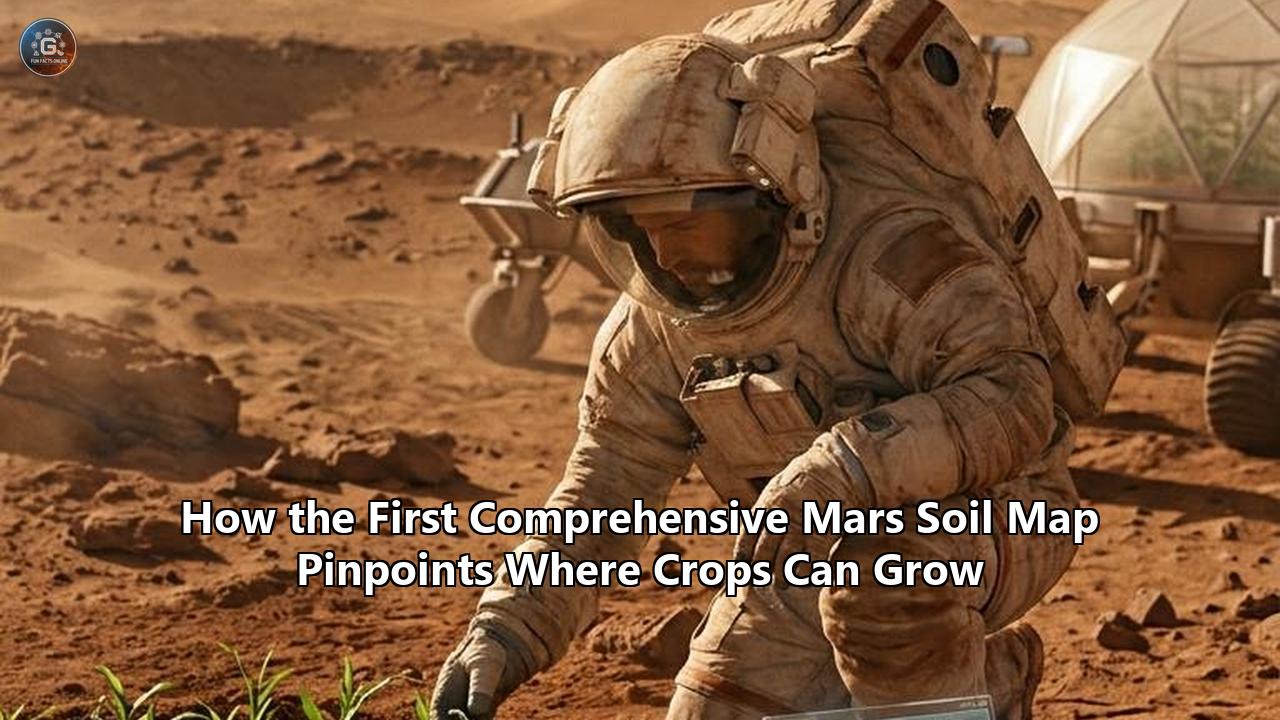
A team of soil scientists from the University of Sydney has produced the first global classification system and digital atlas of Martian soils, cataloging nearly 800 million surface locations across 92 percent of the planet. Published in the soil science journal CATENA, the study introduces an entirely new branch of extraterrestrial pedology, establishing a taxonomic architecture known as the Provisional Polythetic Areth Classification System (PPACS).
Led by doctoral researcher Daniel Irving alongside Professor Alex McBratney, Director of the Sydney Institute of Agriculture, the researchers solved an operational blind spot that has challenged planetary mission planners for decades: treating the Red Planet’s surface as a uniform crust of abrasive dust rather than a chemically and physically diverse pedological terrain.
The investigation evaluated all 2,000 distinct soil forms mapped across the planet to measure their capacity to support plant life within controlled off-world habitats. One specific soil class—designated "Nohibareth"—emerged as the primary candidate, scoring 0.93 on a suitability scale ranging from zero to one. Clustered within equatorial and mid-latitude volcanic lowlands such as Elysium Planitia, Tharsis, and central Arabia Terra, Nohibareth possesses a near-neutral pH of 6.8, a 72 percent clay fraction, and an available water capacity of 202 millimeters per meter.
The findings fundamentally alter the conversation surrounding long-duration space settlement. Food production on Mars will not take place in open fields under an ambient atmospheric pressure of six millibars; it will unfold inside sealed, pressurized greenhouses. Yet the logistics of carrying thousands of metric tons of inert terrestrial potting soil or closed-loop hydroponic infrastructure from Earth across a 140-million-mile void remain economically prohibitive. By identifying precisely where local regolith possesses the physical and mineralogical attributes to sustain crop roots, the PPACS atlas transforms in-situ resource utilization (ISRU) from a theoretical aspiration into a site-selection reality.
From Sterile Regolith to Areths: What Martian Ground Material Actually Is
For decades, planetary geologists and terrestrial agronomists debated whether the surface of Mars could legitimately be referred to as "soil." In traditional Earth pedology, soil is defined as a living, dynamic matrix formed through the interaction of five fundamental factors: parent rock material, climate, topography, biological organisms, and time. Because Mars lacks verified biological activity and organic carbon cycles, planetary scientists traditionally defaulted to the term "regolith"—a loose blanket of unconsolidated, broken mechanical debris sitting atop intact bedrock.
The Sydney researchers bridged this disciplinary divide by introducing the term "areth," derived from Ares, the Greek deity and namesake of the Red Planet. An areth is defined as a natural planetary body composed of mineral and weathered mineral matter that occupies a unique position within a physical landscape, exhibiting spatial variations in texture, chemistry, mineralogy, and depth.
Earth Pedology vs. Martian Areopedology

Terrestrial Soil
├── Parent Material: Igneous, sedimentary, metamorphic rocks
├── Organic Fraction: 1% to 10% (humus, detritus, microbes, root systems)
├── Hydrological Driver: Active liquid water cycle, precipitation, leaching
└── Atmospheric Weathering: Oxygen, nitrogen, carbonic acid

Martian Areth (Regolith)
├── Parent Material: Basaltic bedrock, impact breccias, volcanic ash
├── Organic Fraction: Effectively 0% (trace meteoritic carbon only)
├── Hydrological Driver: Ancient lacustrine/fluvial weathering (frozen cryosphere today)
└── Atmospheric Weathering: Ultraviolet photolysis, thermal fracture, eolian abrasion, perchlorate salt accumulation
The physical reality of an areth is shaped by a history of extreme mechanical pulverization. Without an active plate tectonics cycle to subduct and melt the crust, the Martian surface preserves an ancient geological record spanning four billion years. Billions of years of hypervelocity meteorite impacts have crushed basaltic lavas into fine powders. Unattenuated solar ultraviolet radiation continuously splits chemical bonds at the surface, while abrasive windstorms lift and circulate dust grains globally, smoothing and segregating particle sizes across thousands of kilometers.
Chemically, the material is predominantly weathered basalt, rich in iron, magnesium, aluminum, and silica. The ubiquitous red tint stems from iron oxides—primarily nanocrystalline hematite ($\text{Fe}_2\text{O}_3$) and maghemite—formed via ancient aqueous alteration coupled with dry atmospheric photochemical oxidation. But beneath this thin veneer of oxidized dust lies a varied pedological architecture. Clay-rich smectites and phyllosilicates, hydrated sulfates, and localized silica deposits represent distinct geochemical eras.
Decoding the PPACS Architecture: How 800 Million Data Points Were Classified
Constructing a global soil map for another planet requires an entirely different method than digging profile trenches with an auger. The team developed the Provisional Polythetic Areth Classification System to translate fragmented remote-sensing data into an organized taxonomic hierarchy.
PPACS operates on a rigid, three-tier architecture:
- Realms (10 Classes): The highest organizational tier, determined primarily by dominant continental-scale variations in surface mineralogy, parent rock origins, and broad climatic-weathering zones across equatorial, mid-latitude, and polar bands.
- Assemblages (100 Classes): Intermediate units that capture regional geomorphic and geochemical trends, including local volcanic provinces, crater floor basins, and sediment deposition corridors.
- Forms (2,000 Classes): The high-resolution terminal taxonomic units, representing specific configurations of physical texture, depth, mineral composition, and chemical reactivity.
                     PPACS Hierarchical Structure

                         [ 10 Major Realms ]
                                 │
                                 ▼
                     [ 100 Regional Assemblages ]
                                 │
                                 ▼
                    [ 2,000 Terminal Areth Forms ]
                     (e.g., Nohibareth, Score: 0.93)
The system is polythetic, meaning classes are defined by groups of correlated properties rather than a single pass-fail diagnostic criterion. In terrestrial soil systems like the USDA Soil Taxonomy or the World Reference Base (WRB), classifications rely on diagnostic subsurface horizons—identifiable layers such as an argillic clay horizon or a spodic accumulation zone that must be physically excavated and measured. Because remote orbital sensors cannot dig soil pits, PPACS synthesizes multi-wavelength spectral measurements and geophysical datasets to infer both surface and near-surface physical realities.
The researchers gathered data from multiple interplanetary missions:
- Mineralogical Mapping: Near-infrared and visible reflectance spectroscopy from the Compact Reconnaissance Imaging Spectrometer for Mars (CRISM) aboard NASA’s Mars Reconnaissance Orbiter (MRO), supplemented by data from the Observatoire pour la Minéralogie, l'Eau, les Glaces et l'Activité (OMEGA) instrument on ESA’s Mars Express.
- Elemental Chemistry: Planetary gamma-ray and neutron flux maps captured by the Gamma Ray Spectrometer (GRS) suite aboard NASA’s 2001 Mars Odyssey, providing global distributions of silicon, iron, potassium, chlorine, and thorium.
- Physical Texture and Thermal Inertia: Surface temperature curves measured by the Thermal Emission Imaging System (THEMIS) aboard Mars Odyssey. Materials with high thermal inertia (such as exposed bedrock or dense gravel) warm and cool slowly, whereas loose, fine-grained dust exhibits low thermal inertia. This data enabled precise estimates of grain sizes—differentiating fine clays and silts from sand and rocky lag deposits.
- Topography and Crustal Depth: Elevation and surface roughness profiles from the Mars Orbiter Laser Altimeter (MOLA) aboard the Mars Global Surveyor, alongside localized seismic and subsurface radar profiles from the InSight lander and the SHARAD radar instrument.
Using a centroid-based ordination algorithm, PPACS analyzed approximately 800 million spatial pixels across the Martian surface, calculating the multidimensional mathematical distance between each pixel’s properties and assigning it to the nearest taxonomic profile. The resulting atlas covers roughly 92 percent of the planet, deliberately excluding only perpetual ice caps and extreme high-latitude terrain obscured by seasonal carbon dioxide frosts.
Evaluating Mars Soil Suitability: The Agropedological Index
Once the 2,000 terminal areth forms were classified and mapped, the researchers applied an agronomic filter to test their capability to host terrestrial plant systems within a closed life-support environment.
Assessing Mars soil suitability requires evaluating how an extraterrestrial matrix interacts with plant biology. On Earth, bad soil can often be fixed with irrigation and chemical fertilizer. On Mars, every liter of water, gram of nutrient, and kilowatt-hour of environmental management carries a payload penalty. If an astronaut crew must spend weeks washing, sifting, and acid-buffering an unsuitable local substrate, the energy balance of the entire mission breaks down.
The researchers constructed a composite agropedological index ranging from 0.0 (completely incompatible) to 1.0 (optimal baseline). The score was weighted against five core agronomic metrics:
$$\text{Suitability Index} = f(\text{AWC}, \text{Texture}, \text{pH}, \text{Thickness}, \text{Coarse Fraction})$$
Key Parameters in the Suitability Equation:

1. Available Water Capacity (AWC):
   The volume of water a given volume of soil can hold between field capacity
   (after drainage) and permanent wilting point (where roots can extract no more).
   Threshold: Higher is better; >150 mm/m prevents flash drying of roots.

2. Physical Texture (Clay-Silt-Sand Ratios):
   Controls pore geometry, root penetration resistance, and aeration.
   Ideal: Clay-rich to clay-loam configurations that balance drainage with retention.

3. Reaction Equilibrium (pH):
   Dictates the solubility and chemical bioavailability of essential plant ions.
   Threshold: Neutral window (6.0 to 7.5); extreme alkalinity binds phosphorus
   and iron, while acidity triggers heavy metal mobilization.

4. Profile Thickness:
   The physical depth of unconsolidated, workable material above impenetrable rock.
   Threshold: Minimum 30–50 cm required for mature root zone architecture.

5. Coarse Gravel and Stone Content:
   Volumetric percentage of particles >2 mm.
   Threshold: Minimal presence preferred; excessive rock fragments damage
   automated processing equipment and lower total moisture capacity.
The mathematical evaluation revealed that planetary Mars soil suitability is severely constrained by physical structure. In 73 percent of all 2,000 areth forms evaluated, the primary limiting bottleneck was Available Water Capacity. Most of the Martian surface is covered by coarse, basaltic sands or extremely thin mantles of low-density dust resting on unweathered bedrock. Coarse basaltic sands drain rapidly, behaving like crushed glass: water flows straight through under gravity, failing to remain in the capillary zones where root hairs function. Conversely, pure pulverized dust has so little structural aggregation that when wet, it collapses into a cement-like paste, cutting off root oxygen and suffocating the plant.
Distribution of Agricultural Bottlenecks Across Mars Soil Classes

[█████████████████████████████████████░░░░░░░░░] 73% Low Available Water Capacity (AWC)
[██████░░░░░░░░░░░░░░░░░░░░░░░░░░░░░░░░░░░░░░░] 12% Extreme Grain Size (Rock/Coarse Lag)
[████░░░░░░░░░░░░░░░░░░░░░░░░░░░░░░░░░░░░░░░░░]  8% Unfavorable pH (High Alkalinity/Acidity)
[███░░░░░░░░░░░░░░░░░░░░░░░░░░░░░░░░░░░░░░░░░░]  5% Thin Profile Depth (<15 cm)
[██░░░░░░░░░░░░░░░░░░░░░░░░░░░░░░░░░░░░░░░░░░░]  2% Balanced Agronomic Profiles (Score >0.80)
Only a small fraction of the Martian landscape circumvented these physical limitations, scoring high marks on the agronomic index.
The Nohibareth Class: The Prime Candidate in Elysium and Arabia Terra
Out of 2,000 cataloged terminal forms, the PPACS framework elevated a single class to the top of the agropedological rankings: Nohibareth, which achieved a suitability score of 0.93.
Nohibareth represents a rare combination of mineralogical weathering and physical sedimentation. Its modelled average profile displays an agronomically favorable balance:
- pH Equilibrium of 6.8: Near neutral. Terrestrial agricultural soils are generally considered optimal between 6.2 and 7.0. At a pH of 6.8, primary macro-nutrients (nitrogen, phosphorus, potassium) and secondary nutrients (calcium, magnesium, sulfur) remain chemically soluble and bioavailable, avoiding precipitation into insoluble mineral phases.
- 72 Percent Clay Fraction: Dominated by phyllosilicates and smectite-group clays. Smectites possess an expanding-lattice crystal structure with high internal surface area. This physical configuration provides abundant negative surface charges, yielding high cation-exchange capacity (CEC) to chemically hold and exchange positively charged nutrient ions like potassium ($\text{K}^+$), calcium ($\text{Ca}^{2+}$), and magnesium ($\text{Mg}^{2+}$) rather than letting them leach away.
- Available Water Capacity of 202 mm/m: Exceptionally high moisture retention. Capillary suction within the micro-pores of Nohibareth clays allows the material to retain moisture without immediate drainage, creating an active hydration buffer for crop root systems.
- Minimal Sand and Gravel Content: The coarse stone fraction is negligible, reducing the need for industrial sieving and mechanical sorting before moving the material into habitat grow beds.
Textural Profile Comparison: Nohibareth vs. Typical Martian Regolith

Nohibareth Profile (Suitability: 0.93)
┌────────────────────────────────────────────────────────┐
│ Clay (72%)                   │ Silt (18%)   │ Sand (10%)│
└────────────────────────────────────────────────────────┘
Characteristics: High moisture retention (202 mm/m), pH 6.8, high CEC

Typical Basaltic Regolith (Suitability: ~0.35)
┌────────────────────────────────────────────────────────┐
│ Sand (65%)                   │ Silt (20%)   │ Clay (15%)│
└────────────────────────────────────────────────────────┘
Characteristics: Poor moisture retention (<60 mm/m), alkaline/variable, low CEC
Nohibareth is not distributed uniformly; it covers approximately 0.14 percent of the Martian surface, representing an aggregate footprint of roughly 200,000 square kilometers. The map places these deposits primarily across three regions in the equatorial and mid-latitude bands: Elysium Planitia, Tharsis, and central Arabia Terra.
                          Key Global Deposits of Nohibareth

     180°W                  90°W                   0°                   90°E                  180°E
 +60°┌──────────────────────┬──────────────────────┬──────────────────────┬──────────────────────┐
     │                      │                      │                      │                      │
 +30°│       [ELYSIUM]      │                      │   [ARABIA TERRA]     │                      │
     │       Planitia       │     [THARSIS]        │   Ancient Lacustrine │                      │
   0°│   Volcanic/Sediment  │   Ash Alteration     │     Weathering       │                      │
     │                      │                      │                      │                      │
 -30°│                      │                      │                      │                      │
     │                      │                      │                      │                      │
 -60°└──────────────────────┴──────────────────────┴──────────────────────┴──────────────────────┘
The localized genesis of Nohibareth reflects unique geological conditions. In Arabia Terra, the material aligns with ancient Noachian-aged layered plains where early Mars experienced sustained aqueous alteration, shallow lake deposition, and extensive volcanic ash falls that altered into smectite clays before the planet transitioned into its dry state.
In Elysium Planitia and the margins of Tharsis, volcanic processes generated fine basaltic tuffs and ash falls that interacted with local hydrothermal vents, ground ice, and transient water flows, producing deep, fine-grained clays with low gravel contamination. These localized histories created natural pockets where the physical matrix is suited for plant root architectures.
The Chemical Minefield: Perchlorates, Heavy Metals, and the Sterility Problem
While identifying an areth with high physical suitability provides a structural foundation, using local Martian materials involves navigating a harsh chemical environment. Raw areth material cannot simply be transferred into a greenhouse, hydrated, and planted.
                       The Chemical Challenge

 Raw Martian Areth (Toxic & Sterile)
   ├── Perchlorates: 0.5% to 1.0% (Toxic to plants, lethal to human thyroid)
   ├── Heavy Metals: Soluble Chromium, Lead, Cadmium, excess Iron
   ├── Nitrogen Chemistry: Oxidized traces, lacking organic ammonium/nitrate cycles
   └── Biological Matrix: 0% organic carbon, zero active microbiomes
                       │
                       ▼  [ Multi-Stage Remediation ]
   ├── Aqueous Leaching or Microbial Reduction (Perchlorates -> Chlorides)
   ├── Chemical Chelation & Phytoremediation (Immobilizing Heavy Metals)
   ├── Biofertilization (Alfalfa cover crops, Rhizobial inoculation)
                       │
                       ▼
 Viable Agronomic Soil Bed (Crop-Ready Substrate)
The most severe chemical hazard is the presence of perchlorate salts ($\text{ClO}_4^-$). First detected in situ by NASA’s Phoenix lander in 2008 and later confirmed across the planet by Curiosity and Perseverance, perchlorates occur throughout the global dust at concentrations between 0.5 and 1.0 weight percent. On Earth, perchlorates are rare industrial contaminants; on Mars, they are generated naturally as atmospheric ozone and solar UV radiation react with chlorine compounds over millions of years.
Perchlorates present two agricultural problems:
- Phytotoxicity: High perchlorate concentrations induce severe osmotic stress in plant root membranes, disrupting water uptake and causing chlorosis, leaf necrosis, and stunted growth.
- Bioaccumulation: Plants can absorb perchlorate ions, storing them in their leaves, stems, and fruits. If humans ingest food grown in perchlorate-tainted substrate, the chemical competitively blocks the sodium-iodide symporter in the thyroid gland, halting thyroid hormone production and causing severe metabolic and neurological damage [1.1.5].
Remediation requires chemical or biological treatment before cultivation can begin. Water washing (aqueous leaching) can dissolve and rinse away perchlorate salts due to their high solubility, but this process consumes precious water supplies and produces toxic brine that must be treated.
A more sustainable strategy relies on bioremediation using specialized terrestrial microbes, such as Dechloromonas agitata or Azospira oryzae. These anaerobic bacteria use perchlorate as a terminal electron acceptor in their metabolic respiration, breaking down the toxic compound via a specific enzymatic pathway:
$$\text{ClO}_4^- \xrightarrow{\text{perchlorate reductase}} \text{ClO}_3^- \rightarrow \text{ClO}_2^- \xrightarrow{\text{chlorite dismutase}} \text{Cl}^- + \text{O}_2$$
This biological reduction neutralizes the toxin into harmless chloride ions ($\text{Cl}^-$) and molecular oxygen ($\text{O}_2$), transforming an environmental poison into an essential micronutrient and breathable gas.
Beyond perchlorates, the chemical profile contains elevated levels of heavy metals, including hexavalent chromium, cadmium, and lead. Without organic matter to bind these elements, they can dissolve into soil water solutions and enter plant roots. Remediation will require adding chelating agents or using phytoremediating cover crops—such as hyperaccumulating brassica species—that absorb heavy metals during an initial conditioning cycle and are then removed and processed before food crops are planted.
Finally, there is the problem of total biological sterility. Earth soils contain billions of bacteria, fungi, actinomycetes, and protozoa per gram, forming a living rhizosphere that cycles minerals and protects roots. Mars areths have zero native organic carbon and zero biological history. Placing seeds into raw, sterilized crushed rock guarantees failure; agricultural beds will require intentional inoculation with synthesized microbial ecosystems—mycorrhizal fungi, plant growth-promoting rhizobacteria (PGPR), and nitrogen-fixing organisms.
The Nitrogen Conundrum: Feeding Plants on an Anoxic World
Of all the chemical hurdles to establishing planetary agriculture, managing the nitrogen cycle presents the most stubborn barrier.
Proteins, enzymes, and chlorophyll all require nitrogen. On Earth, plants tap into an atmosphere containing 78 percent nitrogen gas ($\text{N}_2$). While atmospheric $\text{N}_2$ is chemically inert due to its strong triple covalent bond ($N \equiv N$), terrestrial diazotrophs (such as Rhizobium bacteria living in legume root nodules) and industrial Haber-Bosch chemical plants reduce atmospheric nitrogen into bioavailable forms: ammonium ($\text{NH}_4^+$) and nitrate ($\text{NO}_3^-$).
                 Martian Atmospheric Composition by Volume

 [████████████████████████████████████████████░░] 95.32% Carbon Dioxide (CO2)
 [█░░░░░░░░░░░░░░░░░░░░░░░░░░░░░░░░░░░░░░░░░░░]  2.60% Nitrogen (N2)
 [█░░░░░░░░░░░░░░░░░░░░░░░░░░░░░░░░░░░░░░░░░░░]  1.90% Argon (Ar)
 [░░░░░░░░░░░░░░░░░░░░░░░░░░░░░░░░░░░░░░░░░░░░]  0.18% Other (O2, CO, H2O)

 Total Atmospheric Pressure: ~6 to 7 millibars (Less than 1% of Earth's Sea Level)
On Mars, nitrogen is scarce. The thin Martian atmosphere contains only 2.6 percent $\text{N}_2$ by volume. At a surface pressure of roughly six millibars, the partial pressure of nitrogen is an imperceptible 0.16 millibars (compared to roughly 790 millibars on Earth). Extracting atmospheric nitrogen to pressurize greenhouses or synthesize nitrogen fertilizers requires compressing massive volumes of Martian gas, demanding significant electrical power from a habitat's nuclear or solar arrays.
Fortunately, orbital spectroscopy and rover chemistry suites have confirmed the presence of fixed nitrates ($\text{NO}_3^-$) distributed throughout the regolith. In Gale Crater, the Sample Analysis at Mars (SAM) instrument aboard the Curiosity rover discovered nitrates at levels up to 1,100 parts per million. These deposits are ancient byproducts of thermal shock waves generated by meteorite impacts and lightning discharges in Mars’ early atmosphere, which cracked atmospheric nitrogen and oxygen into nitrogen oxides that dissolved into surface minerals.
However, native nitrates are unevenly distributed and wash away quickly during initial perchlorate-leaching operations. To establish a sustainable nitrogen loop, early Martian farmers will need biological pioneering strategies.
                    The Alfalfa Conditioning Cycle

  1. Primary Pioneer Sowing
     Alfalfa (Medicago sativa) planted in washed, perchlorate-free areth.
     Inoculated with engineered Rhizobium bacteria.
               │
               ▼
  2. In-Situ Biological Nitrogen Fixation
     Rhizobia fix trace atmospheric nitrogen inside root nodules;
     taproot system fractures dense smectite clays, increasing aeration.
               │
               ▼
  3. Biomass Termination & Green Manuring
     Mature alfalfa stalks are harvested, shredded, and tilled directly back
     into the areth matrix.
               │
               ▼
  4. Organic Soil Conditioning
     Decomposing alfalfa generates humus, introducing organic carbon, releasing
     bioavailable nitrates, and elevating the base microbial community.
               │
               ▼
  5. Secondary Food Crop Sowing
     Calorie-dense human crops (turnips, radishes, dwarf tomatoes, potatoes)
     are planted into the biologically conditioned substrate.
Research spearheaded by agronomists simulating Martian substrates has validated this biological path. In experiments evaluating basaltic simulants, Medicago sativa (alfalfa) demonstrated an ability to grow in unfertilized volcanic regolith. When the harvested alfalfa biomass was tilled back into the simulant as green manure, the resulting organic matter and fixed nitrogen supported subsequent generations of food crops—including turnips, radishes, and lettuce—without requiring imported synthetic chemical fertilizers.
Engineering the Martian Greenhouse: Physics, Enclosures, and ISRU
Understanding Mars soil suitability is only half the equation; the material must be integrated into an engineered habitat that shields plants from the hostile planetary surface.
External Martian Environment            Pressurized Controlled Greenhouse
├── Atmospheric Pressure: ~6 mbar       ├── Atmospheric Pressure: ~250–350 mbar
├── Temperature: -125°C to +20°C        ├── Temperature: +18°C to +24°C
├── Atmosphere: 95% CO2 (No O2)         ├── Gas Mix: CO2 (1,200 ppm), N2 buffer, O2
├── Radiation: GCR + Solar Particle     ├── Shielding: Water jacket / Regolith berms
└── Irradiance: ~43% of Terrestrial     ├── Lighting: Concentrated Solar + LED Supplement
Plants cannot survive unprotected on Mars. At the ambient surface pressure of six millibars, the boiling point of water drops to near zero degrees Celsius, meaning liquid moisture inside plant leaves would boil and evaporate through open stomata in seconds.
Agricultural modules must operate under artificial pressure, but they do not require a full terrestrial atmosphere of 1,013 millibars. Human lungs require significant partial pressures of oxygen and inert nitrogen, but plants thrive at lower structural pressures. Operating agricultural enclosures at 200 to 350 millibars reduces the engineering stress on greenhouse hulls, cuts gas leak rates, and reduces structural mass requirements, while supporting normal plant transpiration and respiration.
Within these pressurized enclosures, the physical dynamics of the areth substrate will be dictated by Martian gravity, which is just 38 percent of Earth’s. Reduced gravity changes how fluids behave:
- Capillary Rise: Under 0.38g, capillary forces within soil pores pull water higher against gravity than on Earth. A clay-rich substrate like Nohibareth will draw moisture further upward from an underground irrigation source.
- Percolation and Drainage: Water drains through pore channels much slower, increasing the risk of waterlogging and root rot if soil structures become oversaturated.
- Gas Diffusion: Slower drainage alters the rate at which carbon dioxide and oxygen diffuse through wet pore networks to reach root surfaces.
This behavior highlights why the high clay-to-silt balance of Nohibareth is so valuable. Rather than draining rapidly like coarse sand or clumping into an impermeable mass like pure terrestrial montmorillonite, its specific mineral structure provides consistent moisture retention while maintaining open pore spaces for root oxygenation under reduced gravity.
Cross-Section of an Integrated Martian Agricultural Module

                  [ Galactice Cosmic Ray & Micrometeorite Shielding ]
                     (Extruded Basalt Regolith / Water-Filled Truss)
                                         │
 ┌───────────────────────────────────────┴───────────────────────────────────────┐
 │                                                                               │
 │   [ Enriched Atmosphere: 250 mbar, 1,200 ppm CO2, 21°C Constant Temp ]       │
 │                                                                               │
 │      [ High-Efficiency Full-Spectrum LED Photobiological Fixtures ]           │
 │                                                                               │
 │          🌿  🥬  🍅  🥔  (Calorie Crops & Phytoremediation Rows)              │
 │      ═══════════════════════════════════════════════════════════════          │
 │      [ Conditioned Nohibareth Areth Bed (30–50 cm Profile Depth) ]           │
 │      - Smectite Clay Matrix (pH 6.8, AWC 202 mm/m)                           │
 │      - Active Mycorrhizal & Rhizobial Inoculant Layer                         │
 │      ───────────────────────────────────────────────────────────────          │
 │      [ Porous Basalt Gravel Sub-Drainage & Automated Drip Irrigation ]        │
 │                                                                               │
 └───────────────────────────────────────────────────────────────────────────────┘
Light management presents another hurdle. Mars orbits an average of 142 million miles from the Sun, receiving roughly 43 percent of the solar irradiance that reaches Earth (solar constant of ~590 $\text{W}/\text{m}^2$ versus ~1,361 $\text{W}/\text{m}^2$ in terrestrial orbit). Massive, planet-encircling dust storms can block over 90 percent of this sunlight for months at a time. As a result, greenhouses cannot depend entirely on transparent roof domes. Facilities will likely be placed partially underground or shielded by thick layers of processed regolith to block cosmic rays, relying on solar concentrators, nuclear reactors, and high-efficiency horticultural LED arrays to supply targeted wavelengths (450 nm blue and 660 nm deep red) for photosynthesis.
The Economics of Planetary Farming: Regolith vs. Hydroponics vs. Resupply
The value of the Sydney soil map is directly linked to the harsh economics of rocket propulsion.
Every kilogram sent from Earth to the surface of Mars requires a towering stack of propellant. Under current multi-stage rocketry paradigms, the mass fraction delivered to the Martian surface is a fraction of the launch vehicle's initial mass. While next-generation heavy-lift systems aim to push landing costs lower, delivering cargo across interplanetary space remains extremely expensive.
Supply Strategy Mass Balance (Per Crew Member per 500-Day Surface Mission)

Complete Earth Resupply Strategy
├── Dry Food Ration Mass: ~750 kg
├── Packaging and Hydration Mass: ~450 kg
├── Redundancy / Margin Factor (1.5x): ~600 kg
└── Total Resupply Payload: ~1,800 kg per astronaut

In-Situ Geoponics (Regolith-Based) Strategy
├── Initial Seed & Biological Inoculant Stock: ~15 kg
├── Infrastructure & Conditioning Hardware: ~120 kg
├── Nitrogen Extraction & Processing Catalyst: ~45 kg
├── Local Material Harvested (Nohibareth): 0 kg launched (Sourced locally)
└── Total Earth Launch Payload: ~180 kg per astronaut
For a four-person reconnaissance mission, carrying vacuum-packed, freeze-dried meal pouches from Earth is viable. But for a sustained base or expanding scientific settlement of 20 to 100 people, resupply becomes a logistical failure point. If supply ships are lost to launch failures or delayed by orbital dynamics (which align launch windows only once every 26 months), a base without domestic caloric production faces starvation.
This reality has historically led space mission designers to favor hydroponics (growing roots in nutrient-dosed circulating water) or aeroponics (suspending roots in mist). On paper, hydroponics seems clean: it bypasses perchlorates, avoids the need to process rock dust, and offers precise control over water and nutrient delivery.
However, hydroponic infrastructure carries serious operational vulnerabilities:
- Consumable Mass: Hydroponics requires synthetic fertilizers and pure mineral salts shipped continuously from Earth, or sophisticated local chemical extraction factories to dissolve rocks with strong acids.
- Infrastructure Rigidity: Hydroponic systems depend on miles of polymers, mechanical water pumps, flow meters, sensors, and micro-filters that can clog, degrade under radiation, and mechanically fail.
- Catastrophic Failure Modes: Hydroponic reservoirs lack biological buffering capacity. If a pump fails or an irrigation channel develops a bacterial pathogen like Pythium, an entire crop can wilt and die within hours.
Comparison of Cultivation Methods for Mars Base Agriculture

Criteria                  Hydroponics / Aeroponics      In-Situ Areth Geoponics (PPACS-Guided)
─────────────────────────────────────────────────────────────────────────────────────────────
Earth Launch Mass         High (pumps, tubes, salts)    Low (seeds, inoculants, hand tools)
Water Inventory Needed    Very High (liquid medium)     Moderate (held in clay pores)
System Buffer Capacity    Very Low (rapid crashes)      High (moisture and CEC buffering)
Root Structural Support   Artificial frames required    Natural mineral matrix anchorage
Failure Response Window   Minutes to Hours              Days to Weeks
Trace Micronutrients      Must be synthesized/shipped   Naturally present in basalt clays
Perchlorate Treatment     Avoids the problem            Requires initial remediation
In-situ geoponics—planting directly into biologically conditioned, locally harvested areths—avoids these mechanical vulnerabilities. Clay-rich matrices like Nohibareth serve as a resilient physical sponge. They hold water reserves that protect plants if irrigation cycles skip, anchor tall root architectures naturally, and provide a self-replenishing pool of micronutrients (iron, magnesium, manganese, sulfur) weathered directly from native minerals.
Evaluating Mars soil suitability transforms this balance from an abstract concept into an actionable operational framework. By landing in regions where the areth is already physically optimized for water retention and root growth, settlement architects save billions of dollars in payload mass, skipping the heavy industrial machinery required to mechanically crush, pulverize, and mix artificial soil fractions from scratch.
Terrestrial Spin-offs: What Martian Pedology Teaches Us About Arid Earth
The insights gained from mapping Martian areths extend beyond the realm of deep-space exploration; they offer immediate, practical tools for addressing ecological crises on our home planet.
As Professor McBratney pointed out during the release of the PPACS framework, traditional terrestrial soil science has long operated under a biased assumption: that true soil must be rich in organic matter and supported by regular rainfall. But across Earth, climate change, desertification, and decades of unsustainable farming are degrading soils into hyper-arid, organic-depleted mineral surfaces.
                     Shared Pedological Realities

 Martian Extreme Environments             Earth Arid & Degraded Terrains
 ├── Absolute organic void               ├── Rapid organic matter depletion
 ├── Extreme moisture scarcity           ├── Severe desertification & droughts
 ├── Toxic perchlorate & sulfate salts   ├── Agricultural salinization
 └── Low-weathering mineral parentage    ├── Thin, sandy skeletal aridisols
Regions like the Atacama Desert in Chile, the Pilbara craton in Western Australia, the dry valleys of Antarctica, and the expanding edges of the Sahel mirror many of the physical and chemical constraints found on Mars. Soils in these zones frequently suffer from extreme salt accumulation, negligible organic carbon fractions, and near-zero moisture retention capacity.
The mathematical algorithms underpinning PPACS can classify non-traditional, poorly horizonated, and dry soils using satellite remote-sensing data. On Earth, assessing rural and remote arid lands often requires expensive, labor-intensive field sampling trips. The polythetic classification techniques developed by Irving and McBratney allow soil scientists to map soil forms and track degradation across thousands of square miles of inaccessible desert using orbital spectroscopic and thermal data alone.
Furthermore, research into rehabilitating perchlorate-heavy, nutrient-free areths is driving new agricultural techniques for our most challenging lands:
- Salt-Tolerant Microbial Consortia: The perchlorate-reducing bacteria and halo-tolerant rhizobial strains isolated and engineered for Martian greenhouses are showing promise in desalinating salt-damaged agricultural fields across the Mediterranean, Australia’s Murray-Darling Basin, and California’s Central Valley.
- Minimalist Soil Formation: The stepped pioneer protocols developed for Mars—using hardy cover crops like alfalfa to build structural porosity and biological nitrogen in sterile basalt sands—provide a playbook for restoring landscapes stripped bare by open-pit mining or extreme desertification.
- Ultra-Low-Resource Precision Agriculture: The closed-loop irrigation systems, multi-spectral root sensing, and moisture-holding clay amendments optimized for off-world modules provide templates for farming in drought-stricken regions where water must be conserved down to the milliliter.
Validating the Atlas: Next Milestones for Martian Agronomy
The release of the PPACS atlas represents a foundation, but the researchers emphasize that the framework remains explicitly "provisional".
                          Path to Surface Validation

  [ PHASE 1: Earth-Based Analogs ]
  - Synthesizing chemical/physical "Nohibareth" simulants in lab settings.
  - Testing root penetration, moisture retention, and microbial inoculation.
                 │
                 ▼
  [ PHASE 2: Robotic Subsurface Sounding ]
  - Deploying down-hole penetrometers, drill spectrometers, and deep trenching.
  - Moving from 2D orbital estimates to 3D vertical horizon profiles.
                 │
                 ▼
  [ PHASE 3: Sample Return Calibration ]
  - Returning pristine, core-drilled samples to Earth via MSR architecture.
  - Validating remote orbital spectral signatures against laboratory mineralogy.
                 │
                 ▼
  [ PHASE 4: Pilot Greenhouse Testing ]
  - Autonomous robotic agricultural testbeds deployed on the Martian surface.
  - First automated seed germination, growth, and harvesting cycles in treated areth.
The primary operational limitation of PPACS today is the absence of comprehensive, depth-resolved subsurface data. While orbital spectrometers like CRISM and THEMIS examine the uppermost skin of the planet—from a few micrometers to a few centimeters deep—plant root networks require at least 30 to 50 centimeters of consistent substrate.
Current models infer depth profiles using surface thermal inertia and topography, but physical horizons beneath the surface can vary. An area identified from orbit as clay-rich Nohibareth might hide an impermeable layer of cemented sulfate hardpan (duricrust) or a buried field of jagged boulders just ten centimeters down.
Bridging these gaps will require coordinated laboratory experiments and targeted robotic surface missions:
- Laboratory Nohibareth Simulants: The Sydney research group and affiliated institutions are formulating physical and chemical regolith simulants designed to replicate the particle-size distribution, smectite chemistry, and 6.8 pH balance of Nohibareth. These laboratory analogs will be used in sealed hyperbaric test chambers to evaluate how crops like dwarf tomatoes, sweet potatoes, and rye perform in the substrate under low-pressure, low-gravity conditions.
- Deep Horizon Drilling: Future robotic rovers and landers must carry percussion drills equipped with down-hole visual and near-infrared spectrometers to analyze vertical profiles. Rather than studying the chemistry of single rocks, these missions must deliberately trench and log the vertical horizons of the areth.
- Direct Verification from Sample Return: NASA and ESA’s planned Mars Sample Return (MSR) campaigns, alongside private exploration roadmaps, will return physical cores to terrestrial laboratories. Analyzing the grain coatings, pore connectivity, and native perchlorate-nitrate equilibria of these samples will anchor orbital algorithms with ground-truth laboratory data.
The PPACS atlas has fundamentally organized our view of the Red Planet’s geography. When humanity eventually mounts a crewed surface expedition to Mars, the expedition's landing coordinates will not be chosen solely for orbital dynamics, smooth landing terrain, or accessible glacier ice. The mission will look down at the soil classification maps of Daniel Irving and Alex McBratney, steering toward patches of Nohibareth—touching down where the planet's native geology is ready to help feed the explorers.
Reference:
- https://english.news.cn/20261017/d6ef855ed087415794cf2b86d4a39fca/c.html
- https://www.miragenews.com/sydney-student-creates-first-map-of-martian-1761545/
- https://www.eurekalert.org/news-releases/1148012
- https://www.researchgate.net/publication/415320183_Areths_and_the_Provisional_Polythetic_Areth_Classification_System_PPACS_a_hierarchical_and_nomenclatural_framework_for_Martian_soil_classification
- https://www.researchgate.net/profile/Alex-Mcbratney
- https://www.sydney.edu.au/news-opinion/news/2026/10/16/sydney-student-creates-first-map-of-martian-soils.html
- https://www.centauri-dreams.org/2023/11/10/mars-agriculture-knowledge-gaps-for-regolith-preparation/
- https://www.sci.news/space/crops-simulated-martian-lunar-dirt-07697.html
- https://www.ucd.ie/science/research/sciencenorthexhibition/growingformarsandearthplantsforthefuture/
- https://letstalkscience.ca/educational-resources/backgrounders/soil-on-mars
- https://www.researchgate.net/publication/339463051_Initial_results_from_the_InSight_mission_on_Mars
- https://www.zmescience.com/science/crops-map-mars-263623/
- https://pmc.ncbi.nlm.nih.gov/articles/PMC9385024/
- https://www.researchgate.net/scientific-contributions/Daniel-Irving-2330337675
- https://www.researchgate.net/publication/323411310_A_nomenclature_algorithm_for_a_potentially_global_soil_taxonomy
- https://www.reddit.com/r/space/comments/1x71ycf/sydney_student_creates_first_map_of_martian_soils/
- https://www.newsweek.com/mars-map-shows-astronauts-build-space-colony-crops-873786