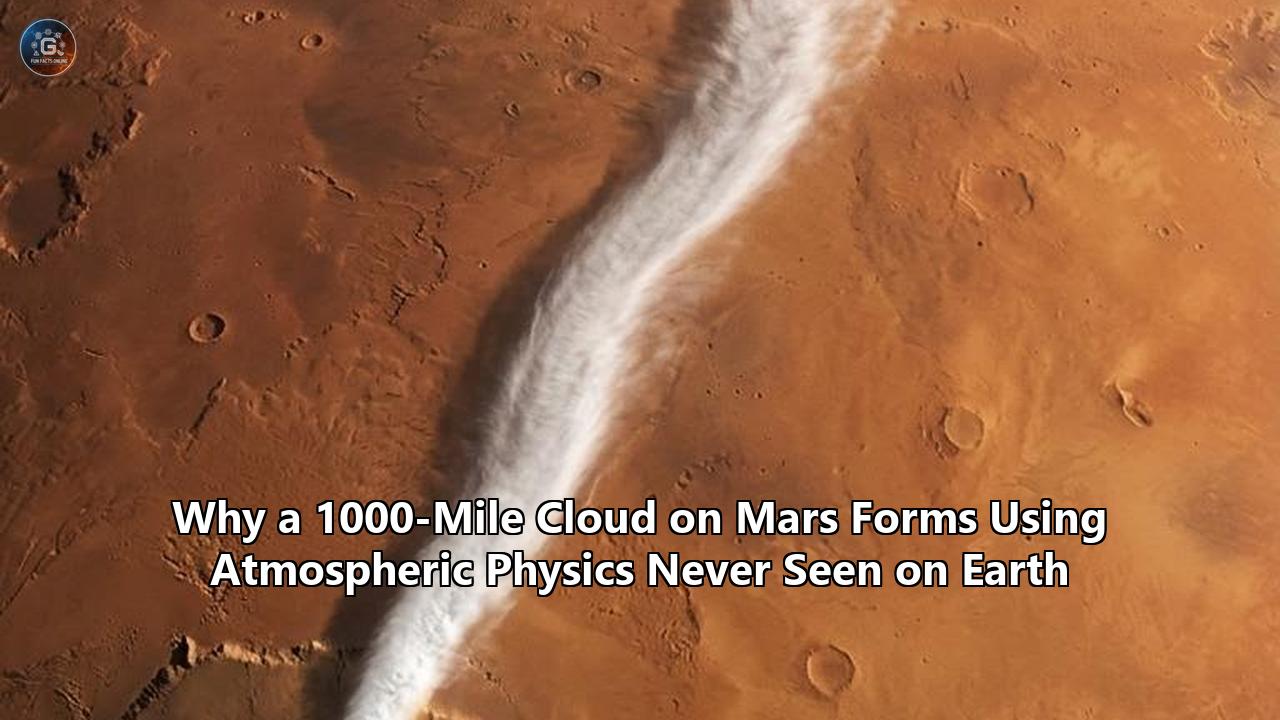
High above the rusty plains of the Martian southern hemisphere, a ribbon of bright white water ice stretches more than 1,100 miles across the sky before vanishing entirely by midday. For years, this phantom structure—known to planetary scientists as the Arsia Mons Elongated Cloud (AMEC)—has puzzled researchers by defying the established rules of atmospheric dynamics. Now, an international research team has demonstrated that the cloud forms through a physical mechanism never before observed in any planetary atmosphere: homogeneous nucleation of water vapor, occurring in an environment so depleted of seeds that moisture must freeze directly out of thin air.
The study, published in Nature Geoscience by atmospheric physicists from Sorbonne Université, France's National Centre for Scientific Research (CNRS), and the University of the Basque Country (UPV/EHU), confirms that this massive plume relies on extreme non-equilibrium thermodynamics. Led by Dr. Jorge Hernández-Bernal, the team used atmospheric data gathered by the European Space Agency’s (ESA) Mars Express spacecraft alongside high-resolution mesoscale climate modeling. Their results prove that the cloud expands across one-twelfth of Mars' circumference without relying on airborne mineral dust to catalyze the condensation process.
The revelation directly challenges foundational assumptions regarding Mars cloud formation by proving that water vapor can freeze spontaneously under natural planetary conditions. On Earth, every cloud, fog bank, and snowflake requires an aerosol nucleus—a speck of sea salt, desert dust, pollen, or industrial soot—to trigger the phase change from vapor to liquid or ice. In the upper atmosphere above Arsia Mons, Mars bypasses this requirement completely.
The findings fundamentally reshape how atmospheric scientists construct global climate models for the Red Planet, force meteorologists to re-evaluate how water escapes from Mars into interplanetary space, and provide an unexpected observational baseline for interpreting the atmospheres of distant exoplanets.
Anatomy of an 1,800-Kilometer Phantom
The Arsia Mons Elongated Cloud is the single longest orographic cloud yet discovered anywhere in the solar system. Originating along the western flanks of Arsia Mons—a massive, extinct shield volcano towering 20 kilometers (12.4 miles) above the Martian datum, more than twice the height of Mount Everest—the cloud follows an exacting, mechanical diurnal schedule.
Every Martian year during the southern spring and summer solstice (a seasonal window spanning solar longitudes $L_s = 220^\circ$ to $320^\circ$), the feature appears at dawn. At approximately 05:30 local solar time, a localized cloud "head" measuring roughly 120 kilometers in diameter condenses over the volcano's leeward, western slope. Over the next two and a half to three hours, the formation undergoes a violent expansion. Propelled by high-altitude winds, an extraordinarily narrow, elongated tail shoots westward at velocities ranging between 130 and 170 meters per second (roughly 290 to 380 miles per hour).
By mid-morning, the tail stretches between 1,600 and 1,800 kilometers (1,000 to 1,120 miles) across the volcanic plains of Daedalia Planum. It hovers at altitudes between 40 and 45 kilometers above the surface, hanging within the rarefied Martian middle atmosphere where ambient surface pressures hover below a few tens of pascals. Yet, almost as soon as it reaches its maximum spatial extent, the entire cloud disintegrates. As solar radiation heats the atmospheric column toward Martian midday, the water ice rapidly sublimates back into an invisible gaseous state, leaving no visual trace until the following sunrise.
This cycle repeats daily for an uninterrupted window of roughly 80 to 100 Martian sols. Despite its plume-like appearance stretching away from a volcanic caldera, instruments confirm the feature is entirely non-volcanic. Arsia Mons has been geologically dormant for millions of years; the structure is purely meteorological.
Capturing the phenomenon required unusual orbital mechanics. Most scientific satellites orbiting Mars, such as NASA’s Mars Reconnaissance Orbiter (MRO), operate in sun-synchronous orbits configured to pass overhead in the mid-afternoon (around 14:00 to 15:00 local time) to maximize solar illumination for optical cameras and mineralogical sensors. Because AMEC completely evaporates before midday, these orbiters flew over empty skies for years, capturing only rare peripheral glimpses.
The cloud was systematically cataloged thanks to the Visual Monitoring Camera (VMC) aboard ESA’s Mars Express. Originally designed as a low-resolution engineering camera to confirm the deployment of the ill-fated Beagle 2 lander in 2003, the VMC was later reactivated as a wide-field scientific sensor. Because Mars Express travels along an eccentric, highly elliptical orbit, the spacecraft regularly sweeps far away from the planet, granting the VMC a wide-angle field of view that can observe the dawn terminator across entire hemispheres at times of day other orbiters miss entirely.
The Physics of Homogeneous Nucleation
To explain how a water-ice structure could grow to 1,800 kilometers in three hours in an atmosphere with less than 1 percent of Earth's air density, researchers spent years testing traditional orographic lift models. Every conventional simulation failed. Standard models produced stunted clouds that extended barely a few dozen miles before stalling, unable to explain how ice crystals could nucleate and remain suspended in a high-speed, westward-surging atmospheric jet.
Understanding Mars cloud formation has historically relied on the assumption that ubiquitous atmospheric dust grains serve as nucleation seeds. In atmospheric physics, this is known as heterogeneous nucleation. In this regime, water molecules transition from vapor to a condensed phase by collecting on the surface of pre-existing solid particles. These foreign surfaces substantially lower the thermodynamic energy barrier—specifically the Gibbs free energy required to construct a critical cluster radius—enabling condensation at relatively modest levels of supersaturation. On Earth, heterogeneous nucleation is the rule. Without aerosols acting as cloud condensation nuclei (CCN) or ice-nucleating particles (INPs), clouds could not form in our troposphere.
In contrast, homogeneous nucleation occurs when molecules of water vapor bind directly to one another without an underlying substrate. Under standard terrestrial atmospheric conditions, homogeneous nucleation of vapor directly into ice deposition is practically impossible. Because water molecules must spontaneously assemble into an orderly crystalline lattice through random thermal collisions, the energy barrier is exceptionally high. Overcoming the surface tension of a nascent sub-nanometer ice embryo requires extreme saturation ratios ($S_i \gg 1$), where local relative humidity with respect to ice exceeds several hundred or even thousands of percent.
On Earth, an atmosphere approaching such hyper-supersaturated conditions will invariably encounter an aerosol particle long before reaching the homogeneous deposition threshold, instantly collapsing the excess vapor through heterogeneous freezing. Terrestrial clouds do experience homogeneous freezing, but only when liquid cloud droplets, already formed on dust or aerosols, are supercooled below −38 degrees Celsius (−36.4 degrees Fahrenheit). Spontaneous condensation directly from vapor to ice remains an abstraction relegated to specialized aerosol chambers.
“To create the AMEC in our modelling, we found that we needed to include some exotic physics… physics that, while included in textbooks, is treated as theoretical and usually thought not to happen in nature,” explained lead author Dr. Jorge Hernández-Bernal in presenting the Sorbonne-CNRS study. “It certainly hasn't been seen in action before. Water vapor turns directly into icy cloud particles without any middle step. It's akin to droplets of condensation appearing in the middle of a room, rather than on a window”.
The team identified the exact chain of dynamic events driving this process:
- Topographic Barrier Interaction: Strong eastward-to-westward winds sweeping across the Tharsis volcanic plateau strike the enormous physical barrier of Arsia Mons.
- Deep Orographic Gravity Waves: The air mass cannot travel around the volcano, which is wider than the state of Hawaii; it is forced directly upward along the windward slope, generating massive stationary lee waves (buoyancy-driven gravity waves) that breach the middle atmosphere.
- Violent Adiabatic Cooling: As the air parcel shoots upward by tens of kilometers in roughly 10 to 15 minutes, the abrupt drop in ambient atmospheric pressure causes catastrophic adiabatic expansion. The temperature within the rising thermal parcel plunges by more than 30 Kelvin (54 degrees Fahrenheit) in less than a quarter of an hour.
- Dust-Free Clean Air: Because the parcel is launched to an altitude of 45 kilometers at dawn, it reaches an atmospheric zone that is starved of coarse mineral dust particles. At this altitude and time of day, the dust-lifting thermal boundary layer has not yet developed.
- Hyper-Supersaturation and Spontaneous Freezing: Because there are virtually no dust grains to act as condensation seeds, the water vapor cannot freeze heterogeneously. Instead, the plunging temperature causes the ice saturation ratio to spike upward, driving the relative humidity past the critical homogeneous nucleation barrier. The water vapor freezes spontaneously, forming an ultra-fine aerosol mist of pure water ice crystals numbering in the trillions.
When the French and Spanish researchers integrated this homogeneous nucleation pathway into the Laboratoire de Météorologie Dynamique (LMD) mesoscale meteorological model, the simulation changed instantly. The artificial cloud tail expanded outward across the digital landscape, perfectly replicating the observed 1,800-kilometer length, the 45-kilometer altitude, the dawn-triggered expansion rate, and the rapid midday evaporation curve.
Orographic Gravity Wave Dynamics Over Arsia Mons
========================================================================
Altitude
  ^
  |      [ Middle Atmosphere: ~45 km Altitude ]
  |      - Ultra-low dust concentration
  |      - Rapid adiabatic drop: ΔT ~ -30 K in 10 minutes
  |      - Ice saturation threshold crossed (Si >> Critical Barrier)
  |      - HOMOGENEOUS NUCLEATION OCCURS: Pure ice mist forms spontaneously
  |                                        \
  |                                         \---> Fast Westward Tail Expansion
  |                                               (130 - 170 m/s; up to 1,800 km)
  |                      ^
  |                     / \  Gravity Wave Crest
  |                    /   \
  |                   /     \
  |    Upward Ascent /       \
  |   (10-15 mins)  /
  |                /  Caldera (20 km)
  |               /|\
  |              / | \
  |             /  |  \
  |            /   |   \  Arsia Mons Volcano
  |           /    |    \
  |__________/_____|_____\__________________________________________> Distance
Who Is Affected by the Discovery
The verification of this process carries immediate consequences across multiple scientific domains, altering operational strategies, theoretical foundations, and future mission profiles.
1. Planetary Meteorologists and Climate Modelers
Atmospheric scientists responsible for developing global circulation models (GCMs) for Mars must fundamentally alter their cloud microphysics algorithms. Previously, all standard models developed by institutions like NASA Ames, the European Mars Climate Database (MCD) consortium, and the Max Planck Institute operated under the core assumption that Mars cloud formation is universally heterogeneous.
By treating dust abundance as an absolute prerequisite for cloud condensation, these models underpredicted high-altitude water ice concentrations and miscalculated planetary albedo. Teams updating the Mars Planetary Climate Model (PCM) at the Institut Pierre-Simon Laplace (IPSL) are already rewriting their microphysical parameters to dynamically trigger homogeneous nucleation when local supersaturation exceeds the critical barrier, fundamentally revising simulated cloud distributions across the Martian equatorial zone.
2. Spacecraft Trajectory and Mission Planners
Engineers designing Entry, Descent, and Landing (EDL) profiles, as well as high-altitude orbital aerobraking maneuvers, rely heavily on atmospheric density predictions. Aerobraking—a maneuver where a spacecraft skims through the upper atmosphere to reduce orbital velocity using aerodynamic drag—demands precise models of atmospheric density.
The presence of an 1,800-kilometer-long, rapidly moving ice formation driven by deep gravity waves introduces localized, high-amplitude density perturbations at altitudes between 40 and 50 kilometers. Spacecraft traversing the Tharsis region during the southern solstice will encounter variations in atmospheric density, aerodynamic drag, and localized thermal profiles that unadjusted models failed to forecast. Future robotic orbiters and crewed aerocapture trajectories passing through low-density Martian horizons must calculate for these sudden wave-induced changes.
3. Terrestrial Cloud Physicists
Meteorologists focused on Earth’s atmosphere now possess their first natural, real-world case study of vapor-phase homogeneous nucleation. While atmospheric physicists have explored the mathematical frameworks of homogeneous deposition in cryo-vacuum chambers on Earth, its relevance to open-air planetary science was historically dismissed as theoretical speculation.
Terrestrial scientists studying Polar Mesospheric Clouds (PMCs)—also known as noctilucent clouds, which form in Earth's extreme upper mesosphere near 80 kilometers altitude—face similar questions regarding ice formation in environments with trace nucleation seeds. The data captured at Arsia Mons provides empirical boundary conditions for non-equilibrium microphysics, helping terrestrial researchers refine nucleation kinetics in low-temperature, ultra-clean environments.
What Changes in Atmospheric and Climate Science
The confirmation that homogeneous nucleation occurs in nature alters long-standing scientific paradigms, replacing foundational assumptions with newly verified dynamics.
| Research Domain | Previous Scientific Paradigm | New Post-Discovery Paradigm |
|---|---|---|
| Nucleation Mechanics | Water-ice cloud formation in planetary atmospheres requires pre-existing aerosols (heterogeneous nucleation). | In hyper-supersaturated, dust-free updrafts, water vapor nucleates homogeneously, bypassing the need for seed particles. |
| Martian Water Cycle | Water vapor remains mostly trapped in the lower planetary boundary layer, except during global dust storms. | Deep topographic gravity waves act as atmospheric elevators, propelling moisture to 45 km altitude on regular daily cycles. |
| Mars Cloud Formation Models | Clouds form solely along paths mapped to background aerosol dust distribution and thermal thresholds. | Localized kinetic dynamics can initiate spontaneous, rapid cloud generation independent of ambient dust levels. |
| Upper Atmospheric Loss | Water transport to the upper atmosphere is largely seasonal and regulated by dust-driven warming. | Non-equilibrium wave action provides a direct conduit for morning water injection into the middle atmosphere during southern summer. |
| Exoplanet Characterization | Transmission spectra indicating cloudy atmospheres assume the mandatory presence of photochemical hazes or mineral ash. | Planetary atmospheres can generate extensive, opaque cloud decks spontaneously through purely dynamic orographic mechanisms. |
The discovery fundamentally alters how atmospheric scientists model Mars cloud formation during extreme seasonal cycles. By confirming that the atmosphere can bypass the requirement for dust seeds, researchers can resolve long-standing discrepancies between satellite observations and climate models.
Short-Term Consequences: Archival Data and Spacecraft Observations
Over the next 12 to 36 months, the impact of the Nature Geoscience paper will ripple through planetary science archives, prompting a sweeping re-evaluation of observational datasets collected over the past two decades.
       CHRONOLOGY OF DISCOVERY & MODEL ADVANCEMENT
========================================================================
 2003          Mars Express launched by ESA with the Visual Monitoring
               Camera (VMC) onboard as an engineering sensor.
 2018          Mars Express VMC systematically captures the recurrrent,
               1,800-kilometer-long Arsia Mons Elongated Cloud (AMEC).
 2021-2022     Observational analysis published by Hernández-Bernal et al.;
               standard mesoscale models fail to reproduce tail length.
 2026 (Oct)    Study in Nature Geoscience confirms homogeneous nucleation
               as the driving physics behind the AMEC.
 2027-2028     Global Climate Models updated; archival MRO, TGO, and
 (Projected)   MAVEN datasets recalibrated for hyper-supersaturation.
Re-Evaluating Mars Express, MRO, and TGO Datasets
Space agencies maintain decades of unanalyzed or partially cataloged atmospheric sounding data. Scientists are already planning re-analyses of data from:
- The Mars Climate Sounder (MCS) aboard NASA's MRO, which measures vertical profiles of temperature, dust, and water-ice clouds. MCS data contains high-altitude radiance profiles that were previously flagged as anomalous or smoothed out by inversion algorithms operating under standard heterogeneous assumptions.
- The ExoMars Trace Gas Orbiter (TGO), operated by ESA and Roscosmos. TGO's NOMAD (Nadir and Occultation for MArs Discovery) and ACS (Atmospheric Chemistry Suite) instruments specialize in solar occultation measurements, tracking trace atmospheric gases and aerosol vertical structures with high sensitivity. Occultation profiles around the Tharsis volcanoes will be re-screened to pinpoint local supersaturation ratios and trace vapor anomalies during early morning hours.
- The SPICAM and OMEGA spectrometers on Mars Express, providing historical baselines that can trace the frequency and optical thickness of the AMEC across more than ten consecutive Martian years.
The Volcano Asymmetry Puzzle
A critical mystery brought into sharp relief by this breakthrough is the regional uniqueness of Arsia Mons. The Tharsis volcanic plateau is home to three massive shield volcanoes arrayed in a neat line—Arsia Mons, Pavonis Mons, and Ascraeus Mons—flanked to the northwest by the colossal Olympus Mons. All four mountains reach comparable altitudes and possess similar broad caldera structures. Yet, during the southern summer solstice, neither Pavonis Mons nor Ascraeus Mons produces a persistent 1,000-mile-long cloud tail.
Now that the specific microphysical trigger has been identified, scientists can investigate the exact atmospheric asymmetry at play. Initial modeling suggests the answer lies in a convergence of seasonal topography and prevailing wind shear. Arsia Mons sits closest to the southern Hadley cell circulation during the southern solstice, positioning its southern and western flanks directly inside the high-velocity return flow of the Martian global overturning circulation.
Ascraeus and Pavonis Mons, situated further north near the equator, sit outside this focused jet and do not experience the same updraft velocities or steep temperature drops. By applying the homogeneous nucleation threshold to regional topography, atmospheric physicists can pinpoint the micro-climatic factors that make Arsia Mons completely unique.
Laboratory Chamber Validation
The findings are driving experimental physics proposals on Earth. Facilities like the AIDA (Aerosol Interactions and Dynamics in the Atmosphere) environmental chamber at the Karlsruhe Institute of Technology in Germany are uniquely equipped to test these parameters. AIDA can recreate the low temperatures (below 150 Kelvin), ultra-low pressures (sub-millibar), and extreme water-ice supersaturation levels characteristic of the Martian middle atmosphere.
Physicists will attempt to deliberately replicate the homogeneous vapor-to-ice nucleation threshold in a vacuum chamber, experimentally measuring the critical saturation ratio required to prompt ice deposition in an aerosol-free chamber. These experiments will validate the empirical mathematical constants utilized in the Sorbonne team's mesoscale model.
Long-Term Consequences: Mars’ Water Evolution, Habitability, and Exoplanetary Weather
Beyond near-term modeling adjustments, the realization that an exotic meteorological process operates over Arsia Mons carries significant long-term implications for our understanding of planetary evolution and our search for life beyond Earth.
The Atmospheric Elevator and Water Loss to Space
One of the most consequential long-term implications concerns how Mars lost its ancient oceans. Billions of years ago, Mars was a warmer, wetter planet with abundant surface water. Today, it is an arid desert that has lost the majority of its volatile inventory to space through atmospheric escape.
The dominant escape pathway involves water molecules ascending to the upper atmosphere, where intense solar ultraviolet radiation breaks them apart through photolysis into hydrogen and oxygen:
$$\text{H}_2\text{O} + h\nu \longrightarrow \text{H} + \text{OH}$$
The light hydrogen atoms, having low atomic mass, easily overcome the planet's weak gravitational pull and bleed away into interplanetary space.
Historically, planetary scientists believed that water vapor was strictly confined to lower altitudes by a "cold trap"—a freezing atmospheric layer that condenses rising vapor into clouds before it can reach the upper atmosphere. Under this model, water was thought to breach the cold trap primarily during global planet-encircling dust storms, where solar heating of dust particles warms the entire atmosphere and lofts moisture to altitudes above 60 kilometers.
The mechanics powering the Arsia Mons Elongated Cloud reveal an alternative, non-catastrophic bypass mechanism. The powerful orographic gravity wave over the volcano operates like an atmospheric elevator. It bypasses lower-altitude boundaries and repeatedly injects localized bursts of water vapor and ice crystals directly into the middle and upper atmosphere at 45 to 50 kilometers.
NASA’s MAVEN (Mars Atmosphere and Volatile EvolutioN) spacecraft has repeatedly observed sudden, episodic spikes in the rate of hydrogen escaping from the Martian exosphere during the southern summer solstice—spikes that could not be fully explained by dust storms alone. The daily, 80-day cycle of the AMEC provides the missing link: a recurring mechanism that punches through the cold trap and feeds volatile water ice into the photolysis pipeline year after year.
Martian Water Escape Mechanism
========================================================================
Interplanetary Space
  ^
  |   [ EXOSPHERE / ESCAPE REGIME ]
  |   Light Hydrogen (H) exceeds escape velocity ---> LOSS TO SPACE
  |   ^
  |   | Photolysis: H2O + UV (hν) ---> H + OH
  |
  |   [ UPPER ATMOSPHERE: 50+ km ]
  |   Sublimation & solar UV exposure
  |   ^
  |   |
  |   [ AMEC PLUME: 40 - 45 km ]
  |   Pure water-ice crystals nucleate homogeneously and drift westward
  |   ^
  |   |
  |   [ THE ATMOSPHERIC ELEVATOR ]
  |   Deep gravity waves force moist surface air upward across Arsia Mons
  |   ^
  |   |
  |   [ LOWER TROPOSPHERE: Surface to 10 km ]
  |   Moist surface air reservoir during southern solstice
========================================================================
Implications for Exoplanetary Atmospheric Spectra
As astronomical observatories like the James Webb Space Telescope (JWST) and upcoming ground-based facilities like the Extremely Large Telescope (ELT) characterize the transmission spectra of exoplanets, interpreting cloud formation has emerged as one of their greatest challenges. When astronomers observe exoplanetary atmospheres, high-altitude clouds often act as an observational mask, flattening transmission spectra and obscuring the chemical signatures of underlying gases.
In almost every theoretical framework applied to exoplanets, modelers assume that cloud formation requires nucleation seeds—such as photochemical hazes, soot, or condensable mineral dust grains. If a target planet's upper atmosphere lacks these aerosol species, astronomers typically assume thick orographic cloud decks cannot form.
The demonstration of homogeneous nucleation on Mars dismantles this assumption. The insights gained from this extreme regime of Mars cloud formation provide a crucial baseline for interpreting transmission spectra from exoplanets, demonstrating that tidally locked worlds, super-Earths, or sub-Neptunes with high topographic relief or steep atmospheric gravity waves can generate dense, opaque cloud decks spontaneously through pure vapor phase transitions, even in the cleanest upper atmospheres.
Strategic Implications for Human Exploration
The presence of intense gravity waves, rapid microphysical transitions, and high-altitude water ice structures over the Tharsis region carries direct implications for human mission architectures.
Arsia Mons and its surrounding volcanic plains have frequently been evaluated as prospective candidate sites for future exploration due to the presence of deep volcanic lava tubes, which could offer natural radiation shielding for subsurface habitats. However, the dynamics fueling the AMEC indicate that the regional atmosphere undergoes severe structural fluctuations every morning during the southern summer.
Any lander, human ascent vehicle (HAV), or surface-to-orbit shuttle attempting to launch or deorbit through this sector must withstand:
- Violent vertical wind shear generated by mountain lee waves that penetrate through the lower and middle atmosphere.
- Sudden, localized spikes in atmospheric density and ice crystallization that could abrade thermal protection systems or induce high aerodynamic jitter.
- Early morning solar obscuration, where the massive 1,100-mile cloud tail reduces incoming solar irradiance across Daedalia Planum, impacting surface solar power generation arrays situated thousands of kilometers downwind of the volcanic caldera.
Unresolved Questions and the Path Ahead
While Hernández-Bernal and his colleagues have solved the primary thermodynamic mystery behind the cloud's origin, several fundamental questions remain unanswered.
One outstanding puzzle centers on the precise microstructural morphology of the ice crystals themselves. Because the ice forms homogeneously in a low-temperature, low-pressure carbon dioxide environment, it is unclear whether the resulting crystals adopt standard hexagonal plates, hollow prisms, or metastable cubic ice phases ($I_c$). Cubic ice, which is structurally disordered and historically difficult to preserve on Earth, is theorized to nucleate preferentially during rapid homogeneous vapor deposition at temperatures below 190 Kelvin. If the AMEC is composed primarily of cubic water ice, its optical scattering properties and atmospheric radiative impact would differ significantly from standard terrestrial cirrus clouds.
Another active avenue of research focuses on electrostatic charging within the cloud tail. On Earth, vigorous phase changes and particle collisions within volcanic eruption columns and thunderstorm updrafts generate powerful triboelectric charging and lightning discharges. Whether the spontaneous, rapid freezing of trillions of water ice crystals within a high-speed Martian gravity wave produces localized electrostatic charge fields remains unknown. If present, such fields could alter the microphysical aggregation of ice grains and present uncharacterized electromagnetic hazards for exploratory hardware.
To resolve these questions, scientists are turning their attention to upcoming missions. The trace atmospheric monitoring suites aboard ESA’s ExoMars Trace Gas Orbiter continue to refine their targeted pointing algorithms, seeking opportunities to gaze directly through the limb of the AMEC tail during its 07:00 local time peak. Furthermore, proposed next-generation missions—such as sub-orbital atmospheric probes and advanced orbital imaging systems designed to measure aerosol polarization—will be tasked with analyzing the cloud's dawn evolution directly.
The Arsia Mons Elongated Cloud stands as proof that planetary meteorology cannot be understood solely through the lens of terrestrial weather. In the cold, clean sky above an extinct Martian volcano, nature bypasses the rules that govern the clouds of Earth, demonstrating that when atmospheric dynamics are pushed to their extremes, the sky itself can freeze out of nothing.
Reference:
- https://astrobiology.com/2026/10/05/homogeneous-nucleation-of-water-vapor-evidenced-by-elongated-clouds-on-mars/
- https://www.sci.news/space/arsia-mons-elongated-cloud-formation-15115.html
- https://thedebrief.org/a-1100-mile-long-cloud-on-mars-is-defying-physics-this-unexpected-discovery-may-reveal-why/
- https://arxiv.org/pdf/2410.03025
- https://gizmodo.com/a-freaky-elongated-cloud-has-reappeared-on-mars-1844544507
- https://www.livescience.com/space/mars/1-000-mile-long-cloud-that-forms-and-vanishes-on-mars-every-day-obeys-exotic-physics-never-seen-on-earth
- https://www.sci.news/space/arsia-mons-elongated-cloud-08697.html
- https://www.facebook.com/ScienceEnthusiast/posts/scientists-studying-mars-have-uncovered-the-secret-behind-a-massive-cloud-that-f/122279659502258354/
- https://www.iflscience.com/weird-physics-causes-this-lonely-martian-cloud-to-reappear-and-grow-longer-than-california-every-day-84893
- https://meetingorganizer.copernicus.org/EGU21/EGU21-7918.html