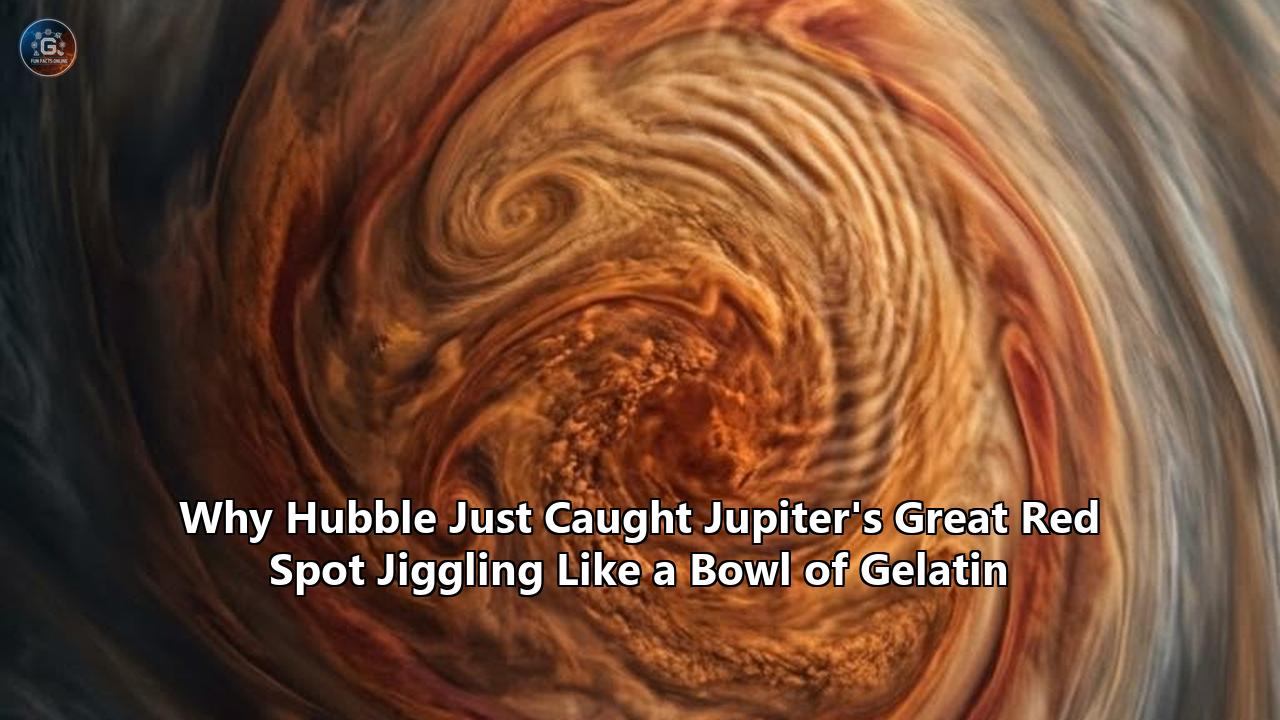
Astronomers pointed the Hubble Space Telescope at Jupiter for 90 consecutive days between December 2023 and March 2024 to track its most recognizable landmark with unprecedented temporal resolution. When the team stitched the data into a high-speed time-lapse, the solar system’s most massive storm did not present as the rigid, slowly drifting marble that planetary textbooks have depicted for over a century. Instead, the vortex was pulsing, stretching, and squishing in a rhythmic 90-day cycle, behaving like a massive bowl of gelatin subjected to an invisible vibrator.
The discovery, detailed in The Planetary Science Journal by lead author Amy Simon of NASA’s Goddard Space Flight Center and her collaborators, provides the first direct confirmation that the storm's physical dimensions expand and contract in tandem with changes in its orbital velocity.
"While we knew its motion varies slightly in its longitude, we didn't expect to see the size oscillate. As far as we know, it's not been identified before," Simon said following the publication. "This is really the first time we've had the proper imaging cadence of the GRS. With Hubble's high resolution we can say that the GRS is definitively squeezing in and out at the same time as it moves faster and slower. That was very unexpected, and at present there are no hydrodynamic explanations."
For planetary meteorologists, the finding disrupts basic assumptions regarding the structural equilibrium of giant vortices. For decades, researchers treated the storm as a largely stable, self-contained fluid dynamic engine bounded by violent atmospheric currents. The realization that this behemoth flexes like a squeezed rubber ball exposes significant gaps in current atmospheric modeling, forcing physicists to reconsider how energy, momentum, and internal pressure distribute across Jovian atmospheres and beyond.
Anatomy of the 90-Day Oscillation
To understand why a planetary storm would pulsate like gelatin, one must look at the precision imaging that revealed the motion. Historically, the Hubble Space Telescope has monitored Jupiter through the Outer Planet Atmospheres Legacy (OPAL) program. While OPAL captures global maps of the outer gas giants once per year, an annual snapshot provides only a freeze-frame. It documents long-term trends—such as the gradual shrinkage of the storm—but completely misses rapid dynamical fluctuations.
The campaign conducted by Simon’s team, which included Michael H. Wong and Phillip S. Marcus of the University of California at Berkeley alongside Patrick G. J. Irwin of Oxford University, took a radically different observational approach. Operating Hubble’s Wide Field Camera 3 (WFC3), the team captured high-cadence, multi-wavelength exposures across eight separate epochs over a single three-month window. During this span, Jupiter’s distance from Earth shifted between 391 million and 512 million miles, yet the telescope resolved atmospheric structures down to several tens of kilometers across the cloud tops.
               North Jet Stream: 20°S (Winds blowing West at ~400 km/h)
   ─────────────────────────────────────────────────────────────────────────►
        ▲
        │ Compression Phase: Storm accelerates westward, narrows north-south
   ─────┴───────────────────────────────────────────────────────────────────
      (   Core dim in UV   )  ──► High-speed drift rate
   ─────────────────────────────────────────────────────────────────────────
        │ Swelling Phase: Storm decelerates westward, bulges across its waist
        ▼     ( Core flares bright in UV; upper haze thins out )
   ─────────────────────────────────────────────────────────────────────────►
               South Jet Stream: 26°S (Winds blowing East at ~400 km/h)
The researchers systematically measured five distinct variables: longitudinal position, semi-major and semi-minor axes (width and height), cloud core brightness across ultraviolet and visible spectra, color variations, and absolute vorticity.
The measurements revealed three synchronized behaviors:
- A Rhythmic Longitudinal Drift: The storm does not coast around Jupiter at an unyielding rate. It constantly accelerates and decelerates along its westward path relative to the interior rotation rate of the planet, completing a back-and-forth speed cycle every 90 days.
- Dimensional Squeezing and Stretching: As the storm speeds up along its longitudinal track, its physical boundary compresses laterally and elongates along its east-west axis. Conversely, when the vortex slows down, it bulges north-to-south, widening across its waist. The storm effectively breathes in and out, trading aspect ratio for linear velocity.
- Synchronized Core Ultraviolet Brightening: When the vortex expands to its maximum north-south width—at the precise moment its longitudinal speed drops to its lowest point—the central core turns intensely bright in ultraviolet wavelengths.
The photometric shift indicates that the storm's vertical cloud column is actively altering its composition or structure during the deformation phase. In ultraviolet light, darker regions signify deep concentrations of photochemical hazes absorbing incoming solar radiation. When the core brightens, it indicates that high-altitude hazes are either being displaced by shifting wind fields or thinned by localized changes in vertical convection, letting reflected light escape more freely.
Trapped in a Planetary Vice: The Jet Stream Sandwich
To understand why the storm expands and contracts rather than wandering freely, one must examine the extreme aerodynamic environment that locks it into place. The Jupiter Great Red Spot is an anticyclone: a colossal high-pressure cell rotating counterclockwise in the planet’s southern hemisphere. With outer winds screaming along its perimeter at up to 400 miles per hour, it dwarfs terrestrial hurricanes, which are low-pressure cyclonic systems.
Earth's hurricanes derive power from warm ocean waters and rapidly disintegrate once they make landfall or drift into unfavorable wind shear. Jupiter, conversely, possesses no solid surface. It is an unbroken expanse of hydrogen and helium fluid. Without continents to introduce ground friction, Jovian vortices can persist for centuries.
Yet the storm is not free to roam. It sits stranded at approximately 22 degrees south latitude, pinned directly between two opposing atmospheric superhighways:
- The Northern Perimeter Jet: A ferocious retrograde wind stream centered near 20 degrees south that races westward relative to the planet's rotation.
- The Southern Perimeter Jet: A prograde wind stream centered near 26 degrees south that blasts eastward at comparable velocities.
                     ANTICYCLONIC SHEAR FORCES

               Westward Zonal Flow (Northern Edge)
               ◄───────────────────────────────────
                           ┌───────────┐
                           │   ┌───┐   │
                ↺          │   │ H │   │          ↺
             Rotation      │   └───┘   │       Rotation
                           │           │
                           └───────────┘
               ───────────────────────────────────►
               Eastward Zonal Flow (Southern Edge)
These opposing jet streams act as continuous mechanical shears. The northern jet pushes the upper rim of the storm to the west, while the southern jet pushes the lower rim to the east, supplying the constant rotational torque that maintains the storm’s counterclockwise spin.
"As it accelerates and decelerates, the GRS is pushing against the windy jet streams to the north and south of it," explained co-investigator Mike Wong. "It's similar to a sandwich where the slices of bread are forced to bulge out when there's too much filling in the middle."
Wong pointed out a key contrast between Jupiter and the outer gas giant Neptune. Voyager 2 and subsequent Hubble observations revealed that Neptune’s Great Dark Spots also exhibit a 90-day oscillation in drift velocity. But Neptune’s atmospheric jets lack the rigid shear barriers found on Jupiter. As a consequence, Neptune’s dark storms slosh erratically across latitude lines, tilting on their sides and eventually drifting into equatorial shear zones where they tear apart and vanish within years.
The Jupiter Great Red Spot has nowhere to go. The northern and southern jet streams create a rigid boundary corridor. The anticyclone cannot drift north without fighting the westward jet, nor can it drift south without running into the eastward jet. Latitudinally trapped, any change in internal velocity or pressure cannot be dissipated by drifting across the planet. The kinetic energy is forced inward, translating into mechanical deformation—the visible jiggling detected by Hubble.
The Hydrodynamic Paradox: Why Classic Vortex Physics Breaks Down
The unexpected nature of this oscillation highlights limitations in theoretical fluid dynamics. In the physics of idealized two-dimensional fluids, the standard mathematical construct used to describe an elliptical vortex embedded in a shear flow is the Kida vortex model, formulated by Japanese physicist Hiroshi Kida in 1981.
Under Kida’s equations, an elliptical patch of uniform vorticity surrounded by constant background shear will maintain its integrity through a delicate balance of internal pressure and external wind strain. If such a vortex is slightly perturbed, the classic equations predict that it can execute periodic oscillations in its aspect ratio and its orientation angle relative to the background flow.
Astronomers have long attempted to model the red storm using adapted Kida formulations. But the new Hubble data reveals significant deviations from pure Kida behavior. In a classical Kida vortex, the changes in shape and orientation follow smooth, reversible phase trajectories governed strictly by the vorticity distribution of the surrounding shear.
The Jovian reality is far messier:
- The storm's internal wind speeds, which Simon’s team mapped across the vortex interior, varied by roughly 20 meters per second (over 44 mph) over the 90-day baseline.
- Unlike the smooth, sinusoidal oscillations seen in the storm’s drift velocity and geometric area, these interior velocity spikes were non-sinusoidal and localized.
- The phase relation between the expansion of the vortex and its longitudinal drift does not align with simple passive fluid models. When the storm expands, it appears to actively resist the ambient flow, transferring momentum into the bounding jets before rebounding.
The primary reason simple fluid models struggle is that Jupiter is not a two-dimensional sheet of fluid. It possesses profound vertical architecture.
                     VERTICAL VORTEX ARCHITECTURE

Altitude  ▲
          │   [Upper Photochemical Haze Layer] ◄── UV Absorption Variations
0 km      ┼── Cloud Tops: Ammonia Ice Crystals (Visible Red Oval)
          │   ▲
          │   │ Baroclinic Upwelling & Downwelling (Energy Exchange)
-50 km    ┼── Water & Ammonia Cloud Base (Moist Convective Storms)
          │   │
          │   ▼
-300 km   ┼── Deep Roots: Juno Microwave Radiometer Detections
          │   (Vortex extends far below sunlight penetration)
-500 km   ┴── Thermal Plumes & Interior Convection Reservoir
Depth     ▼
Data from NASA’s Juno spacecraft, which has been orbiting Jupiter since 2016, proved that the storm is not a thin, skin-deep meteorological feature. By deploying its Microwave Radiometer (MWR) and analyzing subtle gravitational anomalies during ultra-close perijove passes, Juno determined that the vortex extends anywhere from 300 to 500 kilometers deep into the Jovian interior.
This deep root means the storm anchors far below the level where sunlight deposits thermal energy. It sits astride a transition zone characterized by baroclinic instability—a state where surfaces of constant pressure intersect surfaces of constant density. The storm is constantly driven from below by convective internal heat rising from Jupiter’s core, and bounded above by radiative cooling to space.
When the vortex expands horizontally, it must conserve potential vorticity—a foundational quantity in geophysical fluid dynamics defined as:
$$PV = \frac{\zeta + f}{H}$$
Where:
- $\zeta$ is the relative vorticity (the local spin of the storm's winds),
- $f$ is the Coriolis parameter ($2\Omega\sin\phi$, determined by planetary rotation rate and latitude),
- $H$ is the effective vertical thickness of the vortex column.
Because the storm cannot move latitudinally, $f$ remains constant. If the horizontal footprint expands, conservation laws require that either the relative vorticity $\zeta$ must decrease (the storm spins slower), or the vertical depth $H$ must adjust.
Hubble’s detection of synchronous ultraviolet flaring suggests that the vertical column $H$ is directly flexing. The entire storm may be undergoing a peristaltic, three-dimensional breathing motion: compressing vertically as it expands horizontally, driving deep materials up or allowing upper atmospheric hazes to collapse downward. Standard two-dimensional hydrodynamic models cannot simulate this behavior, exposing a need for fully compressible, three-dimensional baroclinic vortex simulations.
From Giant to Midget: A Century of Shrinkage
The discovery of the 90-day wobble arrives during a historic identity crisis for the storm. The Jovian colossus has been undergoing an uninterrupted, century-long shrinking trend that shows no sign of abating.
Continuous telescopic records dating to the late 19th century paint a picture of a storm that once dwarfed its modern incarnation. In 1879, observations recorded the anticyclone’s major axis at over 40,000 kilometers across—wide enough to fit more than three planet Earths side by side. By the time the twin Voyager probes flew past Jupiter in 1979, the storm had shrunk to approximately 24,000 kilometers.
| Observation Era | Primary Platform | Approximate Width | Earth Equivalents | Aspect Ratio (Length-to-Height) |
|---|---|---|---|---|
| Late 1870s | Ground Telescopes | ~40,000 km | ~3.1 Earths | > 3.0 : 1 (Highly elongated) |
| 1979 | Voyager 1 & 2 | ~24,000 km | ~1.9 Earths | ~ 2.1 : 1 (Stretched oval) |
| 2014 | Hubble (OPAL Start) | ~16,500 km | ~1.3 Earths | ~ 1.5 : 1 (Transitional oval) |
| 2024–Present | Hubble WFC3 / Juno | ~14,750 km | ~1.1 Earths | ~ 1.3 : 1 (Approaching circular) |
Today, measurements show the major axis has fallen to just below 14,750 kilometers. It is now only roughly 1.1 times the diameter of Earth. Alongside this reduction in surface area, its geometry has transformed. Once an elongated ellipse resembling an oblong ribbon, the storm is becoming increasingly round.
Astronomers have long debated whether this shrinkage is a terminal death spiral or a natural transition toward a new equilibrium. Simon points out that the newly identified jiggle may hold the answer.
"Right now it's over-filling its latitude band relative to the wind field," Simon noted. "Once it shrinks inside that band the winds will really be holding it in place."
Because the vortex currently overfills the space between the retrograde and prograde jets, its outer edges scrape vigorously against the opposing wind fields. This dynamic creates continuous shear stress along the perimeter.
As the storm accelerates and decelerates, it pushes hard against the boundaries of the jet streams. The resulting friction may strip vorticity and energy from the vortex, shedding small atmospheric streamers and flakes. Planetary amateur astronomers have routinely photographed these "flaking" events over the past decade, capturing red filaments peeling away from the main oval and dissolving into adjacent belts.
Simon’s team hypothesizes that the 90-day oscillation is a structural reaction to this spatial constraint. The storm is attempting to occupy a channel that has grown too narrow for its bulk. If the storm continues shrinking until its north-to-south diameter drops completely inside the neutral shear boundary of the jet streams, the intense lateral scraping will abate. Once enclosed within that protective lane, the oscillation may dampen, allowing the vortex to stabilize into a smaller, circular, and enduring vortex.
Photochemistry and Chromophores: The Riddle of the Red Core
The rhythmic brightening of the vortex core in ultraviolet wavelengths connects this physical squeezing to complex atmospheric chemistry.
Jupiter's ambient atmosphere is predominantly composed of colorless molecular hydrogen and helium, threaded with trace volatiles: ammonia ($NH_3$), water vapor ($H_2O$), methane ($CH_4$), hydrogen sulfide ($H_2S$), and phosphine ($PH_3$). None of these compounds, in their pristine states, are red. The striking reddish-orange hue of the central oval remains one of planetary science’s enduring puzzles.
Laboratory experiments—most notably those conducted by Mark Loeffler and Reggie Hudson at NASA Goddard—demonstrate that when mixtures of ammonia and acetylene or ammonium hydrosulfide are bombarded with ultraviolet light at ultra-low temperatures, cosmic-ray and solar radiation trigger photochemical reactions. These processes yield complex, macromolecular organic polymers and sulfur-bearing complexes known collectively as chromophores.
                       THE CHROMOPHORE CYCLE

                 Solar Ultraviolet Photons (UV)
                             │   │   │
                             ▼   ▼   ▼
               ┌──────────────────────────────┐
               │  Upper Haze Layer (Aerosols) │
               │  Complex Organic Polymers    │
               └──────────────┬───────────────┘
                              │
               [Anticyclonic Upwelling & Downwelling]
                              │
               ┌──────────────▼───────────────┐
               │ Deep Volatiles Reservoir     │
               │ NH₃, PH₃, H₂S, Hydrocarbons  │
               └──────────────────────────────┘
The intensity of the storm’s coloration depends on an equilibrium between two opposing mechanisms:
- Upwelling and Production: The central updrafts of the anticyclone haul fresh, unreacted parent molecules (such as phosphine and ammonia ice crystals) out of the deep atmosphere up to the troposphere, where intense solar UV radiation cooks them into reddish chromophores.
- Subsidence and Shielding: Downwelling currents, atmospheric circulation, or the accumulation of high-altitude photochemical smog can either pull older chromophores down into warmer depths (where heat bleaches them back into simpler molecules) or shield them beneath obscuring haze blankets.
Hubble’s multi-wavelength filters captured the storm core flaring brighter in ultraviolet at the widest point of its oscillation. Because smog and hazes absorb ultraviolet wavelengths, an increase in UV core brightness directly demonstrates that the optical thickness of the upper atmospheric haze drops during this phase of the cycle.
When the storm decelerates and its boundaries expand latitudinally, internal vertical circulation appears to alter. The vertical wind field slows, or upper-tropospheric horizontal divergent winds blow the obscuring upper haze layer outward toward the storm's periphery. This clears the window above the core, reducing ultraviolet haze absorption and allowing solar UV rays to bounce straight off the dense, reflective ammonia ice clouds situated just beneath.
The observation proves that the Jupiter Great Red Spot does not simply drift like a rigid plug in an oceanic stream; its internal microphysics and vertical cloud structure are tied directly to its macroscopic orbital dynamics.
Planetary Meteorology: Applying Jovian Dynamics to Earth and Exoplanets
While observing a gas giant hundreds of millions of miles away might seem like an abstract exercise, the physical principles governing its atmosphere provide a natural laboratory for fluid dynamics across the universe.
On Earth, atmospheric circulation is fractured by irregular landforms, sharp thermal contrasts between continents and oceans, and seasonal variations driven by axial tilt. These boundary conditions disrupt large-scale weather structures, shredding terrestrial high- and low-pressure systems over days or weeks.
Jupiter has no such terrain. Its axial tilt is a mere 3.1 degrees, eliminating dramatic seasonal variation. The planet rotates at a breakneck pace—a Jovian day lasts just under 10 hours—generating colossal Coriolis forces that snap atmospheric motions into clean, zonal bands.
       TERRESTRIAL BLOCKING                   JOVIAN ANTICYCLONE
   (Transient, Topographically Bound)    (Self-Sustaining, Long-Lived)

        ▲ Warm Ridge                          Northern Westward Jet
      ┌─┴─┐                                 ═════════════════════════
      │ H │ (Omega Block)                                ↺
      └─┬─┘                                          [  GRS  ]
        ▼ Cool Trough                       ═════════════════════════
   (Breaks down over 1-3 weeks)               Southern Eastward Jet
                                            (Stable over centuries)
By removing topographic boundaries, Jupiter allows atmospheric physicists to isolate and test fundamental equations of geophysical fluid dynamics:
- Atmospheric Blocking Formations: On Earth, stable high-pressure systems occasionally stall over regions for weeks, creating "Omega blocks" that divert jet streams, stall weather systems, and trigger prolonged droughts or devastating heat waves. The Great Red Spot is the solar system's ultimate blocking pattern. Understanding how the storm balances pressure against its bounding jets helps meteorologists refine non-linear wave theories that explain how terrestrial blocks anchor, oscillate, and collapse.
- Rossby Wave Dynamics: The 90-day drift oscillation observed by Hubble is intimately connected to planetary Rossby waves—meanders in high-altitude jet streams caused by variations in the Coriolis effect across latitudes. Mapping how Rossby waves interact with isolated coherent vortices on Jupiter improves our ability to predict jet-stream meandering in Earth's polar vortex.
- Oceanic Mesoscale Eddies: In Earth's oceans, long-lived coherent vortices such as the Agulhas Rings and Gulf Stream warm-core rings trap heat, salt, and biological ecosystems, transporting them across vast ocean basins for years. These rings interact with boundary currents in ways that closely mirror how the Jovian anticyclone interacts with its surrounding jet streams.
Beyond our solar system, the implications reach into exoplanetary science. Space observatories like the James Webb Space Telescope (JWST) are collecting spectroscopic phase curves and light curves from gas giant exoplanets and sub-stellar brown dwarfs. When astronomers observe periodic fluctuations in brightness emanating from a distant world, the default assumption has often been that the signal is driven by the planet’s orbital period, rapid rotation rate, or transit geometry.
Hubble’s demonstration of a 90-day structural breathing cycle introduces an alternative mechanism: massive anticyclonic storms on distant gas giants can pulse autonomously. Such internal meteorological rhythms can alter thermal emission and scattered light signals across dozens or hundreds of days, independent of the planet's orbital mechanics. Establishing baseline models for how these giant vortices wobble and flare is crucial to avoiding the misinterpretation of atmospheric noise as planetary properties in extrasolar data.
The Horizon of Jovian Exploration
Hubble’s detection of the great storm's wobble marks the beginning of a fresh investigative phase rather than a closed case. Because the targeted campaign tracked the vortex across only one complete 90-day cycle, several immediate questions remain open for exploration:
- Is the 90-day period truly constant? Longitudinal drift speeds have exhibited small historical shifts over decades of record-keeping. Does the cycle period scale with the storm’s shrinking footprint, or is the 90-day cadence fixed by Jupiter's internal planetary acoustic modes or planetary-scale Rossby wave numbers?
- What initiates the pulse? Fluid dynamicists must determine whether the oscillation is an internal limit cycle—a self-exciting mechanical feedback loop between the vortex's core and its perimeter—or an external response driven by the periodic ingestion of smaller passing vortices and convective storms created in adjacent belts.
To address these questions, observers are planning integrated observation runs that combine space telescopes, deep-space orbiters, and high-resolution ground-based instrumentation:
- Continued High-Cadence Hubble Campaigns: Simon and her team have requested additional high-cadence observing blocks with the Hubble Space Telescope to verify whether the 90-day cycle repeats with strict periodicity, and to monitor whether the amplitude of the area oscillation grows as the storm continues to shrink.
- The Juno Extended Mission: As NASA’s Juno orbiter continues its operational trajectory around Jupiter, its instruments are gathering supplementary data on localized atmospheric water abundance, lightning activity, and internal thermal plumes near the southern temperate regions. Coupling Juno’s deep interior soundings with Hubble’s high-altitude cloud tracking provides a three-dimensional dataset spanning from the upper stratosphere down to the roots of the weather layer.
- Ground-Based Infrared Support: Facilities such as the Very Large Telescope (VLT) in Chile, using the MUSE and VISIR instruments, alongside the Keck Observatory in Hawaii, are providing high-resolution ground-based imaging in the thermal infrared. These observations measure temperature fields and vertical wind shear across the perimeter of the vortex, tracking the thermal changes that accompany the ultraviolet flares detected by Hubble.
- Next-Generation Atmospheric Modeling: At research institutions globally, fluid dynamicists are deploying high-performance computing clusters to build non-hydrostatic, fully compressible three-dimensional simulations. These models aim to introduce vertical baroclinic shear and moist convection into the classic Kida vortex framework, attempting to reproduce the gelatin-like wobble discovered by Hubble.
For centuries, Jupiter's Great Red Spot was viewed as a fixed titan of the solar system—an immovable red landmark suspended within a shifting gas sea. By showing that this giant storm squeezes, stretches, and wobbles to a steady 90-day beat, Hubble has revealed that even the most enduring features in planetary astronomy are surprisingly dynamic, elastic, and continuously evolving.
Reference:
- https://telescope.live/blog/new-observations-find-jupiters-great-red-spot-shrinking-and-expanding
- https://www.popsci.com/science/jupiter-great-red-spot-jiggle/
- https://www.sci.news/astronomy/wobbling-fluctuating-great-red-spot-13342.html
- https://science.nasa.gov/missions/hubble/nasas-hubble-watches-jupiters-great-red-spot-behave-like-a-stress-ball/
- https://scitechdaily.com/jupiters-great-red-spot-enigma-unexplained-oscillations-baffle-astronomers/
- https://www.discovermagazine.com/jupiters-great-red-spot-oscillates-like-a-stress-ball-46783
- https://skyandtelescope.org/astronomy-news/jupiters-great-red-spot-shimmies-to-a-beat/
- https://studyfinds.com/jupiter-great-red-spot-gelatin/
- https://earthsky.org/space/jupiters-great-red-spot-wiggles/
- https://www.thebrighterside.news/post/study-reveals-jupiters-great-red-spot-behaves-like-a-stress-ball/
- https://www.futura-sciences.com/en/astronomers-stunned-jupiters-giant-storm-wobbles-like-a-bowl-of-gelatin_24230/