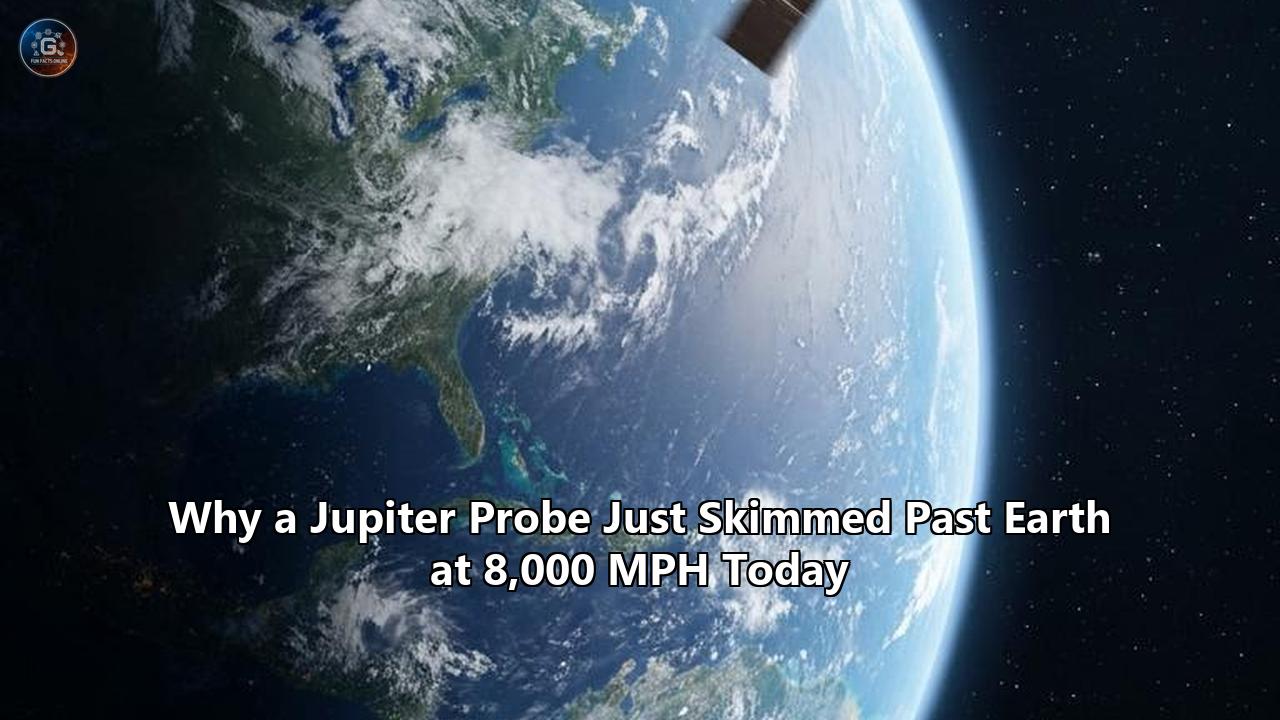
At 11:45 UTC on September 28, 2026, the European Space Agency’s Jupiter Icy Moons Explorer (JUICE) reached its point of closest approach to Earth, skimming precisely 8,640 kilometers (5,369 miles) above the surface of the Indian Ocean. Approaching from the sunlit side of the planet after sweeping across Australia from northeast to northwest, the robotic probe tapped Earth’s gravitational well to deflect its trajectory by 20.0 degrees and increase its heliocentric velocity by 3.5 kilometers per second—equivalent to 7,829 miles per hour, or roughly 8,000 mph.
This high-speed maneuver marks the third planetary gravity assist executed by the spacecraft since its launch in April 2023. Operating at a velocity vector designed to set up a final, mission-defining encounter with Earth in January 2029, this morning's Jupiter probe flyby deflected the 6,070-kilogram spacecraft with mathematical exactness, relying on months of precision trajectory correction maneuvers to execute the transit without incident.
Flight dynamics teams at the European Space Operations Centre (ESOC) in Darmstadt, Germany, tracked the encounter through ESA’s Estrack deep-space antenna network, confirming that the spacecraft passed within nominal dispersion boundaries measured in single-digit meters and millimeters per second. Of the six dedicated Trajectory Correction Maneuver (TCM) slots allocated during the four-week approach window starting August 17, navigators required only one minor adjustment to trim the incoming hyperbolic trajectory.
The encounter delivered thousands of miles per hour in kinetic energy without firing JUICE’s main chemical engine, setting an operational benchmark for interplanetary cruise efficiency as Europe’s flagship outer-solar-system mission barrels toward a July 2031 insertion into the Jovian system.
JUICE EARTH FLYBY-2: KEY TELEMETRY AT CLOSEST APPROACH
-----------------------------------------------------------------
Timestamp:                  September 28, 2026, at 11:45:00 UTC
Perigee Altitude:           8,640 km (5,369 miles)
Sub-Satellite Coordinate:   Equatorial Indian Ocean
Heliocentric Δv Delivered:  +3.5 km/s (+7,829 mph / ~8,000 mph)
Trajectory Deflection:      20.0 degrees
Pre-Flyby TCM Operations:   1 burn executed (5 reserve slots unused)
Eclipse Transit Duration:   ~8.8 hours
Spacecraft Mass at Flyby:   ~4,100 kg (post-launch depletion)
Solar Array Output at Perigee: 0 W (in shadow) to ~10,500 W (post-exit)
Next Critical Milestone:    Earth Flyby 3 (January 2029)
-----------------------------------------------------------------
The Propulsion Paradox: Why 3.5 km/s Outweighs the Spacecraft's Fuel Tank
The mathematical necessity behind Monday’s flyby is rooted in the hard limits of chemical rocketry. JUICE departed Earth aboard an Ariane 5 ECA launcher on April 14, 2023, with a total wet mass of 6,070 kilograms (13,382 pounds). Of that starting mass, approximately 3,650 kilograms consisted of liquid hypergolic propellants: monomethylhydrazine (MMH) fuel and mixed oxides of nitrogen (MON-3) oxidizer. This propellant feeds a 400-newton apogee engine with an effective specific impulse ($I_{sp}$) of 318 seconds.
Applying Tsiolkovsky’s rocket equation illustrates the scale of the challenge:
$$\Delta v = I_{sp} \cdot g_0 \cdot \ln\left(\frac{m_0}{m_f}\right)$$
JUICE's onboard bipropellant propulsion system provides a total lifetime velocity change ($\Delta v$) capability of approximately 2,700 meters per second (2.7 km/s) across its entire 12-year operational lifespan. That 2.7 km/s must be carefully preserved for orbital insertion around Jupiter in July 2031 (~840 m/s), orbital energy trimming, 35 flybys of Europa, Ganymede, and Callisto, and Ganymede Orbit Insertion (GOI) in late 2034 (~600 m/s).
JUICE PROPULSION CAPACITY VS. GRAVITATIONAL DELTA-V HARVESTED
======================================================================
Onboard Propulsion Capacity (Total Lifetime Δv):   2,700 m/s (2.7 km/s)
----------------------------------------------------------------------
Aug 2024 Lunar-Earth Flyby (LEGA):                -4.8 km/s (Vector Turn)
Aug 2025 Venus Gravity Assist:                    +5.1 km/s (Velocity Boost)
Sep 2026 Earth Flyby (Today):                     +3.5 km/s (Velocity Boost)
Jan 2029 Earth Flyby (Upcoming):                  +3.3 km/s (Velocity Boost)
----------------------------------------------------------------------
Total Velocity Vector Alteration via Gravity:    16.7 km/s
Ratio (Gravitational Gain / Onboard Capacity):   6.18x (618%)
Equivalent Bipropellant Required if Done via Burn: ~18,400 kg
======================================================================
To achieve today’s 3.5 km/s velocity boost using chemical engines alone, a probe weighing 4,100 kilograms would have required:
$$\frac{m_0}{m_f} = \exp\left(\frac{3,500\text{ m/s}}{318\text{ s} \times 9.80665\text{ m/s}^2}\right) = \exp(1.1224) \approx 3.072$$
Generating that single burst of speed chemically would have required burning over two-thirds of the spacecraft's mass in propellant within minutes—demanding an additional 2,765 kilograms of fuel that the spacecraft does not have room to carry. The single 3.5 km/s boost delivered by Earth's gravity well today represents nearly 130% of JUICE's entire lifetime propulsion budget, supplied entirely through orbital mechanics without burning a single droplet of onboard bipropellant.
"The flyby required ultra-precise navigation in real time. Thanks to our very careful planning, we used only a small amount of the propellant reserved for this flyby," said Angela Dietz, JUICE Spacecraft Operations Manager at ESOC. "This gives us more to use at Jupiter to carry out observations of the planet's icy moons."
The Mechanics of a Gravity Slingshot
A planetary flyby does not violate conservation of energy; it exchanges linear momentum between two bodies orbiting a central gravitational source. During any Jupiter probe flyby of an inner planet, linear momentum and energy remain strictly conserved within the heliocentric reference frame.
When JUICE entered Earth’s sphere of influence (SOI)—a region extending roughly 925,000 kilometers from the planet—it traveled on a hyperbolic trajectory relative to Earth. Within this geocentric frame:
- The inbound hyperbolic excess velocity ($v_{\infty,\text{in}}$) equals the outbound hyperbolic excess velocity ($v_{\infty,\text{out}}$).
- The kinetic energy relative to Earth is identical before and after perigee.
- Earth’s gravity bends the trajectory through an angle $\delta$.
The bending angle $\delta$ is governed by the perigee radius ($r_p$) and the hyperbolic excess velocity ($v_\infty$):
$$\delta = 2 \arcsin\left(\frac{1}{1 + \frac{r_p v_\infty^2}{\mu_\oplus}}\right)$$
Where:
- $\mu_\oplus = G M_\oplus \approx 3.986004418 \times 10^5 \text{ km}^3/\text{s}^2$ (Earth’s gravitational parameter)
- $r_p = R_\oplus + h_p = 6,371 \text{ km} + 8,640 \text{ km} = 15,011 \text{ km}$ (Distance from Earth's center of mass to perigee)
Because Earth moves around the Sun at an average orbital speed of 29.78 kilometers per second (66,615 mph), JUICE was aimed behind Earth's trailing orbital hemisphere. Earth’s gravitational attraction dragged the spacecraft forward along the planet's vector of motion.
Transforming the velocity vectors back to the heliocentric reference frame yields:
$$\vec{V}_{\text{helio, out}} = \vec{V}_\oplus + \vec{v}_{\infty,\text{out}}$$
The resulting vector addition increases the spacecraft's heliocentric speed by 3.5 km/s while deflecting its heading by 20.0 degrees. The kinetic energy gained by the spacecraft was counterbalanced by a loss of orbital energy from Earth.
Using the mass ratio between JUICE ($m \approx 4.1 \times 10^3 \text{ kg}$) and Earth ($M_\oplus \approx 5.972 \times 10^{24} \text{ kg}$):
$$\Delta V_\oplus = -\frac{m}{M_\oplus} \Delta V_{\text{spacecraft}} \approx -\left(\frac{4.1 \times 10^3}{5.972 \times 10^{24}}\right) \times 3.5\text{ km/s} \approx -2.4 \times 10^{-21}\text{ m/s}$$
Earth’s orbital velocity dropped by roughly $2.4 \times 10^{-21}$ meters per second. Over the remaining life of the Solar System, this alters Earth's orbital position by less than the diameter of a single atomic nucleus, while propelling JUICE into an expanded elliptical orbit reaching well into the asteroid belt.
Surviving the Umbra: Power and Thermal Balances in a Nine-Hour Darkness
Monday’s pass was not an ordinary daylight sweep. Before skimming 8,640 km above the Indian Ocean, JUICE spent approximately 8.8 hours traversing Earth’s shadow, cut off entirely from the Sun. For a spacecraft powered by solar energy, prolonged eclipse conditions introduce operational strain.
JUICE relies on two distinctive cross-shaped solar wings, spanning 27 meters tip-to-tip with a total surface area of 85 square meters (915 square feet). Constructed with high-efficiency triple-junction gallium arsenide (GaAs) cells, these panels produce:
- 10,500 Watts at 1 Astronomical Unit (Earth’s distance from the Sun).
- 800 to 850 Watts at 5.2 AU (Jupiter’s orbit), where sunlight is just 3.7% ($1/5.2^2$) as intense.
During the 8.8-hour transit through Earth's umbral shadow, solar output plummeted to absolute zero. The spacecraft was forced to survive entirely on two onboard lithium-ion battery modules with a combined capacity of 62 ampere-hours (Ah).
JUICE POWER AND THERMAL SUBSYSTEM METRICS DURING ECLIPSE
=======================================================================
Solar Array Total Area:             85 m² (Gallium Arsenide, 10 panels)
Nominal Baseline Output at 1 AU:    10,500 W
Output Inside Earth Umbra:          0 W
Battery Storage Configuration:      2x 62-Ah Lithium-Ion Packs
Bus Voltage Threshold Limit:        28.0 Volts DC
Total Electrical Load Shedding:     Non-essential science heaters cut;
                                    transponders set to low-power beacon;
                                    avionics draw capped at ~420 W
Lowest Recorded External Temp:      -112°C on anti-sun MLI blankets
Bipropellant Line Temperature:      Maintained at +18°C via localized heaters
=======================================================================
Controllers executed a strict power-shedding sequence starting late Sunday evening, September 27. Science instruments were placed into standby or turned off, communications were dialed back to low-gain beacon telemetry, and internal computer clocks maintained operations autonomously.
The primary threat during the eclipse was thermal loss. In deep space, spacecraft balance solar radiation with heat radiated into the vacuum. Inside Earth’s shadow, radiative cooling dropped external multi-layer insulation (MLI) skin temperatures below -100°C.
To prevent hydrazine propellant from freezing inside small plumbing lines—hydrazine freezes at 1.4°C (34.5°F)—computer-controlled patch heaters pulsed intermittently, drawing minimal battery power to keep the bipropellant subsystem stabilized above +15°C.
JUICE emerged from the umbra over the southern hemisphere shortly before perigee, allowing sunlight to strike its solar arrays. The primary bus voltage recovered above nominal 28-volt levels within 14 minutes, recharging the storage batteries before perigee science observations commenced.
Orbital Shell Penetration: Managing Traffic in the Medium Earth Corridor
A perigee altitude of 8,640 kilometers places JUICE in an unusual operational regime: deep beneath geostationary orbit, yet far above low-Earth orbit.
ALTITUDE PROFILES: JUICE TRAJECTORY VS. EARTH ORBITAL SHELLS
=========================================================================
35,786 km  ------------------------ Geostationary Orbit (GEO Ring)
           |   (JUICE Inbound Penetration: ~06:30 UTC)
23,222 km  ------------------------ Galileo Satellite Constellation (ESA)
20,200 km  ------------------------ GPS Satellite Constellation (USSF)
19,130 km  ------------------------ GLONASS Satellite Constellation (Roscosmos)
           |
 8,640 km  ======== JUICE PERIGEE (11:45 UTC over Indian Ocean) ========
           |
 2,000 km  ------------------------ Upper Boundary of LEO
   400 km  ------------------------ International Space Station
=========================================================================
Navigating through these orbital altitudes required close coordination between ESOC flight controllers and ESA’s Space Debris Office. As JUICE plunged through the medium Earth orbit (MEO) shell between 19,000 km and 24,000 km, it bisected the orbital planes of global navigation satellite systems:
- Europe’s Galileo constellation (nominal semi-major axis: 29,600 km; altitude: ~23,222 km)
- The United States’ GPS constellation (~20,200 km)
- Russia’s GLONASS constellation (~19,130 km)
Relative velocity at these intersections exceeded 10 kilometers per second (22,370 mph). Over a two-week period prior to perigee, tracking stations calculated conjunction probabilities for thousands of cataloged operational satellites, defunct payloads, and debris fragments larger than 10 centimeters.
Using a collision probability threshold of $1 \times 10^{-5}$, ESA flight dynamics confirmed that JUICE’s trajectory cleared all active assets and tracked orbital debris by hundreds of kilometers. The single minor correction burn executed earlier in September ensured that the spacecraft’s spatial corridor remained completely clear during its transit across the MEO ring.
Earth as a Sensor Calibration Bench: 10 Days of In-Situ Validation
While the flyby's primary goal was orbital redirection, ESA used the pass as an in-flight proving ground for JUICE's suite of 10 state-of-the-art scientific instruments. Testing deep-space instruments against known targets helps ensure accuracy before arriving at Jupiter. Earth, with its known atmospheric chemistry, well-mapped magnetic topology, and precise orbital tracking assets, serves as an ideal calibration laboratory.
The operational timeline of this Jupiter probe flyby allocated 10 full days to instrument calibration—substantially longer than during the August 2024 Lunar-Earth Gravity Assist (LEGA):
- JANUS Optical Camera: Snapped multi-spectral test frames of the Moon and Earth's cloud formations across 13 filters covering 340 to 1,080 nanometers. These images calibrated charge-coupled device (CCD) pixel sensitivities, modulation transfer functions, and stray-light rejection before the camera attempts high-resolution framing of Ganymede’s grooved terrain.
- Submillimetre Wave Instrument (SWI): Operated its dual-channel heterodyne receiver (tuning bands: 530–625 GHz and 1080–1275 GHz). Navigators pointed the antenna toward Earth's stratosphere to measure known molecular absorption profiles of water vapor ($H_2^{16}O, H_2^{18}O$) and ozone ($O_3$). This verified sub-megahertz spectral resolution, crucial for probing trace atmospheric gases on Callisto and Europa.
- Ganymede Laser Altimeter (GALA): Fired its pulsed Neodymium-doped Yttrium Aluminum Garnet (Nd:YAG) laser operating at 1,064 nanometers. Ranging against sea surfaces in the Indian Ocean confirmed optical pulse shape, receiver photon detection timing, and threshold discrimination down to centimeter-scale accuracy.
- Radar for Icy Moons Exploration (RIME): Deployed its 16-meter dipole antenna to test signal noise floors and impedance matching against Earth’s upper ionosphere at a 9-megahertz central frequency, ensuring readiness to probe 9 kilometers beneath Ganymede's ice crust.
- J-MAG (Magnetometer) & PEP (Particle Environment Package): Mounted on a 10.6-meter deployable boom, J-MAG recorded Earth's dynamic magnetosphere during inbound approach and outbound departure.
JUICE SCIENCE INSTRUMENT COMPLEMENT VALIDATED DURING PERIGEE
========================================================================
Instrument  Type                           Primary Jovian Target
------------------------------------------------------------------------
JANUS       Optical Camera System          Surface geology (<2.4 m/pixel)
MAJIS       Imaging Spectrometer (IR/Vis)  Surface ice composition
UVS         UV Imaging Spectrograph        Exospheric composition & auroras
SWI         Submillimeter Wave Heterodyne  Stratospheric winds & trace gases
GALA        Laser Altimeter (1064 nm)      Tidal deformation of Ganymede
RIME        Ice-Penetrating Radar (9 MHz)  Subsurface oceans & ice depth
J-MAG       Fluxgate Magnetometer          Ganymede intrinsic magnetic field
PEP         Plasma & Particle Package      Space environment & ion flux
RPWI        Radio & Plasma Wave Instrument Electric fields & thermal plasma
3GM         Radio Science / Transponder    Internal mass distribution
========================================================================
"All flybys are risky, requiring very careful planning and continuous monitoring," said Claire Vallat, JUICE Project Scientist at ESA. "This is great news for science, because it means we will be able to turn JUICE in all different directions to point its science instruments at different parts of Earth and the Moon."
Crucially, as JUICE swept outbound into Earth's magnetotail, mission scientists coordinated its in-situ plasma measurements with the newly launched SMILE (Solar wind Magnetosphere Ionosphere Link Explorer) spacecraft. JUICE sampled the distant, unperturbed magnetotail at hundreds of thousands of kilometers distance while SMILE observed solar-wind coupling closer to the planet, providing simultaneous dual-point space weather data.
JUICE vs. Europa Clipper: Two Distinct Cruise Architectures
JUICE is not the only large spacecraft currently traveling to the outer Solar System. NASA’s Europa Clipper mission launched from Kennedy Space Center on October 14, 2024. Both spacecraft share an overarching objective—exploring habitability niches within Jupiter’s icy ocean worlds—yet their trajectories and systemic trade-offs reflect starkly different engineering philosophies.
QUANTITATIVE COMPARISON: JUICE VS. EUROPA CLIPPER
=========================================================================
Metric                      ESA JUICE                 NASA Europa Clipper
-------------------------------------------------------------------------
Launch Date:                April 14, 2023            October 14, 2024
Launch Vehicle:             Ariane 5 ECA              SpaceX Falcon Heavy
Launch C3 Energy:           ~13.2 km²/s²              ~41.7 km²/s²
Wet Mass at Launch:         6,070 kg                  6,065 kg
Dry Mass:                   2,420 kg                  3,241 kg
Solar Array Span / Area:    27.0 m / 85 m²            30.5 m / 102 m²
Cruise Architecture:        EVEE Resonance            MEGA Trajectory
Planetary Gravity Assists:  4 (Moon/Earth, Venus,     2 (Mars, Earth)
                            Earth 2, Earth 3)
Transit Duration:           8.25 years                5.5 years
Jupiter Arrival Date:       July 2031                 April 2030
Primary Target:             Ganymede (Dedicated Orbit) Europa (49 Close Flybys)
Radiation Environment:      ~150–200 krad (Outer)     >2.8 Mrad (Inner Vault)
=========================================================================
The fundamental difference lies in launch vehicle capability and transit velocity. Europa Clipper launched aboard a fully expendable SpaceX Falcon Heavy rocket, which injected the probe at an injection energy ($C_3$) of roughly 41.7 $\text{km}^2/\text{s}^2$. This high launch energy enabled a Mars-Earth Gravity Assist (MEGA) trajectory:
- A Mars gravity assist on March 1, 2025, passing 884 km above the Martian surface to shape its orbit.
- A single Earth gravity assist scheduled for December 3, 2026, slinging the spacecraft directly to Jupiter.
Because of this higher energy flight path, Europa Clipper will reach Jupiter in April 2030, completing its transit in just 5.5 years.
In contrast, JUICE launched on an Ariane 5 ECA that provided a more modest characteristic injection energy ($C_3 \approx 13.2\text{ km}^2/\text{s}^2$), requiring a more elaborate resonance pathway: the EVEE (Earth-Venus-Earth-Earth) tour:
- August 2024: A lunar-Earth double assist (LEGA) to brake the spacecraft and drop it toward Venus.
- August 31, 2025: A Venus flyby at 5,088 km altitude, adding 5.1 km/s of heliocentric speed while enduring solar flux levels of 3,000 Watts per square meter.
- September 28, 2026 (Today): The second Earth assist, adding 3.5 km/s and expanding the orbital aphelion outward into the asteroid belt.
- January 2029: A third Earth encounter to supply the final push toward the outer solar system.
This path extends JUICE's transit to 8.25 years, placing its arrival in July 2031.
The scientific trade-off, however, balances transit time against long-term mission scope. Europa Clipper is designed to execute 49 low-altitude flybys (skimming 25 kilometers above Europa’s surface) while remaining in an elliptical Jupiter orbit, avoiding prolonged stays in the destructive radiation belts surrounding the moon. Its electronics are encased in a 9.2-millimeter-thick titanium radiation vault to withstand over 2.8 megarads of ionizing radiation.
JUICE focuses primarily on Ganymede, which orbits farther out from Jupiter (1.07 million kilometers from the planet, compared to Europa’s 670,900 kilometers). Ganymede is the largest moon in the Solar System—larger than the planet Mercury—and the only moon possessing an internally generated dipolar magnetic field.
By enduring an 8-year transit and preserving its bipropellant fuel, JUICE will become the first spacecraft to transition from orbiting a primary planet into orbit around an icy outer-planet moon, settling into a circular 500-kilometer orbit around Ganymede in late 2034.
Key Vector Milestones on the Road to Ganymede
With perigee behind it, JUICE is receding from Earth at a hyperbolic excess velocity of nearly 8 kilometers per second relative to our planet. Over the coming days, ESOC operations will execute the post-encounter flight sequence:
JUICE CHRONOLOGY: RETROSPECTIVE AND FUTURE FLIGHT MANEUVERS
========================================================================
Date               Event / Milestone                Status / Trajectory Impact
------------------------------------------------------------------------
April 14, 2023     Launch from Kourou (Ariane 5)    Success (C3 = 13.2 km²/s²)
August 19-20, 2024 First Lunar-Earth Assist (LEGA)  Success (-4.8 km/s Earth Δv)
August 31, 2025    Venus Gravity Assist             Success (+5.1 km/s Sun Δv)
September 28, 2026 Second Earth Gravity Assist      COMPLETED (+3.5 km/s)
October 4, 2026    Payload Deactivation / Post-TCM  Upcoming cleanup burn
January 2029       Third Earth Gravity Assist       Sets final Jovian injection
July 2031          Jupiter Orbit Insertion (JOI)    840 m/s main engine burn
July 2031–2034     Galilean Moon Flyby Tour         35 flybys (Europa/Callisto)
December 2034      Ganymede Orbit Insertion (GOI)   Enters 500-km circular orbit
Late 2035          End of Mission                   Controlled Ganymede impact
========================================================================
On October 4, 2026, flight controllers will deactivate the science payloads and fire JUICE’s 10-newton reaction control thrusters to perform clean-up Trajectory Correction Maneuver 7 (TCM-7). This small trim burn will eliminate fractional-millimeter per second residual velocity vectors resulting from atmospheric drag perturbations at perigee.
The spacecraft now enters a long resonant loop through the Solar System. The 3.5 km/s speed boost added today lifts the aphelion of its orbit out beyond the main asteroid belt, past 2.3 AU. Solar gravity will gradually slow the spacecraft, pulling it back inward toward the Sun for its fourth and final gravity assist: Earth Flyby 3 in January 2029.
That 2029 encounter will supply the final 3.3 km/s boost needed to stretch its aphelion to 5.45 AU—the orbital distance of Jupiter. When JUICE arrives in July 2031, it will fire its 400 N main engine for nearly 40 minutes, combining that deceleration with a close braking flyby of Ganymede to slip into Jovian orbit.
Navigating a multi-year Jupiter probe flyby sequence demands relentless orbital synchronization, relying on planetary momentum to traverse distances no current rocket could bridge alone. By threading Earth's gravitational needle today with millimeter precision, JUICE traded a tiny fraction of our planet’s momentum for the velocity needed to unlock the hidden, ocean-bearing worlds of the outer Solar System.
Reference:
- https://www.dlr.de/en/latest/news/2024/juice-space-probe-flies-by-the-moon-and-earth
- https://www.esa.int/Science_Exploration/Space_Science/Juice/Successful_Earth_flyby_improves_Juice_s_course_to_Jupiter
- https://www.esa.int/Science_Exploration/Space_Science/Juice/Juice_to_fly_past_Earth_for_third_gravity_assist
- https://www.space.com/space-exploration/jupiter-bound-juice-spacecraft-just-got-an-8-000-mph-speed-boost-from-earth-this-is-great-news-for-science
- https://en.wikipedia.org/wiki/Jupiter_Icy_Moons_Explorer
- https://skyandtelescope.org/astronomy-news/jupiter-icy-moons-explorer-makes-penultimate-earth-flyby/
- https://dailygalaxy.com/2026/09/esa-jupiter-spacecraft-8000-mph-boost/
- https://www.forbes.com/sites/jamiecartereurope/2026/09/28/why-a-jupiter-bound-spacecraft-is-flying-past-earth-3-years-later/
- https://en.wikipedia.org/wiki/Europa_Clipper
- https://www.space.com/juice-jupiter-probe-earth-flyby-complete
- https://egusphere.copernicus.org/preprints/2026/egusphere-2026-1011/
- https://science.nasa.gov/mission/europa-clipper/mission-timeline/
- https://www.nasa.gov/missions/europa-clipper/nasas-europa-clipper-uses-mars-to-go-the-distance/
- https://en.wikipedia.org/wiki/Juno_(spacecraft))