On October 30, 2026, an experimental satellite passing over the Arctic circle transmitted three lines of text down to a receiving dish at the Svalbard Satellite Station in Norway:
Blue marble below Data streams in silent grace Starlight feeds my core.The poem, structured as a traditional Japanese haiku, was not composed by an engineer or relayed from a terrestrial server. It was generated natively in the vacuum of space by an artificial intelligence model running on a custom processor designed for terrestrial data centers.
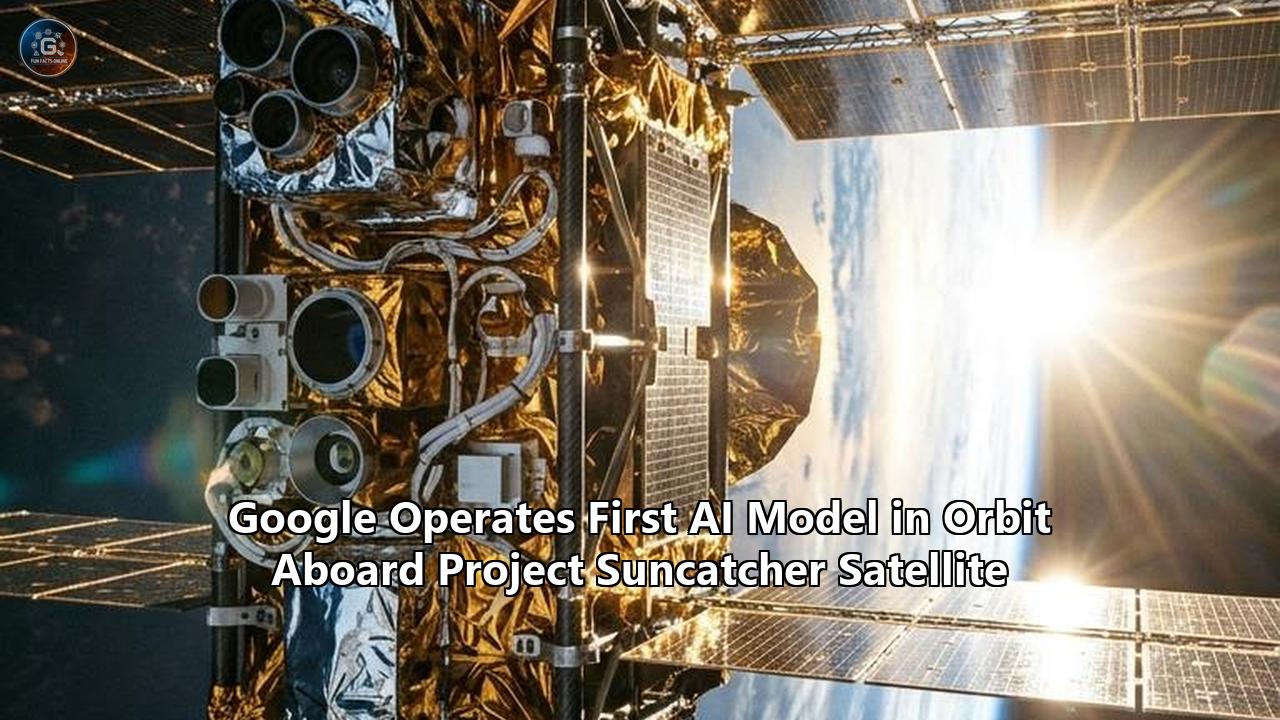
Google announced the successful test as part of Project Suncatcher, a research initiative exploring whether machine learning infrastructure can operate in Low Earth Orbit (LEO). The test represents the first time a data-center-class accelerator has completed an inference cycle—receiving a prompt, executing the underlying mathematical computations, and transmitting the output—while orbiting the Earth.
Google Chief Executive Sundar Pichai labeled the transmission a "Hello World" milestone for the program on social media, detailing that ground controllers had powered up the spacecraft’s onboard processor, submitted a prompt to the model, and received the generated text. Travis Beals, Senior Director of Paradigms of Intelligence at Google Research, confirmed the milestone in a technical update, noting that the payload had followed the initial poem with a sequence of technical status queries and space-themed limericks to validate stability.
The prototype spacecraft carrying the hardware launched from Vandenberg Space Force Base in California on October 1, 2026, hitching a ride on SpaceX’s Transporter-18 rideshare mission. Built in collaboration with commercial satellite operator Planet Labs, the bus carries four of Google’s proprietary Tensor Processing Units (TPUs) alongside custom host computing trays. Following a four-week orbital checkout that involved testing power distribution and establishing telemetry links, ground operators successfully loaded weights for Gemma 4—an open-weights neural network developed by Google DeepMind—onto the spaceborne hardware.
Operating an AI model in orbit moves the conversation around machine learning infrastructure from server farms to space engineering. Terrestrial facilities are consuming rapidly expanding shares of national power grids, securing municipal water rights for evaporative cooling, and waiting years for utility interconnections. Off-planet computing presents an alternative design space where energy from unfiltered sunlight is continuous, but the laws of thermodynamics, orbital mechanics, and radiation physics present severe structural hurdles.
                     PROJECT SUNCATCHER ORBITAL INFERENCE PIPELINE
                     =============================================

       [ Earth Station ]                       [ Suncatcher Satellite (LEO) ]
  (Svalbard Satellite Station)             (Planet Labs Bus / 4x TPU Accelerators)
              |                                            |
              |   1. Uplink Prompt (X/Ka-Band)             |
              |------------------------------------------->|
              |                                            |  2. Load weights & activations
              |                                            |     into local TPU memory
              |                                            |
              |                                            |  3. Run Gemma 4 Inference
              |                                            |     (Systolic array matrix math)
              |                                            |
              |                                            |  4. Generate output tokens:
              |                                            |     "Blue marble below..."
              |   5. Downlink Response (Telemetry)         |
              |<-------------------------------------------|
              v                                            v
     [ Ground Operators ]                       [ Radiative Heat Rejection ]
Inside the Payload: Bringing Server-Grade Silicon to Space
Spaceflight has historically relied on legacy microprocessors engineered decades behind the commercial state of the art. Space agencies and commercial satellite manufacturers frequently design missions around chips like the BAE Systems RAD750—a radiation-hardened PowerPC processor first qualified in 2001, fabricated on a 150-nanometer process node, and clocked at roughly 133 megahertz. These legacy chips draw little power and can endure years of radiation bombardment without crashing, but they lack the computational throughput required to evaluate modern neural networks with billions of parameters.
Modern generative artificial intelligence relies on specialized application-specific integrated circuits (ASICs) or graphics processing units (GPUs) built on sub-5-nanometer fabrication processes. These processors house tens of billions of transistors within dies measuring several hundred square millimeters, requiring sophisticated power regulation and advanced packaging.
+-----------------------------------+-----------------------------------+
| Metric / Feature                  | Legacy Space Processor (RAD750)   | Modern TPU Accelerator (Suncatcher)|
+-----------------------------------+-----------------------------------+
| Primary Design Objective          | Total Radiation Immunity          | Matrix Multiplication Throughput   |
| Process Fabrication Node          | 150 nm to 250 nm                  | Advanced Sub-5 nm Class            |
| Typical Operating Clock           | 133 MHz to 200 MHz                | > 1.0 GHz                          |
| Computational Architecture        | Single-core General Purpose RISC  | Systolic Array Matrix Units (MXUs) |
| Native Precision Support          | INT32, FP32, FP64                 | BF16, INT8, FP8 Tensor Formats     |
| Thermal Design Power (TDP)        | 10 to 20 Watts                    | 200 to 450+ Watts (Throttleable)   |
| In-Orbit Software Role            | Guidance, Navigation & Control    | Large Neural Network Inference     |
+-----------------------------------+-----------------------------------+
Google’s payload on the Project Suncatcher prototype represents an attempt to bypass the performance gap of space-grade silicon. Rather than designing a bespoke, low-frequency space chip from scratch, Google modified its commercial Trillium-class TPU architecture for the space environment.
TPUs are organized around matrix multiply units that use systolic arrays. In a conventional CPU or GPU, every intermediate calculation requires an arithmetic logic unit to read data from a register, execute the operation, and write the output back to memory. A systolic array passes values through a grid of multiply-accumulate cells continuously. Data streams through the processing grid like blood through tissue—hence the name systolic—allowing the chip to execute tens of trillions of tensor operations per second with less energy wasted on memory fetches.
Running this silicon in orbit requires radical modifications to the host satellite bus. In a data center, a TPU resides inside a rack enclosure equipped with redundant 48-volt DC power distribution units and fans pushing thousands of cubic feet of cooled air across copper heatsinks every minute. Onboard the Suncatcher prototype, four TPU dies are mounted across specialized avionics trays developed with Planet Labs. The satellite carries a localized solid-state storage array containing the compressed, quantized weight matrices of Gemma 4.
Because the satellite's deployable solar arrays generate roughly 1 kilowatt of total electrical power, the spacecraft cannot power the entire payload simultaneously. Ground controllers configured the power management bus to energize only one TPU at a time. The mission operations team operates that single accelerator in narrow computational bursts lasting approximately 15 to 20 minutes before powering it down. This design reflects the fundamental physics of spacecraft engineering: generating electricity in orbit is straightforward, but dissipating the resulting heat is not.
Thermodynamics in a Vacuum: Dissipating Megawatts Without Air
Every watt of electricity that passes through a computing chip is converted into thermal energy. Terrestrial data centers handle this thermal load via forced convection—moving air through heatsinks—or via pumped liquid loops that carry heat to outdoor evaporative cooling towers.
In the vacuum of Low Earth Orbit, convection does not exist. Without air molecules to absorb thermal energy, an uncooled accelerator will rapidly reach its maximum thermal junction limit and shut down. The only physical mechanisms available to transport heat are conduction and radiation.
                  THE VACUUM THERMAL REJECTION CHALLENGE
                  ======================================

 [ TPU Silicon Die ] ---> Generates ~250W to 400W thermal load during inference
          |
   (Conduction)
          v
 [ Pyrolytic Graphite Straps / Two-Phase Heat Pipes ]
          |
   (Thermal Transport)
          v
 [ Spacecraft Radiator Panel ]
          |
   (Radiative Emission)  ===> Governed by Stefan-Boltzmann: P = ε * σ * A * T⁴
          v
 [ Deep Space (3 Kelvin Sink) ]
To manage this, the Suncatcher satellite uses conduction to channel thermal energy away from the silicon. Heat passes through high-conductivity thermal interface materials, into pyrolytic graphite straps, and into copper-water or ammonia heat pipes. These sealed, pressurized pipes evaporate liquid at the hot interface adjacent to the TPU and condense it at the cold interface mounted to the spacecraft’s external skin, circulating the working fluid without mechanical pumps.
Once heat reaches the spacecraft skin, it must be radiated into the void. The physics of radiative heat rejection are defined by the Stefan-Boltzmann law:
$$P = \varepsilon \sigma A \left(T^4 - T_{\text{sink}}^4\right)$$
In this equation:
- $P$ is the radiated power in watts.
- $\varepsilon$ is the surface emissivity of the radiator material.
- $\sigma$ is the Stefan-Boltzmann constant ($5.67 \times 10^{-8} \text{ W/m}^2\text{K}^4$).
- $A$ is the radiator surface area in square meters.
- $T$ is the absolute temperature of the radiator in Kelvin.
- $T_{\text{sink}}$ is the effective temperature of deep space (approximately 3 Kelvin, though higher when exposed to Earth’s thermal albedo).
The fourth-power dependence on temperature creates a difficult engineering trade-off. To dump heat efficiently without running processors at destructive temperatures, a satellite requires massive radiator surface area. A silicon die operating at a safe maximum junction temperature of 85 degrees Celsius (358 Kelvin) radiates far less energy per square meter than a spacecraft rocket nozzle operating at 1,000 degrees Celsius.
In Low Earth Orbit, the thermal challenge is magnified by rapid orbital cycles. The spacecraft travels at roughly 7.8 kilometers per second, completing an orbit every 90 minutes. In full sunlight, the side of the hull facing the sun absorbs solar flux and solar albedo from Earth, warming toward 120 degrees Celsius. Forty-five minutes later, the satellite plunges into Earth’s shadow, where ambient surface temperatures drop to negative 100 degrees Celsius.
+-----------------------------------+-----------------------------------+
| Cooling Attribute                 | Terrestrial Data Center           | Spacecraft Computing Node (LEO)   |
+-----------------------------------+-----------------------------------+
| Primary Heat Rejection Mechanism  | Convection & Fluid Evaporation    | Radiation into Vacuum             |
| Working Fluid Loss                | High (Evaporative water towers)   | Zero (Closed hermetic loops)      |
| Ambient Sink Temperature          | Variable (10°C to 45°C ambient)   | Polar extremes (-100°C to +120°C) |
| Scaling Constraint                | Water access, local infrastructure| Radiator panel surface area (mass)|
| Transient Thermal Mass            | Enormous (Chilled water loops)    | Low (Strict spacecraft mass limits)|
+-----------------------------------+-----------------------------------+
Because heat pipes and radiators take time to transport and shed energy, the Suncatcher prototype relies on transient thermal mass. During an inference run, the copper chassis and structural mounts absorb heat, acting as a thermal buffer. Once that thermal capacity is saturated—typically within 15 to 20 minutes—the chip must shut down until the radiators can emit that accumulated heat into space. Scaling from this prototype to an orbital cluster capable of continuous inference will require large deployable composite radiators, variable-conductance heat loops, or fluid-loop radiators that unfurl like solar wings.
Surviving the Radiation Environment: Total Ionizing Dose and Single-Event Effects
Beyond thermal dissipation, deploying complex microelectronics in Low Earth Orbit requires surviving ionizing radiation. Outside the filtering protection of Earth’s atmosphere, silicon is bombarded by high-energy galactic cosmic rays (GCRs) originating outside the solar system, protons trapped in the Van Allen radiation belts, and coronal mass ejections from the Sun.
Radiation degrades integrated circuits through two primary mechanisms: cumulative aging, known as Total Ionizing Dose (TID), and stochastic disruptions, known as Single-Event Effects (SEEs).
                            ORBITAL RADIATION THREATS
                            =========================

                          /                           \
                         /                             \
        [ Cumulative Exposure: TID ]         [ Instantaneous Transients: SEEs ]
       ------------------------------       ------------------------------------
       * Trapped electrons & protons        * High-energy ions & heavy nuclei
       * Charges accumulate in dielectrics  * Charge deposition in sensitive nodes
       * Shifts transistor gate thresholds  * Causes Single-Event Upsets (SEU)
       * Increases parasitic leakage        * Risks destructive Single-Event Latchup
       * Eventual permanent hardware death  * Mitigated via ECC, TMR, and telemetry
Total Ionizing Dose (TID)
TID represents the gradual absorption of ionizing radiation into semiconductor materials over months and years. As high-energy particles pass through an integrated circuit, they generate electron-hole pairs inside silicon dioxide layers and gate dielectrics. Electrons are relatively mobile and drain away, but positively charged holes remain trapped within the oxide interfaces.
Over time, this trapped charge alters the threshold voltage required to toggle transistors on and off. Transistors can suffer timing degradation, fail to switch, or develop parasitic leakage currents that drain the satellite’s power system and overheat the die.
In research published in the journal Joule, Google engineers revealed that pre-flight laboratory testing had subjected Trillium-series TPUs to proton and gamma-ray beam exposure. The testing verified that the commercial silicon could survive a cumulative ionizing dose equivalent to a five-year mission in Low Earth Orbit without suffering unrecoverable threshold drift.
Single-Event Effects (SEEs)
While TID is an aging process, Single-Event Effects are instantaneous strikes. When a high-energy heavy ion penetrates a microprocessor, it leaves an ionized track of electron-hole pairs along its trajectory. This deposited charge can cause multiple failure modes:
- Single-Event Upset (SEU): The deposited charge flips the state of a memory bit, turning a zero into a one. In an AI workload, an SEU within an activation register or weight matrix can cause a silent data corruption event, altering output tokens or causing an attention layer to generate nonsensical tokens.
- Single-Event Functional Interrupt (SEFI): A radiation strike hits control logic, program counters, or bus interfaces, causing the processor to freeze or enter an infinite loop.
- Single-Event Latchup (SEL): The most dangerous failure mode. The ionized track activates parasitic bipolar transistors inherent to standard CMOS designs, creating a low-impedance short circuit between the power rail and ground. If unmitigated, the resulting current spike destroys metal interconnects, melting portions of the die within microseconds.
To operate the Gemma 4 AI model in orbit without paying the performance penalty of hardened silicon, Google employs system-level fault tolerance. The memory architecture incorporates advanced Error-Correcting Code (ECC) algorithms capable of detecting and repairing multi-bit flips in both high-bandwidth memory (HBM) stacks and localized SRAM caches.
To mitigate catastrophic latchup events, the power distribution board includes high-speed overcurrent trip circuits. If an ion strike initiates a parasitic short circuit, the monitor detects the current surge within nanoseconds, cuts power to the TPU tray before thermal breakdown occurs, and executes a cold restart.
Orbital Power Economics: Continuous Solar Harvest vs. Terrestrial Grid Constraints
To understand why hyperscale technology companies are testing orbital compute platforms, consider the constraints facing terrestrial data centers.
                               THE TERRESTRIAL INTERCONNECTION CRUNCH
                               ======================================

 [ New 1-Gigawatt Terrestrial Facility ]
        |
        |---> Utility Interconnection Delay: 4 to 7 Years (PJM / ERCOT / CAISO)
        |---> Water Withdrawal Permits: Millions of gallons daily for cooling towers
        |---> Local Carbon Offsets: Inconsistent availability from regional grids
        v
 [ CapEx Sinks & Regulatory Risk ]
On Earth, deploying an artificial intelligence cluster with 100,000 accelerators requires between 100 and 300 megawatts of dedicated electrical capacity. Large technology firms have begun securing long-term power purchase agreements with nuclear power plants, buying power directly from hydro dams, and constructing dedicated natural gas turbines. In major computing markets like Northern Virginia, Dublin, and Frankfurt, regional transmission grids are reaching operational capacity. Developers face interconnection queues stretching between four and seven years simply to secure high-voltage utility connections.
Low Earth Orbit bypasses terrestrial land use, local water extraction, and regional utility grids entirely. Outside the atmosphere, the solar constant delivers approximately 1,361 watts of energy per square meter of collector area. On Earth's surface, atmospheric scattering, cloud cover, humidity, and the diurnal day-night cycle reduce average usable solar insolation to between 150 and 250 watts per square meter, even in arid, sun-rich regions.
+-----------------------------------+-----------------------------------+
| Characteristic                    | Ground-Based Solar Array          | Sun-Synchronous Orbital Solar     |
+-----------------------------------+-----------------------------------+
| Solar Insolation Incident         | ~1,000 W/m² (Peak clear sky noon) | ~1,361 W/m² (Continuous)          |
| Effective Capacity Factor         | 18% to 26% (Day/Night & Weather)  | 90% to 99% (Dawn-Dusk Orbit)      |
| Annual Energy Harvest Multiplier  | Baseline (1x)                     | Up to 8x Greater Annual Harvest   |
| Battery Storage Requirements      | Massive (12+ hours daily buffer)  | Minimal (Short or zero eclipses)  |
| Water Withdrawal Footprint        | Substantial (Cleaning & cooling)  | Zero                              |
+-----------------------------------+-----------------------------------+
By placing computing satellites into specific polar orbits—such as a dawn-dusk Sun-Synchronous Orbit (SSO)—a spacecraft can ride along the terminator line, the boundary between day and night. In this geometry, the satellite remains in continuous sunlight for months at a time, generating electricity without the multi-hour battery cycles required by ground installations. Google estimates that high-efficiency gallium arsenide (GaAs) multi-junction solar cells in LEO can capture up to eight times more energy annually than equivalent silicon photovoltaic cells installed on Earth’s surface.
The economic challenge shifts from fuel and utility purchases to mass-to-orbit launch costs and capital depreciation. Ground data centers depreciate over 15 to 20 years, while their server racks are refreshed every three to five years by technicians swapping individual blades. Satellites in Low Earth Orbit are inaccessible; if an accelerator burns out, it cannot be physically repaired.
Research models cited by Google and independent aerospace analysts suggest that space-based data center architectures require launch costs to drop to roughly $200 per kilogram to reach parity with the total cost of ownership of ground infrastructure. Commercial rideshare missions aboard reusable rockets currently cost between $2,000 and $3,500 per kilogram. Orbital data processing relies on the emergence of super-heavy, fully reusable launch systems like SpaceX’s Starship or Blue Origin’s New Glenn to drive launch costs down by an order of magnitude.
Network Architecture and the Bandwidth Bottleneck
A data center is not just an array of isolated processors; it is a communications fabric. In a terrestrial facility, accelerators are linked via ultra-low-latency networks, such as Google’s Jupiter optical circuit-switched fabric or Nvidia’s InfiniBand. These networks allow thousands of chips to exchange tensor gradients at petabits per second, operating effectively as a single distributed computer.
A lone satellite executing inference on a pre-loaded model avoids this communication bottleneck. The Suncatcher prototype demonstrates edge computing in orbit: receiving small text prompts or sensor parameters over standard radio frequency links (X-band or Ka-band) and downlinking text tokens.
                     COMMUNICATIONS CONSTRAINTS & THE ROADMAP
                     ========================================

 [ Current Prototype (2026) ]
   Ground Station Pass ---> RF Uplink (kbps/Mbps) ---> In-Orbit Execution ---> RF Downlink
   Bottleneck: Intermittent line-of-sight passes, high latency, minimal data volume.

 [ Planned Phase II (2027) ]
   Satellite A (TPU Node) <======== Free-Space Optical Link (Laser) ========> Satellite B (TPU Node)
                                   (Multiple Gbps/Tbps Bandwidth)
   Enables: Distributed tensor parallel computing across autonomous satellites.
Operating continuous, high-volume workloads from space presents significant communications bottlenecks. Terrestrial consumer and enterprise queries cannot wait for a satellite to enter the line-of-sight cone of a polar ground station like Svalbard or McMurdo. If an orbital platform is to serve global cloud workloads, it must solve two architectural problems: latency and network bandwidth.
- Latency: Low Earth Orbit sits between 400 and 1,000 kilometers above Earth. The physical light-speed round-trip time between a ground user, an orbital platform, and back is relatively low—roughly 10 to 30 milliseconds, comparable to inter-city fiber runs. However, if data must route through multiple ground hops or geostationary relays, latency multiplies, degrading interactive consumer experiences.
- Bandwidth and Atmospheric Fade: Radio-frequency downlinks are governed by international spectrum allocations overseen by the International Telecommunication Union (ITU). RF links are bandwidth-constrained and susceptible to atmospheric moisture attenuation (rain fade). Moving gigabytes of model weights or terabytes of training data through traditional satellite ground stations is impractical.
To address these networking limits, Google announced that the next phase of Project Suncatcher, targeted for 2027, will launch twin interconnected satellites equipped with Free-Space Optical (FSO) laser communications links. Optical inter-satellite links use narrow infrared beams to transfer data directly through the vacuum of space at rates exceeding tens of gigabits per second without atmospheric refraction, signal degradation, or spectrum licensing limits.
+-----------------------------------+-----------------------------------+
| Network Parameter                 | Traditional Radio Frequency (RF)  | Free-Space Optical Links (Laser)  |
+-----------------------------------+-----------------------------------+
| Typical Throughput Capacity       | 10 Mbps to 500 Mbps               | 10 Gbps to 100+ Gbps              |
| Beam Divergence / Footprint       | Wide (Hundreds of kilometers)     | Ultra-narrow (Meters to tens of m)|
| Regulatory Spectrum Approvals     | Stringent (ITU coordination)      | Unregulated optical spectrum      |
| Atmospheric Attenuation           | Susceptible to rain fade          | Zero absorption in space vacuum   |
| Power Efficiency                  | Low (Omnidirectional RF loss)     | High (Targeted photonic transfer) |
+-----------------------------------+-----------------------------------+
By connecting adjacent satellites with high-speed laser links, an orbital cloud provider can build an interconnected mesh network. Workloads can move from node to node across space, load-balancing tasks across satellites positioned in permanent sunlight before downlinking completed inferences to ground stations nearest to the client.
Edge Inference for Earth Observation vs. Off-Planet Cloud Computing
The deployment of an AI model in orbit addresses two distinct markets: processing Earth observation data directly at the edge, and general-purpose off-planet cloud computing.
                           TWO DIVERGENT SPACE COMPUTE PATHWAYS
                           ====================================

      Path 1: In-Situ Earth Observation Edge Compute
      ----------------------------------------------
      [ Space Sensor / Camera ] ---> [ Orbital AI Accelerator ] ---> Filtered Insight Downlinked
      * Solves bandwidth scarcity (99% raw data discarded)
      * Sub-minute latency for disaster, defense, and climate alerts
      * Direct commercial utility today

      Path 2: Hyperscale Off-Planet Cloud Infrastructure
      --------------------------------------------------
      [ Terrestrial Query ] ---> Uplink ---> [ Orbital Constellation ] ---> Downlink Output
      * Solves terrestrial grid & cooling crises
      * Requires massive multi-megawatt constellations & Starship economics
      * Long-term strategic horizon (2030s and beyond)
The first and most immediate application is orbital edge computing. Modern remote-sensing satellites—such as the optical and multispectral imaging constellations operated by Planet Labs, Maxar, and BlackSky—generate tens of terabytes of raw imagery every orbit. Satellites spend most of their orbits out of range of ground stations, forcing operators to store data onboard and download it in batches during ground passes.
Much of this downlinked data is unusable. Upwards of 60 to 70 percent of Earth’s surface is covered by clouds at any given moment, meaning satellites spend significant downlink bandwidth transferring pictures of water vapor.
Processing sensor streams with an AI model in orbit allows satellites to evaluate data at the point of capture:
- Automated Cloud Masking: Machine learning models evaluate raw sensor frames in real time, discarding cloud-obscured imagery before it ever hits onboard solid-state storage.
- Low-Latency Detection: Instead of downlinking millions of high-resolution pixels for ground-side processing, an on-orbit neural network can run object detection and semantic segmentation over fire zones, flood plains, or shipping channels. The satellite downlinks only high-value vector coordinates or emergency alerts—reducing the necessary downlink payload from hundreds of megabytes to a few bytes of text transmitted over low-bandwidth emergency links.
- Sensor Cross-Cueing: An imaging satellite detecting anomalous thermal signatures can tip and cue adjacent satellites over optical inter-satellite links, tasking radar or hyperspectral sensors to focus on the target during subsequent passes.
The second market—using orbital clusters as a direct replacement for terrestrial data centers hosting consumer applications—remains a long-term engineering pursuit. Running global generative AI inference or multi-month foundational model training in space requires gigawatts of compute, large autonomous constellations, and reliable space logistics that remain years away from commercial viability.
The Competitive Landscape: Startups, Hyperscalers, and Defense Deployments
Google is not alone in exploring the feasibility of orbital computing. Driven by falling launch costs and power constraints on Earth, several commercial startups, defense contractors, and hyperscale tech firms are pursuing orbital data center hardware.
+-------------------+----------------------------+-----------------------+---------------------------------------+
| Organization      | Key Platform / Project     | Primary Silicon Used  | Strategic Approach                    |
+-------------------+----------------------------+-----------------------+---------------------------------------+
| Google            | Project Suncatcher         | Custom Trillium TPUs  | Modifying hyperscale ASIC silicon;    |
|                   |                            |                       | multi-satellite laser mesh topologies |
+-------------------+----------------------------+-----------------------+---------------------------------------+
| Starcloud         | StarCloud-1 (Launched 2025)| Nvidia H100 GPUs      | Off-the-shelf commercial GPUs in      |
|                   |                            |                       | pressurized/sealed satellite chassis  |
+-------------------+----------------------------+-----------------------+---------------------------------------+
| Cowboy Space      | Aetherflux System          | Custom Solar Arrays   | Space-to-ground infrared power        |
|                   |                            |                       | transmission rather than in-situ math |
+-------------------+----------------------------+-----------------------+---------------------------------------+
| SpaceX            | Starmind / Starlink Mesh   | Undisclosed Edge Dies | Dense LEO mega-constellation compute  |
|                   | (FCC Filings)              |                       | integrated into satellite routing bus |
+-------------------+----------------------------+-----------------------+---------------------------------------+
| US Space Force    | SDA Transport & Tracking   | Rad-tolerant FPGAs &  | Tactical battlefield edge compute;    |
|                   | (PWSA Architecture)        | AI accelerators       | tracking hypersonic glide vehicles    |
+-------------------+----------------------------+-----------------------+---------------------------------------+
Starcloud
Backed by venture investments linked to hardware manufacturers, Starcloud deployed its prototype satellite, StarCloud-1, in late 2025. Starcloud focused on operating off-the-shelf commercial graphics processing units—specifically Nvidia H100s—inside a pressurized, thermally regulated container. In late 2025, the company demonstrated a short conversational inference from orbit. Starcloud has filed applications with the U.S. Federal Communications Commission (FCC) outlining long-term plans for thousands of computing satellites.
Cowboy Space
Formerly known as Aetherflux, Cowboy Space was founded by Robinhood co-founder Baiju Bhatt and secured $275 million in venture backing in 2026. Cowboy Space takes an alternative approach to orbital power: rather than placing accelerators in space, it is developing constellations of small satellites designed to capture solar energy in orbit and beam that power down to ground-based data centers via continuous, highly concentrated infrared lasers.
SpaceX
SpaceX’s satellite manufacturing and launch cadence gives it an inherent structural cost advantage. The company operates thousands of operational Starlink satellites equipped with inter-satellite laser links. SpaceX has submitted regulatory filings to the FCC seeking clearance to incorporate dense machine learning computing clusters into future Starlink deployments, outlining networks designed to provide orbital computing services.
Defense Deployments
Government agencies are driving operational demand for in-orbit processing. The U.S. Space Development Agency (SDA) is launching its Proliferated Warfighter Space Architecture (PWSA), a multi-layered constellation of hundreds of Low Earth Orbit satellites. The SDA’s tracking and transport layers use onboard artificial intelligence processors to evaluate raw sensor data, track hypersonic glide vehicles, and transmit tactical targeting data directly to ground systems without routing through centralized terrestrial operations centers.
Orbital Debris, Environmental Realities, and Regulatory Hurdles
Building megawatt-scale data centers in space introduces serious environmental and regulatory challenges that do not exist on the ground.
                     ORBITAL SUSTAINABILITY & DECOMMISSIONING
                     ========================================

 [ Operational Life: 3 to 5 Years ]
        |
        |---> Hardware failure, TID radiation damage, battery degradation
        v
 [ End-of-Mission Disposal Options ]
        |
        +---> Controlled Atmospheric Re-Entry (Burn-up)
        |     * Releases metallic aerosols into the upper stratosphere
        |     * Risk of ground impact for dense components
        |
        +---> Orbital Decay Failure (The Debris Risk)
              * Uncontrolled dead satellites in dense LEO shells
              * Risk of collision cascade (Kessler Syndrome)
The first challenge is space debris. Low Earth Orbit is already crowded with commercial satellite fleets, spent upper rocket stages, and fragmentation debris. Large computing clusters require massive solar arrays and wide radiator panels to generate power and shed heat, substantially increasing their physical cross-section. A larger spacecraft cross-section increases the probability of collision with untracked orbital debris traveling at hypervelocity speeds (7 to 10 kilometers per second).
If a collision occurs, it can trigger a cascade of secondary fragments, potentially rendering specific orbital shells unusable—a scenario known as the Kessler Syndrome. To comply with Federal Communications Commission (FCC) and international regulations, any commercial computing satellite must maintain sufficient delta-V (propellant reserves) to deorbit within five years of completing its mission.
The physical reality of deorbiting also introduces environmental questions. When a spacecraft re-enters the atmosphere, it vaporizes, dispersing aluminum oxides, refractory metals, and trace elements into the mesosphere and stratosphere. Atmospheric scientists are studying how the re-entry of thousands of high-mass satellites each year could alter upper-atmospheric chemistry or impact the ozone layer.
Finally, orbital compute infrastructure must navigate sovereign data jurisdiction and international trade regulations. Terrestrial data centers operate within defined legal boundaries: data stored in Frankfurt is subject to the European Union's General Data Protection Regulation (GDPR), while facilities in the United States operate under domestic surveillance and privacy laws.
A satellite constellation operating 500 kilometers above the Earth crosses international boundaries every 90 minutes. Regulating data sovereignty, taxation, compliance, and export-controlled algorithms processed across an off-planet mesh network requires new international legal frameworks, particularly when high-capacity optical laser links allow data to be transferred outside national jurisdictions.
What Comes Next for Project Suncatcher
Google’s demonstration of an AI model in orbit marks a successful preliminary test, but significant engineering questions remain unresolved.
                       PROJECT SUNCATCHER DEVELOPMENT ROADMAP
                       ======================================

 [ Q4 2026: Hello World Achieved ]
   * Single Gemma 4 inference run over Svalbard Ground Station
   * Evaluated basic functional survivability of Trillium TPU silicon
   * Validated short burst-mode operations (15-20 min windows)

 [ 2027: Multi-Satellite Mesh Trial ]
   * Launch twin interconnected Project Suncatcher satellites
   * Validate Free-Space Optical (FSO) laser links between spacecraft
   * Test distributed tensor parallel execution across separate satellites

 [ Late 2020s: Cluster Durability Assessment ]
   * Track cumulative Total Ionizing Dose degradation over multi-year spans
   * Test high-emissivity deployable composite radiators for continuous duty cycles
   * Establish automated latchup-recovery and fault-tolerance telemetry benchmarks

 [ 2030+: Economic Parity Threshold ]
   * Requires super-heavy launch systems (Starship/New Glenn) reaching ~$200/kg
   * Deployment of modular multi-megawatt orbital computing constellations
The Project Suncatcher prototype will spend the next twelve months conducting continuous engineering tests. Ground controllers will systematically expose the four onboard TPUs to thermal extremes and monitor Single-Event Upset rates as the spacecraft passes through the South Atlantic Anomaly—a regional dip in Earth’s magnetic field where radiation flux is intense. The engineering team will track how often memory bits flip, determine whether parity checks successfully prevent model hallucination, and measure how structural thermal cycling affects the physical packaging and solder connections of the silicon dies.
The next major milestone arrives in 2027, when Google plans to launch twin interconnected satellites to test high-bandwidth optical inter-satellite links. That mission will evaluate whether Google’s distributed computing frameworks can execute tensor-parallel or pipeline-parallel machine learning operations across satellites separated by hundreds of kilometers of vacuum.
Moving computing infrastructure from server racks to orbit remains a complex engineering challenge. Terrestrial facilities still offer easier servicing, predictable cooling environments, and high-bandwidth fiber connectivity. Yet as land constraints, environmental concerns, and electrical grid capacities tighten on the ground, Project Suncatcher demonstrates that artificial intelligence hardware is no longer confined to Earth. The haiku beamed down to Svalbard marks the beginning of an ongoing experiment to determine whether the future of computing will remain tethered to Earth's power grid, or expand into orbit.
Reference:
- https://www.tradingview.com/news/stocktwits:cfeb3ef52094b:0-google-just-got-ai-to-talk-from-space-project-suncatcher-scores-first-in-orbit-tpu-response-after-spacex-launch/
- https://www.unite.ai/project-suncatchers-orbiting-tpu-delivers-its-first-ai-generated-haiku/
- https://www.chosun.com/english/industry-en/2026/11/01/7BOSNF4UONA5HAQWRGIHC3ZD5M/
- https://ritzherald.com/google-satellite-returns-first-ai-response-from-orbit-a-haiku-generated-by-onboard-tpu/
- https://www.ndtvprofit.com/technology/sundar-pichai-reveals-project-suncatcher-sent-back-its-first-ai-generated-response-from-space-12262572
- https://www.hindustantimes.com/trending/googles-project-suncatcher-satellite-sends-first-ai-response-from-space-writes-a-haiku-101793421265614.html
- https://economictimes.indiatimes.com/tech/artificial-intelligence/googles-project-suncatcher-achieves-first-successful-ai-response-from-space/articleshow/135388982.cms?from=mdr
- https://techfundingnews.com/googles-project-suncatcher-5-things-to-know-about-its-plan-to-put-ai-chips-in-space/
- https://www.renascence.io/news/148760/googles-first-data-centre-satellite-runs-an-ai-model-in-orbit
- https://research.google/blog/exploring-a-space-based-scalable-ai-infrastructure-system-design/
- https://uk.pcmag.com/networking/168183/google-scores-big-win-in-quest-to-put-data-centers-in-space
- https://blog.google/innovation-and-ai/models-and-research/google-research/google-project-suncatcher-facts/
- https://economictimes.indiatimes.com/world/us/googles-space-ai-just-wrote-a-haiku-from-orbit-heres-how-it-did-it/articleshow/135375352.cms?from=mdr
- https://allatra.media/news/ai-tech-google-suncatcher-first-ai-response-in-orbit