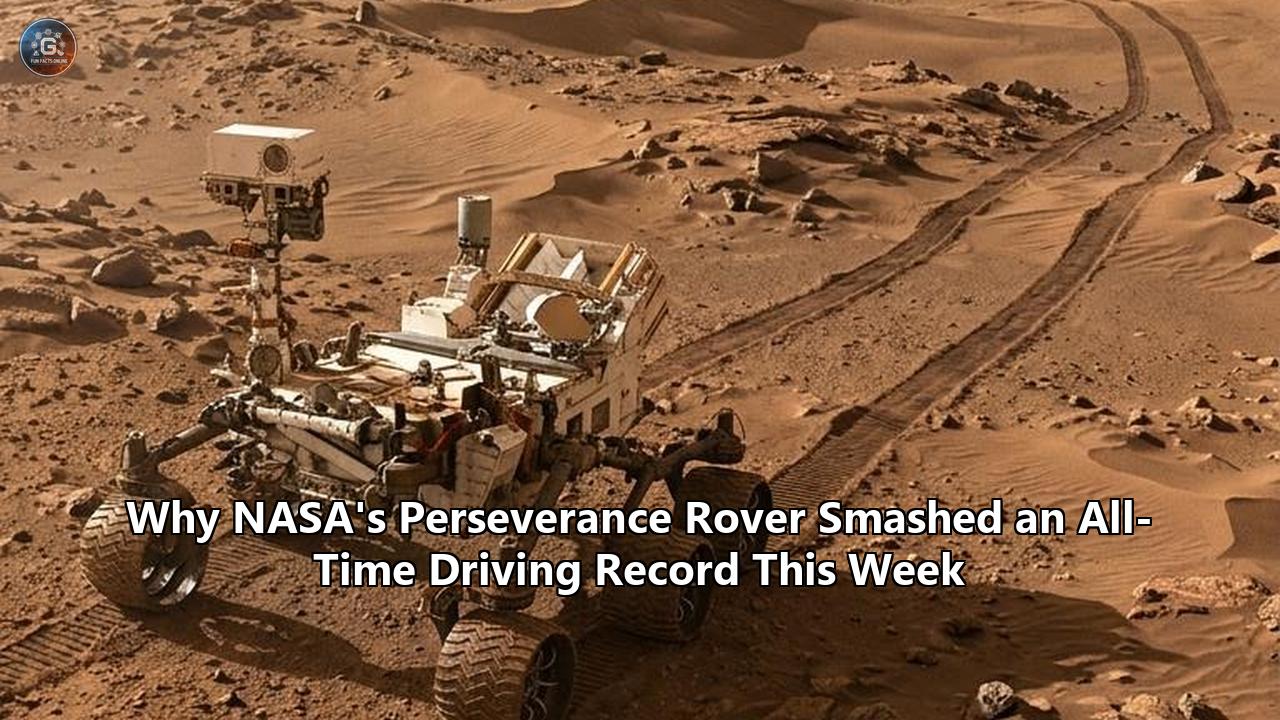
On October 11, 2026, during its 2,006th Martian day of exploration, NASA’s Perseverance rover executed a routine 299.6-foot (91.31-meter) drive across a rocky, ancient plateau beyond the western rim of Jezero Crater. When telemetry reached the Jet Propulsion Laboratory (JPL) in Pasadena, California, the mission's cumulative odometer showed 28.10 miles (45.22 kilometers).
With that short afternoon maneuver, Perseverance officially claimed the all-time extraterrestrial distance crown, establishing a new Perseverance rover driving record by surpassing the 28.06-mile (45.16-kilometer) mark set by the Opportunity rover in 2018.
The achievement represents a tectonic leap in off-world navigation. Opportunity spent 14 years and 5,111 sols grinding through sand dunes and crater rims to complete its historic marathon. Perseverance matched and exceeded that total in five and a half years—traveling nearly three times faster across vastly more unforgiving terrain.
EXTRATERRESTRIAL SURFACE DRIVING DISTANCE BENCHMARKS
──────────────────────────────────────────────────────────────────
Perseverance (Mars, 2021–Present) : ████████████████████ 45.22 km
Opportunity  (Mars, 2004–2018)    : ███████████████████▍ 45.16 km
Lunokhod 2   (Moon, 1973)         : ████████████████▊    39.00 km
Curiosity    (Mars, 2012–Present) : ████████████████▍    38.07 km
Apollo 17 LRV(Moon, 1972)         : ███████████████      35.70 km
Spirit       (Mars, 2004–2010)    : ███▍                  7.70 km
Sojourner    (Mars, 1997)         : ▏                     0.10 km
──────────────────────────────────────────────────────────────────
The milestone was confirmed as the nuclear-powered rover climbed toward a geological formation known as "Idubi," passing through an expanse nicknamed "Lac de Charmes". There, billions of miles away from human hands, the machine was inspecting crustal rocks dating back roughly four billion years—ancient planetary materials erased on Earth by tectonic subduction and atmospheric erosion.
"The rover that broke this record did so by making its own decisions about the path. Given the autonomy to just go, Perseverance is a better driver than the one that landed, and we're not done," said Mark Maimone, deputy team chief for robotic operations on Perseverance at JPL. "Our newest software teaches Perseverance to steer less and roll more, and to check its own position against orbital maps mid-drive."
What began in early 2021 as a slow, cautious validation of mechanical actuators has escalated into an autonomous sprint across Mars. To understand how Perseverance captured this title in a fraction of the time required by its predecessors, one must trace the step-by-step technological and operational escalation that brought the robotic explorer from the floor of Jezero Crater to the summit of its rim.
1997–2018: The Long Road to Jezero
Long-distance surface locomotion on another celestial body was once considered an agonizingly slow proposition. NASA’s first mobile platform on Mars, the 23-pound Sojourner rover delivered by Mars Pathfinder in July 1997, covered just 330 feet (100 meters) during its entire 83-sol operating lifespan. Sojourner moved in increments measured in inches, halting after every tiny lurch to compute 20 distinct spatial measurement points before waiting for ground controllers to confirm its safety.
In January 2004, the twin Mars Exploration Rovers, Spirit and Opportunity, expanded those capabilities. Built to survive 90 Martian days and travel roughly 1,970 feet (600 meters), both far outlasted their warranty. Spirit operated until 2010, recording 4.8 miles (7.7 kilometers) before succumbing to a winter sand trap at Troy. Opportunity pressed on through the undulating basaltic plains of Meridiani Planum, ultimately surrendering to a catastrophic planet-encircling dust storm in June 2018 after logging 45.16 kilometers (28.06 miles).
Opportunity’s endurance established the benchmark against which all future robotic missions would be judged. In July 2014, Opportunity broke the forty-year-old off-world driving record previously held by the Soviet Union’s remote-controlled Lunokhod 2 lunar rover, which had traveled 39 kilometers (24.2 miles) through the Moon’s Le Monnier crater in 1973. Opportunity became the first manufactured machine to complete a full 26.2-mile marathon on another planet.
Yet Opportunity achieved that distance via painstaking manual sequencing. Ground teams at JPL spent hours downloading stereoscopic images, tracing rocks, plotting drive arcs, and uplinking commands overnight. Opportunity possessed an early iteration of autonomous hazard avoidance—AutoNav—but the vehicle’s central processor, a 20-MHz BAE RAD6000 radiation-hardened chip, was strained to its limits. To calculate a collision-free step, Opportunity had to stop rolling, snap stereo images, crunch the numbers for several minutes, advance a few feet, and stop again.
Because of that processing bottleneck, Opportunity relied on autonomous driving for less than 5% of its multi-kilometer lifetime journey. The rest of the traverse was commanded turn-by-turn from Earth.
Curiosity, landing inside Gale Crater in August 2012, introduced a heavier, car-sized mobility architecture with an advanced rocker-bogie suspension and a multi-mission radioisotope thermoelectric generator (MMRTG). However, Curiosity soon encountered severe tire degradation. Pointed ventifacts—wind-sculpted, razor-sharp rocks protruding from the Gale terrain—punched tears and gashes into its thin, 0.75-millimeter aluminum wheels.
JPL engineers were forced to throttle Curiosity’s driving schedules, divert routes into softer sands, and implement reverse-driving protocols to protect the aluminum skin. Through continuous operational adjustments, Curiosity has navigated more than 23.65 miles (38.07 kilometers) over fourteen years, but its top daily speeds were inherently restrained by hardware preservation protocols.
When Perseverance touched down on February 18, 2021, mission engineers carried two decades of accumulated scars and structural lessons. The stage was set for an operational approach that would fundamentally overhaul Martian driving.
Sol 0 to Sol 350: Cautious Footsteps and the Birth of "Thinking While Driving"
Perseverance landed at the Octavia E. Butler Landing site inside Jezero Crater, a 28-mile-wide (45-kilometer-wide) impact basin that had held an open-basin lake fed by a river delta roughly 3.7 billion years ago. The immediate engineering objective was not speed; it was risk mitigation.
The rover was equipped with substantial mechanical upgrades over Curiosity:
- Redesigned Wheels: The diameter was kept at 20.7 inches (52.5 centimeters), but the wheels were made narrower, with thicker skin (roughly double the thickness of Curiosity’s weakest sections) and 48 gently curved cleats instead of chevron-patterned treads. This eliminated the sharp stress-concentration points that had caused Curiosity's skin to tear.
- Dedicated Vision Compute Element (VCE): Unlike previous rovers, which forced their main flight computers to alternate between scientific management, telemetry, and image processing, Perseverance was outfitted with a dedicated Field-Programmable Gate Array (FPGA) co-processor exclusively tasked with visual processing and hazard map construction.
- Upgraded Navigation Cameras: Wide-angle, 20-megapixel color stereo cameras (Navcams) replaced Curiosity’s 1-megapixel grayscale cameras, enabling wide-angle stereo mapping at four times the distance with zero geometric blur.
On March 5, 2021 (Sol 15), Perseverance conducted its first mobility checkout. The rover rolled forward 13 feet (4 meters), executed a 150-degree pivot turn, and backed up 8 feet (2.5 meters), carving its first distinct cleat tracks into the flat, regolith-covered plains. The entire drive covered 21 feet (6.5 meters) and took 33 minutes.
PERSEVERANCE MOBILITY TIMELINE & RECORD ESCALATION
─────────────────────────────────────────────────────────────────────────────
Sol 15  (Mar 2021) : First drive checkout: 6.5 meters in 33 minutes.
Sol 140 (Jul 2021) : AutoNav activated; first autonomous pathfinding test.
Sol 351 (Feb 2022) : Single-sol record shattered: 320 meters through Séítah.
Sol 700 (Feb 2023) : Delta Front campaign concludes; odometer crosses 15 km.
Sol 1250(Sep 2024) : The Rim Climb begins: 500-meter vertical ascent.
Sol 1354(Dec 2024) : Crests Jezero rim at Lookout Hill; 20-degree slopes.
Sol 1850(May 2026) : Apollo 17 & Lunokhod 2 lunar distance records fall.
Sol 2006(Oct 2026) : 91.3-meter drive sets all-time off-world record at 45.22 km.
─────────────────────────────────────────────────────────────────────────────
During the initial 100 sols, driving was slow and deliberate. Perseverance spent extended periods stationary while deploying and supporting the Ingenuity helicopter during its technology demonstration flights. Ingenuity proved to be a valuable scouting asset, capturing aerial imagery of dune fields and boulder fields that rover planners used to chart safe paths through South Séítah.
However, the real transition occurred inside the computer racks on Sol 140 (July 2021), when engineers enabled AutoNav for regular operations.
For the first time on another world, an autonomous navigation system possessed the computing horsepower to generate hazard maps without halting the rover. By offloading image processing to the dedicated FPGA, the system could capture stereo frames, build 3D digital elevation models consisting of 600,000 spatial points per snapshot, evaluate clearances, plot an optimal trajectory, and feed steering adjustments directly to the drive motors while the wheels kept turning at a constant speed of 0.1 miles per hour (4.2 centimeters per second).
JPL roboticists termed this capability "thinking while driving". It transformed rover travel from an episodic series of stops and starts into a sustained, flowing traverse.
Sol 351 to Sol 700: The Crater Floor Sprint
The early signs that Perseverance was destined to demolish planetary distance records emerged in early 2022 during the "Rapid Traverse" campaign. Having completed its initial sampling runs in the South Séítah and Máaz formations on the crater floor, the science team needed to transport the mobile laboratory five kilometers northwest to reach the foot of the ancient river delta.
Under conventional commanding methods, crossing five kilometers of unexplored Martian floor would have consumed an entire operating season. Instead, JPL planners unleashed AutoNav over long stretches of flat regolith peppered with low-lying bedrock.
On February 14, 2022 (Sol 351), Perseverance smashed the single-day Martian driving record by covering 1,050 feet (320 meters) in a single sol. The drive was performed almost entirely through autonomous computation, with the rover negotiating rock clusters and sandy troughs that would have triggered a mandatory safety stop in earlier missions.
ROVER VISION PROCESSING BENCHMARKS (MEASUREMENT POINTS PER GLANCE)
──────────────────────────────────────────────────────────────────
Sojourner (1997)    : 20 points
Spirit/Oppy (2004)  : ~1,600 points
Curiosity (2012)    : ~45,000 points
Perseverance (2021) : 600,000 points
──────────────────────────────────────────────────────────────────
Over the subsequent 30 sols, the rover averaged hundreds of meters per drive. During several exceptional runs through a boulder-strewn flat designated "Snowdrift Peak," Perseverance repeatedly pushed past its own records, ultimately maxing out single-sol traverses at 1,351 feet (412 meters).
The operational tempo escalated because the ground team could shift their workflow. Instead of meticulously mapping every turn around every pebble, the rover planners sat at their workstations at JPL and drew broad, polygonal corridors across high-resolution orbital maps acquired by the High Resolution Imaging Science Experiment (HiRISE) camera aboard the Mars Reconnaissance Orbiter (MRO).
Human planners placed "strategic waypoints" hundreds of meters apart within these corridors. Perseverance was then instructed: Navigate from Waypoint A to Waypoint B, evaluate every rock along the route, stay within the designated boundary, and choose the smoothest surface.
By the time Perseverance reached the base of the delta deposit (the Hawksbill Gap region) on Sol 415, it had completed the multi-kilometer crossing in just over a month. The rover had racked up over 11 kilometers of driving in just over a single Earth year.
At that junction, it was already evident that the original mission design requirement—which called for a platform certified for just 12.4 miles (20 kilometers) of cumulative travel—had massively underestimated what the robotic architecture was capable of delivering.
Sol 700 to Sol 1,250: Conquering the Delta and Neretva Vallis
While flat crater floors provided ideal testing grounds for straight-line velocity, the river delta presented the exact opposite: fractured cliffs, fields of loose boulders dropped by torrential ancient floods, and treacherous sand ripples known as transverse aeolian ridges (TARs).
          CROSS-SECTION: PERSEVERANCE'S CLIMB OUT OF JEZERO CRATER
          ────────────────────────────────────────────────────────

Elevation
  +500m ────────────────────────────────────────── Lookout Hill (Rim Crest)
                                                 /
                                                / [20° Slopes, Loose Scree]
  +250m ───────────────────────────────────────/  Witch Hazel Hill
                                              /
                                             /
    0m  ──── Delta Front (Hawksbill Gap) ───/
        |
        | [Crater Floor / Séítah: Fast AutoNav Flats]
 -200m  ────────────────────────────────────────── Octavia E. Butler Landing
From mid-2022 through early 2024, the mission escalated from open-field sprinting to technical obstacle navigation. As the vehicle worked its way up the front of the delta, AutoNav was confronted with complex, non-geometric terrain hazards:
- Scarp edges: Vertical drops where the river delta had cleaved away, which the computer had to detect early to avoid tipping past its 30-degree mechanical tilt limit.
- Sand traps: Patches of fine, unconsolidated silt where the rover’s six wheels could sink and spin without biting into hard ground.
- Megabreccia and float blocks: House-sized boulders dislodged from crater walls during ancient impact events.
To conquer this labyrinth, JPL uplinks delivered continuous software patches. The mobility team introduced smarter wheel-slip monitoring routines. If the Inertial Measurement Unit (IMU) detected that the wheels were turning faster than the rover was visually advancing across the landscape, the software recognized slip conditions immediately and commanded the rover to halt, back away, and adjust its vector without waiting for intervention from Earth.
Another software enhancement tackled unnecessary maneuvers. Early in the mission, whenever AutoNav encountered a rock field, it frequently executed point-turns—stopping, steering all four corner wheels to an angle, pivoting the chassis in place, and resuming forward motion.
While safe, point-turns caused two major drawbacks: they chewed up the aluminum tread against angular stones, and they consumed precious operating minutes. JPL updated the trajectory planning algorithms to prioritize smooth, continuous arc-turns. The rover learned to weave fluidly around obstacles without arresting its forward progress, dramatically cutting the time and mechanical wear required to traverse dense rock fields.
Along the way, the rover executed complex scientific stops. It drilled and sealed sample after sample in its ultra-clean internal caching mechanism: fine-grained mudstones at "Skrinkle Haven," coarse sandstone at "Wildcat Ridge," and conglomerate boulders at "Mount Washburn."
Even with extended pauses to deploy the sample drill, abrade rock faces, run the PIXL and SHERLOC spectrometers, and drop an initial sample depot of 10 duplicate tubes at "Three Forks," Perseverance maintained a consistent baseline driving cadence. By mid-2024, as the rover completed its sweep of Neretva Vallis—the river channel that breached Jezero’s rim billions of years ago—the vehicle had driven past 28 kilometers, outdistancing every previous Mars rover except Opportunity.
Sol 1,250 to Sol 1,900: The Grueling Rim Climb
In late August 2024, NASA committed Perseverance to its most difficult operational challenge yet: leaving the crater floor behind entirely and scaling the steep western wall of Jezero Crater.
The climb up to the rim crest was designed to access rocks that predate the Jezero impact itself: the ancient basement crust of Mars and megabreccia thrown upward when a massive asteroid excavated the 1,200-kilometer Isidis impact basin 3.9 billion years ago. Scientifically, the journey offered an unprecedented opportunity to study rocks formed during the solar system's earliest era.
Operationally, the rim climb posed a severe threat to the rover's mobility subsystems.
Perseverance had to scale an elevation gain of roughly 1,640 vertical feet (500 vertical meters)—equivalent to climbing an incline taller than the Empire State Building. The terrain was dominated by steep, loose scree, slippery dust blankets, and slopes reaching up to 20 degrees.
               DRIVE TRACTION & TERRAIN COMPARISON
────────────────────────────────────────────────────────────────────────
Feature            Crater Floor (2021)      Western Rim Slope (2024–2025)
────────────────────────────────────────────────────────────────────────
Incline            0° – 5° (Level)          15° – 20° (Extreme Grade)
Substrate          Firm Regolith / Basalt   Loose Talus / Sand-draped Scree
Wheel Slip         < 5%                     Up to 60% – 80% (Forward)
Navigation Mode    Direct AutoNav           Reverse Driving / Zig-Zag Crabbing
Daily Traverse     200 – 400 meters         15 – 50 meters
Thermal Status     Optimal                  Actuators running near thermal limits
────────────────────────────────────────────────────────────────────────
On slopes of that magnitude, the physics of driving a 2,260-pound (1,025-kilogram) machine under Martian gravity (0.38g) shift drastically. When the rover drove forward uphill, its front wheels excavated loose regolith, pushing material backward into the path of the middle and rear wheels. Wheel slip frequently spiked above 60%, and on some sols reached nearly 80%, meaning the drive motors turned for 100 meters of rotational motion while the chassis advanced only 20 meters up the hill.
Rover planners at JPL had to innovate on the fly. They implemented reverse-driving protocols, sending the rover up the slope backward. By reversing up the hillside, the vehicle's mass distribution shifted across the rocker-bogie suspension, maximizing downward pressure on the rear wheels (now leading the climb) and allowing the cleats to bite into firmer substrate below the loose dust.
When the incline became too steep for straight-line reverse driving, planners engineered switchbacks. Perseverance began "crabbing" laterally across the slope face, tacking back and forth across the hillside like a sailboat tacking into an opposing headwind.
Progress was measured not in hundreds of meters per sol, but in dozens. Yet AutoNav continued to process terrain continuously, evaluating local surface tip-tilt metrics with every meter of elevation gained.
In December 2024, Perseverance crested the summit of the rim at a location designated "Lookout Hill". The rover had achieved what no robotic vehicle on Mars had ever attempted: an ascent of a major crater wall from the inside out.
From the crest of Lookout Hill, the rover gazed down upon the entirety of its multi-year journey—the distant landing site, the sprawling sand plains of Séítah, the ribbon of the delta front, and the meandering river channel of Neretva Vallis.
The climb had placed immense strain on the drive actuators, steering pivots, and suspension differential bars. Yet post-climb engineering diagnostics confirmed that every motor, gear assembly, and wheel hull remained in outstanding mechanical health.
Sol 1,900 to Sol 2,006: The Final Push Through Lac de Charmes
Cresting the rim of Jezero marked the start of the Northern Rim science campaign. Moving past Lookout Hill, the rover navigated past "Witch Hazel Hill," a 330-foot (100-meter) sequence of finely layered rock outcrops that preserve an ancient, stacked sequence of early Martian environmental history.
After completing investigations at Witch Hazel, Perseverance descended a gentler outer slope onto the open plains beyond the crater rim, entering a vast geological province dubbed "Lac de Charmes".
                     TRAVERSE TRACK: THE RECORD PUSH
                     ───────────────────────────────

                       [ To Rainbow Falls ]
                                ▲
                                │  (Extended Mission Route)
                                │
                          [ I D U B I ]  ◄── (Hydrothermal Target)
                                ▲
                                │
                           Sol 2,006 Mark: 45.22 km (Record Broken!)
                                ▲
                                │  [299.6-foot / 91.3m Drive]
                                │
                           Sol 2,005 Mark: 45.13 km
                                ▲
                                │
                      [ Lac de Charmes Plains ]
                                ▲
                                │
                      [ Witch Hazel Hill Outcrop ]
                                ▲
                                │
                      [ Lookout Hill (Rim Crest) ]
Free from the confining walls of Jezero and the loose scree of the rim slopes, Perseverance was once again able to open up its throttle. The plains of Lac de Charmes offered broad corridors of ancient bedrock that were less affected by the shock dynamics of the Jezero impact. The target on the horizon was "Idubi," a high-priority scientific region where satellite spectroscopy indicated the possible presence of ancient hydrothermal alteration minerals—chemical environments that could have sustained subterranean microbial life billions of years ago.
As the rover advanced through Lac de Charmes in mid-2026, the mission's cumulative mileage began to cross towering historical milestones:
- May 2026: Perseverance overtook the Apollo 17 Lunar Roving Vehicle's record of 22.2 miles (35.7 kilometers), the maximum distance driven by humans across another planetary body.
- July 2026: The odometer passed 24.2 miles (39 kilometers), moving beyond the mark set in 1973 by the Soviet Union’s Lunokhod 2.
- August 2026: Perseverance crossed 40 kilometers, widening the gap between itself and its operational sibling Curiosity, which was simultaneously working its way through Gediz Vallis inside Gale Crater.
By early October 2026, all eyes at JPL were fixed on Opportunity’s 45.16-kilometer (28.06-mile) mark. On Sol 2,004 and Sol 2,005, a series of automated drives carried Perseverance to within 300 feet of the target.
Finally, on Sol 2,006 (October 11, 2026), the sequence was uplinked. The command sequence instructed the rover to perform a visual-odometry-checked drive across a rocky bench heading directly toward the Idubi outcrop.
Perseverance moved methodically, its Navcams acquiring terrain pairs every couple of meters, its FPGA generating 3D mesh grids, and its software verifying its position against onboard orbital maps. When the drive halted and the rover stowed its mobility system for the Martian night, it had traveled precisely 299.6 feet (91.31 meters).
The new odometer reading: 45.22 kilometers (28.10 miles).
The six-wheeled rover had officially surpassed Opportunity's 14-year record by 40 meters (131 feet). It had taken Perseverance just five years, seven months, and 23 days from landing to rewrite the extraterrestrial record books.
The Engineering Anatomy of Speed: How AutoNav Outpaced History
The dramatic speed difference between Perseverance and every rover that came before it is not a matter of mechanical engine power.
Perseverance does not roll much faster than Curiosity or Opportunity in terms of raw top speed; its brushless DC drive motors are geared to propel the chassis at approximately 0.1 miles per hour (roughly 4.2 centimeters per second) over flat bedrock.
Instead, the Perseverance rover driving record was achieved entirely by eliminating dead computational time.
THE BOTTLENECK REMOVED: STOP-AND-GO VS. CONTINUOUS ROLL
─────────────────────────────────────────────────────────────────────────────
TRADITIONAL ROVER (Opportunity / Early Curiosity):
[Drive 1-2m] ──► [FULL STOP] ──► [Snap Stereo] ──► [Crunch 3-5 min] ──► [Drive 1-2m]
Result: Average effective speed across terrain: ~10 to 20 meters per hour.

PERSEVERANCE AUTONAV (Dedicated FPGA + VCE):
[CONTINUOUS FORWARD ROLL @ 4.2 cm/s]
     ▲                             │
     │ (Real-time motor adjustment)│ (Simultaneous camera capture & 3D mesh)
     └─────────────────────────────┘
Result: Average effective speed across terrain: ~100 to 120 meters per hour.
─────────────────────────────────────────────────────────────────────────────
The Evolution of Computational Architecture
On Opportunity, the RAD6000 flight computer operated at 20 MHz, with 128 MB of DRAM and 3 MB of EEPROM. Image processing competed for clock cycles against thermal management, communications protocols, and science telemetry. Every time Opportunity wanted to assess a hazard, it had to stop all motor rotation to ensure cameras were stable, acquire low-resolution images, process the calculations sequentially, and then re-engage motor relays.
Perseverance decoupled mobility from general housekeeping. It features a BAE RAD750 processor operating at up to 133 MHz with 512 MB of RAM, supported by an advanced FPGA module dedicated purely to the Vision Compute Element.
The rover captures images while rolling at full throttle, processes the pixel grids in parallel hardware circuitry, and builds digital elevation models without reducing its forward speed. While Sojourner processed 20 points per glance and Opportunity analyzed a few thousand, Perseverance processes 600,000 discrete 3D spatial points with every step of its journey.
Map-Relative Localization
In older rovers, visual odometry was purely relative: the rover looked at rocks directly around it, tracked how their pixel coordinates shifted from frame to frame, and estimated how far it had traveled. Over long distances, mathematical drift accumulated. A rover might think it had traveled 100 meters due north, while wheel slip and odometry errors had actually carried it 92 meters north-northeast.
Perseverance received a ground-breaking algorithmic upgrade called Map-Relative Localization (MRL). The rover stores detailed orbital elevation and feature maps created by MRO’s HiRISE camera. As it drives, the rover can cross-reference the features it observes on the surface against its stored orbital maps, resetting its drift to zero mid-drive. This capability allows Perseverance to execute drives hundreds of meters long with absolute positional confidence, navigating tight geological corridors without human oversight.
                  PERSEVERANCE MOBILITY SUBSYSTEM SPECIFICATIONS
──────────────────────────────────────────────────────────────────────────────
Chassis Dimensions      : 10 feet long, 9 feet wide, 7 feet tall (3m x 2.7m x 2.2m)
Total Vehicle Mass      : 2,260 pounds (1,025 kilograms) on Earth; 860 lbs on Mars
Power Source            : Multi-Mission Radioisotope Thermoelectric Generator (MMRTG)
                          (Plutonium-238 decay producing ~110W of continuous power)
Drive Wheels            : 6 machined aluminum wheels, 52.5 cm diameter, 48 cleats
Steering Actuators      : 4 independent steering motors on corner wheels
Suspension System       : Rocker-bogie mechanism capable of clearing 40 cm obstacles
Visual Processing       : Dedicated FPGA Vision Compute Element (VCE)
Navigation Imagery      : Dual 20-megapixel stereo Navcams mounted on 2-meter mast
Autonomy Share          : > 90% of all cumulative distance driven using AutoNav
──────────────────────────────────────────────────────────────────────────────
Wheel Durability and Tire Physics
Curiosity’s wheel damage was an existential threat that forced ground teams into hyper-conservative driving protocols. When rocks punched through Curiosity’s skin, structural stiffness collapsed, threatening the integrity of internal wiring harnesses.
Perseverance’s wheels eliminated this design flaw:
- The aluminum skin thickness was doubled across high-impact zones.
- The chevron cleats were replaced with 48 wave-profile cleats, engineered through extensive testing in JPL's Mars Yard to maximize shear traction in soft sand while distributing concentrated point-loads when rolling over jagged stones.
- After 45.22 kilometers of rolling—including months spent grinding over shattered impact breccia along the rim wall—wheel inspection images captured by the MAHLI-equivalent WATSON camera show only superficial scuffing and scratches, with zero structural punctures or cracks.
Because the mobility hardware showed almost zero structural wear, JPL operators were never forced to restrict Perseverance’s daily traverses to preserve hardware life.
The Scientific Imperative: Why Velocity Matters on Mars
Establishing an extraterrestrial driving record is an exceptional engineering milestone, but NASA does not fund robotic exploration simply to accumulate miles on an odometer. Mobility is directly tied to scientific return.
The fundamental objective of the Mars 2020 mission is to search for signs of ancient biosignatures and collect a diverse suite of rigorously documented rock and regolith samples for eventual return to Earth via the joint NASA-ESA Mars Sample Return (MSR) campaign.
Every additional kilometer traversed unlocks access to a broader cross-section of Martian planetary evolution:
                      STRATIGRAPHIC SAMPLE RECORD ACQUIRED
                      ────────────────────────────────────

Geological Era           Stratigraphic Formation             Samples Collected
──────────────────────────────────────────────────────────────────────────────
Noachian Period          Jezero Crater Western Rim           Ancient basement crust,
(> 3.8 Billion Years)    (Lookout Hill / Witch Hazel)        Isidis impact breccia
                         ─────────────────────────────────────────────────────
                         Lac de Charmes / Idubi              Hydrothermal system
                                                             deposits, altered crust
──────────────────────────────────────────────────────────────────────────────
Early Hesperian Period   Neretva Vallis & Delta Fan          River channel boulders,
(3.5 – 3.8 Billion Yrs)  (Hawksbill Gap / Wildcat Ridge)     Deltaic mudstones,
                                                             Organic-rich siltstones
──────────────────────────────────────────────────────────────────────────────
Late Hesperian / Amazonian  Jezero Crater Floor              Igneous floor units,
(< 3.5 Billion Years)       (Máaz / Séítah Formations)       Olivine-rich cumulates,
                                                             Secondary carbonates
──────────────────────────────────────────────────────────────────────────────
Perseverance has already cored, sealed, and documented 29 distinct sample tubes. By moving rapidly, the science team avoided spending the entire prime mission trapped in a single geological niche.
Had Perseverance possessed the slow, manual locomotion systems of early missions, it would likely still be surveying the lower delta deposits near the crater floor. Instead, its autonomy has transported scientific payloads—including the SHERLOC deep-UV fluorescence spectrometer, PIXL micro-focus X-ray fluorescence instrument, SuperCam laser-induced breakdown spectrometer, and RIMFAX ground-penetrating radar—across three fundamentally distinct geological regimes:
- The Igneous Crater Floor: Revealing that the basin floor was not filled with lake sediments as initially hypothesized, but with ancient volcanic flows and olivine-rich cumulate rocks that provide precise radiometric crystallization dates.
- The River Delta: Revealing fine-grained sedimentary mudstones containing carbonate and sulfate minerals, which preserve high biosignature preservation potential and contain complex aromatic organic molecules.
- The Ancient Crater Rim: Accessing ancient crustal blocks and hydrothermal alterites that date back to the Noachian era, an epoch when Mars possessed a dense atmosphere, a global magnetic field, and active surface water systems.
"The Northern Rim campaign brings us completely new scientific riches as Perseverance roves into fundamentally new geology," explained Ken Farley, Perseverance project scientist at Caltech. "It marks our transition from rocks that partially filled Jezero Crater when it was formed by a massive impact about 3.9 billion years ago to rocks from deep down inside Mars that were thrown upward to form the crater rim after impact. These rocks represent pieces of early Martian crust and are among the oldest rocks found anywhere in the solar system."
Rapid mobility also insulates the mission against component degradation. Scientific instruments on Mars have finite lifespans; detectors degrade under cosmic radiation, laser pump diodes lose efficiency, and thermal cycles stress delicate optical bonds. By driving tens of kilometers in five years rather than fifteen, Perseverance delivered its scientific instruments to high-priority targets while those sensors were operating at peak fidelity.
The 100-Kilometer Horizon: What Lies Ahead
Breaking Opportunity’s record is not a conclusion for Perseverance; it is an operational checkpoint.
NASA recently approved a major mission extension that will fund and direct Perseverance’s operations through the end of 2028. The rover's nuclear power source, the MMRTG, continues to supply steady electricity and vital internal heating, with its plutonium-238 decay profile projecting useful operational power well into the 2030s.
             PROJECTED MISSION MILESTONES (EXTENDED CAMPAIGN)
─────────────────────────────────────────────────────────────────────────────
Late 2026 : Detailed chemical survey and core sampling at Idubi hydrothermal site.
Mid 2027  : Traverse south along crater rim to "Rainbow Falls" megabreccia block.
Late 2027 : Cross 50 kilometers cumulative driving; deploy second sample cache.
Mid 2028  : Long-range trek onto ancient Noachian plains outside Jezero basin.
End 2028  : Extended Mission-1 completes; 60+ kilometers logged.
2030+     : Long-term engineering target: The 100-kilometer off-world mark.
─────────────────────────────────────────────────────────────────────────────
With the off-world driving crown secured, the science and operations teams are already executing the next sequence of long-range moves. After completing investigations of the hydrothermal candidate rocks at Idubi, Perseverance will turn south along the crater rim.
The primary target of the southern extended route is "Rainbow Falls," a colossal 328-foot-wide (100-meter-wide) block of ancient crust uplifted and fractured by the Jezero impact. There, scientists plan to sample deep crustal megabreccia that may represent the primitive mantle-crust boundary of early Mars.
Engineers at JPL have confirmed that the mechanical systems show no signs of systemic failure. Ground-life endurance testing conducted at JPL’s simulated Mars testbeds indicates that the rocker-bogie joints, wheel cleat structures, and actuator gear trains can survive substantial additional mileage.
"The original mission called for no more than 12.4 miles of driving," said Steven Lee, project manager for both the Perseverance and Curiosity rovers at JPL. "We've blown well past that, and with all mobility systems fully operational and favorable extended-ground-life test results, we expect Perseverance to keep adding to this record for many years to come."
Robotic operations teams are already designing software enhancements for future uplinks. JPL engineers are working to enable the rover to evaluate solar illumination vectors dynamically, optimizing drive schedules around shifting shadows that can alter the stereo cameras' depth perception.
Additionally, new predictive traction algorithms will allow AutoNav to sense changes in regolith shear resistance before wheel slip reaches double digits, making drives across steep slopes even faster and safer.
When asked how far the machine could ultimately go, mission drivers do not hesitate to point toward triple digits.
"Our original design was only planned to last for about 20 kilometers of driving," said Mark Maimone. "We've more than doubled that already, and we're looking really good to go for up to 100 kilometers total. We could double what we've done so far."
If Perseverance reaches that 100-kilometer (62-mile) mark, it will establish an extraterrestrial driving benchmark that could stand until human explorers set foot on the Red Planet.
For now, on the dry, windswept plains of Lac de Charmes, the six-wheeled robotic geologist rolls onward, its cameras scanning a path of ancient stone, its silicon mind charting each meter in advance, adding distance with every turn of its wheels to the greatest off-world overland journey humanity has ever launched.
Reference:
- https://www.jpl.nasa.gov/news/nasas-perseverance-sets-off-world-record-for-total-distance-driven/
- https://satnews.com/2026/10/13/nasas-perseverance-mars-rover-breaks-off-world-driving-distance-record/
- https://www.space.com/space-exploration/mars-rovers/nasas-perseverance-mars-rover-breaks-interplanetary-driving-record-and-its-far-from-done
- https://www.iflscience.com/perseverance-beats-opportunity-nasa-rover-has-now-driven-the-furthest-of-any-vehicle-on-the-surface-of-another-world-84919
- https://petapixel.com/2026/10/13/nasa-perseverance-mars-rover-sets-new-record-for-off-world-distance-driven/
- https://www.natureworldnews.com/articles/73539/20261015/nasas-perseverance-rover-breaks-off-world-driving-record-its-team-says-it-could-go-more-twice.htm
- https://www.skyatnightmagazine.com/news/perseverance-rover-record-breaking-distance-travelled
- https://www.sciencealert.com/nasas-perseverance-rover-completes-its-epic-climb-to-crater-rim
- https://www.cbsnews.com/news/perseverance-mars-rover-driving-record-another-world/
- https://www.reddit.com/r/space/comments/sy4xth/perseverance_recently_broke_a_record_for_the_most/
- https://newscord.org/article/nasas-perseverance-rover-sets-off-world-driving-record-at-4522-kilometers--Story_20261013_NasasPerseverancerovc354f179
- https://edition.cnn.com/2024/08/24/science/perseverance-rover-crater-rim-climb
- https://mashable.com/article/nasa-mars-perseverance-rover-jezero-crater-reached-top