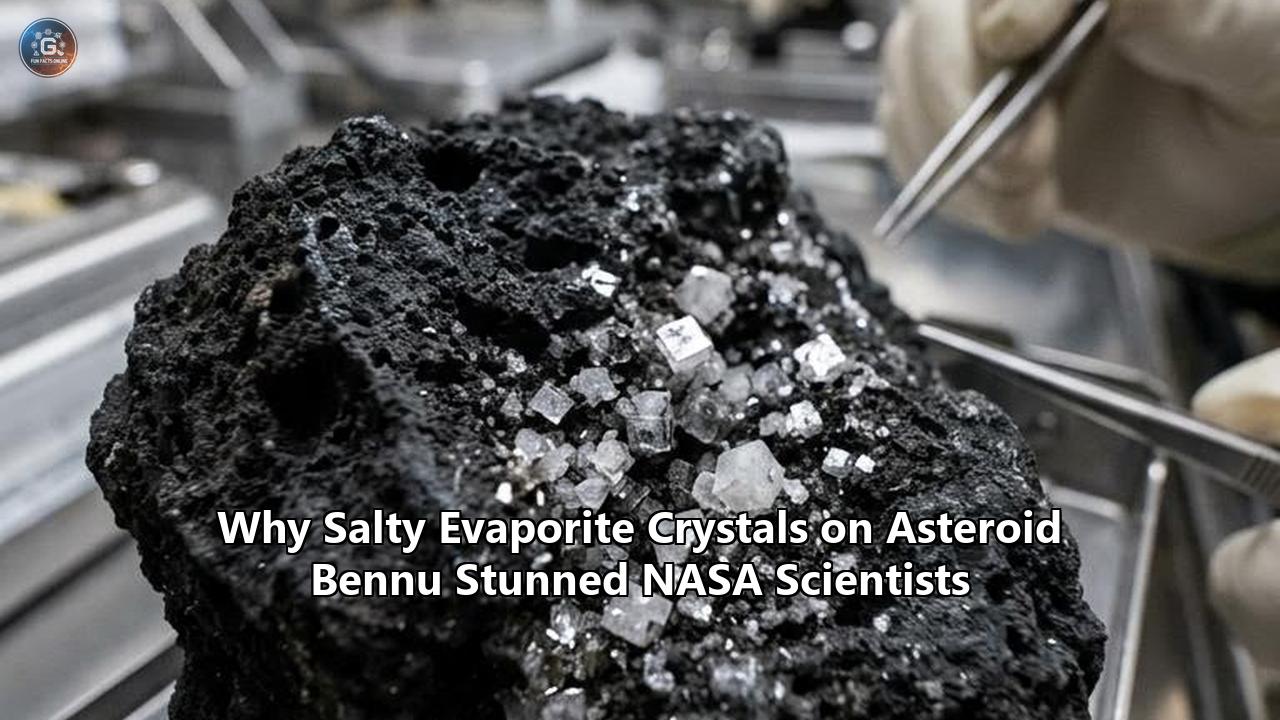
Inside a sealed, ultra-pure nitrogen glovebox at NASA’s Johnson Space Center in Houston, planetary scientists peering through electron microscopes encountered an extraterrestrial scene they had never anticipated. Embedded within the pitch-black, crumbly regolith harvested from asteroid (101955) Bennu were delicate, microscopic needles of salt—crystalline structures less than a tenth the width of a human hair, sparkling against the dark carbonaceous clay.
The discovery, detailed in landmark papers co-led by the Smithsonian Institution, the Natural History Museum in London, and NASA Goddard Space Flight Center, confirmed the presence of a complete sequence of 11 distinct evaporite minerals. Chief among them was trona—a hydrated sodium carbonate compound commonly known as soda ash—marking the first time this mineral has ever been detected in an extraterrestrial sample. Alongside trona lay halite (table salt), sylvite (potassium chloride), sulfates, fluorides, and pure, coarse-grained magnesium-sodium phosphates.
These minerals do not form in space through random collisions or stellar irradiation. On Earth, they precipitate exclusively when long-lasting bodies of saline, alkaline water dry out under steady evaporation. Their discovery inside a 4.5-billion-year-old asteroid collected 200 million miles away proves that Bennu’s parent body once contained persistent pockets of liquid brine—an ancient, warm, chemical broth where water, salts, and the foundational organic ingredients of biology simmered together during the dawn of the solar system.
For decades, planetary researchers classified small carbonaceous asteroids primarily as primitive agglomerations of cosmic dust and primordial ice, lightly altered by localized heating. The revelation that Bennu harbored a dynamic, evolving hydrological system akin to Earth’s desert soda lakes has upended that paradigm, forcing a comprehensive reassessment of where, when, and how prebiotic chemistry unfolded across the early cosmos.
The Chemical Fingerprint of an Evaporated Ocean
The salt crystals retrieved by NASA’s OSIRIS-REx (Origins, Spectral Interpretation, Resource Identification, and Security–Regolith Explorer) mission are not isolated anomalies. They represent an intact evaporite sequence—a chronological, mineralogical diary left behind as mineral-saturated water gradually disappeared.
Primitive Outer Nebula (Water ice, ammonia, CO2, rock)
                        │
                        ▼
Planetesimal Accretion (Radiogenic heating via Al-26)
                        │
                        ▼
Hydrothermal Serpentinization (Alkaline brines, clay formation)
                        │
                        ▼
Fractional Desiccation (Evaporation & boiling in subsurface pockets)
  ├─ Phase 1: Calcite, Dolomite, Magnesite (Insoluble carbonates)
  ├─ Phase 2: Calcium & Sodium Sulfates, Phosphates
  └─ Phase 3: Trona, Halite, Sylvite, Fluorite (Hyper-soluble salts)
                        │
                        ▼
Impact Disruption & Reassembly (Formation of rubble-pile Bennu)
When briny fluids evaporate in closed basins on Earth—such as Searles Lake in California's Mojave Desert or Lake Magadi in the East African Rift—minerals precipitate out of solution in a strict, predictable order governed by thermodynamic solubility. The least soluble compounds drop out first, beginning with calcium carbonates like calcite and dolomite. As the fluid volume contracts and salinity climbs, sulfates crystallize, followed by complex hydrated sodium carbonates such as trona. Finally, when only a hyper-concentrated brine remains, the most soluble halide salts—halite and sylvite—crystallize in the center of the drying basin.
The Bennu samples record this exact physical progression preserved at microscopic scales.
Using high-resolution field emission scanning electron microscopy and focused ion beam milling, researchers identified veins of trona needles measuring between 5 and 10 micrometers in length and less than a micrometer across. These needles cut directly through fine-grained matrix clays rich in serpentine and smectite, with tiny fragments of altered host rock resting atop the crystalline surfaces.
The physical configuration proves that the salts did not condense from high-temperature vapors or freeze out abruptly in a flash-crystallization event. Instead, they were deposited slowly from a cooling, evaporating liquid brine flowing through fractures in the asteroid's interior.
"We're seeing minerals in Bennu samples that we have never seen before in a meteorite or any extraterrestrial sample," explained Dr. Timothy McCoy, curator of meteorites at the Smithsonian’s National Museum of Natural History and co-lead author of the mineralogical study published in Nature. "I've been studying meteorites for 35 years and had never seen this mineral before. That was really the breakthrough that told us we were looking at an ancient evaporite sequence".
The suite of 11 identified minerals constitutes a geochemical fingerprint of a long-lived, alkaline, sodium-dominated hydrothermal system:
- Trona ($\text{Na}_3(\text{CO}_3)(\text{HCO}_3)\cdot 2\text{H}_2\text{O}$): A hydrated sodium sesquicarbonate that requires high concentrations of dissolved carbon dioxide and sodium in alkaline waters under continuous evaporation.
- Halite ($\text{NaCl}$) and Sylvite ($\text{KCl}$): Highly soluble chloride salts that represent the terminal stages of desiccation, crystallizing only when an evaporating fluid has lost nearly all of its free water.
- Magnesium-Sodium Phosphate: First detected during preliminary analyses in mid-2024, this mineral displayed unprecedented grain sizes and a total absence of mineral inclusions, pointing to sustained crystallization from quiet, carbonate-saturated brines.
- Carbonates and Sulfates: A broader matrix of calcite, dolomite, magnesite, and sodium-bearing sulfates that formed during the early and intermediate stages of fluid evolution.
- Fluorite ($\text{CaF}_2$): Halide precipitates confirming the concentration of halogen elements within the late-stage brine pockets.
Prior to the return of the Bennu samples, researchers had observed isolated salt crystals—such as tiny halite grains in the Monahans and Zag meteorites—but never a coherent, multi-mineral suite charting the systematic desiccation of an extraterrestrial aqueous reservoir. The existence of this intact sequence provides direct physical evidence that liquid water was neither a brief nor a catastrophic visitor on Bennu’s ancestral world. It lingered, circulated, reacted, and evaporated over thousands to tens of thousands of years.
Why Meteorites Kept the Salt a Secret
The immediate question confronting planetary scientists was stark: if ancient asteroids harbored widespread salt brines, why had more than two centuries of meteorite research failed to discover this complete evaporite sequence?
The answer lies in the harsh physics of atmospheric entry and the chemical vulnerability of the evaporite minerals themselves.
Every meteorite resting in museum collections across the globe had to endure a fiery plunge through Earth's atmosphere. During entry, meteoric fireballs experience external temperatures reaching thousands of degrees Celsius, accompanied by severe mechanical shock and acoustic pressures. While interior materials often remain cool, volatile and delicate crystalline lattices can suffer thermal shock and micro-fracturing.
Far more destructive, however, is what happens after the meteorite hits the ground.
Earth is an oxidizing, water-drenched environment. When a carbonaceous chondrite lands in a field, a forest, or even an Antarctic ice sheet, it encounters terrestrial humidity. Hydrated salts like trona, halite, and sodium sulfates are water-soluble and hygroscopic. They pull water molecules straight out of ambient air.
To prove this vulnerability, the OSIRIS-REx sample analysis team performed a telling experiment. They took microscopic grains of Bennu regolith containing trona needles out of their protective, inert nitrogen environment and left them exposed to ordinary laboratory air. Within days, the atmospheric moisture caused the fragile trona crystals to dissolve, recrystallize, and break down.
Any meteorite falling naturally to Earth would lose its trona and related evaporites long before a recovery team could log its GPS coordinates. Terrestrial moisture acts as an eraser, wiping away the most delicate chemical evidence of ancient extraterrestrial water.
                     METEORITE PATHWAY VS. SAMPLE RETURN

Natural Meteorite:
Space Asteroid ──► Atmospheric Entry (Thermal Shock) ──► Terrestrial Landing ──► Rain/Air Exposure ──► Evaporites Dissolved & Lost
                                                                                                        (History Erased)

OSIRIS-REx Mission:
Space Asteroid ──► Hermetic Seal in Space ──► Parachute Landing ──► Immediate Nitrogen Purge ──► Pristine Trona Crystals Preserved
                                                                                                  (Discovery Revealed)
This chemical fragility underscores the transformative value of robotic sample return missions. When OSIRIS-REx touched Bennu’s surface on October 20, 2020, its Touch-And-Go Sample Acquisition Mechanism (TAGSAM) fired a blast of pure nitrogen gas to fluidize the regolith, capturing an abundant 121.6 grams (4.29 ounces) of material.
The spacecraft transported that sample through deep space, sealed inside a reverse-engineered heat shield and sample return capsule. On September 24, 2023, the capsule touched down within the Department of Defense’s Utah Test and Training Range. Within hours, recovery teams transferred the capsule into a mobile cleanroom with a continuous nitrogen purge, preventing Earth's atmosphere from ever touching the sample.
At the Astromaterials Research and Exploration Science (ARES) division at NASA Johnson Space Center, curators disassembled the hardware inside customized gloveboxes filled with ultra-pure nitrogen. Only under these rigorously controlled, anhydrous conditions could an evaporite sequence from the birth of the solar system survive intact for scientific study.
The Prebiotic Broth: A Stupendous Organic Factory
The evaporite minerals did not exist in an inorganic vacuum. They were embedded in a matrix overflowing with organic matter, volatile chemicals, and the direct building blocks of cellular biology.
In a parallel paper published in Nature Astronomy, a research team co-led by Dr. Daniel Glavin and Dr. Jason Dworkin of NASA Goddard Space Flight Center documented the organic inventory within the Bennu regolith. The findings established that Bennu contains one of the richest, most complex suites of prebiotic chemicals ever recovered from space.
Scientists identified:
- 33 Distinct Amino Acids: Including 14 of the 20 protein-building amino acids utilized by all terrestrial life, accompanied by 19 non-proteinogenic amino acids rarely found in terrestrial biology.
- All Five Canonical Nucleobases: Adenine, guanine, cytosine, thymine, and uracil—the complete molecular alphabet required to construct both DNA and RNA.
- Abundant Precursor Volatiles: Strikingly high concentrations of ammonia ($\text{NH}_3$) and formaldehyde ($\text{HCHO}$), along with amines, carboxylic acids, and polycyclic aromatic hydrocarbons (PAHs).
- Over 10,000 Nitrogen-Bearing Organic Species: Indicating a vast, chemically diverse organic network spanning thousands of distinct molecular architectures.
The abundance of ammonia inside Bennu proved particularly astonishing: it was measured at levels roughly 75 times higher than those detected in samples of asteroid Ryugu, returned by Japan’s Hayabusa2 mission in 2020. Because ammonia ice sublimates rapidly at temperatures found in the inner solar system, its extreme concentration points directly to Bennu’s deep ancestral roots in the freezing outer reaches of the proto-planetary disk, far beyond the orbit of Saturn.
                     PREBIOTIC CHEMISTRY IN BENNU BRINES

Volatile Precursors                 Evaporative Incubation                Complex Biomolecules
┌─────────────────┐                 ┌────────────────────┐                ┌──────────────────┐
│  Ammonia (NH3)  │                 │  Evaporating Brine │                │  14 Protein      │
│  Formaldehyde   ├────────────────►│  Pools (Trona,     ├───────────────►│  Amino Acids     │
│  Hydrogen       │  Strecker-type  │  Halite, Clays)    │ Polymerization │  All 5 DNA/RNA   │
│  Cyanide (HCN)  │    Reactions    │  High pH, High Salinity             │  Nucleobases     │
└─────────────────┘                 └────────────────────┘                └──────────────────┘
The convergence of the evaporite sequence and this rich organic inventory solves a long-standing thermodynamic puzzle that has plagued origin-of-life models: the so-called "water paradox."
Liquid water is an absolute prerequisite for life because it dissolves ions, facilitates transport, and mediates metabolic biochemistry. Yet, in an open, dilute prebiotic ocean, water poses a fatal thermodynamic barrier to the assembly of complex biopolymers.
Joining amino acids into proteins, or linking sugars and nucleobases into RNA chains, requires condensation reactions—chemical bonds that expel a molecule of water. In an infinite, dilute aqueous medium, the chemical equilibrium favors hydrolysis (the splitting of molecules by water) over polymerization. Simple building blocks dissolve and disperse; they do not assemble into long macromolecular chains.
Evaporating brines completely alter that thermodynamic equation.
When mineral-rich fluids pool inside porous rock fractures and slowly evaporate, several critical geochemical mechanisms engage simultaneously:
- Concentration of Reactants: Dilute amino acids, formaldehyde, and cyanide compounds are forced into tight physical proximity as the water volume shrinks, dramatically increasing the frequency of molecular collisions.
- Thermodynamic Dehydration: Evaporative loss of water drives condensation reactions forward, naturally overcoming the energetic barrier to forming peptide bonds and phosphodiester backbones.
- Catalytic Mineral Templates: Clay minerals like serpentine, along with the surfaces of crystallizing carbonates and salts, serve as mineral scaffolds that align organic monomers, protecting them from degradation and guiding stereochemical orientation.
- Phosphate Mobilization: Phosphorus is an indispensable structural pillar of genetics (forming the backbone of RNA and DNA) and bioenergetics (ATP), but on Earth it is usually locked away in highly insoluble apatite minerals. The magnesium-sodium phosphates discovered on Bennu are water-soluble. In an alkaline brine, they freely dissolve, releasing bioavailable phosphorus directly into the reacting chemical stew.
"You can have all the ingredients for whatever you want to make, but you have to have the environment to make them do something," observed Dr. McCoy. "These papers really go hand in hand in trying to explain how life's ingredients actually came together to make what we see on this aqueously altered asteroid".
The discovery reveals that ancient asteroids were not merely passive delivery trucks carting frozen, raw prebiotic building blocks to a lifeless Earth. They were active chemical crucibles—incubators where the initial steps of macromolecular assembly were already occurring within briny subsurface fractures before Earth had even fully formed.
Reconstructing Bennu’s Ancestral Water World
How did a jagged, 500-meter-wide "rubble pile" asteroid like Bennu ever support liquid brine pools capable of sustained evaporation?
Bennu itself is not a monolithic, geologically integrated world. It is a loose agglomeration of cosmic gravel, boulders, and dust held together by microgravity, featuring a bulk density so low that roughly 50 to 60 percent of its internal volume is empty void space. The asteroid could not generate the internal heat or gravitational pressure required to hold an atmosphere or maintain liquid water on its modern surface.
Instead, Bennu is a surviving shard of an ancient parent body—a miniature planetesimal roughly 100 to 150 kilometers in diameter that formed in the outer solar system approximately 4.56 billion years ago.
                     CHRONOLOGY OF BENNU'S EVOLUTION

4.56 Billion Years Ago:
Parent planetesimal accretes beyond the snowline, rich in ice, rock, and Aluminum-26.
                        │
                        ▼
4.55 - 4.54 Billion Years Ago:
Radiogenic decay of Al-26 melts interior ice. An interior hydrothermal network develops,
producing alkaline brines, serpentinization, and evaporite deposition inside fractures.
                        │
                        ▼
1.0 - 2.0 Billion Years Ago:
A catastrophic collision shatters the parent planetesimal. A small fraction of the shattered,
mineralized rubble re-accretes under mutual gravity to form Bennu.
                        │
                        ▼
Present Day:
Bennu orbits in near-Earth space until OSIRIS-REx captures and returns pristine regolith.
By synthesizing mineralogical, isotopic, and orbital dynamics data, scientists have reconstructed the lifecycle of this vanished world:
1. Accretion in the Outer Solar System
During the solar system's first two million years, the parent body accreted from a mix of silicate dust, refractory organics, and ices—water, carbon dioxide, methane, and abundant ammonia. Critically, it also swept up short-lived radioactive isotopes synthesized in nearby supernovae, predominantly Aluminum-26 ($^{26}\text{Al}$) with a half-life of roughly 717,000 years.
2. Radiogenic Heating and Ice Melting
As $^{26}\text{Al}$ decayed, it released steady radiogenic heat into the planetesimal's interior. Shielded by a thick, frozen outer crust of ice and dust, the internal temperature rose above 0 degrees Celsius, melting the interior ice into liquid water.
3. Hydrothermal Alteration and Serpentinization
The liquid water reacted vigorously with primitive iron-magnesium silicates (such as olivine and pyroxene). This process—known as serpentinization—converted the primary minerals into serpentine and smectite clays, oxidizing iron and releasing alkaline fluids rich in dissolved cations ($\text{Na}^+$, $\text{K}^+$, $\text{Mg}^{2+}$, $\text{Ca}^{2+}$). This chemistry mirrors the geochemical conditions found at mid-ocean ridge hydrothermal systems on Earth, such as the Lost City hydrothermal field.
4. Pockets of Boiling and Evaporation
Because the planetesimal possessed low overall gravity, pressure inside subsurface fractures was modest. In localized pockets where hydrothermal waters approached 50 to 100 degrees Celsius, fluids boiled and degassed volatile compounds like $\text{CO}_2$, $\text{H}_2\text{O}$, and $\text{NH}_3$.
Alternatively, as fluids migrated along fracture networks toward the freezing vacuum of space, water molecules escaped into the void. The remaining solutions transformed into hyper-concentrated alkaline brines. As desiccation proceeded inside these isolated conduits over centuries, the complete evaporite sequence crystallized: first carbonates, then sulfates, followed by trona needles, and finally halite, sylvite, and phosphates.
5. Catastrophic Disruption and Reassembly
Between 1 and 2 billion years ago, a massive impact by another asteroid shattered the parent body into fragments. While most of the shattered debris scattered across the main asteroid belt, a tiny fraction of the fragmented rubble re-accreted under mutual gravitational attraction to form the rubble-pile asteroid Bennu.
The minerals preserved inside Bennu's modern regolith are literal fragments of the fractured plumbing of that ancient, long-dead brine world.
The Cosmic Web of Salty Worlds: Ceres, Enceladus, and Ryugu
The detection of an intact evaporite sequence on Bennu does not stand in isolation. It anchors a rapidly coalescing realization among planetary scientists: alkaline, salt-saturated hydrothermal systems are common across the solar system.
                     COMPARATIVE GEOCHEMISTRY ACROSS SOLAR SYSTEM BODIES

Target Body       Water Environment                   Key Evaporites/Salts Detected            Data Source
────────────────────────────────────────────────────────────────────────────────────────────────────────────────────────
Asteroid Bennu    Ancient subsurface brine pockets    Trona, Halite, Sylvite, Mg-Na Phosphate   Returned Sample (OSIRIS-REx)
Asteroid Ryugu    Ancient aqueous alteration channels Carbonates, Sulfates, Sodium Salts        Returned Sample (Hayabusa2)
Dwarf Planet      Deep relict ocean / cryomagma      Sodium Carbonate, Ammonium Chloride,      Remote Sensing (Dawn)
  Ceres           chambers (Occator Crater)           Halite
Moon Enceladus    Active global subsurface ocean      Sodium Carbonate, Sodium Chloride,        Plume Sampling (Cassini)
  (Saturn)        venting through south polar ice     Phosphates
Consider the dwarf planet Ceres, the largest object in the asteroid belt. When NASA’s Dawn spacecraft entered orbit around Ceres in 2015, it photographed brilliant, reflective white deposits decorating the floor of Occator Crater. Infrared spectrometers revealed that these deposits—the Cerealia and Vinalia Faculae—consist of vast mounds of crystallized sodium carbonate, ammonium chloride, and halite. Scientists determined that an ancient impact punctured Ceres’s icy crust, allowing deep-seated, salty cryomagma to erupt onto the surface, where the water sublimated into space and left behind gleaming salt flats.
Farther out, at Saturn’s icy moon Enceladus, the Cassini spacecraft flew directly through the cryovolcanic geyser plumes erupting from fractures in its south polar terrain. Cassini’s Cosmic Dust Analyzer identified ice grains containing dissolved sodium chloride, sodium carbonate, and potassium salts, alongside dissolved hydrogen gas and organic macromolecules. In 2023, independent analyses confirmed high concentrations of dissolved sodium phosphates in the plume particles.
Meanwhile, JAXA’s Hayabusa2 mission returned 5.4 grams of regolith from the carbonaceous asteroid Ryugu. Laboratory studies revealed that Ryugu had also undergone extensive aqueous alteration, showing salt minerals including carbonates and traces of sodium salts.
Yet, Bennu’s samples stand apart in their pristine preservation, their extreme concentration of outer solar system ammonia, the size and chemical purity of their phosphates, and their complete, contiguous evaporite series.
"Processes that occurred on one likely occurred on many or most similar asteroids, and likely on icy moons," remarked Dr. McCoy. "The salts resemble those recently discovered on the dwarf planet Ceres and on icy moons orbiting Jupiter and Saturn, which likely host subsurface oceans".
These cross-body correlations demonstrate that small planetesimals in the early solar system possessed geochemical machinery fundamentally identical to the processes that govern icy ocean moons today. The chemistry that produces soda lakes on Earth, bright faculae on Ceres, cryovolcanic geysers on Enceladus, and trona veins on Bennu is universal.
Wherever liquid water, basic rock silicates, carbon, and heat converge in the cosmos, an alkaline, organic-rich brine naturally emerges.
State-of-the-Art Forensic Mineralogy
Detecting an 11-mineral evaporite sequence inside microscopic fragments required analytical tools operating at the physical limits of spatial and chemical resolution.
The consortium studying the OSIRIS-REx samples involved more than 66 scientists across four continents, coordinating an analytical workflow that treated every sub-millimeter particle as an irreplaceable archaeological archive.
┌────────────────────────────────────────────────────────────────────────┐
│                   SAMPLE ANALYSIS PIPELINE (ARES / NASA)               │
└───────────────────────────────────┬────────────────────────────────────┘
                                    │
       ┌────────────────────────────┼────────────────────────────┐
       ▼                            ▼                            ▼
┌──────────────┐             ┌──────────────┐             ┌──────────────┐
│  Synchrotron │             │ Focused Ion  │             │ Atom Probe   │
│  STXM (ALS)  │             │ Beam (FIB)   │             │ Tomography   │
└──────┬───────┘             └──────┬───────┘             └──────┬───────┘
       │                            │                            │
       │ Mapping Carbon &           │ Slicing Ultrathin          │ 3D Atomic-    │
       │ Carbonate Bonds            │ Sections (<100 nm)         │ Lattice Map   │
       └────────────────────────────┼────────────────────────────┘
                                    │
                                    ▼
                     ┌─────────────────────────────┐
                     │ High-Resolution Analytical  │
                     │  TEM & ToF-SIMS Chemistry   │
                     └─────────────────────────────┘
The analytical process relied on several primary methodologies:
- Synchrotron Scanning Transmission X-ray Microscopy (STXM): Conducted at the Advanced Light Source (ALS) and Molecular Foundry at the Lawrence Berkeley National Laboratory. STXM utilized finely tuned synchrotron X-rays to map the chemical bonding environments of carbon, oxygen, sodium, and magnesium at spatial resolutions below 30 nanometers. This technique allowed researchers to differentiate between organic macromolecular carbon and inorganic diffuse carbonate salts without altering the delicate host clay.
- Focused Ion Beam (FIB) and Transmission Electron Microscopy (TEM): At laboratories like the Kuiper-Arizona Laboratory for Astromaterials Analysis at the University of Arizona, researchers used focused gallium ion beams to carve ultrathin sections—less than 100 nanometers thick—directly out of selected regolith grains. These slices were then transferred to aberration-corrected TEMs, enabling atomic-lattice imaging of the needle-like trona structures.
- Time-of-Flight Secondary Ion Mass Spectrometry (ToF-SIMS) and NanoSIMS: Used to pinpoint trace isotopic variations and elemental distributions across mineral boundaries, identifying sodium, potassium, fluorine, and chlorine within microscopic salt crystals.
- Chromatography and Mass Spectrometry: At NASA Goddard’s Astrobiology Analytical Laboratory, ultra-high-performance liquid chromatography coupled with Orbitrap high-resolution mass spectrometry was deployed to extract, isolate, and identify amino acids, nucleobases, and volatile amines down to parts-per-billion concentrations.
The technical challenge was magnified by the fragility of the samples. Because many of the evaporites degrade upon exposure to ambient room moisture, all sample preparation, transfer between instruments, and staging had to occur within dry nitrogen transfer vessels or ultra-high vacuum chambers.
Without this multi-million-dollar analytical infrastructure, the salts that stunned NASA scientists would have dissolved into an invisible residue before their discovery could be documented.
The Handedness Conundrum: A Lingering Prebiotic Mystery
While the discovery of evaporites and organic compounds has confirmed the existence of prebiotic incubators in the early solar system, it has simultaneously deepened one of science’s greatest biochemical mysteries: the origin of homochirality.
Many complex biological molecules, including amino acids, exist in two mirror-image configurations—designated as "left-handed" (L) or "right-handed" (D) enantiomers, like a pair of human hands.
Standard abiotic chemistry produces a perfectly balanced, 50/50 mixture of both forms, known as a racemic mixture. Yet, terrestrial life is strictly homochiral: proteins across every domain of life—from bacteria to humans—are constructed almost exclusively out of left-handed amino acids, while DNA and RNA backbones are built exclusively out of right-handed sugars.
In several previously studied meteorites, such as the famous Murchison meteorite that fell in Australia in 1969, researchers reported small excesses of left-handed amino acids (up to 18 percent for certain non-protein amino acids like isovaline). Those earlier findings suggested that the bias toward left-handed biology might have been imprinted by polarized ultraviolet light in interstellar space before being delivered to Earth.
The Bennu samples tell a different, more confounding story.
Detailed isotopic and chromatographic analysis of the amino acids recovered from Bennu revealed that they are essentially racemic—displaying equal mixtures of left- and right-handed forms within measurement uncertainties.
"Life on Earth almost exclusively produces the left-handed variety, but the Bennu samples contain an equal mixture of both," observed Dr. Jason Dworkin, OSIRIS-REx project scientist at NASA Goddard. "This means that on early Earth, amino acids may have started out in an equal mixture, as well. The reason life 'turned left' instead of right remains a mystery".
                     THE HOMOCHIRALITY DILEMMA

         Abiotic Nebula Synthesis:
         50% Left-Handed (L)  │  50% Right-Handed (D)
                              │
                              ▼
         Bennu Asteroid Samples:
         50% L-Amino Acids    │  50% D-Amino Acids  (Racemic)
                              │
                              ├──────────────────────────────────────────┐
                              ▼                                          ▼
         Hypothesis A: Surface Selection            Hypothesis B: Late Terrestrial Symmetry Breaking
         Chiral mineral faces (e.g., quartz,        Autocatalytic amplification in early Earth lakes
         calcite) selectively absorbed L-forms.     pushed a racemic prebiotic mix toward 100% L-life.
The finding leads to two major hypotheses:
- Mineral Surface Sorting: Primordial space rocks delivered a symmetric, racemic prebiotic broth to the early Earth. The symmetry-breaking event that established left-handed dominance occurred on terrestrial ground, perhaps through selective adsorption onto chiral crystal faces of common minerals like quartz or calcite.
- Autocatalytic Amplification: A purely racemic starting pool on early Earth was pushed toward homochirality through spontaneous symmetry-breaking reactions and self-replicating chemical loops during the very earliest stages of cellular emergence.
By demonstrating that pristine extraterrestrial material contains a strictly balanced mixture of enantiomers, the Bennu samples rule out simplistic models claiming that space rocks directly delivered an already left-handed biology to our planet. The ingredients were delivered in abundance, but the final evolutionary turn toward left-handed biochemistry was settled on Earth itself.
Expanding the Horizon of Asteroid Bennu Discoveries
The publication of the evaporite and organic studies represents the opening chapter of a research campaign scheduled to span multiple decades.
NASA’s curation protocols mandate that the agency retain approximately 70 percent of the returned Bennu material inside the pristine nitrogen storage vaults at Johnson Space Center. This material is held in reserve for future generations of planetary scientists, who will apply analytical instruments and methodologies that do not yet exist.
Already, the international allocation of samples is underway:
- International Partners: A portion of the sample has been formally transferred to the Japan Aerospace Exploration Agency (JAXA) under a reciprocal sample-sharing agreement for Hayabusa2’s Ryugu material. The Canadian Space Agency (CSA), which provided the OSIRIS-REx Laser Altimeter (OLA), has received its dedicated share of the regolith.
- Global Research Community: NASA’s Astromaterials Sample Allocation Commission opened the catalog for formal proposals from researchers worldwide, expanding sample distribution to academic institutions across North America, Europe, Asia, and Australia.
Simultaneously, the OSIRIS-REx spacecraft itself continues its deep-space voyage.
After ejecting its sample return capsule into Earth’s atmosphere on September 24, 2023, the mothership fired its thrusters, altered its trajectory, and embarked on an extended mission renamed OSIRIS-APEX (OSIRIS-Apophis Explorer).
In April 2029, the spacecraft will rendezvous with asteroid (99942) Apophis shortly after the 340-meter asteroid makes an unprecedentedly close flyby of Earth, skimming just 20,000 miles above our planet's surface—closer than geostationary communications satellites. OSIRIS-APEX will enter orbit around Apophis, operating its cameras and spectrometers to examine how Earth’s gravitational tides alter the asteroid’s surface, spin state, and structural integrity.
The lessons derived from the recent findings continue to guide astronomers as they analyze data from other ongoing small-body missions. NASA’s Lucy spacecraft is currently touring Jupiter’s Trojan asteroids, while the Psyche mission is traversing the asteroid belt toward the metal-rich asteroid 16 Psyche, scheduled to arrive in 2029.
Every new datum reinforces the central lesson taught by the salty evaporite needles inside Bennu: small, dark asteroids are not simple, inert lumps of slag drifting through the dark. They are intricate, ancient chemical laboratories.
Four and a half billion years ago, as dust and gas coalesced into planets around the newborn Sun, long-lost ocean worlds heated up, circulated mineral-rich waters, and evaporated briny broths. In doing so, they cooked up the complex, salt-stabilized prebiotic recipes that made life on Earth possible—and left behind tiny, glittering crystals of table salt and soda ash to prove it.
The Chemical Timeline: Bennu vs. Early Earth
To contextualize the timescale of the Bennu discoveries, consider how the geochemical evolution of the asteroid's parent body directly predated and overlapped with the formative stages of the early Earth:
| Era / Date | Events on Bennu's Parent Planetesimal | Events on Primordial Earth |
|---|---|---|
| 4.567 Billion Years Ago | Accretion of ice, refractory dust, organic volatiles, and $^{26}\text{Al}$ in the cold outer solar nebula. | Protoplanetary core accretes within the inner terrestrial zone of the proto-solar disk. |
| 4.565 – 4.540 Billion Years Ago | Radiogenic heating melts interior ice; alkaline hydrothermal networks develop; serpentinization occurs; evaporation in fractures leaves an 11-mineral salt suite and concentrated amino acids. | Earth undergoes the Giant Impact with Theia, forming the Moon; global magma ocean blankets the planet; all early surface volatiles vaporize. |
| 4.500 – 4.000 Billion Years Ago | Interior water completely sublimates or free-cycles; hydrothermal activity ceases; evaporites remain frozen and pristine inside deep rock fractures. | Earth cools, solid crust forms, water vapor condenses into first global oceans; continuous heavy bombardment delivers extraterrestrial organics and water. |
| 3.800 – 3.500 Billion Years Ago | Parent body drifts quietly in the asteroid belt, protected from solar wind and heating within the asteroid belt. | Earliest isotopic and fossil evidence for microbial life appears in Earth's rock record (Isua, Pilbara). |
| 1.000 – 2.000 Billion Years Ago | Catastrophic collision shatters parent planetesimal; shattered debris re-accumulates under gravity to form the rubble-pile asteroid Bennu. | Proterozoic Earth witnesses the emergence of complex eukaryotic cells and oxygenation of oceans. |
| September 2023 – Present | OSIRIS-REx delivers pristine regolith to Earth; analysis reveals intact trona, halite, and prebiotic broth preserved for 4.5 billion years. | Laboratory analysis confirms that asteroids acted as self-contained incubators for prebiotic chemistry. |
Critical Analytical Techniques in the Bennu Discoveries
The detection and confirmation of the fragile salt crystals required a multi-tiered array of microscopic and spectroscopic instruments, each serving a targeted forensic function:
                            ANALYTICAL SUITE CAPABILITIES

Instrument                        Primary Target                       Scientific Insight Gained
─────────────────────────────────────────────────────────────────────────────────────────────────────────────────
Scanning Transmission X-Ray       Carbon Functional Groups,           Differentiated between inorganic carbonate
  Microscopy (STXM)               Bonding Inorganics                  salts and surrounding macromolecular organic carbon.

Field Emission Scanning Electron  Micro-morphology, Vein Structures,  Identified delicate needle structures of trona
  Microscopy (FE-SEM)             Crystalline Geometry                intercutting clay-rich rock matrices.

Transmission Electron             Atomic Lattice Spacings,            Confirmed crystalline phase identities and ruled out
  Microscopy (TEM)                Nanocrystal Boundaries              amorphous or flash-frozen condensates.

Focused Ion Beam (FIB)            Sample Preparation                  Extracted 100-nm thin sections from regolith grains
                                                                      without atmospheric moisture exposure.

Ultra-High Performance Liquid     Soluble Organics, Amino Acids,      Quantified 33 amino acids, all five genetic
  Chromatography-Mass Spec        Nucleobases, Ammonia                nucleobases, and ammonia concentrations.

Secondary Ion Mass                Isotopic Fingerprints (D/H,         Traced volatile origins to cold, outer-solar
  Spectrometry (NanoSIMS)         15N/14N), Elemental Halogens        system or interstellar cloud reservoirs.
Open Questions Driving Future Analysis
As sample allocations continue to reach laboratories across North America, Europe, and Asia, several critical scientific questions remain unanswered:
- The Origin of Soluble Boron: Hypersaline soda lakes on Earth, such as Searles Lake, are heavily enriched in boron, an element that plays an essential chemical role in stabilizing the ribose sugar backbone of RNA. Yet, preliminary analyses indicate the Bennu samples are largely depleted in boron. Researchers are conducting targeted micro-spectroscopy to determine whether boron is concealed within rare accessory phases or if prebiotic RNA-world chemistry on the asteroid utilized alternative molecular scaffolds.
- Isotopic Micro-Mapping of Brine Conduits: Were the evaporating brines derived exclusively from melting nebular ice, or was there an influx of cometary or outer-system volatiles late in the parent planetesimal's life? High-precision oxygen and hydrogen isotope measurements of individual trona and halite crystals will pinpoint the exact isotopic reservoir of the parent body’s ancient water.
- Search for Peptides and Macromolecular Chains: While monomers like amino acids and nucleobases are abundant, researchers are scouring the sample for oligomers—short chains of linked amino acids (peptides) or linked nucleotides. Confirming that evaporative desiccation on Bennu successfully bonded monomers into primitive polymers would provide conclusive proof that macromolecular prebiotic evolution was underway in space prior to Earth’s accretion.
- Chirality Across Non-Protein Amino Acids: The discovery that protein-building amino acids on Bennu are racemic (50/50 mixture of L- and D-forms) surprised the astrobiology community. Scientists are currently examining rarer, non-proteinogenic amino acids inside the sample to verify whether an enantiomeric excess exists in exotic chemical species that were not subjected to the same terrestrial contamination questions as standard protein builders.
- Comparative Analysis with Apophis: With the OSIRIS-APEX spacecraft en route to asteroid Apophis for an orbital rendezvous in 2029, planetary geologists are modeling how the chemical, physical, and hydrological history of an S-type asteroid like Apophis compares to the carbonaceous, brine-rich C-type rubble pile that yielded the astonishing Bennu discoveries.
Reference:
- https://www.eurekalert.org/news-releases/1071694
- https://kalfaa.lpl.arizona.edu/news/asteroid-bennu-comes-long-lost-salty-world-ingredients-life
- https://www.nasa.gov/news-release/nasas-asteroid-bennu-sample-reveals-mix-of-lifes-ingredients/
- https://pubmed.ncbi.nlm.nih.gov/39880992/
- https://www.newsweek.com/asteroid-bennu-osiris-rex-nasa-building-blocks-life-2022829
- https://www.nasa.gov/missions/osiris-rex/surprising-phosphate-finding-in-nasas-osiris-rex-asteroid-sample/
- https://www.si.edu/stories/bennu-asteroid-reveals-its-contents-scientists
- https://economictimes.indiatimes.com/news/international/us/this-asteroid-wasnt-just-a-rock-it-was-once-a-salty-watery-world-holding-clues-to-life/articleshow/129791952.cms?from=mdr
- https://als.lbl.gov/bennus-ancient-brine-sheds-light-on-recipe-for-life/
- https://www.si.edu/newsdesk/releases/traces-ancient-brine-discovered-asteroid-bennu-contain-minerals-crucial-life
- https://scitechdaily.com/nasas-asteroid-sample-reveals-a-shocking-link-between-space-and-earths-salt-lakes/
- https://www.smithsonianmag.com/smart-news/scientists-discover-traces-of-salt-water-and-building-blocks-of-life-in-nasas-samples-from-the-asteroid-bennu-180985924/
- https://www.astronomy.com/science/asteroid-bennu-sample-shows-more-signs-of-watery-past/
- https://research.manchester.ac.uk/en/publications/an-evaporite-sequence-from-ancient-brine-recorded-in-bennu-sample/
- https://lpl.arizona.edu/news/spotlight/bennu-holds-solar-systems-original-ingredients-might-have-been-part-wet-world
- https://www.eurekalert.org/multimedia/1058429
- https://lpl.arizona.edu/news/spotlight/asteroid-bennu-comes-long-lost-salty-world-ingredients-life
- https://astrobiology.com/2025/01/30/traces-of-ancient-brine-discovered-on-asteroid-bennu-contain-minerals-crucial-to-life/
- https://science.nasa.gov/mission/osiris-rex/
- https://mashable.com/article/nasa-osiris-rex-asteroid-phosphate
- https://escholarship.org/uc/item/2wn1p94j
- https://eos.org/articles/lifes-building-blocks-found-in-bennu-samples
- https://pure.psu.edu/en/publications/abundant-ammonia-and-nitrogen-rich-soluble-organic-matter-in-samp/
- https://astrobiology.com/2025/01/29/asteroid-bennu-sample-reveals-a-mix-of-lifes-ingredients/
- https://www.nasa.gov/news-release/nasas-asteroid-bennu-sample-reveals-mix-of-lifes-ingredients/
- https://eos.org/articles/asteroid-samples-suggest-a-solar-system-of-ancient-salty-incubators
- https://earthlogs.org/tag/amino-acids/
- https://www.energy.gov/science/bes/articles/bennus-ancient-brine-sheds-light-recipe-life
- https://kalfaa.lpl.arizona.edu/news/asteroid-bennu-comes-long-lost-salty-world-ingredients-life