An international team of astrophysicists has confirmed the detection and precise home of the most distant fast radio burst ever recorded. Designated FRB 20240304B, the flash lasted barely a fraction of a millisecond, yet it traveled through expanding space for roughly 11 billion years to reach modern detectors on Earth. The signal originated when the universe was only 3 billion years old—a chaotic, star-crowded era known to cosmologists as "cosmic noon".
The discovery, detailed in the journal Science, shatters the previous distance record for these fleeting cosmic explosions. It also resolves an intense debate regarding what types of environments can spawn them.
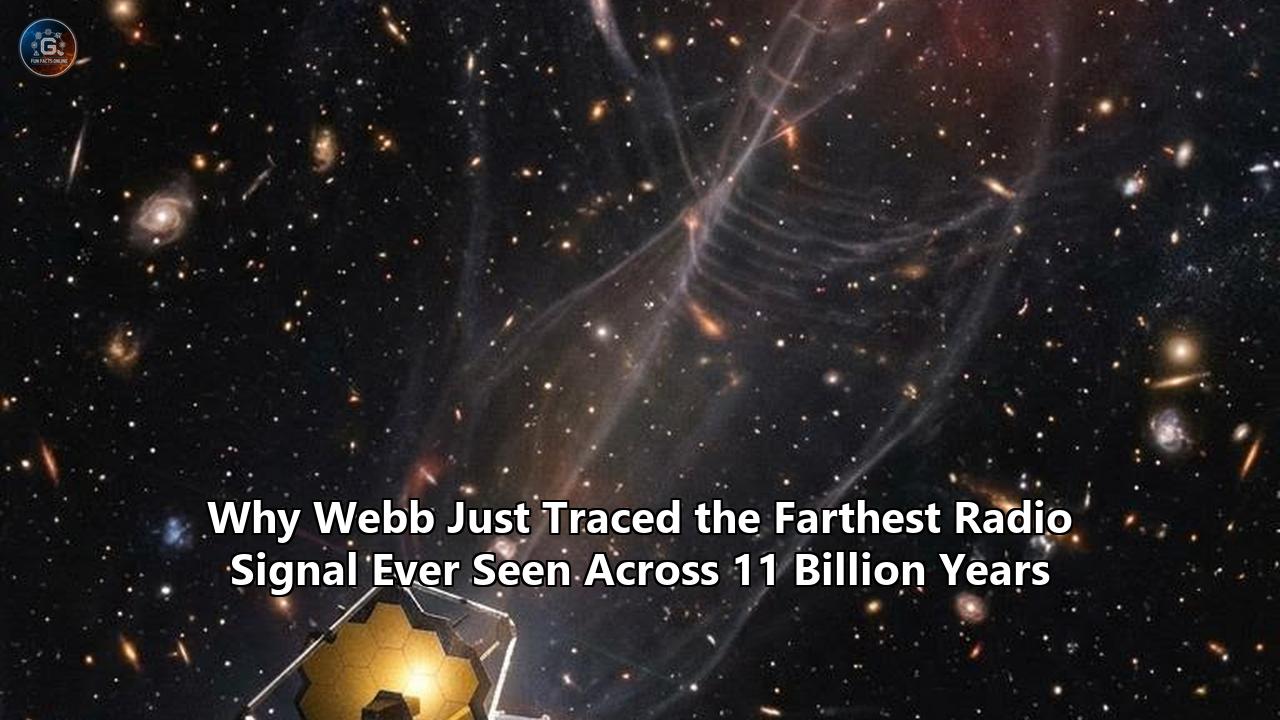
Radio arrays on Earth can capture the timestamp and dispersion of a radio transient, but they cannot clearly photograph the ultra-faint host galaxy across such vast cosmological distances. To locate the pinpoint origin of the burst, astronomers turned to NASA’s flagship observatory stationed at the Second Sun-Earth Lagrange point (L2).
By aligning the radio arrival coordinates with high-resolution infrared spectroscopy, researchers used the observatory to uncover a diminutive dwarf galaxy previously invisible to the world’s premier ground-based telescopes. The collaborative effort demonstrates how a Webb telescope radio signal correlation can decode the early structural evolution of the cosmos.
FAST RADIO BURST 20240304B: BY THE NUMBERS
┌─────────────────────────────────────────────────────────────┐
│ Redshift (z):             2.148 ± 0.001                     │
│ Lookback Time:            ~11 billion years                 │
│ Cosmic Age at Emission:   ~3 billion years post-Big Bang    │
│ Dispersion Measure:       ~2,458 pc/cm³                     │
│ Previous Record (z):      1.016 (FRB 20220610A)             │
│ Host Galaxy Mass:         ~1,000× smaller than typical hosts│
│ Optical Apparent Mag:     ~28th magnitude (extremely faint) │
│ Telescope Partnership:    MeerKAT (Radio) + JWST (Infrared) │
└─────────────────────────────────────────────────────────────┘
The Detective Work: From Karoo Desert Dishes to Deep Space
The journey to uncover FRB 20240304B began in South Africa’s semi-arid Karoo region. On March 4, 2024, the MeerKAT radio telescope—an array of 64 dish antennas operated by the South African Radio Astronomy Observatory (SARAO)—captured an unusually dispersed radio pulse through the real-time MeerTRAP (More Transients and Pulsars) detection system.
Astronomers watching the streaming data immediately recognized that something extraordinary had crossed their focal plane. The pulse flashed once southeast of the star Denebola in the constellation Leo, blazing with more raw energy in thousands of a second than the Sun generates across an entire year.
                       SIGNAL PATH TO EARTH

  [FRB Origin]              [Intergalactic Space]            [Earth & Space]
  Dwarf Galaxy   ───────►  Encountered foreground   ───────►  MeerKAT Array
  at z = 2.148             clusters & cosmic web              (March 4, 2024)
   (~11 Billion             (Dispersed & Delayed)                    │
    Years Ago)                                                       ▼
                                                              JWST Target Pointing
                                                              (NIRCam & NIRSpec)
Initial calculations revealed a high dispersion measure—the parameter that tallies the volume of ionized gas a radio wave intersects along its journey. The MeerKAT signal displayed a dispersion measure of approximately 2,458 parsecs per cubic centimeter.
In observational astrophysics, a value that massive typically points to one of two possibilities: either the radio pulse had traversed a dense clump of plasma sitting right inside a nearby host galaxy, or it had journeyed across an unprecedented expanse of intergalactic space.
Verifying the burst's true distance required identifying the host galaxy and measuring its cosmological redshift. The team initially directed the largest optical observatories on Earth toward the burst's coordinates, including the 10-meter mirrors of the W. M. Keck Observatory in Hawaii. The result was pitch black; nothing appeared at the coordinates. The galaxy was fainter than the detection limit of any terrestrial optical platform.
Astronomers submitted an emergency target-of-opportunity request to the Space Telescope Science Institute (STScI) in Baltimore, directing the James Webb Space Telescope’s 6.5-meter gold-coated beryllium primary mirror to the precise coordinates in Leo.
Webb’s Near-Infrared Camera (NIRCam) peered through the void, revealing a faint, clumpy smudge glowing at the 28th magnitude. Immediately following, Webb’s Near-Infrared Spectrograph (NIRSpec) sliced that infrared glow into its constituent wavelengths.
By measuring the Doppler-like stretching of emission lines produced by ionized oxygen and nitrogen, the team pinned down the host galaxy’s spectroscopic redshift: $z = 2.148 \pm 0.001$.
“This is an extraordinary glimpse into the distant universe,” said lead author Dr. Manisha Caleb of the Sydney Institute for Astronomy at the University of Sydney. “We have caught a fast radio burst from a time when the universe was only about three billion years old, and we have used that brief flash of radio light to learn about the matter it has traveled through over billions of years”.
          REDSHIFT TIMELINE COMPARISON
  Big Bang                                              Today
  (13.8 Ga)                                            (0 Ga)
     │                                                   │
     ▼                                                   ▼
     ├───────────┼───────────────────┼───────────────────┤
     z = ∞     z = 2.148           z = 1.016            z = 0
             FRB 20240304B       FRB 20220610A
            (3 billion yrs       (5.8 billion yrs
             after Big Bang)      after Big Bang)
The spectroscopic confirmation meant the signal had broken the previous distance record—held by FRB 20220610A at redshift $z = 1.016$—by more than double. The flash originated from a universe still in its formative youth, traversing roughly 80 percent of all elapsed cosmic time before hitting modern telescope receivers.
Anatomy of a Fast Radio Burst
Fast radio bursts were unknown to science until 2007, when astronomer Duncan Lorimer and his student David Narkevic sifted through archival 2001 data from Australia’s Parkes Observatory. What they found—now celebrated as the "Lorimer Burst"—defied prevailing theories of radio emissions: an intense burst of energy lasting under five milliseconds, showing a dispersion profile that proved it came from outside the Milky Way.
Physically, an FRB is a short pulse of coherent radio emission, typically observed at frequencies spanning hundreds of megahertz to several gigahertz. Generating coherent radio waves requires billions of charged particles, such as electrons and positrons, to move in synchrony under extreme conditions. Thermal systems, like stars or glowing nebulae, radiate incoherently; their particles move in random directions, producing a steady glow over millions of years.
An FRB, by contrast, operates like an astrophysical maser or synchrotron shock. It concentrates a star’s worth of energy into an ultra-brief pulse. In the case of FRB 20240304B, the total isotropic equivalent energy released within milliseconds was estimated to exceed $10^{34}$ joules—comparable to the Sun’s total energetic output over an entire year compressed into a fraction of a heartbeat.
For nearly two decades, astrophysicists have wrestled with two main questions:
- What physical engine possesses the magnetic and gravitational density to unleash this energy?
- Can we exploit these pulses to probe the deep universe between galaxies?
With this successful confirmation of the Webb telescope radio signal association, astronomers now have concrete data connecting the early cosmic era directly to the extreme physics of the modern universe.
The Science of Dispersion: Weighing the Intergalactic Fog
To understand how a fleeting burst of radio waves carries information across 11 billion light-years, one must look at how electromagnetic radiation moves through plasma.
A common misconception is that the space between galaxies is a pure vacuum. In reality, it is threaded by the intergalactic medium (IGM)—a thin, fully ionized gas consisting mostly of free protons and free electrons.
                     HOW DISPERSION WORKS

 High Frequencies  ───────────► [Faster Propagation]  ────► Arrives First (t₀)

 Low Frequencies   ──~──~──~──► [Resonant Retardation] ──► Arrives Later (t₀ + Δt)

      * Delay (Δt) is directly proportional to the total electron column (DM)
When an electromagnetic wave travels through a cold, ionized plasma, the electric field of the wave causes free electrons to oscillate. This interaction slows the wave's phase and group velocities below the speed of light in a vacuum ($c$). Crucially, this slowing effect depends strongly on frequency: lower radio frequencies interact more strongly with the plasma electrons, while higher radio frequencies pass through relatively unimpeded.
The mathematical relationship governing the time delay ($\Delta t$) between an emission at high frequency ($\nu_{\text{high}}$) and low frequency ($\nu_{\text{low}}$) is:
$$\Delta t = \frac{e^2}{2\pi m_e c} \left( \nu_{\text{low}}^{-2} - \nu_{\text{high}}^{-2} \right) \times \text{DM}$$
where $e$ is the elementary charge, $m_e$ is the mass of an electron, and $\text{DM}$ represents the Dispersion Measure.
The dispersion measure equals the line-of-sight integral of free electron number density ($n_e$) from the emitting source to Earth:
$$\text{DM} = \int_{0}^{d} n_e(l) \, dl$$
By measuring how many milliseconds later the lower frequencies of FRB 20240304B arrived compared to the higher frequencies, researchers measured the total column density of electrons the wave encountered during its journey.
The total measured dispersion measure ($\text{DM}_{\text{obs}}$) is a composite sum:
$$\text{DM}_{\text{obs}} = \text{DM}_{\text{Milky Way}} + \text{DM}_{\text{halo}} + \text{DM}_{\text{IGM}}(z) + \frac{\text{DM}_{\text{host}}}{1 + z}$$
                DISPERSION MEASURE COMPONENTS
┌─────────────────────────────────────────────────────────────┐
│ 1. Milky Way Interstellar Medium (ISM)                      │
│    Local galactic gas contribution (~35 pc/cm³)             │
├─────────────────────────────────────────────────────────────┤
│ 2. Milky Way Circumgalactic Halo                            │
│    Diffuse gas surrounding our galaxy (~50 pc/cm³)          │
├─────────────────────────────────────────────────────────────┤
│ 3. Intergalactic Medium (IGM)                               │
│    Cosmic web, voids, foreground galaxy clusters (~2,000+)  │
├─────────────────────────────────────────────────────────────┤
│ 4. Host Galaxy Environment                                  │
│    Local gas, adjusted by cosmic expansion factor (1/(1+z)) │
└─────────────────────────────────────────────────────────────┘
Without an independent redshift measurement, astronomers could not separate how much of FRB 20240304B’s dispersion was caused by a dense host environment versus billions of light-years of intergalactic transit. Webb’s identification of the host galaxy at $z = 2.148$ anchored the intergalactic component, converting the flash into an accurate probe of the universe's electron content across 80 percent of cosmic history.
Why Ground Telescopes Failed and Webb Succeeded
The localization of FRB 20240304B underscores a fundamental contrast in modern observational astronomy: radio arrays provide sharp temporal timing, but space-based infrared telescopes are required to detect faint sources in deep space.
               OBSERVATORY PERFORMANCE PROFILE
┌───────────────────┬─────────────────────────┬──────────────────────────┐
│ Parameter         │ MeerKAT Array (Radio)   │ JWST (Infrared)          │
├───────────────────┼─────────────────────────┼──────────────────────────┤
│ Primary Role      │ Transient Discovery     │ Deep Optical Profiling   │
│ Time Resolution   │ Microseconds            │ Seconds to Hours         │
│ Spectral Range    │ 0.58 GHz – 1.67 GHz     │ 0.6 µm – 28 µm           │
│ Sky Coverage      │ Wide-field survey mode  │ Targeted pencil-beam     │
│ Detection Goal    │ Dynamic radio dispersion│ Host galaxy redshift (z) │
└───────────────────┴─────────────────────────┴──────────────────────────┘
When MeerKAT first spotted the burst, its interferometric arrays triangulated the position down to an error ellipse measured in arcseconds. However, pointing ground-based optical observatories like Keck, the Very Large Telescope (VLT), or Gemini at those coordinates yielded blank space.
This visibility limit stems from physics and cosmic expansion:
1. Cosmological Redshift ($z$)
As light travels through expanding spacetime, its wavelength stretches:
$$\lambda_{\text{observed}} = \lambda_{\text{emitted}} \times (1 + z)$$
At $z = 2.148$, every photon emitted by stars and nebulae in the host galaxy is stretched by a factor of 3.148. The ultraviolet and optical light emitted by hot young stars (such as the Lyman-alpha transition at 121.6 nm or hydrogen-alpha at 656.3 nm) shifts entirely out of the optical window and into the near- and mid-infrared spectra. Ground-based optical systems cannot view these wavelengths effectively because Earth’s atmosphere absorbs infrared light and glows brightly with its own thermal background.
2. Surface Brightness Dimming
Cosmological expansion dilutes the apparent surface brightness of distant objects according to the Tolman surface brightness test:
$$\text{Surface Brightness} \propto (1 + z)^{-4}$$
For a galaxy at $z = 2.148$, its surface brightness drops by a factor of $(3.148)^4 \approx 98$. What was a distinct stellar nursery in the early universe becomes a heavily diluted smudge by the time its light reaches the Solar System.
       LIGHT SHIFT ACROSS EXPANDING SPACETIME
Emitted UV/Optical Light (3 billion yrs post-Big Bang)
   │
   │ [Wavelength stretched by factor of (1 + z) = 3.148]
   ▼
Detected as Infrared Light by JWST at L2 (Present Day)
Operating in the cold void of deep space at roughly 40 Kelvin, Webb's primary mirror captures these stretched infrared photons without atmospheric distortion.
NIRCam confirmed a compact galaxy at the precise coordinates of the radio blast.
NIRSpec then used its Micro-Shutter Array (MSA) to isolate the target, detecting clear rest-frame optical emission lines—including [O III] at 500.7 nm and [O II] at 372.7 nm, shifted cleanly into the 1.5–1.6 micrometer band. The resulting spectrum yielded a definitive redshift of $z = 2.148$, officially making FRB 20240304B the most distant radio burst with a confirmed host galaxy.
The Host Galaxy Surprise: A Dwarf Instead of a Giant
Before JWST targeted this field, astronomers assumed they knew what kind of galaxy produced FRB 20240304B. Nearly every localized burst discovered in the nearby universe ($z < 0.5$) has been traced to a massive, metal-rich spiral or interacting galaxy containing tens of billions of stars.
Theory suggested that an engine energetic enough to blast a signal across 11 billion years would require a similarly massive galaxy.
Webb’s data overturned that assumption.
               HOST GALAXY COMPARISON
┌─────────────────────────┬──────────────────────────┬──────────────────────────┐
│ Property                │ Typical Local FRB Host   │ FRB 20240304B Host       │
├─────────────────────────┼──────────────────────────┼──────────────────────────┤
│ Stellar Mass ($M_*$)    │ $10^{10} - 10^{11} M_\odot$│ $\sim 10^7 - 10^8 M_\odot$ │
│ Galaxy Morphology       │ Massive Spiral / Merger  │ Clumpy, Compact Dwarf    │
│ Relative Mass Scale     │ Baseline (1,000×)        │ 1/1,000th as massive     │
│ Metallicity             │ Solar to Super-Solar     │ Metal-Poor (10–20% Solar)│
│ Stellar Population Age  │ Several Billion Years    │ < 30 Million Years       │
│ Star Formation Mode     │ Steady-State Disk        │ Intense Dwarf Starburst  │
└─────────────────────────┴──────────────────────────┴──────────────────────────┘
The host galaxy identified by Webb is a tiny dwarf starburst system. Its estimated stellar mass is roughly 1,000 times lower than typical local FRB hosts—making it one of the smallest and least luminous galaxies ever identified in connection with a radio transient.
Spectral analysis also confirmed that this dwarf system is metal-poor, containing only 10 to 20 percent of the heavy elements found in our Sun. In astronomical parlance, any element heavier than hydrogen and helium is classified as a "metal." A low metallicity confirms that this galaxy had not undergone billions of years of stellar recycling.
Instead, the galaxy was in the middle of a short-lived starburst. Webb's photometry indicates that its stellar population formed rapidly within the preceding 30 million years, giving it an extraordinarily young average stellar age.
Magnetars vs. Mergers: Deciding the Theoretical Feud
The youth, small size, and low metallicity of the host galaxy provide strong evidence in the ongoing debate over what generates fast radio bursts.
Astrophysicists have spent years split between two primary origin models:
                  PROPOSED FRB ORIGIN ENGINES

         Model A: Compact Binary Mergers (Delayed)
         Two neutron stars orbit for billions of years
         └── Requires older stellar populations
         └── Incompatible with a 30-million-year-old dwarf

         Model B: Core-Collapse Magnetars (Prompt)
         Massive star explodes as supernova -> Newborn Magnetar
         └── Happens within millions of years of starburst
         └── Perfectly aligns with JWST's dwarf galaxy data
1. Compact Binary Mergers
In this scenario, two neutron stars—or a neutron star and a black hole—orbit each other for hundreds of millions or billions of years while radiating orbital energy as gravitational waves. Eventually, they collide and briefly form a hypermassive neutron star before collapsing into a black hole. During this final merger, magnetic reconnection events can theoretically fire ultra-energetic coherent radio pulses.
A binary merger model predicts that FRBs should often appear in older, passive galaxies with mature stellar populations, since the gravitational wave inspiral process takes a long time to unfold.
2. Core-Collapse Supernovae and Newborn Magnetars
In the competing model, an FRB is powered by a magnetar: an isolated neutron star possessing extreme magnetic fields on the order of $10^{14}$ to $10^{16}$ Gauss (compared to the Earth's magnetic field of roughly 0.5 Gauss).
Magnetars form when a massive star—typically 8 to 40 times the mass of the Sun—exhausts its nuclear fuel, undergoes a core-collapse supernova, and leaves behind a spinning magnetic remnant.
Massive stars live fast and die young, burning through their fuel reserves in just 5 to 30 million years. If FRBs are produced by young, active magnetars experiencing "starquakes" or explosive magnetospheric reconnections, they should occur in active star-forming regions immediately following starburst events.
The JWST data decisively favored the magnetar model. The host galaxy had only begun actively forming stars roughly 30 million years prior to emitting the burst, leaving far too little time for a binary neutron star pair to form, evolve, and inspiral via gravitational radiation.
A single massive star, by contrast, could easily form, explode as a supernova, and leave behind an active magnetar within that narrow window.
“Our work suggests that it’s very unlikely that this FRB was produced by a merger,” Caleb confirmed in a post-publication statement. “The starburst environment fits with the popular magnetar model for fast radio bursts”.
Weighing the Missing Baryons Across 80 Percent of Cosmic Time
Beyond identifying the origin engine, the cross-analysis of this Webb telescope radio signal resolved a core puzzle in modern cosmology: mapping the "missing baryons".
When cosmologists study the Cosmic Microwave Background (CMB) and calculate Big Bang Nucleosynthesis (BBN), they can measure the exact total density of ordinary baryonic matter (the protons and neutrons that make up atomic nuclei) created during the early universe. The CMB measurements show that baryons must account for approximately 5 percent of the universe's total energy-matter budget (with dark matter making up ~27% and dark energy ~68%).
            THE CENSUS OF ORDINARY BARYONIC MATTER
┌─────────────────────────────────────────────────────────────┐
│ Total Predicted Baryonic Density (from CMB/BBN):  100%      │
├─────────────────────────────────────────────────────────────┤
│ Counted in Visible Stars and Cold Interstellar Gas: ~10%    │
│ Counted in Circumgalactic Halos:                    ~15%    │
│ Uncounted "Missing" Baryons (Diffuse IGM / WHIM):   ~75%    │
│                                                             │
│ * FRB dispersion accounts for these free electrons by       │
│   measuring plasma delay directly across cosmic time.       │
└─────────────────────────────────────────────────────────────┘
When astronomers point optical, infrared, and X-ray telescopes across the local universe to count stars, gas clouds, and galaxies, nearly half of that ordinary baryonic matter is nowhere to be found.
Astrophysicists hypothesized that these "missing baryons" were not truly gone. Instead, they had been drawn into the filamentary strands of the cosmic web—the warm-hot intergalactic medium (WHIM)—at temperatures between $10^5$ and $10^7$ Kelvin. At those high temperatures and extremely low densities (fewer than a few atoms per cubic meter), the gas is fully ionized and too diffuse to emit bright spectral lines, rendering it nearly invisible to traditional imaging telescopes.
Fast radio bursts bypass this imaging barrier. Because the dispersed radio pulse must physically traverse those ionized filaments, every free electron along its multi-billion-light-year path adds to the signal's total delay.
In 2020, late astrophysicist J.-P. Macquart proved this concept by establishing the Macquart Relation: a clean linear relationship between an FRB’s dispersion measure and the redshift of its host galaxy.
$$\langle \text{DM}_{\text{IGM}}(z) \rangle = \int_0^z \frac{c \, n_e(z') \, dz'}{H_0 (1+z')^2 \sqrt{\Omega_m (1+z')^3 + \Omega_\Lambda}}$$
Before FRB 20240304B, the Macquart relation had only been verified out to $z \approx 1$. Beyond that, astronomers had no direct empirical proof that the cosmic web retained the same diffuse ionization balance back during cosmic noon.
               THE MACQUART RELATION TEST
  DM_IGM (pc/cm³)
    ▲
    │                                         * FRB 20240304B (z = 2.148)
2500│                                        /
    │                                       /
2000│                                      /
    │                                     /
1500│                       * FRB 20220610A (z = 1.016)
    │                      /
1000│                     /  Theoretical Expectation Line
    │           * * * *  /   (Confirms 100% of Missing Baryons)
 500│     * * *
    └─────┴───────────────┴───────────────────┴────────► Redshift (z)
         z = 0.2         z = 1.0             z = 2.2
FRB 20240304B extended this empirical yardstick across 80 percent of cosmic history.
Its measured dispersion matched the theoretical electron distribution predicted by cosmological models, confirming that the missing baryonic matter had been present in the intergalactic medium all along.
Mapping Cosmic Structures Along the Line of Sight
The signal’s 11-billion-year journey did more than confirm broad cosmic density; it also directly illuminated specific foreground structures positioned between its distant source and Earth.
As the radio beam traveled across the universe, it acted as a pencil-beam probe, passing through several major cosmic structures.
                INTERVENING STRUCTURES CROSSED

  FRB Origin ──────────────────────────────────────────────► Earth
  (z = 2.148)     │                          │
                  ▼                          ▼
           Uncharted Cluster            Virgo Cluster
             at z = 0.31131              Outer Halo
          (~3.5 Billion Ly Away)     (~54 Million Ly Away)
By analyzing subtle variations in the pulse profile and comparing them against wide-field galaxy surveys, the research team identified the signatures of two massive intervening systems:
- An Uncharted Foreground Galaxy Group ($z = 0.31131$):
Roughly 3.5 billion light-years from Earth, the signal passed directly through the circumgalactic halo of an uncataloged cluster of galaxies. The burst’s dispersion profile showed an abrupt electron density enhancement that allowed the team to measure the ionized gas mass of this intervening group.
- The Outskirts of the Virgo Cluster:
Only 54 million light-years from Earth, the radio burst sliced through the outer gas halo of the Virgo Cluster—the massive concentration of over 1,000 galaxies that anchors our local supercluster. This transit provided a clean measurement of the diffuse plasma halo surrounding the Virgo system.
The researchers also analyzed the signal's polarization. The burst showed a linear polarization fraction of roughly 49 percent and a small circular polarization component of about 3 percent.
When polarized light travels through magnetized plasma, its angle of polarization rotates—a process known as Faraday rotation:
$$\Delta \theta = \text{RM} \times \lambda^2$$
where $\text{RM}$ is the Rotation Measure, defined by the line-of-sight integral of electron density weighted by the parallel magnetic field ($B_\parallel$):
$$\text{RM} \propto \int_{0}^{d} n_e(l) B_\parallel(l) \, dl$$
By measuring this rotation, the team calculated the magnetic field strength of intergalactic space across gigaparsec scales, confirming that weak primordial magnetic fields were already permeating cosmic web filaments when the universe was in its infancy.
The Economics and Technical Synergies of Discovery
This discovery highlights how modern astrophysics relies on multi-facility coordination across the electromagnetic spectrum.
No single observatory could have achieved this result on its own:
- MeerKAT provided wide field-of-view monitoring and millisecond-level time resolution, capturing a rare transient that flashed without warning. However, as a radio telescope, it lacked the optical depth and spatial resolution to study an extremely faint 28th-magnitude host galaxy.
- JWST possessed the infrared sensitivity, spectral resolution, and space-based stability to detect the distant host galaxy and calculate its redshift. However, with its narrow pencil-beam field of view, Webb cannot conduct wide-area blind surveys to catch rare millisecond radio flashes in real time.
                      OBSERVATIONAL SYNERGY

        MeerKAT (Radio Survey)            JWST (Targeted Infrared)
       ┌──────────────────────┐          ┌──────────────────────┐
       │ Wide field coverage  │          │ Narrow field of view │
       │ Sub-millisecond timing│         │ Extreme sensitivity  │
       │ Catches dynamic flash│          │ Resolves host galaxy │
       └──────────┬───────────┘          └──────────▲───────────┘
                  │                                 │
                  └─────────► Coordinates ──────────┘
                             Dispersion Measure
                             Polarization Data
Securing JWST director’s discretionary time requires strong empirical justification. Observing time on Webb is valued at tens of thousands of dollars per hour based on mission operations and development budgets.
The MeerTRAP team had to demonstrate that the radio dispersion measure accurately pointed to an unprecedented cosmological distance before the space telescope was slewed to the target.
The project also showcases the value of international open-data architecture:
- South Africa’s investment in the MeerKAT array—which serves as the precursor for the mid-frequency component of the international Square Kilometre Array (SKA)—demonstrates the scientific impact of Southern Hemisphere radio astronomy.
- NASA, ESA, and CSA’s shared management of the Webb telescope enables rapid target-of-opportunity follow-ups that bridge optical, infrared, and radio datasets across global teams.
This multi-messenger partnership demonstrates that studying high-energy astrophysics requires a networked fleet of specialized observatories working across different wavelengths.
What Lies Ahead: Pushing into the Cosmic Dawn
The identification of FRB 20240304B marks a major shift in how astronomers can study the early universe. Fast radio bursts are no longer just mysterious local transients; they have become powerful cosmological probes capable of slicing through 11 billion years of cosmic history.
Several major initiatives are now positioned to build directly upon this foundation:
1. Expanding High-Redshift FRB Catalogs
MeerKAT’s ongoing operations are expected to detect several FRBs per year at redshifts greater than $z > 1.0$.
As the Square Kilometre Array (SKA-Mid in South Africa and SKA-Low in Australia) moves closer to full scientific operations over the coming decade, astronomers expect the global detection rate of fast radio bursts to climb from hundreds per year into the tens of thousands.
Many of these will originate at high redshifts, offering a dense web of sightlines crisscrossing the intergalactic medium.
                  FUTURE DISCOVERY ROADMAP
┌──────────────────────┬─────────────────────────────────────────────────┐
│ Facility / Mission   │ Planned Astrophysical Contribution              │
├──────────────────────┼─────────────────────────────────────────────────┤
│ MeerKAT Upgrades     │ Increasing discovery of z > 1 FRB candidates   │
│ SKA-Mid & SKA-Low    │ Full-scale array detecting ~10,000+ FRBs/year   │
│ JWST Cycle Programs  │ Targeted spectroscopic follow-up of host systems│
│ Nancy Grace Roman    │ Wide-field infrared mapping of cosmic lines     │
└──────────────────────┴─────────────────────────────────────────────────┘
2. Probing the Epoch of Reionization
If magnetars formed during cosmic noon, they likely formed during the Epoch of Reionization ($z > 6$) as well, when the universe’s first stars and proto-galaxies formed out of primordial hydrogen and helium.
Catching an FRB from $z > 6$ would allow astronomers to measure the timeline of cosmic reionization directly, tracking how the universe transformed from an opaque, neutral fog into a fully ionized plasma.
3. Resolving the Hubble Tension
Cosmology remains locked in a statistical debate over the Hubble constant ($H_0$), which measures the universe's current expansion rate.
Measurements derived from the early universe (via the Cosmic Microwave Background) predict an expansion rate of approximately $67.4\text{ km/s/Mpc}$, whereas measurements from the local universe (via Cepheid variable stars and Type Ia supernovae) yield roughly $73.0\text{ km/s/Mpc}$.
Because the Macquart relation depends directly on the cosmic expansion rate, a statistically robust catalog of hundreds of localized, high-redshift FRBs could yield an independent measurement of $H_0$, bypassing the systematic calibration errors that affect traditional distance ladders.
4. Searching for Repetition
Astronomers are continuing to monitor the coordinates of FRB 20240304B to see if it pulses again.
While roughly three percent of known FRBs are repeaters, most have been observed only once.
If FRB 20240304B emits another burst, high-precision radio interferometers can map its local plasma environment in greater detail, confirming whether the burst emerged from an expanding supernova remnant or an isolated magnetosphere.
Tracing the Cosmic Tapestry
The verification of FRB 20240304B highlights how different branches of astronomy can intersect to answer fundamental cosmic questions.
A millisecond flash of radio energy generated in an ultra-compact dwarf galaxy 11 billion years ago traversed expanding space, outliving the stars that formed around it and passing through vast structures within the cosmic web.
               SUMMARY OF COSMIC IMPLICATIONS
┌─────────────────────────────────────────────────────────────┐
│ 1. Engine Identified:                                       │
│    Strong observational evidence for young magnetars born   │
│    from core-collapse supernovae in dwarf starbursts.       │
├─────────────────────────────────────────────────────────────┤
│ 2. Missing Baryons Accounted For:                           │
│    Confirms the Macquart relation out to z = 2.148,         │
│    verifying the diffuse plasma density of the cosmic web.  │
├─────────────────────────────────────────────────────────────┤
│ 3. Multi-Wavelength Strategy Validated:                     │
│    Demonstrates the necessity of pairing ground radio arrays│
│    with deep space-based infrared spectroscopy.             │
└─────────────────────────────────────────────────────────────┘
Captured by dishes in the South African desert and resolved by mirrors orbiting a million miles from Earth, this burst has transformed from an unexplained radio blip into a cosmic probe.
As next-generation observatories scan the skies for more high-redshift transients, astronomers are using these brief bursts of light to illuminate the dark, otherwise invisible matter that shapes our universe.
Reference:
- https://www.space.com/astronomy/galaxies/james-webb-space-telescope-helps-detect-the-most-distant-fast-radio-burst-ever-seen-and-scientists-are-surprised-by-its-source
- https://www.instagram.com/p/DePopj3jFi4/
- https://skyandtelescope.org/astronomy-news/fast-radio-burst-shatters-distance-record/
- https://science.nasa.gov/missions/webb/webb-measures-distance-to-farthest-fast-radio-burst-suggesting-origin/
- https://www.indiatoday.in/science/story/19-years-after-a-mysterious-alien-signal-hit-earth-we-know-where-it-came-from-3013019-2026-10-09
- https://timesofindia.indiatimes.com/science/radio-signal-that-travelled-10-billion-years-may-hold-clues-to-the-universes-early-history/articleshow/131326531.cms
- https://observatoiredeparis.psl.eu/identification-of-the-host.html
- https://economictimes.indiatimes.com/science/james-webb-telescope-traces-radio-burst-11-billion-light-years-away-what-can-this-ancient-signal-reveal-about-the-early-universe/articleshow/134834468.cms?from=mdr
- https://www.facebook.com/QuantumXparadoxx/posts/-the-most-distant-signal-weve-ever-caught-a-flash-of-radio-waves-left-its-tiny-g/122193317834890210/
- https://www.stsci.edu/jwst-program-info/download/jwst/pdf/6779/
- https://www.thebrighterside.news/post/jwst-traces-the-most-distant-known-fast-radio-burst-to-a-strange-dwarf-galaxy/
- https://astrobites.org/2025/08/08/cosmic-noon-frb/
- https://nautil.us/a-distant-planet-emitted-a-burst-of-radio-waves-why-1285695
- https://keckobservatory.org/frb20240304b/
- https://www.courthousenews.com/mysterious-radio-burst-sets-cosmic-record/
- https://www.researchgate.net/publication/415462455_A_fast_radio_burst_at_redshift_2_three_billion_years_after_the_Big_Bang
- https://www.eurekalert.org/news-releases/1146455
- https://www.reddit.com/r/space/comments/1x11tzb/james_webb_space_telescope_has_spotted_the/
- https://science.nasa.gov/missions/webb/webb-measures-distance-to-farthest-fast-radio-burst-suggesting-origin/
- https://www.livescience.com/space/astronomy/james-webb-telescope-pinpoints-the-most-distant-fast-radio-burst-ever-seen-more-than-doubling-the-previous-record
- https://esawebb.org/news/weic2621/
- https://www.universetoday.com/articles/astronomers-detect-most-distant-fast-radio-burst-ever