Deep within the constellation Cetus, roughly 250 light-years from Earth, sits the smoldering ember of an extinct star designated HS 0209+0832. For nearly three decades, this white dwarf held an open cold case in astrophysics: a ultraviolet fingerprint captured by the Hubble Space Telescope in 1999 that contained more than a hundred chemical spectral lines no model could decipher.
The resolution to that case arrived when a team of astrophysicists re-examined the archival Hubble data, corroborated it with photometric signals from NASA’s Transiting Exoplanet Survey Satellite (TESS), and identified an anomaly that fundamentally recalibrates our understanding of planetary lifespans. Orbiting just 3.7 million miles from the stellar corpse is a gas giant roughly the size of Jupiter. It circles the stellar ember once every 4.4 days, enduring a torrent of extreme ultraviolet radiation from a white dwarf that still blazes at 35,000 degrees Celsius.
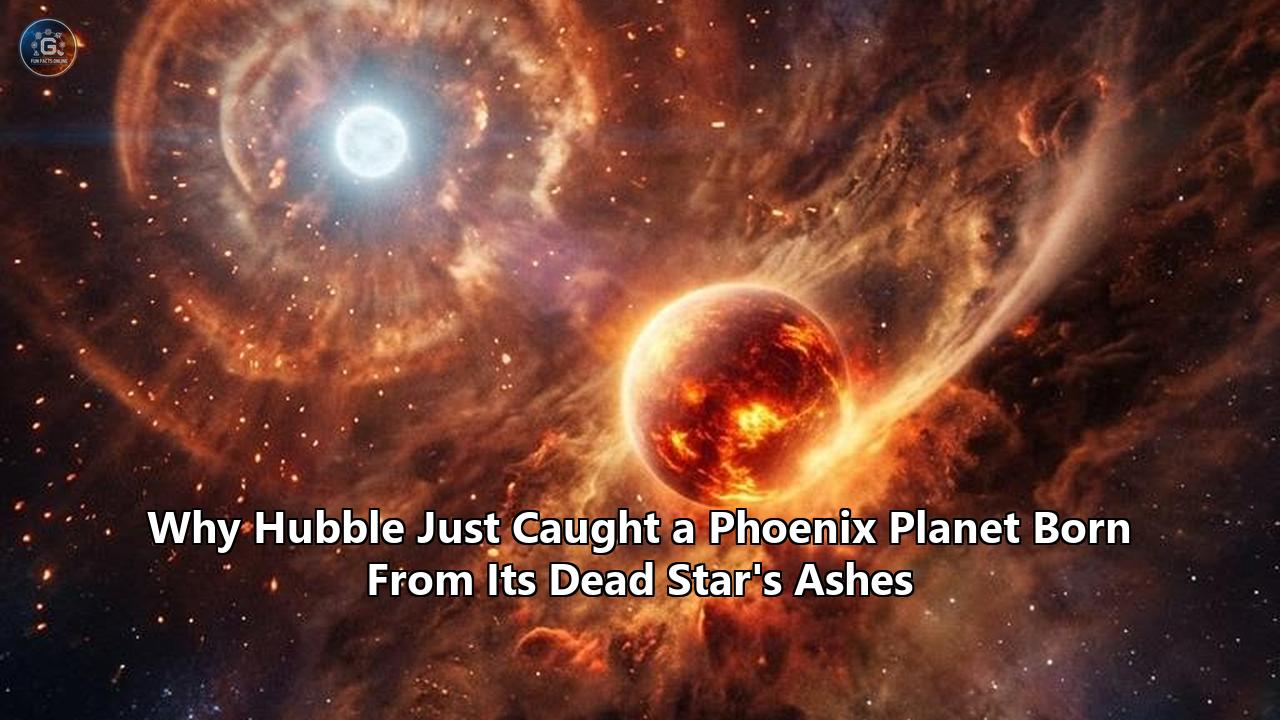
The planet is not a survivor that somehow avoided being swallowed when the star inflated into a red giant millions of years ago. Instead, the chemical evidence shows the planet was forged directly out of the ejected wreckage of the dying star itself. It is a second-generation world—a true phoenix planet, born from the nuclear ashes of its mother star.
The phoenix planet discovery reveals that the death of a star does not necessarily draw the curtain on planet formation. Instead, the final convulsions of a doomed star can provide the raw materials, the density, and the gravitational mechanics needed to assemble entirely new worlds from the grave.
HS 0209+0832 SYSTEM PROFILE
─────────────────────────────────────────────────────────────────
Host Star Type:               White Dwarf (Post-AGB core)
Host Temperature:             ~35,000 K (~63,000 °F)
Distance:                     ~250–270 light-years (Constellation Cetus)
Orbital Period:               4.4 Earth days
Orbital Separation:           ~0.04 AU (~3.7 million miles)
Suspected Planet Mass:        ~1.0–1.2 Jupiter masses
Atmospheric Signature:        Extreme overabundance of Niobium, Zinc, Copper
Formation Mechanism:          Post-stellar fallback accretion disk
Key Observatories:            Hubble (STIS/FOS), TESS, FUSE
─────────────────────────────────────────────────────────────────
The 1999 Cold Case: A Star Bleeding Metals
The investigation began not with an active telescope pointed at a fresh patch of sky, but in the digital vaults of the Mikulski Archive for Space Telescopes (MAST) at the Space Telescope Science Institute in Baltimore.
In 1999, Hubble trained its instruments on HS 0209+0832 as part of a routine survey of high-temperature white dwarfs. Astronomers expected to see the austere, predictable signature of a hydrogen-rich or helium-rich stellar atmosphere. A white dwarf is the compressed remnant of a star that was once up to eight times the mass of the Sun. Having spent its nuclear core through billions of years of hydrogen and helium fusion, such a star sloughs off its vast outer layers into a glowing planetary nebula, leaving behind a carbon-oxygen core roughly the size of Earth packed with half the mass of our Sun.
The physics of these compact objects is governed by immense surface gravity—often more than 100,000 times that of Earth. In such an unforgiving gravitational well, standard sedimentation physics dictates an uncompromising outcome: heavy elements must sink.
"Gravitational settling in a hot white dwarf is merciless," explains Jamie Williams, an astrophysicist at the University of Warwick and lead author of the study published in Nature Astronomy. "Any element heavier than hydrogen or helium—what astronomers call 'metals'—ought to sink down out of sight into the core within weeks, if not days. If you point a spectrograph at a pure white dwarf, its atmosphere should look like a clean slate. It should show you nothing but hydrogen and helium lines."
Yet the 1999 Hubble exposures revealed the exact opposite.
The ultraviolet spectrum of HS 0209+0832 was jagged with absorption features—dips where specific wavelengths of light were being intercepted by elements hovering in the star's upper atmosphere. Over a hundred individual spectral lines were cataloged, but their identities defied classification. At the turn of the millennium, atomic transition databases lacked the laboratory precision needed to match high-ionization states of obscure transition metals under intense radiation fields.
The star was classified as an anomalous "polluted white dwarf," and the files were stored in the archive, an unresolved ledger awaiting better tools and sharper eyes.
For twenty-seven years, the dataset remained an oddity. While astronomers occasionally cataloged polluted white dwarfs whose atmospheres showed traces of rocky asteroids being torn apart by tidal forces—yielding signatures of iron, magnesium, silicon, and calcium—HS 0209+0832 never quite fit that mold. The ratios were wrong. The intensity of the UV absorption hinted at something far more dense and volatile than the dry debris of shattered chondrites.
THE GRAVITATIONAL SETTLING PARADOX
┌─────────────────────────────────────────────────────────────┐
│ High-Density White Dwarf                                    │
│ Surface Gravity: ~100,000 g                                 │
│                                                             │
│  Downwards Gravitational Drift (Timescale: Days to Weeks)   │
│  ▼   ▼   ▼   ▼   ▼   ▼   ▼   ▼   ▼   ▼   ▼   ▼   ▼   ▼     │
│  [Heavy Elements Sunk to Degenerate Core: Invisible]       │
└─────────────────────────────────────────────────────────────┘
                               ▲
                               │ CONTINUOUS ACCRETION REQUIRED
┌──────────────────────────────┴──────────────────────────────┐
│ Observed Upper Photosphere (Hubble UV Spectrum)             │
│ Heavy elements visibly absorbing light right now:           │
│ • Niobium (Nb)   • Zinc (Zn)    • Copper (Cu)               │
│ • Titanium (Ti)  • Nickel (Ni)  • Aluminum (Al)             │
│                                                             │
│ Deduction: An active reservoir MUST be constantly dumping   │
│ material onto the stellar surface in real time.             │
└─────────────────────────────────────────────────────────────┘
The Forensic Trail: The Impossible Abundance of Niobium
When Williams and an international team of researchers reopened the HS 0209+0832 cold case, they brought decades of improved atomic spectroscopy, high-precision laboratory benchmarks, and new observations from the Far Ultraviolet Spectroscopic Explorer (FUSE).
Running modern atmospheric synthesis models against the archival Hubble data, the unidentified dips began to fall into place. Aluminum, titanium, and nickel appeared first—uncommon in these specific ionization fractions, but recognizable. Then came zinc and copper.
Then the models flagged an element that brought the research team to a dead stop: niobium.
Niobium is element 41 on the periodic table. On Earth, it is a rare, shiny transition metal prized for superconducting alloys and jet engines. In cosmic chemistry, it is virtually nonexistent in typical stellar atmospheres, present only in vanishingly small trace amounts.
In the atmosphere of HS 0209+0832, niobium was not just present. It was screaming across the ultraviolet spectrum at concentrations more than 1,000 times higher than its relative abundance in our own Sun.
"When we saw the niobium lines line up with the Hubble data, our first instinct was disbelief," Williams says. "We assumed there was an error in the atomic line list or an artifact in the instrument calibration. Niobium is not something that drops into a star from an errant rocky planetesimal. You cannot assemble an asteroid made of solid niobium. Its existence in those quantities requires a nuclear production site that is specific, violent, and very late in stellar evolution."
To understand why niobium provided the break in the case, one must examine the interior engines of dying stars.
Elements lighter than iron are formed during standard stellar fusion: hydrogen fuses to helium, helium fuses to carbon and oxygen, and so forth. But elements heavier than iron require neutron capture. In the final act of an intermediate-mass star—the Asymptotic Giant Branch (AGB) phase—the star develops a layered interior, with thin, burning shells of hydrogen and helium pulsating around an inert core of carbon and oxygen.
During these thermal pulses, a slow neutron-capture process (the s-process) ignites. Free neutrons are absorbed by iron-group nuclei at a slow pace, allowing radioactive beta-decays to occur before the next neutron is captured. This precise nuclear assembly line breeds specific elements: strontium, yttrium, zirconium, and crucially, niobium.
"Niobium is a nuclear receipt," says Nicholas Stone, a theoretical astrophysicist at the University of Wisconsin–Madison and co-author of the study. "It does not exist in significant quantities in the interstellar cloud that forms a star. It is minted inside the deep interior of an aging red giant immediately before the star expels its envelope into space. When we find an atmosphere enriched in niobium by a factor of a thousand, we are not looking at primordial gas. We are looking directly at the star’s own death-bed ashes."
The presence of niobium solved one mystery but instantly produced a larger physical paradox. Because the gravitational settling time on HS 0209+0832 is so short, those heavy elements could not have simply lingered on the surface since the star shed its envelope. That shell was shed millions of years ago, as evidenced by the white dwarf's cooling rate and its surface temperature of 35,000 K.
Any niobium left on the surface at the time of the white dwarf’s birth would have sunk down into the degenerate core millions of years ago.
The undeniable physical conclusion: something was currently feeding fresh, niobium-drenched material onto the star’s surface in real time.
NUCLEOSYNTHESIS PATHWAY: HOW THE ASHES WERE MINTED
1. Main Sequence (~1–8 Solar Masses)
   Core: Hydrogen → Helium fusion (No heavy elements beyond C/O)
   Abundances: Standard cosmic baseline (Solar-like)

2. Red Giant & Asymptotic Giant Branch (AGB)
   Inert C/O Core + Pulsating H/He Burning Shells
   Thermal pulses release free neutrons: 13C(α, n)16O reaction

3. The s-Process (Slow Neutron Capture)
   Iron-peak seed nuclei slowly absorb neutrons:
   56Fe + n → 57Fe + n ... → 93Zr (β-decay) → 93Nb (Niobium)

4. Envelope Ejection
   Star expands, sheds its outer convective mantle into space
   Expelled gas contains anomalous concentrations of Nb, Cu, Zn

5. Degenerate Collapse
   Core shrinks to Earth-sized White Dwarf (T_eff = 35,000 K)
   Remaining ashes settle around the stellar remnant
The Transit Shadow: Finding the Culprit in Cetus
The spectral clues pointed to an external reservoir. If the star was consuming material enriched with its own post-fusion debris, where was that material being stored?
The team turned to NASA’s Transiting Exoplanet Survey Satellite (TESS). TESS monitors the brightness of hundreds of thousands of stars across the sky, watching for the subtle, periodic dimming caused when an orbiting object crosses directly in front of the stellar disk.
Analyzing the photometric time series of HS 0209+0832, the team spotted a clean, repeatable signal: every 4.4 days, the light from the white dwarf dipped by a fractional amount consistent with an eclipsing body.
The geometry of a white dwarf transit is unusual. Because a white dwarf is compact—roughly the same physical radius as Earth—a planet the size of Jupiter does not merely blot out a fraction of a percent of light, as it does when transiting a standard Sun-like star. A Jupiter-sized planet can occult a white dwarf completely if it passes dead-center across the line of sight.
In this case, the transit was grazing, shaving off a slice of the white dwarf's light every 105.6 hours.
TRANSIT GEOMETRY: WHITE DWARF VS. GAS GIANT

   Path of Orbit (Period = 4.4 Days)
  ───────────────────────────────────────────►
                  ┌─────────┐
             ┌────│  Planet │────┐
             │    │ (~1 R_J)│    │
             │    └─────────┘    │
             │                   │
             │      [ * ]        │
             │   White Dwarf     │
             │    (~1 R_Earth)   │
             └───────────────────┘

  Because the host star is the size of Earth, a gas giant
  is nearly 10 times larger in physical diameter.
  A grazing transit creates a distinct, sharp V-shaped
  light curve profile measured by TESS and Hubble.
The data yielded the profile of an enormous gas giant planet, roughly 1 to 1.2 times the mass of Jupiter, orbiting at a blisteringly close distance of approximately 0.04 Astronomical Units.
At that proximity, the planet is locked in a gravitational vice. It is orbiting nearly ten times closer to its host star than Mercury orbits our Sun. And unlike Mercury, which faces a cooling sun, this gas giant is parked right in front of a stellar core that radiates predominantly in harsh ultraviolet and soft X-ray wavelengths.
"The physics of that close an orbit around a 35,000-degree white dwarf is pure violence," says Boris Gänsicke, a professor of physics at the University of Warwick and a world authority on polluted white dwarf dynamics. "The dayside of that planet is continuously heated to thousands of degrees. Its upper atmosphere is being blasted away by photoevaporation. The extreme ultraviolet radiation strips gas from the planet's envelope at a rate of millions of tons per second."
This photoevaporative outflow provided the missing link in the forensic chain.
The planet's expanding, boiling atmosphere spills beyond its gravitational Roche lobe. A fraction of that escaping gas forms a tenuous accretion stream, spiraling inward toward the white dwarf. When the gas strikes the stellar surface, it deposits its volatile contents directly into the star’s thin atmosphere.
Hubble was not watching an asteroid impact. It was watching a white dwarf actively feed on the evaporating carcass of an orbiting giant planet.
Yet this realization led the team into a theoretical contradiction that challenged existing models of planetary evolution.
If the planet is losing its atmosphere to the white dwarf, and the atmosphere being transferred is laden with niobium, copper, and zinc—elements created only during the final AGB thermal pulses of the star—where did this planet come from?
The Anatomy of the Phoenix Planet Discovery: Why Survival Was Impossible
Under standard models of stellar evolution, when a Sun-like star runs out of hydrogen fuel in its core, it expands into a red giant. Its outer radius inflates by a factor of several hundred, swelling outward to engulf its inner planets.
When our Sun reaches this stage roughly five billion years from now, it will expand beyond the orbit of Mercury, devour Venus, and almost certainly vaporize Earth.
If HS 0209+0832 swelled into a red giant with a radius of 1 to 2 AU, how could a gas giant currently be found sitting at 0.04 AU?
Two classical explanations have historically been invoked for anomalous exoplanets near stellar remnants:
- The Inward Migrator Scenario: The planet formed during the star’s initial birth 5 billion years ago (a first-generation planet) far out in the cold regions beyond Jupiter, survived the red giant expansion, and then somehow migrated inward via chaotic multi-body gravitational scattering after the star died.
- The Common Envelope Survivor: The planet was engulfed by the expanding red giant's atmosphere, survived the immense frictional drag without evaporating completely, and dragged itself down into a tight inner orbit before the star ejected its envelope.
The research team tested both scenarios against the observational data. Both failed completely.
THE MIGRATION VS. REBIRTH ELIMINATION PROCESS
┌─────────────────────────────────────────────────────────────────┐
│ Hypothesis 1: Inward-Migrated First-Generation Planet           │
│ • Mechanics: Formed at birth (4–5 Gyr ago) at >5 AU;            │
│   scattered inward post-stellar death.                          │
│ • Fatal Flaw: Chemistry. A primordial planet carries the        │
│   primordial composition of the parent molecular cloud.         │
│   It CANNOT contain 1,000x solar Niobium, Zinc, or Copper.     │
│ • Verdict: REJECTED BY SPECTROSCOPY                             │
├─────────────────────────────────────────────────────────────────┤
│ Hypothesis 2: Common Envelope Engulfment Survivor               │
│ • Mechanics: Devoured during Red Giant phase; dragged to 0.04 AU.│
│ • Fatal Flaw: Hydrodynamics. A gas giant engulfed by a red      │
│   giant will deposit orbital energy, causing either total       │
│   evaporative destruction or full merger with the core.         │
│   Furthermore, its core composition would remain primordial.    │
│ • Verdict: REJECTED BY DYNAMICAL STABILITY                      │
├─────────────────────────────────────────────────────────────────┤
│ Hypothesis 3: Second-Generation Phoenix Planet                  │
│ • Mechanics: Built from the post-AGB fallback disk. Ejected     │
│   ashes gathered, condensed, and coalesced into a newborn world.│
│ • Chemical Match: Exact match to late-stage AGB s-process       │
│   nucleosynthesis products (Nb, Cu, Zn, Ni, Ti).                │
│ • Verdict: CONFIRMED BY COMBINED HUBBLE/TESS DATA               │
└─────────────────────────────────────────────────────────────────┘
The decisive argument lay not in the orbital mechanics, but in the elemental inventory.
If the planet had formed at the dawn of the system from the primordial nebula—like Jupiter or Saturn—its chemical makeup would mirror the primordial composition of the star when it was born: rich in hydrogen, helium, methane, and standard solar-abundance refractories. It could not possess an atmospheric reservoir packed with late-stage AGB nuclear ash.
"You are what you eat, but more importantly, a planet is what it condenses from," Williams notes. "A first-generation planet that migrated inward would feed the star standard primordial gas. It could never provide an atmosphere saturated with niobium, because that niobium did not exist in the universe when that original planetary system was constructed.
The chemical pattern made it certain: the planet was built out of the material the star shed during its dying breaths. It is a world assembled from the ash heap.
This realization crystallized the phoenix planet discovery. Rather than an ordinary planetary system reaching its final cemetery, astronomers were bearing witness to a planetary system that had experienced a post-mortem rebirth.
Reconstructing the Crime: How to Build a World From Nuclear Fallout
To understand how a planet forms around a dead star, the team had to reconstruct the chain of physical processes that occurred between the red giant’s death and the white dwarf’s present state.
The birth of a second-generation planet requires an environment of immense density and rapid cooling. When an AGB star ejects its outer envelope, the expansion velocity of the gas is typically 10 to 30 kilometers per second. Under normal circumstances, that gas expands freely into the interstellar medium, creating the translucent, ethereal structures seen in images of planetary nebulae like the Ring Nebula or the Helix Nebula. In those scenarios, the gas disperses entirely, leaving the white dwarf isolated in empty space.
For a phoenix planet to form, something must prevent that gas from escaping.
The dynamical models formulated by Stone and his theoretical colleagues suggest that HS 0209+0832 did not die in isolation. The system likely began as a binary star system.
CHRONOLOGY OF A PLANETARY REBIRTH
Step 1: The Binary Precursor
Two stars orbit each other. Star A (primary) is slightly more massive
than our Sun (~1.5–2.0 M_Sun). Star B is a low-mass companion (M-dwarf).

Step 2: Inflation and Engulfment
Star A exhausts its core, inflates into a red giant, and engulfs Star B.
Star B spirals inward, transferring orbital energy to Star A's outer envelope.

Step 3: The Expulsion and Fallback Trap
The envelope is violently ejected, but the orbital presence of the companion
star captures a significant fraction (~1–5%) of the ejected gas,
funneling it into a dense, gravitationally bound circumbinary or
circum-stellar fallback disk.

Step 4: Rapid Grain Growth in the Ashes
The fallback disk is exceptionally metal-rich (enriched in s-process ash).
High metallicity drops the cooling time of the disk precipitously.
Dust grains of iron, silicates, and heavy refractories condense rapidly,
triggering runaway pebble accretion.

Step 5: The Birth of the Phoenix
Within a few hundred thousand years—an eyeblink in cosmic terms—a massive
core forms and accretes the remaining volatile gas, building a
Jupiter-mass second-generation giant planet.

Step 6: The Modern Era (The Slow Consumption)
The white dwarf emerges bare and blisteringly hot. The newborn planet,
locked in a tight 4.4-day orbit, is photoevaporated by the white dwarf's
UV flux, raining its niobium-rich atmosphere back onto the host star.
"To trap enough expelled gas to make a planet, you need a gravitational scoop," Stone explains. "If a red giant has a low-mass companion star or even an existing massive brown dwarf orbiting nearby, that companion acts as a gravitational blender. As the giant sheds its envelope, the companion's orbital motion pulls the ejected material into a bound circumstellar disk rather than letting it fly off into the galaxy."
This structure is known as a fallback accretion disk.
A fallback disk is distinct from the protoplanetary disks that surround newborn stars. Primordial disks are overwhelmingly hydrogen and helium, with only a 1 to 2 percent sprinkling of heavier elements (the cosmic metallicity baseline).
A fallback disk formed from the outer layers of an AGB star is heavily concentrated with freshly synthesized metals. The concentration of carbon, oxygen, titanium, zinc, copper, and s-process elements like niobium is orders of magnitude higher than in any infant stellar nursery.
In protoplanetary disks, high metallicity acts as an accelerator for planet formation. Heavy elements cool the gas through infrared radiation far more efficiently than light elements. As the gas cools, it loses pressure support, allowing it to settle into a thin, ultra-dense midplane.
In this hyper-concentrated graveyard disk, dust grains do not take millions of years to slowly stick together. Heavy element grains condense out of the vapor phase rapidly, cascading through the "pebble accretion" barrier in mere thousands of years.
The core of the planet would have assembled with astonishing speed, rapidly accumulating rock and metal before hoovering up the surrounding envelope of hydrogen and volatile trace metals. By the time the planetary nebula dispersed into deep space, a brand-new, second-generation gas giant was already orbiting the cooling white dwarf.
The companion star that facilitated this birth may have met a gruesome fate: either merging directly with the primary core during the common envelope phase or being slingshotted out of the system entirely by the violent angular momentum redistribution.
What remained was an Earth-sized stellar remnant, still white-hot, accompanied by a newborn world constructed entirely from its parent’s discarded skin.
Cannibal and Child: The Physics of Atmospheric Stripping
The irony of the system is structural: the dead star gave birth to the planet, and now it is methodically devouring it.
The planet, designated HS 0209+0832 b, exists in a thermodynamic pressure cooker. The physical conditions at 0.04 AU from a 35,000-degree white dwarf are vastly more hostile than those found at the same distance from a cooler, main-sequence red dwarf.
A white dwarf of this temperature puts out peak emissions in the extreme ultraviolet (EUV) and soft X-ray spectrum. High-energy photons slam into the upper atmosphere of the gas giant, ionizing hydrogen atoms and heating the exosphere to temperatures exceeding 10,000 K.
THE EVAPORATION AND FEEDING LOOP

                 Radiation Pressure & Extreme UV Flux
            ◄─────────────────────────────────────────────
┌──────────────┐                                      ┌──────────────┐
│ White Dwarf  │                                      │ Gas Giant    │
│ HS 0209+0832 │ === Accretion Stream / Comet Tail ===│ HS 0209+0832b│
│ (35,000 K)   │◄─────────────────────────────────────│ (Jupiter-Sz) │
└──────────────┘                                      └──────────────┘
       ▲                                                     │
       │                                                     ▼
Continual Deposition                                   Hydrodynamic
of Niobium, Zinc,                                      Atmospheric Escape
and Copper onto                                        (Millions of tons
Photosphere (Hubble UV)                                per second)
At these temperatures, the thermal velocity of the gas exceeds the escape velocity of the planet’s gravitational field. The atmosphere undergoes hydrodynamic blow-off—a process where the gas does not merely leak out atom by atom, but expands outward in a continuous, planetary-scale wind.
Calculations published by Williams and his co-authors indicate that the planet is shedding mass at a rate that forms a substantial cometary tail of ionized gas trailing behind it.
As this gas stream sweeps through the system, it loses orbital angular momentum through magnetic interactions and radiation drag, funneling a portion of the expelled gas inward toward the white dwarf.
The material forms a diffuse accretion structure around the white dwarf, gradually raining down onto the magnetic poles or across the equatorial belt.
Because the white dwarf's surface gravity is so extreme, the falling gas impacts the photosphere at speeds of hundreds of kilometers per second, heating up and integrating into the razor-thin stellar atmosphere.
The heavy elements—the aluminum, titanium, nickel, copper, zinc, and niobium—hang suspended in the upper optical layers of the white dwarf just long enough to absorb the light escaping from the degenerate core, creating the jagged absorption spectra that Hubble recorded in 1999.
"It is a cosmic feeding loop," Gänsicke says. "The star dies, ejects its envelope; the ashes condense into a second-generation planet; the planet is cooked by the remnant star, and the evaporated ashes fall right back onto the star’s face. Hubble didn't just find a static world; it caught the system mid-metabolism."
This raises an inevitable question: Will the phoenix planet be entirely consumed?
The observational timeline provides a hopeful prognosis for the newborn world. A white dwarf does not possess an internal nuclear engine; it is a cooling ember with a finite store of thermal energy. Over the next several hundred million years, HS 0209+0832 will cool rapidly. Its temperature will drop from 35,000 K to under 10,000 K, and its ionizing ultraviolet flux will decay exponentially.
As the star’s radiation dims, the photoevaporation will subside. The planetary atmosphere will contract back down into its gravitational well.
"The planet is taking a severe beating right now, but it is massive enough to survive this juvenile phase," Williams explains. "Our models suggest it will lose perhaps 5 to 15 percent of its total envelope mass before the white dwarf cools down enough for the stripping to stop. Once the star settles into its long, quiet twilight, this planet will remain in orbit for billions of years. It will sit in what is effectively a stable, long-term graveyard, quietly circling the ashes of the star that forged it."
A New Planetary Taxonomy: Beyond the First Generation
The wider significance of the HS 0209+0832 discovery extends far beyond the borders of Cetus. It shatters an implicit assumption in exoplanet science: that the formation of planets is strictly an accompaniment to the birth of a star.
Until now, the exoplanet catalog—numbering over 5,600 confirmed worlds—has been treated almost exclusively as an archive of first-generation objects. We look at our own solar system and see an architecture formed 4.56 billion years ago from the same interstellar cloud that collapsed to ignite the Sun. The planets are our star’s siblings, built from the leftover scraps of its natal disk.
Astronomers had documented only one confirmed exception to this rule: pulsar planets.
In 1992, Aleksander Wolszczan and Dale Frail made history by detecting the very first exoplanets ever discovered—not around an ordinary star, but around PSR B1257+12, a rapidly spinning neutron star left behind by a cataclysmic supernova. Those planets could not possibly have survived the detonation of a massive blue star. They had to be second-generation worlds, assembled from the debris that fell back after the supernova blast.
PLANETARY GENERATIONS: A COMPARATIVE TAXONOMY
┌────────────────────┬────────────────────┬────────────────────┐
│ Metric             │ First-Generation   │ Second-Generation  │
│                    │ (Standard Planets) │ (Phoenix Planets)  │
├────────────────────┼────────────────────┼────────────────────┤
│ Host Stellar State │ Main Sequence Star │ Degenerate Remnant │
│                    │ (e.g., The Sun)    │ (White Dwarf)      │
├────────────────────┼────────────────────┼────────────────────┤
│ Origin of Raw      │ Primordial Inter-  │ Stellar Nucleo-    │
│ Material           │ stellar Gas Cloud  │ synthesis Fallout  │
├────────────────────┼────────────────────┼────────────────────┤
│ Heavy Element      │ Standard Solar /   │ Super-Enriched:    │
│ Ratios             │ Cosmic Baseline    │ Post-AGB s-process │
│                    │                    │ (Nb, Zn, Cu, Ni)   │
├────────────────────┼────────────────────┼────────────────────┤
│ Formation          │ Core Accretion /   │ Fast Accretion in  │
│ Timescales         │ Gravitational Inst.│ Hyper-Dense Fall-  │
│                    │ (Millions of yrs)  │ back Disks (Fast)  │
├────────────────────┼────────────────────┼────────────────────┤
│ Cosmic Frequency   │ Abundant; billions │ Rare; requires     │
│                    │ per galaxy         │ specific binary /  │
│                    │                    │ fallback dynamics  │
└────────────────────┴────────────────────┴────────────────────┘
Pulsars are exotic, extreme oddities born of massive stars that represent less than 1 percent of the stellar population.
White dwarfs are not oddities. They are the destiny of more than 95 percent of all stars in the Milky Way, including our own Sun.
The phoenix planet discovery demonstrates that post-stellar planetary genesis is not restricted to supernova catastrophes. It can happen within the common, everyday channels of intermediate-mass stellar evolution.
"When we look at planetary demographics, we have always treated the death of a star as the end of the line," says Williams. "A star becomes a red giant, expands, destroys its inner system, leaves behind a white dwarf, and maybe a couple of frozen outer planets survive in wide orbits. What this system shows is that stellar death can also be a creative process. Under the right conditions, the death throes of a star can seed a whole second generation of worlds."
This realization forces astrophysicists to reconsider the chemical evolution of planetary systems.
A second-generation planet is inherently distinct from anything formed around a young star. It begins its life without the volatile elements that were lost to space, but with a massive overabundance of synthesized metals. If rocky, terrestrial-sized second-generation planets can also form in these fallback disks—condensing closer in, where gas density is high and temperatures allow silicates to crystallize—they would be worlds with interior geologies unlike anything in our solar system.
Imagine a terrestrial world where niobium, zinc, zirconium, and titanium are not rare geological anomalies buried under miles of mantle, but principal rock-forming constituents. Such planets would possess radically different magnetic dynamos, crustal dynamics, and mantle convection regimes.
"We are looking at an entirely new chemical domain of comparative planetology," Stone emphasizes. "The elemental building blocks of these second-generation worlds are shifted toward the heavy end of the periodic table. Their mineralogy, their thermal properties, and their evolutionary timelines represent an unmapped continent in planetary astrophysics."
CHEMICAL DIFFERENTIATION: PRIMORDIAL VS. PHOENIX WORLDS
Relative abundance compared to standard solar baseline:

Element    Primordial Cloud (Earth/Jupiter)    Phoenix Fallback Disk
─────────────────────────────────────────────────────────────────
Hydrogen   [████████████████████] Baseline     [████████░░░░░░░░░░] Depleted
Helium     [████████████████████] Baseline     [████████████░░░░░░] Moderate
Iron       [████████████████████] Baseline     [██████████████████] Unchanged
Zinc (Zn)  [████████████████████] Baseline     [████████████████████████] 5x–10x
Copper(Cu) [████████████████████] Baseline     [████████████████████████] 5x–10x
Niobium(Nb)[████████████████████] Baseline     [████████████████████... 1000x+
─────────────────────────────────────────────────────────────────
The Fate of Our Solar System: A Distant Mirror
The broader implications reach home, inviting an unsettling look into the distant future of our own corner of the galaxy.
In roughly five to six billion years, the Sun will burn through the hydrogen in its core. It will swell into a bloated red giant, expanding outward through the inner solar system. Mercury and Venus will be consumed. Earth will either be swallowed outright or reduced to an incinerated, airless cinder skimming the surface of the solar atmosphere.
Later, the Sun will experience thermal pulses on the AGB, coughing its outer layers into space to create a glowing planetary nebula. At the center will sit a white dwarf, packing roughly half the Sun’s current mass into an Earth-sized sphere.
Astronomers have long assumed our solar system’s story will simply fade out at that point: the outer planets—Jupiter, Saturn, Uranus, and Neptune—will drift outward into wider, colder orbits as the Sun sheds mass, wandering through the cosmic dark like frozen tombstones.
The discovery in Cetus complicates that simple narrative.
"Our solar system may not have the massive companion star required to drive a dense fallback disk like the one we suspect formed the planet around HS 0209+0832," Williams reflects. "However, the dynamics of our outer gas giants during the Sun's mass-loss phase are known to be chaotic. Gravitational instabilities could trigger orbital crossings. Gas from the expelled solar envelope could interact with Jupiter's vast gravitational field."
Could the Sun’s ultimate demise leave behind a second-generation world?
If even a fraction of the Sun’s ejected mantle is gravitationally retained or focused by interactions between Jupiter and Saturn, thin fallback structures could coalesce in the inner solar system. Millions of years after Earth has been incinerated, a new, metal-heavy world could theoretically assemble out of the Sun’s nuclear ashes, settling into an orbit around the solar white dwarf.
"It completely changes how you view the lifecycle of stars," Williams says. "Rather than the white dwarf stage being an epilogue to the story of a star and its planets, this research points to the systems we are familiar with only being the first chapter of a potentially much longer tale. There can be second acts in stellar systems."
THE TWO SCENARIOS FOR THE SOLAR SYSTEM'S RETIREMENT
Classical Paradigm:
[Sun Expands] ──► [Engulfs Inner Planets] ──► [Ejects Nebula] ──► [Eternal Deep Freeze]
(Mercury/Venus/Earth destroyed; Jupiter/Saturn/Uranus drift outward forever)

The Post-Phoenix Discovery Paradigm:
[Sun Expands] ──► [Engulfs Inner Planets] ──► [Ejects s-Process Envelope]
                                                         │
                                                         ▼
                                            [Partial Fallback Retention]
                                                         │
                                                         ▼
                                            [Second-Generation Genesis]
                                                         │
                                                         ▼
                                            [Phoenix Planet Assembles]
                                                         │
                                                         ▼
                                       [New Planetary System Around White Dwarf]
The Evidence Trail Ahead: JWST and the Archival Vaults
The discovery has initiated a coordinated observational campaign across several premier facilities.
While the archival Hubble data provided the definitive chemical identification and TESS delivered the orbital timing, key questions remain. The researchers are preparing proposals for director's discretionary time on the James Webb Space Telescope (JWST).
JWST’s high-resolution infrared spectrographs (NIRSpec and MIRI) can probe the system with unprecedented sensitivity. Where Hubble detected the absorption of light by the evaporated gas falling onto the star, JWST can observe the planet itself during secondary eclipse—when the planet slips behind the white dwarf.
This will allow astronomers to isolate the thermal emission spectrum of the planet’s dayside atmosphere.
"With JWST, we want to look directly at the atmosphere of the planet while it is being cooked," Williams states. "We want to verify the isotopic ratios of the gas before it hits the stellar surface. We want to see the carbon-to-oxygen ratio, the abundance of titanium oxide and refractory metal clouds, and search for the thermal emission signature of niobium. If the planet's dayside confirms the same heavy-element enrichment that we see on the white dwarf's surface, the case is closed beyond all reasonable doubt."
THE OBSERVATIONAL ROADMAP
┌──────────────┬──────────────────────────────┬──────────────────────────────┐
│ Observatory  │ Target Regime                │ Scientific Objective         │
├──────────────┼──────────────────────────────┼──────────────────────────────┤
│ Hubble       │ Far-UV Spectroscopy          │ Monitor variability of Nb/Zn │
│ (STIS/COS)   │                              │ accretion lines over time    │
├──────────────┼──────────────────────────────┼──────────────────────────────┤
│ JWST         │ High-Resolution Infrared     │ Direct dayside emission;     │
│ (NIRSpec)    │ (Transmission / Eclipse)     │ isolate isotopic ratios      │
├──────────────┼──────────────────────────────┼──────────────────────────────┤
│ VLT / ELT    │ High-Precision Radial        │ Constrain exact planetary    │
│ (ESPRESSO)   │ Velocity Measurements        │ mass and orbital eccentricity│
├──────────────┼──────────────────────────────┼──────────────────────────────┤
│ MAST Archive │ Archival Mining of ~5,000    │ Identify hidden s-process    │
│ (Data Science)│ UV White Dwarf Spectra      │ absorption lines in past data│
└──────────────┴──────────────────────────────┴──────────────────────────────┘
Simultaneously, the discovery has turned the astronomical community back toward the archives.
Tens of thousands of stellar spectra collected by Hubble, the Sloan Digital Sky Survey (SDSS), and the European Space Agency’s Gaia mission sit in public databases. Many of these observations were taken decades ago, analyzed with the limited models of their time, and archived when they did not fit the expected molds.
Teams are deploying automated machine-learning algorithms to comb through the ultraviolet spectra of thousands of known white dwarfs, cross-referencing their coordinates with transit databases from TESS and the upcoming PLATO mission.
They are hunting specifically for the s-process fingerprint: the telltale spikes of niobium, zirconium, zinc, and copper that signal a star accreting its own reincarnated debris.
"HS 0209+0832 was treated as a bizarre anomaly for twenty-seven years simply because we lacked the physical framework to recognize what we were looking at," Gänsicke says. "It was filed away under 'unexplained.' Now that we know that second-generation planets can form from stellar ashes, we have to ask how many other phoenix planets are sitting in our databases right now, disguised as unresolved cold cases."
The discovery in Cetus demonstrates that planetary science cannot be confined to the origins of young stars. The universe is an unceasing engine of recycling.
A star lives for billions of years, converts simple hydrogen into an array of heavy elements, and blows apart in a spasm of heat and light. And sometimes, in the immediate wake of that devastation, the scattered embers refuse to dissipate. They gather, collapse under their own gravity, and construct a new world—orbiting in the shadow of the dead star that died to give it life.
Reference:
- https://www.thedailystar.net/news/technology/news/astronomers-discover-possible-phoenix-planet-formed-the-remains-dying-star-4294656
- https://www.sciencealert.com/more-might-be-out-there-a-scorching-phoenix-planet-may-solve-a-3-decade-old-astronomical-cold-case
- https://www.smithsonianmag.com/smart-news/like-a-mythical-phoenix-this-planet-may-have-risen-from-the-ashes-of-a-dead-star-180989628/
- https://www.space.com/astronomy/exoplanets/completely-unexpected-phoenix-planet-was-born-from-the-ashes-of-a-dying-star
- https://www.livescience.com/space/exoplanets/completely-unexpected-astronomers-spy-never-before-seen-phoenix-planet-rising-from-the-ashes-of-a-dead-star
- https://scitechdaily.com/nasa-hubble-cold-case-a-dead-star-may-have-given-birth-to-a-new-planet/
- https://theweek.com/science/phoenix-planet-white-dwarf-space
- https://spacenexus.us/ai-insights/the-phoenix-planet-archival-hubble-data-points-to-a-second-generation-world-orbi
- https://www.newsweek.com/phoenix-exoplanet-hot-neptune-planet-space-johns-hopkins-study-1910392
- https://kfgo.com/2026/10/06/alien-phoenix-planet-was-born-from-the-ashes-of-a-dying-star/
- https://www.space.com/phoenix-exoplanet-nasa-star-bombardment