On a moonless night in late September 2022, six low-slung, dark grey vessels skimmed across the Black Sea, closing the distance to the Russian naval fortress at Sevastopol. Packed with shaped-charge explosives and steered by satellite telemetry, the experimental Ukrainian unmanned surface vessels (USVs) were intended to deliver a crippling blow to the anchored warships of Russia’s Black Sea Fleet. Inside a bunker in Kyiv, Ukrainian military commanders and intelligence officers watched live video feeds beamed back from the lead drones. Then, roughly seventy kilometers off the coast of occupied Crimea, every monitor went black.
The sea drones lost guidance. Deprived of their low-latency command uplink, the vessels lost steerage, drifted helplessly in the chop, and eventually ran aground on the Crimean shoreline, where Russian military engineers recovered them intact.
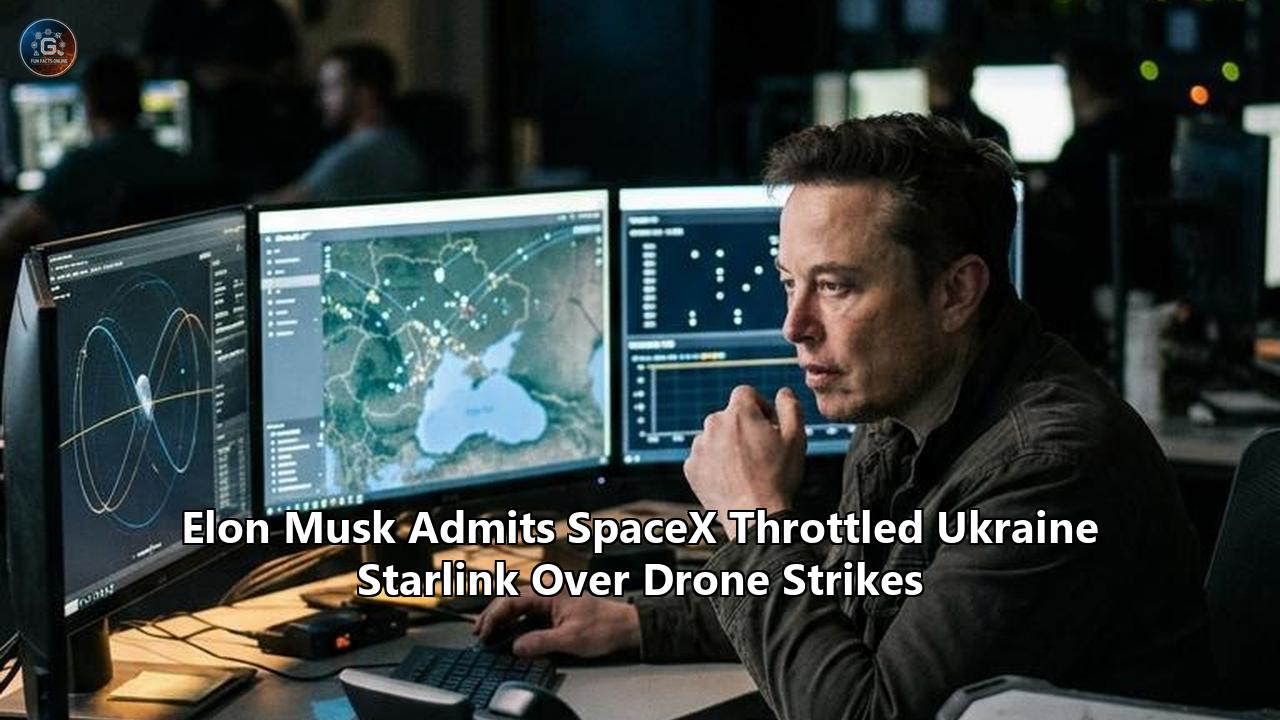
In the immediate aftermath, Ukrainian commanders suspected a catastrophic electronic warfare barrage by Russian coastal defenses. The reality was decided thousands of miles away in California. SpaceX Chief Executive Officer Elon Musk had personally intervened. Fearing that a successful surprise raid on Sevastopol would provoke Moscow into a tactical nuclear response, Musk refused an urgent Ukrainian operational request to activate Starlink satellite connectivity over the Crimean coastline, suffocating the attack mid-stride.
Musk later publicly confirmed the intervention. Writing on his social platform X, he insisted he did not deactivate coverage that was already active, but acknowledged that SpaceX had deliberately geofenced the peninsula and flatly rejected an emergency military appeal to turn it on. "The Starlink regions in question were not activated. SpaceX did not deactivate anything," Musk stated, arguing that acquiescing to the Ukrainian request would have made SpaceX "explicitly complicit in a major act of war and conflict escalation".
The Crimean episode shattered a foundational assumption of modern warfare: that private defense infrastructure, once contracted or deployed in a theater of war, operates subordinate to sovereign military commands. It signaled the arrival of an unprecedented dynamic where a single corporate executive could assert operational veto power over a nation's kinetic strikes.
The systemic conflict over SpaceX Starlink Ukraine drone strikes did not end with that aborted raid. Instead, it catalyzed a multi-year struggle involving classified Pentagon contracts, technical modifications to terminal firmware, intense Capitol Hill scrutiny, and an ongoing diplomatic tug-of-war over who holds the sovereign kill switch on 21st-century battlefields.
The Sevastopol Intercept: What Transpired Behind Closed Doors
The operational details of the aborted Crimean raid reveal a panicked, late-night series of communications between Ukrainian leadership and SpaceX’s chief executive. According to Ukrainian defense officials and reporting later documented in Walter Isaacson’s biography of the billionaire, the strike had been planned under strict operational security. The drone boats, predecessors to what Kyiv would eventually formalize as the Sea Baby and Magura V5 naval platforms, relied entirely on commercial Starlink user terminals bolted to their sterns to transmit multi-camera video feeds and receive micro-steering commands in real time.
[ Ukrainian USV Fleet ]
       │
       ▼ (Ku-band Phased Array Uplink)
[ Starlink LEO Satellite Shell (~550 km) ]
       │
       ▼ (Ka-band / Laser Inter-Satellite Mesh)
[ Terrestrial Gateway Station ]
       │
       ▼ (Encrypted Command Stream)
[ Military Control Bunker (Kyiv) ]
As the drones crossed the threshold of what SpaceX internal maps had designated as sovereign, Ukrainian-controlled territory, the terminals abruptly dropped their handshakes with passing Starlink low Earth orbit (LEO) satellites.
Inside the command center, Mykhailo Fedorov, Ukraine’s Vice Prime Minister and Minister of Digital Transformation, initiated an emergency contact chain. Fedorov, who had originally secured Musk’s commitment to send thousands of Starlink terminals to Ukraine days after Russia’s February 2022 invasion, sent urgent messages via encrypted messaging apps directly to Musk. Ukrainian Gen. Valerii Zaluzhnyi, then commander-in-chief of the armed forces, urgently sought an operational override.
Fedorov explained the operational parameters of the maritime strike craft to Musk, pleading with him to extend connectivity to Sevastopol Bay for the duration of the mission. Fedorov emphasized that the drones were striking legitimate military targets: warships actively firing Kalibr cruise missiles at Ukrainian power plants and urban centers.
Musk refused.
The SpaceX founder told Fedorov that he would not permit Starlink to be used for deep offensive strikes inside what Moscow viewed as its sovereign red lines. Musk claimed he had engaged in high-level backchannel discussions with senior Russian officials, including Anatoly Antonov, the Russian Ambassador to the United States. Antonov had explicitly warned Musk that any direct Ukrainian assault on Crimea—which Russia illegally annexed in 2014 and treats as a vital naval redoubt—would cross a threshold that could trigger a nuclear retaliation against Ukraine or NATO.
Musk viewed the strike not as a tactical counterattack, but as a catalyst for a global conflagration. Privately, he likened the strike to a "mini-Pearl Harbor," telling colleagues that enabling Starlink inside Sevastopol harbor would drag his commercial venture directly into World War III. Standing down the link, he believed, was an act of planetary stewardship rather than corporate interference.
In Kyiv, the reaction was fury. Senior presidential adviser Mykhailo Podolyak publicly denounced the intervention, stating that by preventing Ukrainian drones from neutralizing Russian missile carriers, civilians paid the price: "As a result, civilians, children are being killed. This is the price of a cocktail of ignorance and big ego".
Forensic Clarification: The Mechanics of Geofencing
Much public confusion initially stemmed from early reports suggesting Musk had manually "switched off" an active satellite blanket over Crimea during the attack. Isaacson later published an explicit correction, stating that Starlink coverage had never been turned on over Crimea in the first place due to U.S. sanctions and corporate policy.
The technical operational reality, however, shows that the difference between turning off and refusing to extend was an operational distinction that had the exact same tactical consequence on the water: the failure of the mission.
           GEOFENCE BOUNDARY (Crimean 100km Buffer)
                      │
  ACTIVE CELL ZONE    │    DISABLED / GEOFENCED ZONE
                      │
   [Starlink LEO]     │        [Starlink LEO]
         │            │              │
         │ (Active RF)│              │ (RF Denied / Drop Packet)
         ▼            │              ▼
    [USV Drone] ─────►│────────► [Dead USV]
   Full Telemetry     │          Telemetry Zero
                      │
Starlink does not function like a passive radio relay. It is an actively routed, software-defined phased-array constellation operating in low Earth orbit at altitudes between 540 and 570 kilometers. The network relies on strict spatial coordinate management to manage radio frequency (RF) spectrum licensing, cross-border regulatory constraints, and sovereign permissions.
Phased-Array Dynamic Beamforming
Starlink user terminals (known colloquially within SpaceX as "Dishy") do not sweep mechanically across the sky. They utilize an active electronically scanned array (AESA) comprising hundreds of tiny antenna elements. By micro-delaying the phase of the signal emitted by each individual element, the terminal directs a constructive radio beam directly at an overhead satellite without physically moving.
The satellites—transiting at approximately 27,000 kilometers per hour overhead—project localized "cells" of Ku-band radio energy down to the surface of the Earth. Each satellite remains in direct view of a ground terminal for only three to five minutes before handing off the active session to another satellite rising over the horizon.
               [ SATELLITE A ] ──handoff──► [ SATELLITE B ]
                     \                             /
                      \                           /
                       \                         /
                        ▼                       ▼
                   [ USER TERMINAL (AESA Phased Array) ]
Hexagonal Cell Management (H3 Indexing)
To coordinate this dynamic web, SpaceX divides the entire surface of the planet into discrete hexagonal cells using an architecture derived from Uber’s open-source H3 hierarchical spatial index. Each cell, typically indexed at Resolution 7 or 8, covers an area of roughly 5 to 25 square kilometers.
When a Starlink terminal powers on, its integrated Multi-Constellation Global Navigation Satellite System (GNSS) receiver locks onto GPS, Galileo, or GLONASS signals to determine its exact physical coordinates, altitude, and velocity vector.
- The terminal packages this position fix into its encrypted handshake request, transmitting it to the overhead satellite.
- The satellite forwards this metadata through Ka-band feeder links to an Earth-based gateway station, which passes the query to SpaceX’s central network management system.
- The network management system queries a whitelist database: Is the terminal's reported H3 cell authorized for service?
If an H3 cell falls inside an excluded territorial polygon—such as Russian-occupied Crimea, portions of the Donbas, or international maritime waters deemed outside the authorized service zone—the network management software issues an immediate rejection. The satellite’s digital beamformer is instructed not to allocate RF capacity to that coordinate, and the ground terminal’s transceiver is ordered to suppress transmission to prevent unauthorized electromagnetic radiation.
When Ukrainian mission planners plotted the Sevastopol strike, they assumed coverage extended into the maritime approaches to Crimea. But SpaceX had drawn a hard perimeter around the peninsula. The moment the USVs breached that invisible boundary, the terminals reported coordinates falling inside the blacklisted H3 cells. The network severed the connection instantly, terminating the live video stream and command loop.
Musk's refusal was not a complicated engineering endeavor; it was an operational decision not to click an administrative button that would have modified the database rules governing those specific H3 cells.
The Legal Tightrope: ITAR, Loitering Munitions, and Combatant Status
While Musk framed his decisions through the lens of averting a world war, behind the scenes at SpaceX headquarters in Hawthorne, California, a parallel crisis was consuming the company’s legal and regulatory teams.
From the earliest weeks of the conflict, the Ukrainian military had innovated rapidly, converting commercial off-the-shelf (COTS) technologies into tactical weapon platforms. Engineers stripped down standard Starlink dishes, removed their plastic casings to reduce weight, coated them in matte-black radar-absorbent paint, and mounted them directly onto the hulls of explosive-packed speedboats and aerial loitering munitions.
This adaptation created an existential legal vulnerability for SpaceX under United States export control regimes.
                     ┌─────────────────────────────┐
                     │ Commercial Starlink Terms   │
                     │ of Service: Prohibition on  │
                     │ Kinetic Weapons Integration │
                     └──────────────┬──────────────┘
                                    │
                                    ▼
       ┌────────────────────────────────────────────────────────┐
       │     U.S. International Traffic in Arms Regulations     │
       │                         (ITAR)                         │
       └────────────────────────────┬───────────────────────────┘
                                    │
            ┌───────────────────────┴───────────────────────┐
            ▼                                               ▼
┌───────────────────────────────┐       ┌───────────────────────────────┐
│ U.S. Munitions List Cat. XV   │       │ U.S. Munitions List Cat. XII  │
│  Spacecraft Systems & Payload │       │ Guidance & Control Hardware   │
└───────────────────────────────┘       └───────────────────────────────┘
Under the International Traffic in Arms Regulations (ITAR) and the Export Administration Regulations (EAR), commercial communication services are legally restricted from being directly integrated into offensive weapon systems without explicit State Department and Directorate of Defense Trade Controls (DDTC) licensing.
- The Weaponization Threshold: If a commercial satellite uplink provides general command-and-control for soldiers in a trench, it is classified as dual-use telecommunications infrastructure.
- The Fire-Control Threshold: The moment that same uplink is hardwired into the terminal guidance system of an explosive drone designed to steer into a warship, the commercial service risks being legally reclassified as an integrated component of a kinetic munition—a regulated "Defense Service" under ITAR.
SpaceX’s own commercial Terms of Service reflected this statutory panic. Section 8 of the standard Starlink agreement explicitly states:
"Starlink is not designed or intended for use with or in military weapons systems, combat drones, or any other kinetic weapon systems. Use of Starlink for such purposes is strictly prohibited and constitutes a breach of this Agreement."
In February 2023, SpaceX President and Chief Operating Officer Gwynne Shotwell addressed the friction publicly during a defense conference in Washington, making it clear that the corporate leadership was drawing a bright line between tactical defensive communications and direct weaponization.
"We know the military is using them for comms, and that’s OK," Shotwell told reporters. "But our intent was never to have them use it for offensive purposes... Starlink was never meant to be weaponized. Ukrainians have leveraged it in ways that were unintentional and not part of any agreement."
Beyond domestic export laws, there was the darker shadow of international humanitarian law (the Law of Armed Conflict).
If SpaceX knowingly and directly routed real-time telemetry into active kinetic strikes against Russian territory, the Russian Federation could argue that SpaceX ground stations, commercial data pipelines, and the physical satellites themselves had forfeited their civilian protection, rendering them legitimate military targets under Article 52 of Additional Protocol I to the Geneva Conventions.
Senior Russian diplomats at the United Nations Committee on the Peaceful Uses of Outer Space (COPUOS) had already laid that rhetorical groundwork, warning that "quasi-civilian infrastructure" used in support of Ukrainian strikes could become targets for retaliatory strikes.
For Musk and Shotwell, the dilemma was acute: maintain strict boundaries on SpaceX Starlink Ukraine drone strikes, or risk dragging a commercial company into the Crosshairs of federal export violations and Russian counter-space kinetic or cyber warfare.
From Black Sea Boats to Airspace Interceptors: The 100-MPH Velocity Cutoff
The friction between corporate constraints and frontline military tactics reached a renewed boiling point when the conflict shifted from maritime strikes to high-speed aerial drone warfare.
Having observed how Starlink permitted sea drones to evade Russian radio-frequency jamming, Ukrainian engineers began mounting modified Starlink terminals onto mid-range unmanned aerial vehicles (UAVs) and high-speed interceptor platforms. These aircraft were designed to track down and ram Russian reconnaissance drones and jet-powered Shahed loitering munitions.
Because the Starlink phased array maintains an extremely tight, steerable radio beam aimed vertically at satellites in orbit, it is practically impervious to conventional terrestrial radio-jamming systems, like Russia's Krasukha-4 or Zhitel, which broadcast jamming noise horizontally across the landscape.
[ Russian Jammer (Zhitel) ] ── Horizontal Interference Wave (Blocked by Horizon/Shielding)
                                     X
                                     X
 [ Ukrainian Drone ] ◄═══════════════╬════════════════► [ Starlink Satellite ]
                               Tightly Focused
                            Vertical Phase-Array Beam
This unjammable capability made Starlink the ultimate guidance system for deep penetration strikes. However, the response from SpaceX’s engineering divisions was swift and enacted at the firmware level.
The Motion Ceiling
Standard commercial Starlink terminals were originally programmed with an operating motion limit of roughly 70 to 100 kilometers per hour, intended to allow connectivity on moving passenger vehicles or boats while preventing deployment on high-velocity aircraft or ballistic munitions.
As Ukrainian strike drones cruise at speeds ranging from 110 km/h to over 180 km/h, they routinely collided with this programmatic ceiling.
SPEED THRESHOLD ENFORCEMENT
──────────────────────────────────────────────────────────────────────────
0 km/h ──────── 100 km/h ──────── 160 km/h (100 mph) ──────── 400+ km/h
[ Tactical Vehicles ]     [ High-Speed Drones ]       [ Starshield Restored ]
  Always Connected         Terminals Drop Offline        Connections Stable
                           During Drone Throttling
──────────────────────────────────────────────────────────────────────────
In mid-October 2026, Ukrainian drone crews on the southern and eastern front lines suddenly experienced widespread dropouts. The 7th Rapid Reaction Corps and the 7th Air Assault Corps reported that strike drones climbing to operational cruise speeds between 110 and 120 km/h abruptly lost their telemetry uplinks for 10 to 20 seconds at a time. Deprived of visual guidance, operators could not adjust course, and dozens of missions collapsed mid-flight.
Serhii "Flash" Beskrestnov, a technical adviser to Ukraine’s defense leadership on radio and drone technologies, revealed that SpaceX had introduced an unannounced velocity cap precisely at 100 miles per hour (161 km/h).
The restriction went beyond consumer dishes, hitting terminals provided under dedicated defense frameworks. "I confirm that overnight SpaceX introduced a speed limit for terminals operating in motion," Beskrestnov noted on Telegram. "Our defense forces did not receive a warning about this limitation, and this led to the disruption of several missions".
How the Constellation Clocks a Moving Terminal
The engineering behind this speed throttle is built directly into how Starlink maintains link coherence with LEO satellites:
- Doppler Frequency Shift Compensation: Because Starlink satellites orbit at 7.6 km/s relative to the Earth's surface, the radio frequency received by a ground terminal experiences significant Doppler shifting. The terminal’s baseband processor continuously calculates and compensates for this shift to hold the carrier frequency lock. If the terminal itself begins moving at high speed, it introduces an additional Doppler component.
- Onboard Telemetry Metrics: The terminal's GNSS receiver measures ground speed, altitude, and heading continuously.
- Firmware Cutoff Execution: When the telemetry processor registers a ground speed exceeding 160 km/h, the firmware flags the unit as violating its operational profile.
- Packet Rejection: The transceiver drops transmission frames or stops transmitting altogether, forcing the data throughput to zero until velocity falls below the reset threshold.
The impact was instantaneous: the daily average of Ukrainian drone strikes fell from upwards of 150 to under 50 within forty-eight hours. Ukrainian mid-range strikes targeting Russian rail junctions, ammunition dumps, and command posts behind the front lines stalled out, showing just how dependent Ukraine's kill chain had become on commercial space infrastructure.
The Political Finger-Pointing and the Starshield Mandate
The crisis surrounding velocity caps and geofenced zones escalated into a high-stakes diplomatic confrontation. This was not a private donor donating spare equipment; by mid-2023, the U.S. Department of Defense had intervened precisely to prevent Elon Musk from unilaterally dictating battlefield operations.
                ┌──────────────────────────────────┐
                │   U.S. Department of Defense     │
                │    (DISA / Space Development)    │
                └────────────────┬─────────────────┘
                                 │
             Dedicated Funding & │ Sovereign Authority
             Procurement Mandate │ (Contractual Firebreak)
                                 ▼
                ┌──────────────────────────────────┐
                │      SpaceX Starshield Tier      │
                │  (Classified Military Network)   │
                └────────────────┬─────────────────┘
                                 │
          Controlled Bandwidth & │ Operational Whitelisting
          Hardened C2 Encryption │ Over Combat Theaters
                                 ▼
                ┌──────────────────────────────────┐
                │ Ukrainian Armed Forces Terminals │
                │ (Tactical Strike & Interception) │
                └──────────────────────────────────┘
In June 2023, the Pentagon announced a formal contract with SpaceX through the Defense Information Systems Agency (DISA). Under this and subsequent agreements, the U.S. military funded thousands of dedicated terminals under SpaceX’s military branch, Starshield.
Starshield was conceived specifically to address the legal and operational liabilities that paralyzed standard Starlink operations:
- Starshield terminals operate under Department of Defense operational custody, with data traffic routed through secured, government-managed cryptographic overlays.
- The commercial terms of service prohibiting weaponization are superseded by Title 10 military authorizations, giving the Pentagon—not SpaceX executives—the legal right to allocate connectivity for offensive kinetic operations.
Yet, when Starshield terminals abruptly began dropping offline at 100 mph in October 2026, the entire institutional architecture fell into confusion.
A bitter dispute erupted between Washington, Hawthorne, and Kyiv. Musk pushed back against claims that he had personally ordered the throttling. Posting on X, Musk insisted that operational parameters for Starshield were out of his hands: "Starshield systems are owned and controlled by the US government. Any limits on speed or usage are decided by the US military and ultimately POTUS".
In Washington, officials disputed that account. U.S. Secretary of State Marco Rubio told reporters that "nobody" in the civilian leadership of the State Department had authorized an intentional operational shutdown. Simultaneously, defense reporting indicated that senior figures within the White House had sought ways to curb Ukrainian deep strikes against Russian oil refineries to stabilize international fuel prices, sparking widespread speculation that pressure had been applied to slow Starshield down.
Ukrainian President Volodymyr Zelenskyy addressed the standoff on international broadcasts, warning that while political leaders traded blame, Ukrainian soldiers were losing critical capabilities: "The service was still limited... This costs human lives on the front line".
The dispute was finally resolved after ten days of tense backchannel diplomacy. Ukrainian Defense Minister Yevhenii Khmara confirmed that SpaceX had lifted the velocity restrictions following a direct communication between the White House, the Pentagon, and SpaceX leadership.
"The monitoring systems of the Ministry of Defense of Ukraine officially record the restoration of the speed of Starlink/Starshield," Khmara announced. "The connection remains stable [while equipment is moving] at speeds over 400 km/h". The restoration enabled Ukrainian interceptor drones to resume hunting Russian Shahed munitions, but the underlying vulnerability had been laid bare once again.
The Congressional Backlash: Scrutiny on Private Monopolies
The recurring disputes over satellite access ignited bipartisan fury on Capitol Hill. The realization that an unelected tech executive, through personal decisions or contractual disputes, could constrain sovereign military maneuvers challenged the foundations of modern defense procurement.
CONGRESSIONAL INVESTIGATIVE PRESSURE
─────────────────────────────────────────────────────────────────────────────
• Senate Armed Services Committee (Sens. Jack Reed, Elizabeth Warren)
  Focus: Monopoly risks, defense supply chain reliance, unilateral foreign policy veto.
• Senate Permanent Subcommittee on Investigations (Sen. Richard Blumenthal)
  Focus: Legality of mid-combat operational throttling, Pentagon contractual enforcement.
• House Armed Services Committee (Reps. Steny Hoyer, Mike Rogers)
  Focus: Subpoenas for defense leadership and SpaceX executives regarding chain of command.
─────────────────────────────────────────────────────────────────────────────
Sen. Elizabeth Warren (D-Mass.), a senior member of the Senate Armed Services Committee, demanded a sweeping congressional inquiry into SpaceX’s operations. "The Congress needs to investigate what's happened here and whether we have adequate tools to make sure foreign policy is conducted by the government and not by one billionaire," Warren stated. "If it is one man who is dictating our foreign policy, then he puts the United States at enormous risk".
Sen. Jack Reed (D-R.I.), Chairman of the Armed Services Committee, voiced similar unease, warning that while commercial innovation had driven down the cost of orbital launches, national security could not be left to the whims of a single contractor. "Governments have traditionally controlled satellites and left it up to presidents to decide what to do with them," Reed said. "Musk can’t be the last word when it comes to national security".
In late October 2026, Sen. Richard Blumenthal (D-Conn.) launched a formal congressional probe into the Starshield velocity restrictions, demanding an accounting from Defense Secretary Pete Hegseth. Blumenthal’s inquiry focused on establishing who held the legal and technical authority to change network parameters on terminals deployed in active combat zones:
"In the late evening of October 13, Ukrainian forces lost critical access to Starshield after their access to speeds at which equipment could stay connected to the network was capped. This puts Ukrainian troops and civilians at risk and raises urgent concerns about who controls critical capabilities the United States government has spent billions acquiring."
Simultaneously, Representative Steny Hoyer (D-Md.) formally petitioned the House Armed Services Committee to subpoena both Pentagon leadership and Elon Musk to testify under oath regarding the command structure governing Starlink battlefield modifications.
The congressional scrutiny laid bare an uncomfortable truth: the United States military was structurally dependent on SpaceX. SpaceX was not merely a vendor; with its reusable Falcon 9 launch fleet and an operational LEO constellation comprising thousands of active satellites, it possessed a near-monopoly on orbital access and responsive tactical low-latency bandwidth. The Pentagon had no alternative constellation capable of matching Starlink's scale, resilience, and bandwidth density in real time.
Frontline Adaptation: Breaking the Orbital Tether
Faced with recurring geofencing constraints and velocity throttling, the Ukrainian defense apparatus realized that complete dependence on SpaceX was an unsustainable tactical vulnerability. Behind the scenes, the Security Service of Ukraine (SBU), the Main Directorate of Intelligence (HUR), and private Ukrainian defense incubators began engineering workarounds to insulate their drone fleets from third-party intervention.
                     UKRAINIAN MULTI-LAYERED C2 ARRAYS
                                      │
     ┌────────────────────────────────┼────────────────────────────────┐
     │                                │                                │
     ▼                                ▼                                ▼
[ SATELLITE TIER ]            [ RADIO MESH TIER ]             [ AUTONOMOUS TIER ]
 • Starshield (Primary)        • High-power COFDM Radios       • Visual Inertial Odometry
 • Eutelsat / OneWeb           • Aerial Relay Drone Links      • Terminal Optical Homing
 • Kymeta Flat Terminals       • Jamming-Resistant FHSS        • AI Target Acquisition
Diversified Satellite Backbones
While Starlink remained the backbone for general infantry communications and logistics, long-range naval and aerial strike platforms were quietly retrofitted with redundant satellite links:
- Ukrainian maritime drones began incorporating Kymeta flat-panel electronically steered terminals capable of bridging into alternative satellite networks, such as Eutelsat OneWeb.
- While OneWeb's higher orbital altitude (~1,200 km) introduces higher latency (~70–100 ms compared to Starlink's 25–40 ms), it operates under corporate and governmental governance based in the United Kingdom and France, which placed no restrictions on Ukrainian operations targeting Russian naval assets in the Black Sea.
Airborne Radio Relays (COFDM Mesh Networks)
To completely bypass satellite requirements during the terminal phase of an attack, Ukrainian developers built a sophisticated radio relay network using Coded Orthogonal Frequency Division Multiplexing (COFDM).
In an assault on maritime or rear-echelon targets, strike drones are escorted by high-altitude, long-endurance reconnaissance drones (such as the Shark or Tekever AR3).
                                [ High-Altitude Relay UAV ]
                                       ▲         ▲
                                      /           \
                 Directional COFDM   /             \  Directional COFDM
                       Radio Link   /               \  Radio Link
                                   /                 \
                                  ▼                   ▼
                      [ Low-Flying USV ]        [ Ground Station ]
                       (Target Vector)             (Kyiv/Odesa)
The high-altitude UAV acts as an airborne cell tower, routing point-to-point, frequency-hopping radio signals directly from the low-flying strike drone back to terrestrial command outposts over distances exceeding 150 kilometers, completely independent of commercial satellite constellations.
Terminal Autonomous Homing (Edge AI)
Perhaps the most consequential technical leap was eliminating the need for a continuous human-in-the-loop connection during the final strike sequence.
Ukrainian defense tech firms began deploying onboard compute boards equipped with lightweight neural networks. When an aerial drone or USV approaches an excluded zone—or when a Starlink terminal drops offline due to a velocity ceiling—the drone switches to autonomous guidance:
- Visual-Inertial Odometry (VIO): By fusing data from internal gyroscopes and optical flow cameras, the drone calculates its trajectory without relying on GPS (which Russia jammers routinely disrupt) or satellite telemetry.
- Convolutional Neural Network Target Acquisition: When the drone closes to within three kilometers of a target, its onboard electro-optical sensors cross-reference the camera image against stored silhouette databases of Russian naval hulls or logistics platforms.
- Lock and Detonate: The system locks its flight surfaces onto the designated target center-of-mass, executing the kinetic terminal dive without sending or receiving a single byte of external data.
The tactical fruits of this adaptation became clear. Despite the 2022 Crimean intervention, Ukraine systematically leveraged its multi-layered communications and autonomous systems to destroy, sink, or disable over a third of Russia's Black Sea Fleet. Flagships, landing vessels, and submarines were hit directly inside the bays of Sevastopol and Feodosia, forcing the remnants of Moscow’s naval power to permanently retreat to the safety of Novorossiysk, hundreds of miles to the east.
Comparative Assessment: Sovereign vs. Commercial Battle Networks
The operational friction over SpaceX Starlink Ukraine drone strikes exposed a profound structural divide between legacy military procurement and the modern deployment of dual-use commercial constellations.
| Dimension | Commercial Network (e.g., Starlink Standard) | Sovereign Military Network (e.g., Starshield / WGS) | Frontline Ad-Hoc Hybrid (Ukrainian Workaround) |
|---|---|---|---|
| Operational Control | Corporate Executives & Terms of Service | Sovereign Defense Commands (Title 10) | Mixed: Military command with commercial fallbacks |
| Geographic Flexibility | Enforced via H3 Hexagonal Cell Geofencing | Whitelisted globally or by theater commander | Dynamic switching based on RF availability |
| Velocity Parameters | Hard-capped (originally 100 mph / 160 km/h) | Uncapped (stable above 400 km/h) | Terminal phase runs on local radio / Inertial VIO |
| Legal Liabilities | Bound by ITAR, EAR, and civil communications law | Fully authorized Defense Service under military custody | Sovereign state military necessity |
| Electronic Warfare Resilience | High: Steerable phased-array uplink | Very High: Jam-resistant military-band nulling | Extremely High: Multi-band redundancy & mesh relays |
| Latency & Bandwidth | 25–40 ms; high throughput (100–220 Mbps) | 25–40 ms; cryptographically isolated channels | Variable: 50–150 ms depending on relay links |
This comparison highlights why Ukraine—and the broader Western defense establishment—struggled with Starlink.
Commercial constellations provide unrivaled bandwidth density and low latency at a fraction of the cost of traditional defense satellites. But that commercial efficiency comes with a permanent strategic vulnerability: the customer does not own the infrastructure, does not control the orbital shells, and remains subject to the corporate policies, liability fears, and personal ideologies of the individuals who manage the code.
The New Doctrine of Sovereign Space
The technical and geopolitical fallout of the SpaceX-Ukraine dilemma has permanently changed how nations prepare for satellite-dependent warfare. The episode disproved the utopian concept that commercial communications infrastructure could operate neutrally in a high-intensity interstate conflict.
European defense ministries, having witnessed Ukraine's vulnerability to sudden satellite cutoffs, have accelerated initiatives to build sovereign space capabilities. The European Union’s planned IRIS² (Infrastructure for Resilience, Interconnectivity and Security by Satellite) constellation was fast-tracked with billions of euros in dedicated defense spending, specifically designed to ensure European armed forces never find themselves dependent on an American corporate board for real-time tactical communications.
In Washington, the Pentagon is fundamentally overhauling its commercial space integration doctrine. Future contracts under the Space Development Agency’s Proliferated Warfighter Space Architecture (PWSA) now mandate ironclad "government control" clauses.
These contracts require commercial operators to sign over administrative and operational command of dedicated constellation segments, ensuring that geofences, speed gates, and whitelists cannot be altered without written authorization from a combatant commander.
The precedent established in the waters off Sevastopol and confirmed during the velocity throttles of the eastern front will shape military engagements for decades. When commercial satellites become the nervous system of modern kinetic kill chains, the divide between corporate governance and sovereign command disappears.
As unmanned drone swarms, high-speed strike platforms, and autonomous systems come to dominate the battlespaces of tomorrow, the decisive terrain of conflict will no longer be fought purely in the mud of the trenches or across the surface of the sea. It will be determined hundreds of kilometers overhead, in the microcode governing low Earth orbit, where the boundaries of war are written into lines of software.
Reference:
- https://www.businessinsider.com/elon-musk-biographer-how-he-stopped-ukraine-attacking-russian-fleet-2023-9
- https://www.theguardian.com/books/2023/sep/12/elon-musk-biographer-admits-suggestion-spacex-head-blocked-ukraine-drone-attack-was-wrong
- https://www.pravda.com.ua/eng/news/2023/09/12/7419424/
- https://satnews.com/2026/10/14/spacex-restricts-military-starshield-speeds-in-ukraine-disrupting-pentagon-funded-tactical-drone-operations/
- https://newsukraine.rbc.ua/news/us-senator-investigates-who-restricted-military-1792778324.html
- https://elearning.asc.edu.ag/spacex-limiting-starlink-ukrainian-drones-changes-modern-warfare-forever
- https://blog.v-g.club/en/posts/starlink-throttling-investigation-geopolitics/
- https://industrialbasealpha.com/article/white-house-orders-spacex-to-limit-starshield-speed-capability-for-ukraine
- https://en.wikipedia.org/wiki/Starlink_in_the_Russo-Ukrainian_war
- https://www.dirittoue.info/on-starlink/
- https://starlink.com/technology
- https://airpluxtec.com/how-starlink-works/
- https://www.reddit.com/r/Starlink/comments/1fzq29x/starlink_geofencing/
- https://eureka.patsnap.com/article/starlink-user-terminals-phased-array-antenna-technology
- https://www.cbsnews.com/news/elon-musk-starlink-starshield-ukraine-russia/
- https://www.pcmag.com/news/starlink-faces-anger-from-poland-over-new-roam-restriction
- https://www.reddit.com/r/spacex/comments/1x5ojq2/ukrainian_soldiers_in_combat_have_access_to/
- https://finance.biggo.com/news/68f93e5b-81d3-4963-9a46-7cb123882233
- https://www.pravda.com.ua/eng/news/2026/10/14/8057926/
- https://www.defensenews.com/pentagon/2026/10/16/order-to-limit-starshield-for-ukraine-came-from-inside-white-house-sources-say/
- https://newscord.org/article/ukraine-says-starlink-connection-is-stable-after-trump-ordered-musk-to-lift-spee--Story_20261024_UkrainesaysStarlinkc468d6581
- https://medium.com/the-manifest-archive/ukraines-interceptor-drones-now-have-the-same-speed-limit-as-starlink-s-roaming-plan-25326475859c
- https://www.tomshardware.com/tech-industry/drones/spacex-limits-starlink-service-for-ukraines-high-speed-military-drones-without-prior-warning-ukrainian-officials-say-limitation-significantly-complicates-logistics-and-drone-operations
- https://www.legion.org/information-center/news/security/2026/october/lawmakers-call-for-investigation-into-source-of-starlink-disruptions-in-ukraine
- https://www.youtube.com/watch?v=g38BiCFOO_w
- https://finance.biggo.com/news/68f93e5b-81d3-4963-9a46-7cb123882233
- https://hoyer.house.gov/media/press-releases/hoyer-sends-letter-armed-services-committees-requesting-investigation-starlink
- https://www.reddit.com/r/europe/comments/1x5kdps/spacex_restricts_starlink_use_on_ukrainian/