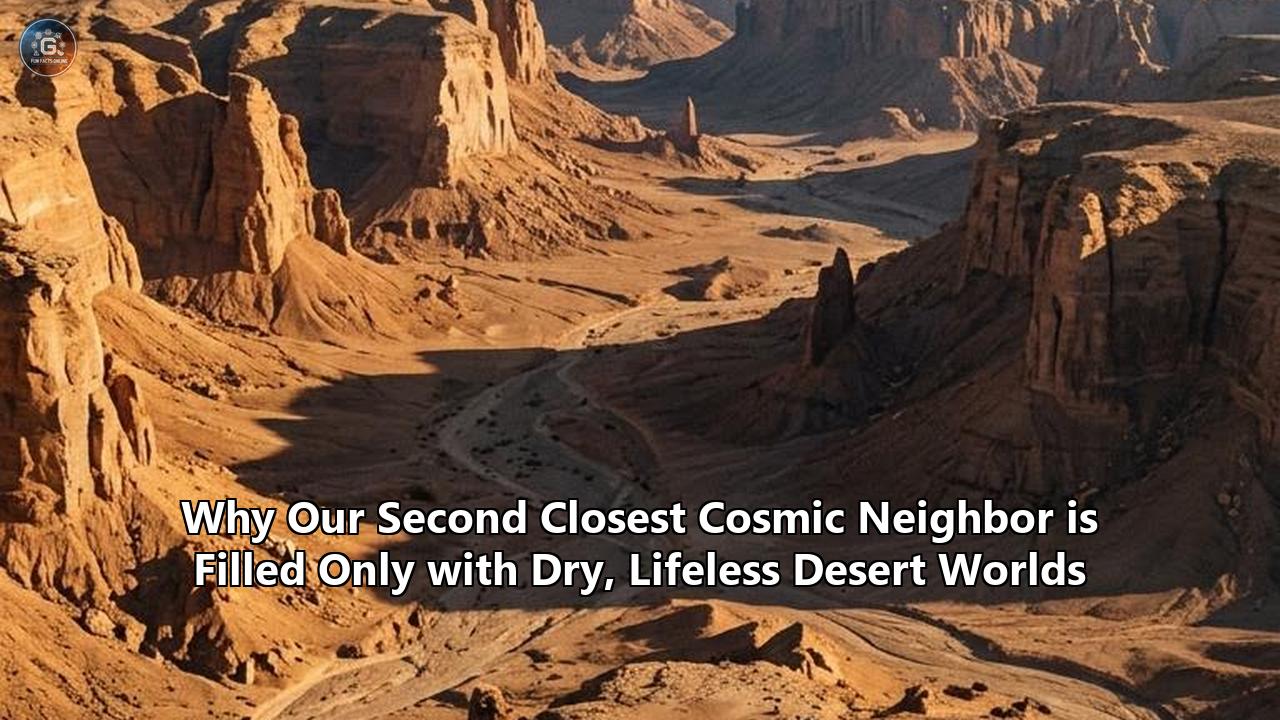
For decades, the crimson surface of Mars has served as a silent monument to planetary tragedy. Our second closest cosmic neighbor is a world of bone-dry valleys, towering dead volcanoes, and sweeping sand dunes. It is a planet-wide desert where liquid water cannot exist on the surface for more than a fleeting moment before boiling or freezing away. Yet, a rapid succession of major scientific discoveries—culminating in the recent retirement of a legendary atmospheric probe, a revelatory study on Martian dust storms, and a paradigm-altering map of the planet's deep interior—has finally answered the central question of why is mars a desert.
In June 2026, NASA officially declared the end of its highly successful Mars Atmosphere and Volatile Evolution (MAVEN) mission. After more than 11 years in orbit, the spacecraft fell permanently silent, but not before delivering its final, crucial datasets. These last transmissions, paired with a landmark March 2026 study published in Communications Earth & Environment, have exposed a violent, active "atmospheric pump" that continues to bleed Mars’s remaining water into the cold void of space.
Simultaneously, deep-space seismologists analyzing the archives of the retired InSight lander have completed a comprehensive "geological autopsy" of the Martian interior. These studies—including the late-2025 confirmation of a solid inner core and the 2024 detection of a massive, unreachable liquid ocean sealed twenty kilometers beneath the crust—have completely reshaped our understanding of planetary death.
Mars was not born a desert; it was driven to become one. The story of its transformation is a complex web of dying internal dynamos, lopsided magnetic shields, and catastrophic atmospheric erosion. Exploring these mechanisms reveals not only the tragic history of our neighbor but also the profound, challenging implications for the future of human space exploration and the search for life across the cosmos.
The Cosmic Autopsy: Reconstructing the Death of a Wet Mars
To fully comprehend why is mars a desert, planetary scientists have spent decades conducting a meticulous forensic investigation of the Martian surface and atmosphere. The geological evidence left behind is indisputable: Mars was once a blue world.
During the Noachian epoch, roughly 4.1 to 3.7 billion years ago, Mars boasted a dense, carbon-rich atmosphere capable of supporting a global water cycle. Floods of liquid water rushed across the southern highlands, carving massive outflow channels and depositing thick layers of sediment. Deep lakes filled impact basins like Gale Crater and Jezero Crater, where rivers deposited fan-shaped deltas rich in clay minerals. There may have even been a vast northern ocean covering a third of the planet's surface.
Yet, by the end of the Hesperian epoch, about 3 billion years ago, this warm, wet paradise had vanished. The liquid water disappeared, the atmosphere thinned to a mere fraction of its former density, and Mars froze into the hyper-arid wasteland we see today.
The primary culprit behind this planetary heist is the Sun. Unlike Earth, which is shielded by a powerful global magnetic field, modern Mars is entirely exposed to the solar wind—a relentless stream of highly energetic, charged particles ejected from the Sun at speeds exceeding one million miles per hour. When this solar wind collides with the unprotected upper atmosphere of Mars, it initiates a destructive process known as atmospheric sputtering.
For over a decade, the MAVEN spacecraft watched this sputtering process occur in real time. Equipped with sensitive mass spectrometers and magnetometers, MAVEN measured the speed and composition of ions escaping from Mars. Within weeks of its arrival in 2014, the probe observed hydrogen, oxygen, and carbon atoms actively fleeing into space. These escaping elements were the chemical building blocks of Mars's ancient water ($H_2O$) and carbon dioxide ($CO_2$) atmosphere.
[Solar Wind Particles]
       │
       ▼ (Direct Collision)
[Unprotected Upper Atmosphere] ──► Photodissociation (H2O ──► H + OH)
       │
       ▼ (Charge-Exchange & Sputtering)
[Atmospheric Escape] ──► Hydrogen & Oxygen escape to space
The physical mechanism of this escape relies on photoionization. High-energy solar ultraviolet (UV) radiation strikes molecules in the upper atmosphere, stripping away their electrons and turning them into charged ions. The magnetic fields carried by the passing solar wind then grab these ions, accelerating them to escape velocity and sweeping them out of the Martian gravity well.
MAVEN's long-term observations revealed that during solar storms and coronal mass ejections, the rate of atmospheric stripping spikes by a factor of ten or more. Over billions of years, this slow but steady erosion peeled away more than 90 percent of Mars's original atmospheric volume, dooming the surface water to dry up and evaporate.
The Atmosphere-Shedding Machine: How Dust Storms Blast Water Into Space
While solar wind sputtering explains how Mars's atmosphere was lost over geological time, scientists have long struggled to understand how water—normally trapped as ice or vapor near the cold surface—could rise high enough into the upper atmosphere to be stripped away. The answer came in a landmark study published on March 27, 2026, by an international team led by Adrián Brines of the Instituto de Astrofísica de Andalucía and Shohei Aoki of Tohoku University.
Using coordinated observations from orbital instruments, the researchers identified a highly dynamic, seasonal "atmospheric pump" powered by localized dust storms. Historically, scientists assumed that only massive, planet-encircling dust storms—rare events that occur roughly once every three to four Martian years—could loft water vapor to high altitudes. The March 2026 study shattered this assumption, proving that even relatively small, regional dust storms during the Northern Hemisphere summer are incredibly efficient at launching water into the crosshairs of space weather.
During these localized dust storms, airborne dust particles absorb solar radiation, heating the surrounding thin Martian air. This pocket of warm air rises rapidly, creating a localized updraft that acts as a giant atmospheric elevator. Water vapor trapped near the surface is sucked into this elevator and carried deep into the middle and upper atmosphere, reaching altitudes of 50 to 80 kilometers.
[Local Dust Storm] ──► Absorbs Solar Heat ──► Creates Rapid Updraft
                                                    │
                                                    ▼
                                       [Water Vapor Lofted to 80km]
                                                    │
                                                    ▼ (UV Photodissociation)
                                       [H and OH Radicals Formed]
                                                    │
                                                    ▼
                                       [Hydrogen Escapes at Exobase]
At these extreme heights, the water vapor levels measured during the Northern Hemisphere summer spiked to ten times their normal levels—a dramatic surge never predicted by standard Martian climate models. Once the water vapor is lofted to these altitudes, it is no longer protected by the lower atmospheric layers. Intense solar UV radiation immediately breaks the water molecules apart through photodissociation, yielding free hydrogen and hydroxyl ($OH$) radicals.
The extremely light hydrogen atoms quickly rise to the exobase—the outer boundary where Mars's atmosphere transitions into space. The March 2026 study documented a 2.5-fold increase in escaping hydrogen at the exobase directly following these regional dust storms. Because Mars possesses only 38 percent of Earth's surface gravity, its grasp on these light hydrogen atoms is weak, allowing them to drift into the interplanetary medium.
This violent, ongoing leakage is a primary reason why is mars a desert today. Every regional dust storm acts as a conveyor belt, lifting the planet's remaining volatile molecules to high altitudes where they are systematically disassembled and cast into space.
The Core Paradox: A Solid Heart and a Defunct Dynamo
The atmospheric stripping of Mars is only a symptom of a much deeper, more fundamental planetary failure. To understand why the atmosphere was left vulnerable to the solar wind in the first place, we must look to the very center of the planet.
A planet’s primary defense against solar radiation is its magnetosphere—a protective magnetic bubble generated by an active internal dynamo. Earth's dynamo is powered by the rapid churning of its liquid iron outer core, a process driven by heat escaping from the solid inner core as it slowly crystallizes over billions of years.
For decades, the standard scientific consensus held that Mars lost its magnetic field because its core was entirely molten. Without a solid inner core to drive compositional convection, it was believed that the internal dynamo simply ran out of energy as the planet's interior cooled, shutting down roughly 4 billion years ago.
However, this long-standing theory was completely upended by a seismic study published in Nature in late 2025. By analyzing the travel times of core-reflected seismic waves (specifically $PKiKP$ waves) recorded by the highly sensitive seismometer on NASA's InSight lander, researchers successfully detected a solid inner core at the heart of Mars.
This newly discovered solid inner core has a radius of approximately 613 kilometers—about 18 percent of the planet's total radius. This proportion is remarkably similar to Earth's inner core, which makes up about 19 percent of Earth's radius. This discovery was highly unexpected, as earlier analyses of marsquakes had suggested the Martian core was entirely liquid and filled with light, buoyant elements like sulfur and hydrogen that would prevent solidification.
  EARTH'S CORE (Active Dynamo)            MARTIAN CORE (Defunct Dynamo)
  ┌─────────────────────────┐             ┌─────────────────────────┐
  │  Liquid Outer Core      │             │  Liquid Outer Core      │
  │  (Rapid Convection)     │             │  (Slow/Stagnant)        │
  │         ▲               │             │         ▲               │
  │         │               │             │         │ (Weak heat)   │
  │  Solid Inner Core       │             │  Solid Inner Core       │
  │  (Crystallizing)        │             │  (Slow crystallization) │
  └─────────────────────────┘             └─────────────────────────┘
  Result: Strong, global magnetic         Result: Weak, hemispheric or
  field (Magnetosphere)                   extinct magnetic field
Finding a solid inner core on Mars created an intriguing paradox: if Mars has a crystallizing solid core similar to Earth's, why did its global magnetic field disappear?
The likely explanation, proposed by planetary scientist Douglas Hemingway of the University of Texas at Austin, is a matter of thermal dynamics and speed. Because Mars is much smaller than Earth—with only about 11 percent of Earth's mass—it possesses a much lower volume-to-surface-area ratio, causing it to lose its primordial heat far more rapidly.
Early in Mars's history, its magnetic field was powered by rapid thermal convection as heat escaped from its superheated, fully liquid core. As the planet cooled, this thermal convection weakened. While the core did eventually begin to crystallize, forming the solid inner core observed by InSight, this crystallization process and the resulting compositional convection in the outer core are simply too slow to power a global magnetic dynamo today.
This picture is further complicated by an April 2025 study from the University of Texas Institute for Geophysics (UTIG). Led by research associate Chi Yan and Sabine Stanley of Johns Hopkins University, the study presented evidence that early Mars's magnetic field was highly asymmetrical, covering only the southern hemisphere.
Running supercomputer simulations of a fully liquid Martian core under asymmetric heat flux from the mantle, the team found that heat escaped much faster from the southern hemisphere. This created a lopsided dynamo that left the northern hemisphere completely exposed to solar wind stripping even during the planet’s early, supposedly shielded epoch.
Peering into this deep interior helps us reconstruct why is mars a desert, revealing that the planet's internal heat engine died before it could establish a permanent, global magnetic shield like Earth's. When the lopsided dynamo finally collapsed entirely 4 billion years ago, the Martian atmosphere was left totally defenseless against the solar wind, initiating the long, dry slide into planetary desertification.
The Hidden Reservoir: An Ocean Sealed Twenty Kilometers Underground
For decades, the prevailing narrative of Martian history was that once the magnetic field died, almost all of the planet’s water evaporated and escaped into space. While a portion of this water was known to be frozen in the polar ice caps or trapped in shallow permafrost, the total volume of this ice was far too small to account for the massive oceans, rivers, and lakes mapped by orbital missions.
In August 2024, a team of geophysicists solved this mystery of the "missing water" with a groundbreaking announcement published in the Proceedings of the National Academy of Sciences (PNAS). Using seismic wave readings from NASA's InSight lander, researchers Vashan Wright, Michael Manga, and Matthias Morzfeld mapped the physical properties of Mars’s mid-crust.
SURFACE: Hyper-arid, frozen desert
  │
  ▼ 0 to 5 km: Dry upper crust (no water ice detected)
  │
  ▼ 5 to 11.5 km: Dry, transition zone of fractured rock
  │
  ▼ 11.5 to 20 km: MID-CRUSTAL WATER TRAP
  │   - Liquid water saturated in tiny rock pores and fractures
  │   - Volume: Enough to cover Mars in an ocean 1 to 2 km deep
  │
  ▼ 20+ km: Deep, dense Martian mantle
By analyzing how seismic waves altered their velocity and direction as they passed through the planet's crust, the team solved a complex mathematical inverse problem. Their calculations revealed that the seismic readings were best explained by a vast, planet-wide aquifer of liquid water trapped deep within the Martian crust.
This hidden reservoir is located between 11.5 and 20 kilometers (7 to 13 miles) beneath the surface. The water is not stored in massive, open underground caverns, but is instead saturated within the microscopic cracks, pores, and fractures of ancient igneous rocks.
The scale of this underground reservoir is staggering. The researchers estimated that the volume of groundwater locked in the Martian mid-crust is large enough to cover the entire surface of Mars with a global ocean between 1 and 2 kilometers (0.6 to 1.2 miles) deep.
This finding alters the very premise of why is mars a desert. The planet is not entirely devoid of water; rather, its water has been structurally quarantined deep within the crust, far out of reach of the surface.
As the ancient Martian atmosphere began to thin and cool, the surface water did not merely evaporate into space. Instead, a massive fraction of it slowly seeped downward through the fractured crust, filtering into the deep subsurface over millions of years.
Once trapped at these extreme depths, sealed beneath kilometers of dry, frozen rock, this water was protected from solar wind sputtering. However, its extreme depth also means it is effectively locked away, preserved in a cold, high-pressure vault that is completely isolated from the modern Martian surface.
Who is Affected: The Shattered Dreams of Easy Space Colonization
The scientific verification of Mars's deep interior structure and the active stripping of its atmosphere has sent shockwaves through the space exploration community. The primary groups affected by these discoveries are future human explorers, planetary defense organizations, and astrobiologists.
| Affected Group | Core Finding Impacting Them | Practical Consequences |
|---|---|---|
| Future Astronauts & Colonists | Mid-crustal water is trapped 11.5–20 km deep. | Cannot use deep water for In-Situ Resource Utilization (ISRU); forced to rely on dirty polar ice. |
| Astrobiologists | Deep subsurface aquifer contains liquid water and geothermal energy. | Shifts search for extant life from surface soil to deep crustal fractures. |
| Spaceflight Engineers | Active dust storms act as a powerful water and volatile pump. | Requires rethinking life support recycling and spacecraft protection during storms. |
| Planetary Science Mission Planners | End of MAVEN mission and arrival of ESCAPADE. | Lost key relay satellite; must transition to new, dual-satellite space weather architectures. |
Future Astronauts and the Collapse of ISRU
For years, plans for crewed missions to Mars—promoted by NASA and private entities like SpaceX—relied heavily on the concept of In-Situ Resource Utilization (ISRU). The core philosophy of ISRU is simple: spacecraft cannot carry all the water, oxygen, and fuel needed for a return trip, so astronauts must harvest these vital resources from the Martian environment.
The discovery that Mars’s massive liquid water reserves are locked 11 to 20 kilometers underground is a devastating blow to these plans. On Earth, drilling a well to a depth of just 10 kilometers is an extraordinary, multi-billion-dollar engineering challenge that requires heavy industrial infrastructure, specialized drilling muds, and immense power grids. Doing so on Mars, under 38 percent gravity and in a near-vacuum environment, is currently flatly impossible.
As a result, future colonists cannot simply "dig a well" to tap into Mars’s hidden ocean. Instead, they will be forced to rely on the far more difficult, energy-intensive process of mining and processing dry polar ice sheets or extracting water from shallow, dust-contaminated permafrost. This severely limits potential landing sites to frigid, high-latitude regions, making the establishment of self-sustaining equatorial colonies far more difficult and dangerous.
Astrobiologists and the Redirection of the Search for Life
For astrobiologists hunting for evidence of extraterrestrial life, these discoveries are a double-edged sword. On one hand, the confirmation of a planet-wide, liquid water aquifer deep in the Martian crust provides a highly promising habitat for microbial life.
On Earth, deep subsurface lithotrophic microbial communities thrive miles beneath the surface, completely independent of sunlight, deriving their energy from chemical reactions between water and minerals in the rock. The ingredients for a similar, deep biosphere undoubtedly exist within Mars’s mid-crust.
On the other hand, the extreme depth of this aquifer makes detecting or sampling this potential biosphere incredibly difficult. Robotic rovers like Curiosity and Perseverance are only equipped to scratch the surface, drilling just a few centimeters into the topsoil.
If life on Mars has retreated 15 kilometers underground to survive the planet's harsh, radiation-drenched surface desert, we may not be able to confirm its existence for generations, until we possess the heavy industrial drilling technologies required to penetrate the crust.
What Changes: Redefining the Parameters of Cosmic Habitability
The realization of how Mars lost its water and why its internal dynamo failed has forced astrophysicists to completely rewrite the rules of planetary habitability across the universe.
The Illusion of the Goldilocks Zone
For decades, the search for habitable exoplanets focused almost exclusively on the "Circumstellar Habitable Zone"—popularly known as the Goldilocks Zone. This is the orbital band around a star where the temperature is just right for liquid water to exist on a planet's surface.
Under this simplistic definition, early Mars was comfortably situated within our solar system's habitable zone. Yet, despite its prime real estate, Mars died.
     OLD PARADIGM                             NEW PARADIGM
┌─────────────────────────┐             ┌─────────────────────────┐
│     Habitable Zone      │             │     Habitable Zone      │
│  (Distance from Star)   │             │  (Distance from Star)   │
└─────────────────────────┘             └────────────┬────────────┘
                                                     │ (Plus)
                                        ┌────────────▼────────────┐
                                        │ Planetary Mass & Core   │
                                        │ (Dynamic internal heat) │
                                        └────────────┬────────────┘
                                                     │ (Plus)
                                        ┌────────────▼────────────┐
                                        │ Magnetic Dynamo Shield  │
                                        │ (Prevents sputtering)   │
                                        └─────────────────────────┘
The new planetary model established by these findings demonstrates that distance from a star is merely a secondary factor in long-term habitability. The true, primary driver of a planet's life cycle is its mass and its internal geodynamics.
Without sufficient mass, a planet cannot retain its internal primordial heat long enough to sustain a liquid outer core and a vigorous magnetic dynamo. Without that dynamo, the star's solar wind will inevitably strip away the atmosphere, and the planet's surface water will either bleed into space or seep irreversibly into the frozen crust.
This means that small, rocky exoplanets—even those sitting precisely in the habitable zones of their host stars—are highly likely to be dead, dry deserts. Planetary mass and core dynamics are now recognized as the critical gatekeepers of cosmic life.
The Asymmetric Shielding Model
The April 2025 UTIG discovery of Mars’s lopsided, southern-hemisphere-only magnetic field has introduced an entirely new variable into planetary climate modeling. Previously, astrophysicists assumed that planetary magnetic fields were always symmetrical, dipolar structures like Earth's, which shield the entire globe evenly.
We now know that a planet's core can generate asymmetrical, hemispheric magnetic fields if the heat flow through the mantle is uneven. This means a planet can be "half-protected," with one hemisphere shielded from space weather while the other is actively eroded by solar radiation.
This lopsided shielding dramatically accelerates atmospheric loss and represents a highly volatile, previously unmodeled transition phase in the death of rocky worlds.
Short-Term and Long-Term Consequences for the Human Future on Mars
The realization that Mars is a deeply buried, actively leaking water system has direct, tangible consequences that will play out over both the short and long term.
Short-Term Consequences (Next 5 to 15 years)
1. Shifting Exploration Targets to Polar Ice Sheets
With deep liquid groundwater ruled out as an accessible resource, space agencies are rapidly shifting their landing site selections for future crewed missions. Instead of targeting equatorial regions like Gale Crater or Jezero Crater—which are highly attractive for science but devoid of easily accessible water—missions are being redirected toward high-latitude regions like Arcadia Planitia or Utopia Planitia.
These areas host massive, shallow subsurface glaciers and ice sheets that can be scraped up with robotic excavators, albeit under much colder, harsher environmental conditions.
                  SHORT-TERM TARGETS (5-15 Years)
  ┌──────────────────────────────┬──────────────────────────────┐
  │      Arcadia Planitia        │       Utopia Planitia        │
  ├──────────────────────────────┼──────────────────────────────┤
  │ - Abundant shallow ice sheet │ - Massive subsurface glacier │
  │ - High-latitude, very cold   │ - High-latitude, dark winters│
  │ - Harder to land, less light │ - Harder to power solar arrays│
  └──────────────────────────────┴──────────────────────────────┘
2. The Rise of "Clay Mining" and Methane Extraction
Because drilling 15 kilometers deep is impossible, scientists are exploring alternative mineralogical resources. Analysis of Martian smectite clays has shown that these minerals contain trapped molecules of water and methane within their crystal structures.
In the near term, robotic missions are being designed to test "clay baking" technologies—heating these abundant surface clays to high temperatures to extract the trapped water and methane, which can then be processed into rocket propellant without needing to drill deep aquifers.
3. Re-evaluating Planetary Protection Protocols
The confirmation of a massive liquid aquifer 11.5 to 20 kilometers deep has reignited fierce debates within COSPAR (the Committee on Space Research).
If Mars possesses a vast, contiguous underground liquid ocean, any surface biological contamination introduced by human landing missions could slowly migrate downward through deep seismic cracks and contaminate the entire planetary aquifer over centuries. This may lead to much stricter sterilization requirements for any landers targeting regions with active seismic faults, such as Cerberus Fossae.
Long-Term Consequences (Next 50 to 150 years)
1. The Collapse of the Terraforming Myth
For over a century, science fiction and speculative science have dreamed of terraforming Mars—melting the polar ice caps, releasing vast quantities of $CO_2$, and restoring a thick, warm atmosphere to create a green, ocean-bearing world.
The latest data from MAVEN and the Tohoku University dust storm study have exposed this dream as a physical impossibility.
                  THE TERRAFORMING TRAP
  ┌─────────────────────────────────────────────────────────────┐
  │ Artificial Atmosphere Injected                              │
  ├─────────────────────────────────────────────────────────────┤
  │                            │                                │
  │ (No Magnetic Field)        │ (Dust-Storm Pump Active)       │
  │            ▼               │               ▼                │
  │ Solar Wind Sputtering      │ Water vapor lofted to 80km,    │
  │ strips gas into space      │ destroyed by UV, escapes       │
  ├────────────────────────────┴────────────────────────────────┤
  │ Result: Atmosphere continually bleeds into space;           │
  │ planet cannot maintain surface liquid water.                 │
  └─────────────────────────────────────────────────────────────┘
Without an active internal dynamo to generate a global magnetic shield, any atmosphere artificially injected into Mars would be slowly but relentlessly stripped away by the solar wind. Furthermore, the newly discovered dust-storm pumping mechanism would actively loft any injected water vapor into the upper atmosphere, where solar UV radiation would dismantle it and eject the hydrogen into space.
Humanity cannot build a stable, long-term biosphere on the surface of Mars. The planet's active atmosphere-shedding machine is simply too powerful.
2. Subterranean Cities and Lava Tube Habitats
Because the surface of Mars is a permanent desert drenched in lethal cosmic radiation and swept by abrasive dust storms, the long-term future of human civilization on Mars will not be built under giant glass domes on the surface. Instead, humanity must become a subterranean species.
Colonists will build their cities deep inside the massive volcanic lava tubes of the Tharsis region. These colossal underground tunnels, formed billions of years ago by rushing lava flows, provide natural shielding from cosmic rays, meteoroid impacts, and the violent dust storms that regularly engulf the surface.
3. The Century-Long Drilling Project
A hundred years from now, humanity's greatest engineering project on Mars will likely be the construction of a deep-crust geothermal-hydrothermal drilling rig.
To finally unlock Mars's hidden ocean, engineers will have to develop ultra-deep drilling techniques—such as millimeter-wave directed energy drilling or plasma-assisted thermal drilling—capable of penetrating 15 kilometers of solid, fractured basaltic rock.
Tapping into this deep aquifer would finally provide Martian cities with an inexhaustible supply of pure liquid water, turning the planet's hidden interior into the lifeblood of a subterranean civilization.
Looking Forward: The Final Frontiers of Mars Exploration
Ultimately, understanding why is mars a desert forces us to recognize that surface habitability is not merely a product of stellar distance, but a fragile, complex balance between a planet's deep internal geology and the harsh physics of space weather. As we look to the next phase of Martian exploration, several upcoming milestones will expand on these recent breakthroughs.
The ESCAPADE Mission (Late 2026)
With the legendary MAVEN spacecraft now declared dead, the torch of atmospheric monitoring has been passed to a new generation. In late 2025, NASA launched the Escape and Plasma Acceleration and Dynamics Explorers (ESCAPADE) mission.
Consisting of two identical, small satellites built by Rocket Lab and managed by UC Berkeley, ESCAPADE is scheduled to arrive in Mars orbit in late 2026.
                ESCAPADE MISSION ARCHITECTURE
               ┌──────────────────────────────┐
               │  Dual Satellite Orbiters     │
               │  (Blue and Gold)             │
               └──────────────┬───────────────┘
                              │
               ┌──────────────▼───────────────┐
               │  Multi-Point Space Weather   │
               │  Measurements (160-10,000km) │
               └──────────────┬───────────────┘
                              │
         ┌────────────────────┴────────────────────┐
         │                                         │
┌────────▼─────────────────┐              ┌────────▼─────────────────┐
│ Real-time response to    │              │ Dynamics of the "hybrid" │
│ solar wind storms        │              │ magnetosphere            │
└──────────────────────────┘              └──────────────────────────┘
Unlike MAVEN, which could only measure space weather at a single point in space at any given moment, ESCAPADE's dual-satellite architecture will allow scientists to make simultaneous, multi-point measurements of the Martian magnetosphere and upper atmosphere.
One satellite will monitor the incoming solar wind, while the other measures the atmospheric response deeper in orbit. This will provide the first real-time, three-dimensional views of how solar storms interact with Mars’s weak, patchy magnetic field, providing unprecedented detail on how the planet's atmosphere continues to erode.
Deep Seismic Mapping
Following the stunning success of the InSight seismic data analysis, planetary scientists are drawing up plans for a global Martian seismic network. Future robotic missions will aim to deploy small, rugged seismometer networks across different regions of the planet, particularly around the seismically active Cerberus Fossae and the Tharsis volcanic province.
This network will allow researchers to refine their maps of the deep mid-crustal aquifer, pinpointing the areas where the liquid water rises closest to the surface, and searching for any potential hydrothermal activity that could indicate active, deep-crust volcanic heat sources.
Summary of the Planetary Tragedy
The desert of Mars is a quiet, haunting mirror. It is a stark warning of what happens to a terrestrial world when its geological heart stops beating.
Billions of years ago, Mars was a vibrant, wet planet with the potential to host a thriving biosphere. But because of its small size, its core cooled too quickly, its lopsided magnetic shield collapsed, and its atmosphere was left entirely defenseless against the relentless wind of our parent star.
The water that once rushed through ancient rivers did not simply disappear into the void; much of it seeped deep into the cold, dark fractures of the Martian crust, sealing itself away fifteen kilometers beneath a frozen, silent desert.
As we prepare to send the first human explorers to walk upon those red sands, we do so with a profound new appreciation for the delicate, interlocking systems that keep our own Earth alive—a planet with a churning iron core, a powerful magnetic shield, and a stable, wet atmosphere that has sustained life for billions of years.
Reference:
- https://www.youtube.com/watch?v=6U9JiQ-Gp7I
- https://www.sciencedaily.com/releases/2026/03/260326075606.htm
- https://www.planetary.org/space-missions/maven
- https://www.universetoday.com/articles/nasa-bids-farewell-to-maven-mars-mission-in-public-teleconference
- https://www.space.com/astronomy/mars/very-interesting-wiggles-in-data-from-silent-nasa-mars-spacecraft-lead-to-unexpected-solar-wind-discovery
- https://eos.org/articles/scientists-may-have-finally-detected-a-solid-inner-core-on-mars
- https://skyandtelescope.org/astronomy-news/mars-might-have-a-surprisingly-large-solid-core-marsquakes-reveal/
- https://www.skyatnightmagazine.com/news/mars-missing-water-atmosphere-found
- https://news.berkeley.edu/2024/08/12/scientists-find-oceans-of-water-on-mars-its-just-too-deep-to-tap/
- https://ig.utexas.edu/news/2025/molten-martian-core-could-explain-red-planets-magnetic-quirks/
- https://www.futura-sciences.com/en/a-vanished-ocean-resurfaces-on-mars-shaking-everything-we-thought-we-knew_26315/
- https://www.space.com/23529-nasa-maven-mars-mission-explained-infographic.html
- https://science.nasa.gov/mission/escapade/
- https://scitechdaily.com/long-standing-planetary-mystery-solved-scientists-discover-mars-has-an-earth-like-core/
- https://www.discovermagazine.com/mars-liquid-core-may-have-once-powered-only-half-of-its-magnetic-field-47419
- https://www.aljazeera.com/news/2024/8/13/new-study-suggests-ocean-of-water-lies-beneath-marss-surface