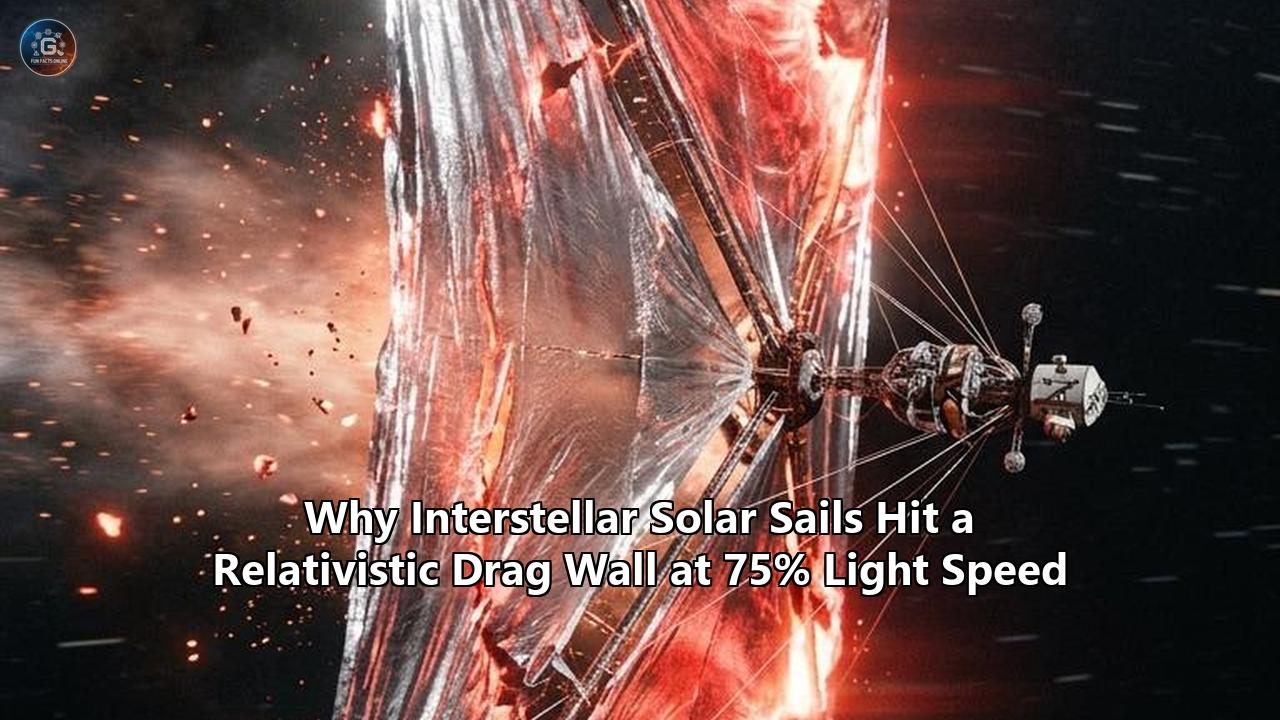
For decades, interstellar mission architectures have operated under a straightforward thermodynamic premise: to bypass the tyrannical mass ratios of the Tsiolkovsky rocket equation, humanity must decouple the propellant from the spacecraft. By utilizing fixed, high-energy laser arrays anchored in the solar system to beam gigawatts of coherent radiation against ultra-lightweight reflective membranes, interstellar solar sails appeared to offer a frictionless highway to neighboring star systems at significant fractions of the speed of light.
That theoretical highway just encountered a hard relativistic speed bump.
A study published by astrophysicists Chao Shen and Jiaze Li from the Harbin Institute of Technology reveals that directed-energy propulsion encounters an intrinsic aerodynamic-like drag generated by the driving light itself. Published in Relativistic Lightsail Propulsion Dynamics, the paper demonstrates that once a lightsail crosses approximately 75 percent of the speed of light ($0.75c$), relativistic light aberration fundamentally alters the momentum transfer of diffusely scattered photons. Rather than contributing forward thrust, scattered photons are beamed forward in the laboratory frame of reference, creating a counter-thrust that acts as an active braking mechanism.
This dynamic does not simply reduce acceleration efficiency; it establishes a fundamental scaling ceiling for beamed-energy sails. Using the Shen-Li findings as a primary case study reveals how relativistic electrodynamics, Doppler shift degradation, and interstellar medium interactions converge to redefine the design envelope for deep-space exploration.
Anatomy of Photon Thrust: The Three Pillars of Radiative Force
To understand how propelling light morphs into a braking force, one must isolate the three distinct momentum transfer mechanisms operating when a coherent photon beam impacts an interstellar membrane.
                       INCOMING PHOTONS (P_in)
                                │
                                ▼
         ┌──────────────────────────────────────────────┐
         │              LIGHTSAIL SURFACE               │
         └───────┬──────────────────────────────┬───────┘
                 │                              │
                 ▼                              ▼
      [Specular Reflection]            [Diffuse Scattering]
     Photons bounce cleanly           Photons absorbed & re-emitted
     Forward push = 2 · P_in          Aberrates forward at > 0.75c
     (Dominant thrust)                (Becomes active drag)
When an electromagnetic wave strikes an arbitrary surface, the net radiation pressure tensor decomposes into:
- Direct Incident Momentum: The brute kinetic transfer occurring as incoming photons are absorbed or intercepted by the sail's cross-sectional area.
- Specular Reflection: The elastic bouncing of photons where the angle of reflection equals the angle of incidence. Because momentum is a vector quantity ($\vec{p} = \hbar \vec{k}$), a $180^\circ$ retro-reflection transfers twice the photon’s initial momentum ($2p$) to the sail, delivering the highest propulsive efficiency.
- Diffuse Scattering and Thermal Re-Emission: The inelastic or quasi-elastic absorption and subsequent Lambertian (isotropic) re-emission of photons across the membrane’s hemispherical surface.
In classical Newtonian mechanics, all three forces point in the direction of the laser vector, assuming the beam strikes the sail perpendicularly from behind. If a sail possesses an optical absorption coefficient $\alpha$, a specular reflection coefficient $\rho_s$, and a diffuse scattering coefficient $\rho_d$ (such that $\alpha + \rho_s + \rho_d = 1$), the classical force $F$ exerted by an incident beam of power $P$ is expressed as:
$$F_{\text{classical}} = \frac{P}{c} \left( 1 + \rho_s + \frac{2}{3}\rho_d \right)$$
In this low-velocity regime, diffuse scattering provides a modest positive contribution to forward thrust ($\frac{2}{3} \rho_d \frac{P}{c}$) because the photons are re-emitted uniformly over the rear-facing hemisphere. For early flight demonstrator missions within the inner solar system—such as JAXA’s IKAROS, The Planetary Society’s LightSail 2, or NASA’s Advanced Composite Solar Sail System (ACS3)—this classical formulation held true.
At relativistic velocities ($\beta = v/c \gg 0.1$), however, the invariance of the speed of light forces a radical transformation in how these vector components interact.
The Aberration Tipping Point: Why 0.75c Inverts Scattered Momentum
The root of the drag phenomenon lies in relativistic light aberration—the angular displacement of incoming and outgoing light rays caused by relative motion between the emitter, the sail, and an external observer.
Consider two reference frames: the inertial frame of the emitter on Earth ($S$) and the rest frame of the accelerating sail ($S'$). In the rest frame of the sail ($S'$), photons that are absorbed and diffusely scattered are re-emitted according to Lambert’s cosine law, symmetrical with respect to the sail's surface normal. In this frame, the re-emission carries net rearward momentum, pushing the sail forward.
Frame S' (Sail Frame):
         Diffuse Emission
            ▲   ▲   ▲
             \  │  /
        ──────┴───┴─── (Sail)
        Thrust pushed FORWARD

Frame S (Observer/Lab Frame at v = 0.75c):
              \ │ /   (Forward Beaming)
               ▼▼▼
        ──────┬───┬─── (Sail)
        Aberration redirects photons FORWARD
        Thrust pushed BACKWARD (Radiative Drag)
However, transforming those scattered photons back to the laboratory frame ($S$) requires the relativistic aberration equation:
$$\cos \theta = \frac{\cos \theta' + \beta}{1 + \beta \cos \theta'}$$
Where $\theta'$ is the emission angle in the sail frame relative to its direction of motion, $\theta$ is the emission angle in the Earth frame, and $\beta = v/c$.
As $\beta$ increases, the Lorentz transformation skews the emission pattern forward in the laboratory frame—a phenomenon known in high-energy astrophysics as the "headlight effect". As the velocity climbs toward the speed of light, the angular distribution of re-emitted photons concentrates into an increasingly narrow cone oriented along the vector of motion.
Aberration Angle vs Velocity:
β = 0.00c : Isotropic rear hemisphere emission (Forward net push)
β = 0.50c : Emission cone shifts forward; net thrust degrades
β = 0.75c : CRITICAL THRESHOLD — Mean momentum vector flips forward
β = 0.90c : Intense forward beaming; heavy radiative back-reaction
Shen and Li calculated the precise integration of the scattered radiation pressure tensor across the full relativistic velocity profile. The mathematical tipping point occurs at:
$$\beta_{\text{crit}} \approx 0.75$$
At this velocity, the forward angular concentration of re-emitted photons in the laboratory frame exceeds the momentum carried by the initial absorption. Because the sail is radiating net momentum forward into the direction of travel from the perspective of the resting coordinate system, the conservation of relativistic four-momentum requires an equal and opposite reaction.
The diffuse scattering component ceases to be a propulsive element and becomes an active radiative drag force.
While the net propulsion force remains positive if the specular reflection ($\rho_s$) from the high-power laser is sufficiently dominant, the parasitic drag generated by diffuse scattering introduces a steep penalty in the differential acceleration equation:
$$\frac{d(\gamma m v)}{dt} = F_{\text{incident}} + F_{\text{specular}} - F_{\text{diffuse\_drag}}(v)$$
Where $\gamma = (1 - \beta^2)^{-1/2}$ is the Lorentz factor. As $\beta \to 0.75$ and beyond, this counter-acting force continuously saps the kinetic gains achieved by the laser array.
The Compounding Doppler Penalty
The emergence of aberration-induced drag at $0.75c$ does not occur in isolation. It is multiplied by another relativistic barrier: the longitudinal Doppler shift.
As the spacecraft accelerates away from the planetary laser array, the frequency of the photons striking the rear surface decreases precipitously. The relativistic Doppler factor for an emitter and receiver moving directly apart is governed by:
$$f' = f_0 \sqrt{\frac{1 - \beta}{1 + \beta}}$$
Where $f_0$ is the rest-frame laser frequency and $f'$ is the frequency experienced by the sail.
Velocity (β)  |  Lorentz Factor (γ)  |  Doppler Factor (f'/f₀)  |  Available Power Ratio
─────────────┼──────────────────────┼─────────────────────────┼────────────────────────
 0.10 c      |        1.005         |         0.904           |         0.818
 0.20 c      |        1.020         |         0.816           |         0.667
 0.50 c      |        1.155         |         0.577           |         0.333
 0.75 c      |        1.512         |         0.378           |         0.143
 0.90 c      |        2.294         |         0.229           |         0.053
Because the momentum of each photon is proportional to its frequency ($p = hf/c$), the force delivered per unit of laser energy emitted from Earth drops dramatically. At $\beta = 0.20$ (the target velocity for the Breakthrough Starshot mission profile), the sail receives roughly 81.6 percent of the original photon frequency, corresponding to a modest drop in effective force.
At $\beta = 0.75$, however, the Doppler factor drops to $0.378$. The sail captures less than 38 percent of the initial photon energy per second for a fixed photon flux. When combined with the time-dilation and spatial divergence of the laser beam over millions of kilometers, the net kinetic energy transferred to the sail falls off according to an inverse square-root power profile.
When this decaying incident force is combined with:
- The relativistic increase in dynamic inertia (the sail’s longitudinal mass resistance scales as $\gamma^3 m_0$),
- The aberration-induced drag of diffuse scattering, which grows stronger relative to the diminished net forward momentum,
the kinetic curve hits an effective asymptote. Pushing a lightsail from $0.20c$ to $0.75c$ requires non-linear power scaling; attempting to push it past $0.75c$ demands exponentially prohibitive energy budgets that risk vaporizing the membrane.
The Broader Pattern: Baryonic Drag and the Interstellar Gas Wall
The Harbin Institute study highlights radiative electrodynamics, but the structural lessons run deeper. When these radiative constraints are evaluated alongside the physical environment of the interstellar medium (ISM), the $0.75c$ threshold exposes a wider systemic barrier: the transition from vacuum mechanics to high-energy particle physics.
================================================================================
                    RELATIVISTIC DRAG REGIME TRANSITIONS
================================================================================

 Velocity (β)     Primary Drag Source            Physical Interaction
 ─────────────────────────────────────────────────────────────────────────────
 0.00c - 0.10c    Epstein Gas Drag               Elastic macroscopic collisions
 0.10c - 0.50c    Bethe-Bloch Ion Penetration    Atomic ionization & sputtering
 0.50c - 0.75c    Doppler Thrust Decay           Massive radiative redshifting
 > 0.75c          Relativistic Aberration Drag   Diffuse light vector flips forward
 0.75c - 0.99c    Relativistic Particle Beam     Continuous baryonic radiation (MW)
================================================================================
The interstellar medium is not empty space; it contains approximately $10^6$ hydrogen atoms per cubic meter, alongside trace helium, heavier ions, and microscopic dust grains.
At speeds below $0.10c$, the interaction between the sail and interstellar gas operates in the classical Epstein drag regime. The gas particles strike the forward surface as individual elastic or inelastic ballistic collisions, causing negligible deceleration for macroscopic structures.
Between $0.20c$ and $0.75c$, this interaction changes qualitatively:
1. The Bethe-Bloch Regime and Sputtering
At relativistic speeds, ambient interstellar protons do not bounce off the sail. Instead, they act as ionizing radiation, penetrating into the atomic lattice of the sail material.
The stopping power is governed by the Bethe-Bloch formula for high-energy charged particles. At $\beta \approx 0.75$, incoming interstellar protons hit the sail with a kinetic energy of approximately:
$$E_k = (\gamma - 1) m_p c^2 \approx (1.512 - 1) \times 938.3 \text{ MeV} \approx 480 \text{ MeV}$$
At nearly half a gigaelectronvolt per nucleon, the interstellar medium ceases to behave like an ambient gas and behaves instead like the concentrated proton beam of a particle accelerator. These high-energy collisions knock atoms out of the sail’s crystal lattice (physical sputtering), steadily thinning the membrane and degrading its optical coatings.
2. The Thermodynamic Transition
Recent analyses of relativistic baryonic drag on interstellar probes demonstrate that at extreme relativistic limits ($\beta \to 0.99$), the probe experiences an "inertial stiffening" where relativistic mass growth ($\gamma^3$) prevents the craft from slowing down significantly. However, the energy deposited by this continuous atomic bombardment shifts the primary threat from kinematic drag to catastrophic thermal absorption.
For a membrane spanning multiple square meters, intercepting continuous $480\text{ MeV}$ ions at $0.75c$ dumps megawatts of thermal energy directly into a structure with zero convective cooling options. If the sail's diffuse scattering already generates radiative drag while absorbing incoming kinetic energy, the membrane faces thermal runaway and structural collapse long before reaching its destination.
Lessons for Interstellar Mission Design
The discovery of the $0.75c$ radiative drag wall provides critical clarity for the physics community. Rather than treating light-sail propulsion as an open-ended velocity curve limited only by laser wattage, mission planners must now treat relativistic aerodynamics as a strict boundary condition.
Several key design principles emerge from this case study:
1. The Strategic Justification for the 0.2c Mission Envelope
When the Breakthrough Starshot initiative was announced, its target speed of $0.20c$ (aimed at reaching Proxima Centauri b in roughly 20 years) was frequently viewed as an arbitrary, conservative milestone on a path to $0.50c$ or $0.80c$.
The Shen-Li derivation provides a rigorous radiative justification for this choice. At $\beta = 0.20$:
- The Doppler factor remains manageable ($0.816$).
- The diffuse aberration angle does not beam backward force onto the vehicle.
- Interstellar proton kinetic energy remains below $20\text{ MeV}$, avoiding the deep relativistic spallation and severe sputtering thresholds found at higher Lorentz factors.
Operating between $0.15c$ and $0.25c$ represents the thermodynamic and electrodynamic "sweet spot" for beamed interstellar solar sails.
                     EFFICIENCY VS VELOCITY PROFILE
Thrust Efficiency
   100% ──┐
          │\
    80% ──┤ \  [Breakthrough Starshot Envelope: β = 0.20]
          │  \
    60% ──┤   \
          │    \
    40% ──┤     \
          │      \   [Doppler Decay & Sputtering Accelerate]
    20% ──┤       \
          │        \  [Aberration Tipping Point: β = 0.75]
     0% ──┴─────────\───────────────────────────────────────►
         0.0c  0.2c  0.4c  0.6c  0.8c  1.0c  Velocity (β)
2. Elimination of Diffuse Scattering via Metamaterials
The mathematical emergence of radiative drag relies directly on non-specular diffuse scattering ($\rho_d$). In a perfectly reflective mirror ($\rho_s = 1.0, \rho_d = 0, \alpha = 0$), no diffuse re-emission occurs, and the aberration drag component vanishes.
Real materials, however, possess surface roughness, micro-defects, and intrinsic material absorption. Under laser irradiances exceeding $1\text{ GW/m}^2$, even an absorption fraction of $\alpha = 10^{-5}$ can heat a membrane beyond its vaporization point.
┌─────────────────────────────────────────────────────────────┐
│                    METAMATERIAL SOLUTIONS                   │
├──────────────────────────────┬──────────────────────────────┤
│ Conventional Thin-Film       │ Engineered Photonic Crystal  │
├──────────────────────────────┼──────────────────────────────┤
│ • Random surface defects     │ • Sub-wavelength periodicity │
│ • Non-zero diffuse scatter   │ • Zero diffuse scattering    │
│ • Susceptible to 0.75c drag  │ • Coherent phase control     │
│ • Isotropic thermal emission │ • Tuned directional emission │
└──────────────────────────────┴──────────────────────────────┘
To bypass the aberration drag limit, future interstellar solar sails cannot rely on simple reflective films like aluminum or standard Mylar. Mission architectures must transition to engineered photonic crystal membranes and non-local dielectric metasurfaces.
By creating nanostructured silicon nitride ($\text{Si}_3\text{N}_4$) or transition-metal dichalcogenide monolayers with sub-wavelength spatial patterning, researchers can eliminate diffuse scattering entirely. Photons that are not specularly reflected are phase-controlled through diffractive interference rather than random thermalized re-emission, suppressing the aberration vector.
3. Harnessing Aberration for Beam-Riding Stability
One of the most complex operational challenges for laser sails is beam-riding stability: keeping a micro-payload centered inside a high-intensity laser spot across millions of kilometers without onboard steering thrusters.
The Harbin Institute study suggests a dual-use opportunity for relativistic aberration. If the sail geometry is shaped into a parabolic or specifically faceted diffractive shell, the velocity-dependent aberration forces can be engineered to generate passive restoring torques.
If the sail drifts off-center, the asymmetrical Doppler shift and angular aberration create differential radiation pressures across the opposing facets. This passive optical restoring force acts as a self-correcting optical tweezer, stabilizing the craft within the central core of the laser beam.
Architectural Pathways for Relativistic Acceleration
Navigating these relativistic limits requires changing how directed-energy systems are architected from the ground up. Propulsion researchers are modeling several advanced paradigms designed to mitigate the combined effects of Doppler redshifting, thermal sputtering, and aberration drag.
Dynamic Frequency Chirping
Because the Doppler shift systematically degrades photon energy transfer, stationary laser arrays emitting at a static wavelength ($\lambda_0 = 1064\text{ nm}$) lose coupling efficiency over the course of the burn.
To sustain optimal photon pressure without increasing total beam power, the emitter array must execute dynamic frequency chirping. By continuously shifting the transmitted laser frequency blue-ward over the multi-minute acceleration window:
$$\lambda(t) = \lambda_0 \sqrt{\frac{1 - \beta(t)}{1 + \beta(t)}}$$
the light arriving in the sail frame ($S'$) maintains an unshifted, constant resonance with the sail's narrow-band photonic crystal reflector. This eliminates off-band absorption, suppresses diffuse thermal re-emission, and maintains peak thrust efficiency across the acceleration trajectory.
Earth Emitter (Dynamic Blue-Chirping) ──► [ Redshift in Transit ] ──► Sail Frame (Resonant Match)
           λ_emitted < λ₀                                                λ_received = λ₀
Self-Evolving Geometric Sails
To balance the competing demands of high-thrust acceleration and low-drag interstellar coasting, researchers are exploring morphing structures.
During the primary propulsion phase (from $0$ to $0.20c$), the sail remains fully deployed as an ultra-flat or spherical reflector to intercept the laser spot. Once the directed-energy phase concludes, electro-actuated carbon nanotube latches fold the membrane into an ultra-thin needle or trailing tether profile.
Reducing the frontal cross-sectional area by four to five orders of magnitude minimizes collisions with the interstellar medium, reducing erosion from 480 MeV baryonic drag during the decades-long coast through interstellar space.
The Horizon of Beamed Propulsion
The demonstration that interstellar solar sails experience radiative drag at 75 percent light speed eliminates the simplistic assumption that interstellar travel is purely a function of laser energy. The speed of light is not merely an ultimate velocity limit; its underlying Lorentz transformations actively reshape the mechanics of reflection, radiation, and material stability long before a spacecraft approaches $c$.
================================================================================
                      RESEARCH ROADMAP & NEXT MILESTONES
================================================================================

 [Phase 1: Laboratory Metamaterials]
 ├─ Fabricate non-diffuse Si₃N₄ photonic crystal membranes
 └─ Validate reflectivity (> 99.999%) under vacuum laser loads > 1 GW/m²

 [Phase 2: Orbital Laser Accelerators]
 ├─ Test small-scale diffractive sails under dynamic Doppler shifts
 └─ Measure restoring torques from passive aberration-based beam riding

 [Phase 3: Relativistic In-Situ Probes]
 ├─ Deploy sub-gram wafer-scale payloads to 0.05c - 0.20c
 └─ Gather empirical data on ISM baryonic sputtering & Bethe-Bloch damage
================================================================================
The immediate focus for advanced propulsion laboratories shifts to material validation. Research teams at institutions like Caltech, the University of Pennsylvania, and the Harbin Institute are working to fabricate free-standing, sub-micron dielectric membranes capable of withstanding gigawatt-level laser fluxes while maintaining ultra-low diffuse scattering profiles. Validating these nanostructures in ultra-high vacuum test chambers under simulated Doppler profiles represents the next technical baseline.
By mapping the electrodynamic drag wall at $0.75c$, physicists have established the boundary conditions for the next era of deep-space engineering. Deep space exploration does not require brute-forcing physics through sheer electromagnetic wattage. Instead, the path to the stars depends on nanophotonic precision—designing spacecraft tailored to the relativistic fabric of the cosmos.
Reference:
- https://vdoc.pub/documents/the-elements-of-relativity-78mrcotp1ft0
- https://scitechdaily.com/the-strange-force-that-could-slow-interstellar-solar-sails/
- https://arxiv.org/html/1708.00959v2
- https://www.engineering.upenn.edu/stories/a-new-kind-of-light-sail-brings-interstellar-travel-one-step-closer/
- https://www.sciencedaily.com/releases/2026/08/260831015157.htm
- http://www.sciencedaily.com/releases/2026/08/260831015157.htm
- https://www.facebook.com/DigitalTrends/posts/a-new-study-suggests-laser-driven-interstellar-lightsails-may-face-a-hidden-effi/1368003031848965/
- https://www.quora.com/Is-it-realistically-possible-to-slow-a-spacecraft-down-from-0-8c-using-a-solar-sail-without-adding-more-than-a-couple-years-onto-the-journey
- https://starlust.org/light-could-power-interstellar-spacecraftuntil-it-starts-slowing-them-down/
- https://thedebrief.org/this-breakthrough-propulsion-technology-could-one-day-carry-humans-to-the-stars-but-theres-a-problem/
- https://arxiv.org/html/2604.00041v1
- https://www.reddit.com/r/Futurism/comments/1w5htzd/interstellar_solar_sails_hit_a_strange_problem_at/
- http://toughsf.blogspot.com/2017/04/interstellar-trade-is-possible-part-ii.html
- https://arxiv.org/pdf/1708.00959
- https://www.researchgate.net/publication/395170368_Lightsails_for_Interstellar_Travel_Photonics_for_Propulsion_Thermal_Management_and_Stability