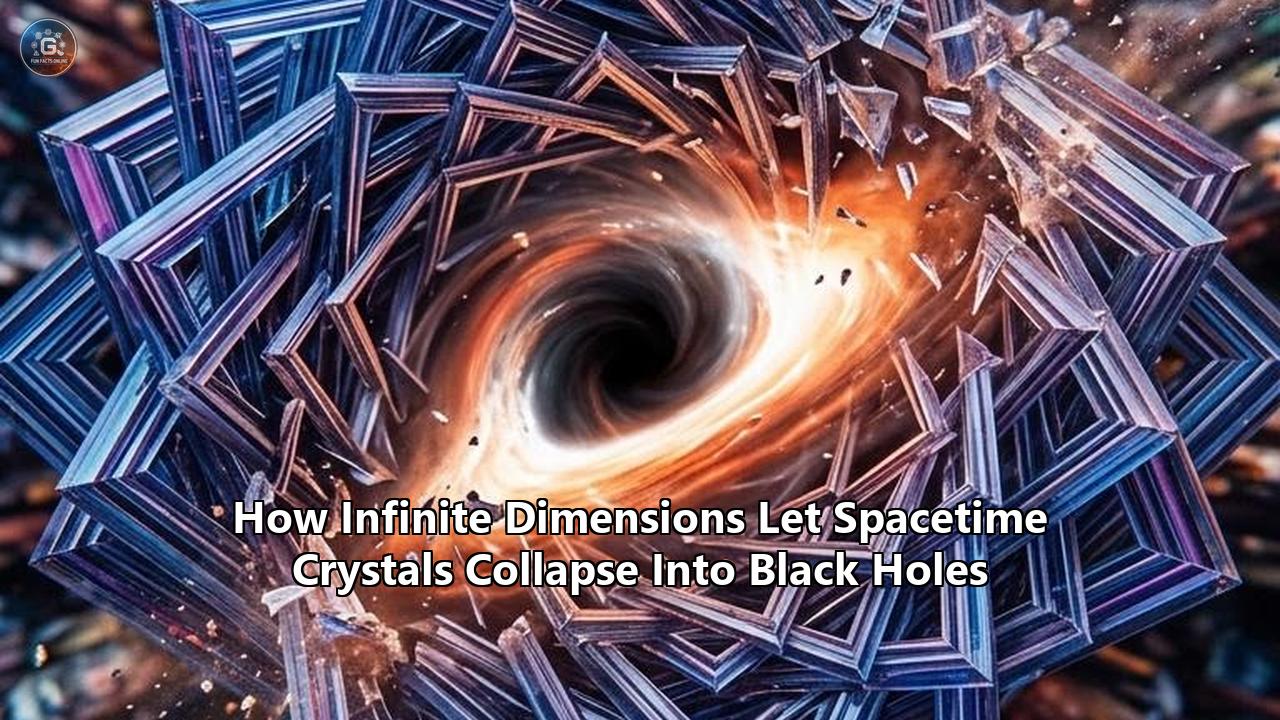
A theoretical physics collaboration between Goethe University Frankfurt and the Vienna University of Technology (TU Wien) has resolved a three-decade-old enigma in gravitational physics by deriving the first closed-form analytical equations that describe the critical collapse of space and time. Published in Physical Review Letters, the research demonstrates how ordered, repeating geometric configurations—termed "spacetime crystals"—balance upon an infinitesimally sharp knife-edge between total dispersion and sudden catastrophic collapse into microscopic black holes.
To overcome mathematical obstacles that have thwarted general relativists since the early 1990s, the researchers employed an unconventional mathematical framework: they solved Einstein’s field equations in a universe with an infinite number of spatial dimensions before systematically projecting the results back into four-dimensional spacetime.
The discovery provides the first exact mathematical solution for discrete self-similarity in critical gravitational collapse, an unstable threshold phenomenon previously observed only through complex supercomputer simulations. By providing a rigorous mathematical description for how localized ripples of pure geometry organize into crystalline spacetimes before tipping into gravitational collapse, the findings open fresh pathways for understanding primordial black hole formation in the infant cosmos, the limits of cosmic censorship, and the long-sought bridge between general relativity and quantum mechanics.
                CRITICAL COLLAPSE PHASE SPACE

   Energy Parameter (p)
        │
        │      Subcritical Regime (p < p*)
        ├──────────────────────────────────────────► Disperses into flat space
        │
        │      CRITICAL THRESHOLD (p = p*)
        ├───► [ SPACETIME CRYSTAL / DSS STATE ] ────► Discrete self-similar echo
        │
        │      Supercritical Regime (p > p*)
        └──────────────────────────────────────────► Collapses into Black Hole
                                                     (Mass M ∝ |p - p*|^γ)
The Thirty-Three-Year Computational Impasse
The origins of this breakthrough trace back to 1993, when physicist Matthew Choptuik published a study on the numerical collapse of spherically symmetric, massless scalar fields in four dimensions. Prior to Choptuik’s work, conventional wisdom held that gravity’s non-linearities would cause any collapsing mass-energy above a certain generic threshold to produce a black hole with a characteristic mass determined primarily by initial conditions.
Choptuik discovered something far stranger. By fine-tuning the initial amplitude or energy parameter $p$ of an incoming gravitational or scalar wave packet to a critical threshold $p^$, he uncovered a universal regime at the boundary of black hole formation:
- Subcritical Evolution ($p < p^$): The incoming wave focuses toward the center of coordinates, accumulates local energy density, but fails to reach the threshold required for trapped surfaces to form. It subsequently reflects off the origin and disperses outward toward spatial infinity, leaving behind completely flat, empty Minkowski spacetime.
- Supercritical Evolution ($p > p^$): The energy concentration exceeds the critical density, an event horizon materializes, and a black hole forms. Crucially, the resulting black hole's mass $M_{\text{BH}}$ does not jump discontinuously; it follows a precise power-law scaling relation:
$$M_{\text{BH}} \propto |p - p^|^\gamma$$
Here, $\gamma$ is a universal critical exponent ($\gamma \approx 0.37$ for a massless scalar field in four dimensions), completely independent of the shape, width, or initial profile of the collapsing matter wave.
- *Critical Solution ($p = p^$): Precisely at the threshold, the system never settles into empty space, nor does it form an immediate event horizon. Instead, it enters an intermediate, endlessly repeating state characterized by discrete self-similarity (DSS)*.
In this critical state, the geometry of spacetime reproduces itself at geometrically shrinking spatial and temporal scales, repeating its configuration after every time step compressed by an echoing period factor $\Delta \approx 3.44$. The curvature repeats in a scale-invariant cascade, producing a fractal-like, periodic pulsation in the fabric of space and time.
For thirty-three years, this self-similar echoing state remained locked inside numerical simulations. The non-linear, coupled partial differential equations governing Einstein gravity coupled to matter fields proved too mathematically intricate to yield exact analytical formulas. Theorists could compute the numbers on supercomputers using adaptive mesh refinement, but they lacked an analytical expression for the underlying intermediate state.
Mapping the Architecture of Spacetime Crystals
The intermediate, self-similar state identified at the threshold of gravitational collapse behaves precisely as a crystalline structure of spacetime.
In condensed matter physics, a conventional crystal represents a state of matter that breaks continuous spatial translation symmetry down to a discrete subgroup; atoms arrange themselves into regularly repeating spatial lattices. A "time crystal"—first conceptualized theoretically by Nobel laureate Frank Wilczek in 2012—breaks continuous time translation symmetry, repeating its structure periodically across time without consuming energy.
The critical gravitational solutions uncovered by Choptuik combine both phenomena across curved coordinates. When mapped onto logarithmic coordinates:
$$\tau = \ln\left(\frac{t^ - t}{r_0}\right), \quad \xi = \frac{r}{t^ - t}$$
where $t^$ marks the accumulation time of singularity formation, the continuous scale-invariance of the gravitational field equations breaks down into a discrete scale invariance.
Logarithmic
Time (τ)
  ▲
  │   ├─── Period Δ ───┤
  │   ┌────────────────┐   ┌────────────────┐   ┌────────────────┐
  │   │  Scale Echo 1  │   │  Scale Echo 2  │   │  Scale Echo 3  │
  │   │  Curvature     │──►│  Curvature     │──►│  Curvature     │
  │   │  Concentration │   │  Shrinks e^-Δ  │   │  Shrinks e^-2Δ │
  │   └────────────────┘   └────────────────┘   └────────────────┘
  └───────────────────────────────────────────────────────────────► Spatial Scale (ξ)
The metric and matter fields become strictly periodic in $\tau$ with period $\Delta$:
$$g_{\mu\nu}(\tau + \Delta, \xi) = g_{\mu\nu}(\tau, \xi), \quad \Phi(\tau + \Delta, \xi) = \pm \Phi(\tau, \xi)$$
This mathematical structure forms a spacetime crystal: a geometry whose curvature, energy-momentum tensor, and metric coefficients repeat in a periodic lattice across spacetime scale dimensions.
The critical configuration possesses an interior boundary known as a Self-Similar Horizon (SSH). Across this null separatrix, the crystal vector $\partial_\tau$ alters its causal signature:
- Outside the SSH, $\partial_\tau$ is spacelike, exhibiting spatial periodicities.
- Inside the SSH, $\partial_\tau$ becomes timelike, evolving as a dynamical time crystal.
- On the SSH itself, the crystal vector is strictly null (lightlike).
Despite its geometric regularity, this spacetime crystal is radically unstable. Linear perturbation analysis indicates that the spectrum of perturbations around this background contains exactly one unstable growing mode, with an instability Lyapunov exponent given by $\lambda = 1/\gamma$.
It is this singular instability that positions the crystal precisely at the crossroads of existence. If the physical system has an energy deficit—even by a quantum fluctuation—the crystal dissolves, unraveling into outward-propagating gravitational radiation. If it possesses the slightest excess of energy, the crystal undergoes catastrophic gravitational collapse, trapping all local geometry behind an event horizon.
The challenge was that deriving the exact geometry of this fragile crystal directly in four-dimensional space had defied every conventional mathematical technique in relativistic field theory.
The Dimensional Expansion Trick: Moving to $D \to \infty$
The breakthrough achieved by Christian Ecker (Goethe University Frankfurt), Florian Ecker (TU Wien), and Daniel Grumiller (TU Wien) emerged from a counterintuitive theoretical strategy: abandoning four-dimensional spacetime entirely and evaluating the Einstein-Klein-Gordon field equations in an infinite number of spatial dimensions.
                     THE LARGE-D DIMENSIONAL EXPANSION

  D = 4 (Physical Spacetime)                     D → ∞ (Infinite Dimension Limit)
  ──────────────────────────                     ────────────────────────────────
  • Non-linear, fully coupled PDEs               • Extreme gravitational localization
  • Gravitational fields spread widely           • Field lines compress into boundary layer
  • Radiative & static modes mixed               • Decoupling of angular and radial modes
  • Only numerical supercomputing works          • Exact closed-form analytical solutions
              │                                                │
              │                                                │
              └────────◄── Systematic 1/D Expansion ───────────┘
                           (Calculates 4D corrections)
In physics, expanding around an extreme limit often converts intractable nonlinear problems into solvable baseline systems. In quantum chromodynamics and condensed matter physics, physicists frequently study systems with $N$ color charges or vector components, solving the model exactly as $N \to \infty$ before computing $1/N$ perturbative corrections. In 2013, general relativists Roberto Emparan, Ryotaku Suzuki, and Kentaro Tanabe proved that general relativity possesses an analogous simplifying parameter: the inverse number of spacetime dimensions, $1/D$.
When the spacetime dimension $D$ increases toward infinity, the qualitative nature of gravity changes in ways that eliminate computational complexity:
1. Near-Horizon Gravitational Localization
In $D$ dimensions, Newton’s gravitational potential scales with radial distance $r$ from a mass source $M$ according to the higher-dimensional Poisson solution:
$$\Phi(r) \propto -\frac{G M}{r^{D-3}}$$
In four dimensions ($D=4$), the potential decays as $1/r$, allowing gravitational field lines to disperse broadly through space. As $D \to \infty$, the factor $r^{-(D-3)}$ approaches zero at extraordinary speed for any $r > r_0$.
Consequently, the gravitational field of an object ceases to permeate surrounding space and compresses entirely into an ultra-thin boundary layer directly adjacent to the mass concentration or horizon. Gravity becomes an intensely localized contact interaction.
2. Decoupling of Non-Linear Degrees of Freedom
In conventional four-dimensional relativity, gravitational radiation, static horizon deformations, and scalar field gradients interact non-linearly across all spatial scales. In the limit $D \to \infty$, the vast number of spatial angular directions suppresses radiative back-reaction and decouples the transverse spatial modes from radial dynamics.
The infinitely complex partial differential equations of general relativity simplify into a tractable set of lower-dimensional hydrodynamic and algebraic equations.
3. Exact Analytic Solvability
By applying this large-$D$ expansion to the spherically symmetric Einstein-massless-Klein-Gordon system, the Frankfurt-Vienna team achieved what had been impossible in $D=4$: they wrote down the discrete self-similar critical collapse equations in closed, analytical form.
                     SCALING PARAMETERS ACROSS DIMENSIONS

  Spacetime Dimension (D)   Echoing Period (Δ)   Choptuik Exponent (γ)
  ───────────────────────────────────────────────────────────────────
  D → 3⁺ (Lower Limit)      Δ → 0                γ → 0
  D = 3.76 (Peak Echo)      Δ ≈ 3.46 (Maximum)   γ ≈ 0.33
  D = 4 (Physical Universe) Δ ≈ 3.445            γ ≈ 0.374
  D = 5                     Δ ≈ 3.222            γ ≈ 0.413
  D = 10                    Δ ≈ 2.105            γ ≈ 0.620
  D = 100                   Δ ≈ 1.082            γ ≈ 0.941
  D → ∞ (Large-D Limit)     Δ → 1.000            γ → 1.000
By expanding metric perturbations in orders of $1/D$:
$$\Psi(r, \tau) = \sum_{n=0}^{\infty} \left(\frac{1}{D}\right)^n \Psi_{(n)}(r, \tau)$$
the researchers derived an analytical infinite family of discrete self-similar solutions.
In the pure $D \to \infty$ limit, the echoing period converges neatly to $\Delta = 1$, and the critical Lyapunov exponent locks to $\lambda = 1$ ($\gamma = 1$).
Subleading corrections—calculated at next-to-leading order (NLO) and next-to-next-to-leading order (NNLO)—systematically restore the finite-dimensional behavior.
When the researchers applied their series expansion back down to four-dimensional spacetime ($D=4$), their purely analytical equations matched the echoing period ($\Delta \approx 3.445$) and critical scaling exponent ($\gamma \approx 0.374$) obtained through Choptuik’s thirty-three years of empirical computer simulations with extreme numerical fidelity.
Inside the Mechanism: How Spacetime Crystals Collapse
The analytical formulation derived by the team reveals the step-by-step physical mechanics governing the transition from a stable geometry to a critical crystal, and ultimately into a black hole.
                              THE PATHWAYS OF CRITICAL EVOLUTION

                               ┌─────────────────────────────┐
                               │ Incoming Wave Packet (p)    │
                               │ Massless Scalar / Graviton  │
                               └──────────────┬──────────────┘
                                              │
                                              ▼
                               ┌─────────────────────────────┐
                               │ Focuses at Origin           │
                               │ Non-linear Coupling Grows   │
                               └──────────────┬──────────────┘
                                              │
                    ┌─────────────────────────┴─────────────────────────┐
                    ▼                                                   ▼
       ┌──────────────────────────┐                       ┌──────────────────────────┐
       │   Energy Deficit (p < p*)│                       │  Energy Balance (p = p*) │
       │   Subcritical Dispersal  │                       │  SPACETIME CRYSTAL       │
       └────────────┬─────────────┘                       └─────────────┬────────────┘
                    │                                                   │
                    ▼                                         ┌─────────┴─────────┐
       ┌──────────────────────────┐                           ▼                   ▼
       │ Curvature unwinds;       │                 p < p* - δE (Deficit)   p > p* + δE (Surplus)
       │ Waves reflect outwards   │                 Dissolves to flat space Traps interior
       │ Leaves flat Minkowski    │                 Curvature disperses     Forms Event Horizon
       │ empty spacetime          │                                         MICRO BLACK HOLE
       └──────────────────────────┘
The mathematical architecture governing how spacetime crystals black holes transition across the critical threshold can be broken down into four distinct phases:
Phase 1: Focusing and Non-Linear Amplification
A spherically symmetric wave packet of massless matter (such as scalar radiation or localized gravitational energy) travels inward toward the coordinate center at the speed of light. In the linear regime, when curvature is weak, the packet would simply pass through itself and disperse. However, as the energy density concentrates in an increasingly microscopic volume, the non-linear terms of Einstein's field equations begin to dominate. Curvature generates self-attraction, decelerating the outward dispersion and compressing the energy into a highly localized zone.
Phase 2: Symmetry Breaking and Crystal Nucleation
When the initial energy parameter matches the critical threshold ($p = p^$), the system neither explodes outward nor immediately collapses. The continuous time-translation and spatial-scaling symmetries of the background spacetime spontaneously break.
The geometry reorganizes into a discrete self-similar lattice—a critical spacetime crystal.
Curvature invariants, such as the Ricci scalar $R$ and the Kretschmann scalar $K = R_{\alpha\beta\gamma\delta} R^{\alpha\beta\gamma\delta}$, develop a nested, concentric series of spatial shells whose densities oscillate periodically in logarithmic time $\tau$. Each oscillation compresses the spatial footprint by a factor of $e^{-\Delta} \approx e^{-3.44} \approx 0.032$, concentrating energy thirty-one times more densely with every successive cycle.
Phase 3: The Intermediate Balance and the Unstable Mode
The analytical solution demonstrates that the spacetime crystal possesses a unique unstable eigenvalue in its linearized perturbation spectrum. The Frankfurt-Vienna team’s exact equations show that this instability mode corresponds to an energy-shifting perturbation that alters the balance between the kinetic energy of the collapsing scalar field and the localized gravitational potential energy.
- If the perturbation subtracts energy ($\delta E < 0$), the kinetic energy overcomes the gravitational pull. The periodic shells of the crystal de-synchronize, the Self-Similar Horizon dissolves, and the accumulated curvature unwinds, radiating out toward spatial infinity and returning the region to empty Minkowski space.
- If the perturbation adds energy ($\delta E > 0$), the local gravitational potential exceeds the kinetic escape velocity. The periodic echoes cannot sustain their self-similar balance.
Phase 4: Event Horizon Formation and Microscopic Trapping
Once tipped by a positive energy perturbation, the inward-collapsing phase of the spacetime crystal accelerates exponentially.
In higher-dimensional analysis, this transition corresponds to a rapid instability where the boundary layer of intense gravitational curvature detaches and forms an apparent horizon. The apparent horizon rapidly expands outward to merge with the event horizon of a newly formed black hole.
Because the collapse occurs from a self-similar state that has already compressed down through multiple echoing cycles, the resulting black hole can have an arbitrarily small mass.
Unlike stellar-mass black holes, which require a dying star exceeding the Tolman-Oppenheimer-Volkoff limit (roughly 2.17 solar masses) to overcome neutron degeneracy pressure, the critical collapse of a spacetime crystal has no fundamental lower mass limit. It can yield black holes with masses measured in grams, Planck masses ($10^{-5}\text{ g}$), or subatomic scales.
                              LATTICE CURVATURE OSCILLATION

 Curvature
 Density
    ▲
    │         /\                  /\                  /\
    │        /  \                /  \                /  \
    │       /    \              /    \              /    \
    │      /      \            /      \            /      \
    │     /        \          /        \          /        \
    │    /          \        /          \        /          \
    └───┴────────────┴──────┴────────────┴──────┴────────────┴───► Time (τ)
        │◄── Period Δ ──────►│◄── Period Δ ──────►│

        [ Echo Scale n ]      [ Echo Scale n+1 ]   [ Echo Scale n+2 ]
        Radius: r             Radius: r · e^-Δ     Radius: r · e^-2Δ
        Density: ρ            Density: ρ · e^2Δ    Density: ρ · e^4Δ
Expert Perspectives on the Discovery
The theoretical physics community has welcomed the Frankfurt-Vienna equations as a turning point in gravitational theory, ending an era where critical phenomena in general relativity could be investigated only through brute-force computation.
"This spacetime crystal is an exceptional physical configuration," explained co-author Daniel Grumiller of TU Wien’s Institute for Theoretical Physics. "It represents an unstable intermediate state—a critical balancing point that can evolve in two diametrically opposed directions. Left completely undisturbed or given a slight negative nudge, it dissolves away, leaving empty, calm spacetime behind. But add the slightest fraction of energy, and the self-organizing pattern collapses catastrophically into a black hole."
Christian Ecker of Goethe University Frankfurt emphasized the utility of using unphysical dimensions to solve real four-dimensional problems:
"Our universe has four dimensions—three of space and one of time. But mathematically, nothing prevents us from writing down Einstein's field equations for five, ten, forty-two, or infinitely many dimensions. In infinite dimensions, gravity localizes completely, turning impossible partial differential equations into solvable systems. Once we obtain the exact formula in that limit, we can systematically project the solution back down to four dimensions with extraordinary accuracy."
Florian Ecker, co-author from TU Wien, pointed out the stability of the analytical framework:
"The mathematical technique has proven remarkably robust. Depending on the level of precision required, we can systematically refine the formulas using higher-order $1/D$ perturbation terms. This gives the physics community an analytical toolkit for studying black-hole-related phenomena that previously required weeks of supercomputing time."
Beyond confirming numerical constants, the analytical formula provides a way to address core theoretical debates regarding the Weak and Strong Cosmic Censorship Hypotheses formulated by Roger Penrose.
In exact critical collapse ($p = p^$), the black hole mass scales down to precisely zero ($M_{\text{BH}} = 0$), meaning the self-similar cascade concentrates curvature down to a mathematical point without forming an event horizon. This produces a naked singularity—a point of infinite density and curvature that is visible to distant observers, theoretically exposing naked quantum gravitational effects directly to the outside universe.
Because achieving a naked singularity requires infinite fine-tuning ($p = p^$ to infinite decimal places), physicists have debated whether naked singularities are real physical possibilities or mere mathematical artifacts. The analytical equations derived from the large-$D$ expansion prove that the critical spacetime crystal contains strictly one unstable perturbation mode. This formally confirms that the formation of a naked singularity has a mathematical probability of zero in nature, fully preserving Penrose's Cosmic Censorship in realistic, non-fine-tuned environments.
Cosmological Implications: Primordial Black Holes and Dark Matter
While critical collapse represents an idealized mathematical state, the conditions required for spacetime crystals black holes to emerge likely existed in the violent, highly energetic environment of the early universe.
                     PRIMORDIAL CRITICAL COLLAPSE IN EARLY COSMOS

  Cosmic Inflation ──► Quantum Fluctuations ──► Overdense Plasma Horizons
                                                       │
                                                       ▼
  ┌────────────────────────────────────────────────────────────────────────┐
  │ Density Perturbations Re-enter Horizon (p ≈ p*)                        │
  │ • Matter fields organize into Critical Spacetime Crystals              │
  │ • Infinitesimal surplus energy tips crystal into collapse              │
  └───────────────────────────────────┬────────────────────────────────────┘
                                      │
                                      ▼
  ┌────────────────────────────────────────────────────────────────────────┐
  │ PRIMORDIAL BLACK HOLE (PBH) POPULATION EMERGES                         │
  │ • Masses range from sub-atomic (10^-5 g) to Planetary / Asteroid scale │
  │ • Non-stellar formation mechanism                                      │
  │ • Serves as viable candidate for Cold Dark Matter                      │
  └────────────────────────────────────────────────────────────────────────┘
During the first fractions of a second following the Big Bang, cosmic inflation stretched quantum fluctuations into macroscopic density perturbations. As these perturbations re-entered the cosmological horizon during the radiation-dominated era, regions with extreme overdensities collapsed directly into Primordial Black Holes (PBHs).
Cosmologists have long sought to understand the exact mass spectrum of these primordial objects. Standard models of PBH formation assumed that an overdense region either collapsed into a black hole with a mass roughly equal to the mass contained within the cosmological horizon at that time, or did not collapse at all.
Incorporating critical collapse dynamics alters this paradigm:
- Broadening the Mass Spectrum: Because critical collapse allows black hole masses to scale continuously down toward zero via the scaling relation $M_{\text{BH}} \propto |p - p^|^\gamma$, a significant fraction of primordial black holes could have formed with masses orders of magnitude smaller than the horizon mass.
- Sub-Atomic and Asteroid-Mass Windows: PBHs with masses between $10^{17}\text{ g}$ and $10^{22}\text{ g}$ (equivalent to the mass of an asteroid or small moon, but compressed into the size of an atomic nucleus) have avoided complete evaporation via Hawking radiation over the 13.8-billion-year history of the cosmos. These long-lived microscopic black holes remain a prime candidate for explaining the universe's elusive dark matter without requiring unknown exotic particles.
- Analytic Primordial Power Spectra: Prior to the Frankfurt-Vienna breakthrough, calculating PBH abundance across different inflation models required complex numerical simulations for each distinct inflationary potential. The newly derived closed-form formulas allow astrophysicists to compute the formation probability and mass distribution of primordial black holes directly using analytical field theory.
Holography, String Theory, and Lower-Dimensional Duals
The discovery of exact analytical solutions for spacetime crystals in the large-$D$ limit also builds a direct bridge to holographic duality (the AdS/CFT correspondence) and quantum gravity.
                     HOLOGRAPHIC DUALITY MAPPING

  BULK GRAVITY (D Dimensions)                   BOUNDARY CFT (D-1 Dimensions)
  ───────────────────────────                   ─────────────────────────────
  Spacetime Crystal at Threshold   ◄────────►   Driven Non-Equilibrium State
  (Discrete Self-Similar Curvature)             (Discrete Scale Invariant QFT)
               │                                              │
               ▼                                              ▼
  Collapse into Micro Black Hole   ◄────────►   Thermalization / Quantum Chaos
  (Event Horizon Formation)                     (Entropy Scrambling)
In modern theoretical physics, the AdS/CFT correspondence establishes that gravitational dynamics in a $D$-dimensional bulk spacetime containing a negative cosmological constant are mathematically equivalent to a non-gravitational quantum field theory (CFT) living on its $(D-1)$-dimensional boundary.
Applying the large-$D$ crystal equations to asymptotically Anti-de Sitter (AdS) spacetimes produces striking dualities:
- Dual Non-Equilibrium States: The discrete self-similar spacetime crystal in the gravitational bulk maps onto a strongly coupled quantum field theory undergoing a discrete scale-invariant limit cycle. It represents a quantum field theory periodically driven by scale transformations, analogous to Floquet time crystals engineered in condensed matter laboratories.
- Holographic Thermalization: The collapse of the spacetime crystal into a black hole corresponds precisely to the process of thermalization and quantum information scrambling on the boundary. The formation of an event horizon in bulk gravity is the holographic dual of an initially pure, highly ordered quantum state decaying into a thermalized, high-entropy mixed state.
- The $1/D$ Expansion as a String Coupling Analogy: Physicists have observed formal mathematical parallels between the $1/D$ expansion in general relativity and the $\alpha'$ (string length) expansion in string theory. In both cases, an intractable continuous geometry simplifies into an effective worldsheet or fluid membrane description.
By demonstrating that the large-$D$ limit can cleanly capture non-perturbative, highly dynamical processes like critical collapse, the new research provides a universal framework for analyzing black hole horizons as membrane-like fluids. Under this limit, horizon vibrations, gravitational quasinormal modes, and Gregory-Laflamme instabilities can all be solved analytically without running into computational singularities.
Comparing the Approaches: 1993 Numerical Simulation vs. 2026 Analytical Solution
The contrast between Matthew Choptuik’s original numerical approach in 1993 and the analytical breakthrough achieved in 2026 highlights the technical leap in theoretical methodology:
| Parameter / Feature | Choptuik Numerical Method (1993) | Large-$D$ Analytic Framework (2026) |
|---|---|---|
| Spacetime Dimension ($D$) | Fixed at $D = 4$ ($3+1$ dimensions) | Variable $D \to \infty$, analytically continued to $D \in (3, \infty)$ |
| Mathematical Methodology | Finite-difference numerical integration, adaptive mesh refinement | Perturbative $1/D$ expansion, closed-form asymptotic matching |
| Solution Type | Numerical grid approximations; discrete data points | Closed-form analytical formulas for metric and scalar field |
| Echoing Period $\Delta$ | Computed empirically as $\Delta \approx 3.44$ | Derived analytically: $\Delta = 1 + \mathcal{O}(1/D)$, matching $\Delta \approx 3.445$ at finite $D$ |
| Scaling Exponent $\gamma$ | Computed empirically as $\gamma \approx 0.37$ | Derived analytically: $\gamma = 1 - \mathcal{O}(1/D)$, matching $\gamma \approx 0.374$ at finite $D$ |
| Computational Requirement | High-performance supercomputer clusters | Pencil-and-paper calculation / symbolic algebra scripts |
| Theoretical Insight | Discovered universal power-law scaling and DSS empirically | Proved the uniqueness of the unstable mode and structural mechanics |
| Extension to Other Dimensions | Requires writing and executing new simulation code for each dimension $D$ | Continuous function providing exact values across all dimensions $D > 3$ |
Exploring the Lower Limit: The Small-$(D-3)$ Expansion
Alongside the large-$D$ expansion, the research team made another surprising discovery: gravitational critical collapse can also be analyzed from the opposite dimensional extreme—the limit where spacetime dimensions approach three from above ($D \to 3^+$).
In strictly three-dimensional spacetime ($D=3$), Einstein gravity has no propagating local degrees of freedom; the Weyl curvature tensor vanishes identically, meaning empty space cannot support gravitational waves, and asymptotically flat black holes cannot exist.
However, by treating the spacetime dimension $D$ as a continuous real parameter and studying the limit $D = 3 + \epsilon$ (where $\epsilon \ll 1$), the team discovered that critical collapse exhibits a dual behavior:
  D = 3⁺ Limit (Small-ϵ Expansion)             D → ∞ Limit (Large-D Expansion)
  ────────────────────────────────             ───────────────────────────────
  • Echoing period vanishes: Δ → 0             • Echoing period stabilizes: Δ → 1
  • Choptuik exponent vanishes: γ → 0          • Choptuik exponent stabilizes: γ → 1
  • Discrete self-similarity smooths into      • Horizon behaves as an ultra-localized
    Continuous Self-Similarity (CSS)             hydrodynamic membrane
As the dimension approaches three ($D \to 3^+$), the echoing period $\Delta$ shrinks toward zero.
When the echoing period vanishes, the discrete time-translation steps become infinitesimal, causing the discrete self-similarity to transition into a continuous self-similar (CSS) solution.
By charting the behavior across the entire spectrum—from $D = 3 + \epsilon$ all the way to $D \to \infty$—the Frankfurt-Vienna team mapped out the complete trajectory of critical gravitational collapse across all possible geometries.
They demonstrated that the echoing period $\Delta$ reaches an absolute mathematical maximum near $D \approx 3.76$ ($\Delta \approx 3.46$) before tapering down steadily toward unity as $D \to \infty$, explaining why the echoing period in our four-dimensional universe ($D=4$, $\Delta \approx 3.445$) is so pronounced.
 Echoing Period (Δ)
    ▲
3.5 ┼               * (Maximum at D ≈ 3.76, Δ ≈ 3.46)
    │             *   *  (D = 4, Δ ≈ 3.445)
3.0 ┼           *       *
    │          *          *  (D = 5, Δ ≈ 3.22)
2.0 ┼         *             *
    │        *                 *  (D = 10, Δ ≈ 2.10)
1.0 ┼       *                     * * * * * * * * * * ► (Converges to Δ = 1 as D → ∞)
    │      *
0.0 ┼─────*───────────────────────────────────────────► Spacetime Dimension (D)
    3.0  3.5  4.0  4.5  5.0       10.0       50.0  ∞
   (D→3⁺, Δ→0)
Future Horizons: Observational Tests and Quantum Limits
With the analytical equations for the collapse of spacetime crystals now established, theoretical and observational physics initiatives are preparing to explore their consequences:
1. Gravitational Wave Signatures of Microscopic Mergers
Next-generation gravitational wave observatories—including the space-based LISA (Laser Interferometer Space Antenna), the European Einstein Telescope, and the American Cosmic Explorer—will possess the sensitivity required to detect high-frequency gravitational wave bursts.
If primordial black holes formed via critical collapse in the early universe, their distinct mass and spin distribution will leave unique imprints in the stochastic gravitational wave background and sub-solar mass merger events.
The exact formulas allow theorists to model the precise gravitational waveforms produced during these events.
2. Generalization to Rotating and Charged Geometries
The current closed-form solutions describe spherically symmetric, non-rotating spacetimes coupled to scalar fields.
Theoretical teams are already adapting the large-$D$ expansion method to examine:
- Axisymmetric, rotating systems (the critical collapse threshold for Kerr black holes),
- Geometries coupled to gauge fields (such as the Einstein-Maxwell system),
- Pure gravitational vacuum collapse (the collapse of pure Brill gravitational waves without matter fields).
3. Quantum Back-Reaction and the Minimum Black Hole Mass
In classical general relativity, the critical collapse formula allows black holes to form with arbitrarily infinitesimal mass ($M_{\text{BH}} \to 0$).
In nature, however, quantum mechanics imposes fundamental constraints. As a collapsing spacetime crystal compresses below the Planck scale ($\ell_P = \sqrt{\hbar G / c^3} \approx 1.6 \times 10^{-35}\text{ meters}$), quantum fluctuations in the metric must disrupt the smooth classical geometry.
The analytical formula provides a mathematical foundation for calculating quantum back-reaction.
By inserting the exact classical background into the equations of quantum field theory in curved spacetime, physicists can now calculate the precise moment when Hawking radiation and quantum vacuum polarization halt the self-similar cascade, establishing a definitive quantum-corrected minimum mass for black holes born from critical collapse.
                  THE ROADMAP OF FUTURE DEVELOPMENTS

  2026 Analytical Formula ──► Non-Spherical / Kerr Generalization
  (Large-D Scalar Collapse)   (Rotating Spacetime Crystals)
            │
            ├──► Quantum Back-Reaction & Planck-Scale Limits
            │    (Determining Minimum Physical Mass)
            │
            ├──► Primordial Black Hole Mass Spectrum Integration
            │    (Dark Matter Candidate Profiling)
            │
            └──► Next-Gen Gravitational Wave Detection (2030s)
                 (LISA, Einstein Telescope, Cosmic Explorer Searches)
The mathematical derivation from Goethe University Frankfurt and TU Wien demonstrates that the boundary between ordinary space and black hole formation is not a featureless void, but an intricate, self-organizing realm governed by crystalline symmetries.
By showing how infinite dimensions let spacetime crystals collapse into black holes, the researchers have turned a 33-year numerical challenge into an analytical framework that illuminates the foundational structure of gravitational physics.
Reference:
- https://timesofindia.indiatimes.com/science/scientists-crack-a-30-year-old-mystery-about-how-black-holes-form-without-a-dying-star/articleshow/131764704.cms
- https://www.facebook.com/groups/303649262041653/posts/1101837812222790/
- https://inkorr.com/en/fiziki-vperse-opisali-ak-kristal-prostoru-casu-stae-mikroskopicnou-cornou-dirou-345085
- https://arxiv.org/html/2602.10185v2
- https://www.researchgate.net/publication/399967120_Analytic_discrete_self-similar_solutions_of_Einstein-Klein-Gordon_at_large_D
- https://www.sciencedaily.com/releases/2026/08/260829035225.htm
- https://thedebrief.org/scientists-reveal-a-bizarre-space-time-structural-phenomenon-that-could-be-creating-baby-black-holes/
- https://hayadan.com/tiny-black-holes-spacetime-crystals
- https://www.researchgate.net/publication/400704450_Critical_spacetime_crystals_in_continuous_dimensions
- https://scitechdaily.com/the-strange-spacetime-crystal-that-can-suddenly-turn-into-a-black-hole/
- https://www.facebook.com/Cosmocuriouss/posts/reality-is-way-stranger-than-fiction-physicists-have-just-mathematically-discove/122207163320762872/