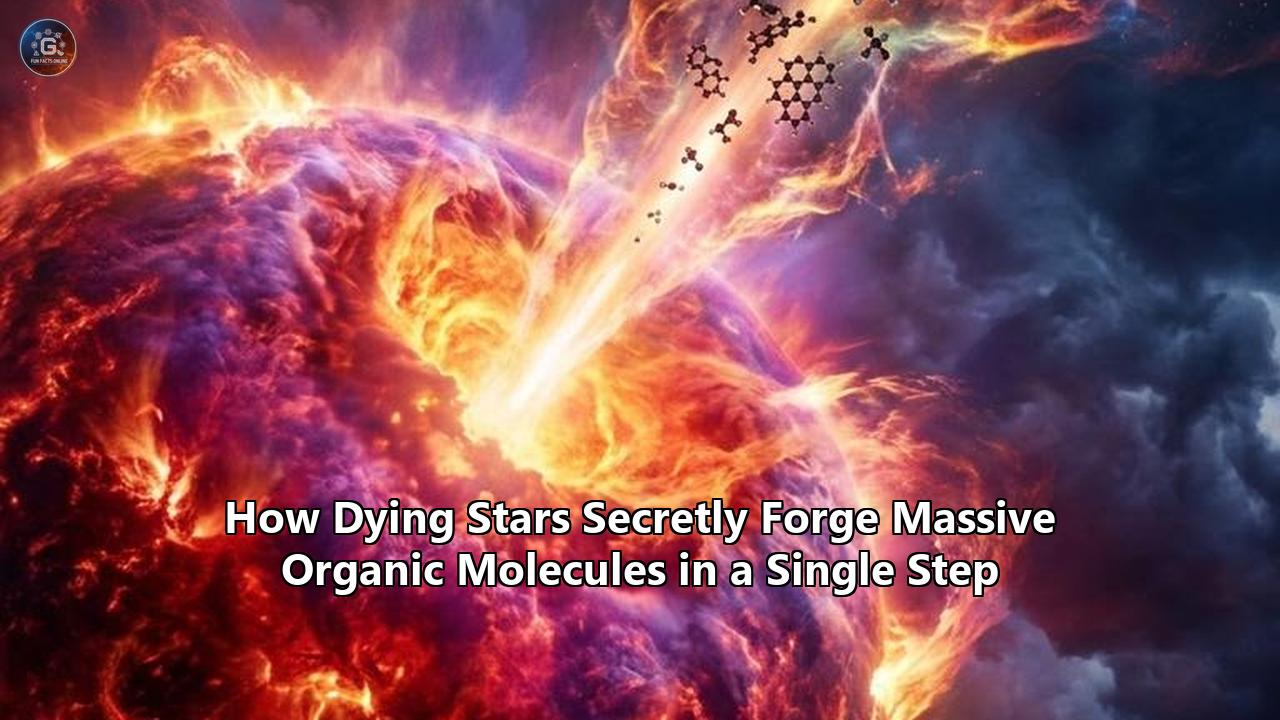
A study published in Nature Communications by a team of physical chemists and astrophysicists at the University of Hawaiʻi at Mānoa, National Dong Hwa University, and the SOLEIL Synchrotron facility has uncovered how aging, carbon-rich stars assemble massive polycyclic aromatic hydrocarbons (PAHs) in single-step molecular reactions.
For decades, astrochemists faced an intractable rate-equation problem. Telescopes like the James Webb Space Telescope (JWST) and the Atacama Large Millimeter/submillimeter Array (ALMA), alongside laboratory analyses of pristine carbonaceous material returned from asteroids Ryugu and Bennu, consistently revealed large organic ring structures distributed across deep space. Standard astrochemical models, however, predicted that circumstellar environments expand and cool too rapidly for these multi-ring frameworks to grow through traditional atom-by-atom or acetylene-by-acetylene addition.
The experimental and computational study, led by Shane J. Goettl and Professor Ralf I. Kaiser, proves that high-temperature stellar winds drive an alternative pathway: aryl radical addition–dehydrocyclization. Rather than undergoing dozens of sequential collisions to build one ring at a time, reactive aromatic fragments slam together in energetic stellar winds, simultaneously closing multiple carbon rings and expelling hydrogen in a single reaction step.
This discovery provides a direct physical mechanism for how the primary building blocks of cosmic carbon dust are forged. More fundamentally, it serves as an empirical lens into the non-equilibrium chemistry of the universe, revealing that cosmic complexity often arises through rapid, modular molecular assembly rather than slow, incremental accretion.
┌─────────────────────────────────────────────────────────────────────────────┐
│             CIRCUMSTELLAR HYDROCARBON GROWTH: TWO COMPETING MODELS          │
├─────────────────────────────────────────────────────────────────────────────┤
│                                                                             │
│  1. LEGACY MODEL: Sequential Stepwise Addition (HACA)                       │
│     [Benzene] + H• ──> [Radical] + C2H2 ──> [Chain] ──> [Ring Closure] ...   │
│     • Requires dozens of successive bimolecular collisions                  │
│     • Timescale: 10^3 - 10^4 years (often outpaced by wind expansion)       │
│     • Kinetic bottleneck: High activation barriers at intermediate steps    │
│                                                                             │
│  2. NEW FRAMEWORK: Aryl Radical Addition–Dehydrocyclization (PAC)           │
│     [Aryl Radical (e.g., Phenyl)] + [Aromatic Substrate (e.g., Naphthalene)]│
│                                  │                                          │
│                                  ▼  Single Collision Event (~1,000–1,500 K) │
│                [Transient Radical Addition Adduct]                          │
│                                  │                                          │
│                                  ▼  Prompt Intramolecular Dehydrocyclization│
│         [Fused Polyaromatic Scaffold (e.g., Fluoranthene/Triphenylene)]     │
│                             + Atomic Hydrogen (H•)                          │
│                                                                             │
│     • Forms multiple covalent bonds simultaneously in a single step         │
│     • Timescale: Microseconds to milliseconds inside outflow shocks         │
│     • Bypasses classical kinetic bottlenecks at high temperatures           │
└─────────────────────────────────────────────────────────────────────────────┘
The Circumstellar Bottleneck: Why Traditional Astrochemistry Failed
To understand the mechanics of the UH Mānoa discovery, one must examine the extreme environments surrounding Asymptotic Giant Branch (AGB) stars. In the final hundred thousand years of a low-to-intermediate-mass star’s life (stars between 1 and 8 solar masses), the stellar core exhausts its core helium and transitions to alternating hydrogen- and helium-shell burning. Periodic thermal pulses dredge up freshly synthesized carbon-12 from the core to the stellar surface. When the atmospheric carbon-to-oxygen ratio ($C/O$) exceeds unity, all available oxygen becomes locked in stable carbon monoxide ($CO$) molecules, leaving a surplus of carbon atoms to initiate rich organic chemistry.
These pulsating giants lose mass at staggering rates—up to $10^{-5}$ to $10^{-4}$ solar masses per year—ejecting their outer atmospheres at velocities between 10 and 30 kilometers per second. As this gas flows outward, it cools from photospheric temperatures of roughly 3,000 K down to a few hundred Kelvin over a physical span of tens to hundreds of astronomical units (AU).
                     STELLAR OUTFLOW STRUCTURE & THERMAL REGIMES

  Photosphere           Inner Dust Shell           Intermediate Envelope       Interstellar Medium
  (T ~ 2,500-3,500 K)   (T ~ 1,000-1,500 K)        (T ~ 300-800 K)             (T ~ 10-50 K)
┌────────────────────┐ ┌────────────────────────┐ ┌──────────────────────────┐ ┌───────────────────┐
│ Stellar Pulsations │ │ Rapid Aryl Fusion Zone │ │ Radical Freeze-Out       │ │ Diffuse Chemistry │
│ Heavy Dredge-Up    │─│ Shock Waves Compress   │─│ Condensation onto Grains │─│ Photodissociation │
│ C/O Ratio > 1      │ │ Gas Density: 10^8 cm^-3│ │ Gas Density: 10^4 cm^-3  │ │ UV Processing     │
└────────────────────┘ └────────────────────────┘ └──────────────────────────┘ └───────────────────┘
         │                          │                          │                        │
         └──────── 1–2 R* ──────────┴─────── 5–20 R* ──────────┴────── 50–500 R* ───────┘
For more than three decades, the primary mechanism invoked to explain hydrocarbon growth in these outflows was the Hydrogen-Abstraction-Carbon-Addition (HACA) pathway, a model imported directly from terrestrial combustion chemistry. In HACA, an ambient hydrogen atom strips a hydrogen from an aromatic ring (such as benzene), leaving a phenyl radical. This radical then reacts with an acetylene ($C_2H_2$) molecule to form an ethynyl-substituted intermediate. A second hydrogen abstraction and a second acetylene addition are subsequently required before the structure can undergo ring closure to produce a two-ring system like naphthalene ($C_{10}H_8$).
The mathematical problem with HACA in circumstellar winds is collision frequency. In a terrestrial combustion flame, the total pressure is near 1 atmosphere, and the molecular density exceeds $10^{18}\text{ molecules/cm}^3$. In an expanding stellar wind, however, the density drops inversely with the square of the radius ($n(r) \propto r^{-2}$), falling from $10^9\text{ molecules/cm}^3$ near the stellar surface to under $10^4\text{ molecules/cm}^3$ in the intermediate envelope.
Because HACA requires an alternating sequence of bimolecular collisions with precise energetic barriers, the overall rate of multi-ring formation is severely limited by gas expansion. Before a benzene molecule could undergo the 8 to 12 distinct collisions needed to build a three- or four-ring PAH, the circumstellar gas would expand into the tenuous interstellar medium, where temperatures plunge below 50 K and kinetic barriers shut off thermal reactions entirely.
Yet infrared space observatories continued to detect intense emission features corresponding to large PAHs and fullerenes in young circumstellar envelopes, indicating that the synthesis of organic molecules in stars occurs orders of magnitude faster than classical stepwise frameworks allowed.
Dissecting the Discovery: The Aryl Radical Addition–Dehydrocyclization Experiment
To resolve this discrepancy, Goettl, Kaiser, and their international collaborators designed an experimental architecture that reproduced the high-temperature, low-pressure gas dynamics of circumstellar envelopes.
┌─────────────────────────────────────────────────────────────────────────────┐
│                    EXPERIMENTAL ARCHITECTURE AT SOLEIL                      │
├─────────────────────────────────────────────────────────────────────────────┤
│                                                                             │
│  [High-Temperature Microreactor]                                            │
│   ├── Resistively heated silicon carbide (SiC) tube                         │
│   ├── T = 1,000 – 1,500 K | P_local ~ tens of Torr                          │
│   └── Pyrolysis of precursor: Generates specific aryl radicals (C6H5•)      │
│                                │                                            │
│                                ▼                                            │
│  [Supersonic Molecular Beam Expansion]                                      │
│   ├── Collision-free expansion into ultra-high vacuum (10^-7 Torr)          │
│   └── "Freezes" transient reaction products without wall collisions         │
│                                │                                            │
│                                ▼                                            │
│  [Synchrotron Vacuum Ultraviolet (VUV) Photoionization]                     │
│   ├── SOLEIL DESIRS Beamline (tunable photon energy: 7.0 – 11.0 eV)        │
│   ├── Soft ionization prevents molecular fragmentation                      │
│   └── Double Imaging Photoelectron Photoion Coincidence (i2PEPICO)          │
│                                │                                            │
│                                ▼                                            │
│  [Reflectron Time-of-Flight Mass Spectrometry (ReTOF-MS)]                    │
│   ├── Isomer-specific identification via Photoionization Efficiency (PIE)  │
│   └── Unambiguous separation of structural isomers (e.g., C16H10, C18H12)   │
└─────────────────────────────────────────────────────────────────────────────┘
The researchers utilized a high-temperature chemical microreactor consisting of a resistively heated silicon carbide (SiC) tube coupled to a continuous supersonic molecular beam. Inside the microreactor, regulated thermal pyrolysis at temperatures between 1,000 K and 1,500 K generated clean beams of specific aryl radicals—such as the phenyl radical ($C_6H_5^\bullet$) or naphthyl radical ($C_{10}H_7^\bullet$). These radicals were introduced directly into a stream of aromatic co-reactants (such as naphthalene, biphenyl, or phenanthrene).
The reacting mixture was immediately expanded through a 100-micrometer nozzle into an ultra-high vacuum chamber. This supersonic expansion rapidly cooled the internal degrees of freedom of the molecules, halting further collisions and preserving the nascent reaction products in a pristine gas-phase environment.
To detect and identify the synthesized molecules without breaking them apart, the molecular beam was intercepted by tunable synchrotron vacuum ultraviolet (VUV) light at the DESIRS beamline of the SOLEIL synchrotron. By continuously scanning the photon energy across a range of 7.0 to 11.0 electron volts (eV) and measuring the kinetic energy of the ejected photoelectrons alongside mass-to-charge ($m/z$) ratios via Photoelectron Photoion Coincidence (PEPICO) spectroscopy, the team extracted distinct Photoionization Efficiency (PIE) curves.
These PIE curves act as unmistakable electronic fingerprints. The experimental ionization thresholds matched quantum chemical calculations, confirming the isomer-specific generation of heavy polycyclic hydrocarbons in a single bimolecular encounter:
- Reaction of Phenyl Radical ($C_6H_5^\bullet$) with Naphthalene ($C_{10}H_8$): Produced fluoranthene ($C_{16}H_{10}$) and its isomers via direct addition followed by the elimination of a single hydrogen atom.
- Reaction of Phenyl Radical ($C_6H_5^\bullet$) with Biphenyl ($C_{12}H_{10}$): Yielded triphenylene ($C_{18}H_{12}$), closing a fully aromatic, planar six-membered ring between two existing phenyl rings.
- Reaction of Aryl Radicals with Substituted Aromatics: Demonstrated rapid pathways to non-planar and butterfly-shaped PAHs, including dibenzo[$e,l$]pyrene ($C_{24}H_{14}$) and chrysene cores ($C_{18}H_{12}$).
                MOLECULAR TRANSFORMATION: SINGLE-STEP FUSION

   Phenyl Radical          Naphthalene                 Fluoranthene
     (C6H5•)                (C10H8)                     (C16H10)

        H                      H   H                       H   H
      /   \                  /   \ / \                   /   \ / \
    HC     CH              HC     C   CH               HC     C   CH
    ||     ||       +      ||     ||  ||      ───>     ||     |   ||    +  H•
    HC     C•              HC     C   CH               HC     C   CH
      \   /                  \   / \ /                   \   / \ /
        H                      H   H                       C ── C
                                                         /   \ /  \
                                                       HC     C    CH
                                                       ||     ||   ||
                                                       HC     CH   CH
                                                         \   /      \
                                                           H         H

    [Reactant Energy]  ──>  [Barrierless Addition] ──> [Dehydrocyclization] ──> [Exothermic Product]
Potential Energy Surfaces and Reaction Dynamics
To understand why this reaction occurs so rapidly, high-level ab initio electronic structure calculations (performed at the CBS-QB3 and DFT levels by Agnes Chang’s group in Taiwan) mapped the underlying Potential Energy Surfaces (PES).
ENERGY DYNAMICS OF THE ARYL RADICAL ADDITION–DEHYDROCYCLIZATION
─────────────────────────────────────────────────────────────────────────────
Relative Energy (kJ/mol)

 +50 ┤
     │         [TS1: Addition Barrier]
   0 ┼── Reactants ─── (~10-15 kJ/mol)
     │   (C6H5• + C10H8)      \
 -50 ┤                         \      [Intermediate 1: C16H13 Radical]
     │                          \───> (-120 kJ/mol)
-100 ┤                                        \
     │                                         \─── [TS2: Cyclization]
-150 ┤                                               \  (-45 kJ/mol)
     │                                                \
-200 ┤                                                 ▼
     │                                       [Intermediate 2: Fused Intermediate]
-250 ┤                                       (-210 kJ/mol)
     │                                                │
-300 ┤                                                ▼ [Prompt H-Elimination]
     │                                       Fluoranthene (C16H10) + H•
-350 ┼───────────────────────────────────────────────────────── (-340 kJ/mol)
─────────────────────────────────────────────────────────────────────────────
The calculations revealed three distinct thermodynamic and kinetic phases:
- Phase 1: Low-Barrier Aryl Addition. The electrophilic radical center of the phenyl radical attacks a carbon site on the substrate aromatic ring. The entrance barrier is minimal (typically 8–18 kJ/mol), a threshold easily surmounted in the 1,000–1,500 K inner winds of AGB stars. This forms a covalently bonded, vibrationally excited radical intermediate ($C_{16}H_{13}^\bullet$) sitting in a deep potential well roughly 120 to 160 kJ/mol below the initial reactants.
- Phase 2: Intramolecular Attack and Ring Closure. Instead of waiting for a second external collision, the newly formed radical center within the intermediate attacks an adjacent carbon atom on the neighboring aromatic moiety. The barrier for this intramolecular cyclization lies well below the total energy of the initial colliding system, allowing the molecule to undergo internal cyclization rapidly via the excess internal vibrational energy imparted by the collision.
- Phase 3: Prompt Atomic Hydrogen Elimination. The resulting closed-ring intermediate contains a redundant hydrogen atom at the bridging site. The excess energy within the complex causes rapid unimolecular cleavage of the carbon-hydrogen bond ($C–H$), ejecting an energetic $H^\bullet$ atom into the gas phase.
The entire process—from initial bimolecular encounter to final planar polycyclic structure—occurs within a single collision complex on a sub-microsecond timescale. It completely eliminates the multi-decade wait times that rendered previous stepwise models mathematically impossible.
Comparative Analysis: Stepwise Growth vs. Modular Radical Fusion
A comparative analysis between traditional stepwise addition and the newly validated aryl radical addition–dehydrocyclization framework clarifies the fundamental differences between the two paradigms.
| Parameter / Metric | Hydrogen-Abstraction-Carbon-Addition (HACA) | Aryl Radical Addition–Dehydrocyclization (PAC) |
|---|---|---|
| Primary Reactant Feedstock | Acetylene ($C_2H_2$) + Hydrogen Atoms ($H^\bullet$) | Pre-formed Aryl Radicals ($C_6H_5^\bullet, C_{10}H_7^\bullet$) + Aromatics |
| Reaction Steps to Add a Ring | 4 to 6 distinct sequential bimolecular collisions | 1 single bimolecular collision event |
| Kinetic Bottleneck | Reversibility of acetylene addition; low collision frequency in expanding gas | Initial aryl radical formation rate (governed by shock kinetics) |
| Optimal Temperature Window | 1,400 K – 1,800 K (narrow thermal survival zone) | 900 K – 1,600 K (broad inner-to-mid envelope reach) |
| Structural Selectivity | Linear and peri-condensed PAHs; vulnerable to side-chain fragmentation | Highly diverse: Planar (Triphenylene), Non-planar (Fluoranthene), Curved (Corannulene cores) |
| Astrophysical Timescale | $10^3\text{ to }10^5\text{ years}$ (often exceeds outflow dissipation times) | $10^{-6}\text{ seconds}$ per reaction step; days to years for envelope saturation |
| Observational Agreement | Underpredicts high-mass PAH abundances by 2 to 4 orders of magnitude | Directly matches JWST/ALMA column densities and Ryugu asteroid inventories |
Case Study Lessons: The Governing Principles of Cosmic Chemistry
The confirmation of single-step aryl addition is not an isolated chemical curiosity; it establishes broader principles that apply across astrochemistry, planetary science, and non-equilibrium thermodynamics. Evaluating this discovery as a case study reveals three governing principles that explain how complex matter evolves in extreme cosmic environments.
┌─────────────────────────────────────────────────────────────────────────────┐
│                 THREE GOVERNING PRINCIPLES OF COSMIC COMPLEXITY             │
├─────────────────────────────────────────────────────────────────────────────┤
│                                                                             │
│  [PRINCIPLE 1: Modular Synthesis Bypasses Kinetic Bottlenecks]              │
│   • Complexity builds from the collision of complex fragments, not single   │
│     atoms. Pre-assembled aromatic rings act as prefabricated modules.       │
│                                                                             │
│  [PRINCIPLE 2: Non-Equilibrium Kinetic Trapping Preserves Complexity]       │
│   • Outflow dynamics transport energetic reaction products into cold        │
│     regimes before equilibrium dissociation can tear them apart.            │
│                                                                             │
│  [PRINCIPLE 3: Gas-Phase Aromatic Networks Bridge Gas and Stardust]        │
│   • Molecular growth directly seeds macroscopic nanoparticles, connecting   │
│     gas-phase astrochemistry to carbonaceous dust and planetary systems.    │
│                                                                             │
└─────────────────────────────────────────────────────────────────────────────┘
Principle 1: Modular Molecular Assembly Over Monomer Accretion
The longstanding assumption in interstellar modeling was that chemistry always proceeds from the simplest possible monomer—adding single carbons ($C$), dicarbon ($C_2$), or methyl groups ($CH_3$) to an expanding backbone. This assumption was inherited from terrestrial polymer synthesis and combustion modeling.
The UH Mānoa results demonstrate that cosmic chemistry is inherently modular. In the high-energy envelopes of dying stars, basic building blocks like benzene ($C_6H_6$) form rapidly through the dimerization of propargyl radicals ($C_3H_3^\bullet$) or acetylene trimerization. Once these initial aromatic units exist, they become the reactive subunits for the next stage of growth.
By fusing two pre-fabricated rings (such as phenyl and naphthalene), the universe doubles its molecular complexity in a single physical event. This modularity bypasses intermediate kinetic bottlenecks, proving that molecular evolution in space relies on radical-driven modular cross-coupling rather than endless step-by-step assembly.
Principle 2: Non-Equilibrium Kinetic Trapping Drives Astrophysical Synthesis
In static thermodynamic equilibrium, high-temperature stellar gas would eventually dissociate complex organic molecules back into stable diatomic species like $CO$, $C_2$, and atomic hydrogen. The survival and proliferation of complex species depends entirely on the coupling between chemical reaction rates and macroscopic gas dynamics.
In an AGB stellar wind, the gas moves through a rapid thermal and density gradient. Pulsational shock waves compress and heat the gas to over 1,500 K, triggering barrierless radical reactions. The rapid expansion of the wind then carries these newly formed molecules into colder, lower-density regions ($T < 500\text{ K}$) within decades.
This hydrodynamic transport acts as a kinetic quench. The products are "frozen out" into the interstellar medium before high-temperature thermal dissociation or back-reactions can break them down. The synthesis of complex organic molecules in stars is fundamentally enabled by this balance between rapid, barrier-crossing radical reactions and fast hydrodynamic cooling.
Principle 3: Gas-Phase Aromatic Networks Serve as the Stardust Interface
For decades, the astrochemical community maintained a divide between gas-phase molecular chemistry and solid-state grain physics. Large carbonaceous dust grains—the carbon particles that populate interstellar space—were often treated as forming through separate, poorly understood condensation pathways.
The aryl addition mechanism provides the missing link across this phase boundary. As PAHs grow from two rings to four, eight, and sixteen rings via modular radical fusion, their physical characteristics shift:
                     THE CONTINUUM OF COSMIC CARBON EVOLUTION

  Gas-Phase Radicals          Small PAHs              Large PAHs / Cages       Carbonaceous Stardust
  (C6H5•, C3H3•)              (C10H8, C16H10)         (C24H12, C60)            (MAONs / Nanodust)
┌────────────────────┐      ┌────────────────────┐   ┌──────────────────────┐ ┌──────────────────────┐
│ Single-Ring        │─────>│ Fused 2-4 Ring     │──>│ Curved & peri-fused  │─>│ Amorphous Carbon     │
│ Intermediates      │      │ Aromatics          │   │ Graphenic sheets     │ │ Solid Grain Mantles  │
└────────────────────┘      └────────────────────┘   └──────────────────────┘ └──────────────────────┘
         │                            │                         │                        │
         ▼                            ▼                         ▼                        ▼
  Size: ~0.3 nm                Size: ~0.8 nm             Size: ~1.5 nm            Size: 5 - 100 nm
Once PAHs exceed approximately 20 to 30 carbon atoms, their internal heat capacities and van der Waals interactions increase dramatically. They begin stacking through $\pi$-$\pi$ interactions, clustering into Mixed Aromatic/Aliphatic Nanoparticles (MAONs) and serving as nucleation seeds for solid amorphous carbon dust. The single-step gas-phase synthesis discovered in the laboratory is the initial reaction that drives gas into solid stardust.
Observational Corroboration: Space Telescopes and Sample Returns
The validation of the aryl addition–dehydrocyclization mechanism solves longstanding observational anomalies documented by modern space astronomy and planetary exploration.
┌─────────────────────────────────────────────────────────────────────────────┐
│                    OBSERVATIONAL AND PHYSICAL EVIDENCE                      │
├─────────────────────────────────────────────────────────────────────────────┤
│                                                                             │
│  [JWST / Spitzer Infrared Spectroscopy]                                     │
│   ├── Unidentified Infrared Emission (UIE) Bands (3.3, 6.2, 7.7, 11.2 µm)   │
│   ├── C60 / C70 Fullerene detections in Planetary Nebulae (e.g., Tc 1)       │
│   └── Spatial mapping shows massive PAHs directly in inner shock boundaries │
│                                                                             │
│  [ALMA Submillimeter Molecular Mapping]                                     │
│   ├── High-resolution tracking of IRC+10216 (CW Leonis)                     │
│   └── Colocation of reactive radicals (C6H5•, C4H, CN) with expanding gas   │
│                                                                             │
│  [Asteroid Sample Return Missions: Ryugu & Bennu]                           │
│   ├── Hayabusa2 & OSIRIS-REx returned pristine extraterrestrial carbon      │
│   ├── Identification of complex PAHs: Fluoranthene, Pyrene, Chrysene        │
│   └── Isotopic 12C/13C signatures verify high-temperature circumstellar     │
│       stellar origin rather than cold interstellar synthesis                │
└─────────────────────────────────────────────────────────────────────────────┘
The Unidentified Infrared Emission (UIE) Bands
Since the 1970s, infrared telescopes have observed strong, ubiquitous emission features at 3.3, 6.2, 7.7, 8.6, 11.2, and 12.7 micrometers throughout the Milky Way and distant galaxies. These features—originally dubbed the Unidentified Infrared Emission (UIE) bands—correspond directly to the vibrational modes of polycyclic aromatic ring frameworks: $C–H$ stretching, $C–C$ skeletal stretching, and out-of-plane $C–H$ bending.
Recent high-angular-resolution observations by the James Webb Space Telescope (JWST) have mapped these emission features directly into the inner dust-formation regions of carbon stars such as IRC+10216 (CW Leonis) and the proto-planetary nebula CRL 618. JWST NIRSpec and MIRI data show that large aromatic compounds appear within 5 to 10 stellar radii of the central star—precisely inside the high-temperature zone ($1,000\text{ to }1,500\text{ K}$) where the aryl addition–dehydrocyclization mechanism operates at its peak efficiency.
The Fullerene ($C_{60}$) Problem in Planetary Nebulae
In 2010, NASA’s Spitzer Space Telescope discovered vast quantities of buckminsterfullerene ($C_{60}$) and $C_{70}$ in the young planetary nebula Tc 1 and subsequently in numerous post-AGB envelopes. Fullerenes are closed carbon cages containing 60 carbon atoms arranged in 12 pentagons and 20 hexagons.
The astronomical presence of fullerenes presented a severe kinetic paradox: how could fragile, hydrogenated gas assemble into closed, hydrogen-free spherical carbon cages in tenuous circumstellar gas?
                                  ROUTE TO FULLERNES

  Planar PAHs                  Curved Corannulene Radical            Buckminsterfullerene
   (C18H12)                            (C20H9•)                            (C60)
┌──────────────┐   Aryl Radical     ┌────────────────────┐   UV / Thermal   ┌─────────────────┐
│ Six-Membered │ ─────────────────> │ Pentagonal Ring    │ ────────────────>│ Cage Closure    │
│ Fused Rings  │   Dehydrocycl.     │ Induced Curvature  │   Hydrogen Loss  │ 60-Carbon Shell │
└──────────────┘                    └────────────────────┘                  └─────────────────┘
The aryl radical mechanism explains this pathway. By facilitating the rapid, single-step formation of non-planar PAHs containing five-membered carbon rings—such as fluoranthene and corannulene derivatives—the reaction introduces geometric curvature into the growing carbon scaffold.
Once these curved aromatic sheets form, subsequent UV photolysis by the exposed white dwarf core strips away remaining peripheral hydrogens, causing the curled graphenic sheets to snap closed into fullerenes ($C_{60}$).
Ground Truth from Asteroids Ryugu and Bennu
The most direct physical corroboration comes from laboratory analyses of carbonaceous asteroid samples returned by JAXA’s Hayabusa2 mission (from asteroid Ryugu) and NASA’s OSIRIS-REx mission (from asteroid Bennu).
High-resolution mass spectrometry of organic extracts from Ryugu revealed thousands of polycyclic organic compounds, including significant abundances of fluoranthene, pyrene, chrysene, and triphenylene—the precise molecular architectures synthesized in Goettl and Kaiser’s single-step reactions.
Isotopic analysis of these asteroid samples revealed carbon-13 ($^{13}C$) and deuterium ($D$) ratios that are characteristic of high-temperature stellar nucleosynthesis and circumstellar processing, rather than low-temperature ($10\text{ K}$) interstellar cloud chemistry. This establishes an unbroken chemical lineage: the massive organic molecules found inside primordial Solar System asteroids were manufactured billions of years ago in the single-step fiery winds of dying stars.
Prebiotic Implications: The Cosmic Seeding Pipeline
The realization that dying stars forge massive PAHs in rapid, single-step reactions alters our understanding of how prebiotic matter is distributed across galaxies.
                     THE GALACTIC CARBON CYCLING PIPELINE

┌─────────────────────────────────────────────────────────────────────────────┐
│ 1. STELLAR FORGE: AGB Stars & Proto-Planetary Nebulae                       │
│    • Carbon nucleosynthesis (3-alpha process)                               │
│    • Mass loss ejections (10^-5 Msun/yr)                                    │
│    • Fast Aryl Addition creates PAHs, Fullerenes & Nanodust in Single Steps │
└──────────────────────────────────────┬──────────────────────────────────────┘
                                       │
                                       ▼
┌─────────────────────────────────────────────────────────────────────────────┐
│ 2. INTERSTELLAR MEDIUM (ISM): Diffuse & Dense Molecular Clouds              │
│    • PAHs lock up 10–25% of all cosmic carbon                               │
│    • UV radiation & cosmic rays functionalize aromatic backbones            │
│    • Formation of ice mantles (H2O, CO, NH3, CH3OH) over aromatic cores     │
└──────────────────────────────────────┬──────────────────────────────────────┘
                                       │
                                       ▼
┌─────────────────────────────────────────────────────────────────────────────┐
│ 3. PROTOSTELLAR COLLAPSE: Protoplanetary Disks & Planet Formation           │
│    • Stardust incorporates into planetesimals, asteroids, and comets        │
│    • Aqueous alteration inside parent bodies creates soluble organics       │
│    • Meteoritic delivery of nucleobase precursors to young planetary surfaces│
└─────────────────────────────────────────────────────────────────────────────┘
The traditional view of prebiotic chemistry posited that terrestrial planets started with a completely blank organic slate. Simple inorganic gases (like methane, ammonia, and water) were thought to require local energy sources (such as lightning or hydrothermal vents) to build complex biological precursors from scratch.
The astrochemistry of evolved stars presents a fundamentally different paradigm: cosmic chemical inheritance. Rather than delivering bare carbon atoms to newly formed planetary disks, dying stars seed the interstellar medium with complex, resilient aromatic scaffolds.
These large organic molecules in stars survive the harsh journey through the interstellar medium due to their high thermodynamic stability and resonance energy. Once incorporated into dense molecular clouds, their surfaces undergo functionalization:
- Photochemical Functionalization: Interstellar ultraviolet photons and galactic cosmic rays strike ice-coated PAHs, driving the addition of hydroxyl ($-OH$), amino ($-NH_2$), and carboxyl ($-COOH$) functional groups.
- Heterocyclic Conversion: Nitrogen insertion into expanding aromatic rings yields Polycyclic Aromatic Nitrogen Heterocycles (PANHs), the structural precursors to purines and pyrimidines (adenine, guanine, cytosine, uracil, and thymine).
- Aqueous Alteration: When these carbonaceous grains coalesce into asteroids and comets in nascent solar systems, internal hydrothermal activity inside the parent bodies hydrolyzes these materials into water-soluble amino acids, quinones, and amphiphilic molecules capable of forming primitive proto-cell membranes.
The Earth did not have to invent organic complexity entirely from scratch. A substantial fraction of the structural organic carbon that facilitated the origin of life was pre-assembled in single-step reactions inside the fiery winds of dying stars billions of years before the Sun ignited.
Methodological Blueprint: Redefining Laboratory Astrophysics
The success of the UH Mānoa study establishes a new methodological blueprint for how laboratory astrophysics must operate in the era of high-precision space telescopes.
For decades, astrochemical reaction databases—such as the UMIST Database for Astrochemistry and the KIDA (Kinetic Database for Astrochemistry) catalog—relied heavily on extrapolated rate coefficients drawn from low-temperature gas kinetics or empirical combustion flame data. The discovery of the aryl addition pathway illustrates the severe limitations of applying terrestrial combustion approximations to cosmic environments without direct molecular-beam verification.
┌─────────────────────────────────────────────────────────────────────────────┐
│                 THE MODERN ASTROCHEMICAL RESEARCH CYCLE                     │
├─────────────────────────────────────────────────────────────────────────────┤
│                                                                             │
│   [Space Observations]                       [Laboratory Simulation]        │
│   • JWST (MIRI / NIRSpec)                    • High-T Microreactors         │
│   • ALMA (Sub-mm mapping)                    • Supersonic Molecular Beams   │
│   • Sample Returns (Ryugu/Bennu)             • Synchrotron VUV (SOLEIL/ALS) │
│             │                                           │                   │
│             │ Spectral & Chemical Discrepancies         │ Reaction Products │
│             ▼                                           ▼                   │
│   ┌───────────────────────────────────────────────────────────────┐         │
│   │        AB INITIO QUANTUM DYNAMICS & REACTION MAPPING          │         │
│   │        • Potential Energy Surface (PES) calculations          │         │
│   │        • RRKM Statistical Rate Constants                      │         │
│   │        • Non-adiabatic and excited-state modeling             │         │
│   └───────────────────────────────┬───────────────────────────────┘         │
│                                   │                                         │
│                                   ▼                                         │
│                    [Updated Global Astrochemical Models]                    │
│                    • Integrated into UMIST / KIDA networks                  │
│                    • Accurately predicts galactic carbon cycles             │
└─────────────────────────────────────────────────────────────────────────────┘
The integration of three experimental and theoretical pillars proved decisive in cracking this problem:
- Clean Radical Generation in Supersonic Flows: Generating isolated, unstable free radicals in high number densities within microreactors, then freezing them in supersonic expansions to eliminate secondary wall reactions.
- Isomer-Selective Synchrotron VUV Mass Spectrometry: Utilizing tunable vacuum ultraviolet light to ionize molecules gently at their precise threshold energies, resolving distinct structural isomers that share identical molecular weights.
- *Rigorous Ab Initio Potential Energy Surfaces: Combining experiment with high-level electronic structure theory and Rice-Ramsperger-Kassel-Marcus (RRKM) statistical rate calculations to prove that the single-step pathway is dynamically and energetically favored under stellar temperatures.
Astrochemical networks can no longer treat carbonaceous growth as a simple 1D chain of monomer additions. Global circumstellar models must be rewritten to incorporate modular radical-radical and radical-neutral fusion reactions as primary drivers of molecular mass growth.
Forward Horizons: Next Milestones in Cosmic Organic Chemistry
While the discovery of aryl radical addition–dehydrocyclization resolves the formation of core PAHs, it opens critical frontiers in astrochemistry and observational astrophysics.
┌─────────────────────────────────────────────────────────────────────────────┐
│                      UPCOMING MILESTONES & FRONTIERS                        │
├─────────────────────────────────────────────────────────────────────────────┤
│                                                                             │
│  1. Heteroatom Integration (N, O, S) in Single Steps                        │
│     • Testing single-step radical pathways to pyridines, quinolines, and    │
│       sulfur-bearing PAHs under stellar envelope conditions.                │
│                                                                             │
│  2. High-Resolution Circumstellar Surveys with JWST Cycle 4/5               │
│     • Spatially resolving the transition from gas-phase aryl radicals to    │
│       condensed MAONs in IRC+10216, CRL 2688, and NGC 7027.                 │
│                                                                             │
│  3. Metal-Catalyzed Gas-Phase Growth                                        │
│     • Examining how transition metals (Fe, Ni, Ti) dredged up in dying      │
│       stars accelerate single-step carbon ring cyclization.                 │
│                                                                             │
│  4. ALMA Band 1 & Band 2 Millimeter Spectroscopic Mapping                   │
│     • Detecting pure rotational signatures of heavy asymmetric PAHs and     │
│       polar radical intermediates directly in proto-planetary shells.       │
└─────────────────────────────────────────────────────────────────────────────┘
Heteroatom Insertion and Prebiotic Heterocycles
The next phase of laboratory investigations focuses on how heteroatoms—nitrogen, oxygen, and sulfur—are incorporated into expanding carbon skeletons. Researchers are adapting the microreactor apparatus to examine the reactions of pyridyl radicals ($C_5H_4N^\bullet$) and pyrimidyl intermediates with unsaturated hydrocarbons.
If nitrogen-containing aromatic rings can undergo single-step dehydrocyclization with the same efficiency as pure hydrocarbons, it will prove that the core heterocyclic building blocks of RNA and DNA are synthesized directly in the winds of dying stars, establishing a direct cosmic pipeline for genetic materials.
Catalytic Role of Refractory Metal Clusters
Circumstellar envelopes are rich in transition metals, including iron ($Fe$), magnesium ($Mg$), titanium ($Ti$), and silicon ($Si$), which nucleate into tiny refractory carbide and metal nanoclusters.
Future experiments will investigate how gaseous metal atoms and clusters act as atomic catalysts, lowering the activation barriers for aryl radical addition and facilitating single-step cyclization at even lower temperatures ($T \sim 500\text{ K}$) in the outer shells of evolved stars.
Observational Mapping with JWST and ALMA
On the observational front, upcoming observing cycles with the James Webb Space Telescope and ALMA will target a wide sample of carbon stars and proto-planetary nebulae at varying evolutionary stages.
By correlating high-resolution spatial maps of radical emission (such as $CN$, $C_4H$, and $C_6H$) with the infrared signatures of large PAHs and fullerenes, astronomers aim to track the birth, growth, and ejection of organic molecules in stars in real time across the galaxy.
Synthesis: A New Architecture for the Cosmic Carbon Cycle
The discovery that dying stars forge massive organic molecules in a single reaction step changes our understanding of cosmic chemistry. By replacing slow, step-by-step addition with rapid aryl radical addition–dehydrocyclization*, the study bridges the gap between laboratory physics, observational astronomy, and planetary science.
The universe is far more chemically efficient than classical models assumed. In the violent, expanding winds of dying stars, nature does not wait for millions of gentle, atom-by-atom collisions. Instead, it uses energetic shock waves and radical-driven modular fusion to snap complex, multi-ringed organic molecules into existence in fractions of a second.
These resilient aromatic scaffolds travel across interstellar space, seed planet-forming disks, and ultimately provide the primordial chemical foundation from which habitable worlds and living systems emerge.
Reference:
- https://www.hawaii.edu/news/2026/08/27/rapid-pathways-complex-aromatic-molecules/
- https://orcid.org/0000-0001-9233-8620
- https://www.space.com/how-complex-organic-molecules-form-deep-space
- https://www.chemicalonline.com/doc/uh-discovery-reveals-rapid-pathways-to-complex-aromatic-molecules-in-space-0001
- https://news.arizona.edu/news/organic-molecules-offer-clues-about-dying-stars-and-outskirts-milky-way
- https://pubs.acs.org/doi/abs/10.1021/acs.accounts.5c00311
- https://academic.oup.com/mnras/article/550/2/stag1202/8723315
- https://www.researchgate.net/publication/335606147_Synthesis_of_Polycyclic_Aromatic_Hydrocarbons_by_Phenyl_Addition-Dehydrocyclization_The_Third_Way
- https://www.pnas.org/doi/10.1073/pnas.0602277103
- https://iac.edu.es/en/projects/nucleosynthesis-and-molecular-processes-late-stages-stellar-evolution?base_route_name=entity.node.canonical&overridden_route_name=entity.node.canonical&page_manager_page=node_view&page_manager_page_variant=node_view-panels_variant-6&page_manager_page_variant_weight=10&page=1
- https://arxiv.org/pdf/1207.5817
- https://pubs.acs.org/aesccq/article/8/5/798/335527/Role-of-Acetylene-in-the-Chemical-Evolution-of
- https://pubs.acs.org/jpcafh/article/125/16/3231/503582/Aromatics-and-Cyclic-Molecules-in-Molecular-Clouds
- https://pubs.aip.org/aip/jcp/article/146/16/160901/195091/Perspective-C60-and-laboratory-spectroscopy
- https://uhmreactiondynamics.org/DOE.html
- https://www.researchgate.net/profile/Shane-Goettl
- https://www.researchgate.net/publication/333216288_Polycyclic_Aromatic_Hydrocarbons_as_Potential_Building_Blocks_for_Organic_Solar_Cells
- https://www.researchgate.net/profile/Shane-Goettl
- https://pubs.acs.org/aesccq/article/8/5/798/335527/Role-of-Acetylene-in-the-Chemical-Evolution-of
- https://www.researchgate.net/publication/364843307_Single-Handed_Helicene_Nanoribbons_via_Transfer_of_Chiral_Information
- https://lightsources.org/2023/03/27/how-football-shaped-molecules-occur-in-the-universe/
- https://pubmed.ncbi.nlm.nih.gov/25720971/
- https://www.facebook.com/popularmechanics/posts/a-four-carbon-sugar-discovered-26000-light-years-away-may-explain-how-dnas-backb/1407120201275212/
- https://pmc.ncbi.nlm.nih.gov/articles/PMC7610582/
- https://chemistry.as.virginia.edu/unique-chemistry-dying-stars-organics-metals-and-fullerenes
- https://pubmed.ncbi.nlm.nih.gov/9150566/
- https://www.mdpi.com/2075-4434/13/2/36
- https://www.researchgate.net/publication/230568117_THE_FORMATION_OF_COSMIC_FULLERENES_FROM_AROPHATIC_CLUSTERS
- https://novastargazing.co.uk/social-media-%26-blog/f/from-the-death-for-giant-stars-comes-the-material-to-make-you
- https://www.facebook.com/groups/1572893699951268/posts/2057608151479818/
- https://en.wikipedia.org/wiki/Abiogenesis
- https://www.aanda.org/articles/aa/full_html/2024/01/aa47035-23/aa47035-23.html
- https://www.researchgate.net/publication/301562872_Photochemistry_and_Astrochemistry_Photochemical_Pathways_to_Interstellar_Complex_Organic_Molecules
- https://buttondown.com/ooldigest/archive/ool-digest-august-31/
- https://www.researchgate.net/profile/Komal-Kadam-7
- https://pmc.ncbi.nlm.nih.gov/articles/PMC13098308/