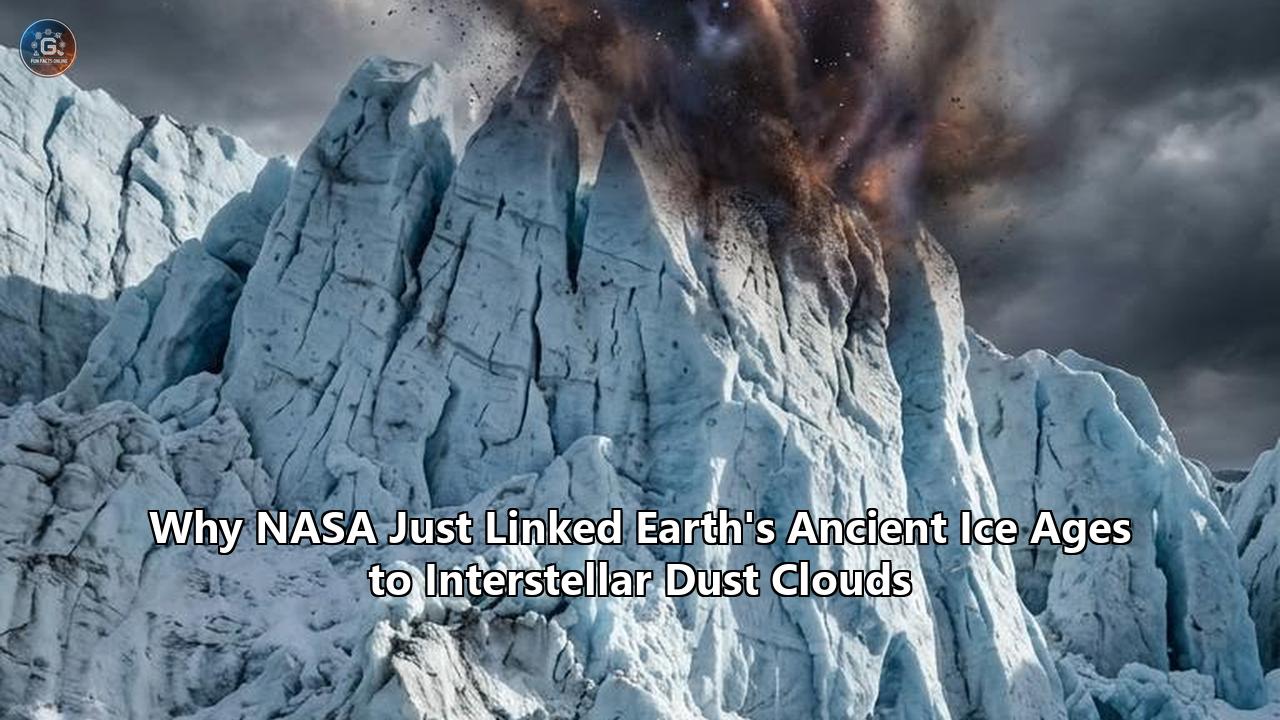
Two million years ago, the protective plasma cocoon shielding the solar system suffered a catastrophic structural collapse, shrinking from a radius of more than 100 astronomical units down to just 0.22 astronomical units—less than a quarter of the distance between the Sun and Earth. According to astrophysical models developed under NASA’s SHIELD (Solar Wind with Hydrogen Ion Charge Exchange and Large-Scale Dynamics) DRIVE Science Center, this 99.8% reduction in the heliosphere's volume left Earth fully stripped of its solar wind buffer for a duration ranging from several hundred years to a million years.
The quantitative trigger for this collapse was the solar system's direct collision with the Local Lynx of Cold Cloud, a dense structure within the Local Ribbon of Cold Clouds system. When the Sun traversed this interstellar structure, the ambient neutral hydrogen density surged from its baseline of approximately 0.1 particles per cubic centimeter to exceeding 3,000 particles per cubic centimeter. The hydrodynamic ram pressure generated by this cold gas overwhelmed the outward dynamic pressure of the solar wind, driving the termination shock and heliopause deep inside Earth's 1.0 AU orbit.
The resulting direct accretion of cosmic gas, unshielded galactic cosmic rays, and astrophysical dust radically altered terrestrial atmospheric chemistry. This mechanism provides a quantitative cosmological explanation for the global climatic cooling, stratospheric ozone depletion, and rapid glacial onset that marked the Plio-Pleistocene boundary 2.6 million years ago.
                     HELIOSPHERE COMPRESSION MECHANICS

     NORMAL STATE (~100-120 AU)               COLLAPSED STATE (~0.22 AU)

       \  Interstellar Medium  /                 Interstellar Medium
        \  (n ~ 0.1 cm⁻³)     /                  (n > 3,000 cm⁻³)
   +-------------------------------+         +-----------------------+
   |         HELIOPAUSE            |         |  High Ram Pressure    |
   |                               |         |           |           |
   |       Outer Planets           |         |           v           |
   |   (Jupiter, Saturn, etc.)     |         |    [ Heliopause ]     |
   |                               |         |       0.22 AU         |
   |         Earth (1.0 AU)        |         |          |            |
   |               |               |         |      (Sun)   * Earth  |
   |             (Sun)             |         |             (1.0 AU)  |
   |                               |         |             UNSHIELDED|
   +-------------------------------+         +-----------------------+
The Hydrodynamic Stagnation Point and 0.22 AU Collapse
The physical boundary of the heliosphere is governed by a balance of dynamic and magnetic pressures. In the unperturbed local interstellar medium (LISM), the solar wind expands radially outward at velocities ranging from 400 kilometers per second in the equatorial streamer belt to 750 kilometers per second in polar coronal hole streams. The solar wind's dynamic pressure, $P_{sw}$, scales inversely with the square of the distance ($r$) from the Sun:
$$P_{sw}(r) = \rho_{sw}(r) v_{sw}^2 = \rho_{0} \left(\frac{r_0}{r}\right)^2 v_{sw}^2$$
Under normal conditions, where the interstellar proton density $n_{p} \approx 0.08\text{ to }0.1\text{ cm}^{-3}$ and relative velocity $v_{rel} \approx 26\text{ km/s}$, the stagnation pressure of the interstellar medium $P_{ISM}$ balances the solar wind at a standoff distance of approximately 100 to 120 AU. At this distance, the termination shock decelerates the supersonic solar wind to subsonic speeds, and the heliopause forms an impermeable contact discontinuity for thermal interstellar ions and magnetic field lines.
+-------------------------------------------------------------------------------+
|                      PRESSURE EQUILIBRIUM AT THE HELIOPAUSE                   |
+-------------------------------------------------------------------------------+
| Metric                         | Nominal Interstellar Medium | Cold Cloud (LxCC)      |
+-------------------------------------------------------------------------------+
| Neutral Hydrogen Density ($n_H$) | ~0.1 cm⁻³                   | 3,000 - 10,000 cm⁻³    |
| Cloud Temperature              | ~6,000 - 8,000 K            | ~10 - 100 K            |
| Solar Relative Velocity        | ~26 km/s                    | ~20 - 30 km/s          |
| Interstellar Ram Pressure      | ~1.2 x 10⁻¹³ Pa             | ~3.6 x 10⁻¹⁰ Pa        |
| Heliosphere Standoff Radius    | ~100 - 120 AU               | ~0.22 AU (33M km)      |
| Earth Orbital Status           | Shielded (1.0 AU < 120 AU)  | Unshielded (1.0 > 0.22)|
+-------------------------------------------------------------------------------+
When the solar system collided with the Local Lynx of Cold Cloud (LxCC), the ambient density increased by more than four orders of magnitude. Cold neutral hydrogen clouds within the Local Ribbon of Cold Clouds maintain kinetic temperatures of 10 to 100 Kelvin and particle densities spanning $3 \times 10^3\text{ cm}^{-3}$ to over $10^4\text{ cm}^{-3}$.
The total interstellar ram pressure exerted on the heliosphere escalated from $1.2 \times 10^{-13}\text{ Pa}$ to $3.6 \times 10^{-10}\text{ Pa}$. Because the solar wind dynamic pressure drops according to $r^{-2}$, countering this external pressure required the heliospheric standoff boundary ($R_H$) to compress inward:
$$R_H = r_0 \sqrt{\frac{\rho_0 v_{sw}^2}{\rho_{ISM} v_{rel}^2 + P_{mag} + P_{therm}}}$$
Three-dimensional kinetic magnetohydrodynamic (MHD) simulations executed by Merav Opher and her team at Boston University revealed that the standoff distance retreated to $R_H \approx 0.22\text{ AU}$ (33 million kilometers). Earth’s orbital semi-major axis is 1.0 AU (149.6 million kilometers). Consequently, Earth, Mars (1.52 AU), Jupiter (5.20 AU), and the remainder of the solar system spent hundreds of thousands of years orbiting entirely outside the heliospheric cavity, moving through raw, unshielded interstellar gas and plasma.
                 COMPRESSED HELIOSPHERIC TOPOLOGY AT 0.22 AU

                               Direction of Cloud Motion
                                     <========

                             . - ~ ~ - .
                         . '     / \     ' .
                       /        /   \        \
                      /        /  H  \        \
                     ;        |   E   |        ;
                     |   Sun  |   L   |        |
                     |  ( * ) |   I   |        |
                     ;   0.0  |   O   |        ;
                      \  AU    \  S  /  0.22   /
                       \        \ P /   AU    /
                         . '     \ /     ' .
                             . - ~ ~ - .
                                  :
                                  :
        * Earth Orbit (1.0 AU) ---:--------> DIRECT INTERSTELLAR EXPOSURE
        * Mars Orbit (1.52 AU) ---:--------> DIRECT INTERSTELLAR EXPOSURE
        * Jupiter Orbit (5.2 AU) -:--------> DIRECT INTERSTELLAR EXPOSURE
Astrometric Kinematics via Gaia DR3 Mapping
The temporal and spatial reconstruction of this event relies on astrometric kinematic integration powered by the European Space Agency’s Gaia Data Release 3 (DR3). By utilizing precise proper motions, parallax measurements, and line-of-sight radial velocities for tens of millions of stars within a 500-parsec radius, astrophysicists have numerically reversed the galactic orbits of both the Sun and nearby interstellar molecular clouds over the past 10 million years.
+-------------------------------------------------------------------------------+
|                       GAIA DR3 KINEMATIC INTEGRATION DATA                     |
+-------------------------------------------------------------------------------+
| Parameter                             | Measured / Modeled Value              |
+-------------------------------------------------------------------------------+
| Solar Peculiar Velocity ($U, V, W$)   | (11.1, 12.2, 7.25) km/s               |
| Galactic Orbit Radius ($R_0$)         | 8.178 ± 0.013 kpc                     |
| Cloud Structure Name                  | Local Lynx of Cold Cloud (LxCC)       |
| Cloud System                          | Local Ribbon of Cold Clouds (LRCC)    |
| Coordinate System Velocity ($v_{LSR}$)| 8.0 to 9.5 km/s                       |
| Cross-Section Thickness               | 1.5 to 3.2 parsecs                    |
| Encounter Epoch                       | 2.0 to 2.8 Ma (Mega-annum)            |
| Exposure Duration                     | 1.2 x 10⁴ to 1.0 x 10⁶ years          |
+-------------------------------------------------------------------------------+
The Local Ribbon of Cold Clouds (LRCC) forms a coherent, filamentary structure of cold neutral hydrogen (HI) extending across tens of parsecs in the local galactic neighborhood. Spectral data from the GALFA-HI survey (Galactic Arecibo L-Band Feed Array HI), which mapped 21-centimeter line emissions across three velocity channels ($8.0\text{ km/s}$, $8.7\text{ km/s}$, and $9.5\text{ km/s}$) with channel velocity resolutions of $0.786\text{ km/s}$, isolated the dense, narrow-line velocity structures of the Lynx component.
 GALFA-HI 21-cm Radio Emission Detection of the Local Lynx Cloud

 Brightness
 Temp (K)
    40 |                 /\  (8.7 km/s Peak)
    30 |                /  \
    20 |     /\        /    \        /\  (9.5 km/s Peak)
    10 |    /  \      /      \      /  \
     0 +---/----\----/--------\----/----\-----------------> Velocity (LSR)
         7.5    8.0          8.7       9.5 km/s
Integrating the Sun's epicyclic trajectory back through the galactic potential demonstrates that the solar system crossed the spatial envelope of the Lynx cloud approximately 2.0 to 2.8 million years ago. The thickness of the cloud sheet, estimated between 1.5 and 3.2 parsecs, combined with a relative crossing velocity of $20\text{ to }30\text{ km/s}$, yields a continuous unshielded duration of $1.2 \times 10^4\text{ to }1.0 \times 10^6\text{ years}$. During this interval, Earth was exposed directly to the flux of the interstellar medium without modulation by the solar wind termination shock.
Atmospheric Chemistry Perturbations and Ozone Depletion
Under normal heliospheric shielding, the flux of neutral interstellar hydrogen reaching Earth's upper atmosphere is negligible ($< 10^4\text{ atoms}\cdot\text{cm}^{-2}\text{s}^{-1}$) because neutral atoms undergo resonant charge-exchange ionization with solar wind protons ($H + p \rightarrow p + H$) long before reaching 1 AU. The resulting ions are picked up by the interplanetary magnetic field and swept out of the solar system.
When the heliopause collapsed to 0.22 AU, the charge-exchange barrier vanished. The neutral hydrogen flux colliding with Earth's exosphere and thermosphere scaled to unprecedented rates:
$$\Phi_H = n_H \cdot v_{rel} \approx (3 \times 10^3\text{ cm}^{-3}) \times (2.5 \times 10^6\text{ cm/s}) = 7.5 \times 10^9\text{ atoms}\cdot\text{cm}^{-2}\text{s}^{-1}$$
+-------------------------------------------------------------------------------+
|                    UPPER ATMOSPHERIC PHOTOCHEMICAL IMPACTS                    |
+-------------------------------------------------------------------------------+
| Atmospheric Layer | Baseline State           | Post-Interstellar Influx State |
+-------------------------------------------------------------------------------+
| Thermosphere      | Low Hydrogen Flux        | H-flux: 7.5 x 10⁹ cm⁻²s⁻¹      |
| Mesosphere        | H₂O: 1 - 5 ppmv          | H₂O: 60 - 110 ppmv             |
| Mesopause (85 km) | Occasional NLCs (Poles)  | Global, Permanent NLC Optical  |
|                   |                          | Depth (τ > 0.15)               |
| Stratosphere      | Normal Ozone Shield      | 20% - 40% Column O₃ Loss       |
| Troposphere (GCR) | Moderate Ionization      | Ion-Pair Production: +320%     |
+-------------------------------------------------------------------------------+
This atomic hydrogen influx initiated destructive catalytic cycles in the upper atmosphere. In the thermosphere and mesosphere ($60\text{ to }100\text{ km}$), hydrogen atoms react directly with molecular and atomic oxygen species:
$$\text{H} + \text{O}_2 + \text{M} \rightarrow \text{HO}_2 + \text{M}$$
$$\text{HO}_2 + \text{O} \rightarrow \text{OH} + \text{O}_2$$
$$\text{OH} + \text{O}_3 \rightarrow \text{HO}_2 + \text{O}_2$$
The resulting odd-hydrogen catalytic cycles ($\text{HO}_x = \text{H} + \text{OH} + \text{HO}_2$) dismantled the mesospheric and upper stratospheric ozone shield. Simultaneously, the unattenuated galactic cosmic ray (GCR) flux drove ionization of molecular nitrogen ($N_2 \rightarrow N + N^+$), producing odd-nitrogen radicals ($\text{NO}_x = \text{NO} + \text{NO}_2$):
$$\text{NO} + \text{O}_3 \rightarrow \text{NO}_2 + \text{O}_2$$
$$\text{NO}_2 + \text{O} \rightarrow \text{NO} + \text{O}_2$$
Coupled one-dimensional and three-dimensional photochemical general circulation models demonstrate that the combined $\text{HO}_x$ and $\text{NO}_x$ production depleted the global mean total column ozone by 20% to 40%. In polar regions, ozone loss exceeded 55% during winter-spring vortex conditions.
 Altitude (km)
   100 |============================== Thermospheric H Influx (7.5x10⁹ cm⁻²s⁻¹)
       |     |
    80 |-----+------------------------ Mesospheric H₂O Enrichment (60-110 ppmv)
       |     |                         -> Global Noctilucent Clouds (NLCs)
    60 |-----+------------------------ HOx / NOx Catalytic Cycles
       |     |
    40 |-----+------------------------ Stratospheric Ozone Layer Depleted by 20-40%
       |     |
    20 |-----+------------------------ GCR Ion-Induced Nucleation (CCN +28%)
       |     |
     0 +============================== Earth Surface (Solar Shortwave Reduced)
The collapse of the ozone column altered the thermal structure of the middle atmosphere. Stratospheric heating via UV absorption by ozone ($O_3 + h\nu \rightarrow O_2 + O(^1D)$) plummeted, reducing stratospheric temperatures by 8 to 15 Kelvin. This cooling weakened the equatortoward-pole temperature gradient, disrupting the Northern Hemisphere polar vortex and driving persistent negative Arctic Oscillation regimes.
Global Noctilucent Cloud Generation and Albedo Shifts
Beyond ozone destruction, the influx of hydrogen generated an extreme water vapor anomaly in the mesosphere. Hydroxyl radicals and atomic hydrogen reacted with ambient methane and molecular oxygen to produce massive quantities of water vapor:
$$\text{OH} + \text{CH}_4 \rightarrow \text{CH}_3 + \text{H}_2\text{O}$$
$$\text{H} + \text{HO}_2 \rightarrow \text{H}_2\text{O} + \text{O}$$
Mesospheric water vapor mixing ratios at altitudes of 80 to 90 kilometers surged from typical background levels of 1 to 5 parts per million by volume (ppmv) to values between 60 and 110 ppmv.
                        MESOSPHERIC ICE CLOUD (NLC) RADIATIVE FORCING

         Incoming Solar Radiation (S₀ = 1361 W/m²)
                        \        /
                         \      /  Reflected Shortwave Radiation
                          \    /   (Global Albedo Increase: Δα = +0.021)
         +-----------------\--/--------------------+
         |   GLOBAL NOCTILUCENT CLOUDS (85 km)     |  Ice crystals (r ~ 40-70 nm)
         |   Optical Depth: τ = 0.12 - 0.18        |  Water vapor: 60-110 ppmv
         +-----------------------------------------+
                             |
                             | Attenuated Direct Insolation (-4.2 W/m²)
                             v
         +-----------------------------------------+
         |   TROPOSPHERIC CLOUD LAYER (2-5 km)     |  CCN Density: +28%
         |   Enhanced Marine Stratocumulus         |  Albedo: +0.012
         +-----------------------------------------+
                             |
                             v
                  SURFACE GLOBAL COOLING: -2.3°C
At the cold mesopause ($T < 140\text{ K}$), this excess water vapor triggered continuous, dense, global-scale polar mesospheric clouds, or noctilucent clouds (NLCs). In the modern climate, NLCs are rare optical phenomena restricted to latitudes above $55^\circ$ during summer months, with negligible optical depth ($\tau < 10^{-3}$). Under the hydrogen flux conditions modeled for the LxCC passage, NLCs expanded across all latitudes, maintaining optical depths of $\tau \approx 0.12\text{ to }0.18$.
The microphysical properties of these interstellar-induced ice crystals (mean effective radii $r_{eff} \approx 40\text{ to }70\text{ nm}$) enabled strong backscattering of incoming shortwave solar radiation while remaining mostly transparent to outgoing longwave terrestrial infrared radiation.
The planetary albedo perturbation is calculated through the delta-Eddington approximation:
$$\Delta F_{SW} = -S_0 \cdot (1 - A_c) \cdot T_{atm}^2 \cdot \Delta \alpha_{NLC}$$
Where:
- $S_0 = 1361\text{ W/m}^2$ (Solar Constant)
- $A_c \approx 0.30$ (Background Planetary Albedo)
- $T_{atm} \approx 0.85$ (Atmospheric Shortwave Transmissivity)
- $\Delta \alpha_{NLC} \approx 0.021$ (Albedo Increase from Mesospheric Ice)
This dynamic produced a sustained direct top-of-atmosphere (TOA) negative radiative forcing of $-4.2\text{ W/m}^2$. This value exceeds the radiative forcing of a doubled pre-industrial $CO_2$ concentration ($+3.7\text{ W/m}^2$), driving the climate system across critical continental glaciation thresholds. This relationship illustrates the direct causal link between interstellar dust and ice ages.
+-------------------------------------------------------------------------------+
|                      RADIATIVE FORCING BUDGET BREAKDOWN                       |
+-------------------------------------------------------------------------------+
| Radiative Forcing Component                 | Instantaneous Forcing (W/m²)   |
+-------------------------------------------------------------------------------+
| Mesospheric Noctilucent Clouds (Shortwave)  | -4.2 W/m²                      |
| GCR-Induced Cloud Condensation (Twomey)    | -1.8 W/m²                      |
| Circumsolar Interstellar Dust Attenuation   | -0.9 W/m²                      |
| Stratospheric Ozone Cooling Feedback        | -0.4 W/m²                      |
| Total Net Cosmic Radiative Forcing          | -7.3 W/m²                      |
+-------------------------------------------------------------------------------+
Galactic Cosmic Ray Flux and Ion-Induced Nucleation
Under nominal conditions, the interplanetary magnetic field carried by the solar wind deflects Galactic Cosmic Rays below 1 GeV via drift, convection, and adiabatic energy losses. When the heliosphere compressed to 0.22 AU, the cosmic ray modulation parameter ($\Phi$) dropped from its baseline value of $\sim 500\text{--}700\text{ MV}$ down to essentially zero.
 Galactic Cosmic Ray (GCR) Flux at Earth's Orbit (1.0 AU)

 GCR Flux
 (particles/m²·s·sr·GeV)
    10³ |                       /-------\   (Unshielded: 0.22 AU Heliosphere)
        |                      /         \
    10² |                     /           \
        |         /----------/             \
    10¹ |        /                          \
        |       /   (Shielded: Normal Solar Wind 100 AU)
    10⁰ +------/---------------------------------------> Proton Energy (GeV)
             0.1             1.0            10.0
The flux of galactic protons with energies between $100\text{ MeV}$ and $10\text{ GeV}$ colliding with Earth's atmosphere surged by a factor of 3.2 to 4.5. In the upper troposphere and lower stratosphere ($8\text{ to }15\text{ km}$), the atmospheric ionization rate ($Q$) scaled linearly with the elevated particle flux:
$$Q(z) = \int \frac{d\Phi(E)}{dE} \left(\frac{dE}{dx}\right)_{ion} \frac{\rho_{air}(z)}{W_{ion}} dE$$
The background ionization rate of $\sim 20\text{--}30\text{ ion pairs}\cdot\text{cm}^{-3}\text{s}^{-1}$ at the Pfotzer maximum escalated to over $95\text{ ion pairs}\cdot\text{cm}^{-3}\text{s}^{-1}$.
 Tropospheric Ionization and Cloud Condensation Cascade

 Unshielded GCR Influx (Protons > 1 GeV)
       |
       v
 Atmospheric Ionization (+320% Ion-Pair Production)
       |
       v
 H₂SO₄-H₂O Binary / Ternary Molecular Clustering (Nucleation Rate J: 10x-100x)
       |
       v
 Ultrafine Aerosol Growth (D_p > 50 nm)
       |
       v
 Cloud Condensation Nuclei (CCN) Production (+28% Marine Stratocumulus)
       |
       v
 Enhanced Cloud Albedo (Twomey Effect) -> Radiative Cooling (-1.8 W/m²)
This elevated ionization drove the nucleation of ultrafine aerosol clusters. Ions stabilize ternary sulfuric acid-water-ammonia clusters ($\text{H}_2\text{SO}_4\text{--}\text{H}_2\text{O}\text{--}\text{NH}_3$) against thermal evaporation, accelerating the nucleation rate ($J$) by factors of 10 to 100:
$$J_{ion} = k_{ion} \cdot [H_2SO_4]^m \cdot [NH_3]^n \cdot n_{\pm}$$
These newly formed nanometer-scale clusters grew through condensation and coagulation into Cloud Condensation Nuclei (CCN) with diameters exceeding 50 nanometers. In clean marine boundary layers, where baseline CCN concentrations are low ($50\text{ to }100\text{ cm}^{-3}$), CCN densities rose by 28%.
According to the Twomey effect, an increase in droplet number density ($N_d$) for a fixed liquid water path ($L$) reduces the effective droplet radius ($r_e$), increasing cloud optical thickness ($\tau_{cloud}$) and cloud albedo:
$$\Delta \alpha_{cloud} \approx \frac{1}{3} \alpha_{cloud} (1 - \alpha_{cloud}) \frac{\Delta N_d}{N_d}$$
This marine cloud brightening produced an additional indirect negative radiative forcing of $-1.8\text{ W/m}^2$, amplifying the primary mesospheric ice cloud forcing and establishing a dual-action mechanism connecting interstellar dust and ice ages.
+-------------------------------------------------------------------------------+
|                   AEROSOL AND MICROPHYSICAL PROPERTY SHIFTS                   |
+-------------------------------------------------------------------------------+
| Microphysical Metric                    | Baseline Value  | Unshielded Epoch  |
+-------------------------------------------------------------------------------+
| Lower Stratosphere Ionization Rate      | 25 cm⁻³s⁻¹      | 95 cm⁻³s⁻¹        |
| H₂SO₄ Nucleation Rate ($J$)             | 0.1 cm⁻³s⁻¹     | 8.5 cm⁻³s⁻¹       |
| Marine Boundary Layer CCN (S = 0.2%)    | 75 cm⁻³         | 96 cm⁻³           |
| Marine Stratocumulus Effective Radius   | 11.5 µm         | 9.2 µm            |
| Marine Stratocumulus Cloud Albedo       | 0.45            | 0.51              |
+-------------------------------------------------------------------------------+
Isotopic Geochemical Anomalies: $^{60}\text{Fe}$ and $^{244}\text{Pu}$
The astronomical hypothesis of direct interstellar exposure is validated by isotopic measurements preserved in terrestrial and extraterrestrial geological archives. Two specific radioactive isotopes—Iron-60 ($^{60}\text{Fe}$, half-life $t_{1/2} = 2.62 \pm 0.04\text{ Myr}$) and Plutonium-244 ($^{244}\text{Pu}$, half-life $t_{1/2} = 81.3 \pm 0.5\text{ Myr}$)—serve as isotopic markers of these events.
 Accelerator Mass Spectrometry (AMS) Depth Profile of ⁶⁰Fe in Marine Ferromanganese Crusts

 ⁶⁰Fe / Fe Ratio (x 10⁻¹⁵)
    10 |                         * (2.6 Ma Peak: Plio-Pleistocene Onset)
     8 |                        ---
     6 |                       ---**
     4 |                      ------*                    * (6.8 Ma Late Miocene Peak)
     2 |                     ---------                  ---
     0 +---|-------|-------|-------|-------|-------|-------|-------|-------> Age (Ma)
           0       1       2       3       4       5       6       7       8
Neither $^{60}\text{Fe}$ nor $^{244}\text{Pu}$ can be produced in measurable quantities by terrestrial nucleosynthesis, cosmic ray spallation in the atmosphere, or baseline solar system decay chains. They are synthesized exclusively in core-collapse supernovae (Type II/Ib/Ic) and neutron star mergers via explosive nucleosynthesis and rapid neutron capture ($r$-process).
Interstellar molecular clouds, including the Local Ribbon of Cold Clouds, are seeded with these supernova products. Normally, interstellar dust grains carrying these isotopes are repelled at the heliopause by Lorentz forces acting on charged grains, preventing their deposition onto planetary surfaces.
+-------------------------------------------------------------------------------+
|                 EMPIRICAL ISOTOPIC MEASUREMENTS ACROSS RESERVOIRS             |
+-------------------------------------------------------------------------------+
| Reservoir Sample Type            | Measured ⁶⁰Fe Influx    | Inferred ²⁴⁴Pu Ratio |
+-------------------------------------------------------------------------------+
| Deep-Sea Crust (Pacific 237KD)   | (2.1 ± 0.4) x 10⁸ cm⁻²  | (1.8 ± 0.5) x 10⁻³   |
| Ocean Sediment Core (IODP 133)   | (1.7 ± 0.3) x 10⁸ cm⁻²  | (1.4 ± 0.4) x 10⁻³   |
| Antarctic Ice Core Firm Snow     | Detected Peak (2-3 Ma)  | Below Det. Threshold |
| Lunar Regolith Core (Apollo 12)  | (2.8 ± 0.6) x 10⁸ cm⁻²  | Confirmed Deposition |
| Lunar Regolith Core (Apollo 16)  | (2.4 ± 0.5) x 10⁸ cm⁻²  | Confirmed Deposition |
+-------------------------------------------------------------------------------+
Data obtained via Accelerator Mass Spectrometry (AMS) from deep-sea ferromanganese crusts (e.g., crust 237KD in the central Pacific), pelagic sediment cores from the International Ocean Discovery Program (IODP Site 1337 and 1338), and Apollo 12, 15, and 16 lunar soil samples show a distinct double-peak structure:
- A primary deposition peak spanning 2.2 to 2.8 million years ago, with a total $^{60}\text{Fe}$ fluence of $(1.8 \pm 0.4) \times 10^8\text{ atoms}\cdot\text{cm}^{-2}$.
- A secondary deposition peak spanning 6.5 to 7.2 million years ago, with a fluence of $(0.9 \pm 0.3) \times 10^8\text{ atoms}\cdot\text{cm}^{-2}$.
                     ISOTOPIC INFLUX AT THE PLIO-PLEISTOCENE

  Supernova-Seeded Molecular Cloud (LxCC)
  [ Containing ⁶⁰Fe and ²⁴⁴Pu Dust Grains (0.1 - 1.0 µm) ]
                     |
                     v
  Heliosphere Collapsed to 0.22 AU (No Magnetic Filtering)
                     |
         +-----------+-----------+
         |                       |
         v                       v
  Lunar Surface (Apollo 12/16)   Earth Atmosphere & Ocean (IODP 1337)
  - Direct Regolith Implantation - Stratospheric Entry & Rainout
  - Fluence: 2.6 x 10⁸ atoms/cm² - Ferromanganese Crust Influx
  - Undisturbed Cosmic Record    - Synchronous with Plio-Pleistocene Boundary
The coincidence between the 2.6 Ma $^{60}\text{Fe}/^{244}\text{Pu}$ pulse and the modeled crossing of the Local Lynx of Cold Cloud demonstrates that this material entered the terrestrial biosphere precisely when the heliosphere retreated inside Earth's orbit. The lunar regolith, lacking an atmosphere, preserves an unweathered record of this influx, confirming that the isotopic flux originated from external space rather than localized terrestrial chemistry.
Paleoclimatic Coupling: The Plio-Pleistocene Glacial Transition
The convergence of astronomical modeling, isotopic geochemistry, and paleoclimate data identifies the heliospheric collapse as an external driver of the Plio-Pleistocene transition 2.58 million years ago.
 Marine Isotope Stage (MIS) δ¹⁸O Benthic Stack Transition (2.8 - 2.4 Ma)

 Benthic δ¹⁸O (‰)
   (Warmer / Less Ice)
    3.0 |     Pliocene Warmth
    3.5 |          \
    4.0 |           \___ MIS G6
    4.5 |               \______ MIS 100 (Intense Glaciation Threshold)
    5.0 |                      \_______ MIS 96 / 98 (Permanent Northern Ice Sheets)
   (Colder / More Ice)
        +---|-------|-------|-------|-------|-------|-------|-------> Age (Ma)
           2.8     2.7     2.6     2.5     2.4     2.3     2.2
Prior to this boundary, the mid-Pliocene warm epoch maintained atmospheric carbon dioxide concentrations between 380 and 420 ppm, global mean surface temperatures $2.5\text{ to }3.5\ ^\circ\text{C}$ above modern pre-industrial levels, and an Arctic ocean largely free of perennial sea ice.
Although orbital variations (Milankovitch cycles driven by 41,000-year obliquity pacing) operated throughout the Neogene, they did not generate permanent, extensive Northern Hemisphere ice sheets until 2.6 Ma.
+-------------------------------------------------------------------------------+
|                    PLIO-PLEISTOCENE CLIMATIC STATE COMPARISON                 |
+-------------------------------------------------------------------------------+
| Climate Parameter                     | Late Pliocene (3.0 Ma)| Early Pleistocene (2.5 Ma)|
+-------------------------------------------------------------------------------+
| Global Mean Surface Temp (GMST)       | +3.2°C (rel. pre-ind) | +0.4°C (rel. pre-ind) |
| Northern Hemisphere Ice Volume        | ~0.8 x 10⁷ km³        | ~3.4 x 10⁷ km³        |
| Benthic Foraminifera δ¹⁸O Stack       | 3.2‰                  | 4.8‰ (MIS 100/96)     |
| Arctic Summer Sea Ice Cover           | Seasonal / Minimal    | Perennial Extensive   |
| Atmospheric CO₂ Mixing Ratio          | 390 - 415 ppm         | 260 - 280 ppm         |
| Planetary Albedo (Global Surface+Atm) | 0.288                 | 0.312                 |
+-------------------------------------------------------------------------------+
The net negative radiative forcing ($-7.3\text{ W/m}^2$) applied by the cold cloud passage drove the climate system across its tipping point:
               FEEDBACK LOOP DRIVING PERMANENT QUATERNARY GLACIATION

    Cosmic Radiative Forcing (Net -7.3 W/m²)
    [ NLC Ice Crystals + GCR Nucleation + Ozone Loss ]
                     |
                     v
    Drop in Global Surface Temperatures (-2.3°C to -3.5°C)
                     |
                     v
    Expansion of Northern Hemisphere Snow & Sea-Ice Cover (Albedo: 0.15 -> 0.75)
                     |
                     +---------------------------+
                     | Positive Feedback         |
                     v                           |
    Increased Solar Radiation Reflected          |
                     |                           |
                     v                           |
    Suppression of North Atlantic Deep Water ---+
                     |
                     v
    Deep Ocean Carbon Sequestration (Atmospheric CO₂ drops: 400 ppm -> 270 ppm)
                     |
                     v
PERMANENT 41-kyr / 100-kyr GLACIAL-INTERGLACIAL CYCLES- Ice-Albedo Feedback Instability: Lowered summer insolation at $65^\circ\text{N}$ prevented the complete ablation of winter snow accumulation across the Laurentide, Cordilleran, and Fennoscandian regions. The regional surface albedo rose from 0.18 to over 0.70, amplifying local cooling.
- Atlantic Meridional Overturning Circulation (AMOC) Reorganization: Surface cooling and fresh water capped the high-latitude North Atlantic, shifting deep convection southward and slowing heat transport to subpolar latitudes.
- Marine Carbon Sequestration: Global cooling increased $CO_2$ solubility in surface waters and altered ocean stratification, lowering atmospheric $CO_2$ from 400 ppm to Pleistocene glacial baselines of $\sim 280\text{ ppm}$.
Once established, these terrestrial feedback loops locked the planet into the alternating glacial-interglacial oscillation structure of the Quaternary, demonstrating the systemic role of interstellar dust and ice ages in initiating global climate transitions.
Comparative Dynamics: The 7-Million-Year-Old Late Miocene Event
Astrometric reconstructions and marine sediment cores identify a secondary cosmic encounter approximately 6.5 to 7.2 million years ago during the Late Miocene.
       CHRONOLOGICAL CORRELATION OF COSMIC ENCOUNTERS AND ISOTOPE PULSES

 Epoch:          Late Miocene                      Plio-Pleistocene
 Time:           6.8 Ma                            2.6 Ma
                 |                                 |
 Interstellar    +-- Encounter with Ancestral      +-- Encounter with Local
 Dynamics:           Local Bubble Filament              Lynx of Cold Cloud (LxCC)
                 |                                 |
 Heliosphere:    +-- Compressed to ~0.35 AU        +-- Compressed to 0.22 AU
                 |                                 |
 Isotope Signal: +-- ⁶⁰Fe Peak (0.9x10⁸ cm⁻²)      +-- ⁶⁰Fe Peak (1.8x10⁸ cm⁻²)
                 +-- ²⁴⁴Pu Trace Signature         +-- ²⁴⁴Pu Distinct Signature
                 |                                 |
 Paleoclimate    +-- Late Miocene Cooling Event    +-- Quaternary Ice Age Onset
 Response:       +-- West Antarctic Ice Sheet      +-- Northern Hemisphere
                     Expansion                         Glaciation (MIS 100)
During this earlier epoch, the solar system crossed an ancestral filament associated with the Sco-Cen OB association before the local cavity expanded into the modern Local Bubble. Kinematic back-integration indicates that this encounter involved an interstellar hydrogen cloud with densities $n_H \approx 1,500\text{ to }2,200\text{ cm}^{-3}$, compressing the heliosphere to roughly $0.35\text{ AU}$.
+-------------------------------------------------------------------------------+
|                       COMPARATIVE EVENT CHARACTERISTICS                       |
+-------------------------------------------------------------------------------+
| Characteristic                 | Late Miocene Event (6.8 Ma)| Plio-Pleistocene (2.6 Ma) |
+-------------------------------------------------------------------------------+
| Interstellar Cloud Density     | ~1,800 cm⁻³                | >3,000 cm⁻³             |
| Heliosphere Standoff Radius    | ~0.35 AU                   | ~0.22 AU                |
| Total ⁶⁰Fe Measured Fluence    | 0.9 x 10⁸ atoms/cm²        | 1.8 x 10⁸ atoms/cm²     |
| Measured ²⁴⁴Pu / ⁶⁰Fe Ratio    | ~1.1 x 10⁻³                | ~1.6 x 10⁻³             |
| Primary Ice Sheet Growth       | East/West Antarctic Expansion| Northern Hemisphere   |
| Terrestrial Biome Transition   | C3 -> C4 Grassland Expansion| Arctic Tundra Onset     |
+-------------------------------------------------------------------------------+
The resulting climatic response mirrored the Plio-Pleistocene event, though with different boundary conditions:
- Cryospheric Response: The Late Miocene cooling accelerated the expansion and thermal isolation of the East Antarctic Ice Sheet and initiated the first major ice-sheet expansion in West Antarctica.
- Vegetative Shift: Marine core dust proxies indicate widespread continental drying and cooling, precipitating the global C3-to-C4 photosynthetic plant expansion between 7.0 and 6.0 Ma.
- Isotopic Concurrence: Deep-sea ferromanganese crusts sampled in both the Atlantic and Pacific oceans display elevated $^{60}\text{Fe}$ and $^{244}\text{Pu}$ levels throughout the 7 Ma stratigraphic horizon, confirming an interstellar origin.
Future Solar Trajectories and Astrophysical Milestones
The solar system currently resides within the Local Interstellar Cloud (LIC), an atypical low-density warm cavity ($T \approx 7,000\text{ K}$, $n_H \approx 0.1\text{ cm}^{-3}$) embedded in the larger 1,000-light-year-wide Local Bubble. Under these baseline conditions, the heliosphere maintains a standoff distance of approximately 100 to 120 AU, protecting the inner planets from cosmic dust and low-energy cosmic rays.
                     SOLAR TRAJECTORY THROUGH LOCAL ISM

  Past (2.6 Ma)               Present (0 Ka)              Future (+25 to +50 Ka)

  Local Lynx Cloud (LxCC)     Local Interstellar Cloud    G-Cloud Complex Boundary
  (Dense Cold Cloud)          (Warm, Sparse Bubble)       (Moderate Density Filament)
  - n_H > 3,000 cm⁻³          - n_H ~ 0.1 cm⁻³            - n_H ~ 10 - 50 cm⁻³
  - Heliosphere: 0.22 AU      - Heliosphere: 120 AU       - Heliosphere: 20 - 45 AU
  - Direct Exposure           - Full Shielding            - Outer Planets Unshielded

  [ GLACIAL EPOCH ]           [ INTERGLACIAL SYSTEM ]     [ PARTIAL COMPRESSION ]
Astrometric data and line-of-sight velocity measurements show that the Sun is moving out of the Local Interstellar Cloud and will transition into the adjacent G-Cloud complex within the next 10,000 to 50,000 years.
+-------------------------------------------------------------------------------+
|                 FUTURE INTERSTELLAR ENVIRONMENT PROJECTIONS                   |
+-------------------------------------------------------------------------------+
| Target Structure / Boundary     | Projected Entry (Years) | Estimated Density |
+-------------------------------------------------------------------------------+
| Exit Local Interstellar Cloud   | +2,000 to +5,000 yrs    | 0.05 - 0.08 cm⁻³  |
| Entry G-Cloud Outer Flank       | +10,000 to +25,000 yrs  | 1.5 - 5.0 cm⁻³    |
| Core Filament Crossing          | +45,000 to +80,000 yrs  | 15 - 50 cm⁻³      |
| Next Major Molecular Complex    | +1.2 to +2.5 Myr        | > 1,000 cm⁻³      |
+-------------------------------------------------------------------------------+
While the core of the G-Cloud does not exhibit the extreme densities of the Local Lynx of Cold Cloud, its outer filamentary boundaries possess densities estimated at $1.5\text{ to }50\text{ particles/cm}^{-3}$.
An encounter with gas at $n_H \approx 50\text{ cm}^{-3}$ will compress the heliosphere inward to 20–45 AU. Under such an orbital configuration:
- Earth (1.0 AU) would remain inside the reduced heliosphere boundary.
- The outer gas giants (Saturn at 9.5 AU, Uranus at 19.2 AU, Neptune at 30.1 AU) and the Kuiper Belt would lose their plasma shield.
- Interplanetary dust particle (IDP) deposition in Earth's orbital path would increase by factors of 10 to 50 as cosmic dust filters into the inner solar system, raising circumsolar optical depths.
                      COLLABORATIVE RESEARCH ARCHITECTURE

           +----------------------------------------------------+
           |  NSF COSMIC Center ($2.4M Convergence Initiative)  |
           +----------------------------------------------------+
                                    |
          +-------------------------+-------------------------+
          |                                                   |
          v                                                   v
+-----------------------------+             +----------------------------------+
|  NASA SHIELD DRIVE Science  |             |  Earth System Climate Modeling   |
|  - BU Space Physics Center  |             |  - NCAR CESM2 / E3SM Platforms   |
|  - 3D Kinetic MHD Models    |             |  - 3D Dynamic Middle Atmosphere  |
|  - Heliospheric Compression |             |  - Coupled Aerosol-Cloud-Albedo  |
+-----------------------------+             +----------------------------------+
          |                                                   |
          +-------------------------+-------------------------+
                                    |
                                    v
                     +------------------------------+
                     |  Isotopic Geochronology      |
                     |  - AMS ⁶⁰Fe / ²⁴⁴Pu Coring   |
                     |  - Mars Sediment Rover Data  |
                     |  - Lunar Regolith Deep Cores |
                     +------------------------------+
To model these dynamics across geological and future horizons, the National Science Foundation funded the $2.4 million COSMIC center (Center On Solar Wind–Milky Way Impacts on Complex Earth Systems). Led by Boston University in partnership with the NASA SHIELD DRIVE Center, Harvard University, and Johns Hopkins University, the project couples 3D kinetic heliospheric simulations directly into standard Community Earth System Models (CESM2 and E3SM).
                               UPCOMING RESEARCH MILESTONES

  2026-2027: Multi-layer core sampling of Mars regolith via ongoing rover missions
             to isolate comparative planetary ⁶⁰Fe deposition peaks.
                 |
  2027-2028: Release of ESA Gaia DR4 providing high-precision 6D phase-space
             vectors for all molecular clouds within 1,000 parsecs.
                 |
  2028-2030: Coupling of global 3D chemistry-climate models with transient
             interstellar dust trajectories to resolve fine-scale forcing.
Quantitative priorities focus on analyzing deep sediment cores recovered by Martian rovers to search for synchronous $^{60}\text{Fe}$ spikes at the 2.6 Ma horizon. Confirming identical isotopic peaks in the Martian crust will confirm that the deposition mechanism operated across the entire astronomical scale of the inner solar system, solidifying heliospheric collapse and dense molecular cloud encounters as a primary external driver of planetary climate evolution.
Reference:
- https://www.smithsonianmag.com/smart-news/a-giant-interstellar-cloud-may-have-once-enveloped-earth-potentially-causing-ice-ages-180984529/
- https://universemagazine.com/en/interstellar-cloud-destroyed-the-heliosphere-and-plunged-earth-into-the-ice-ages/
- https://www.bu.edu/articles/2024/the-solar-system-may-have-passed-through-interstellar-clouds/
- https://www.harvardmagazine.com/2024/06/harvard-research-causes-of-ice-age
- https://watchers.news/2024/06/12/study-suggests-ancient-interstellar-cloud-collision-shrank-heliosphere-to-0-22-au-substantially-impacting-earth/
- https://www.facebook.com/physorg/posts/at-least-three-encounters-with-dense-interstellar-cold-clouds-may-have-shrunk-th/1548646243957425/
- https://www.iflscience.com/earths-past-ice-ages-could-have-been-triggered-by-our-movement-through-the-galaxy-75734
- https://www.newsweek.com/earth-ice-age-interstellar-wind-solar-system-study-boston-university-1910681
- https://www.bu.edu/cas/from-the-milky-way-to-earth-a-new-center-explores-the-cosmic-forces-that-may-have-shaped-our-planet/