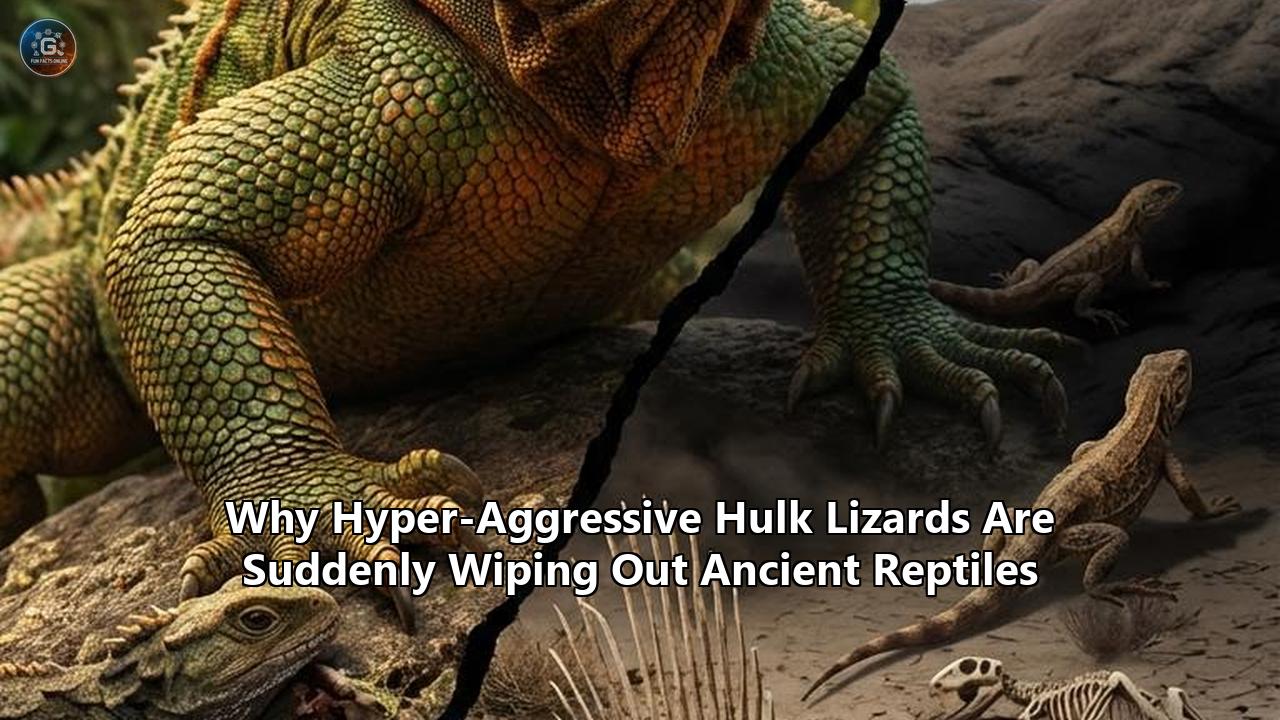
An extensive data analysis covering 240 isolated animal populations has just documented the mathematical collapse of a biological system that remained stable for millions of years. According to a newly published study in the journal Science, researchers analyzing more than 10,000 individual common wall lizards (Podarcis muralis) across the Mediterranean have recorded a sudden, aggressive geographic takeover by a newly evolved green-and-black variant.
Nicknamed the “Hulk” lizard due to its high muscle mass, striking neon-green pigmentation, and extreme territorial dominance, this single phenotypic variant is rapidly wiping out the species' historic genetic diversity. For epochs, the common wall lizard has exhibited a stable, tri-color throat polymorphism—white, yellow, and orange—where each color directly correlates to highly specific reproductive and survival algorithms. Now, researchers track a near-total fixation of the white-throated trait wherever the Hulk morph expands, pushing the yellow and orange morphs toward localized extinction.
“We are seeing how the coexistence of several different color morphs, something that has been stable for millions of years, is being lost over a very short evolutionary time scale,” said Tobias Uller, a professor of evolutionary biology at Lund University who led the multi-national research effort.
The speed of this genetic overwrite forces biologists to reevaluate standard evolutionary timelines. Rather than gradual adaptation spanning hundreds of thousands of generations, the statistical output from the Rome region outward demonstrates an immediate, aggressive disruption of local social ecologies. The quantitative evidence reveals that evolutionary stasis is highly fragile and can be systematically dismantled by the emergence of a single, statistically dominant trait.
Morphometrics and the Aggression Gap
To understand how a single variant can outcompete millions of years of balanced evolution, the research team from Lund University, the Max Planck Institute, and the University of Tasmania built a comprehensive database measuring the physical and behavioral disparities between the Hulk lizards and traditional morphs.
The data indicates that the Hulk lizards possess a measurable physical advantage in combat and resource monopolization. While the ancestral brown-backed wall lizards rely on complex, balanced behavioral loops to maintain their tri-color equilibrium, the green-and-black newcomers utilize sheer biomechanical superiority.
Field observations quantify this behavioral shift. When territorial disputes arise, the Hulk variants exhibit a statistically higher win rate against rival males. In evolutionary biology, reproductive success is the ultimate currency, and the Hulk variant’s ability to win physical confrontations translates directly to unequal mating opportunities. Because the Hulk variant is exclusively associated with the white-throat trait, their unchecked reproductive dominance acts as a genetic funnel.
In the 240 populations surveyed, the correlation was absolute: as the frequency of the Hulk phenotype increases within a specific geographic quadrant, the frequency of the yellow and orange throat genes inversely drops. In dozens of local populations heavily saturated by the green-and-black males, the yellow and orange morphs have already hit a 0% frequency rate. The traditional color palette has simply been erased.
Breaking the Nash Equilibrium of Evolution
The collapse of this specific reptile population provides a real-time, quantitative case study in evolutionary game theory. Prior to the emergence of the Hulk variant, the white, yellow, and orange morphs operated in a biological state mirroring a Rock-Paper-Scissors dynamic. No single color could achieve 100% dominance because the specific survival strategy of one morph was naturally countered by another.
In a standard tri-morph system, the strategies generally map to distinct behaviors: hyper-aggressive territory defense, cooperative or versatile resource gathering, and "sneaker" tactics that bypass direct confrontation to secure mating. This cyclical balance locks the population into a Nash equilibrium—a mathematical state where no single strategy can yield a higher payoff than the current mix, provided the other strategies remain constant.
The introduction of the Hulk phenotype fundamentally broke this algorithm. By possessing physical metrics that overpower the specific advantages of the yellow and orange morphs, the Hulk variant removes the cyclical penalty of the game. They do not just beat one strategy; their physical dominance allows them to outcompete all alternative strategies simultaneously.
Geoff While, an Associate Professor at the University of Tasmania’s School of Natural Sciences, pointed to the genomic architecture underlying this takeover. The research team ran intensive DNA sequencing to determine if the loss of color was due to "genetic hitchhiking"—a process where the gene for the white throat just happened to be physically attached on the chromosome to the genes controlling the larger size and green coloration. The genomic mapping ruled this out. The loss of the yellow and orange alleles is not a structural genetic accident; it is the direct, measurable result of the Hulk lizards altering the social ecology of the species. The competitive balance tipped so far mathematically that the alternative strategies simply ceased to be viable.
Neural Crest Cells and the Engine of Macro-Mutation
Tracking the exact biological mechanism behind the Hulk phenotype requires analyzing the embryonic development of the lizards. Nathalie Feiner, an evolutionary biologist at Lund University and the Max Planck Institute, focused her laboratory's efforts on tracing the cellular origin of this combined morphological and behavioral shift.
Feiner’s team isolated the driver to neural crest cells—a highly versatile group of embryonic cells that develop early in vertebrate formation. These cells migrate throughout the developing embryo and differentiate into a wide variety of tissues, including the facial skeleton, pigment cells (melanocytes), and components of the peripheral nervous system.
“All tissues and organs that are behind the Hulk-like appearance develop from cells called neural crest cells that form in the early embryo,” Feiner reported. “We believe that the cells that underlie changes in shape, colour and behaviour are regulated together, and that the traits therefore evolve together.”
This joint regulation explains the immediate, compound advantage of the new variant. Instead of requiring separate, sequential mutations for increased muscle mass, altered pigmentation, and heightened testosterone or aggression markers, a shift in neural crest cell regulation can package these traits together. The Hulk lizard represents a macro-evolutionary leap triggered by a concentrated cellular adjustment.
The quantitative implications of Feiner’s work extend far beyond the Mediterranean wall lizard. Approximately 70,000 species of vertebrates rely on neural crest cells for their fundamental development. Over the next several years, Feiner’s laboratory will utilize CRISPR-Cas9 gene-editing technologies to precisely map the gene regulatory networks controlling these cells. By editing specific loci in lizard embryos, researchers aim to mathematically quantify the exact cascade of genetic commands that produce the Hulk phenotype.
Geographic Velocity: Tracking a Genetic Invasion
The spatial data mapping the spread of the Hulk variant reveals an outward expansion that mirrors the most aggressive biological incursions. The variant originated thousands of years ago in the region surrounding present-day Rome. From that epicenter, the population density of the green-and-black phenotype has expanded radically, pushing northward toward the French border and outward across the Italian peninsula.
Treating this phenomenon with the same spatial and mathematical models used for traditional hulk lizards invasive species tracking shows a staggering expansion rate. Usually, invasive ecology deals with an entirely foreign organism introduced into an unadapted ecosystem. Here, the invader is a newly mutated iteration of the native species itself.
Ecologists mapping the dispersion out of the Rome region note that, much like introduced hulk lizards invasive species, the green-and-black morph faces zero native biological resistance from within its own kind. The ancestral morphs lack the physical mechanics or behavioral algorithms required to stall the expansion. Consequently, the genomic mapping of the Italian peninsula shows a distinct, measurable wave of genetic homogenization sweeping outward from the capital region.
The economic and ecological cost of typical biological invasions is well documented, but evaluating these hulk lizards invasive species requires a new genomic framework. The cost here is not measured in agricultural damage or immediate localized extinction of prey, but rather in the permanent deletion of millions of years of genetic and behavioral biodiversity. As the front line of the Hulk population advances, the local biodiversity index for Podarcis muralis drops by a factor of 66%—moving from three viable behavioral morphs down to just one.
Climate Synergies and Ectotherm Metabolic Scaling
The rapid geographic spread of the Hulk lizard cannot be modeled in an ecological vacuum. The expansion vector coincides heavily with measurable shifts in the Mediterranean climate basin. Recent oceanic and atmospheric data show the Mediterranean undergoing severe temperature spikes, with water temperatures in some coastal regions climbing from historical averages of 25°C (77°F) up to nearly 32°C (90°F).
For terrestrial ectotherms like Podarcis muralis, ambient environmental temperature directly dictates metabolic rate, kinetic energy, and reproductive output. The thermal ecology of the Mediterranean is shifting, creating prolonged active seasons for reptiles. A lizard's metabolic engine runs on external heat; an increase in average annual temperature yields more foraging days, shorter brumation (winter dormancy) periods, and potentially multiple reproductive clutches per year.
While exact thermal performance curves for the Hulk variant are still being processed by research teams, fundamental principles of evolutionary physiology suggest that a larger, more aggressive animal requires a higher absolute caloric intake to maintain its muscle mass and fuel its territorial defense. The lengthening of the Mediterranean warm season provides the precise ecological surplus needed to support a highly aggressive, metabolically demanding phenotype.
If local conservation authorities begin classifying the hulk lizards invasive species management protocols may need to be entirely rewritten. Traditional containment relies on temperature boundaries to naturally halt the spread of warm-adapted pests. As the isotherms shift northward across Europe, the thermal barriers that might have historically kept the Roman Hulk population in check are dissolving, granting them a literal runway to the French border and beyond.
Measuring the Ecosystem Cascades of Lost Diversity
Quantifying the true cost of this genetic takeover requires looking past the immediate species and modeling the broader trophic network. When a species loses two-thirds of its behavioral and phenotypic diversity, the localized ecosystem loses two-thirds of its functional redundancy.
In the historic tri-morph system, the distinct behaviors of the white, yellow, and orange lizards meant they likely partitioned their micro-habitats and foraging strategies slightly differently. One morph might patrol open rocky outcrops, while another utilizes denser vegetation for ambush predation. This micro-niche partitioning maximizes the species' overall ability to regulate local insect populations and provides a predictable, varied food source for avian and mammalian predators.
With the total fixation of the white-throated Hulk phenotype, the entire population of Podarcis muralis in these invaded zones is suddenly operating on a single behavioral algorithm. They hunt in the same manner, defend territory in the same manner, and utilize the exact same micro-habitats.
From a data perspective, this creates heavy localized density in specific ecological zones while leaving other micro-niches entirely vacant. Insect populations that were historically preyed upon by the yellow or orange morphs may experience sudden, unchecked population growth due to the absence of their specific predators. Conversely, the prey targeted by the hyper-aggressive Hulk variants may face intense, localized depletion. The homogenization of a keystone reptile species forces a mathematically predictable instability upon the lower tiers of the food web.
Furthermore, genetic uniformity is a strictly negative metric in population survival models. Diversity is the primary buffer against novel pathogens. If a specific virus or fungal infection preferentially attacks the genetic or physiological markers of the Hulk phenotype, the entire regional population is now acutely vulnerable. They no longer possess the yellow or orange genetic reservoirs that might have carried natural immunity.
Comparative Baselines in Reptilian Decline
To contextualize the speed of this biological overwrite, we must look at the standard metrics of reptilian decline. A 2012 study published in the journal Oryx by the U.S. Geological Survey and the French National Center for Scientific Research detailed the extinction of the copper striped blue-tailed skink (Emoia impar) in the Hawaiian Islands. That extinction was categorized as "cryptic"—meaning it occurred so slowly and the species was so easily confused with similar taxa that its disappearance went unnoticed for decades. Field surveys from 1988 to 2008 yielded zero sightings, culminating in its formal extinction declaration.
The Hawaiian skink extinction was driven by standard external pressures: invasive species (specifically predatory ants), habitat loss, and human activity. The timeline spanned nearly half a century of gradual decline.
In stark contrast, the data emerging from Lund University regarding the Mediterranean wall lizard shows an internal extinction event happening at an accelerated evolutionary frame. The genome is not being wiped out by an external predator; it is actively rewriting itself. The loss of the yellow and orange morphs across vast stretches of the Italian peninsula is measurable year over year, not decade over decade. This provides empirical evidence that intra-species competition, when heavily skewed by a macro-mutation, can eradicate genetic history faster than standard external ecological pressures.
Tobias Uller’s assessment that evolutionary rules can be rewritten by a single powerful player is borne out by the numbers. The transition from a mixed-morph distribution to a 100% white-morph fixation in surveyed populations highlights a severe steepening of the evolutionary selection curve.
Predictive Models and Forthcoming Milestones
The data aggregate from the 10,000 sequenced lizards provides a baseline for predictive modeling over the next decade. Based on the current trajectory and the ongoing warming of the Mediterranean basin, statistical projections for the year 2030 indicate a high probability of the Hulk phenotype crossing the Alps and establishing permanent footholds in southern France and beyond.
The immediate next steps for the global biological community rely on the incoming data from Nathalie Feiner’s CRISPR-Cas9 trials. By isolating the exact genetic sequence regulating the neural crest cells responsible for the Hulk mutation, geneticists will gain a functional blueprint of how rapidly complex behavioral and physical traits can be linked and deployed in vertebrate populations.
Tracking the expansion of these hulk lizards invasive species mechanics will remain a primary focus for European ecologists. The 240 populations currently under observation serve as a live-action laboratory for evolutionary speed. Researchers will specifically monitor the exact borders where the Hulk variants are currently interacting with the last remaining pockets of yellow and orange morphs. Measuring the exact rate of genetic dilution in these boundary zones will provide the final variables needed to calculate the exact terminal date for the ancestral color palette.
The collapse of the tri-color common wall lizard population is a permanent loss of millions of years of biological history, erased in real-time by the sudden dominance of a superior genetic algorithm. As the green-and-black phenotype continues its outward march, the core focus shifts from analyzing what was lost to measuring exactly how fast the remaining landscape will be overwritten.
Reference:
- https://www.thenews.com.pk/latest/1400466-study-reveals-how-aggressive-hulk-lizards-are-wiping-out-millions-of-years-of-evolution
- https://www.sciencedaily.com/releases/2026/04/260424233212.htm
- https://scitechdaily.com/hulk-lizards-are-wiping-out-millions-of-years-of-evolution/
- https://nachrichten.idw-online.de/2026/01/09/when-evolution-breaks-the-rules-a-hulk-wall-lizard-is-erasing-colour-morphs-that-lasted-millions-of-years
- https://www.utas.edu.au/about/news-and-stories/articles/2026/italys-wall-lizards-are-losing-their-colours-thanks-to-a-hulk-newcomer
- https://www.lunduniversity.lu.se/article/incredible-hulk-lizard-provides-clues-understanding-evolution
- https://www.techno-science.net/en/news/evolution-in-real-time-new-hulk-lizards-destabilize-the-mediterranean-N28618.html
- https://www.techno-science.net/en/news/the-mediterranean-is-tropicalizing-before-our-eyes-N27504.html
- https://scitechdaily.com/another-native-hawaiian-vertebrate-species-reported-extinct/
- https://www.miragenews.com/hulk-lizard-knocks-out-ancient-colour-palette-1605405/