When Rachel Fordyce decided to save money on parking by walking through East Lawn Cemetery to her job at a Cornell University entomology lab, she inadvertently triggered one of the largest entomological discoveries of the decade.
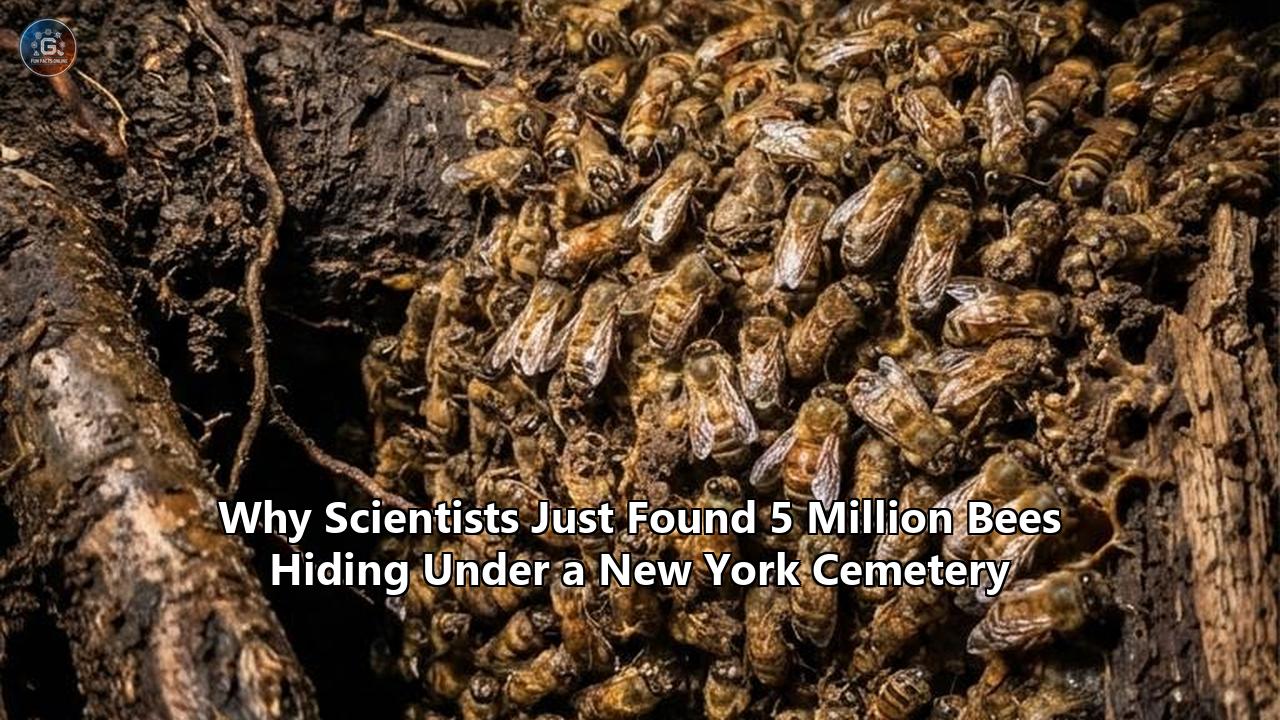
During a spring commute in 2022, Fordyce noticed an unusual amount of insect activity hovering just above the headstones. She captured a few specimens in a jar and brought them to her supervisor, Professor Bryan Danforth. By April 2026, the culmination of that chance encounter was published in the journal Apidologie, revealing an astonishing reality: a 1.5-acre plot within the Ithaca cemetery is home to an estimated 5.5 million individual, ground-nesting bees.
This is not a single, massive hive. The insects identified are Andrena regularis, commonly known as the regular mining bee. They are solitary, wild pollinators that build individual nests in the ground. To put the sheer scale of this discovery into perspective, the aggregation contains more than three times the human population of Manhattan. It is the equivalent of more than 200 commercial honeybee hives, concentrated entirely in a modest burial ground.
The sheer density of bees in New York cemetery environments has immediately altered how researchers view urban conservation. Guided by lead author and undergraduate researcher Steve Hoge, the Cornell team spent the following spring meticulously calculating the population. Rather than relying on estimates from visual swarms, they deployed specialized emergence traps over the cemetery turf. Extrapolating the data across roughly 6,000 square meters of suitable nesting habitat, they arrived at the unprecedented 5.5 million figure.
This discovery goes far beyond a localized curiosity. It systematically upends established assumptions about urban land use, agricultural reliance, and the biological vaults hiding beneath our feet.
Deconstructing the Swarm: Who Exactly is Affected?
The fallout from this discovery radiates outward, immediately impacting several key stakeholders—from agricultural titans to local land managers.
The New York Agricultural Sector
New York State is one of the nation's leading apple producers, a multi-million-dollar industry that depends heavily on early-spring pollination. Andrena regularis emerges precisely when apple trees begin to bloom. Unlike managed honeybees—which are notoriously sluggish in the cold, damp weather typical of a Northeastern spring—these solitary mining bees are highly efficient in cooler temperatures.
Just a third of a mile from East Lawn Cemetery lies Cornell Orchards. The proximity is no coincidence. The orchard provides the staggering floral resources required to sustain 5.5 million foraging insects, while the bees provide a massive, free pollination service that guarantees crop yields. For local farmers, the health of these solitary bees is directly tied to the financial viability of their seasonal harvest.
Entomologists and Conservationists
Historically, the lion's share of pollinator research and conservation funding has been funneled toward the European honeybee (Apis mellifera). Yet honeybees represent only a tiny fraction of global bee diversity. The vast majority of the world's bee species are solitary and nest in the ground. By documenting one of the largest known aggregations of solitary bees in New York cemetery soil, the Cornell researchers have provided a glaring mandate to redirect scientific attention toward these understudied wild populations.
Cemetery Management and Urban Landscapers
For Keven Morse, the superintendent of East Lawn Cemetery, the discovery reframes his daily operations. His family has managed the nonprofit cemetery for 46 years. While he routinely observes deer, nesting geese, hawks, and foxes on the grounds, realizing he is the custodian of a world-class entomological mega-population completely changes the stakes of landscape management. The maintenance crews who mow the grass and manage the soil are suddenly operating on the front lines of global biodiversity preservation.
Rewriting Ecological Assumptions: What Changes Now
We are conditioned to think of nature preserves as remote, untouched wilderness areas. The existence of 5.5 million bees under neatly arranged gravestones forces a critical rewrite of our ecological rulebook.
The Mechanics of Minimal Disturbance
To understand why this massive aggregation exists here, one must understand the lifecycle of the regular mining bee. These insects spend up to 11 months of the year entirely underground. A single female digs a vertical shaft into the soil, excavates lateral tunnels, provisions them with pollen and nectar, and lays a single egg in each chamber. The larvae hatch, consume the provisions, pupate, and remain dormant through the winter.
This delicate process requires one absolute condition: the soil must remain undisturbed.
Commercial agriculture relies on heavy tilling, which instantly destroys these subterranean networks. Urban development paves over them with concrete. Even typical suburban lawns, with their thick, chemically treated turf grass and dense layers of wood mulch, create impenetrable barriers for ground-nesting bees.
The Cemetery as an Accidental Sanctuary
Founded in 1878, East Lawn Cemetery perfectly replicates the ideal habitat for Andrena regularis. The soil is sandy and well-drained, making it easy for the bees to excavate. Because it is a permanent burial site, the earth is never aggressively tilled or redeveloped. The minimal use of pesticides and the historical lack of deep soil disruption have allowed generation after generation of mining bees to return to the exact same site, multiplying over a century into an entomological megalopolis.
When analyzing the success of these bees in New York cemetery habitats, it becomes overwhelmingly clear that highly manicured, human-dominated spaces can function as critical biological vaults—provided the soil architecture is left intact.
Immediate Tremors: Short-Term Consequences of the Discovery
The publication of the Cornell study has triggered a rapid series of shifts in both scientific methodology and localized land management.
Exposing the Brood Parasite Threat
Where there is an abundance of hosts, parasites inevitably follow. The dense concentration of Andrena regularis allowed the researchers to study the dynamics of brood parasitism on a massive scale. They documented significant activity from the nomad bee (Nomada imbricata), commonly known as a "cuckoo bee".
Cuckoo bees do not forage for pollen or dig their own nests. Instead, they exhibit cleptoparasitism. They wait near the entrance of a mining bee's burrow. When the host female leaves to forage, the cuckoo bee sneaks down the shaft and deposits her own egg inside the freshly provisioned brood cell. The cuckoo larva hatches quickly, consumes the host egg, and gorges itself on the stolen pollen. Understanding how the host population sustains these heavy parasitic loads without collapsing is an immediate priority for the Cornell team, offering insights into the resilience of high-density wildlife aggregations.
Methodological Shifts in Entomology
The way researchers measure wild bee populations will change immediately due to the success of this study. Digging up nests to count larvae is highly destructive. Visual counts of flying adults are notoriously inaccurate.
The Cornell team deployed ten specialized emergence traps—mesh, tent-like structures placed directly over the soil—between March 30 and May 16, 2023. As the overwintering bees completed their pupation and emerged from the earth, they were safely captured at the apex of the trap. This allowed researchers to calculate exact emergence densities per square meter and accurately extrapolate that data across the 1.5-acre cemetery plot. This non-destructive, highly precise method is set to become the new gold standard for surveying ground-nesting pollinators globally.
Protective Zoning and Landscaping Adjustments
In the short term, East Lawn Cemetery will likely see adjustments to its groundskeeping protocols to ensure the continued protection of the nesting sites. Land managers at other historical burial sites across the Northeast are already fielding inquiries from entomologists looking to replicate the Cornell study. The immediate consequence is a hyper-awareness of sandy, undisturbed soils in older urban spaces.
Cultivating the Future: Long-Term Consequences for Agriculture and Cities
The ripples of this discovery will extend far beyond the borders of Ithaca, shaping agricultural policy and urban planning for decades to come.
Hedging Against Commercial Hive Collapse
The global agricultural sector is currently engaged in a high-stakes gamble. Billions of dollars in crop yields rely almost entirely on the European honeybee. Yet commercial hives are increasingly vulnerable to colony collapse, Varroa mite infestations, and pesticide exposure. Shipping commercial hives across the country in semi-trucks places immense stress on the insects, leading to high mortality rates.
The discovery of a massive, localized population of wild pollinators provides a blueprint for agricultural resilience. Solitary bees like Andrena regularis represent a free, native insurance policy for farmers. If agricultural zones can identify, protect, and foster adjacent aggregations of wild ground-nesting bees, they can drastically reduce their dependence on rented commercial hives. Over the long term, farm management will shift from solely importing pollinators to actively cultivating the wild habitats immediately surrounding their fields.
The Push for Purposeful Bare Earth
Urban planning is facing a reckoning regarding green space design. For decades, the aesthetic ideal for city parks, median strips, and corporate campuses has been uninterrupted, lush green grass or heavily mulched flower beds. Both of these practices are effectively deserts for ground-nesting bees.
As the findings from the Cornell study permeate city planning boards, expect to see a push for "purposeful bare earth" in zoning regulations. Landscape architects will be encouraged—or mandated—to leave specific patches of sandy, well-draining soil entirely unmulched and unseeded. Ensuring the survival of bees in New York cemetery environments proves that we do not need to abandon urban aesthetics; we simply need to integrate deliberate, undisturbed access points to the soil beneath our cities.
Shifting the Pollinator Narrative
Public conservation campaigns have spent the last twenty years urging citizens to "Save the Bees." However, the imagery used is almost exclusively of honeybees and hexagonal wax hives. The long-term consequence of the East Lawn Cemetery discovery is a necessary rebranding of what a bee actually is.
Educating the public that over 70% of bee species live solitary lives underground will change consumer behavior. Homeowners may become less likely to pave over sandy patches of their yards or blanket their gardens in thick landscape fabric.
Looking Ahead: Unresolved Questions and the Next Frontier
While the documentation of 5.5 million wild bees is a triumph of localized research, it opens the door to complex, unresolved questions regarding the future of these insects in a rapidly shifting environment.
- Climate Change and Phenological Mismatch: The most pressing threat to this newly discovered megalopolis is shifting global temperatures. Andrena regularis relies on specific soil temperature cues to trigger its spring emergence. Apple trees rely on similar air temperature cues to trigger their blossoming. If climate change causes the soil to warm significantly faster than the trees bloom, the bees will emerge to find a landscape devoid of food, risking mass starvation. Conversely, if the trees bloom before the ground thaws, the farmers lose their primary pollinators. Monitoring the synchronicity between the cemetery's soil temperatures and the nearby Cornell Orchards will be a critical, ongoing phase of this research.
- The Global Search for Overlooked Aggregations: As Steve Hoge accurately pointed out following the publication of the study, this is merely one of the largest aggregations documented in the literature. It is almost certainly not the only one of its kind. Older cemeteries, historic battlegrounds, and century-old golf courses across Europe and the Americas share the exact same soil profile and history of minimal disturbance as East Lawn.
The immediate scientific frontier involves scaling this search globally. Entomologists are now armed with the methodology and the justification to look closer at the manicured spaces we pass through every day. The millions of solitary bees thriving beneath the gravestones of Ithaca have delivered a loud, clear message: some of the planet's most vital biological reserves are not hiding in distant rainforests or remote nature preserves, but right beneath our feet, quietly waiting to be found.
Reference:
- https://news.cornell.edu/stories/2026/04/55m-ground-nesting-bees-make-home-ithaca-cemetery
- https://www.fingerlakes1.com/2026/04/14/study-finds-millions-of-ground-nesting-bees-thriving-in-ithaca-cemetery/
- https://nationaltoday.com/us/ny/new-york/news/2026/04/14/massive-ground-nesting-bee-colony-discovered-in-ithaca-cemetery/
- https://bioengineer.org/cornell-researchers-record-one-of-the-largest-ground-nesting-bee-populations-ever-documented/