The Precipitating Event: A Backpack in the Cloud Forest
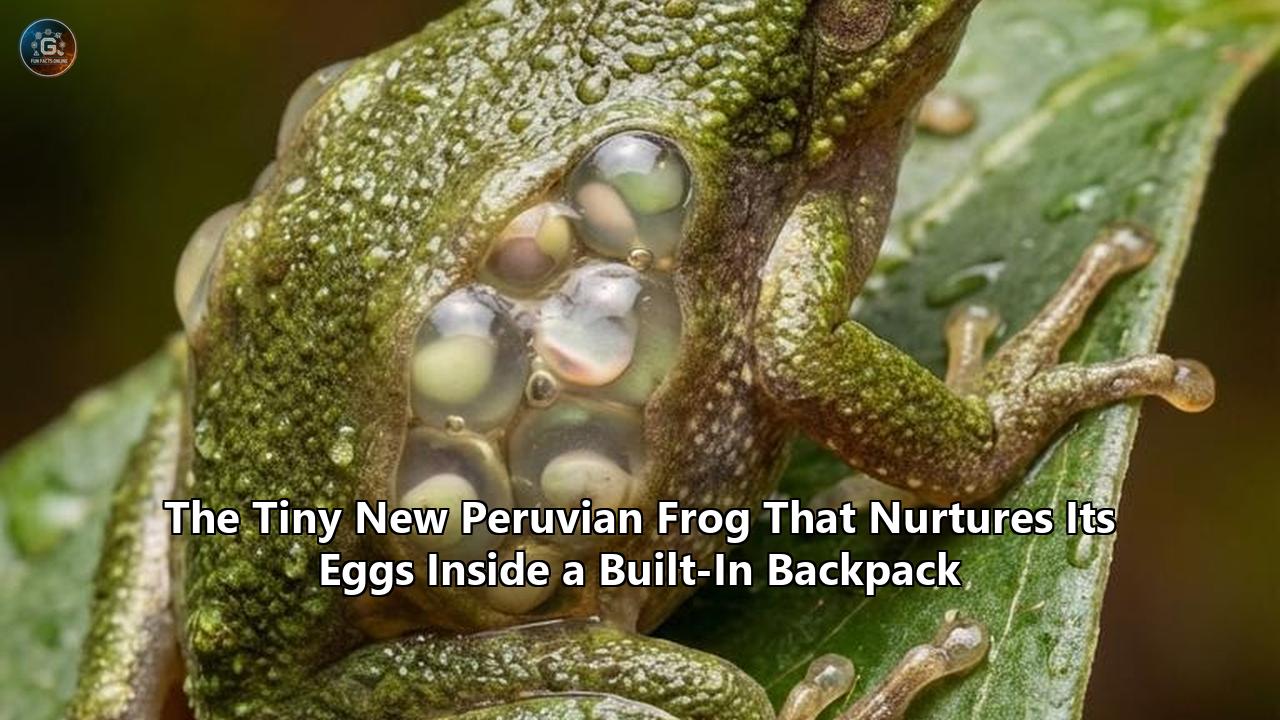
In early April 2026, researchers surveying the high-altitude cloud forests of the Peruvian Amazon bordering Ecuador documented an extraordinary biological mechanism: a tiny green amphibian carrying its developing young in a specialized dorsal pouch. Formally introduced to the scientific record in the journal Zootaxa, Gastrotheca mittaliiti measures a mere 2.7 to 3.3 centimeters in length. Visually, the amphibian is distinguished by bright green pigmentation, rough skin lined with small protuberances, raised ridges along its back, and narrow adhesive discs on its digits. But its physical appearance is secondary to its reproductive anatomy. The female of this species possesses a built-in pouch—essentially a biological backpack—where she incubates her fertilized eggs until they are ready to emerge.
The identification of this Peruvian frog new species was announced by the Ceja de Selva Research Institute for Sustainable Development, operating under the Toribio Rodriguez de Mendoza National University. The research team, collaborating with Florida International University and the University of Seville, immediately classified the amphibian as highly vulnerable. Its native mountainous ecosystem is rapidly degrading due to anthropogenic climate shifts and the aggressive expansion of slash-and-burn agriculture.
Manuel Oliva, the director of the Ceja de Selva Research Institute, presented the finding not just as a localized triumph of herpetology, but as a critical metric of regional biodiversity. "This is further evidence of the enormous natural wealth we possess," Oliva stated, emphasizing that many uncatalogued organisms likely remain hidden within the dense vegetation of the Andes-Amazon transition zone.
This discovery provides a precise analytical lens through which we can examine a broader ecological pattern. Gastrotheca mittaliiti is an indicator species. By studying the highly specialized way it interacts with its environment—and the immediate threats jeopardizing its survival—we can extract critical lessons about evolutionary adaptation, the fragility of micro-ecosystems, and the compounding pressures of modern agricultural practices on undocumented global biodiversity.
Biological Mechanics: Internalizing the Aquatic Environment
To understand the analytical value of this discovery, one must examine the specific evolutionary problem Gastrotheca mittaliiti has solved. Amphibians are historically tethered to water. Across the more than 7,700 recognized species of frogs globally, the standard reproductive strategy involves depositing gelatinous egg masses into ponds, slow-moving streams, or ephemeral puddles. These aquatic environments provide the necessary moisture for the shell-less eggs to survive and supply the habitat for the subsequent tadpole stage.
Marsupial frogs, which belong exclusively to the genus Gastrotheca (now comprising 75 recognized species), have circumvented this vulnerability by internalizing the pond. Following fertilization, the male Gastrotheca uses his toes to physically push the eggs into the female's dorsal pouch. The opening seals or tightens, enclosing the embryos in a highly vascularized chamber. Inside this pouch, the eggs remain physically connected to the mother's circulatory system, allowing for the continuous exchange of oxygen and carbon dioxide.
Recent physiological analyses of related Gastrotheca species have demonstrated that this pouch does more than provide a humid microclimate. Research utilizing stable isotope tracking has proven that maternal nutrients, including essential fats and proteins, actively transfer across the pouch lining into the developing embryos—a biological process functionally analogous to mammalian gestation. By nurturing her eggs within this dorsal compartment, the female Gastrotheca mittaliiti completely bypasses the need for standing water. The offspring eventually emerge directly from the pouch, fully skipping the highly vulnerable, free-swimming aquatic tadpole phase that defines most amphibian lifecycles.
This reproductive mechanism represents a radical evolutionary divergence. By carrying her young, the female ensures they are not subjected to aquatic predators, sudden pond desiccation, or localized water contamination. The biological backpack allows the species to colonize steep, fast-draining mountainous terrains where standing water is virtually nonexistent. However, this physiological triumph requires an immense energetic expenditure from the mother, setting the stage for the specific vulnerabilities the species now faces.
The Geographic Matrix: The Huancabamba Anomaly
The location of this discovery is as scientifically critical as the organism itself. Gastrotheca mittaliiti was located in the Amazonas region of northern Peru, adjacent to the Ecuadorian border. This specific geographical coordinate sits within a broader geological feature known as the Huancabamba Depression. Here, the massive, continuous wall of the Andes Mountains dips to its lowest point, creating a complex matrix of deep valleys, isolated peaks, and fractured cloud forests.
Researchers publishing the Zootaxa study specifically highlighted the Huancabamba region as the global epicenter of Gastrotheca species richness. The topography drives an ecological phenomenon known as micro-endemism. Because high-altitude cloud forests act like "islands in the sky," the flora and fauna trapped on these peaks evolve in strict isolation. A frog adapted to a cloud forest at 2,500 meters of elevation cannot migrate across a hot, dry valley floor sitting at 1,000 meters to reach the next peak. Consequently, populations become genetically isolated, eventually diverging into distinct species separated by only a few dozen kilometers.
Every time researchers isolate a Peruvian frog new species in this terrain, it reinforces the principle that highly complex topographies generate accelerated speciation. The cloud forests they inhabit are defined by persistent, low-level cloud cover. The vegetation—including bromeliads, orchids, and dense mosses—strips moisture directly from the fog, creating a permanently saturated environment.
For a marsupial frog, this atmospheric moisture is the vital substitute for terrestrial bodies of water. The ambient humidity prevents the female's skin from drying out while she carries the heavy metabolic burden of her developing clutch. The Huancabamba anomaly thus provides the exact parameters required for Gastrotheca mittaliiti to thrive: topographical isolation to drive speciation, steep terrain that favors water-independent reproduction, and persistent fog to maintain general amphibian homeostasis.
Case Analysis: Adaptation as a Liability
When analyzing biological case studies, a recurring principle emerges: extreme specialization offers an absolute advantage in a stable environment, but becomes a fatal liability when environmental parameters shift rapidly. Gastrotheca mittaliiti is a masterclass in this paradox.
Consider the reproductive math. A standard Amazonian tree frog might deposit 2,000 eggs into a temporary pool. If a predator consumes 90% of the eggs, and a sudden drought kills half the resulting tadpoles, the sheer volume of the initial clutch still ensures that a dozen individuals reach maturity. This is an r-selected reproductive strategy, relying on high volume and zero parental investment to overpower environmental friction.
Gastrotheca mittaliiti, constrained by the physical dimensions of its 3-centimeter body, can only fit a tiny fraction of that number inside its dorsal pouch. The species employs a K-selected strategy, characterized by low reproductive output coupled with intensive maternal investment. When the cloud forest remains stable, this strategy works flawlessly. The survival rate of pouch-reared frogs is exceptionally high compared to aquatic tadpoles.However, this mathematical reality means that a local population of Gastrotheca mittaliiti cannot quickly rebound from sudden mass mortality. If a localized threat wipes out fifty adult females, the population has lost not just fifty individuals, but a massive percentage of its localized reproductive capacity. There are no dormant eggs waiting in the mud, and no massive swarms of tadpoles to replenish the numbers next spring.
The biological mechanisms that allowed the species to conquer the high-altitude cloud forest—water independence, internal gestation, and low brood size—now severely restrict its ability to adapt to sudden ecological shocks. The built-in backpack is a highly calibrated tool that only functions optimally within a very narrow band of temperature and humidity. As those variables begin to fluctuate wildly, the evolutionary brilliance of the marsupial frog transforms into an ecological straitjacket.
The Anthropogenic Variable: Fire, Farming, and Fragmentation
The research team responsible for cataloging this Peruvian frog new species did not merely describe its morphology; they issued an immediate warning. Gastrotheca mittaliiti was immediately designated as being at "high risk" due to two intersecting anthropogenic forces: climate change and agricultural land clearing. Analyzing these threats requires looking beyond the immediate boundaries of the amphibian's habitat to understand the macro-economic forces driving local land use.
The Amazonas region of Peru is currently experiencing intense agricultural pressure. Local farmers heavily utilize slash-and-burn techniques to clear primary forest for subsistence farming, cattle grazing, and the cultivation of cash crops like coffee and cacao. Historically, the high-altitude cloud forests were largely immune to these fires. The persistent moisture, low temperatures, and dense, wet biomass acted as a natural firebreak. A fire deliberately set in a lower valley would naturally extinguish itself as it crept up the saturated mountainside.
That dynamic has structurally changed. Macro-level climate change has altered precipitation patterns across the Andes-Amazon transition zone. Dry seasons have become extended and more severe. The cloud base—the altitude at which fog consistently forms—is migrating higher up the mountains as regional temperatures increase. Consequently, the lower margins of the cloud forest are drying out.
When farmers set clearing fires in the valleys below, the flames no longer encounter a saturated wall of wet moss. Instead, the fires easily breach the drying perimeter of the cloud forest, incinerating the highly specialized micro-habitats that species like Gastrotheca mittaliiti rely upon.
For a terrestrial frog that moves slowly and carries its young on its back, a forest fire is an inescapable extinction event. Furthermore, agricultural clearing fragments the remaining habitat. Because Gastrotheca species require uninterrupted canopy cover to maintain their specific moisture requirements, they will not cross a cleared pasture or a sun-baked coffee plantation. A once-continuous population becomes fractured into isolated, genetically stagnant pockets, accelerating their vulnerability to disease, predation, and localized extinction.
Strategic Conservation Imperatives: Lessons from a 3-Centimeter Amphibian
The rapid endangerment of Gastrotheca mittaliiti demands a critical reassessment of regional conservation strategies. Protecting an organism with such precise biological requirements requires shifting the focus from species-centric interventions to systemic habitat defense.
First, conservation efforts must address the immediate catalyst of habitat destruction: agricultural fire. Punitive measures against slash-and-burn farming are historically ineffective when driven by systemic poverty. Effective conservation requires integrating local farming communities into the economic structure of preservation. Initiatives that promote shade-grown coffee, which retains the native forest canopy, or provide financial incentives for maintaining intact forest buffers, directly address the economic drivers of deforestation.
Second, the discovery underscores the necessity of continuous, boots-on-the-ground field biology. While satellite imagery can track broad deforestation trends, it cannot detect a 3-centimeter green frog hiding in a bromeliad. The fact that an entirely new reproductive variation can still be discovered in 2026 proves that our baseline inventory of Amazonian biodiversity remains deeply incomplete.
The collaborative framework that led to this discovery serves as a functional model for future expeditions. The alliance between the Toribio Rodriguez de Mendoza National University in Peru, Florida International University, and the University of Seville demonstrates how international academic synergy can accelerate species cataloging. Funding must be routed specifically to these types of joint institutions, ensuring that local scientists have the resources to continually survey high-altitude environments before those habitats are erased.
Third, the habitat fragmentation caused by agricultural clearing must be countered with the strategic implementation of biological corridors. Because cloud forest amphibians cannot traverse open terrain, protecting isolated peaks is insufficient. Conservation planners must prioritize the protection of the forested ridges and saddles that connect these mountain peaks, ensuring that genetic material can still flow across the landscape. Restoring degraded land to bridge these "sky islands" is the only way to ensure the long-term genetic viability of organisms with low mobility and high specialization.
Analytical Expansion: The Physiology of Pouch Gestation
To fully grasp what is lost if this species disappears, it is necessary to examine the specific physiological mechanisms that allow pouch gestation to occur. The dorsal pouch of the female Gastrotheca is not merely a fold of skin; it is a highly specialized, hormonally responsive reproductive organ.
When the female is preparing to reproduce, elevated hormone levels trigger a morphological change in the tissue of her back. The skin thickens, and blood vessels multiply rapidly, creating a dense vascular network immediately beneath the surface. This vascularization is critical. As the embryos develop inside the eggs, their metabolic oxygen demand increases exponentially. The oxygen diffuses from the mother's highly oxygenated blood, across the thin membrane of the pouch lining, and directly into the eggs. Simultaneously, carbon dioxide produced by the developing embryos passes in the opposite direction to be expelled by the mother's lungs.
Furthermore, the physical logistics of getting the eggs into the pouch represent a high-stakes behavioral adaptation. Unlike most frog species that engage in amplexus (the mating embrace) and simply release sperm and eggs into the water simultaneously, the marsupial frog requires a coordinated anatomical ballet. As the female extrudes the eggs, the male, positioned on her back, uses his hind limbs to catch the fertilized eggs and physically maneuver them into the opening of the dorsal pouch.
If the ambient humidity is too low during this process, the eggs can desiccate before they are safely secured inside the pouch. This narrow margin for error highlights why the altering climate of the Huancabamba region is so lethal. A drop in relative humidity—caused by localized deforestation or broader climate patterns—does not just threaten the adult frogs; it completely short-circuits their reproductive viability.
The Broader Implications of Amphibian Declines
The vulnerability of Gastrotheca mittaliiti must also be viewed within the macro-context of the global amphibian crisis. Amphibians are currently the most threatened class of vertebrates on the planet. Their highly permeable skin, which they rely upon for secondary respiration and moisture absorption, makes them acutely sensitive to environmental toxins, temperature fluctuations, and infectious diseases.
For decades, the primary driver of global amphibian decline has been Batrachochytrium dendrobatidis (Bd), a virulent chytrid fungus that attacks the keratin in frog skin, disrupting their ability to regulate electrolytes and eventually causing cardiac arrest. The fungus thrives in cool, moist environments—the exact conditions of the high-altitude cloud forests.
While the Zootaxa study primarily cited climate change and fire as the immediate threats to Gastrotheca mittaliiti, the underlying threat of chytridiomycosis remains a constant variable. Marsupial frogs are uniquely positioned in this dynamic. By avoiding standing water—the primary transmission vector for the chytrid fungus—they might theoretically reduce their exposure to the pathogen. However, their low population densities and slow reproductive rates mean that if the fungus does infiltrate a localized population, the resulting crash is immediate and often irreversible.
This places the newly discovered frog at the intersection of three distinct extinction vectors: mechanical habitat destruction (fire), atmospheric habitat alteration (climate change), and biological threats (pathogens). The survival of any species facing this triad of pressures requires an environment with sufficient buffer zones—areas where populations can retreat, stabilize, and slowly adapt. The tragedy of the cloud forest is that it offers no retreat; the species is already pushed to the absolute vertical limit of its habitable zone.
Integrating Local Policy and Global Conservation Mechanisms
Addressing these intersecting threats requires a sophisticated policy approach that bridges local agricultural realities with global conservation funding. The designation of Gastrotheca mittaliiti as a high-risk species provides the necessary legal and scientific leverage for the Peruvian government to designate the specific valleys of the Amazonas border region as strictly protected sanctuaries.
However, paper parks—protected areas that lack enforcement funding—are notoriously ineffective at stopping agricultural encroachment. Real protection requires the deployment of remote sensing technology, acoustic monitoring, and continuous ranger patrols to interdict illegal logging and unpermitted agricultural fires before they spread into the cloud forest.
Global conservation mechanisms, such as carbon offset markets and international biodiversity grants, must be funneled directly to institutions like the Toribio Rodriguez de Mendoza National University. By financially empowering the local scientists who discovered the species, international organizations can ensure that the subsequent monitoring and habitat defense are managed by stakeholders who understand the immediate socio-political landscape.
Furthermore, the specific discovery of a Peruvian frog new species with such unique reproductive traits presents an opportunity to elevate the public profile of amphibian conservation. While large, charismatic megafauna like jaguars and tapirs typically dominate Amazonian conservation campaigns, the extreme biological ingenuity of the marsupial frog offers a compelling narrative for preserving micro-habitats. Public and institutional funding is invariably tied to a narrative of uniqueness; a frog that carries its young in a biological backpack perfectly fulfills that criteria.
Future Trajectories: The Race Against Unrecorded Extinctions
Looking forward, the documentation of Gastrotheca mittaliiti forces the scientific community to confront the phenomenon of dark extinction—the loss of species before they are ever formally described by science. If a vividly green, highly specialized frog managed to evade detection until 2026 in a region known to be a biological hotspot, it mathematically guarantees that hundreds of other specialized invertebrates, plants, and small vertebrates are currently residing in those same threatened cloud forests.
As Manuel Oliva noted, there are many species still waiting to be discovered. But the window for that discovery is closing rapidly. The fires expanding into the upper elevations of the Amazonas region are not merely burning trees; they are erasing the evolutionary record of the Andes-Amazon transition zone.
The immediate next steps for the research teams involved will likely focus on delineating the exact geographic range of the new marsupial frog. Using environmental DNA (eDNA) sampling from moisture pockets in the cloud forest, or deploying automated acoustic recorders to listen for unrecognized mating calls, researchers can establish a more accurate population baseline without relying solely on visual encounters.
The story of the tiny frog with the built-in backpack is ultimately a study in the limits of evolutionary endurance. The species spent millions of years perfecting a biological mechanism to master one of the most demanding environments on Earth, achieving complete independence from the aquatic environments that anchor the rest of its amphibian relatives. Yet, that evolutionary masterpiece is instantly nullified by a single match struck in a drying valley.
The survival of Gastrotheca mittaliiti going forward will not depend on its own remarkable physiological adaptations. It will depend entirely on how rapidly regional agricultural policies, international conservation funding, and localized habitat enforcement can adapt to protect the precise atmospheric conditions of the Huancabamba cloud forests. Monitoring the population stability of this newly documented amphibian will provide researchers with a highly sensitive, real-time barometer for the overall health of the Andean ecological frontier.
Reference:
- https://www.goodgoodgood.co/articles/new-miniature-marsupial-frog-carries-a-secret-in-a-hidden-pouch
- https://www.turkiyetoday.com/lifestyle/news-species-of-frog-carrying-eggs-on-its-back-discovered-in-peru-3217344
- https://www.gmanetwork.com/news/scitech/science/982533/new-frog-species-carrying-eggs-on-back-discovered-in-peru/story/
- https://www.columbiagorgenews.com/news/national/new-frog-species-carrying-eggs-on-back-discovered-in-peru/article_25ed0f15-6a82-55a8-b937-91b656c5bf95.html
- https://en.socportal.info/en/news/a-frog-has-been-found-in-peru-that-carries-its-eggs-in-a-pouch-on-its-back/amp/
- https://trexperienceperu.com/blog/amazon-rainforest-animals