Deep within the rainforest canopy of French Guiana, a dead branch suspended eight meters above the forest floor housed an evolutionary anomaly. When a team of international entomologists, led by University of Florida researcher Rudolf Scheffrahn, breached the 20-centimeter-thick wood in late 2025, they did not find a standard colony of drywood termites. Instead, they uncovered a soldier caste with a cranial structure completely alien to the known catalog of the Cryptotermes genus.
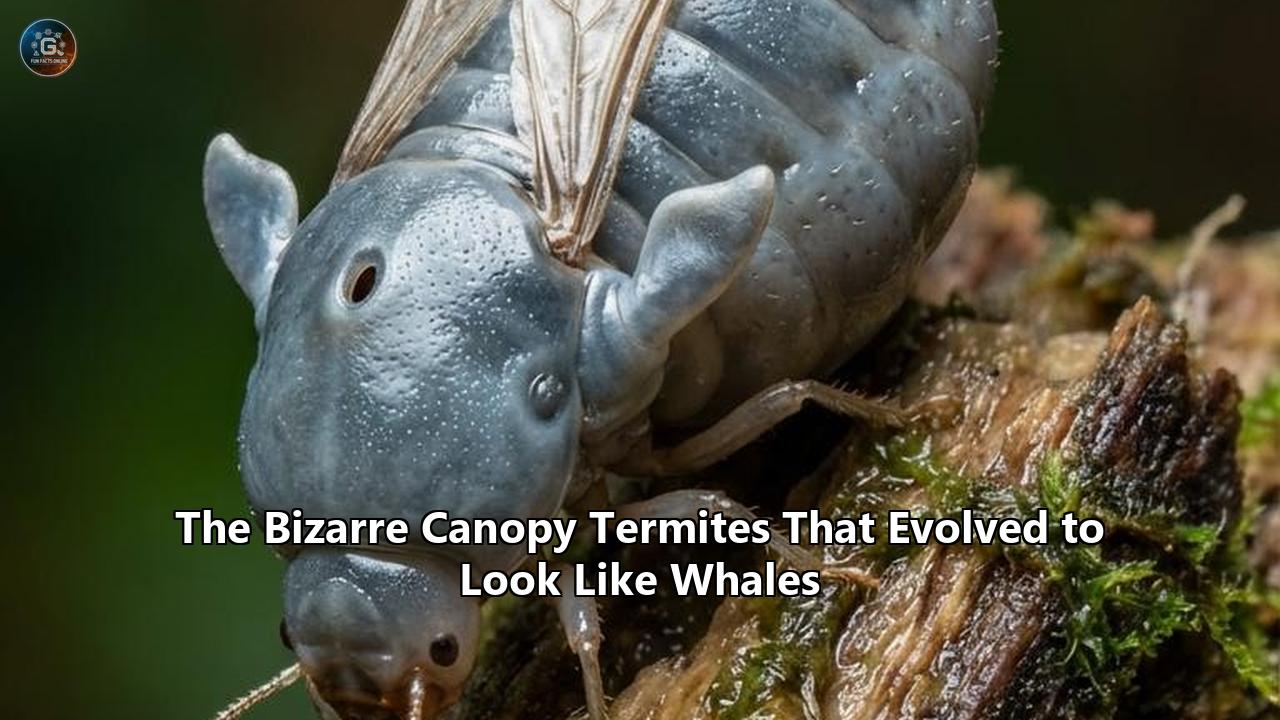
When researchers first extracted these canopy termites, whale-like in their cranial proportions, they assumed they were looking at an entirely undocumented genus. The insect possessed a massive, elongated, rounded head capsule that thrust forward, entirely obscuring its mandibles from a lateral view. Its antennal sockets were positioned far back on the skull, perfectly mirroring the anatomical placement of a sperm whale’s eye. The resemblance was so literal that the research team—including Aleš Buček, David Sillam-Dussès, and Jan Šobotník—named the sixteenth South American species of its kind Cryptotermes mobydicki.
This discovery exposes a hidden layer of morphological extremes occurring hundreds of feet above the soil. To understand how a microscopic insect evolves to mimic the profile of a marine leviathan, we must dismantle the standard architecture of the insect head and examine the severe biomechanical demands of canopy warfare.
Anatomical Restructuring: The Mechanics of Mandibular Eclipse
The standard termite soldier is built for open combat. Genera like Macrotermes possess flattened head capsules equipped with massive, heavily sclerotized mandibles designed to slash, crush, or pierce the armor of invading ants. In these species, the head serves as an anchor point for immense adductor muscles that snap the jaws shut with lethal force.
Cryptotermes mobydicki abandoned this offensive architecture entirely.To understand why, we can apply a simple thought experiment. Imagine defending a narrow stone corridor against an endless swarm of invaders. If you wield a broadsword, you need room to swing. If the corridor is too tight, your weapon becomes a liability, snagging on the walls and leaving gaps through which a small, agile enemy can slip. However, if you drop the sword and instead carry a shield perfectly matched to the exact dimensions of the corridor, you can block the passage entirely. You no longer need to fight; you simply need to hold your ground.
This is the evolutionary logic behind the Moby Dick termite's cranial redesign. The insect has undergone severe mandibular regression. Its jaws are stunted and tucked beneath the massive, swollen frontal prominence of its head—a physical state Scheffrahn described as the mandibles being "eclipsed." By eliminating the protruding jaws, the termite achieves a perfectly smooth, blunt, rounded anterior profile.
The head capsule is heavily armored, reinforced with cross-linked cuticular proteins that render it virtually impenetrable to the biting mandibles of predatory ants. The whale-like profile is not an aesthetic coincidence; it is a highly calculated geometric plug.
The Physics of Phragmosis: A Biological Portcullis
The defensive strategy employed by Cryptotermes mobydicki is a biomechanical process known as phragmosis—the use of a modified body part to block a nest entrance. While many kalotermitids (drywood termites) use phragmotic defense, the extreme elongation of the mobydicki skull introduces unique static mechanics.
When arboreal ants discover a breach in the termite gallery, the C. mobydicki soldier advances to the exact bottleneck of the tunnel. The diameter of the gallery is meticulously excavated by the colony’s pseudergates (false workers) to match the exact cranial circumference of the soldier caste.
Once in position, the soldier operates as a biological portcullis. From a physics perspective, the termite must withstand significant pushing forces from the invading ants without being dislodged backward into the gallery. This resistance is achieved through two mechanical principles:
- Frictional Anchoring: The termite utilizes its short, stout legs to brace against the rough internal walls of the wooden gallery. The angle of the legs maximizes static friction. Because the head is elongated—much like the battering ram of a sperm whale—any lateral force applied by the ants is distributed evenly across the smooth frontal plane, preventing the ants from finding a grip or a lever point to flip the defender.
- Hydrostatic Bracing: Inside the termite's body, muscle contractions shift hemolymph (insect blood) pressure, slightly expanding the softer abdominal segments against the tunnel walls behind them, creating an additional wedge effect.
As we examine the physical profiles of these canopy termites, whale-like head capsules reveal an intricate biological machinery dedicated entirely to passive resistance. The soldier may sit in this plugged position for hours or days, completely inert, while the invaders exhaust themselves trying to bite through its heavily sclerotized skull.
Trophic Economics: The Caloric Burden of a Weaponized Head
Evolution rarely offers a morphological upgrade without exacting a severe physiological tax. The extreme modification of the Cryptotermes mobydicki head renders the soldier completely incapable of feeding itself. Mandibles designed to sit flush beneath a phragmotic shield cannot chew through solid wood or forage for lichen.
Consequently, the soldier caste becomes a permanent metabolic sink for the colony. The survival of these bizarre defenders relies on a complex internal economy managed by the pseudergates. These immature, unspecialized nestmates digest the dead wood of the canopy branch, processing the tough cellulose and lignin through a symbiotic community of gut flagellates and bacteria.
Once the wood is broken down into usable short-chain fatty acids, the pseudergates feed the soldiers via stomodeal (mouth-to-mouth) or proctodeal (anus-to-mouth) trophallaxis. The soldiers are effectively helpless, tethered to the colony's supply line.
This strict trophic dependency explains why soldier ratios in phragmotic colonies are meticulously controlled by primer pheromones. If a colony produces too many whale-headed soldiers, the caloric burden will collapse the pseudergate workforce. The colony maintains just enough soldiers to plug the available breach points in their wooden fortress, ensuring maximum security with minimum caloric waste.
Divergent Weaponry: The Chemical Artillery of the Nasutes
While the blunt-headed drywood species relies on plugging tunnels, other canopy termites, whale-like in their bulbous profiles, opt for an entirely different defensive paradigm: chemical artillery. The subfamily Nasutitermitinae shares the high-altitude arboreal habitat with Cryptotermes, yet they have engineered a completely different solution to ant predation.
Instead of a flat, shielded face, nasute soldiers possess a distended, teardrop-shaped head that tapers into a long, syringe-like snout called a nasus. The sheer volume of the swollen head gives them a distinctly cetacean or dolphin-like silhouette. However, rather than wedging this head into a hole, the nasute termite uses it as a pressurized containment vessel for toxic adhesives.
Micro-computed tomography (microCT) scans conducted on nasute species by researchers like Aleš Buček have unveiled the internal architecture of these biological squirt guns. The transition from ancestral biting mandibles to a chemical nozzle required a total internal reorganization of the cranial cavity.
In a standard termite, the head is packed with massive mandibular adductor muscles. In the nasutes, mandibular regression has reduced the jaws to functionless, microscopic vestiges. The vacant space inside the skull is instead consumed by a massive, unpaired organ known as the frontal gland, which occupies nearly the entire cranial volume and extends deep into the abdomen. This gland is surrounded by highly modified muscle networks that no longer control jaws, but instead act as pneumatic compressors.
Fluid Dynamics of a Living Syringe: The Physics of the Squirt
When a nasute termite detects the chemical signature of an approaching ant, it engages a highly sophisticated fluid ejection system. The mechanics of this biological squirt gun operate on principles of fluid dynamics that scientists are still actively modeling.
The ejection process can be mapped in distinct biomechanical phases:
Phase 1: Chamber CompressionThe modified mandibular muscles, now wrapped around the swollen frontal gland, contract violently. Because the gland is a sealed reservoir, this contraction spikes the internal hydrostatic pressure instantly. According to Pascal's principle, this pressure is transmitted undiminished throughout the fluid inside the gland.
Phase 2: Viscous ExtrusionThe defensive secretion is a highly viscous, non-Newtonian fluid—essentially a biological epoxy. Pushing a thick fluid through a narrow tube requires immense force. Poiseuille’s Law dictates that the flow rate of a fluid through a cylindrical pipe is inversely proportional to the viscosity of the fluid and highly dependent on the radius of the tube. The nasus (the snout) is incredibly narrow, meaning the termite must generate extreme internal pressure to force the glue out.
Phase 3: The Jetting PhenomenonUpon breaching the tip of the nasus, the pressurized fluid is ejected as a high-speed jet. Researchers observing fluid ejections in nature have noted that these viscous jets can achieve remarkable speeds, expanding almost two times the length of the termite's body. Because of the specific viscosity of the chemical cocktail, the fluid does not aerosolize into a mist; instead, it remains cohesive, forming a "liquid lasso" that arcs through the air and impacts the target with heavy physical mass.
Phase 4: Curing and EntrapmentUpon contacting the air and the exoskeleton of the attacking ant, the volatile components of the secretion evaporate rapidly. This evaporation cures the remaining heavy resins, turning the liquid lasso into a hardened cement. The ant is instantly immobilized, its legs glued to its body and its antennae fouled, rendering it helpless and neutralizing the threat without a single physical bite being administered.
Biochemistry of the Frontal Gland: Synthesizing the Payload
The lethality of the nasute squirt gun is not just mechanical; it is deeply rooted in complex organic chemistry. The frontal gland is essentially a microscopic chemical reactor, synthesizing compounds that are rarely found elsewhere in the animal kingdom.
Analyses of the defensive secretions from species like Nasutitermes macrocephalus in Brazil have mapped the precise chemical architecture of this payload. The secretion is a multiphasic mixture categorized by molecular weight:
Monoterpenes (The Solvents and Alarms):The lighter, volatile fractions of the secretion consist of monoterpenes such as alpha-pinene and limonene. These compounds serve a dual purpose. First, they act as the solvent, keeping the heavier resins in a liquid state while stored inside the frontal gland. Second, because they are highly volatile, they vaporize instantly upon ejection. This vapor cloud acts as a potent alarm pheromone. When one soldier fires its nasus, the vapor drift alerts nearby soldiers, who immediately rush to the breach, creating a cascading defense response.
Sesquiterpenes (The Irritants):Mid-weight molecules, including beta-trans-caryophyllene and gamma-selinene, act as topical toxins. While the glue physically entraps the predator, these sesquiterpenes seep into the ant's spiracles (breathing tubes) and cuticular joints, causing severe cellular irritation and central nervous system disruption.
Diterpenes (The Concrete):The heavy fraction of the secretion consists of highly complex diterpenes, primarily trinervitanes and rippertanes. These are the large, sticky molecules that polymerize into cement when exposed to oxygen. The biological synthesis of these compounds is a marvel of enzymatic engineering. Isomerases and transferases within the termite’s glandular epithelium construct these massive carbon frameworks de novo from basic precursors.
Recent pharmacological studies on these termite-derived diterpenes have revealed extreme biological potency. For example, researchers isolating the compound 3alpha-hydroxy-15-rippertene from Nasutitermes secretions discovered that it possesses intense antibacterial properties, actively inhibiting methicillin-resistant Staphylococcus aureus (MRSA) in laboratory settings. The termites likely evolved these antibacterial properties to prevent their frontal glands from becoming infected by ambient canopy pathogens, inadvertently creating a chemical capable of fighting modern human superbugs.
Environmental Crucibles: The Selective Pressures of the Arboreal Microhabitat
Why do these extreme morphological shifts—whether the blunt, plugging head of Cryptotermes mobydicki or the chemical sniper-snout of Nasutitermes—occur so frequently in the canopy? The answer lies in the severe selective pressures of the arboreal microhabitat.
Unlike subterranean termites, which have access to the infinite, climate-controlled expanse of the soil, canopy termites live in highly restricted, isolated universes. A colony of Cryptotermes mobydicki exists entirely within a single dead branch suspended high above the ground.
This environment imposes brutal constraints:
- Moisture Scarcity: Canopy dead wood is often baked by the sun and swept by dry winds. Drywood termites cannot travel to the soil for water. They must extract all their moisture from the wood they eat and recover metabolic water through highly efficient rectal pads that extract every drop of moisture from their feces before excretion.
- Spatial Limitation: The physical boundaries of the colony are strictly defined by the volume of the branch. They cannot dig deeper to escape predators; they are trapped in a finite wooden matrix.
- Hyper-Aggressive Predation: The rainforest canopy is dominated by arboreal ant species (such as Azteca and Crematogaster). These ants run continuous, aggressive patrols over every inch of bark. If they locate a termite gallery, they will pour inside and massacre the colony in minutes.
Because running away is impossible, and conventional warfare within narrow twigs is inefficient, the environmental crucible forces morphological innovation. The isolation of these canopy termites, whale-like shapes and chemical guns included, represents a desperate evolutionary arms race where the only viable defense is total barricade or absolute chemical suppression.
Genetic Isolation and Allopatric Speciation in the Treetops
The discovery of Cryptotermes mobydicki also provides a profound case study in allopatric speciation on a micro-scale.
Speciation in kalotermitids begins during the nuptial flight. A male and female alate (winged reproductive) launch into the canopy air currents. The vast majority are eaten by birds, bats, or spiders. A fraction of a percent manages to land on a suitable piece of suspended dead wood. They shed their wings, locate a small crack in the bark, and chew their way inside to form a nuptial chamber.
Once inside, the king and queen seal the entrance behind them. They will never see the outside world again. Their offspring will spend their entire lives inside that specific piece of wood.
Because these colonies are completely cut off from the gene pools of other termite populations, they are highly susceptible to genetic drift and rapid localized adaptation. Over millions of years, isolated populations of the Cryptotermes ancestor diverged heavily. While one lineage across the Neotropics maintained a relatively standard defensive head, the lineage trapped in the high-altitude branches of French Guiana began to accumulate mutations that extended the frontal prominence of the skull.
Individuals with slightly more elongated, rounded heads survived ant sieges at a higher rate because their heads formed a tighter seal in the galleries. Generation after generation, the mandibles recessed, the skull stretched, and the sensory sockets migrated backward, pushing the evolutionary trajectory directly toward the Moby Dick profile.
This genetic isolation explains why C. mobydicki looks drastically different from the other fifteen Cryptotermes species in South America. It is a product of an evolutionary bottleneck, shaped by the exact geometric dimensions of the dead branches it inhabits.
The Dynamics of Autothysis: When All Else Fails
While mechanical plugging and chemical squirting represent highly refined defensive tactics, some canopy termites harbor a final, catastrophic fallback protocol. When a breach is too large for a single Cryptotermes head to plug, or when a Nasutitermes soldier drains its frontal gland of glue, certain termite lineages resort to autothysis—defensive suicide.
In closely related neotropical species, aging workers (who have lost their foraging efficiency) develop specialized biological backpacks containing toxic crystalline proteins. When the colony is overwhelmed, these elderly workers rush the front lines. Through severe abdominal muscle contraction, they intentionally rupture their own exoskeletons, violently tearing themselves apart to release a toxic, sticky slurry that coats the invaders.
Autothysis demonstrates the ultimate logical extreme of eusocial evolution. Because the workers and soldiers are sterile, their individual lives have zero genetic value outside of protecting the reproductive king and queen. Whether an insect evolves a massive, immobile head that renders it incapable of feeding itself, or develops the capacity to detonate its own internal organs, the individual is merely a expendable cell in the larger superorganism of the colony.
The Future of Taxonomic Exploration
The identification of a miniature sperm whale hidden in the dead wood of a French Guianan canopy is more than a taxonomic novelty. It serves as a stark metric for the sheer volume of undiscovered biodiversity lingering in the world's vertical ecosystems.
For centuries, entomological surveys have been restricted by gravity. Soil and leaf-litter termites are well-documented, but the high canopy remains a biological frontier accessible only via specialized climbing gear, canopy cranes, or the opportunistic sampling of fallen branches. As researchers push higher into the arboreal strata, they are consistently unearthing organisms that defy foundational morphological rules.
Unlike invasive subterranean termites that destroy human infrastructure, species like Cryptotermes mobydicki are fragile specialists. They are locked into highly specific ecological niches, dependent on the exact decay stages of suspended dead wood in undisturbed primary rainforests. Their existence is deeply tethered to the health of the canopy.
The bizarre cranium of the Moby Dick termite and the pressurized biochemical reactors of the nasutes force us to reevaluate the limits of phenotypic plasticity. They illustrate that evolution is not a march toward a singular, optimal form, but a chaotic, fluid process of engineering hyper-specific solutions to hyper-specific problems. As we continue to sequence the genetics and map the mechanics of these arboreal architects, the forest canopy reveals itself not just as a habitat, but as a high-altitude laboratory where the rules of anatomy are constantly rewritten.
Reference:
- https://en.wikipedia.org/wiki/Nasutitermitinae
- https://www.termiteweb.com/the-nasutitermitinae-termites/
- https://www.entsocnsw.org.au/wp-content/uploads/2022/04/GAE-50-27-29-Smart_Nasute.pdf
- https://www.researchgate.net/publication/397351002_Cryptotermes_mobydicki_Isoptera_Kalotermitidae_an_extraordinary_new_termite_species_from_French_Guiana
- https://pmc.ncbi.nlm.nih.gov/articles/PMC11269045/
- https://pubmed.ncbi.nlm.nih.gov/23472463/
- https://www.researchgate.net/publication/235893076_Chemical_Composition_and_Biological_Activities_of_Soldiers_of_the_Brazilian_Termite_Species_Nasutitermes_macrocephalus_Isoptera_Natutitermitinae
- https://www.miragenews.com/scientists-unveil-termite-resembling-mini-sperm-1649515/
- https://scitechdaily.com/unlike-anything-weve-ever-seen-bizarre-new-insect-discovered-in-south-america-stuns-scientists/
- https://www.researchgate.net/publication/229175056_Terpene_biosynthesis_by_nasute_termite_soldiers_Isoptera_Nasutitermitinae
- https://dailygalaxy.com/2026/03/moby-dick-whale-headed-termite-species-found-in-french-guiana/