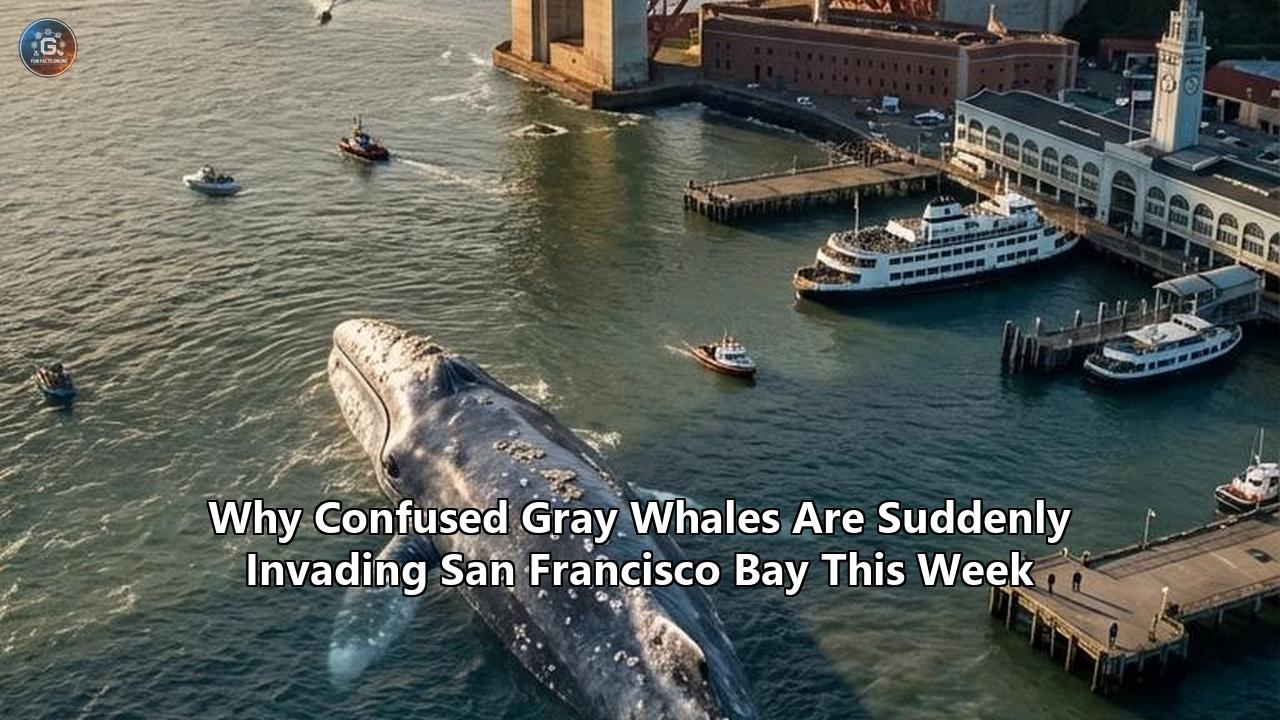
This week, a bleak reality check arrived for marine biologists and commercial mariners monitoring the California coastline. According to a highly anticipated study published on April 13, 2026, in Frontiers in Marine Science, nearly one in five gray whales that detour into San Francisco Bay never leave alive. The sprawling estuary, which was never historically part of the species' ancient migratory route, has abruptly transformed into a deadly trap. Lured in by starvation and a collapsing Arctic food web, a growing number of these massive marine mammals are turning right at the Golden Gate Bridge, only to find themselves navigating one of the most heavily trafficked maritime bottlenecks on the planet.
The numbers released by researchers at Sonoma State University, The Marine Mammal Center, and the California Academy of Sciences paint a stark, data-driven picture of a species in distress. Between 2018 and 2025, scientists positively identified 114 individual gray whales entering the bay. Of those, at least 21 were later found dead in the surrounding waters—an 18 percent mortality rate. The true toll is likely higher, as many carcasses sink to the ocean floor or decompose beyond the point of definitive identification.
The official paper, titled "Gray whales (Eschrichtius robustus) in San Francisco Bay experience high mortality and have limited affiliation to known foraging groups," confirms that more than 40 percent of these documented fatalities were the direct result of blunt force trauma from vessel strikes. The remaining animals primarily succumbed to severe malnutrition.
"Gray whales have a low profile to the water when they surface, and this makes them difficult to see in conditions like fog which are common to San Francisco Bay," Josephine Slaathaug, lead author of the study and a biology researcher at Sonoma State University, explained upon the data's release. "Additionally, San Francisco Bay is a highly trafficked waterway, and the Golden Gate Strait serves as a bottleneck through which all traffic and whales must enter and exit."
To understand why a 40-foot, 30-ton marine mammal would abruptly abandon a migration route encoded in its DNA for millennia, we have to look thousands of miles north to the warming waters of the Arctic. We must examine the cascading economic and biological physics that occur when an apex species collides with the global supply chain, and decode the complex ecological puzzle of why gray whales in San Francisco Bay are desperately trying to adapt to an industrialized ocean.
The 12,000-Mile Starvation Diet: The Biology of the Gray Whale Migration
The eastern North Pacific gray whale (Eschrichtius robustus) undertakes one of the most extreme endurance events in the animal kingdom. Every year, the population swims up to 12,000 miles round-trip. They spend their winters mating and calving in the warm, hypersaline lagoons of Baja California, Mexico—specifically San Ignacio Lagoon, Magdalena Bay, and Ojo de Liebre.
In these protected southern waters, newborn calves are safe from transient killer whales, and the warm temperature allows them to conserve energy and build up the blubber necessary for oceanic survival. But these lagoons offer virtually nothing to eat.
When spring arrives, the adult whales push north toward their summer feeding grounds in the Chukchi and Bering Seas. Historically, this meant swimming continuously for months without consuming a single calorie. The journey is entirely subsidized by the thick layer of blubber they acquired the previous summer. By the time they reach the California coast—usually between February and May—they are effectively running on fumes.
Under normal circumstances, gray whales are disciplined, focused travelers. They hug the coastline, utilizing the shallow acoustic environment to navigate and hide calves from predators, but they do not stop to forage. Their specialized feeding mechanism requires a specific type of prey that, until recently, was only abundant in the Arctic.
Unlike humpback or blue whales, which gulp massive swarms of krill or schooling fish in the open water column, gray whales are benthic foragers. They dive to the shallow ocean floor, roll onto their right sides, and use their powerful, muscular tongues to suction up massive mouthfuls of muddy sediment. They then use their thick, rigid baleen plates to filter out the mud and water, leaving behind dense mats of amphipods—tiny, lipid-rich, shrimp-like crustaceans.
This hyper-specialized diet, reliant on a specific ocean floor consistency, is exactly what is driving gray whales in San Francisco Bay to desperation. They are looking for mud, but the mud they are finding is fundamentally empty of the calories they need to survive.
The Climate Trigger: Disintegration of the Arctic Food Web
The invasion of the bay cannot be understood without dissecting the thermal dynamics of the Arctic Ocean over the last decade.
The amphipods that gray whales rely on are tied directly to the seasonal lifecycle of Arctic sea ice. During the frigid winter months, sea ice forms a thick ceiling over the Bering and Chukchi Seas. On the underside of this ice, vast blooms of algae grow. When the ice melts in the spring, this nutrient-dense ice algae detaches and sinks to the sea floor, essentially fertilizing the benthic zone and creating an all-you-can-eat buffet for the amphipod crustaceans.
But the Arctic is warming at a rate roughly four times faster than the rest of the planet. Over the past several years, the sea ice has been forming later, freezing thinner, and melting much earlier. The critical ice algae blooms have drastically diminished as a result. Without the algae dropping to the ocean floor, the amphipod populations have crashed.
When the gray whales arrive in the Arctic, exhausted from their 6,000-mile swim north, they are increasingly finding a barren seafloor. They spend the summer diving and filtering, expending precious caloric energy, only to come up with mouthfuls of empty sediment. When the fall arrives and they must turn south to breed, they are already operating at a severe caloric deficit.
The resulting starvation triggered an "Unusual Mortality Event" (UME) formally declared by the National Oceanic and Atmospheric Administration (NOAA) in early 2019. Over the subsequent four years, the visual evidence of the crisis washed ashore week after week, from the beaches of Mexico up to the coast of Alaska.
The Plunge to 13,000: The Math of the UME
The sheer scale of the population crash is staggering. Prior to the UME, the eastern North Pacific gray whale population stood at an estimated robust 27,000 individuals. By the time the UME was officially closed in November 2023, the population had plummeted.
However, the closure of the UME did not mean the crisis was over. While the massive spike in strandings slowed, the population continued to bleed out. By 2025, NOAA released a revised population estimate showing continued decline: only about 12,900 to 13,000 individuals remained. This represents the lowest population size for the species since the early 1970s, effectively erasing decades of hard-fought conservation gains.
Perhaps most alarming for marine biologists is the collapse of the birth rate. To maintain or grow a population, breeding-age females must produce calves. But a female gray whale requires immense fat reserves to gestate a calf and produce the highly concentrated milk necessary to nurse it in the Baja lagoons. Starving mothers simply do not reproduce. In 2025, observers counted only about 85 gray whale calves migrating past Central California—the lowest number recorded since systematic calf counting began in 1994.
The whales migrating north in April 2026 are the survivors of this brutal ecological culling. They are deeply emaciated, carrying the metabolic debt of multiple consecutive bad years in the Arctic. Desperate, and running completely empty mid-migration, they are breaking their ancient behavioral protocols. They are turning into river mouths, industrial ports, and bays looking for anything to eat.
The False Refuge of the Mudflats: What the 'Bay Grays' Find
When a starving gray whale swims past the Farallon Islands and detects the massive tidal outflow of the Golden Gate, its sensory biology registers a vast, shallow, muddy estuary. To a desperate benthic forager, it feels like a logical place to pull over and refuel.
Researchers and maritime observers have dubbed these detour animals the "Bay Grays". Observations from The Marine Mammal Center confirm that these whales are not just resting; they are actively foraging. They have been documented diving into the mudflats near Richmond, Angel Island, and Alcatraz, leaving distinct "feeding pits" in the sediment.
"We think it has a lot to do with the fact that the whales haven't been getting enough food," Bill Keener, a veteran biologist with The Marine Mammal Center in Sausalito, noted regarding the behavioral shift. "They may be weak and resting for a while, or they may be looking for an alternative food source."
But the mud of San Francisco Bay is not the mud of the Chukchi Sea. While the bay contains ghost shrimp, marine worms, and other small invertebrates, the overall caloric density is vastly lower than the Arctic amphipod mats the whales evolved to eat. The animals expend massive amounts of energy diving, rolling, and filtering, only to receive a fraction of the necessary caloric reward.
Some individuals have lingered in the bay for astonishingly long periods. In 2023, one whale stayed for at least 75 days. In 2025, researchers tracked an individual that remained inside the bay for 67 days. During these prolonged stopovers, they are exposing themselves to an industrial maritime landscape they lack the evolutionary hardware to comprehend. The very features that make San Francisco Bay a world-class natural harbor also make it a fatal gauntlet for a sluggish, confused marine mammal.
The Golden Gate Bottleneck: The Economics of a Maritime Superhighway
To grasp the mechanics of the 18 percent mortality rate, one must look closely at the maritime economics and physical hydrodynamics of the region.
San Francisco Bay is a critical artery of the global supply chain. The Port of Oakland is one of the busiest container ports in the United States, processing millions of TEUs (twenty-foot equivalent units) of cargo annually. In addition to massive, deep-draft container ships, the bay hosts oil tankers heading to heavy refineries in Richmond, bulk carriers, a sprawling network of high-speed commuter ferries, commercial fishing fleets, and thousands of recreational sailboats.
Every single one of these vessels—and every single gray whale entering or exiting the bay—must pass through the Golden Gate Strait.
This strait is a geographic pinch point just one mile wide. It features complex, churning tidal currents that routinely exceed six knots. When a 1,200-foot container ship approaches the Golden Gate, it is not highly maneuverable. These vessels weigh upwards of 150,000 tons. They take miles of open water to come to a complete stop. A commercial pilot steering a freighter through the fog cannot simply swerve to avoid an obstacle, even if that obstacle is a 30-ton mammal.
The physical dynamics of a vessel strike are brutal. It is not always the direct bow of the ship that does the damage. Large commercial vessels displace massive amounts of water, creating a powerful hydrodynamic draw along the length of the hull. A slow-moving whale swimming parallel to a cargo ship can literally be sucked inward, drawn toward the massive, rotating bronze blades of the ship's propulsion system.
"In San Francisco Bay, the biggest threat to these whales is vessel traffic," Rebekah Lane of the Center for Coastal Studies, a co-author of the Frontiers study, stated clearly. The data backs this up: of the 70 gray whales found dead in the surrounding region between 2018 and 2025, 30 were definitively confirmed to have been struck by vessels.
The Physics of a Vessel Strike: Acoustics, Fog, and Starvation
Why do whales with excellent acoustic sensitivity fail to swim out of the way of a roaring cargo ship? The answer lies in a lethal combination of acoustic physics, regional weather patterns, and the physiological realities of starvation.
First, the weather. San Francisco Bay is famous for its dense, localized advection fog, particularly in the spring and early summer when the northern migration peaks. Gray whales do not possess a prominent, upright dorsal fin like killer whales or bottlenose dolphins. They feature a subtle dorsal hump followed by a series of small "knuckles" along their lower back. When they surface to breathe, they keep an incredibly low profile. In the choppy, gray, fog-shrouded waters of the bay, a surfacing gray whale is virtually invisible to a ship captain scanning the horizon from a bridge located 100 feet in the air.
Second, the acoustics. It seems entirely counterintuitive that an animal relying on sound to navigate could fail to notice an approaching freighter. However, marine acousticians have identified a phenomenon known as the "bow null effect" or acoustic shadow. As a massive ship pushes forward, the bulbous bow generates a pressure wave of water ahead of it. The sound of the ship's engine and propeller is largely projected outward and backward. Directly in front of the ship—in the immediate path of danger—exists an acoustic blind spot. By the time the sound wave reaches the whale, the steel hull is already upon it.
Finally, the biological factor of starvation cannot be ignored. The whales entering the bay are severely emaciated. They are operating on a critical caloric deficit, which compromises their muscle function and reaction times. A healthy, fat-laden gray whale might possess the burst speed required to dive deep and evade a fast-moving ferry; a starving gray whale simply lacks the muscular glycogen to react in time. "It's argued that the two causes may be more connected than they first appear," notes the Oceanographic Magazine coverage of the study. "A starving whale is a slower, less responsive whale, and therefore less capable of detecting and avoiding an oncoming hull."
The Grim Detective Work: Necropsies and Photo-Identification
How do scientists know precisely which whales are dying, and exactly what killed them? The answers emerge from a physically demanding, often gruesome scientific process.
The recent Frontiers study was built on an exhaustive catalog of opportunistic sightings, structured vessel surveys, and community science photographs spanning the seven years from 2018 to 2025. Gray whales feature distinct, heavily mottled skin—a unique canvas of natural pigmentation, white barnacle clusters, and historical scars from killer whale attacks. No two whales look exactly alike.
Researchers painstakingly built a database of the 114 distinct individuals that entered the bay. When a dead whale washes up on a beach in Marin County, Pacifica, or the rocky shores of San Rafael, a specialized response team mobilizes.
Performing a necropsy (an animal autopsy) on a 40-foot, rapidly decaying whale is a logistical and sensory nightmare. It involves heavy machinery to move the carcass, giant flensing knives to cut through blubber, and a race against shifting tides and decomposition. The scientists look for highly specific biological markers:
- Blubber thickness: To assess the exact level of starvation and assign a body condition score.
- Stomach contents: To determine if the whale was successfully finding food in the bay, or if it had ingested plastic and maritime debris.
- Skeletal fractures and hematomas: The unmistakable internal signatures of a vessel strike.
Through this meticulous process, scientists successfully matched 21 dead whales to the living photographs in their database. The case studies are tragic. Take a whale known to researchers as TMMC-1-91, affectionately nicknamed "Ladybug." Ladybug was photographed swimming in the central bay against the backdrop of the San Francisco skyline on May 5, 2025. Weeks later, Ladybug's massive carcass washed ashore near McNears Beach in San Rafael.
Another whale, dubbed "Denali," was spotted lifting its rostrum above the water near Crissy Field. Days later, Denali was found dead, exhibiting the massive internal hemorrhaging consistent with blunt force trauma from a ship's hull. "The main finding was hemorrhaging on the animal's left lateral side between the head and pectoral fin, concentrated near the skull," researchers noted after a similar necropsy in Richmond.
"To see adult whales and adult females of breeding age dying in the San Francisco Bay Area by vessel strikes is extremely concerning," Slaathaug pointed out. In a population struggling to rebound from an unusual mortality event, the survival of breeding-age females is the single most critical metric for the species' future.
The Regulatory Friction: Can the Global Supply Chain Slow Down?
The stark revelation that nearly 20 percent of the gray whales entering the bay are dying there sets up a complex, high-stakes collision between wildlife conservation and regional economics. How do regulators protect a highly mobile, unpredictable marine mammal without crippling a multi-billion-dollar shipping industry?
The most effective, scientifically proven method for reducing vessel strikes is the implementation of mandatory speed reductions. The physics are straightforward: a ship moving at 10 knots gives the whale drastically more time to react, gives the captain more time to spot the animal, and significantly reduces the lethality of the blunt force impact if a collision does occur.
Since 2014, NOAA has operated a Vessel Speed Reduction (VSR) program along the California coast, asking ships to slow down to 10 knots or less in key shipping lanes during peak migration months. Compliance has improved over the years, but voluntary measures outside the Golden Gate do not solve the localized, concentrated crisis inside the bay.
Implementing mandatory speed limits inside San Francisco Bay carries heavy economic friction. For the high-speed commuter ferries—which transport thousands of tech workers, tourists, and residents daily between San Francisco, Marin, Vallejo, and Oakland—speed is their entire foundational product. Forcing a high-speed ferry to travel at 10 knots turns a fast, efficient commute into a slow crawl, heavily impacting the economic viability of the transit network.
For the global freight industry navigating the Port of Oakland, time is literally money. Supply chains are optimized down to the hour. Slowing down massive container ships adds transit time, increases labor costs, and complicates docking schedules tied to strict, narrow tidal windows.
Yet, as the data proves, the status quo is highly lethal. Conservationists, maritime engineers, and port authorities are desperately seeking technological middle grounds.
One emerging avenue is the deployment of real-time acoustic monitoring buoys inside the bay. These hydrophones listen for the distinct vocalizations of whales and immediately ping alerts to ship captains via digital networks used by commercial mariners. However, gray whales are notoriously quiet compared to highly vocal species like humpbacks, meaning acoustic buoys often miss them entirely.
Another proposed tool involves thermal imaging. Researchers are testing AI-driven infrared cameras mounted on the bows of commercial vessels. Because a whale's blow (the misty exhalation from its blowhole) is warmer than the ambient ocean air, thermal cameras can detect the heat signature of a surfacing whale through dense fog. Theoretically, this gives the captain enough warning to cut the engines or adjust course. But thermal technology struggles in high seas, where crashing waves create a chaotic, noisy heat-signature environment.
"Route changes and speed restrictions have been found to significantly reduce vessel strike mortality to large whales, and an assessment of risk can help identify the most effective strategies to protect these animals," Lane emphasized. The next step involves using the data from the Frontiers study to push for dynamic routing—temporarily shifting shipping lanes away from areas like Alcatraz or Angel Island when whale aggregations are actively feeding.
Examining the Behavior: Is This an Evolutionary Adaptation?
One of the most pressing biological questions raised by the 2026 data is whether the "Bay Grays" represent a tragic dead-end, or the messy, difficult beginnings of an evolutionary behavioral shift.
Throughout the history of commercial whaling in the 19th and early 20th centuries, gray whales were hunted to the very brink of extinction. The discovery of their shallow breeding lagoons in Baja led to wholesale slaughter. Despite this profound historical trauma, the species proved remarkably resilient. Following international protections enacted in the 1940s, and the effectiveness of the Marine Mammal Protection Act of 1972, their numbers steadily rebounded, culminating in their removal from the endangered species list in 1994.
This immense resilience suggests an innate plasticity—a biological ability to adapt to rapidly changing circumstances.
Marine biologists already know that not all gray whales make the full 12,000-mile migration. A distinct sub-population known as the Pacific Coast Feeding Group (PCFG) stops migrating around the Pacific Northwest. They spend their summers feeding in the coastal waters of Oregon, Washington, and British Columbia, utilizing specialized techniques to hunt mysid shrimp in kelp forests.
Similarly, a tiny sub-group known as the "Sounders" has learned to detour into Puget Sound in Washington state. These whales have successfully figured out how to hunt ghost shrimp buried deep in the mudflats, carefully navigating the shallow waters to avoid stranding.
Are the gray whales entering San Francisco Bay trying to become the next "Sounders"?
The data from the Frontiers study suggests that, for now, the answer is definitively no. A successful behavioral adaptation requires the animal to survive, learn, and return. The researchers noted a critically grim statistic: of the 114 whales identified in the bay over the seven-year study period, only four were ever seen returning in multiple years.
"One of the theories that we have as to why the number isn't larger of returning individuals is that they have a very high mortality rate," Slaathaug pointed out.
Rather than a new, viable feeding ground, San Francisco Bay is currently acting as an ecological sink. The whales enter out of desperation, expend precious energy dodging freighters and foraging in low-yield mudflats, and either die from blunt force trauma or quietly succumb to starvation, their bodies washing out with the king tides.
The Broader Ecological Ripple Effect
The crisis of gray whales in San Francisco Bay is a hyper-localized symptom of a massive, hemispheric shift in ocean dynamics.
Gray whales are considered a sentinel species. Because their migration spans the entire coastline of North America, and because their diet is so intricately tied to the foundational layers of the Arctic food web, their health provides a highly visible, undeniable diagnostic read-out for the overall health of the Pacific Ocean.
When gray whales thrive, it indicates a stable, predictable oceanographic environment. When they begin starving and wandering into industrial ports, it is an alarm bell indicating systemic ecological failure.
Their absence in the Arctic also removes a critical mechanical function from the northern ecosystem. When thousands of gray whales plow the Bering Sea floor for amphipods, they perform a process called "benthic bioturbation." They churn up nutrients trapped deep in the sediment, suspending them in the water column where they can be utilized by phytoplankton, small fish, and diving seabirds. A 50 percent reduction in the whale population means a massive reduction in this natural tilling process, which could lead to further stagnation and decline in Arctic biodiversity.
Furthermore, the carcasses of gray whales—when they don't wash up on human beaches—perform a vital role in the deep ocean. "Whale falls" (when a dead whale sinks to the abyssal plain) create localized, thriving micro-ecosystems. A single whale carcass provides decades of sustenance for sleeper sharks, hagfish, specialized bone-eating worms, and deep-sea crabs. The spatial shift of where these whales are dying alters the distribution of these massive, vital nutrient drops.
Future Implications: What the 2026 Season Tells Us About Ocean Health
As the spring of 2026 unfolds, the northern migration is reaching its peak. Observers stationed at coastal bluffs from Point Reyes to Fort Funston are scanning the horizon, counting the spouts. The immediate concern for conservationists is the health of the mother-calf pairs.
Mothers and their newborn calves are typically the last group to migrate north, leaving the Baja lagoons only when the calves have gained enough strength for the journey. They hug the coastline tightly to avoid predatory killer whales, which makes them highly visible to shore-based observers—but also highly likely to encounter the outflow of San Francisco Bay.
Biologists are bracing for what the coming weeks will bring. Will a new wave of desperate mothers steer their calves into the bay searching for food? And if they do, will they survive the gauntlet of container ships and ferries?
The data from the Frontiers study has laid the biological and economic realities bare. The eastern North Pacific gray whale is a species caught in a tightening vice. At the northern extreme of their range, climate change is systematically dismantling their food supply. At the central points of their migration, human industrialization presents a literal wall of steel and spinning propellers.
The sudden invasion of San Francisco Bay is not a quirky animal anomaly or a temporary navigational deviation. It is the highly visible manifestation of a sentinel species fighting for its life against compounding global crises.
What happens next depends entirely on two factors: the capacity of the Arctic ecosystem to eventually stabilize, and the willingness of the maritime industry to adjust its operations. The gray whales have proven their resilience time and time again, surviving the harpoons of the 19th century and the chemical pollution of the 20th. But as the 2026 migration proves, survival in the 21st century requires navigating an entirely new, invisible, and incredibly deadly set of obstacles.
The coming months will be critical in determining whether the estuary remains a death trap, or whether humans can adapt their own economic behaviors fast enough to grant these ancient mariners safe passage home.
(If you spot a whale in the bay this spring, marine officials urge you to report the sighting to The Marine Mammal Center at 415-289-SEAL or use the Whale Alert app. Your observation provides the critical data required to track these animals and, potentially, prevent the next vessel strike).Reference:
- https://www.sciencedaily.com/releases/2026/04/260413043127.htm
- https://www.frontiersin.org/news/2026/04/13/18-of-gray-whales-that-enter-san-francisco-bay-die-there-frontiers-marine-science
- https://www.eurekalert.org/news-releases/1121388
- https://oceanographicmagazine.com/news/one-in-five-gray-whales-entering-san-francisco-bay-die-there/
- https://www.sciencedaily.com/releases/2026/04/260413043127.htm
- https://www.sfchronicle.com/bayarea/article/whale-deaths-22191878.php
- https://e360.yale.edu/digest/san-francisco-gray-whales
- https://scienceblog.com/wildscience/2026/04/13/starving-gray-whales-are-swimming-into-san-francisco-bay-and-nearly-one-in-five-dies-there/
- https://graywhaleresearchmexico.org/media/532/download?attachment
- https://www.marinemammalcenter.org/news/how-to-see-the-gray-whale-migration
- https://www.marinemammalcenter.org/news/mercury-news-lots-of-gray-whales-are-swimming-under-the-golden-gate-bridge-into-san-francisco-bay-why
- https://www.latimes.com/environment/story/2024-07-14/gray-whales-san-francisco-bay
- https://sanfranciscowhaletours.com/whale-migration-seasons/
- https://www.calacademy.org/press/releases/california-academy-of-sciences-confirms-24-dead-whales-in-the-san-francisco-bay-area
- https://www.fisheries.noaa.gov/national/marine-life-distress/2019-2023-eastern-north-pacific-gray-whale-ume-closed
- https://www.fisheries.noaa.gov/feature-story/eastern-north-pacific-gray-whales-continue-decline-after-downturn-during-unusual
- https://www.sfgate.com/local/article/gray-whale-sf-bay-21345537.php
- https://bergensia.com/gray-whales-are-dying-in-san-francisco-bay-at-an-alarming-rate/
- https://www.marinemammalcenter.org/news/three-additional-dead-gray-whales-reported-in-san-francisco-bay
- https://www.marinemammalcenter.org/news/scientists-respond-to-dead-gray-whale-in-san-francisco-bay-as-species-faces-population-recovery-challenges
- https://oceanographicmagazine.com/news/one-in-five-gray-whales-entering-san-francisco-bay-die-there/
- https://cascadiaresearch.org/announcement/post-unusual-mortality-event-monitoring-begins-in-washington-state-with-the-examination-of-2-dead-gray-whales-and-an-entangled-gray-whale-response/
- https://graduatestudies.sonoma.edu/spotlight/2025/ms-student-leads-research-climate-change-impact-whales
- https://www.marinemammalcenter.org/news/scientists-respond-to-two-additional-gray-whales-in-san-francisco-bay
- https://www.reddit.com/r/biology/comments/1e383hx/unprecedented_numbers_of_gray_whales_are_visiting/