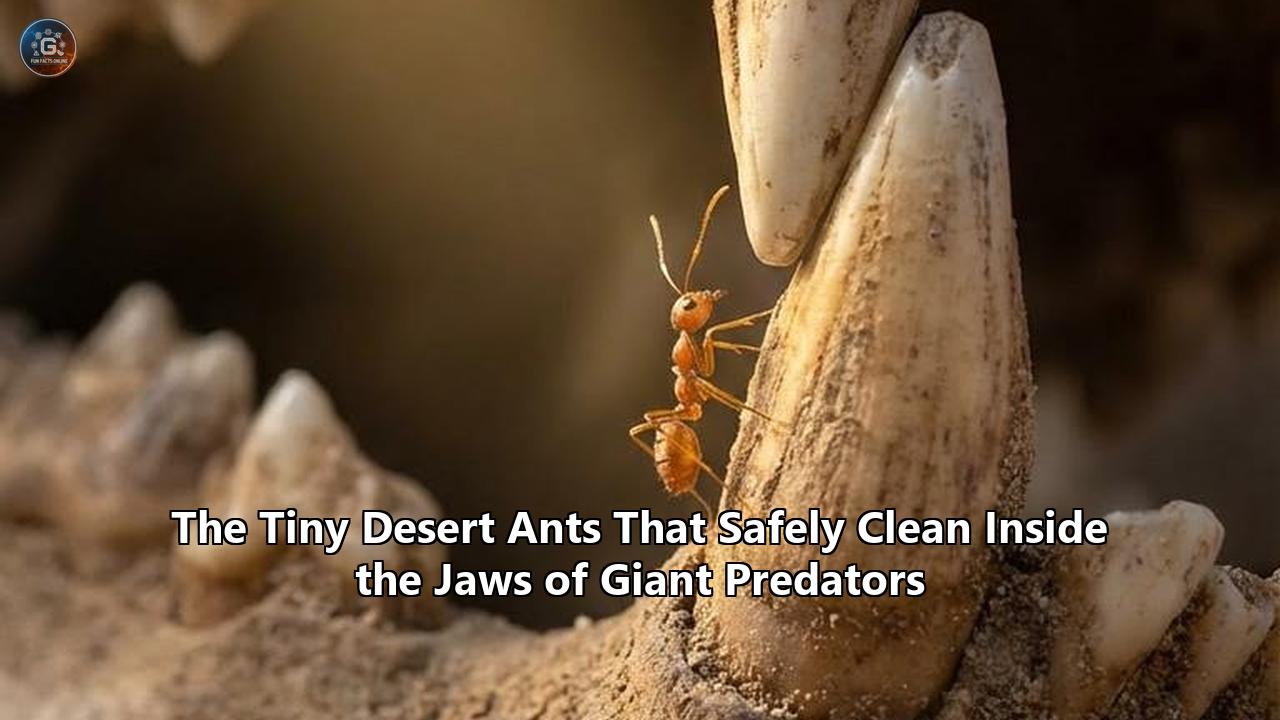
During a mid-April 2026 field expedition to the Chiricahua Mountains of southeastern Arizona, entomologists recorded 90 distinct instances of a previously undocumented biological exchange: tiny cone ants (Dorymyrmex) actively foraging inside the gaping, serrated mandibles of massive harvester ants.
Published this week in the journal Ecology and Evolution, the dataset reveals an extreme asymmetry in this interaction. The host insects, potentially dangerous harvester ants, possess bite forces capable of generating peak kinetic energy over 300 times their body weight. Yet, instead of snapping their jaws shut on the vulnerable cone ants, the massive insects adopt a rigid, defensive-free posture, allowing up to five of the smaller ants to systematically groom their carapaces and the interior of their open mouths.
The duration of these encounters ranges strictly between 15 seconds and just over 300 seconds. Entomologist Mark Moffett, a research associate at the Smithsonian’s National Museum of Natural History who documented the phenomenon, noted that the smaller ants use their tongue-like mouthparts to "squeegee" microscopic, calorie-rich debris from the larger insects.
"This new ant species is the insect equivalent of cleaner fish in the ocean," Moffett reported. "The potentially dangerous harvester ants even permit the visitors to groom between their open jaws."
The data isolates a rare terrestrial analog to the marine cleaning stations utilized by apex predators like sharks and moray eels, where smaller organisms remove dead skin and parasites without triggering a predatory response. By mapping the precise timelines, chemical exchanges, and biomechanical risks involved, researchers are now constructing a quantitative model of how such extreme trust operates in one of North America's harshest ecosystems.
Behavioral Mechanics and the Cleaning Protocol
The protocol initiating this mutualistic exchange is rigidly structured and statistically predictable. According to the field observations, 100% of the documented interactions began with the larger harvester ant voluntarily approaching the nest of the cone ants.
Upon arrival, the host ant enters a state of controlled catalepsy. The positioning requires the harvester to extend its legs to maximum height, lifting its thorax away from the soil surface, and locking its serrated mandibles in a wide-open position.
Response times from the cone ant colony are measurable and swift. In 82% of the recorded events, the first cleaner ant emerged from the nest and initiated contact within 60 seconds of the host assuming the pose. The number of cleaners simultaneously servicing a single host scales with the duration of the visit, maxing out at five cone ants during the longest five-minute sessions.
The cleaning process is highly localized. High-resolution macrophotography analysis indicates the cone ants distribute their grooming efforts unevenly across the host's body:
- Mandibles and Oral Cavity: 45% of interaction time
- Thorax and Joint Crevices: 30% of interaction time
- Abdomen (Gaster): 15% of interaction time
- Antennae and Eyes: 10% of interaction time
Termination of the cleaning session is entirely controlled by the host. Once a threshold of grooming is reached, the harvester ant executes a sudden, high-frequency kinetic shake. This physical dismissal is forceful enough to break the cone ants' grip, occasionally flipping them upside down, signaling an immediate end to the interaction before the host returns to its standard foraging behavior.
The Biomechanical Threat Profile
To understand the evolutionary cost-benefit analysis of this behavior, the physical danger to the cone ants must be quantified. Harvester ants are heavily armored and structurally designed for crushing hard seeds and dispatching smaller arthropods.
While specific force metrics for the Arizona harvester species are currently undergoing secondary lab testing, comparative data from related large-mandible species provides a baseline for the threat level. For example, trap-jaw ants (Odontomachus) can close their mandibles in an average of 130 microseconds, reaching speeds up to 230 km/h (143 mph) and generating acceleration forces of 100,000 g. While harvester ants do not possess the same spring-loaded mechanism as trap-jaws, their bite force relies on dense adductor muscle fibers that produce sustained, crushing pressure easily capable of cleaving a cone ant's exoskeleton in a fraction of a second.
The thickness of a cone ant's cuticle averages just 4 to 6 micrometers. The puncture force required to breach this cuticle is mathematically negligible compared to the static bite force of a mature harvester ant. Consequently, the cone ant operates with a zero-margin for error. A single misfiring of the host's predatory or defensive instincts would result in immediate fatality for the cleaner. The fact that researchers observed zero fatalities or predatory strikes during the 90 recorded interactions indicates an overriding neurochemical or behavioral suppression mechanism at play.
Nutritional Economics and Caloric Yield
The primary driver for the cone ants appears to be caloric acquisition. Desert ecosystems operate on strict energetic budgets, where the caloric expenditure of foraging must be heavily outweighed by the nutritional yield.
Harvester ants spend their days traversing the desert floor, actively dismantling seeds and dragging organic material back to their subterranean granaries. This labor leaves them coated in microscopic particulate matter. Moffett’s research suggests the cone ants are harvesting these "dust-size morsels".
A quantitative breakdown of this debris reveals three primary nutritional components:
- Seed Endosperm Fragments: High in carbohydrates and lipids, providing immediate kinetic energy.
- Fungal Spores: Harvested inadvertently from the soil, offering trace minerals and proteins.
- Exudates and Biofilm: Secretions from the host ant's own body, likely containing amino acids.
If a single cone ant ingests 0.05 milligrams of this concentrated debris during a five-minute cleaning session, the energetic density of the material (estimated at 5-7 calories per gram) provides a highly efficient return on investment. Furthermore, by waiting at the entrance of their own nest for the food to be delivered to them via the host's body, the cone ants reduce their foraging distance to zero. This eliminates the metabolic cost of long-distance navigation and drastically cuts their exposure to solar radiation and independent predators.
Cuticular Hydrocarbons and Chemical Camouflage
In the Formicidae family, visual processing is secondary to chemical communication. Ants rely on complex blends of cuticular hydrocarbons (CHCs) coating their exoskeletons to distinguish nestmates from hostile invaders. An intrusion by a foreign species typically triggers an immediate alarm pheromone cascade, resulting in aggressive swarming.
The mechanism allowing desert ants cleaning predators to bypass these hardwired defensive triggers represents a highly specialized chemical adaptation. While the exact CHC profiles of the Chiricahua cone ants are currently undergoing Gas Chromatography-Mass Spectrometry (GC-MS) analysis, historical data on ant symbiosis offers two probable pathways.
The first is chemical mimicry, where the cone ants actively synthesize the specific hydrocarbon chains of the harvester ants, effectively cloaking themselves as recognized entities. However, given that multiple harvester ants from different colonies may visit a single cleaning station, synthesizing a universal "friendly" scent is metabolically expensive and genetically complex.
The second, more statistically probable pathway is chemical insignificance. The cone ants may lack a distinct chemical signature altogether, rendering them practically invisible to the host's olfactory receptors. When combined with the deliberate, non-aggressive tactile feedback of their licking and nibbling, this chemical blank slate prevents the harvester ant's threat-detection neurons from firing, allowing the extreme physical proximity required for the symbiosis. Furthermore, Moffett noted that the cone ants were solely interested in living hosts, completely ignoring frozen harvester ant specimens placed near their nests, proving that the interaction requires active biological feedback, not just static chemical cues.
Pathogen Load Reduction and Host Benefits
While the caloric benefit to the cleaner ants is measurable, the return on investment for the host requires complex ecological modeling. What evolutionary pressure drives a large, heavily armored insect to halt its foraging, expose its most vulnerable joints, and expend valuable time waiting to be groomed?
The leading hypothesis centers on the mitigation of ectoparasites and fungal pathogens. In desert microclimates, soil-dwelling mites and entomopathogenic fungi (such as Beauveria bassiana or Metarhizium) act as primary vectors for colony collapse. Harvester ants, with their highly textured exoskeletons and deep joint crevices, are particularly susceptible to microscopic hitchhikers that their own grooming appendages cannot reach.
By exposing their mandibles and neck joints to the cone ants, the harvesters receive a level of micro-sanitation that extends their lifespan. If the cleaning reduces fungal spore loads by even 15-20%, the statistical probability of a pathogen infiltrating the harvester's primary nest is drastically lowered. This form of preventative medicine scales up exponentially; a single worker ant operating at peak efficiency without the metabolic drain of fighting an infection directly contributes to the overall reproductive output of the host colony.
Thermal Constraints of the Chiricahua Environment
The environmental parameters of the Chiricahua Mountains play a critical role in structuring this behavior. Extreme thermal stress dictates the metabolic and temporal limits of desert insects. During peak sunlight hours in April, soil surface temperatures in this region can rapidly escalate beyond 45°C (113°F).
Desert ants frequently utilize a strategy called thermal windowing, restricting their above-ground activities to narrow timeframes when temperatures are survivable but hot enough to suppress the activity of cold-blooded predators like lizards.
The cleaning interactions observed in Arizona must fit precisely within these thermal windows. A five-minute stationary cleaning session under direct solar radiation subjects the host ant to significant heat accumulation. The host's decision to break off the interaction via shaking may not just be a response to being sufficiently clean, but a critical thermal threshold being reached. If core body temperatures approach 50°C (122°F), critical critical thermal maximum (CTmax) is triggered, leading to loss of motor control and eventual death. The timing of the cleaning sessions—15 to 300 seconds—aligns directly with the established heat-sink capacities of similarly sized desert arthropods.
Comparative Mutualism: The Marine Equivalent
To contextualize the data, entomologists are drawing direct comparisons between the Arizona site and marine cleaning stations. In reef ecosystems, cleaner wrasses (Labroides dimidiatus) maintain dedicated territories where larger client fish—including predatory sharks and groupers—arrive specifically to have ectoparasites removed.
Marine biological market theory dictates that the cleaner organisms dictate the quality of service based on the value of the client. Wrasses have been documented offering preferential treatment (longer, more thorough cleaning) to larger, more dangerous clients to ensure their own survival and to extract the maximum caloric value from the heavy parasite loads.
The dynamics of desert ants cleaning predators appear to follow a parallel algorithm. The harvester ants act as the "client fish," arriving at a fixed spatial coordinate (the cone ant nest) and adopting a recognizable posture to signal non-aggression. The cone ants operate as the "cleaner wrasses," managing a queue of clients and extracting biological material. The presence of this exact economic exchange across entirely separate phylogenetic trees and environments confirms that cleaning mutualism is a highly convergent evolutionary strategy, driven by universal mathematical principles of energy exchange.
Evolutionary Timelines and Biological Market Theory
The emergence of this behavior offers a distinct timeline for behavioral evolution in the Formicidae family. Ants diverged from their wasp ancestors roughly 140 million years ago, with extreme morphological specializations appearing in the fossil record around 100 million years ago. However, complex mutualism—such as the agricultural farming of fungi by leafcutter ants or the protective herding of honeydew-producing aphids—developed much later as ecosystem pressures forced inter-species reliance.
The specific interaction observed by Moffett likely originated as an opportunistic scavenging behavior. Early iterations of cone ants may have foraged near the refuse piles of larger ant colonies, picking up discarded seed husks. Over thousands of generations, this proximity bred tolerance. The transition from scavenging dead material off the ground to actively cleaning living material off a stationary host represents a shift from commensalism (where one benefits and the other is unaffected) to obligate or facultative mutualism.
Biological market theory applies perfectly here: the cone ants are providing a service (cleaning) in exchange for a commodity (food). As long as the market remains stable—meaning the host does not begin eating the cleaners, and the cleaners do not begin parasitizing the host (e.g., feeding on hemolymph instead of debris)—the interaction remains evolutionarily viable.
Experimental Validation and Ecological Modeling
Moving from field observation to controlled data extraction requires isolating the specific variables of the exchange. Future models quantifying desert ants cleaning predators will need to track the energetic flow using isotopic labeling.
By introducing stable isotopes (such as Carbon-13 or Nitrogen-15) into the primary food sources of the harvester ants, researchers can track the exact molecular transfer of these isotopes into the bodies of the cone ants. This will provide hard data on exactly what percentage of the cone ant's total dietary intake is provided by the cleaning sessions.
Additionally, exclusion experiments will measure the direct health benefits to the host. By physically preventing harvester ants in a test plot from accessing the cone ant cleaning stations, scientists can monitor the subsequent accumulation of cuticular pathogens and compare the mortality rates against a control group that maintains access to the cleaners. If the exclusion group shows a statistically significant increase in mite infestations or fungal mortality, the obligate nature of the mutualism will be confirmed.
Upcoming Milestones in Myrmecology
The April 2026 publication serves as a baseline, but the documentation of this behavior triggers a cascade of immediate research priorities. Field teams are already preparing for the summer active season in the Sonoran and Chihuahuan deserts to determine the geographic distribution of this symbiosis.
Key milestones to watch for in the coming months include:
- Taxonomic Identification: The exact species of the Dorymyrmex cone ant involved remains unidentified. DNA barcoding will determine if this is a hyper-localized endemic species or a widely distributed phenotype.
- Chemical Assays: The publication of the GC-MS data detailing the cuticular hydrocarbon profiles of both species will clarify the exact mechanism of chemical pacification.
- Cross-Species Trials: Researchers will test whether these cone ants will clean other large desert arthropods, or if the behavior is strictly limited to harvester ants.
The mathematical precision required for two vastly different insect species to negotiate a peaceful exchange of services—especially one involving the interior jaws of a heavily armored scavenger—highlights a sophisticated level of ecological networking previously reserved for vertebrate ecosystems. As climate pressures increase thermal and pathogen stress on desert invertebrates, tracking the resilience of these microscopic biological markets will provide critical data on the limits of evolutionary adaptation.
Reference:
- https://www.eurekalert.org/news-releases/1123748
- https://www.sciencedaily.com/releases/2026/04/260414075641.htm
- https://www.discovermagazine.com/small-ants-observed-cleaning-large-ants-in-the-arizona-desert-a-new-behavior-in-insects-48967
- https://www.quora.com/What-do-trap-jaw-ants-eat
- https://www.ant-shack.com/blogs/ant-articles/ant-colony-symbiosis-the-mutualistic-relationships-in-ant-societies
- https://pmc.ncbi.nlm.nih.gov/articles/PMC1685857/
- https://www.antnest.co.uk/symbiosis-in-ants/