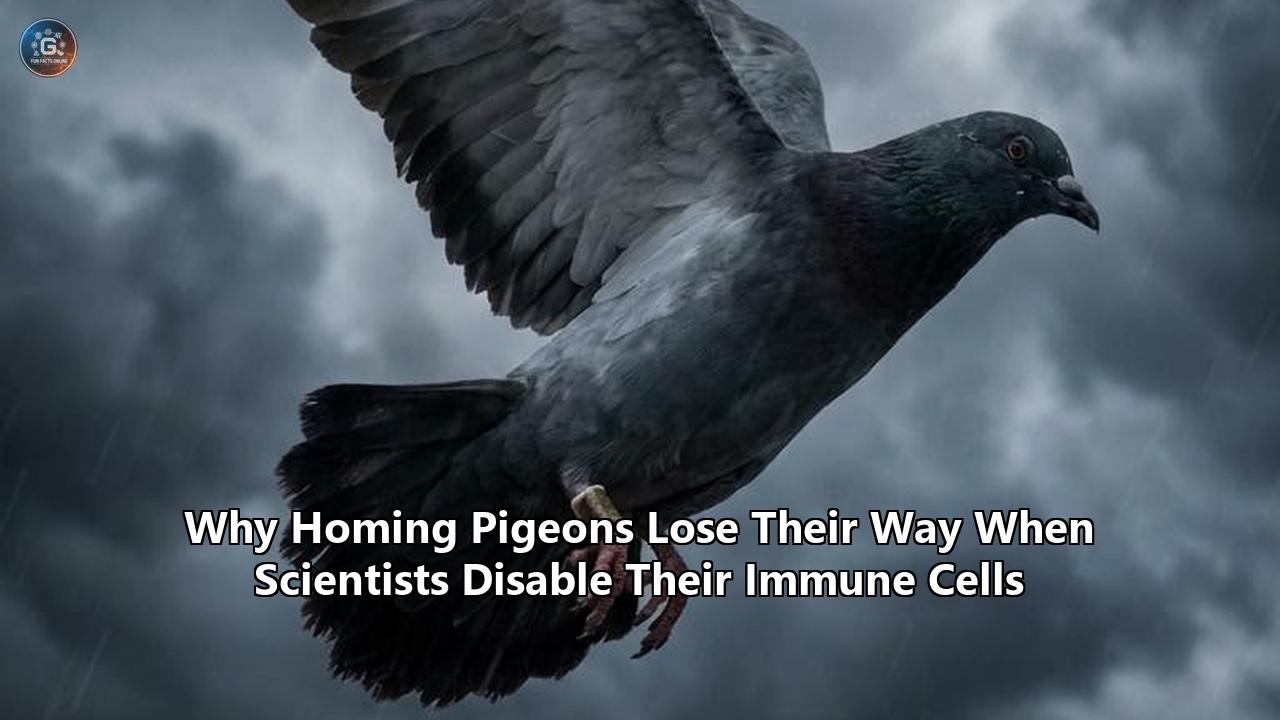
On May 28, 2026, a groundbreaking study published in the journal Science solved one of biology’s most enduring mysteries, revealing that the key to how homing pigeons navigate when the sun is hidden lies not in their eyes or their beaks, but deep within their livers.
For decades, researchers had searched for the physical "compass" that allows migratory and homing birds to detect the Earth’s weak magnetic field. The new research, conducted by an interdisciplinary team from the Max Planck Institute of Animal Behavior, the University of Bonn, and the University of Duisburg-Essen, demonstrated that specialized, iron-laden immune cells called macrophages in the pigeon’s liver act as dynamic magnetic sensors.
When researchers chemically disabled these specific immune cells, the results were stark: the pigeons completely lost their sense of direction under overcast skies. This discovery not only resolves a century-old debate but also introduces a startling concept to the biological sciences—that the immune system can serve as a primary sensory organ, bridging the gap between internal bodily defense and external physical navigation.
The Konstanz Experiments: A Scrambled Backup Compass
To prove that liver macrophages function as an internal magnetic compass, the research team, led by cell biologist Clivia Lisowski and immunologist Christian Kurts from the University of Bonn, alongside ornithologist Martin Wikelski from the Max Planck Institute, devised a elegant behavioral experiment in Konstanz, Germany.
The scientists trained a group of 34 homing pigeons to return to their home aviary from a release site located approximately 19 kilometers away. Homing pigeon navigation is known to rely on a hierarchical multi-sensory system. When the sky is clear, pigeons prefer to use a "time-compensated sun compass," tracking the sun's position throughout the day and adjusting their flight path relative to their internal circadian clock. They only activate their magnetic compass as a critical backup system on overcast days when the sun is completely obscured by clouds.
                    [ Clear Skies ]
                           │
             Uses Time-Compensated Sun Compass
                           │
                   Navigates Successfully
                           │
                ┌──────────┴──────────┐
                ▼                     ▼
         [ Control Birds ]    [ Macrophage-Depleted ]
         Navigated Home        Navigated Home

  ────────────────────────────────────────────────────────

                    [ Overcast Skies ]
                           │
             Switches to Magnetic Compass
                           │
                ┌──────────┴──────────┐
                ▼                     ▼
         [ Control Birds ]    [ Macrophage-Depleted ]
         Navigated Home        Flew Erratically / Lost
         (Using Liver Cells)   (Until Sun Reappeared)
The researchers waited for a period of heavy, unbroken cloud cover. Twenty-four hours before releasing the birds, they treated half of the flock with liposomes containing clodronate—a drug that is selectively engulfed by macrophages, triggering their programmed cell death (apoptosis) and reducing the population of iron-rich liver macrophages by approximately 80 percent. The remaining half of the flock received a harmless control injection.
Both groups of birds were released with high-precision GPS trackers attached to their backs. The results were immediate and conclusive:
- The Control Pigeons: Navigated with their usual precision, finding the correct bearing almost instantly and returning safely to the aviary in about 70 minutes.
- The Macrophage-Depleted Pigeons: Flew erratically in scattered, chaotic directions. They were unable to establish a homeward heading and remained lost across the German countryside.
- The Sunny Day Control: When the same macrophage-depleted pigeons were released on a bright, cloudless day, they flew directly home without delay, proving that the clodronate treatment had not impaired their physical strength, vision, or general motivation to fly. It had only disrupted their ability to sense the Earth's magnetic field.
The Great Beak Debate and the Irony of the 2012 Dismissal
To understand why this discovery has sent shockwaves through the scientific community, one must look at the history of magnetoreception research. For decades, the search for the avian magnetic sensor was defined by intense debate and high-profile retractions.
In the early 2000s, several prominent papers claimed to have found the elusive magnetic sensor in the upper beak of homing pigeons. Researchers reported finding six bilateral clusters of iron-rich, magnetite-containing nerve endings (trigeminal afferents) that supposedly sent magnetic signals directly to the brain. This "beak-sensor" theory became the established dogma in textbooks, heavily relied upon by both behavioral biologists and physicists.
However, in 2012, a meticulous study published in Nature, led by neuroscientist David Keays (then at the Institute of Molecular Pathology in Vienna), systematically dismantled this hypothesis. Keays and his team used advanced 3D imaging to show that these iron-rich cells in the pigeon beak were not sensory neurons at all. Instead, they were macrophages—specialized white blood cells that happen to accumulate iron while recycling old red blood cells.
At the time, Keays famously declared that macrophages were "unlikely to be involved in magnetic sensing" because they are not excitable cells, meaning they cannot generate the electrical action potentials required to send signals to the nervous system. He argued that the iron in these cells was merely cellular waste, and concluded that the search for the true magnetic sensor had to start over.
The 2026 Science study brings this historical debate to a highly ironic resolution. Keays was entirely correct that the iron-rich cells were macrophages, but he was wrong to dismiss them as sensory candidates. The issue was that scientists were looking in the wrong organ. While some iron-rich macrophages are scattered throughout the beak and spleen, they exist in their highest density and most organized state within the liver—the body's primary filtration and iron-recycling organ.
How it Works: The Quantum Physics of the Liver
The mechanism of this liver-based compass is a masterclass in biological engineering, combining cellular physiology, quantum physics, and neurology.
Step 1: The Accumulation of Iron Nanoparticles
Red blood cells (erythrocytes) have a limited lifespan. When they wear out, liver-resident macrophages (known as Kupffer cells) engulf and destroy them. A key byproduct of this breakdown is iron, which is retrieved from the hemoglobin molecules.
Instead of merely storing this iron as amorphous waste, the liver macrophages of homing pigeons organize it into highly structured, crystalline iron oxide nanoparticles. These nanoparticles exhibit a physical property known as superparamagnetism.
[ Worn-out Red Blood Cell ]
            │
            ▼ (Engulfed by Liver Macrophage)
[ Heme Iron Extraction ]
            │
            ▼ (Crystallization into Nanoparticles)
[ Superparamagnetic Oxide Nanoparticles ]
            │
            ▼ (Exposed to Earth's Magnetic Field)
[ Mechanical Alignment / Torque ]
            │
            ▼ (Physically Presses/Pulls Membrane)
[ Hepatic Nerve Fiber Contact ]
            │
            ▼ (Electrical Signal Fired)
[ Sensory Information Sent to Brain ]
Step 2: The Superparamagnetic Compass
Unlike ferromagnetism (the permanent magnetism found in a standard bar magnet), superparamagnetism only occurs in extremely small nanoparticles. In this state, the magnetic moments of the nanoparticles randomly flip direction under the influence of temperature, meaning the cells do not remain permanently magnetized in the absence of an external field.
However, when exposed to an external magnetic field—such as the Earth's geomagnetic field—the nanoparticles instantly align with the field lines, becoming strongly magnetized and creating a localized physical force. Because these nanoparticles are suspended inside the flexible, fluid membrane of the macrophage, their alignment with the Earth's magnetic field lines exerts a subtle mechanical torque (a twisting or pulling force) within the cell.
Step 3: The Neural Relay
How does a non-excitable immune cell transmit this mechanical force to the brain? This was the missing puzzle piece that had prevented scientists from considering macrophages as sensory receptors for over a decade.
Using ultra-high-resolution electron microscopy, Clivia Lisowski and her team discovered that these iron-rich macrophages in the pigeon liver are not floating freely. Instead, they are locked in direct, stable physical contact with a dense network of hepatic nerve fibers.
When the pigeon flies and changes direction relative to the Earth's magnetic field, the superparamagnetic nanoparticles inside the macrophages shift, dragging against the cell membrane. This physical movement applies localized mechanical pressure directly onto the touching hepatic nerve fibers. The nerve fibers, which are packed with mechanosensitive ion channels, translate this physical pressure into electrical impulses that travel up the vagus or sympathetic nerve pathways directly to the bird’s brain, providing a continuous, real-time compass heading.
The Coffee Break Eureka Moment
This discovery was not the result of a single targeted experiment, but rather an accidental, cross-disciplinary eureka moment that occurred more than ten years ago.
Immunologist Christian Kurts of the University of Bonn was attending an academic conference, sitting at a coffee table with ornithologist Martin Wikelski of the Max Planck Institute. Kurts, frustrated by a recurring technical problem in his immunology lab, was complaining that whenever he tried to separate different types of immune cells from mouse spleens and livers using specialized magnetic separation columns, the macrophages would consistently stick to the magnetic columns, ruining his experiments.
The macrophages stuck because they were packed with iron recycled from red blood cells.
Wikelski, whose life’s work revolved around tracking migratory animals and solving the mystery of animal navigation, had a sudden realization. If macrophages naturally possess enough magnetic properties to stick to laboratory magnets, could they be sensitive enough to align with the Earth’s magnetic field inside a living animal?
This conversation sparked a decade-long collaboration, bringing together immunologists to study cell biology, physicists (such as Ulf Wiedwald from the University of Duisburg-Essen) to analyze the superparamagnetic properties of the cells, and ornithologists to conduct field trials with GPS-tracked homing pigeons.
Who Is Affected? The Paradigm Shifts in Science
The revelation that liver macrophages act as the primary magnetic compass has profound implications that extend far beyond the study of homing pigeon navigation. It fundamentally challenges long-held assumptions across several major scientific disciplines.
| Stakeholder / Field | Old Paradigm | New Paradigm | Impact |
|---|---|---|---|
| Sensory Neurobiologists | Sensory perception is restricted to specialized, dedicated cranial organs (eyes, ears, nose). | Visceral, internal organs can house primary environmental sensors via immune-neural connections. | Forces a rewrite of textbooks regarding how animals interact with their physical environment. |
| Immunologists | Macrophages are strictly defense cells, limited to pathogen destruction and tissue debris clearance. | Macrophages are multi-functional agents capable of sensory transduction and environmental mapping. | Opens up the brand-new field of "sensory immunology" or "quantum immunology". |
| Ecologists & Conservationists | Migration disruption is primarily caused by habitat loss or light pollution. | Navigational failure can be caused by immune stress, iron disorders, or chemical exposure affecting the liver. | Shifts conservation strategies to monitor internal bird health and liver function to prevent migration collapse. |
| Aerospace & Tech Engineers | Drone/vehicle navigation must rely on external satellites (GPS) or heavy, active electronic sensors. | High-sensitivity, passive, solid-state navigation can be modeled on superparamagnetic cell networks. | Drives development of un-jammable biomimetic navigation systems for defense and exploration. |
Systematic Structural Changes: Redefining Sensory Biology
The structural changes prompted by this study are rewriting the rules of sensory biology. Traditionally, the scientific community viewed the immune system and the sensory nervous system as two entirely separate entities that only communicated during times of illness or injury (such as when inflammation causes pain).
The discovery of the liver-based compass merges these two systems into a unified regulatory and sensory network.
1. From "Cranial-Centric" to "Visceral" Sensing
For over a century, the primary dogma of homing pigeon navigation was that the bird's head was the sole seat of navigation. Scientists focused on light-sensitive cryptochrome proteins in the retina of the eye (which allow birds to "see" the inclination of magnetic field lines) and assumed that any physical compass must also reside near the brain.
By shifting the locus of magnetoreception to the liver, this study establishes the concept of "visceral sensing." The liver, long viewed as a quiet, metabolic workhorse, is now recognized as a highly sensitive sensory interface. This validates the colloquial concept of a "gut feeling" or an internal bodily sense of direction, proving it has a demonstrable, physical basis in the abdomen.
  [ Old Paradigm: Cranial-Centric ]

        Retina (Cryptochromes) ───────┐
                                      ▼
        Upper Beak (Magnetite) ───► BRAIN ───► Navigational Output

  ==================================================================

  [ New Paradigm: Visceral / Systemic ]

        Retina (Cryptochromes) ───────┐
                                      │
        Liver (Macrophages) ──────────┼───► BRAIN ───► Navigational Output
        (Primary Backup Compass)      │
                                      │
        Spleen / Other Organs? ───────┘
2. The Birth of "Quantum Immunology"
The study represents the first documented case where quantum-level physical phenomena (superparamagnetic alignment of iron-oxide nanoparticles) are harnessed by the immune system to dictate macro-level animal behavior. This convergence of quantum physics, cell biology, and behavioral ecology marks the birth of a new field of research: quantum immunology. Researchers in this field will study how sub-cellular, quantum-sensitive structures within immune cells interact with global physical forces to regulate systemic physiological states.
Short-Term Consequences: Intense Debate and the Race to Replicate
The immediate fallout of this study is characterized by intense debate, a rush to replicate the findings, and several unresolved scientific questions.
The Redundancy Argument: One Compass or Many?
While the Science paper presents direct, compelling evidence that liver macrophages are essential for navigation under overcast skies, outside experts caution against declaring the mystery entirely solved.
Commenting on the study in an accompanying editorial in Science, veterinary pathologist Simon Spiro of the London Zoo and biologist Hal Drakesmith of Oxford University suggested that animal navigation is highly redundant. They point out that homing pigeons may use a combination of different techniques depending on the task.
For example, cryptochromes in the eye might act as an "inclination compass" to help the bird determine its latitude, while the liver macrophages might function as an "intensity map" or a secondary directional compass.
"It's highly likely that this magnetic puzzle doesn't have a single, simple answer," Spiro and Drakesmith wrote. "Birds could use different physical techniques to sense magnetic fields depending on whether they are traveling thousands of kilometers across continents or finding a specific loft a few miles away".
The Mapping of the Neural Pathway
Another critical short-term focus is identifying the exact neural pathway that connects the liver macrophages to the brain. Susanne Åkesson, an animal ecologist at the University of Lund in Sweden who was not involved in the study, noted that while the visual contact between the macrophages and nerve fibers is clear, we must still prove how those signals are integrated into the brain.
"Next, we need to know how these cells transfer information to the nervous system, which specific nerves are firing during flight, and which brain areas are receiving and processing these visceral magnetic signals," Åkesson said.
Teams of neurophysiologists are already preparing to perform electrophysiological recordings on the vagus and splanchnic nerves of flying pigeons to capture these magnetic signals in real-time.
Long-Term Consequences: Medicine, Ecology, and Technology
Looking further into the future, the implications of this discovery could yield transformative advancements in medicine, environmental protection, and human technology.
1. Ecological and Conservation Implications
If homing pigeon navigation is fundamentally tied to liver health and iron metabolism, this radically changes how we assess the impact of environmental pollution on wildlife.
- Heavy Metal and Chemical Pollution: Many industrial pollutants and heavy metals (such as lead, cadmium, and mercury) accumulate preferentially in the liver, disrupting macrophage function and iron storage. A bird exposed to sublethal levels of heavy metals might appear healthy in a laboratory cage, but its liver-resident macrophages could be severely damaged, rendering it unable to navigate during its annual migration.
- Electromagnetic Pollution: The rise of high-frequency electromagnetic fields (EMFs) from communication towers, power lines, and urban infrastructure could theoretically interfere with the delicate, superparamagnetic nanoparticles inside liver macrophages. If human-made EMFs alter the magnetic alignment of these nanoparticles, they could effectively blind migratory birds and other animals on cloudy days, leading to massive, unexplained detours or migratory failures.
2. Biomedical Breakthroughs: Do Humans Have a Magnetic Sense?
One of the most provocative long-term questions raised by the study is whether other animals—including humans—possess a similar, liver-based magnetic compass.
Like pigeons, mammals (including mice and humans) have liver-resident macrophages (Kupffer cells) that are constantly engulfing senescent red blood cells and recycling iron. During this process, human macrophages also accumulate significant amounts of iron.
While humans are not known to consciously navigate using magnetic fields, there is a long-standing, controversial body of research suggesting that human physiology and brain activity can be subtly influenced by geomagnetic storms and electromagnetic fields.
If human liver macrophages also house superparamagnetic nanoparticles that sit adjacent to hepatic nerves, it could provide a concrete, physical mechanism explaining how external electromagnetic forces might register within the human nervous system. This could lead to a reappraisal of environmental health standards regarding EMF exposure and inspire new therapeutic interventions for neurological and immunological disorders.
3. Next-Generation Biomimetic Navigation Tech
In the defense and aerospace sectors, there is an urgent demand for navigation systems that do not rely on global positioning system (GPS) satellites, which are highly vulnerable to jamming, spoofing, or destruction during conflicts.
The micro-architecture of the pigeon liver compass provides a perfect blueprint for next-generation, passive, solid-state navigation technology. By engineering synthetic, fluid-filled microfluidic chips containing superparamagnetic nanoparticle arrays coupled to highly sensitive piezoelectric sensors, engineers could create incredibly compact, un-jammable compasses.
These biomimetic sensors could allow autonomous drones, submarines, and spacecraft to calculate their position with extreme accuracy based entirely on localized anomalies in the Earth's magnetic field, operating completely independently of external satellite signals.
Unresolved Questions and Future Milestones
As the scientific community digests this monumental shift, several key milestones and unresolved questions will define the research landscape in 2027 and beyond:
- The Spleen and Other Organs: While the liver showed the strongest magnetic response in the study, iron-rich macrophages were also spotted in the spleen, beak, and other tissues. Do these other macrophage populations serve as secondary compasses, or do they play a different role in magnetic intensity mapping?
- Diet and Iron Intake: Does a bird's diet directly impact its navigation? Will pigeons raised on an iron-deficient diet fail to develop functional superparamagnetic nanoparticles, rendering them lost on overcast days? Conversely, could iron supplementation restore or enhance navigation in disoriented wild populations?
- Evolutionary Origins: Is this macrophage-based magnetic sense an ancient evolutionary trait shared by all vertebrates, or is it a highly specialized adaptation unique to avian flyers? Testing for similar macrophage-nerve interfaces in migratory fish (like salmon), reptiles (like sea turtles), and mammals (like bats) will be critical to mapping the evolutionary history of magnetoreception.
The Liver as the Map and the Compass
The discovery that homing pigeons navigate using iron-rich immune cells in their livers completely redefines our understanding of animal perception. It shatters the artificial barrier that science has long maintained between the immune system and the sensory nervous system, demonstrating that the body's defensive "garbage collectors" can double as a highly sophisticated, quantum-level navigation system.
As research teams worldwide race to map the neural pathways from the liver to the brain, test for this mechanism in other migratory species, and explore the technological applications of superparamagnetic sensors, one thing is clear: the age-old mystery of animal navigation has been blown wide open. The journey to understanding how animals find their way across our planet no longer points to the heavens, but to the quiet, vital workings of the inner body.
References
- --- Lisowski, C., et al. (2026). "Homing pigeon navigation relies on superparamagnetic macrophages under overcast conditions." Science. DOI: 10.1126/science.ady2486.
- --- AP News / Max Planck Institute of Animal Behavior. (2026). "Pigeons may navigate using their liver's immune cells, study suggests."
- --- Treiber, C. D., Keays, D. H., et al. (2012). "Clusters of iron-rich cells in the upper beak of pigeons are macrophages, not magnetosensitive neurons." Nature*, 484, 367–370.
Reference:
- https://www.ksl.com/article/51503797/pigeons-may-be-navigating-with-their-liver-study-suggests
- https://www.eurekalert.org/news-releases/1129314
- https://quantumzeitgeist.com/pigeons-lose-direction-liver-immune/
- https://spacedaily.com/d-a-remarkable-new-study-suggests-pigeons-may-navigate-using-their-liver-solving-a-decades-long-mystery-about-how-birds-find-their-way-home-across-hundreds-of-miles-by-pointing-to-an-organ-no/
- https://www.sciencenews.org/article/pigeon-navigation-iron-liver-cells
- https://www.youtube.com/watch?v=eQ-3JkgTo-U
- https://www.ucl.ac.uk/news/2012/apr/pigeons-homing-skill-not-down-iron-rich-beak-cells
- https://www.thehindu.com/sci-tech/science/pigeon-navigation-magnetic-sensors-in-beak-a-fallacy-says-study/article3304055.ece
- https://www.researchgate.net/publication/223976607_Clusters_of_iron-rich_cells_in_the_upper_beak_of_pigeons_are_macrophages_not_magnetosensitive_neurons
- https://www.sciencedaily.com/releases/2012/04/120411132059.htm
- https://www.popsci.com/environment/pigeon-liver-magnetic-field-navigate/
- https://www.mpg.de/26511515/pigeons-navigate-using-magnetic-sensors-in-their-livers
- https://pmc.ncbi.nlm.nih.gov/articles/PMC8171495/
- https://www.2news.com/news/national/pigeons-may-be-navigating-with-their-liver-study-suggests/article_e1218c35-a980-54cb-b2fe-a3e0f32cc836.html
- https://www.ft.com/content/27f061cc-881f-4883-98da-a20ff8c40cc1?syn-25a6b1a6=1