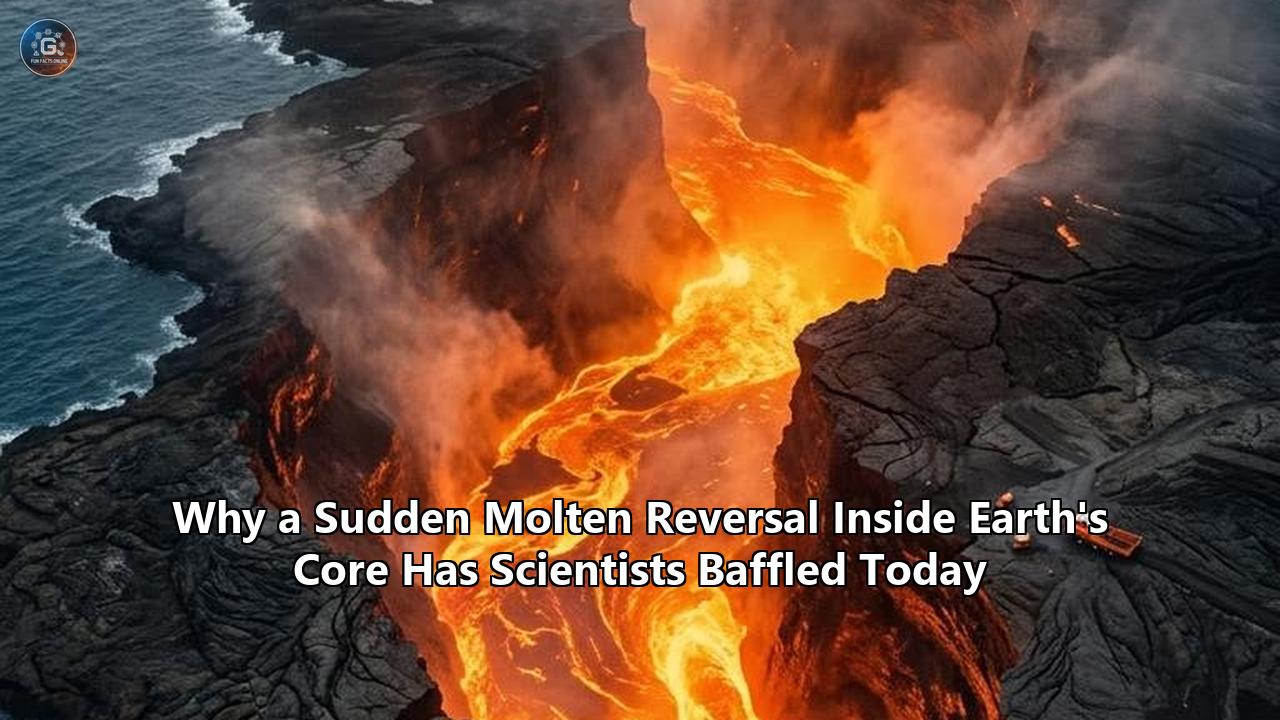
Deep beneath the equatorial Pacific, more than 2,200 kilometers below the rocky mantle where Earth’s solid crust gives way to a churning sea of liquid metal, something has shifted.
For centuries, the planetary engine that generates our protective magnetic shield was believed to grind along in a slow, predictable rhythm. The superheated, electrically conductive liquid iron-nickel alloy of the outer core was assumed to drift steadily westward, dragging the geomagnetic field along with it in a gradual, centuries-long cycle.
But in May 2026, a study published in the Journal of Studies of Earth's Deep Interior (jSEDI) upended these core assumptions.
Using nearly three decades of satellite data and ground-based magnetic observations, an international team of researchers discovered that a massive, regional current of molten iron beneath the Pacific Ocean did not just slow down—it completely reversed direction. In 2010, this subterranean river of metal abruptly abandoned its weak westward drift and began surging strongly to the east, peaking before beginning to ebb once more around 2020.
This sudden earth core molten reversal has left the scientific community scrambling for answers. It suggests that the deep interior of our planet is far more dynamic, volatile, and fast-evolving than anyone had previously modeled.
“The scale and speed of this reversal are entirely unexpected,” says Frederik Dahl Madsen, a geophysicist at the University of Edinburgh’s School of GeoSciences and lead author of the study. “We used to think of the outer core as a slow-moving, stable giant. Now we are realizing that its circulation can reorganize itself on a regional scale in just a single decade. It raises profound questions about the hidden connections between Earth’s deepest layers.”
Section 1: The Invisible Fingerprint: Mapping the Abyss from Orbit
To understand how scientists detected a major physical reversal 1,400 miles beneath our feet, one must first appreciate the scale of the engineering challenge.
+-------------------------------------------------------------+
|                     EARTH'S INTERNAL LAYERS                 |
|                                                             |
|   [ Crust ]  <-- 0 to 35 km (Our home)                      |
|                                                             |
|   [ Mantle ] <-- 35 to 2,890 km (Solid, hot rock)           |
|                                                             |
|================== CORE-MANTLE BOUNDARY =====================|  <-- Location of the Pacific Reversal
|                                                             |
|   [ Outer Core ] <-- 2,890 to 5,150 km (Molten Iron/Nickel) |  <-- 2,200 km Deep Molten Flow (Swirling Dynamo)
|                                                             |
|   [ Inner Core ] <-- 5,150 to 6,371 km (Solid Iron Sphere)  |  <-- "Backtracking" relative to Mantle
+-------------------------------------------------------------+
Humanity has never physically drilled deeper than the Kola Superdeep Borehole in Russia—a mere 12.2 kilometers (7.6 miles) deep, which barely scratches the planet's outer skin. We cannot drop probes into the outer core; any material we send would be instantly crushed by pressures exceeding 1.3 million atmospheres and melted by temperatures hovering around 5,000 degrees Celsius (9,000 degrees Fahrenheit).
Instead, geophysicists must rely on indirect diagnostics. Just as doctors use electrocardiograms to map the electrical activity of a patient’s heart from the surface of their skin, geophysicists use the planet’s magnetic field to map the motion of the liquid metal churning thousands of kilometers below.
To reconstruct the Pacific flow patterns, Madsen and his colleagues synthesized data from a constellation of Earth-orbiting satellites and ground stations spanning from 1997 to 2025. The crown jewel of this dataset was the European Space Agency's (ESA) Swarm mission—three identical satellites launched in 2013 that fly in highly coordinated orbits to measure the strength, direction, and variations of Earth's magnetic field with unprecedented precision. By subtracting the magnetic noise generated by solar winds, the ionosphere, the oceans, and magnetised crustal rocks, researchers isolated the "secular variation"—the slow, structural drift of the magnetic field generated purely by the deep geodynamo.
This secular variation acts as an invisible fingerprint of the liquid outer core. By applying a mathematical framework known as the "frozen-flux approximation"—which assumes that on timescales shorter than a century, the magnetic field lines are locked into the highly conductive liquid iron like threads in a moving fabric—the team was able to invert the magnetic satellite data to map the physical velocity of the fluid at the very top of the core.
The resulting velocity models revealed a startling anomaly. Underneath the equatorial Pacific, a massive current of iron-rich fluid had been drifting lazily westward at the start of the 21st century. But by 2010, the westward movement stalled. Within a matter of months, the current reversed, accelerating into a powerful eastward jet that peaked in intensity before starting to decelerate after 2020.
“When we looked at the inversion models, the signal was unmistakable,” Madsen explains. “In the Pacific, the flow didn’t just wiggle or slow down—it pulled a complete U-turn. For geophysicists who are accustomed to thinking of the core as a system that changes over centuries, seeing a structural flow reversal manifest in the span of a few years is incredibly jarring.”
Section 2: The Westward Drift Illusion: Shattering a Century of Geophysics
The discovery of the Pacific reversal strikes at the heart of one of modern geophysics' oldest dogmas: the concept of "westward drift."
In 1692, the famed astronomer Royal Edmund Halley—best known for calculating the orbit of the comet that bears his name—noticed something peculiar about Earth’s magnetic field. By comparing historical navigation charts from Portuguese, Spanish, and English sailors, Halley observed that the positions of magnetic declination (the angle between magnetic north and true geographic north) were slowly migrating westward over time. He hypothesized that Earth was made of concentric shells, and that an inner sphere was rotating slightly slower than the outer crust, causing the magnetic field to slip backward.
Over the next three centuries, as scientific instruments evolved from hand-held compasses to orbiting magnetometers, the reality of westward drift was confirmed. By the late 20th century, numerical geodynamo models had established a standard framework to explain this phenomenon: the eccentric planetary gyre.
                     HYPOTHETICAL CORE-SURFACE FLOW

            +-----------------------------------------------+
            |          North Polar Region                   |
            |                                               |
            |    <==== Westward Flow (Planetary Gyre) ====  |
            |                                               |
            |    Equatorial Zone                            |
            |    [====== Westward ====>] [==== Eastward ===]|
            |         (Normal)              (Reversal Zone) |
            |                                               |
            |    <==== Westward Flow (Planetary Gyre) ====  |
            |                                               |
            |          South Polar Region                   |
            +-----------------------------------------------+
According to this paradigm, the swirling of liquid iron in the outer core is not entirely chaotic. Instead, it is dominated by a massive, continent-sized loop of circulating material—a gyre—that is offset from Earth’s rotation axis. This planetary gyre acts as a steady conveyor belt, pushing the bulk of the core's surface fluid in a westward direction. Because the gyre was believed to be a permanent, stable feature driven by the deep thermal and compositional convection of the planet, geophysicists assumed that westward drift was a permanent, immutable characteristic of our world’s interior.
The equatorial Pacific, however, sits outside the main loop of this planetary gyre. Historically, flow models indicated that this region was a quiet zone, characterized by a weak, almost negligible westward drift. Because it was isolated from the main convective engine, scientists assumed that nothing of major consequence could happen there on a human timescale.
The 2010 event shattered this assumption. The rapid rise of a strong eastward current in the Pacific showed that the outer core's circulation is not a monolithic, static system dominated solely by a slow-moving global gyre. Instead, it is highly regionalized and capable of undergoing sudden, dramatic reorganizations.
“The Pacific has historically been a bit of an enigma in geomagnetism,” says Dr. William Brown, a researcher with the British Geological Survey who co-authored the jSEDI paper. “We used to think the weak westward drift there was just a quiet background state. But this earth core molten reversal demonstrates that the Pacific is actually a dynamic gateway where localized, intense forces can override the global westward flow. It tells us that our models of the geodynamo are missing some crucial, high-frequency physics.”
Section 3: The Synchronized Dance: Following the Seismic Trail
If the liquid outer core's sudden shift is the mystery, where do we look for the suspect?
To find the answer, geophysicists have had to follow an extraordinary evidence trail that leads even deeper into the planet—straight into the solid inner core, a moon-sized sphere of pure crystalline iron and nickel suspended at the very center of the Earth.
========================= THE EVIDENCE TRAIL =========================

   [2023: Peking University Study]
   - Analyzed seismic waves from deep earthquakes.
   - Discovered the solid inner core's rotation halted around 2009.
   - Inferred the beginning of a relative "backtracking" phase.
                |
                v
   [2024: USC & Chinese Academy of Sciences Study]
   - Used repeating earthquake doublets and Cold War nuclear test data.
   - Confirmed the solid inner core decelerated and backtracked in 2010.
   - Proved the inner core was moving slower than the mantle.
                |
                v
   [2026: Edinburgh & BGS Satellite Analysis]
   - Mapped the liquid outer core using ESA's Swarm satellites.
   - Discovered a sudden regional flow reversal in the liquid core in 2010.
   - Proved the outer core flow reversal was perfectly synchronized
     with the inner core's deceleration.
======================================================================
The realization that the inner and outer cores are locked in a complex, synchronized dance did not happen overnight. The first clues emerged in January 2023, when geophysicists Yi Yang and Xiaodong Song of Peking University published a landmark paper in Nature Geoscience.
By analyzing seismic shear waves from repeating earthquakes—seismic events that strike the exact same fault line years apart—Yang and Song tracked how long it took for earthquake vibrations to travel through the inner core to the other side of the globe. Because the inner core is anisotropic (meaning seismic waves travel faster along its structural grain in one direction than another), any rotation of the inner core relative to the mantle will cause the travel times of these repeating seismic waves to slowly change over the decades.
Yang and Song’s data revealed a stunning trend: from the 1970s through the mid-2000s, the inner core was "super-rotating"—spinning slightly faster than Earth’s mantle and crust. But around 2009, this differential spin ground to a near-halt. The inner core synchronized its rotation with the surface of the Earth and then began to slowly sub-rotate, meaning it was now spinning slower than the mantle. To an observer on the surface, it appeared as though the inner core had reversed its direction of motion, backtracking relative to the crust.
The scientific community was initially skeptical. Skeptics argued that the seismic data could be interpreted in other ways, such as localized changes on the surface of the inner core rather than a global slowdown of its rotation.
However, the skepticism began to dissolve in June 2024. A team led by John Vidale, Dean’s Professor of Earth Sciences at the University of Southern California (USC), and Wei Wang of the Chinese Academy of Sciences published an unambiguous confirmation of the inner core’s backtracking in the journal Nature.
Vidale and Wang utilized a highly specialized dataset of 121 repeating earthquakes recorded between 1991 and 2023 in the South Sandwich Islands. To calibrate their findings, they also dug up historic seismic data from twin Soviet nuclear tests conducted at the Novaya Zemlya test site in 1971 and 1974, as well as American and French nuclear test records.
“When I first saw the seismograms that hinted at this change, I was stumped,” Vidale recalled at the time. “But when we found two dozen more observations signaling the same pattern, the result was inescapable. The inner core had slowed down for the first time in many decades.”
Vidale’s study pinned the exact moment the inner core began to decelerate and backtrack to 2010—the identical year that Frederik Dahl Madsen's team identified as the onset of the sudden molten reversal in the outer core beneath the Pacific.
This synchronization is too precise to be a coincidence. It suggests a profound physical link between the liquid outer core and the solid inner core.
Section 4: The Physics of the Pull: Electromagnetic and Gravitational Tug-of-War
How do a solid metal sphere the size of the Moon and a churning, liquid outer core coordinate their movements across thousands of miles of pitch-black, high-pressure space?
The answer lies in a highly complex dynamical feedback loop governed by two fundamental physical forces: electromagnetic torque and gravitational coupling.
                 THE CORE-MANTLE DYNAMICAL LOOP

         +--------------------------------------------+
         |        Dense, Uneven Lower Mantle         |
         +--------------------------------------------+
                               ^
                               | (Gravitational Tug)
                               v
         +--------------------------------------------+
         |        Swirling Liquid Outer Core          |  <-- "Generates Magnetic Fields"
         +--------------------------------------------+
                               ^
                               | (Electromagnetic Drag)
                               v
         +--------------------------------------------+
         |         Solid Iron Inner Core              |  <-- "Backtracks relative to Crust"
         +--------------------------------------------+
Earth’s solid inner core is suspended inside the liquid outer core, structurally isolated from the rest of the planet. In theory, it is free to spin at whatever rate its environment dictates. However, it is subject to a constant tug-of-war.
On one side is the geodynamo itself. The liquid outer core is constantly generating massive electrical currents and magnetic fields. These intense magnetic fields penetrate the solid, highly conductive iron of the inner core, acting like an electromagnetic motor. This electromagnetic drag exerts a rotational torque on the inner core, either accelerating it (super-rotation) or decelerating it (sub-rotation) depending on the direction and strength of the liquid metal flow.
On the other side of the tug-of-war is the Earth's rocky mantle. The mantle is not a perfectly uniform sphere; it contains massive, dense gravitational anomalies—such as the Large Low-Shear-Velocity Provinces (LLSVPs) lying deep beneath Africa and the Pacific Ocean. Because the solid inner core is also slightly asymmetric, these heavy regions in the lower mantle exert a subtle but powerful gravitational pull on the inner core. This gravitational coupling acts like an elastic band, trying to lock the inner core in place and prevent it from rotating too far out of alignment with the mantle.
For several decades, the electromagnetic forces from the liquid outer core dominated, pulling the solid inner core along at a slightly faster speed than the rest of the planet. But as the inner core super-rotated, the "gravitational elastic band" connecting it to the mantle stretched tighter and tighter.
By 2009, the gravitational tension reached its limit. The gravitational pull of the mantle overcame the electromagnetic torque of the outer core, slowing the inner core to a halt and forcing it to begin backtracking.
The sudden deceleration of the solid inner core had immediate, violent consequences for the liquid outer core surrounding it. Because angular momentum must be conserved within the Earth's interior, the rapid deceleration of the solid inner core acted as a massive brake on the swirling liquid iron of the outer core.
This is where the Pacific Ocean enters the equation. The boundary between the core and the mantle is not smooth; it is a highly active thermal and chemical frontier. When the inner core slowed down, it triggered a series of massive, regional fluid-dynamic instabilities that rippled outward through the liquid outer core. Beneath the Pacific, where the core-mantle boundary is heavily influenced by the overlying dense mantle structures, these instabilities manifested as a localized fluid-dynamic collapse. The weak westward-drifting current was overwhelmed by these deep torsional waves, forcing the fluid to rapidly reverse direction and surge eastward.
“It’s a classic action-and-reaction scenario, but on a planetary scale,” says John Vidale. “The outer core’s magnetic field drags on the inner core, but gravity from the mantle pulls back. When the inner core finally gave in to that gravitational pull and slowed down in 2010, the resulting sloshing of the liquid iron was so severe that it completely reversed the regional flow beneath the Pacific. We are looking at a beautifully synchronized, planet-wide mechanical feedback loop.”
Section 5: A Looming Crisis for the Magnetic Shield?
Whenever scientists announce a sudden, unexpected change in Earth's core, the public reaction often veers toward the apocalyptic.
Visions of the 2003 science fiction disaster film The Core—in which the planet’s core stops rotating, causing the magnetic shield to collapse, microwave storms to fry cities, and birds to crash into walls—inevitably dominate online discourse.
How concerned should we be about the earth core molten reversal?
                     GEOMAGNETIC SHIELD INTEGRITY

   [ SOLAR WINDS ] ===>  \  /   \  /  <=== [ HARMFUL RADIATION ]
                          \/     \/
                     .----''.   .'`----.
                   .'       \  /        `.
                  /          \/           \
                 |     (  EARTH  )         |  <-- Magnetosphere remains
                 |      \       /          |      intact despite local
                  \      \     /          /       flow reversals.
                   `.     \   /         .'
                     `----.\_/.----'
To answer this, it is necessary to separate cinematic fantasy from geophysical reality. The magnetic field of the Earth is indeed our primary shield against the vacuum of space. Without it, the relentless stream of highly charged solar particles emitted by the Sun—the solar wind—would gradually strip away our atmosphere, rendering our planet as dry, cold, and barren as Mars.
Additionally, our modern, highly technological civilization is uniquely vulnerable to changes in the magnetosphere. A severely weakened magnetic field would expose our global satellite networks, GPS systems, commercial aviation routes, and electrical grids to devastating space weather events, leading to potential multi-trillion-dollar communication collapses.
However, geophysicists emphasize that the sudden regional flow reversal beneath the Pacific is not a harbinger of global magnetospheric collapse, nor does it mean a full magnetic pole reversal is imminent.
“The geodynamo is incredibly robust,” explains Dr. Elisabetta Iorfida, an ESA Swarm Mission Scientist who was not involved in the Edinburgh study but has closely monitored its findings. “What we are seeing is a regional, decadal-scale fluctuation. The global magnetic field is generated by convective currents spanning the entire 2,200-kilometer thickness of the outer core. A localized flow reversal at the very surface of the core beneath the Pacific changes the local shape and drift of the field, but it does not threaten to shut the entire dynamo down.”
That is not to say, however, that the reversal is without consequence.
While it poses no direct threat to human health or the climate, these rapid regional shifts can have significant, real-world impacts on human technology:
- Satellite Navigation and GPS: Global navigation systems rely on highly precise mathematical representations of Earth's magnetic field, such as the World Magnetic Model (WMM). When local currents in the outer core reverse, they alter the rate of magnetic drift at the surface. If these changes are not continuously tracked and updated, navigation systems can develop cumulative errors, affecting everything from commercial shipping lanes to autonomous military drones.
- Spacecraft and Satellite Operations: Rapidly shifting magnetic fields can alter the configuration of the magnetosphere, shifting the boundaries of radiation belts in near-Earth space. Satellites orbiting through these zones may experience unexpected electrostatic discharges, memory corruption, or sensor failures if their shielding is not calibrated to the shifting magnetic landscape.
- The South Atlantic Anomaly (SAA): For decades, scientists have watched a massive, growing "weak spot" in Earth's magnetic field stretching from South America to southern Africa. Known as the South Atlantic Anomaly, this region allows cosmic radiation to penetrate much closer to the surface, causing frequent computer glitches and instrument resets on satellites and the International Space Station. Some geophysicists hypothesize that localized flow reversals at the core-surface, similar to the one observed beneath the Pacific, are the primary mechanism behind the formation and growth of such anomalies.
Understanding the behavior of regional flow reversals is therefore critical for forecasting space weather and maintaining the integrity of our global communications infrastructure.
Section 6: The 70-Year Heartbeat: Oscillations and the Length of a Day
As scientists work to decipher the mechanics of the Pacific molten reversal, they are finding that the phenomenon may be part of a highly coordinated, planet-wide cycle that has been quietly beating for millennia.
In their 2023 paper, Yi Yang and Xiaodong Song proposed that the inner core’s rotation is not a continuous, one-way journey. Instead, they argued that the inner core operates like a giant, slow-motion pendulum, oscillating back and forth relative to the mantle.
According to their calculations, this pendulum completes a full cycle roughly every 60 to 70 years, reversing its relative direction of spin every 30 to 35 years.
The timeline of this proposed 70-year cycle matches historical observations with uncanny accuracy:
                  THE 70-YEAR INNER CORE CYCLE

     [ Early 1970s ]      [ Mid-1970s to 2000s ]       [ 2009 - 2010 ]
   Inner core rotation     Inner core rotates fast      Inner core rotation
     temporarily             relative to mantle           nearly pauses &
       pauses.               (Super-rotation).            begins backtracking.
          |                         |                           |
          v                         v                           v
     +---------+               +---------+                 +---------+
     |  PAUSE  | ============> |  SPIN   | ==============> | BACKTRACK|
+---------+ +---------+ +---------+- The Early 1970s: Seismic travel-time data from this era suggests that the inner core’s rotation relative to the mantle paused and reversed, similar to the event in 2009.
- The 1980s and 1990s: The inner core entered a phase of super-rotation, spinning faster than the mantle.
- The late 2000s (2009-2010): The inner core completed its fast-spinning phase, paused, and began backtracking once again.
This 70-year heartbeat does not just remain hidden deep underground. It leaves clear, observable marks on the surface of our planet—most notably in tiny, precise variations in the Length of Day (LOD).
Because Earth is a closed rotational system, its total angular momentum must be conserved. If the inner core slows down and the outer core experiences a major regional reversal, that lost angular momentum cannot simply vanish. It must be transferred to the overlying mantle and crust, causing the solid planet wrapped around the core to spin slightly faster. Conversely, when the inner core speeds up, it draws angular momentum back, causing the crust to spin slightly slower.
These variations are incredibly minute—on the order of a few thousandths of a second per day—and are easily masked by the much more chaotic, high-frequency "noise" generated by the sloshing of Earth's oceans and the movement of atmospheric winds.
Yet, when geophysicists analyze long-term, decade-scale LOD datasets using atomic clocks and satellite laser ranging, the 60-to-70-year oscillation emerges clearly out of the background noise. The length of a day was slightly longer in the early 1970s, shortened through the 1980s and 1990s as the core spun faster, and has begun to lengthen slightly again since 2010.
Even more intriguing, some scientists have pointed out that global mean sea levels and global average temperatures also exhibit subtle, unexplained 60-to-70-year oscillations that align with the core’s mechanical cycles. While researchers are quick to emphasize that these deep core variations are far too small to explain modern, human-driven global warming, the correlations suggest that the "boiler room" of our planet may have subtle, indirect pathways of influencing the surface environment that we are only beginning to comprehend.
Not everyone in the scientific community is convinced that this 70-year cycle is a clean, predictable pendulum, however.
"We have only been monitoring the core with high-precision seismic arrays and satellites for a few decades," says Dr. John Vidale. "While the evidence for the 2010 slowdown and the subsequent earth core molten reversal is incredibly solid, predicting that this is a perfectly periodic, 70-year cycle is still a big leap. The core could be a much more chaotic, turbulent system that fluctuates on many different timescales simultaneously. The next decade of observations will be absolutely critical to see if the core starts speeding up again as the 70-year model predicts, or if it does something completely different."
Section 7: The Core-Mantle Boundary: A Chemical Battlefield
The sudden reversal of the Pacific molten current has forced geophysicists to look closer at what is perhaps the most mysterious and complex region of our planet: the Core-Mantle Boundary (CMB).
                     THE CORE-MANTLE BOUNDARY (CMB)

           +--------------------------------------------+
           |                 MANTLE                     |
           |   (Solid, highly viscous silicate rock)    |
           +--------------------------------------------+
           |~~~~~~~~~~~~~~~~~~~~~~~~~~~~~~~~~~~~~~~~~~~~|  <-- Ultra-Low Velocity Zones (ULVZs)
           |   D'' Layer: Chemical reaction zone,        |      and massive thermal gradients.
           |   partial melting, iron-rich sediments.    |
           |~~~~~~~~~~~~~~~~~~~~~~~~~~~~~~~~~~~~~~~~~~~~|
           +--------------------------------------------+
           |               OUTER CORE                   |
           |      (Churning, liquid iron-nickel)        |
           +--------------------------------------------+
Located roughly 2,900 kilometers (1,800 miles) beneath the surface, the CMB is a region of extreme contrasts. It represents the sharpest transition zone on Earth—a boundary where solid silicate rock, which moves at the geologic pace of centimeters per year, meets liquid iron-nickel, which flows at speeds of tens of kilometers per year.
The temperature gradient across the CMB is staggering, dropping by as much as 1,500 degrees Celsius over a distance of just a few dozen kilometers.
Geophysicists increasingly view the CMB not as a simple, passive border, but as a highly active, chemical battlefield. Over billions of years, heavy iron-rich sediments from the mantle have slowly sunk to the bottom, while lighter elements from the core (such as oxygen, silicon, and sulfur) have floated to the top, forming a highly heterogeneous transition layer known as the D'' (D-double-prime) layer.
This D'' layer is filled with strange, colossal structures:
- Ultra-Low Velocity Zones (ULVZs): Massive, pancake-like patches of partially molten rock that slow down seismic waves by up to 30 percent.
- Mantle Plumes: Towering columns of hot, buoyant rock that rise from the CMB all the way to the surface, fueling volcanic hotspots like Hawaii and Iceland.
- Iron "Snow": Microscopic crystals of iron that freeze out of the outer core's fluid, slowly falling inward toward the inner core while lighter, buoyant liquid rises to the top.
It is within this chaotic D'' layer that the Pacific molten reversal is taking place.
The new satellite data reveals that the top of the outer core is not a simple, clean boundary where liquid iron slides smoothly beneath the mantle. Instead, the topography of the CMB—with its deep valleys, massive thermal gradients, and heavy gravitational anomalies—acts as a series of massive, subterranean "mountain ranges" that actively redirect, block, and channel the core's liquid currents.
The sudden reversal in 2010 suggests that these core-mantle interactions are far more dynamic than previously modeled. It is highly likely that a localized build-up of heat or chemical buoyancy beneath the Pacific reached a critical tipping point in 2010, triggering a sudden convective instability that forced the liquid iron to change course.
“This research raises intriguing questions about how Earth's deepest layers are dynamically connected,” says Madsen. “We can no longer study the inner core, the outer core, and the lower mantle as isolated systems. They are parts of a single, highly integrated thermal engine. What happens at the very center of our planet can ripple outward and trigger dramatic flow reorganizations thousands of miles away near the mantle boundary within just a decade.”
Section 8: Unifying the Core's Mysteries
As scientists attempt to construct a unified theory of Earth's interior, they are faced with a series of seemingly disparate geological mysteries that may all be pieces of the same puzzle.
By looking at how these phenomena overlap, we can begin to see the outline of a grand, interconnected system:
| Mystery | Observed Phenomenon | Proposed Connection to the Reversal |
|---|---|---|
| Inner Core Backtracking | Solid inner core slowed down and began moving slower than the mantle around 2010. | Deceleration reduced electromagnetic drag, triggering fluid instabilities in the outer core. |
| The Pacific Molten Reversal | A massive regional current of liquid iron reversed from westward to eastward flow in 2010. | Coincides precisely with the inner core's slowdown, representing the "sloshing" of conserved angular momentum. |
| Length of Day (LOD) Drift | Earth's rotation speed fluctuates on a 60-to-70-year cycle, with days lengthening since 2010. | Reflects the transfer of angular momentum between the decelerating inner core, the reversing outer core, and the mantle. |
| Geomagnetic Jerks | Abrupt, localized accelerations of the magnetic field occurring every few years. | Likely generated by fast-moving torsional waves triggered by sudden changes in regional core-surface flow. |
| South Atlantic Anomaly Growth | A massive, expanding weak spot in the magnetic field over South America and the Atlantic. | Driven by localized flow reversals and eddies at the core-surface, similar to the Pacific event. |
Section 9: What to Watch for Next
The discovery of the sudden molten reversal beneath the Pacific has opened an exciting new chapter in deep Earth science, but it has also raised more questions than it has answered.
As geophysicists look toward the future, several critical milestones and unresolved questions will dominate their research over the coming decade:
1. Will the Eastward Current Fade Entirely?
The latest data analyzed by Madsen's team through 2025 indicates that the powerful eastward current beneath the Pacific peaked around 2018 and has been steadily weakening since 2020.
Scientists will be watching closely to see if the flow continues to decay, eventually returning to its historical westward drift, or if it stabilizes into a new, long-term equilibrium. If the current reverses yet again, it will provide powerful confirmation of short-period, high-frequency oscillations in the geodynamo.
2. The Launch of Next-Generation Magnetic Satellites
Our ability to monitor these deep-core flows is entirely dependent on our eye in the sky: satellite magnetometry. ESA’s Swarm constellation, though incredibly successful, is aging.
Scientists are currently advocating for next-generation geomagnetic satellite missions equipped with advanced quantum magnetometers. These instruments will be capable of resolving even smaller, higher-frequency magnetic variations, allowing researchers to map deep-core eddies and torsional waves with unprecedented detail.
3. Reconciling Core Shape Changes with Rotation Rate
A study published in early 2025 in Nature Geoscience suggested that the inner core is not just rotating and backtracking—it is also actively changing its physical shape.
Due to the intense gravitational and thermal forces acting at the inner-core boundary, the solid iron sphere appears to be undergoing viscous deformation, flexing and squishing on a timescale of years. Geophysicists must now work to integrate these shape-shifting models with rotation rate models to understand how a deforming inner core influences the fluid dynamics of the outer core.
4. Advanced Supercomputer Geodynamo Simulations
As global supercomputing power continues to scale, numerical modelers are finally able to run geodynamo simulations that approach the true physical parameters of Earth's core.
Historically, simulations had to artificially inflate the viscosity of the liquid iron to make the equations solvable, resulting in highly damped, slow-evolving models. Next-generation, low-viscosity simulations will allow researchers to test whether gravitational and electromagnetic coupling can naturally produce the rapid, regional flow reversals observed in the Pacific.
The Dynamic Engine Beneath Our Feet
For centuries, humanity looked up at the stars, mapping the orbits of distant planets and the evolution of far-off galaxies, while remaining largely ignorant of the colossal, churning engine humming just a few thousand kilometers beneath our feet.
The sudden earth core molten reversal discovered beneath the Pacific Ocean is a stark reminder that our planet is not a static, dead rock, but a highly complex, dynamic, and interconnected living system.
The ground beneath our feet is moving, the heart of our planet is dancing, and the invisible shield that makes life on Earth possible is constantly being reshaped by forces we are only beginning to truly understand. As satellites continue to monitor the shifting magnetic winds from orbit and seismologists listen to the echoes of deep earthquakes, we can be certain of one thing: Earth's deep interior still has plenty of surprises left to reveal.
Reference:
- https://thedebrief.org/deep-inside-the-earths-molten-core-a-sudden-reversal-now-has-scientists-searching-for-answers/
- https://www.ed.ac.uk/news/mysterious-flow-of-earths-molten-core-revealed
- https://scitechdaily.com/scientists-baffled-by-a-sudden-reversal-deep-inside-earths-core/
- https://newatlas.com/physics/earths-outer-core-reversed-2010-scientists-may-know-why/
- https://www.esa.int/Applications/Observing_the_Earth/FutureEO/Swarm/Insights_into_Earth_s_molten_outer_core_from_space
- https://www.popularmechanics.com/science/environment/a71412331/molten-core/
- https://scitechdaily.com/scientists-baffled-by-a-sudden-reversal-deep-inside-earths-core/
- https://dailygalaxy.com/2026/07/earth-core-hidden-current-sudden-reversal/
- https://jsedi.episciences.org/en/articles/17268
- https://scholar.google.com/citations?user=9Ld2-IYAAAAJ&hl=en
- https://today.usc.edu/usc-study-confirms-the-rotation-of-earths-inner-core-has-slowed/
- https://news.cornell.edu/stories/2024/06/study-confirms-rotation-earths-inner-core-has-slowed
- https://www.sciencenews.org/article/earth-inner-core-reverse-rotation
- https://spacedaily.com/earths-inner-core-may-have-quietly-reversed-course-after-decades-of-spinning-slightly-faster-than-the-surface-seismic-waves-from-repeating-earthquakes-show-it-slowed-around-2010-and-began-d/
- https://www.youtube.com/watch?v=hse8miXdksE
- https://www.iflscience.com/earths-deep-interior-shows-a-shift-in-outer-core-circulation-far-beneath-the-pacific-it-started-in-2010-83612
- https://english.elpais.com/science-tech/2024-06-19/the-earths-core-is-slowing-down.html
- https://www.sciencefocus.com/news/earths-core-rotation-speed-changing
- https://www.sciencedaily.com/releases/2024/06/240613161147.htm
- https://www.discovermagazine.com/earths-inner-core-is-slowing-down-and-may-not-be-entirely-solid-47105
- https://sages.ac.uk/people/frederik-dahl-madsen/
- https://dailygalaxy.com/2026/07/earth-core-hidden-current-sudden-reversal/
- https://jsedi.episciences.org/en/articles